warning lights MERCEDES-BENZ M-Class 2014 W166 Owner's Manual
[x] Cancel search | Manufacturer: MERCEDES-BENZ, Model Year: 2014, Model line: M-Class, Model: MERCEDES-BENZ M-Class 2014 W166Pages: 462, PDF Size: 6.23 MB
Page 8 of 462
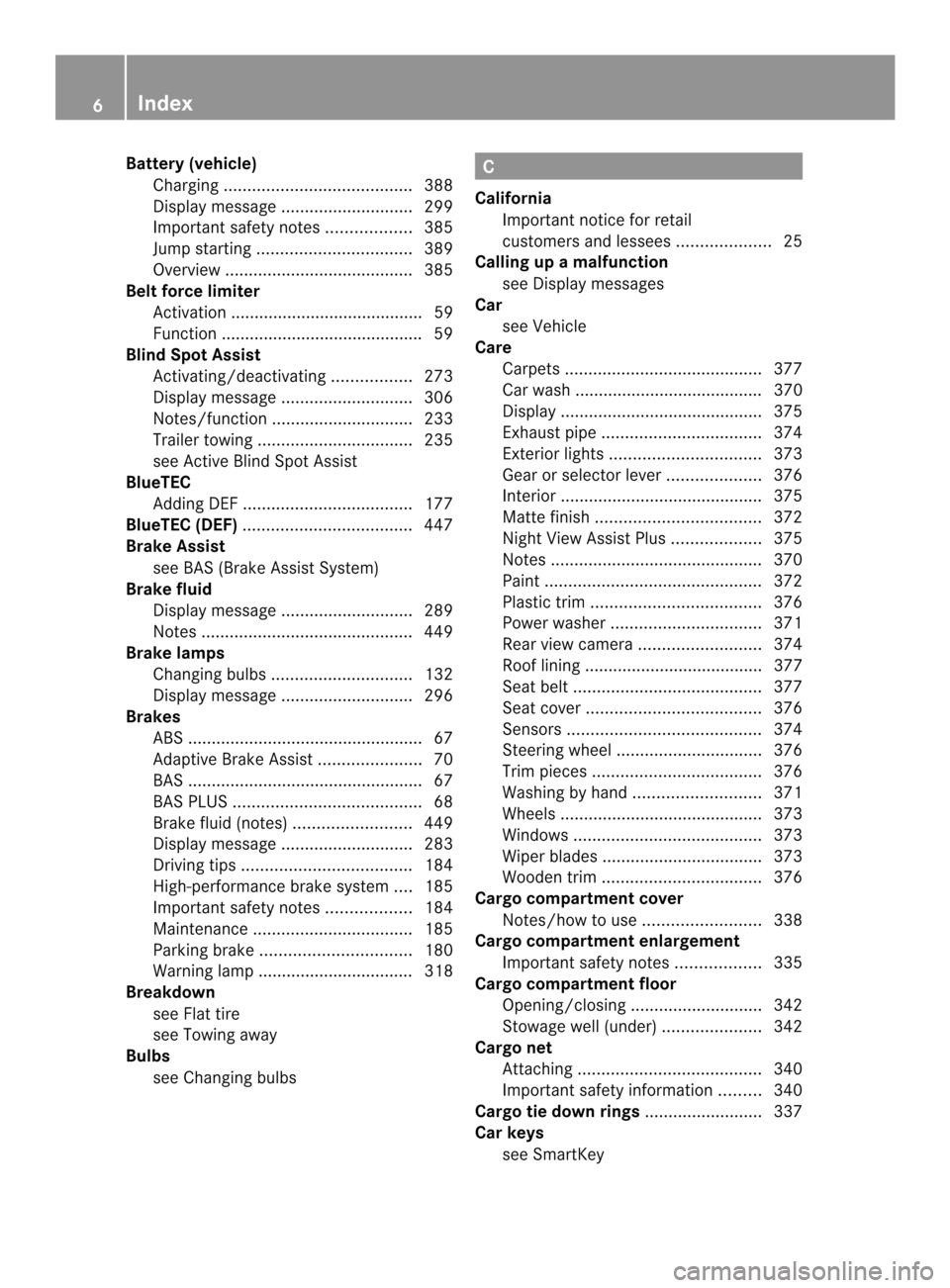
Battery (vehicle)
Charging ........................................ 388
Display message ............................ 299
Important safety notes ..................385
Jump starting ................................. 389
Overview ........................................ 385
Belt force limiter
Activation ......................................... 59
Function .......................................... .59
Blind Spo tAssist
Activating/deactivating .................273
Display message ............................ 306
Notes/function .............................. 233
Trailer towing ................................. 235
see Active Blind Spot Assist
BlueTEC
Adding DEF .................................... 177
BlueTEC (DEF) .................................... 447
Brake Assist see BAS (Brake Assist System)
Brake fluid
Display message ............................ 289
Notes ............................................. 449
Brake lamps
Changing bulbs .............................. 132
Display message ............................ 296
Brakes
ABS .................................................. 67
Adaptive Brake Assist ......................70
BAS .................................................. 67
BAS PLUS ........................................ 68
Brake fluid (notes) .........................449
Display message ............................ 283
Driving tips .................................... 184
High-performance brake system ....185
Important safety notes ..................184
Maintenance .................................. 185
Parking brake ................................ 180
Warning lamp ................................. 318
Breakdown
see Flat tire
see Towing away
Bulbs
see Changing bulbs C
California Important notice for retail
customers and lessees ....................25
Calling up a malfunction
see Display messages
Car
see Vehicle
Care
Carpets .......................................... 377
Car wash ........................................ 370
Display ........................................... 375
Exhaus tpipe .................................. 374
Exterior lights ................................ 373
Gea rors electo rlever .................... 376
Interior ........................................... 375
Matte finish ................................... 372
Nigh tView Assist Plus ...................375
Notes ............................................. 370
Paint .............................................. 372
Plastic trim .................................... 376
Power washer ................................ 371
Rea rview camera .......................... 374
Roof lining ...................................... 377
Seat bel t........................................ 377
Seat cover ..................................... 376
Sensors ......................................... 374
Steering wheel ............................... 376
Trim pieces .................................... 376
Washing by hand ........................... 371
Wheels ........................................... 373
Windows ........................................ 373
Wiper blades .................................. 373
Wooden trim .................................. 376
Cargo compartment cover
Notes/ho wtouse......................... 338
Cargo compartment enlargement
Important safety notes ..................335
Cargo compartment floor
Opening/closing ............................ 342
Stowag ewell (under) ..................... 342
Cargo net
Attaching ....................................... 340
Important safety information .........340
Cargo tie down rings .........................337
Car keys see SmartKey 6
Index
Page 10 of 462
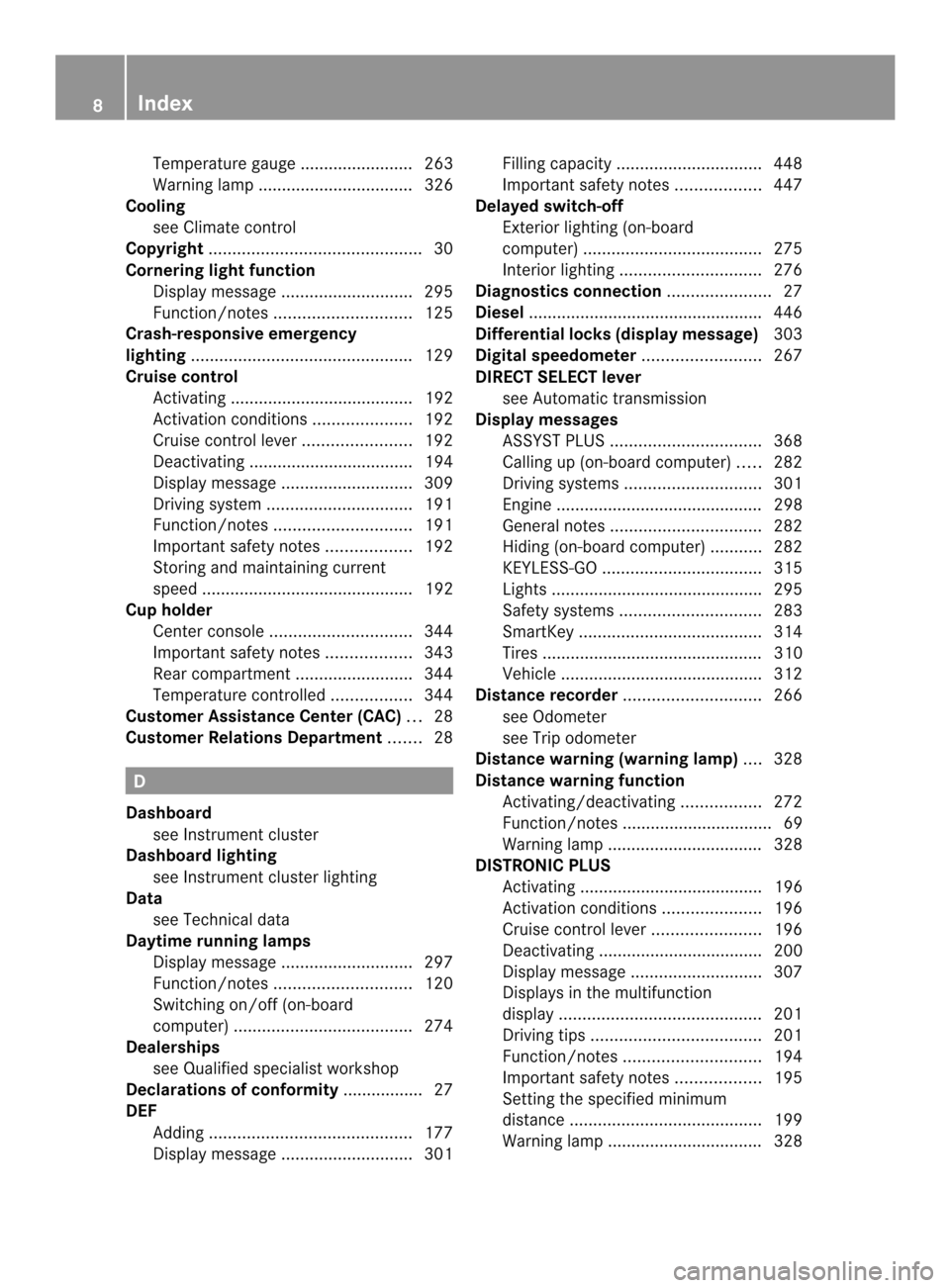
Temperature gauge ........................ 263
Warning lamp ................................. 326
Cooling
see Climate control
Copyright ............................................. 30
Cornering light function Display message ............................ 295
Function/notes ............................. 125
Crash-responsive emergency
lighting ............................................... 129
Cruise control Activating ....................................... 192
Activatio ncondition s..................... 192
Cruise control leve r....................... 192
Deactivating ................................... 194
Display message ............................ 309
Driving system ............................... 191
Function/notes ............................. 191
Important safety notes ..................192
Storing and maintaining current
spee d............................................. 192
Cu p holder
Center console .............................. 344
Important safety notes ..................343
Rea rcompartmen t......................... 344
Temperature controlle d................. 344
Customer Assistance Center (CAC) ...28
Customer Relations Department .......28 D
Dashboard see Instrument cluster
Dashboard lighting
see Instrument cluster lighting
Data
see Technical data
Daytime running lamps
Display message ............................ 297
Function/notes ............................. 120
Switching on/off (on-board
computer) ...................................... 274
Dealerships
see Qualified specialist workshop
Declarations of conformity ................. 27
DEF Adding ........................................... 177
Display message ............................ 301Filling capacity
............................... 448
Important safety notes ..................447
Delaye dswitch-off
Exterio rlighting (on-board
computer )...................................... 275
Interior lighting .............................. 276
Diagnostics connection ......................27
Diesel ................................................. .446
Differential locks (display message) 303
Digital speedometer .........................267
DIRECT SELECTl ever
see Automatic transmission
Displa ymessages
ASSYS TPLUS ................................ 368
Calling up (on-board computer) .....282
Driving systems ............................. 301
Engine ............................................ 298
General notes ................................ 282
Hiding (on-board computer) ...........282
KEYLESS-GO .................................. 315
Lights ............................................ .295
Safety systems .............................. 283
SmartKey ....................................... 314
Tires ............................................... 310
Vehicle .......................................... .312
Distance recorder ............................. 266
see Odometer
see Trip odometer
Distance warning (warning lamp) ....328
Distance warning function Activating/deactivating .................272
Function/notes ................................ 69
Warning lamp ................................. 328
DISTRONIC PLUS
Activating ....................................... 196
Activation conditions .....................196
Cruise control leve r....................... 196
Deactivating ................................... 200
Display message ............................ 307
Displays in the multifunction
displa y........................................... 201
Driving tips .................................... 201
Function/notes ............................. 194
Important safety notes ..................195
Setting the specified minimum
distance ......................................... 199
Warning lamp ................................. 328 8
Index
Page 13 of 462
ESP
®
(Electronic Stability
Program) AMG menu (on-board computer) ...279
Deactivating/activating ...................72
Display message ............................ 283
ETS/4ETS ........................................ 71
Function/notes ................................ 71
General notes .................................. 71
Important safety information ...........72
Trailer stabilization ........................... 73
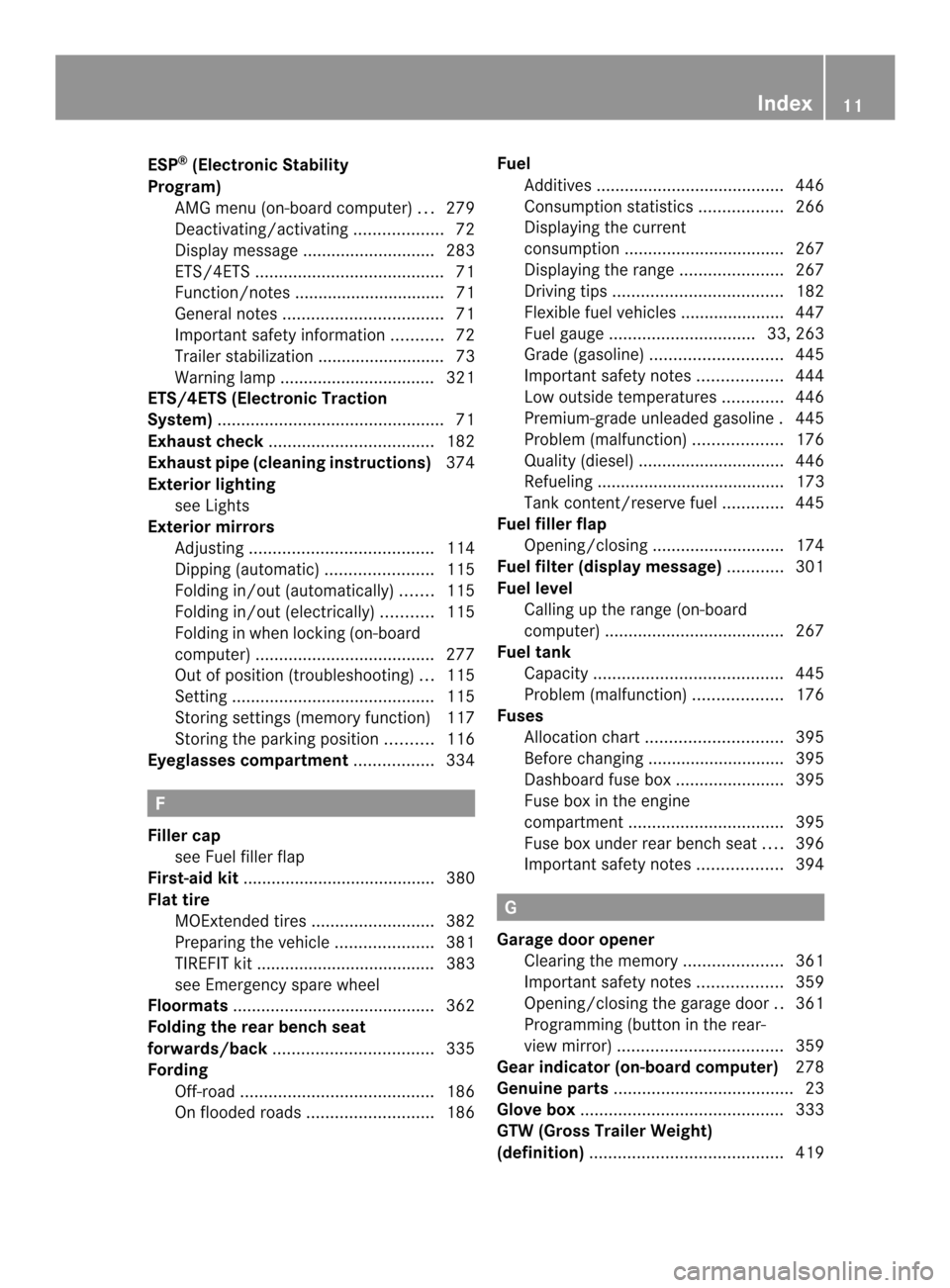
Warning lamp ................................. 321
ETS/4ETS (Electronic Traction
System) ................................................ 71
Exhaus tcheck ................................... 182
Exhaus tpipe (cleaning instructions) 374
Exterior lighting see Lights
Exterior mirrors
Adjustin g....................................... 114
Dipping (automatic) .......................115
Folding in/ou t(automatically) .......115
Folding in/ou t(electrically) ...........115
Folding in whe nlocking (on-board
computer) ...................................... 277
Out of position (troubleshooting) ...115
Setting ........................................... 115
Storing settings (memory function) 117
Storing the parking position ..........116
Eyeglasses compartment .................334 F
Fille rcap
see Fuel filler flap
First-aid kit ......................................... 380
Flat tire MOExtended tires ..........................382
Preparing the vehicle .....................381
TIREFIT kit ...................................... 383
see Emergency spare wheel
Floormats ........................................... 362
Folding the rear bench seat
forwards/back .................................. 335
Fording Off-road ......................................... 186
On flooded road s........................... 186Fuel
Additives ........................................ 446
Consumption statistics ..................266
Displaying the current
consumption .................................. 267
Displaying the range ......................267
Driving tips .................................... 182
Flexible fuel vehicles ......................447
Fuel gauge ............................... 33, 263
Grade (gasoline) ............................ 445
Important safety notes ..................444
Low outside temperatures .............446
Premium-grade unleaded gasoline .445
Problem (malfunction) ...................176
Quality (diesel )............................... 446
Refueling ........................................ 173
Tank content/reserve fuel .............445
Fuel filler flap
Opening/closing ............................ 174
Fuel filte r(display message) ............301
Fuel level Calling up the range (on-board
computer) ...................................... 267
Fuel tank
Capacity ........................................ 445
Problem (malfunction) ...................176
Fuses
Allocation chart ............................. 395
Before changing ............................. 395
Dashboard fuse box .......................395
Fuse box in the engine
compartment ................................. 395
Fuse box unde rrear bench seat ....396
Important safety notes ..................394 G
Garage door opener Clearing the memory .....................361
Important safety notes ..................359
Opening/closing the garage door ..361
Programming (button in the rear-
view mirror) ................................... 359
Gear indicator (on-board computer) 278
Genuine parts ...................................... 23
Glove box ........................................... 333
GTW (Gross Trailer Weight)
(definition) ......................................... 419 Index
11
Page 15 of 462
Lap time (RACETIMER)
......................279
LATCH-type (ISOFIX) child seat
anchors ................................................ 63
Level control (display message) ......302
Level control (vehicles with
AIRMATIC package)
Basi csettings ................................ 210
Function/notes ............................. 209
Important safety notes ..................209
Level control (vehicles with the
ON&OFFROAD package)
Basi csettings ................................ 203
Function/notes ............................. 202
Important safety notes ..................202
License plate lamp (display
message) ............................................ 296
Light function ,active
Display message ............................ 297
Lighting
Ligh tswitc h................................... 120
Lights
Activating/deactivating the
interio rlighting delayed switch-off .276
Active light function .......................125
Automatic headlamp mode ............120
Cornering light function .................125
Driving abroad ............................... 120
Hazard warning lamps ...................124
High beam flasher .......................... 124
High-beam headlamps ...................124
Low-beam headlamps ....................121
Parking lamps ................................ 122
Rea rfog lamp ................................ 122
Setting the brightness of the
ambient lighting (on-board
computer) ...................................... 275
Setting the color of the ambient
lighting (on-board computer) .........275
Standing lamps .............................. 123
Switching Adaptive Highbeam
Assist on/off ................................. 275
Switching the daytime running
lamps on/off (on-board computer) 274
Switching the exterio rlighting
delayed switch-off on/off (on-
board computer )............................ 275Switching the surround lighting
on/off (on-board computer)
..........275
Turn signals ................................... 123
see Changing bulbs
see Interior lighting
Light sensor (display message) .......298
Loading guidelines ............................332
Locking see Centra llocking
Locking (doors)
Automatic ........................................ 88
Emergency locking ........................... 88
From inside (central locking
button) ............................................. 87
Locking centrally
see Centra llocking
Locking verification signal (on-
board computer) ............................... 276
Low-beam headlamps Changing bulbs .............................. 130
Display message ............................ 295
Setting for driving abroad
(symmetrical) ................................. 120
Switching on/off ........................... 121
LOW RANGE
Display message ............................ 304
Off-road gea r................................. 249
LOW RANGE off-road gear ................249
Luggage holde r(EASY-PACK load-
securing kit) ...................................... .341
Lumbar support Adjusting (on the seat) ..................108
Luxury head restraints .....................107 M
M+S tires ............................................ 400
Malfunction message see Display messages
Matte finish (cleaning instructions) 372
mbrace Call priority .................................... 354
Display message ............................ 289
Downloading destinations
(COMAND) ..................................... 354
Downloading route s....................... 358
Emergency call .............................. 351
General notes ................................ 350 Index
13
Page 45 of 462
SRS (Supplemental Restraint System)
Introduction SRS consists of:
R
001F SRS warning lamp
R air bags
R the air bag control unit with crash sensors
R ETDs for the front seat belts and the outer
seat belts in the rear
R seat belt force limiters
SRS reduces the risk of vehicle occupants
coming into contact with parts of the
vehicle's interior in the event of an accident.
It can also reduce the forces to which vehicle
occupants are subjected during an accident.
SRS warning lamp G
WARNING
If SRS is malfunctioning, child restraint
system components may be triggered
unintentionally or might not be triggered at all
in the event of an accident with a high rate of
vehicle deceleration. There is an increased
risk of injury, possibly even fatal.
Have SRS checked and repaired immediately
at a qualified specialist workshop.
SRS functions are checked regularly when
you switch on the ignition and when the
engine is running. Therefore, malfunctions
can be detected in good time.
The 001F SRS warning lamp in the instrument
cluster lights up when the ignition is switched
on. It goes out no later than a few seconds
after the engine is started.
The SRS components are in operational
readiness when the 001FSRS warning lamp
goes out while the engine is running. There is a malfunction if:
R
the 001F SRS warning lamp does not light
up when the ignition is switched on
R the engine is running and the 001FSRS
warning lamp does not go out after a few
seconds
R the engine is running and the 001FSRS
warning lamp lights up again
Safety guidelines for seat belts,
Emergency Tensioning Devices (ETDs)
and air bags G
WARNING
R Damaged seat belts or seat belts that have
been subjected to stress in an accident
must be replaced. Their anchoring points
must also be checked. Only use seat belts
installed or supplied by an authorized
Mercedes-Benz Center.
R Air bags and pyrotechnic Emergency
Tensioning Devices (ETDs) contain
perchlorate material, which may require
special handling and regard for the
environment. Check your national disposal
guidelines. California residents, see
www.dtsc.ca.gov/HazardousWaste/
Perchlorate/index.cfm .
R Air bags and ETDs are designed to function
on a one-time-only basis. An air bag or ETD
that has deployed must be replaced. PRE-
SAFE ®
has electrically operated reversible
belt tensioners in addition to the
pyrotechnic ETDs.
R Do not pass seat belts over sharp edges.
They could tear.
R Do not make any modification that could
change the effectiveness of the seat belts.
R Do not bleach or dye seat belts as this may
severely weaken them. In a crash they may
not be able to provide adequate protection.
R No modifications of any kind may be made
to any components or wiring of the SRS.
R Do not change or remove any component
or part of the SRS. Occupant safety
43Safety
Z
Page 47 of 462
vehicle. In order to prevent potential
breathing difficulties, you should leave the
vehicle as soon as it is safe to do so. If you
have any breathing difficulty but cannot get
out of the vehicle after the air bag inflates,
then get fresh air by opening a window or
door. G
WARNING
In order to reduce the potential dange rof
injuries caused during the deploymen tofthe
front air bags, the driver and front passenger
must always be correctly seated and wear
their seat belts.
For maximum protection in the event of a
collision, you must always be in the normal
seat position with your back against the
backrest. Fasten your seat belt and make sure
that it is correctly positioned on your body.
As the air bag inflates with considerable
speed and force, a proper seating position
and correct positioning of the hands on the
steering wheel will help to keep you at a safe
distance from the air bag. Occupants who are
not wearing their seat belt, are not seated
properly or are too close to the air bag can be
seriously injured or killed by an air bag, as it
inflates with great force instantaneously:
R sit with the seat belt fastened correctly and
in a position that is as upright as possible
with your back against the backrest.
R move the driver's seat as far back as
possible, still permitting proper operation
of vehicle controls. The distance from the
center of the driver's chest to the center of
the air bag cover on the steering wheel
must be at least 10 inches (25 cm). You
should be able to accomplish this by
adjusting the seat and steering wheel. If
you have any difficulties, please contact an
authorized Mercedes-Ben zCenter.
R do not lean your head or chest close to the
steering wheel or dashboard.
R only hold the steering wheel on the outside.
Placing hands and arms inside the rim can
increase the risk and potential severity of hand/arm injury if the driver front air bag
inflates.
R adjust the front-passenger seat as far back
as possible from the dashboard when the
seat is occupied.
R occupants, especially children, should
never place their bodies or lean their heads
in the area of the door where the side
impact air bag inflates .This could result in
serious or fatal injuries should the side
impact air bag be deployed. Always sit as
upright as possible, wear the seat belt
properly and use an appropriately sized
infant restraint, toddler restraint or booster
seat recommended for the size and weight
of the child.
Failure to follow these instructions can result
in severe injuries to you or other occupants.
If you sell your vehicle, it is important that you
make the buyer aware of this safety
information. Be sure to give the buyer this
Operator's Manual.
If the air bags are deployed, you will hear a
bang, and a small amount of powder may also
be released. Only in rare cases will the bang
affect your hearing. The powder that is
released generally does not constitute a
health hazard and does not indicate that there
is a fire in the vehicle. The dust might cause
some temporary breathing difficulty for
people with asthma or other breathing
trouble. To avoid this, you may wish to get out
of the vehicle as soon as it is safe to do so.
You can also open the window to allow fresh
air to enter the vehicle interior. The 001FSRS
warning lamp lights up.
The air bag installation locations are
identified by the AIR BAG symbol.
The air bags are deployed if the air bag control
unit detects the need for deployment.O nly in
the event of such a situatio nwill the air bags
provide their supplemental protection.
If the drive rand front passenge rdo not wear
their seat belts, it is not possible for the air Occupant safety
45Safety Z
Page 55 of 462
Problems with the occupant classification system
G
WARNING
If the 001A001C indicator lamp illuminates and remains illuminated when the weight of a typical
adult or someone larger than a small individual has been detected on the passenger seat, do not
allow any occupant to use the passenger seat until the system has been repaired. G
WARNING
If the 001A001C indicator lamp does not illuminate or remains out with the weight of a typical
12-month-old child in a standard child restraint or less, or is unoccupied, on the front-passenger
seat, do not transport achild on the front-passenger seat until the system has been repaired. Problem Possible causes/consequences and
0001 Solutions
The PASSENGER AIR
BAG OFF indicator
lights up and remains
on.
The person on the
front-passenger seat:
R
has the weight of a
typical adult
R has been determined
by the system not to
be a child The OCS is malfunctioning.
X
Make sure that the front passenger is sitting in a correct, upright
position.
X Have the OCS checked as soon as possible at a qualified
specialist workshop.
X Observe the additional display messages in the multifunction
display (Y page 293). Occupant safety
53Safety Z
Page 60 of 462

Belt height adjustment
You can adjus
tthe seat belt height on the
front seats. Adjust the belt to a height that
allows the upper part of the seat belt to be
routed across the center of your shoulder.
X To raise: slide the belt sash guide upwards.
The belt sash guide engages in various
positions.
X To lower: press and hold belt sash guide
release 0002.
X Slide the belt sash guide downwards.
X Release belt sash guide release 0002and
make sure that the belt sash guide has
engaged.
Releasing seat belts !
Make sure that the seat belt is fully rolled
up. Otherwise, the seat belt or belt tongue
will be trapped in the door or in the seat
mechanism. This could damage the door,
the door trim panel and the seat belt.
Damaged seat belts can no longer fulfill
their protective function and must be
replaced. Visit a qualified specialist
workshop. 0002
Belt sash guide
0003 Seat belt tongue
0023 Buckle
0022 Release button
X Press release button 0022and guide belt
tongue 0003back towards belt sash
guide 0002.
Belt warning for the driver and front
passenger Every time the engine is started, the
0020
seat belt warning lamp lights up for six
seconds. It lights up regardless of whether
the driver's and front-passenger seat belts
have already been fastened. If the driver's
and front-passenger seat belts have already
been fastened, the 0020seat belt warning
lamp then goes out.
If the driver's seat belt is not fastened when
the engine is started, an additional warning
tone will sound. This warning tone stops after
a maximum of six seconds or once the
driver's seat belt is fastened.
If after six seconds, the driver or front
passenger have not fastened their seat belts
and the doors are closed:
R the 0020 seat belt warning lamp remains lit
as long as the driver's or front-passenger's
seat belt is not fastened 58
Occupant safetySafety
Page 61 of 462
and
R if a vehicle speed of 15 mph (25 km/h) is
exceeded, the 0020seat belt warning lamp
begins to flash. Awarning tone also sounds
with increasing intensity for a maximum of
60 seconds or until the driver or front
passenger have fastened their seat belts.
If the driver/front passenger unfasten their
seat belt while the vehicle is in motion, the
0020 seat belt warning lamp lights up and a
warning tone sounds again.
The warning tone ceases eve nifthe driver or
front-passenger seat belt has still not been
fastened after 60 seconds. The 0020seat belt
warning lamp stops flashing but remains
illuminated.
After the vehicle comes to a standstill, the
warning tone is reactivated. The 0020seat
belt warning lamp flashes again if the vehicle
speed exceeds 15 mph (25 km/h).
The 0020 seat belt warning lamp only goes
out if:
R both the driver and the front passenger
have fastened their seat belts.
or
R the vehicle is stationary and a door is open.
i For more information on the 0020seat
belt warning lamp, see "Warning and
indicator lamps in the instrument cluster,
seat belts" (Y page 317).
Emergency Tensioning Devices, seat
belt force limiters G
WARNING
Pyrotechnic Emergency Tensioning Devices
that have been deployed are no longer
operational and are unable to perform their
intended protective function. This poses an
increased risk of injury or even fatal injury.
Therefore, have pyrotechnic Emergency
Tensioning Devices which have been
triggered immediately replaced at a qualified
specialist workshop. !
If the front-passenger seat is not
occupied, do not engage the seat belt
tongue in the buckle on the front-
passenger seat. Otherwise, the Emergency
Tensioning Device could be triggered in the
event of an accident.
i Vehicles with PRE-SAFE ®
: Emergency
Tensioning Devices that are triggered by an
electric motor can be deployed as often as
desired and do not need to be replaced.
The front seat belts and the outer seat belts
in the rear are equipped with Emergency
Tensioning Devices and seat belt force
limiters.
The Emergency Tensioning Devices on the
driver's and front-passenger seat consist of
pyrotechnic belt buckle tensioners and belt
anchor installation tensioners that are
triggered together. The belt buckle tensioner
is mounted on the B-pillar and the belt anchor
installation is mounted on the side of the seat.
After deploying, both tensioners must always
be replaced.
Emergency Tensioning Devices tighten the
seat belts in an accident, pulling them close
against the body.
Emergency Tensioning Devices do not
correct incorrect seat positions or incorrectly
fastened seat belts.
Emergency Tensioning Devices do not pull
vehicle occupants back towards the
backrest.
When triggered, seat belt force limiters help
to reduce the force exerted by the seat belt
on the vehicle occupant.
The seat belt force limiters for the front seats
are synchronized with the front air bags,
which take on a part of the deceleration force.
This results in the force exerted on the
occupant being distributed over a greater
area. Occupant safety
59Safety Z
Page 62 of 462
Emergency Tensioning Devices can only be
activated when:
R
the ignition is switched on.
R the restraint systems ar eoperational; see
"SRS warning lamp" (Y page 43)
R the belt tongue is engaged in the buckle on
each of the lap-shoulder belts in the front
R the front-passenger seat is occupied and
the belt tongue is engaged in the buckle on
the front-passenger side
The ETDs on the outside seats in the rear
compartment are triggered independently of
the lock status of the seat belts.
The ETDs are triggered depending on the type
and severity of an accident:
R if, in the event of a head-on or rear-end
collision, the vehicle decelerates or
accelerates rapidly in a longitudinal
direction during the initial stages of the
impact.
R if, in the event of a side impact, on the side
opposite the impact the vehicle
decelerates or accelerates rapidly in a
lateral direction.
R if, in certain situation swhere the vehicle
rolls over, the system determines that it
can provide additional protection.
If the ETDs are deployed, you will hear a bang,
and a small amount of powder may also be
released. Only in rare cases will the bang
affect your hearing. The powder that is
released generally does not constitute a
health hazard and does not indicate that there
is a fire in the vehicle. The dust might cause
some temporary breathing difficulty for
people with asthma or other breathing
trouble. To avoid this, you may wish to get out
of the vehicle as soon as it is safe to do so.
You can also open the window to allow fresh
air to enter the vehicle interior. The 001FSRS
warning lamp lights up. Children in the vehicle
Child restraint systems
Important safety notes G
WARNING
According to accident statistics, children are
safer when properly restrained in the rear
seating positions than in the front seating
position. Thus, we strongly recommend that
children be placed in the rear seats whenever
possible. Regardless of seating position,
children 12 years old and under must be
seated and properly secured in an appropriate
infant restraint, toddler restraint, or booster
seat recommended for the size and weight of
the child.
The infant or child restraint must be properly
secured with the vehicle's seat belt, the seat
belt and top tether strap, or lower anchors and
top tether strap, fully in accordance with the
child seat manufacturer's instructions.
Occupants, especially children, should always
sit as upright as possible, wear the seat belt
properly and use an appropriately sized infant
restraint, toddler restraint, or booster seat
recommended for the size and weight of the
child.
Children can be killed or seriously injured by
an inflating air bag. Note the following
important information when circumstances
require you to place a child in the front
passenger seat:
R Your vehicle is equipped with air bag
technology designed to deactivate the front
passenger front air bag in your vehicle
when the system senses the weight of a
typical 12-month-old child or less along
with the weight of a standard appropriate
child restraint on the front passenger seat.
R For children larger than the typical
12-month-old child, the front passenger
front air bag may or may not be activated.
Always make sure the 001A001Cindicator
lamp is illuminated, indicating that the front
passenger front air bag is deactivated. 60
Children in the vehicleSafety