key MERCEDES-BENZ M-CLASS SUV 2011 Owners Manual
[x] Cancel search | Manufacturer: MERCEDES-BENZ, Model Year: 2011, Model line: M-CLASS SUV, Model: MERCEDES-BENZ M-CLASS SUV 2011Pages: 389, PDF Size: 9.22 MB
Page 337 of 389
A
Jack
B Ratchet rin gspanner "M
inispare" emergency spare wheel
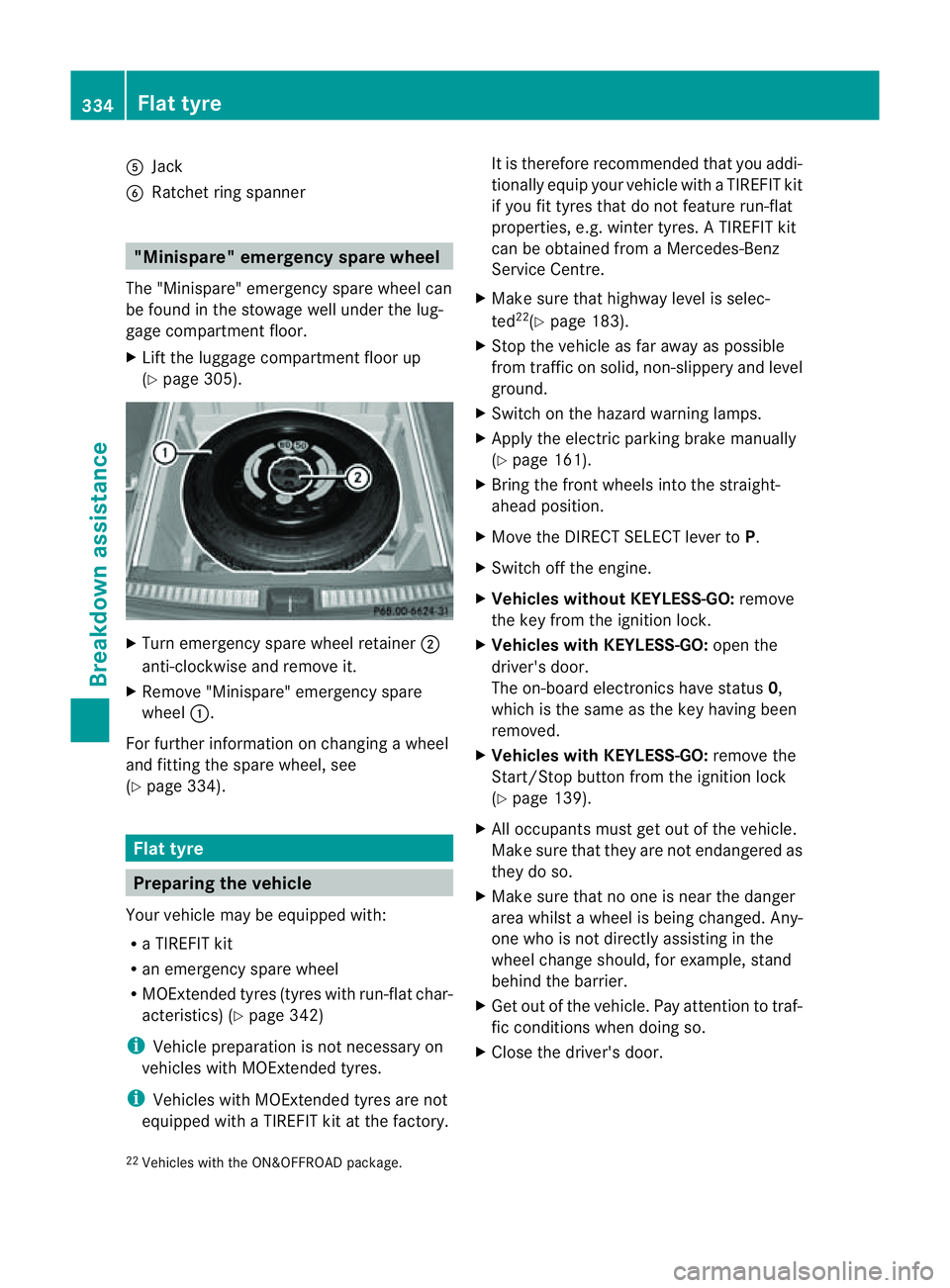
The "Minispare" emergency spar ewheel can
be fou ndin th estowage well unde rthe lug-
gage compartmen tfloor.
X Lif tthe luggage compar tment floor up
(Y page 30 5). X
Tur nemergency spare whee lretainer ;
anti-clockwise and rem ove it.
X Remove "Minis pare" emergency spare
wheel :.
For fur ther information on changing awheel
and fittin gthe spar ewheel, see
(Y page 33 4). Flat tyre
Preparing th
evehicle
Your vehicle may be equipped with:
R aT IREFIT kit
R an eme rgency spare wheel
R MOExtende dtyre s(tyres with run-flat char-
acteristics) (Y page 342)
i Vehicle preparation is not necessary on
vehicles with MOExtended tyres.
i Vehicles with MOExtended tyre sare not
equippe dwithaTIREFIT kit at th efactory. It is therefore recommended that you addi-
tionally equip your vehicle with
aTIREFIT kit
if yo ufit tyre sthat do not fea ture run-flat
prope rties, e.g. winter tyres. ATIREFIT kit
can be obtaine dfrom aMercedes-Benz
Servic eCentre.
X Make sure that highway level is selec-
ted 22
(Y page 183).
X Stop the vehicle as far away as possible
from traffic on solid, non-slippery and level
ground.
X Switch on the hazar dwarning lamps.
X Apply the electric parking brake manually
(Y page 161).
X Bring the front wheels into the straight-
ahead position.
X Move the DIRECT SELECT lever to P.
X Switch off the engine.
X Vehicles without KEYLESS-GO: remove
the key from the ignition lock.
X Vehicles with KEYLESS-GO: open the
driver' sdoor.
The on-boar delectronics have status 0,
which is the same as the key having been
removed.
X Vehicles with KEYLESS-GO: removethe
Star t/Stop butto nfrom th eignition lock
(Y page 139).
X All occupants must get out of the vehicle.
Make sure that they ar enot endangered as
they do so.
X Make sure that no one is near the danger
area whilst awheel is being changed. Any-
one who is not directly assisting in the
wheel change should, for example, stand
behind the barrier.
X Get out of the vehicle. Pay attention to traf-
fic condition swhen doing so.
X Close the driver's door.
22 Vehicles wit hthe ON&OFFROAD package. 334
Flat tyreBreakdown assistance
Page 339 of 389
If yo
uget TIREFI Tonyour clothing, have it
cleaned as soo naspossible with perchloro-
ethylene. X
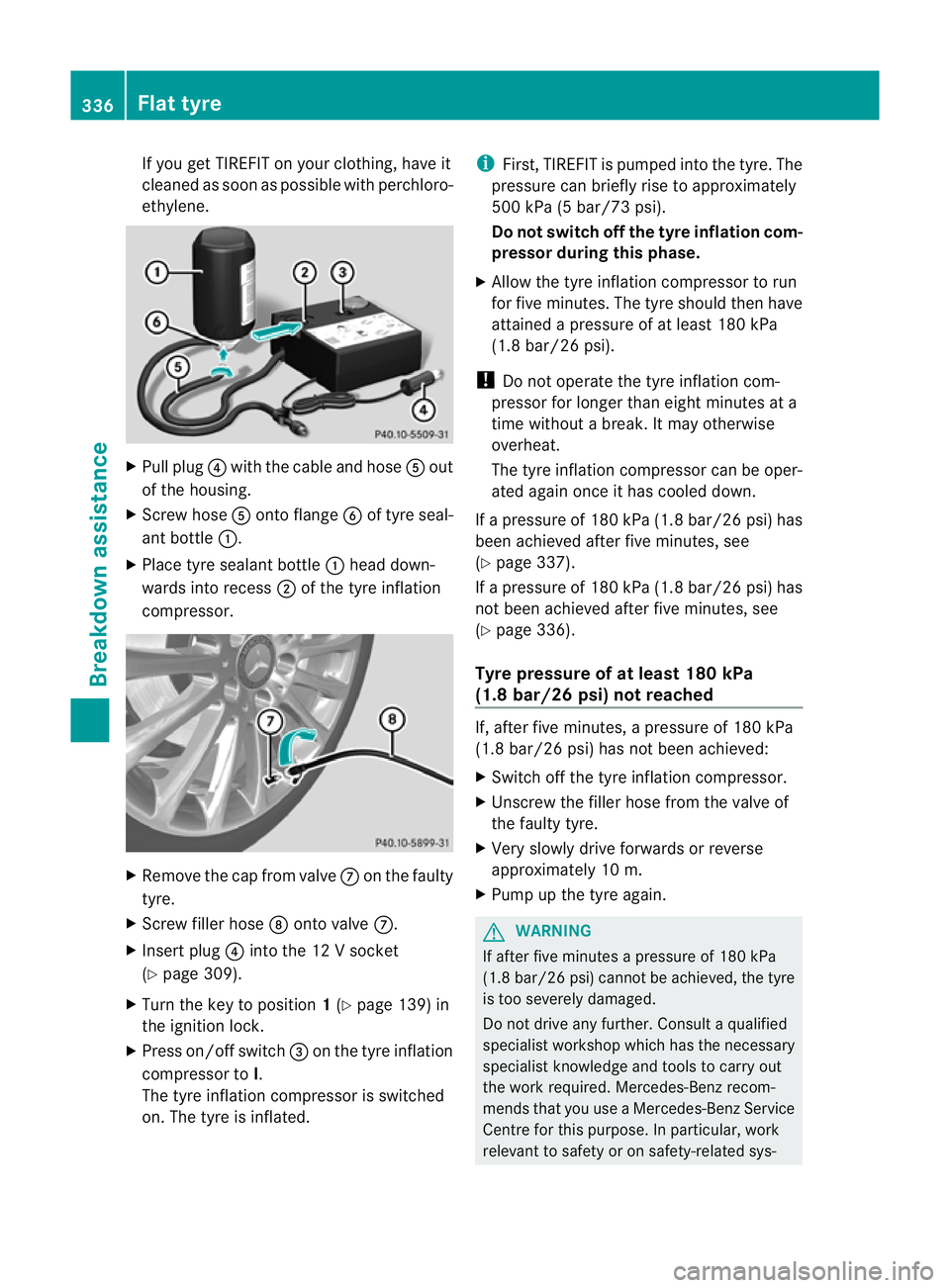
Pull plug ?with the cabl eand hose Aout
of the housing.
X Screw hose Aontoflange Bof tyre seal-
ant bottle :.
X Place tyre sealant bottle :head down-
wards int orecess ;of the tyr einflation
compressor. X
Remove the cap fro mvalve Con the faulty
tyre.
X Screw filler hose Dontovalve C.
X Insert plug ?into the 12 Vsocket
(Y page 309).
X Tur nthe key to position 1(Y page 139) in
the ignition lock.
X Press on/of fswitch =on the tyr einflation
compressor to I.
The tyr einflation compressor is switched
on. The tyre is inflated. i
First ,TIREFIT is pumpe dinto the tyre. The
pressure can briefly rise to approximately
500 kPa (5 bar/73 psi).
Do not switch off the tyr einflation com-
pressor du ring this phase.
X Allow the tyr einflation compresso rtor un
for five minutes. The tyre should then have
attained apressure of at leas t180 kPa
(1.8 bar/26 psi).
! Do not operat ethe tyr einflation com-
presso rfor longer than eight minutes at a
tim ew ithout abreak. It may otherwise
overheat.
Th et yre inflation compressor can be oper-
ated again once it has coole ddown.
If ap ressure of 180 kPa (1.8 bar/26 psi) has
been achieved afte rfive minutes, see
(Y page 337).
If ap ressure of 180 kPa (1.8 bar/26 psi) has
not been achieved afte rfive minutes, see
(Y page 336).
Tyr epressure of at least 180 kPa
(1.8 bar/26 psi) not reached If, after five minutes,
apressure of 180 kPa
(1.8 bar/26 psi) ha snot been achieved:
X Switch off the tyr einflation compresso r.
X Un screw the filler hose from the valv eof
the faulty tyre.
X Very slowly drive forwards or reverse
approximately 10 m.
X Pump up the tyre again. G
WARNING
If after five minutes apressure of 180 kPa
(1.8 bar/26 psi) cannot be achieved ,the tyre
is too severel ydamaged.
Do not drive any further. Consult aqualified
specialist workshop which has the necessary
specialist knowledge and tools to carry out
the work required. Mercedes-Benz recom-
mends that you use aMercedes-Ben zService
Centr efor this pur pose.Inp articular, work
relevant to safety or on safety-related sys- 336
Flat tyreBreakdown assistance
Page 347 of 389
R
make sure that yo udonot create an elec-
trostati ccharge, e.g. by wearing synthetic
clothing or as aresul toff riction on fabrics.
Therefore, you should not pul lorslide the
battery over carpets or other synthetic
materials.
R never touc hthe battery fir st. To discharge
ap ossible electrostatic charge, ste pout of
the vehicle firs tand touch the bodywork.
R do not wipe the battery using acloth. The
battery may explode as aresul tofe lectro-
static charge or due to flying sparks.
! Switch off the engin eand remove the key
befo redisconnecting the terminal clamps
from the battery. On vehicles with KEY-
LESS-GO, mak esure that the ignition is
switched off .Check that all the indicator
lamps in the instrumen tcluster are off .You
ma yotherwis edestroy electronic compo-
nents, such as the alternator.
i When you park the vehicle, remove the
key if you do not require any electrical con-
sumers. The vehicle will then use ver ylittle
energy, thus conserving battery power.
Mercedes-Benz recom mends that you do not
carry out work on batteries yourself, e.g.
removing or charging. Have this work per-
formed at aqualified specialist workshop, e.g.
aM ercedes-Benz Servic eCentre. Installation location of the battery
Your vehicle is equipped with abattery in the
vehicle interior. It is located under the front
seat on the right-hand side of the vehicle
when viewed in the direction of travel.
X Apply the electric parking brake and shift
the transmission to position P.
X Position the right-hand front seat as far for-
wards as possible.
X Switch off all electrical consumer s(e.g.
radio, blower, etc.).
X Turn the key to position 0(Y page 139) in
the ignition lock and remove it. On vehicles with KEYLESS-GO, mak
esure the ignition
is switched off (Y page 139). All indicator
lamps in the instrument cluster must be off. X
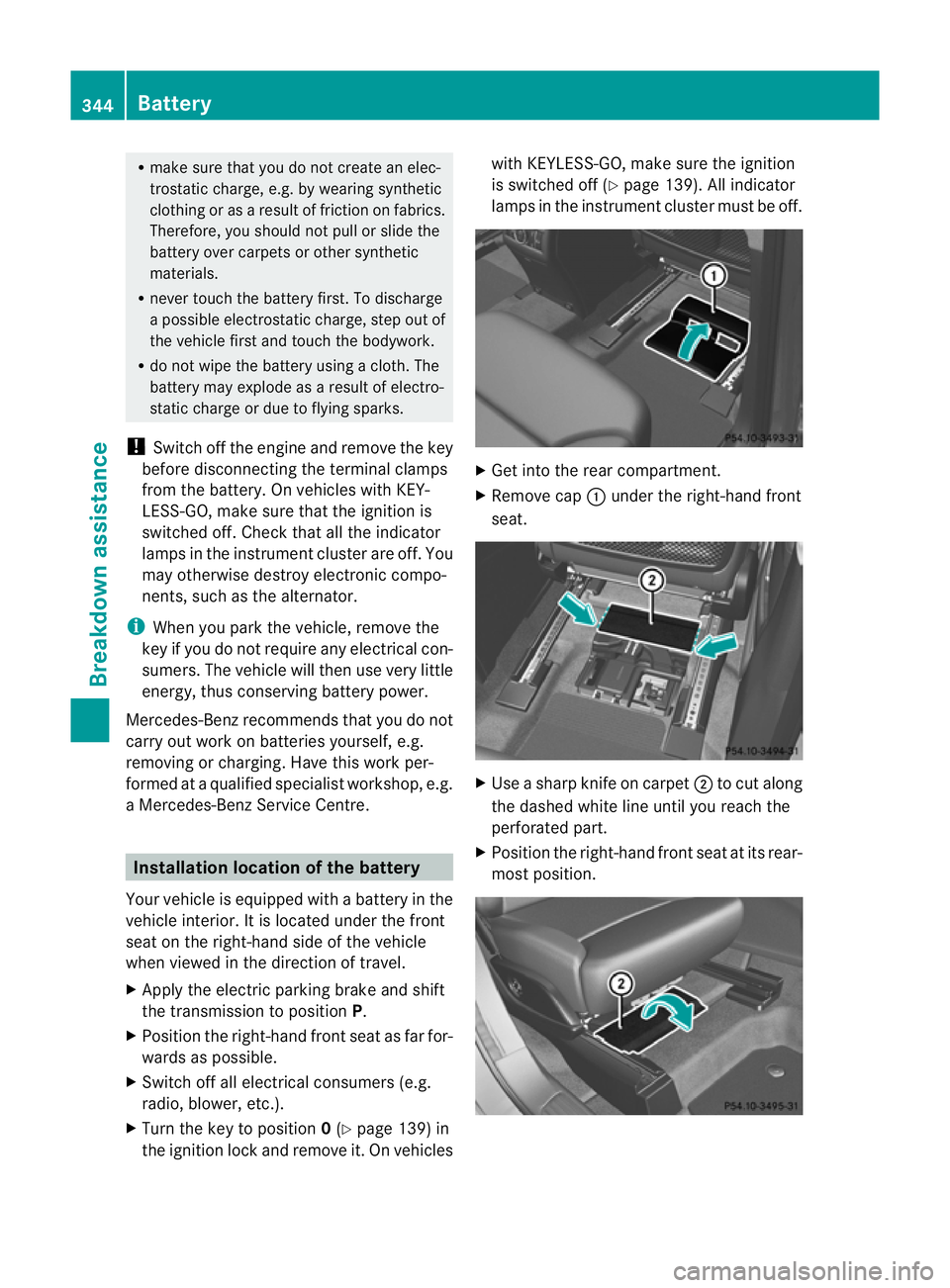
Get into the rear compartment.
X Remove cap :under the right-hand front
seat. X
Use ashar pknifeonc arpet;to cut along
the dashe dwhite line until you reach the
perforated part.
X Position the right-hand front seat at its rear-
most position. 344
Ba
tteryBreakdown assistance
Page 351 of 389
Jum
p-starting G
WARNING
There is arisk of acid burns when jump-starting avehicle due to the gases which escape from
the battery. Do not lean over the batter ywhile the engin eisbeing jump-started. G
WARNING
Gases escapin gfrom th ebattery during jump-starting may cause minor explosions. Avoid cre-
ating sparks. Keep naked flames away from the battery, and do not smoke.
Comply with safety precautions when handling batteries. You will find these under "Battery" in
the index.
! Avoid repeated and lengthy startin gattempts. Otherwise, non-combuste dfuel may dam-
age the catalytic converter 24
and create arisk of fire.
Do not use arapid-charging device to start the engine.
Make sure the jump leads are not damaged.
Make sure the jump leads are not touching any other metal objects when they are connected
to the battery.
If your vehicle's battery is discharged ,the engin ecan be jump-started from another vehicle
or from asecond batter yusing jum pleads.
Observ ethe followin gpoints:
X The battery is not accessible in all vehicles. If the other vehicle' sbattery is not accessible,
jump-start the vehicle using asecond batter yorajump-star ting device.
X Only jump-start the vehicl ewhen th eengineisc old an dthe catalytic converter system has
cooled down 25
.
X Do no tstart the engine if the battery is frozen. Let the battery thaw first.
X Jump-starting may only be performed from batterie swithanominal voltage of 12 V.
X Only use jum pleads which have asufficient cross-section and insulated terminal clamps.
X Make sure that the jump leads cannot come into contact with parts, such as the pulley or
the fan. Thes eparts move when the engine is started and while it is running.
X If the battery is fully discharged ,leave the batter ythat is being used to jump-star tconnected
for afew minutes befor eattempting to start. This charges the empty battery alittle.
i Jump leads and further information about jump-startin gcan be obtained from any
Mercedes-Ben zService Centre, for example.
X Make sure that the two vehicles do not touch.
X Secure the vehicle by applying the electric parking brake.
X Shif tthe transmission to position P.
X Tur nthe key to position 0(Y page 139) in the ignition lock and remove it. On vehicles with
KEYL ESS-GO ,make sure the ignition is switched off (Y page 139). All indicator lamps in the
instrumen tcluster must be off.
24 Only vehicles with apetrol engine.
25 Only vehicles with apetrol engine. 348
Jump-startingBreakdown assistance
Page 353 of 389
R
the engine is not running.
R there is abrake syst emmalfunction.
R there isam alfunction in the power supply
or the vehicle' selectrical system.
The power assistance for the steering and the
brake forc ebooster do not work when the
engin eisnot running. You will need more
force to steer and brake, you may have to
depress the brake pedal with maximu mforce.
Before towin gaway ,make sure that the steer-
ing can be moved and is not locked.
If you tow or tow-star tanothe rvehicle, its
weight must not exceed the maximu mper-
missible gross vehicle weight of your vehicle. G
WARNING
The vehicle is braked when the HOL Dfunction
or DISTRONIC PLUS is activated. Therefore,
deactivate HOLD and DISTRONIC PLUS if the
vehicle is to be towed.
It is better to have the vehicle transported
than to have it towed.
! You may tow the vehicle for amaximum
of 50 km. Atowing speed of 50 km/h must
not be exceeded.
For towin gdistances over 50 km, the entire
vehicle must be lifted up and transported.
! Make sure that the electric parkin gbrake
is released. If th eelectric parkin gbrake is
faulty, visit aqualified specialist workshop.
! Only secure the tow rope or towing bar to
the towing eyes. The vehicle may otherwise
be damaged.
! Do not use the towing eye for recovery,
as this could damage the vehicle. If in
doubt, recover the vehicle with acrane.
! When towing, pull awa yslowly and
smoothly. If the trac tivepower is too high,
the vehicles could be damaged.
! To tow vehicles with KEYLESS-GO, use
the key instead of the Star t/Stop button.
Th ea utomatic transmission may otherwise switch to position
Pwhen you open the
driver' sorfront-passenger door which
could damag ethe transmission.
! Vehicles with differential locks: make
sur ethe differential lock sare in automatic
mode. Th edifferential locks must not be
switched on by hand when towing the vehi-
cle. The transmission may otherwise be
damaged.
If the vehicle has suffered transmission dam-
age, have it transported on atransporter or
trailer.
Th ea utomatic transmission must be in posi-
tion Nwhen the vehicle is being towed.
The battery must be connected and charged.
Otherwise, you:
R cannot turn the key in the ignition lock to
position 2
R cannot shift the automatic transmission to
position N
i Before the vehicle is towed, switch off the
automatic locking feature (Y page 249).
You could otherwis ebelockedout when
pushing or towing the vehicle.
Deactivate tow-away protection
(Y page 69) before the vehicle is towed. Fitting/removing the towing eye
Fitting the towing eye Vehicles with
atrailer to whitch: if you intend
to use the vehicle for towing, fold out the ball
coupling and connect the towbar to it
(Y page 228).
X Remove the towing eye from the vehicle
tool kit (Y page 333).
The mountings for the removable towing eyes
are located in the bumpers. They are at the
front and at the rear ,under the covers. 350
Towing and tow-startingBreakdow
nassistance
Page 354 of 389
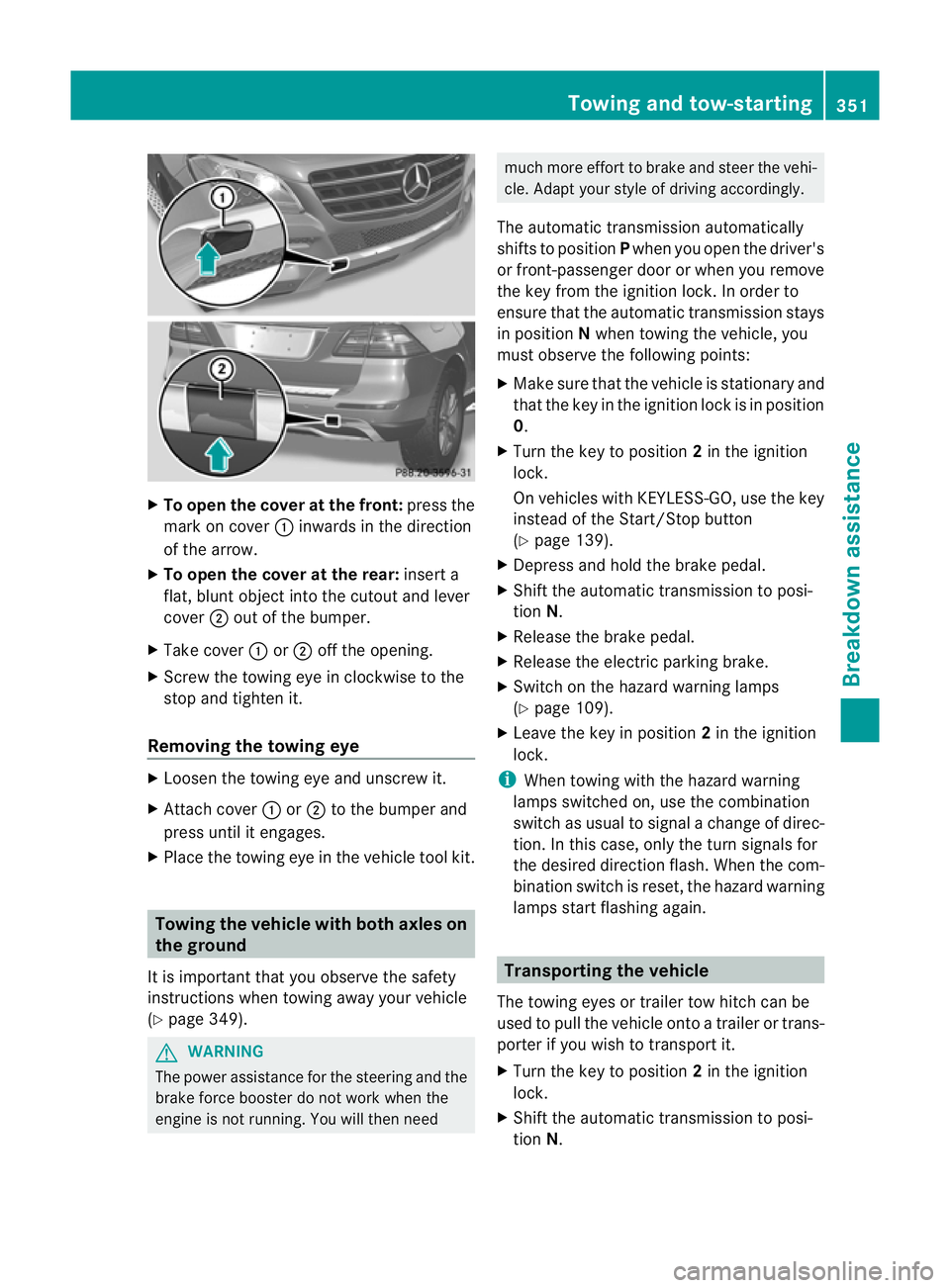
X
To ope nthe cove ratthe front: press the
mark on cover :inw ards in the direction
of the arrow.
X To open the cover at the rear: insert a
flat ,blunt object into the cutout and lever
cover ;out of the bumper.
X Take cover :or; off the opening.
X Screw the towing eye in clockwise to the
stop and tighten it.
Removin gthe tow inge ye X
Loose nthe towing eye and unscrew it.
X Attach cover :or; to the bumper and
press until it engages.
X Plac ethe towing eye in the vehicle tool kit. Towing th
evehicle with both axles on
the ground
It is importan tthat you observe the safety
instructions when towing away your vehicle
(Y page 349). G
WARNING
The power assistanc efor the steering and the
brake force booster do not work when the
engin eisnot running. You will then need much mor
eeffort to brak eand stee rthe vehi-
cle. Adap tyour style of driving accordingly.
The automatic transmission automatically
shifts to position Pwhen you open the driver's
or front-passenger door or when you remove
the key from the ignition lock. In order to
ensur ethat the automatic transmission stays
in position Nwhen towing the vehicle, you
must observe the followin gpoints:
X Make sure that the vehicle is stationar yand
that the key in the ignition lock is in position
0.
X Turn the key to position 2in the ignition
lock.
On vehicles with KEYLESS-GO, use the key
instead of the Start/Stop button
(Y pag e139).
X Depres sand hol dthe brake pedal.
X Shif tthe automatic transmission to posi-
tion N.
X Release the brake pedal.
X Release the electric parkin gbrake.
X Switch on th ehazard warning lamps
(Y page 109).
X Leave the key in position 2in the ignition
lock.
i When towing with the hazard warning
lamps switched on, use the combination
switch as usua ltosignal achange of direc-
tion .Int his case ,only the turn signals for
the desired direction flash .When the com-
bination switc hisreset, the hazar dwarning
lamps start flashing again. Transporting the vehicle
The towing eyes or trailer tow hitch can be
used to pull the vehicle onto atrailer or trans-
porter if yo uwish to transport it.
X Turn the key to position 2in the ignition
lock.
X Shift the automatic transmission to posi-
tion N. Towing and tow-starting
351Breakdownassis tance Z
Page 355 of 389
As soon as th
evehicle is loaded:
X Preven tthe vehicle from rolling away by
applying the electric parkin gbrake.
X Shift th eautomatic transmission to posi-
tion P.
X Turn the key in the ignition lock to position
0 and remove the key from the ignition
lock.
X Secure the vehicle.
! Only lash the vehicle down by the wheels
or wheel rims, not by parts of the vehicle
such as axle or steering components. Oth-
erwise, the vehicle could be damaged. Notes for 4MATIC vehicles
! Vehicles with 4MATIC must not be towed
with the front or rear axle raised; otherwise,
the transmission may be damaged.
If the vehicle has transmission damage or
damage to the front or rear axle, have it trans-
ported on atransporter or trailer.
In the even tofdamage to the ele ctrical
system
If the battery is defective, the automatic
transmission will be locked in position P.To
shif tthe automatic transmission to position
N,y ou must provide power to the vehicle's
electrical system in the same way as when
jump-startin g(Ypage 348).
Hav ethe vehicle transported on atransporter
or trailer. Recovering
avehicle that ha sbecome
stuck
! When recovering atrapped vehicle ,donot
je rk the vehicle or pull it at an angle. If the
tractive powe rist oo high, th evehicles
could be damaged.
If th edrive wheels ge ttrapped on loose or
muddy ground, recover th evehicle with the
utmost care, especially so if the vehicle is
laden. Never attempt to recover
avehicle with a
trailer atta ched.
Pull out the vehicle backwards, if possible,
using the tracks it made when it became
stuck. Tow-starting (emergency engine
starting)
! Vehicles with automatic transmission
must not be tow-star ted. The tra nsmission
ma yotherwise be damaged. Electrical fuses
Important safet
ynotes G
WARNING
Only use fuses that have been approved for
Mercedes-Benz vehicles and which have the
correct fuse ratin gfor the system scon-
cer ned. Do not attempt to repair or bridge
faulty fuses. Usin gfuses which have not been
approved or attempting to repair or bridge
faulty fuses could cause the fuse to be over-
loaded and result in afire. Have the cause
traced and rectified at aqualified specialist
workshop.
The fuses in your vehicle serve to close down
faulty circuits. If afuse blows, all the compo-
nen tson the ci rcuit and their functions stop
operating.
Blown fuses must be replaced with fuses of
the same rating, which you can recognise by
the colour and fuse rating. The fuse ratings
are listed in the fuse allocation chart.
If the newly inser tedf use also blows ,have the
cause traced and rectified at aqualified spe-
cialist workshop, e.g. aMercedes-Benz
Servic eCentre.
! Only use fuses that have been approved
for Mercedes-Ben zvehicles and which
have the cor rect fuse rating for the system
concerned. For the fuse boxes in the engine
compartment and unde rthe rea rbench 352
Electrical fusesBreak
down assistance
Page 356 of 389
seat
,only use fuses with the suffix "S".
Components or systems could otherwise
be damaged. Before changin
gafuse
X Park th evehicle and apply the electric park-
ing brake.
X Switch off all electrical consumers.
X Remov ethe key from the ignition lock.
The fuses ar elocated in variou sfuse boxes:
R fuse box on the front-passenger side of the
dashboard
R fuse box in the engine compartment on the
right-hand side of the vehicle, when viewed
in the direction of travel
R fuse box under the rear bench seat
The fuse allocation chart is located in the fuse
box (Y page 353 )under the rear bench seat. Dashboard fuse box
! Do not use apointed objec tsuch as a
screwdriver to open the cover in the dash-
board. You could damage the dashboard or
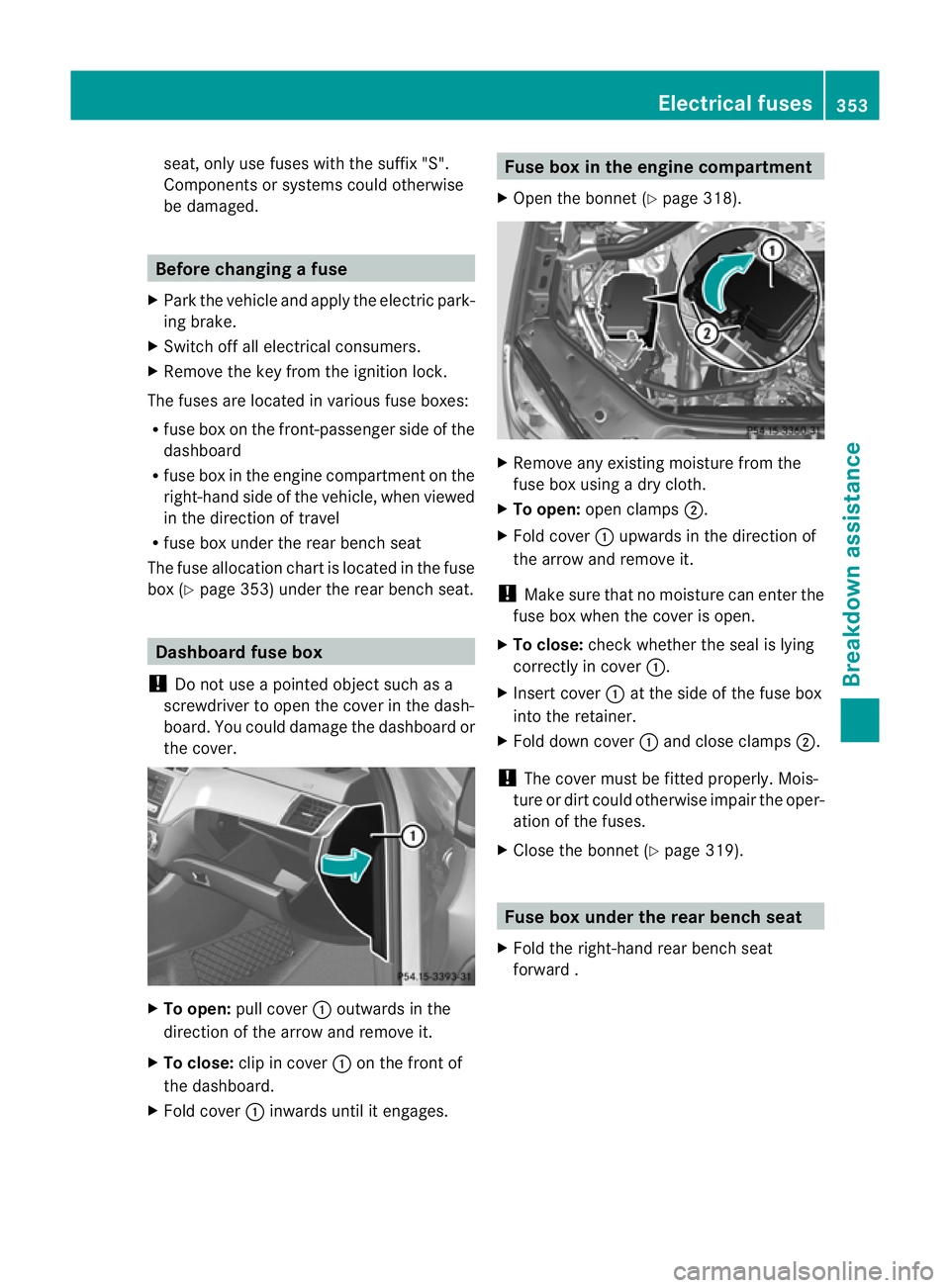
the cover. X
To open: pull cover :outwards in the
direction of the arrow and remove it.
X To close: clip in cover :on the front of
the dashboard.
X Fold cover :inwards until it engages. Fuse box in the engin
ecompar tment
X Open the bonnet (Y page 318). X
Remove any existing moisture from the
fuse box using adry cloth.
X To open: open clamps ;.
X Fol dc over :upwards in the direction of
the arrow and remove it.
! Make sure that no moistur ecan enter the
fuse box when the cover is open.
X To close: check whethe rthe seal is lying
correc tlyinc over:.
X Insert cover :at the side of the fuse box
int ot he retainer.
X Fold down cover :and close clamps ;.
! The cover must be fitted properly. Mois-
tur eord irt could otherwise impair the oper-
ation of the fuses.
X Close the bonnet (Y page 319). Fuse box under the rear benc
hseat
X Fold the right-hand rear bench seat
forwar d. Electrical fuses
353Breakdownassistance Z
Page 364 of 389
R
you are drivin gonsandorg ravel.
R yo ua dopt averys porty driv ings tyle (cor-
nering at hig hspeeds or driv ingw ith high
rates of acceleration).
R you are towing avery heavy or lar getrailer.
R you are driving with aheavy load (in the
vehic le oron the roof).
Restarting th etyre pressure lo sswarn-
ing system Restart the tyre press
urel oss warnin gsystem
if you have:
R changed the tyre press ure
R changed the whe elso rtyres
R fitted new wheels or tyres
X Before restarting, consult the table of tyre
press ures on the inside of the fuel filler flap
to ensur ethat the tyr epressure in all four
tyre siss et correctly for the respective
operating conditions.
X Observ ethe notes in the section on tyre
pressures (Y page 359). G
WARNING
The tyr epressure loss warn ings ystem can
only give reliabl ewarnings if you have set the
correct tyre pressure.
If an incorrect tyre pressure is set, these
incorrect values wil lbemonitored.
At yre with insufficient pressure results in
vehicle instability when driving, thu sincreas-
ing the risk of an accident.
X Make sure that the key is in pos i-
tion 2(Ypage139) in the igniti onlock.
X Press =or; on the steering wheel
to select the Serv. menu.
X Press 9or: to select Tyre pres‐ sure .
X Press the abutton.
The RunF lat Indicato ractive Restart with OK message ap
pears in the
multifunction display. If you wis
htoconfirm the restart:
X Press the abutton.
The Tyre press. no wOK? message
ap pe ars in the multifunction display.
X Press the 9or: button to select
Yes .
X Press the abutton.
The RunF lat Indicato rrestarted message ap
pears in the multifunction dis-
play.
After ateach-in period, the tyr epressure
loss warn ings ystem wil lmonitor the set
tyr ep ressures of all fou rtyres.
If you wis htocancel the restart:
X Press the %button.
or
X If the Tyre press. now OK? message
appears ,press 9 or: to select
Cancel .
X Press the abutton.
Th et yre press urev alues stored at the last
restart wil lcontinue to be monitored. Tyre pressur
emonitor
Important safety notes If
at yre press urem onitor system is fitted, the
vehicle's wheels have sensor sfitted that
monitor the tyre pressures in all four tyres.
The tyre pressure monitor warns you when
the pressure drops in one or more of the
tyres. The tyre pressure monitor only func-
tions if the correct sensors are fitted to all
wheels. G
WARNING
The tyre pressure monitor does not warn you
of an incorrectly set tyre pressure. The table
on the inside of the fuel filler flap wil lhelp you
decide whether the tyre pressures should be
correc ted.
The tyr epressure monitor is not abl etow arn
you of asudden loss of pressure, e.g. if the Tyr
epressure
361Wheels and tyres
Z
Page 365 of 389
tyre is penetrated by
aforeign object .Inthe
event of asudden loss of pressure, bring the
vehicl etoah altbyb rakingcarefully. Do not
make any sudden steering movements when
doing so.
Informatio nontyre pressures is displayed in
the multifunction display. After afew minutes
of driv ing, the curren ttyre pressure of each
tyre is sho wn inthe multifunction display.
i Thet yre pressure values indicated by the
on-board computer may differ from those
measured at afilling station with apressure
gauge. Th etyre pressures shown by the on-
board computer refer to thos emeasured at
sea level. At high altitudes, the tyr epres-
sure values indicated by apressure gauge
are higher than thos eshown by the on-
boar dcomputer .Inthis case ,donot reduce
the tyr epressures.
i Theo peration of the tyr epressure moni-
to rc an be affected by interference from
radio transmitting equipment (e.g. radio
headphones ,two-way radios) that may be
being operated in or near the vehicle.
Checking tyr epressure electronically X
Make sure that the key is in position 2
(Y page 139) in the ignitio nlock.
X Press the =or; button on the steer-
ing wheel to select the Serv. menu.
X Press the 9or: button to select
Tyre pressure .
X Press the abutton.
The curren ttyre pressure for each wheel
will be displayed in the multifunction dis-
play.
If the vehicle has been parked for longe rthan
20 minutes, the Tyre pressures will be
displaye
dafter afew minutes of driving message appe
ars.
After ateach-in period, the tyr epressure
monito rautomatically recognise snew
wheels or new sensors. As long as aclear
allocation of the tyre pressure values to the individual wheels is not possible
,the Tyre pressure monito
ractive displa
ymes-
sage is shown instead of the tyr epressure
display. Th etyre pressures are already being
monitored.
i Ifas pare wheel/emergenc yspare wheel
is fitted, the system may continue to show
the tyr epressure of th ewheel that has
been removed for afew minutes. If this
occurs, note that the value displayed for
the position where the spare wheel/emer-
gency spare wheel is fitted is not the same
as the spare wheel/emergenc yspare
wheel's current tyr epressure.
Tyre pressure monito rwarning mes-
sages If the tyre pressure monitor detects
asignifi-
cant pressure loss on one or more tyres, a
warnin gmessage is shown in the multifunc-
tion display. Awarning ton ealso sounds and
th et yrep ressure warning lamp ligh tsup in
the instrumen tcluster.
Eac htyret hat is affected by asignificant loss
of pressure is highlighted in th epressure dis-
play.
If the Please correc ttyrep ressure messag
eappear sinthe multifunctio ndis-
play:
X Chec kthe tyr epressure on all fou rwheels
and correc titifn ecessary.
i If the wheel positions on the vehicle are
inter changed, the tyre pressures may be
displ ayed for th ewrong positions for a
short time .This is rectified after afew
minutes of driving, and the tyr epressures
are displayed for th ecorrect positions.
Restarting th etyre pressure monitor When yo
urestar tthe tyr epressure monitor,
all existing warning message sare deleted and
th ew arning lamps go out. The monitor uses
the currently set tyre pressures as the refer-
ence values for monitoring. In most cases, the
tyre pressure monitor will automatically 362
Tyr
epressureWheels and tyres