lock MERCEDES-BENZ M-CLASS SUV 2011 User Guide
[x] Cancel search | Manufacturer: MERCEDES-BENZ, Model Year: 2011, Model line: M-CLASS SUV, Model: MERCEDES-BENZ M-CLASS SUV 2011Pages: 389, PDF Size: 9.22 MB
Page 32 of 389
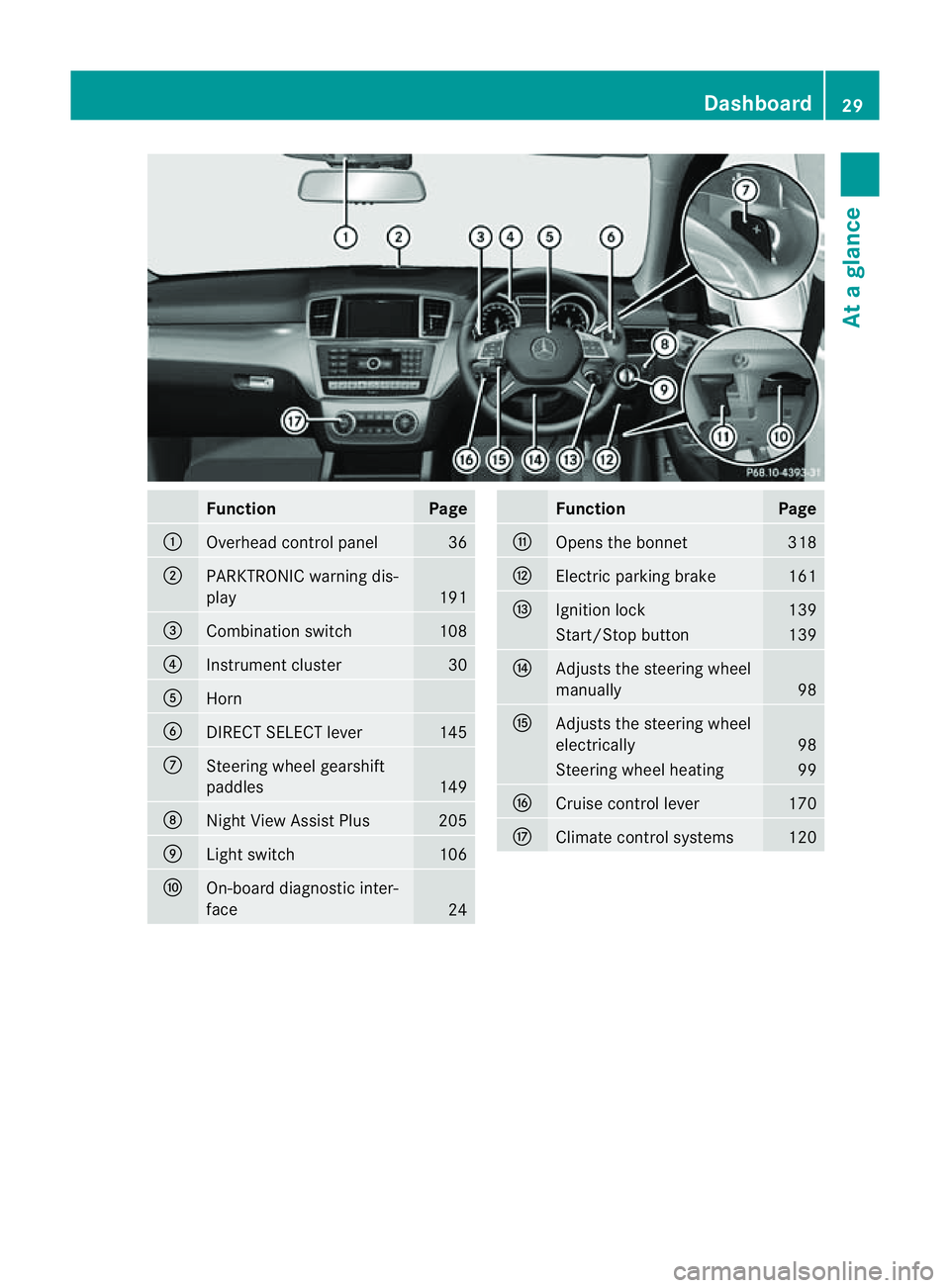
Function Page
:
Overhead con
trol panel 36
;
PARKTRONI
Cwarning dis-
play 191
=
Combination switch 108
?
Instrument cluster 30
A
Horn
B
DIRECT SELECT lever 145
C
Steerin
gwheel gearshift
paddles 149
D
Nigh
tView Assist Plus 205
E
Light switch 106
F
On-board diagnostic inter-
face 24 Function Page
G
Opens the bonnet 318
H
Electric parking brake 161
I
Ignition lock 139
Start/Stop button 139
J
Adjusts the steerin
gwheel
manually 98
K
Adjusts the steeri
ngwheel
electrically 98
Steerin
gwheel heati ng 99
L
Cruise control lever 170
M
Climate control systems 120Dashbo
ard
29Atag lance
Page 33 of 389
Instr
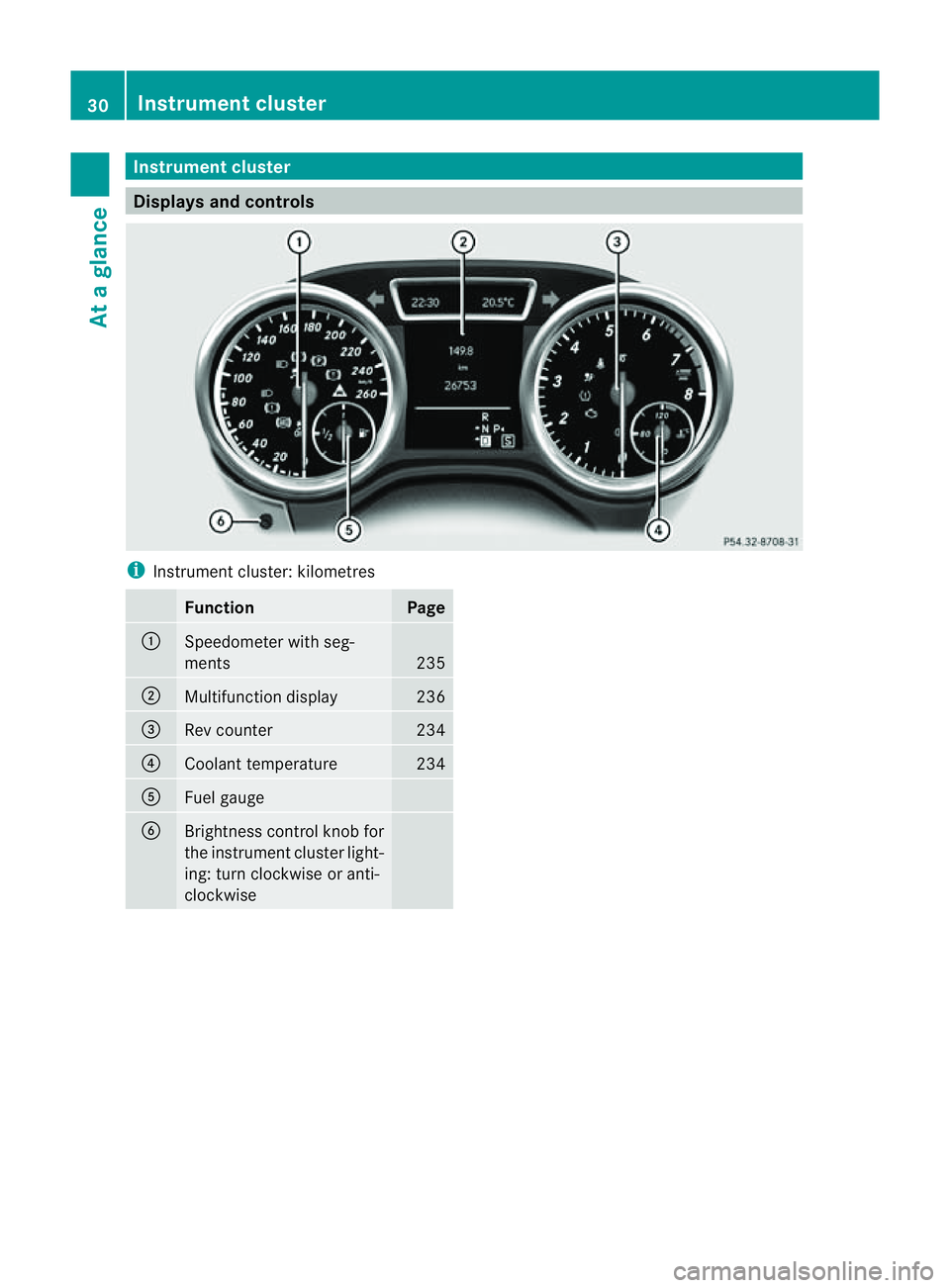
umentc luster Displa
ysand controls i
Inst rument cluster: kilometres Function Page
:
Speedometer with seg-
ments
235
;
Multi
function display 236
=
Rev counter 234
?
Coolant temperature 234
A
Fuel gauge
B
Brightness control knob for
the instrument cluster light-
ing: tur nclockwise or anti-
clockwise 30
Instrument clusterAt
ag lance
Page 34 of 389
i
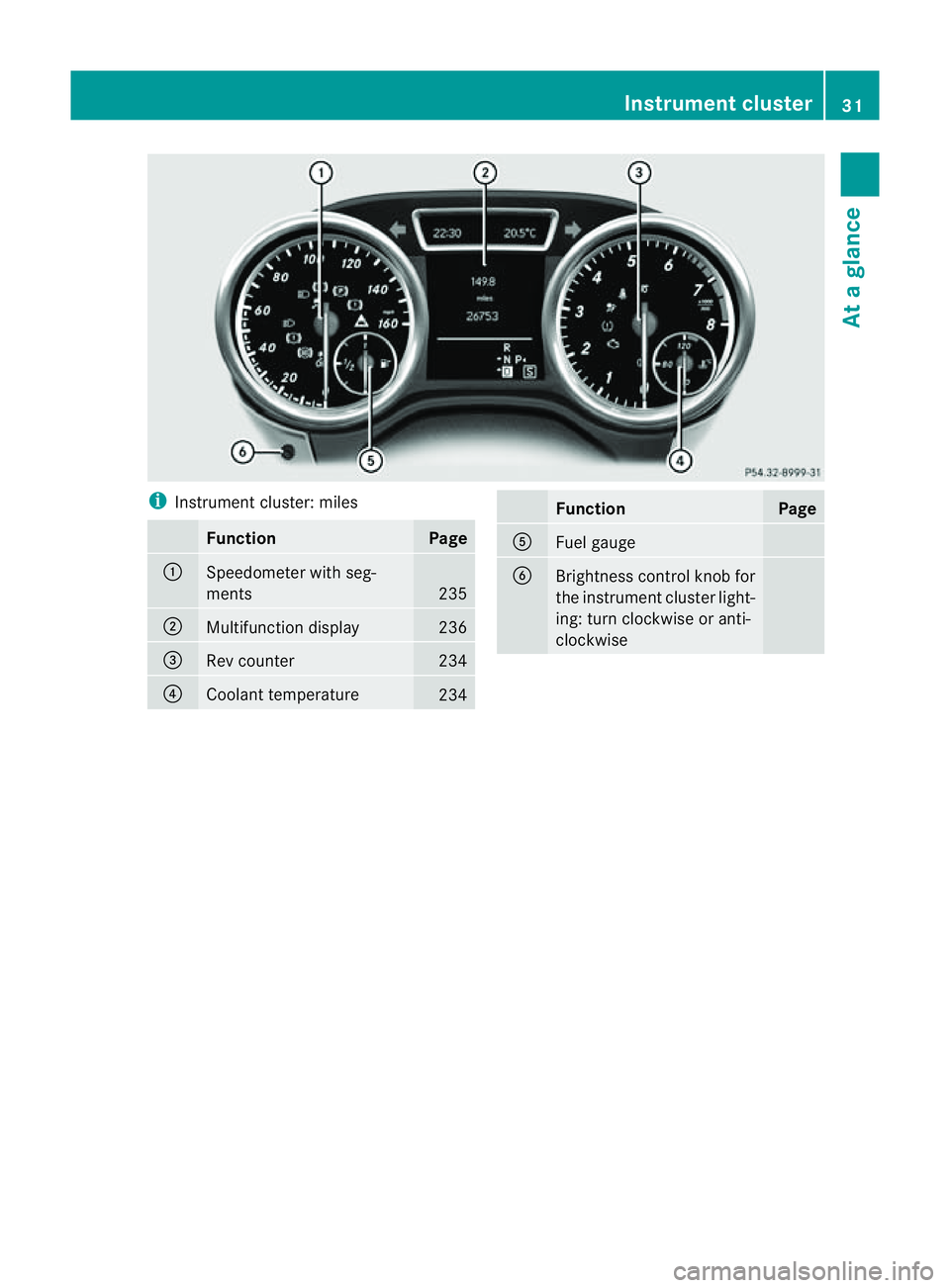
Instrument cluster: miles Fun
ction Page
:
Speedometer with seg-
ments
235
;
Multifunctio
ndisplay 236
=
Rev counter 234
?
Coolant temperature
234 Function Page
A
Fuel gauge
B
Brightness control knob for
the instrument cluster light-
ing: turn clockwise or anti-
clockwise Instrument cluster
31Atag lance
Page 40 of 389
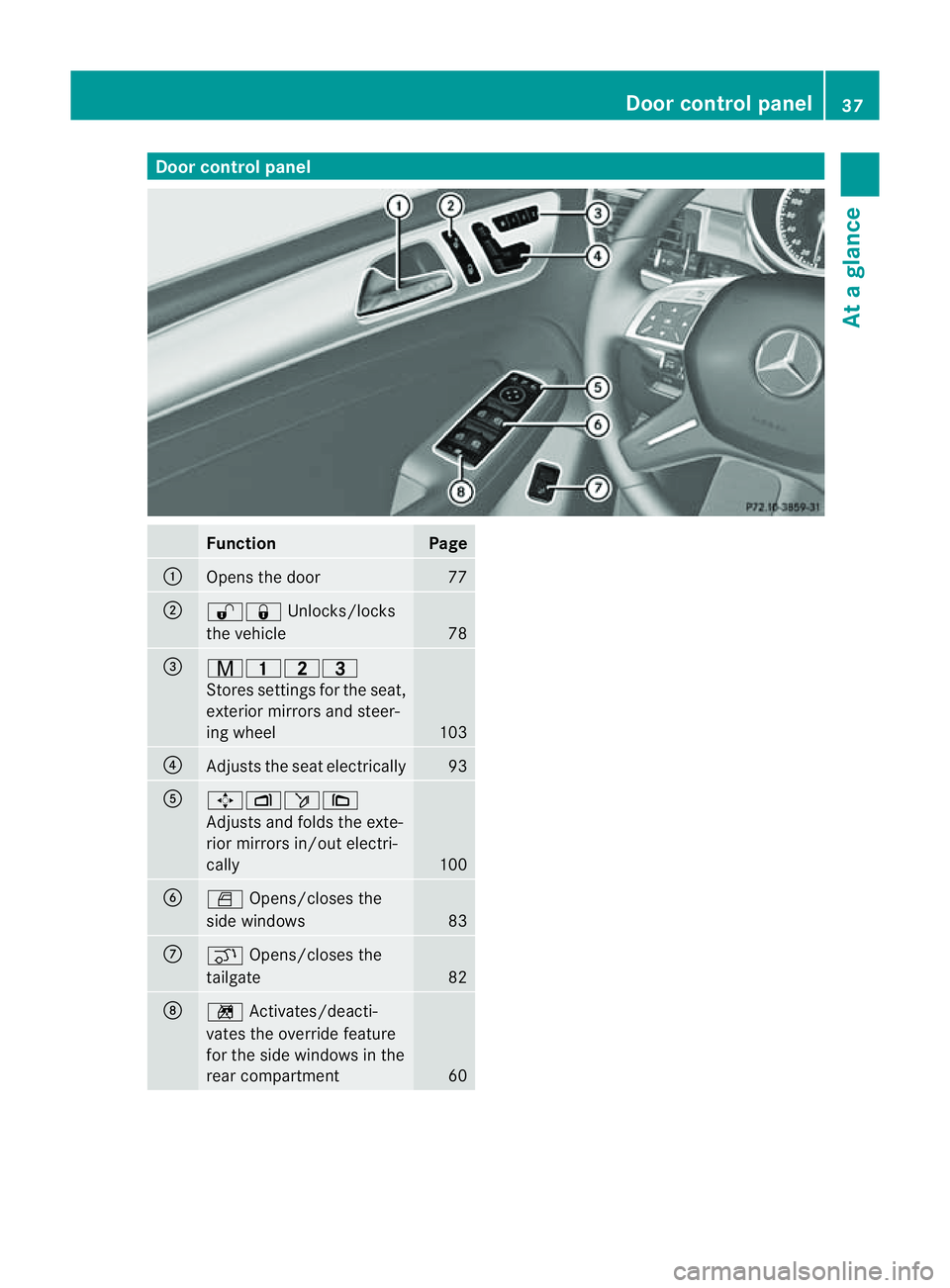
Door control panel
Function Page
:
Opens th
edoor 77
;
%&
Unlocks/locks
th ev ehicle 78
=
r4
5=
Stores se ttingsfor theseat,
exterior mirrors and steer-
ing wheel 103
?
Adjusts the seat electrically 93
A
7Zö\
Adjusts and folds the exte-
rio
rm irrors in/out electri-
cally 100
B
W
Opens/closes the
side windows 83
C
q
Opens/closes the
tailgate 82
D
n
Activates/deacti-
vates the override feature
for the side windows in the
rear compartment 60 Doo
rcontrol panel
37Atag lan ce
Page 49 of 389
PRE-
SAFE®
inte rvenes:
R in emergenc ybraking situations ,e.g. if BAS
is activated or for vehicles with DISTRONIC
PLUS, BAS PLUS intervenes powerfully
R if the radar senso rsystem detects an immi-
nent dange rofcollision in cer tain situa-
tions (on vehicles with DISTRONIC PLUS)
R in critical drivin gsituations, e.g. when phys-
ical limits are exceed and the vehicle under-
steers or oversteers severely
PRE-SAFE ®
takes the following measures
depending on the hazardous situation detec-
ted:
R the fron tseat belts are pre- tensio ned.
R vehicles with the memory fun ction :it
adjust sthe front-pas senger seat if it is in
an unfavourable position.
R if th evehicle skids, th eslidin gsunroof/
panoram aslidin gsunroof and th eside win-
dows are closed so tha tonly asmall gap
remains.
If th ehazardous situatio npasses without
resulting in an accident ,PRE-SAFE ®
slackens
the belt pretensioning. All settings made by
PRE-SAFE ®
can then be reversed.
If the seat belts are not released:
X Move the backrest or seat back sligh tly, but
only when the vehicle is stationary.
The belt pretensionin gisreduced and the
locking mechanis misreleased. G
WARNING
When adjusting the seat, mak esure that
nobody can become trapped.
! Make sure that there are no objects in the
footwell or behind the seats when moving
the seat back. There is arisk that the seats
and/or the objects could be damaged.
More information abou tseat-belt adjust-
men t,ac onvenienc efunction integrated into
PRE-SAFE ®
,c an be found in the "Seat-belt
adjustment" section (Y page 48). Seat belts
Important safety notes Seat belts are the most effective means of
restraining the movemen
tofvehicle occu-
pant sint he even tofana ccident. This
reduce sthe risk of vehicle occupan ts coming
into contact with parts of the vehicl einterior. G
WARNING
As eat belt which is not worn correctly, or
which has not been engaged in the seat belt
buckle correctly, can notp erform its intended
protectiv efunction. Under certain circum-
stances, this could cause severe or even fatal
injuries in the event of an accident.
Make sure that all occupant s–inparticular,
pregnan twome n–w ear their seat belt cor-
rectly at all times.
R The seat belt must fit snugly on your body
and must no tbetwisted. Therefore, avoid
wearing bulky clothing, e.g. awinter coat.
The shoulder belt section must be routed
across the centre of your shoulder –onno
account across your neck or under your
arm –and pulled tight against your upper
body .The lap belt must always pass across
your lap as low down as possible, i.e. over
your hip join ts–n ot across your abdomen.
If necessary ,push down the belt strap
slightly and then retighten it in the roll-up
direction.
R Do not route the belt strap across sharp
edge sorfragil eobjects, especially if these
are located on or in your clothing, e.g. spec-
tacles, pens, keys, etc. The seat belt strap
could be damaged and tear in an accident,
and you or other vehicl eoccupants could
be injured.
R Onl yone person should use each sea tbelt
at any one time. Children must never travel
sittin gont he lap of other occupan ts.It
would not be possible to restrain the child
in the event of asudden change in direc-
tion, braking or an accident .This could 46
Occupant safetySafety
Page 51 of 389
Sea
tbelt adjustment The seat-belt adjustment func
tion adjusts the
driver's and front-passenger seat belt to the
upper body of the occupants.
The belt strap is tighte neds lightly when:
R you engage the belt tongue in the belt
buckle and you then turn the key to position
2 in the ignition lock.
R the key is in position 2in the ignition lock
and you then engage the belt tongue in the
buckle.
The seat-belt adjustment will apply acertain
tightening force if any slack is detected
between the occupant and the seat belt. Do
not hold on to the seat belt tightly while it is
adjusting. You can switc hthe seat-belt
adjustment on and off in the on-boar dcom-
puter (Y page 251).
The seat-belt adjustment is an integra lpart of
the PRE-SAFE ®
convenience function. More
information about PRE-SAFE ®
can be found
in the "PRE-SAFE ®
(preventative occupant
protection)" section (Y page 45).
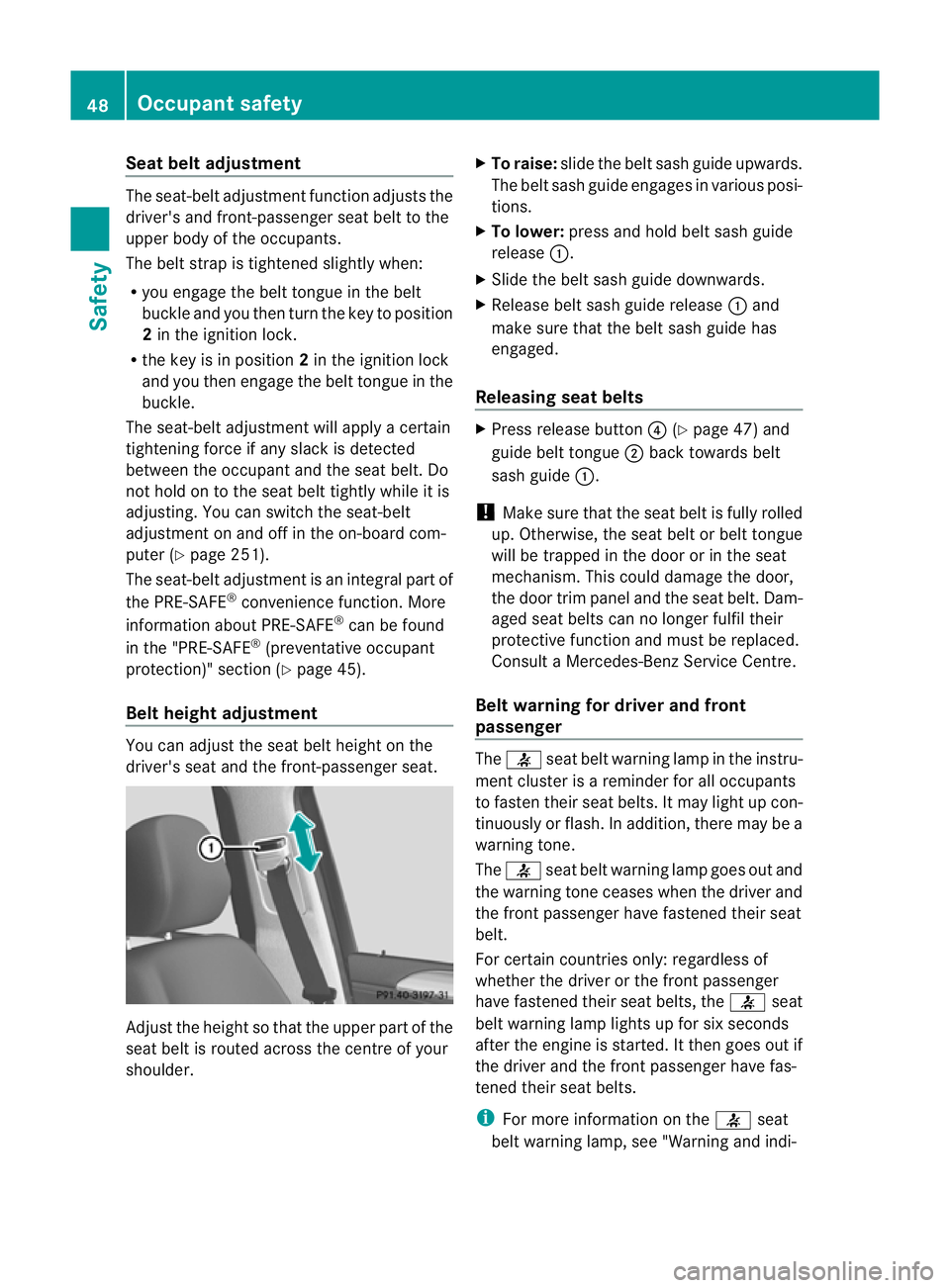
Belt height adjustment You can adjust the seat belt height on the
driver' sseat and the front-passenger seat. Adjust the height so that the upper part of the
seat belt is routed across the centre of your
shoulder. X
To raise: slide the belt sash guide upwards.
The belt sash guide engages in various posi-
tions.
X To lower: press and hold belt sash guide
release :.
X Slide the belt sash guide downwards.
X Release belt sash guide release :and
mak esure that the belt sash guide has
engaged.
Releasing seat belts X
Press release button ?(Ypage 47) and
guide belt tongue ;back towards belt
sash guide :.
! Make sure that the seat belt is fully rolled
up. Otherwise, the seat belt or belt tongue
will be trapped in the door or in the seat
mechanism. This could damage the door,
the door trim panel and the seat belt. Dam-
aged seat belts can no longer fulfil their
protective function and must be replaced.
Consult aMercedes-Benz Servic eCentre.
Belt warning for driver and front
passenger The
7 seat belt warning lam pint he instru-
men tcluster is areminder for all occupants
to fasten their seat belts. It may light up con-
tinuously or flash. In addition ,there ma ybea
warning tone.
The 7 seat belt warning lamp goes out and
the warning tone ceases when the driver and
the front passenge rhave fastened their seat
belt.
For certain countries only: regardless of
whethe rthe driver or the front passenger
hav efastened their seat belts, the 7seat
belt warning lamp lights up for six seconds
after the engine is started. It then goes out if
the driver and the front passenger have fas-
tened their seat belts.
i For more information on the 7seat
belt warning lamp, see "Warning and indi- 48
Occupant safetySafety
Page 52 of 389
cator lamps in the instrument cluster, se
at
belt" (Y page284).
Rear seat belt status indicator Th
er ear-com partment se at belt status indi-
cator tells you if the rear passengers have
their seat belts fastened.
The rear-compartment seat belt status indi-
cator indicates the rear seat on which the belt
is fastened. The üsymbol in the display
indicates afastened seat belt. If aseat belt is
not fastened or if aseat is not occupied, the
ý symbol is displayed.
The rear-compartment seat belt status indi-
cator appear sint he multifunction displa yfor
around 30 seconds if:
R you drive off and reach aspeed of approx-
imately 10 km/h.
R the rear passengers fasten or unfasten
their seat belts while the vehicle is in
motion.
R someon egets in or out of the vehicle and
the vehicle drives off again.
You can also can celthe rea rseat belt status
indicator immediately (Y page 253).
i The status indicator for the rear- compart-
ment seat belts is onl yavailable for certain
countries.
Bel ttensioners, belt force limiters The fron
tseat belts and the outer seat belts
in the rear are equipped with belt tensioners.
The belt tensioners tighten the seat belts in
an accident, pullin gthem close against the
body.
Belt tensioner sdonot correct incorrect seat
positions or incorrectly faste neds eat belts.
Belt tensioners do not pull vehicle occupants
back towards the back rest.
If the seat belt is also fitted wit habelt for ce
limiter and this is triggered, the forc eexerted
by the sea tbelt on the vehicle occupan tis
red uced. Th
eb elt force limiters on the front seats are
synchroni sedw ith the front airbags .They
tak eonap art of the deceleratio nforce,
resultin ginthe force exerted on the occupant
being distributed over agreater are a.
The belt tensioners can only be activated
when:
R the ignition is switched on.
R the restraint systems are operational; see
"SRS warning lamp" (Y page 41).
R the front-passenger seat is occupied and
the belt tongue is engaged in the buckle on
the front-passenger side.
The belt tensioners on the outside seats in the
rear compartment are triggered independ-
ently of the lock status of the seat belts.
The belt tensioners are triggered depending
on the type and severit yofanaccident:
R if, in the event of ahead-on or rear-en dcol-
lision, the vehicle decelerates or acceler-
ates rapidly in alongitudinal direction dur-
ing the initial stages of the impact
R if, in the even tofaside impact, on the side
opposit ethe impac tthe vehicle deceler-
ates or accelerates rapidly in alateral direc-
tion
R if in certain situations where the vehicle
overturns and the system determines that
it can provide additional protection
If the airbags are deployed, you will hear a
bang, and asmall amount of powder may also
be released. Only in rare cases will th ebang
affect your hearing. The powde rthat is
released generally does not constitute a
healt hhazard. The 6SRS warning lamp
lights up. G
WARNING
If the seat belt tensioners have been trig-
gered, they provide no additional protection
in the event of another accident. Therefore,
have belt tensioners which have been trig-
gered replaced at aqualified specialist work-
shop. Occupant safety
49Safety
Z
Page 55 of 389
the dashboard and on both side
softhe sun
visor on the fr ont-passenge rside.
Information about recommended child
restraint system sisavailabl eatany
Mercedes-Ben zServic eCentre.
Automatic child seat recognition on the
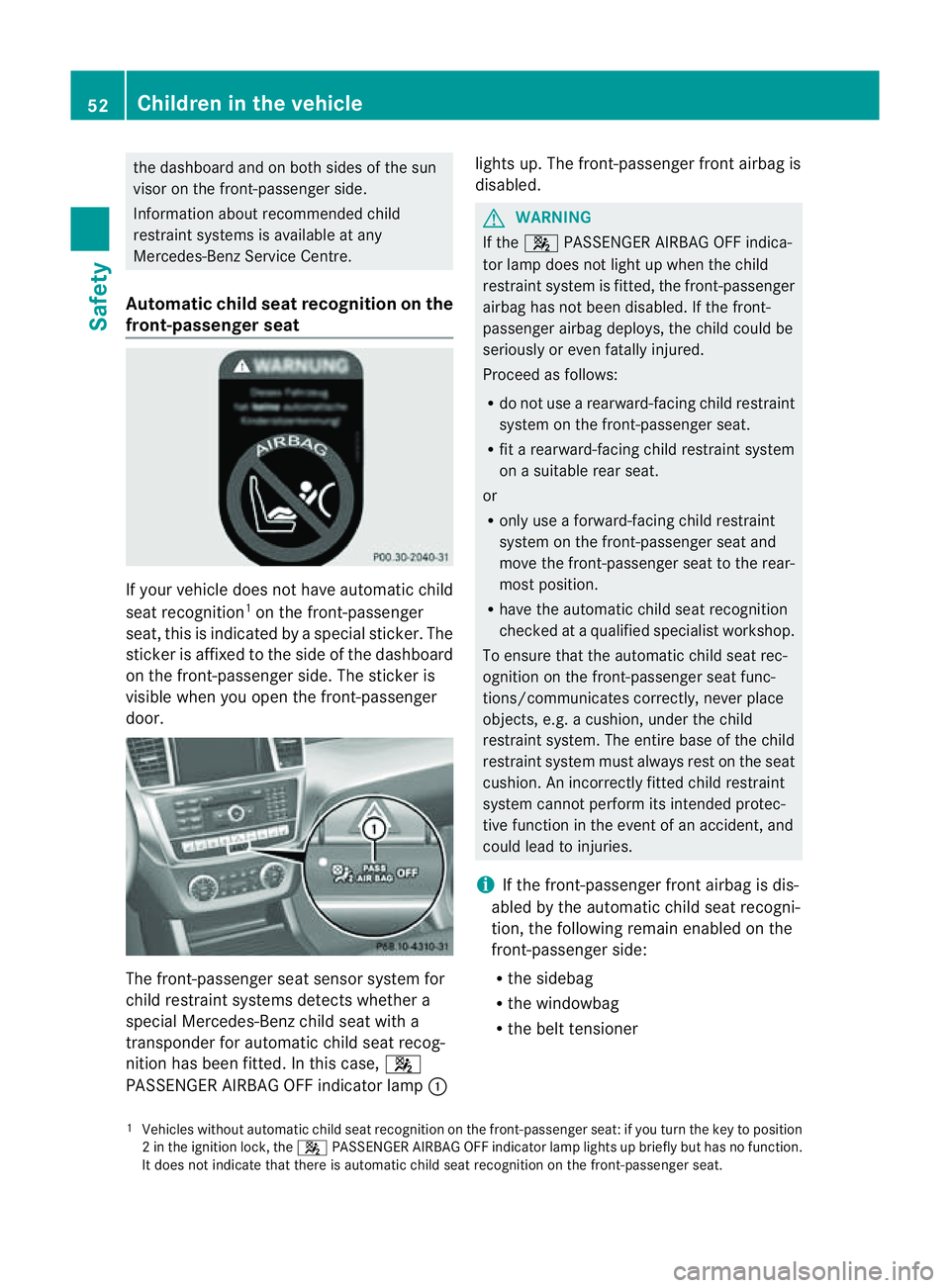
front-passenger seat If your vehicle does not have automatic child
seat recognition 1
on the fron t-passenger
seat, this is indicated by aspecial sticker .The
stic kerisa ffixe dtot he side of the dashboard
on the front-passenger side. The stic keris
visible when yo uopen the front-passenger
door. The front-passenger seat sensor system for
child restraint systems detect swhether a
special Mercedes-Ben zchild seat with a
transpo nder for automatic child seat recog-
nition has been fitted. In this case, 4
PASSENGER AIRBA GOFF indicato rlamp : lights up. The front-passenger front airbag is
disabled. G
WARNING
If the 4 PASSENGER AIRBAG OFF indica-
tor lamp does not light up when the child
restraint system is fitted, the front-passenger
airbag has not been disabled. If the front-
passenger airbag deploys, the child could be
seriously or even fatally injured.
Proceed as follows:
R do not use arearward-facing child restraint
system on the front-passenger seat.
R fit arearward-facing child restraint system
on asuitable rear seat.
or
R only use aforward-facing child restraint
system on the front-passenger seat and
mov ethe front-passenger seat to the rear-
most position.
R hav ethe automatic chil dseat recognition
checked at aqualified specialist workshop.
To ensure that the automatic child seat rec-
ognitio nonthe front-passenger seat func-
tions/communicates correc tly, never place
objects, e.g. acushion, under the child
restraint system. The entire base of the child
restraint system must always rest on the seat
cushion. An incorrectly fitted child restraint
system cannot perform its intended protec-
tive function in the event of an accident, and
could lead to injuries.
i If the front-passenger front airbag is dis-
abled by the automatic child seat recogni-
tion, the following remain enabled on the
front-passenger side:
R the sidebag
R the windowb ag
R the belt tensio ner
1 Vehicles withou tautomatic child seat recognition on the front-passenger seat: if you turn the key to position
2int he ignition lock ,the 4 PASSENGER AIRBAG OFF indicator lamp lights up briefly but has no function.
It does not indicate that there is automatic child seat recognition on the front-passenger seat. 52
Childre
ninthe vehic leSafety
Page 56 of 389
G
WARNING
Do not pl acee lectronic devices on the front-
passenger seat, e.g.:
R laptops, when switched on
R mobil ephones
R cards with transponders, e.g. ski passes or
access cards
Signals from electronic equipment can cau se
interference in the automatic child seat rec-
ognitio nsensor system. This can lead to a
system malfunc tion. This may cause the
4 PASSENGER AIRBA GOFF indicator
lamp to light up without there being achild
seat with transponder sfor automatic child
seat recognition fit ted. The front-passenger
airba gwill not then deploy during an accident.
It is also possible that the 6SRS warning
lamp lights up and/or the 4PASSENGER
AIRB AGOFF indicator lam pdoes not light up
briefly when you tur nthe key in the ignition
lock to position 2.
ISOFIX child seat securing system for
th er ear seats ISOFIX is
astandardised securing syste mfor
specially designed child restraint system son
the rear seats .Securin grings for two ISOFIX
child restraint systems are fitted on the left
and right of the rear seats. G
WAR
NING
Ac hild restraint system secured by the ISOFIX
chil dseat securing system does not provide
sufficien tprotection for children weighing
more than 22 kg. For this reason, do not
secure children weighing more than 22 kg in
ac hild restraint system secured by the ISOFIX
chil dseat securing system. If the child weighs
mor ethan 22 kg, secur ethe chil drestraint
system using athree-point seat belt. G
WARNING
The chil drestraint system cannot perform its
protec tive function if it is not correctly fitted
to as uitable vehicle seat. The child cannot be restrained in the event of an accident, heavy
braking or sudde
nchanges of direction. The
chil dcould be seriously or even fatally injured.
For this reason, when fittin gachild restraint
system ,observ ethe manufacturer' sinstalla-
tion instructions and the correct use of the
child restraint system.
For reasons of safety, only use child restraint
systems with the ISOFIX child sea tsecuring
system on the rear seats.
We recommen dthat you use the ISOFI Xchild
restraint system sthat hav ebeen recommen-
ded for Mercedes-Benz.
An incorrectly fitted child restraint system
could com eloose and seriously or even fatally
injure the child or other vehicle occupants.
When fittin gthe chil drestraint system, always
mak esure that it is engage dcorrectly in the
securing rings on both sides. G
WARNING
Please note that if child restraint systems, or
their retaining systems, are damaged or sub-
jected to aload in an accident ,they ma ynot
be able to provide their protective function.
This coul dresult in serious or even fatal inju-
ries to the secured child in the event of an
accident, heavy braking or asudden change
in direction.
For this reason, have child restraint systems
and their anchorages which have been dam-
aged or subjected to aload in an accident
chec kedi mmediatel yataq ualified specialist
workshop.
! Whe nfittin gthe chil drestraint system,
mak esure that the seat belt for the centre
seat does not get trapped. Otherwise, the
seat belt could be damaged. Children in the vehic
le
53Safet y Z
Page 63 of 389
Child-proof locks
Important safety notes G
WARNING
Activate th echild-proo flocks for th erear
door sand the override switch for the rear
windows whe nchildren are travelling in the
vehicle. Otherwise, the chil dren could open
doors or side windows while the vehicle is in
motion and injure themselv esor others. G
WARNING
Do not leave children unsupervised in the
vehicle, even if they are secur edinac hild
restraint system .They coul dinjure them-
selve sonp arts of the vehicle. They could also
be seriousl yoreven fata llyi njured by pro-
longed exposure to extreme hea torcold.
Do not expose the child restraint system to
direct sunlight. Part softhe chil drestraint sys-
tem could heat up and the child could burn
herself/himself on them.
If ac hild opens adoor, the child or other per-
sons coul dbeinjured as aresult. They could
get out and injure themselves or be injured by
ap assing vehicle.
Also observe the notes on HOLD. Relevant
information can be found in the index.
Child-proof locks for the rear doors You secure each door individually with the
child-proo flocks on the rea rdoors. Adoor
secured with achild-proof lock can notbe
opened from inside the vehicle. When the
vehicle is unlocked, the door can be opened
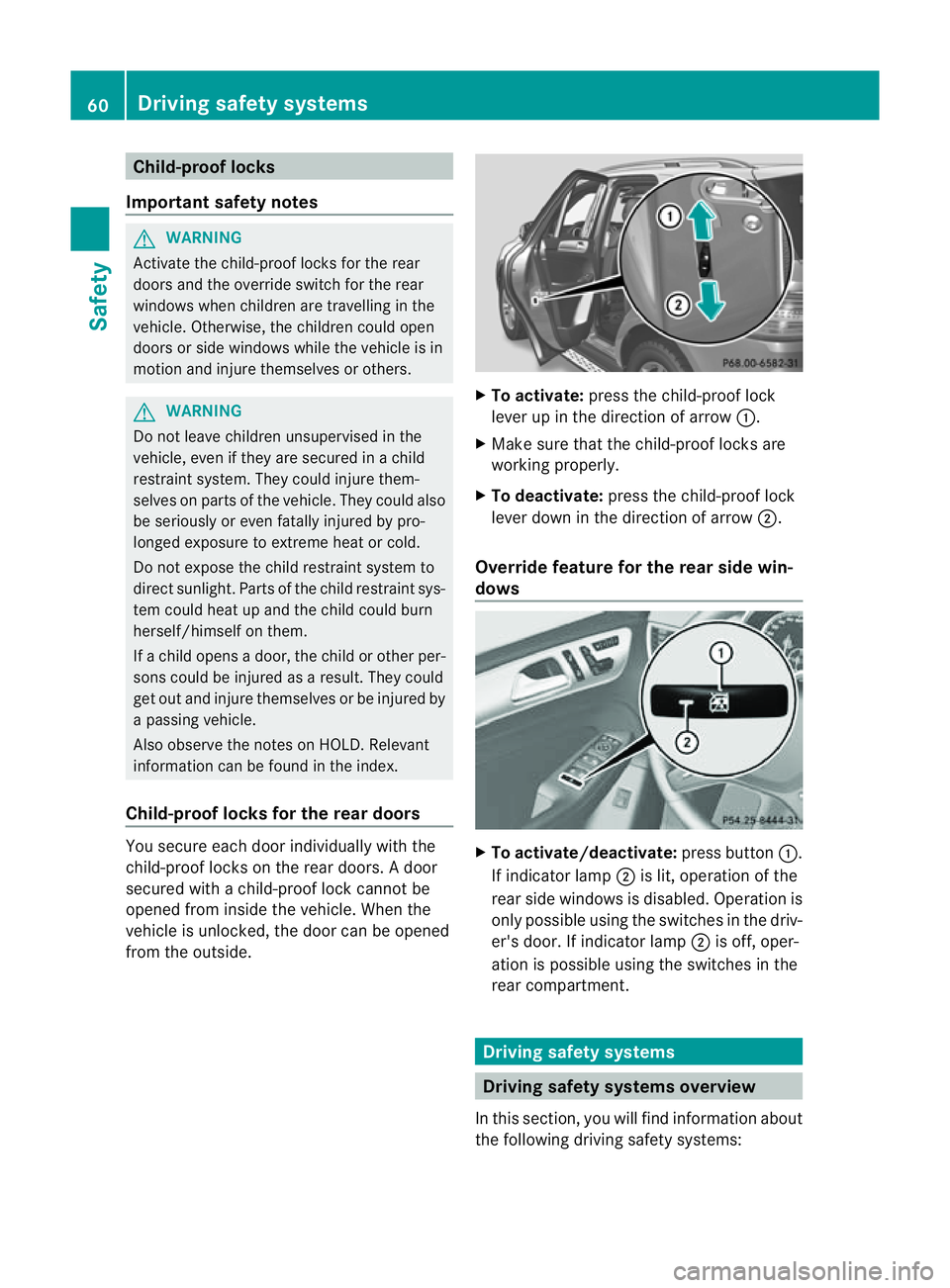
from the outside. X
To activate: press the child-proof lock
leve rupint he direction of arrow :.
X Make sur ethat the child-proof lock sare
workin gproperly.
X To deactivate: press thechild-proof lock
lever down in the direction of arrow ;.
Overrid efeature for the rear side win-
dows X
To activate/deactivate: press button:.
If indicator lamp ;is lit, operation of the
rear side windows is disabled. Operation is
only possible using the switches in the driv-
er' sd oor. If indicator lamp ;is off ,oper-
ation is possible using the switches in the
rear compart ment. Driving safety systems
Driving safety systems overview
In this section, you will find information about
the following driving safety systems: 60
Drivin
gsafety systemsSafety