fuel pressure MERCEDES-BENZ M-CLASS SUV 2011 Owners Manual
[x] Cancel search | Manufacturer: MERCEDES-BENZ, Model Year: 2011, Model line: M-CLASS SUV, Model: MERCEDES-BENZ M-CLASS SUV 2011Pages: 389, PDF Size: 9.22 MB
Page 23 of 389
Two-way radio
Frequencie s................................... 371
Installati on .................................... .371
Transmission output (maximum ).... 371
Type identification plate
seeV ehicle identificat ionp late
Tyr epressure
Calling up (on-bo ardc omputer )..... 361
Display message ............................ 277
Not reac hed( TIREFIT) .................... 336
Pressure loss warning ....................360
Reache d(TIREFIT) .......................... 337
Rec ommended ............................... 359
Tyre pressur emonitor
Function/notes ............................. 361
Restarting ...................................... 362
Warn ingl am p................................. 293
Tyres
Checking ........................................ 356
Directi on ofrotation ...................... 364
Display message ............................ 277
Gri p................................................ 164
Important safety note s.................. 356
Replacing ....................................... 363
Service life ..................................... 357
Storing ........................................... 364
Tyr esize (data) .............................. 364
Tyr etrea d...................................... 357
se eF lat tyre U
Unladen weight ................................. 377
Un lock ing
Emergency unlocking .......................79
From insid ethe vehicle (central
unl ocking button) ............................. 78V
Vanity mirror (in sun visor) ..............308
Variable SP EEDTRONIC
se eS PEEDTRONIC
Vehicle
Corr ectu se ...................................... 25
Data acq uisition ............................... 25
Display message ............................ 280
Electronics ..................................... 371Equ
ipment ....................................... 22
Implied warranty .............................. 25
Individua lsettings .......................... 246
Leaving pa rkedup. ........................ 162
Locking (i nanemergency) ............... 79
Locking (ke y)................................... 72
Lowering ........................................ 341
Pullin gaway................................... 141
Rais ing. .......................................... 339
Registratio n..................................... 24
To wing away .................................. 349
Transporting .................................. 351
Unlockin g(in an emergency) ...........79
Unlockin g(key )................................ 72
Veh icle data ................................... 377
Vehi cleb attery
se eB attery (vehicle)
Vehicle data ....................................... 377
se eT echnical data
Vehicle dimensions ...........................377
Vehi clee mergency locking ................79
Vehi clei dentification number
se eV IN
Vehi clei dentification plate ..............372
Vehi clel evel (display message) .......269
Vehi clet ool kit .................................. 333
Vehi clew eights ................................. 377
Vents seeA ir vents
Video (DVD) ....................................... .242
Vide oDVD (on-board computer) ......242
VIN ...................................................... 372 W
Warning and indicator lamps ABS ................................................ 286
Brake s........................................... 285
Distance warning signa l................. 293
ESP ®
.............................................. 288
ESP ®
OFF ....................................... 288
LIM (cruise control )........................ 170
LIM (DISTRONIC PLUS) ..................176
LIM (variabl eSPEEDTRONI C)......... 173
Overview .......................................... 32
PASSENGER AIRBAG OFF ................52
Reserve fuel ................................... 291
Sea tbelt. ....................................... 28420
Index
Page 25 of 389
Protection of th
eenvironment Notes
H
Environmental note
Daimler's declared polic yisone of integrated
environmental protection.
The objectives are for the natural resources
which form the basis of our existence on this
plane ttobeu sed sparingl yand in amanner
which takes the requirements of both nature
and humanity into account.
You too can help to protect the environment
by operating your vehicle in an environmen-
tally responsible manner.
Fuel consumption and the rate of engine,
transmission, brake and tyre wear depend on
the following factors:
R operating conditions of your vehicle
R your personal driving style
You can influence both factors. You should
bear the following in mind:
Operating conditions:
R avoid short trips as these increase fuel con-
sumption.
R make sure that the tyre pressures are
always correct.
R do not carr yany unnecessary weight.
R keep an eye on the vehicle's fuel consump-
tion.
R remove roof racks once you no longer need
them.
R ar egularly serviced vehicle will contribute
to environmental protec tion. You should
therefor eadhere to the service inter vals.
R always have maintenance work carried out
at aq ualified specialist workshop ,e.g. a
Mercedes-Benz Service Centre.
Personal driving style:
R do not depress the accelerator pedal when
starti ngthe engine.
R do not warm up the engine with the vehicle
stationary. R
drive carefully and maintain asafe distance
from the vehicle in front.
R avoid frequent, sudden acceleration.
R change gear in good time and use each gear
only up to Ôof its maximum engine speed.
R switch off the engine in stationary traffic. Returning end-of-life vehicles
Mercedes-Benz will take back your
Mercedes-Benz to dispose of it in an environ-
mentally responsible manner, in accordance
with the European Union (EU) End of Life
Vehicles Directive.
The End of Life Vehicles Directive applies to
vehicles with agros svehicle weight of up to
3. 5t ,ina ccordance with national regulations.
For several years ,Mercedes-Benz has been
meeting all the legal requirements for a
design which allows for recycling and reuse.
There is anetwor kofreturnpoint sand dis-
assembly plants which can recycle your vehi-
cle in an environmentally responsible man-
ner. The options for recycling vehicles and
parts are constantly being develope dand
improved .This means that your Mercedes-
Ben zwill also continue to meet even the
increased recycling quotas in the futur ein
good time. You can obtai nfurther information
from your national Mercedes-Benz homepage
or your national hotline number. Vehicle equipment
This Owner's Manual describes all models
and all standard and optional equipment of
your vehicle available at the time of publica-
tion of the Owner's Manual. Country-specific
differences are possible. Pleas enote that
your vehicle ma ynot be equipped with all fea-
tures described. This also applies to safety-
relevant system sand functions .The equip-
men tiny our vehicle ma ytherefore differ from
that shown in the descriptions and illustra-
tions. All the system sfound in your vehicle 22
Introduction
Page 35 of 389
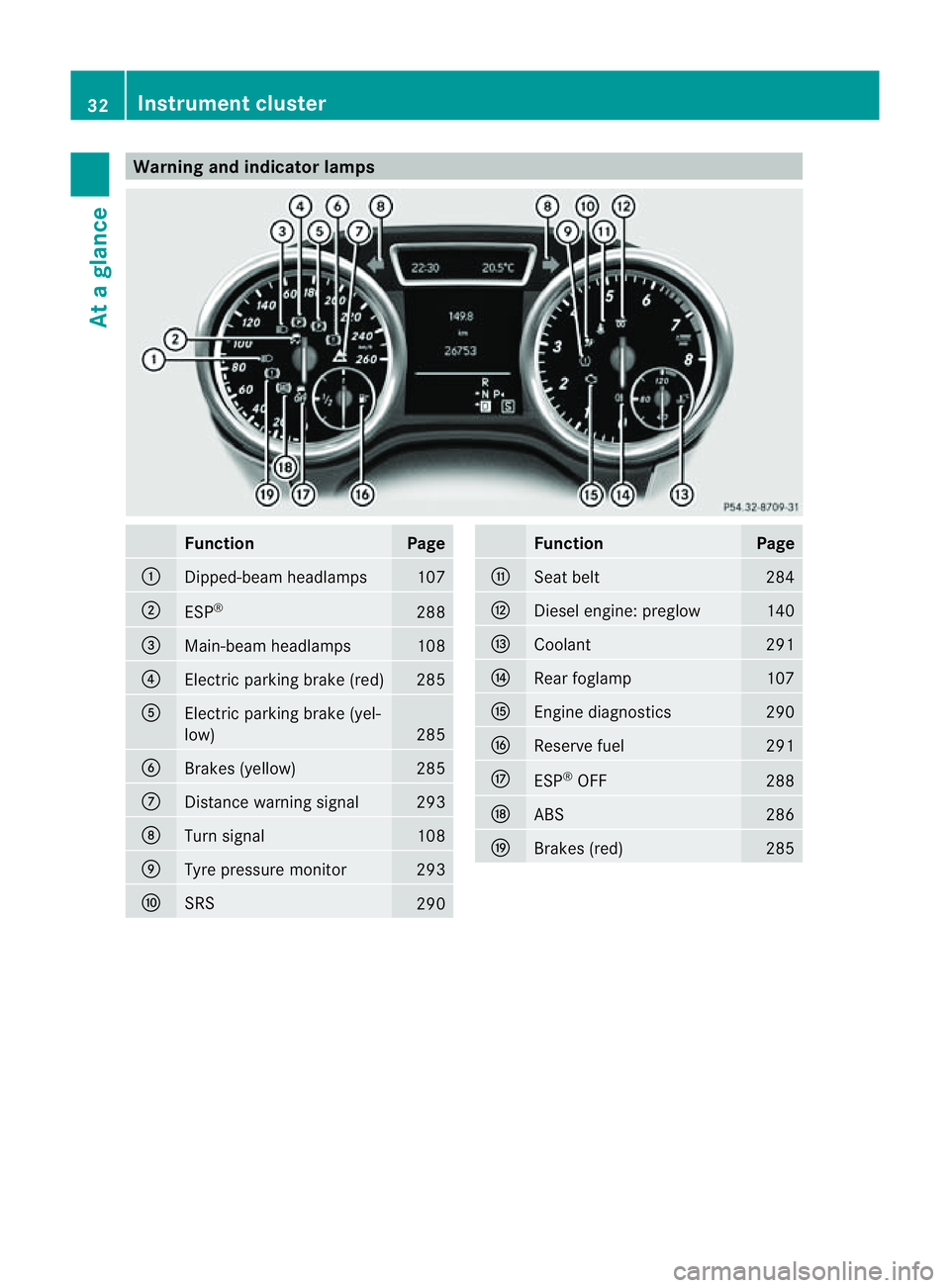
Warnin
gand indicator lamps Fun
ction Page
:
Dipped-bea
mheadlamps 107
;
ESP
® 288
=
Main-beam headlamps 108
?
Electric parkin
gbrake (red) 285
A
Electric parking brake (yel-
low)
285
B
Brakes (yellow) 285
C
Distance warning signal 293
D
Turn signal 108
E
Tyre pressure moni
tor 293
F
SRS
290 Function Page
G
Sea
tbelt 284
H
Diesel engine: preglow 140
I
Coolant 291
J
Rear foglamp 107
K
Engine diagnostics 290
L
Reserv
efuel 291
M
ESP
®
OFF 288
N
ABS 286
O
Brakes (red) 28532
Instrument clusterAt
ag lance
Page 157 of 389
R
paraffin
R kerosene
Do not mix these fuels with diesel fuels and
do not use any special additives. Other-
wise, this can lead to damage to the engine.
This excludes flow improver ;see "Low out-
side temperatures".
! Use afilter when adding fuel from afuel
can. Otherwise, the fuel lines and/or the
diesel injection system could be blocked by
particles from the fuel can.
For further information on "Fuel", see
(Y page 374).
Low outsid etemperatures Diesel fuel with improved cold flow qualities
is available during the winter months. In
Europe, various climate-dependent low-tem-
peratur eclasses are defined in EN 590 .Refu-
elling with diesel fuel which complies with the
climatic specification sofstandard EN 590
can hel ptoprevent operatin gproblems. At
exceptionall ylow tempera tures, it is possible
that the flow properties of the fuel ma ybe
inadequate. This also applies to fuel that has
not been adapted to suit the climatic condi-
tions, e.g. diesel fuel from warmer regions.
i Further information about country-spe-
cific fuel properties can be obtained from
oil companies, e.g. at filling stations.
Flow improver Flow improvers can be added to improv
ethe
cold resistan ceof diesel fuel. The effective-
ness of aflow improver is not guaranteed with
every diesel fuel.
Correc tdosage and thorough mixing ar edeci-
sive factor sinensuring improvement in low-
temperature resistance. Avoid excessive dos-
age .Exce ssiv edosage ma yactuall ydecrease
low-temperature resistanc eunder certain cir-
cumstances. Follo wthe manufacturer's dos-
ing inst ructions. Mix the additive with the diese
ling ood time,
befor ethe flo wproperties of th ediesel
become inadequate. Malfunction scan other-
wise only be rectified by heating the entire
fuel system, e.g. by parking the vehicle in a
heated garage.
Observe the information provided by the man-
ufacturer when using aflow improver. Only
use flow improvers that have been tested and
approved by Mercedes-Benz. You can obtain
further information from any Mercedes-Benz
Servic eCentre. Refuelling
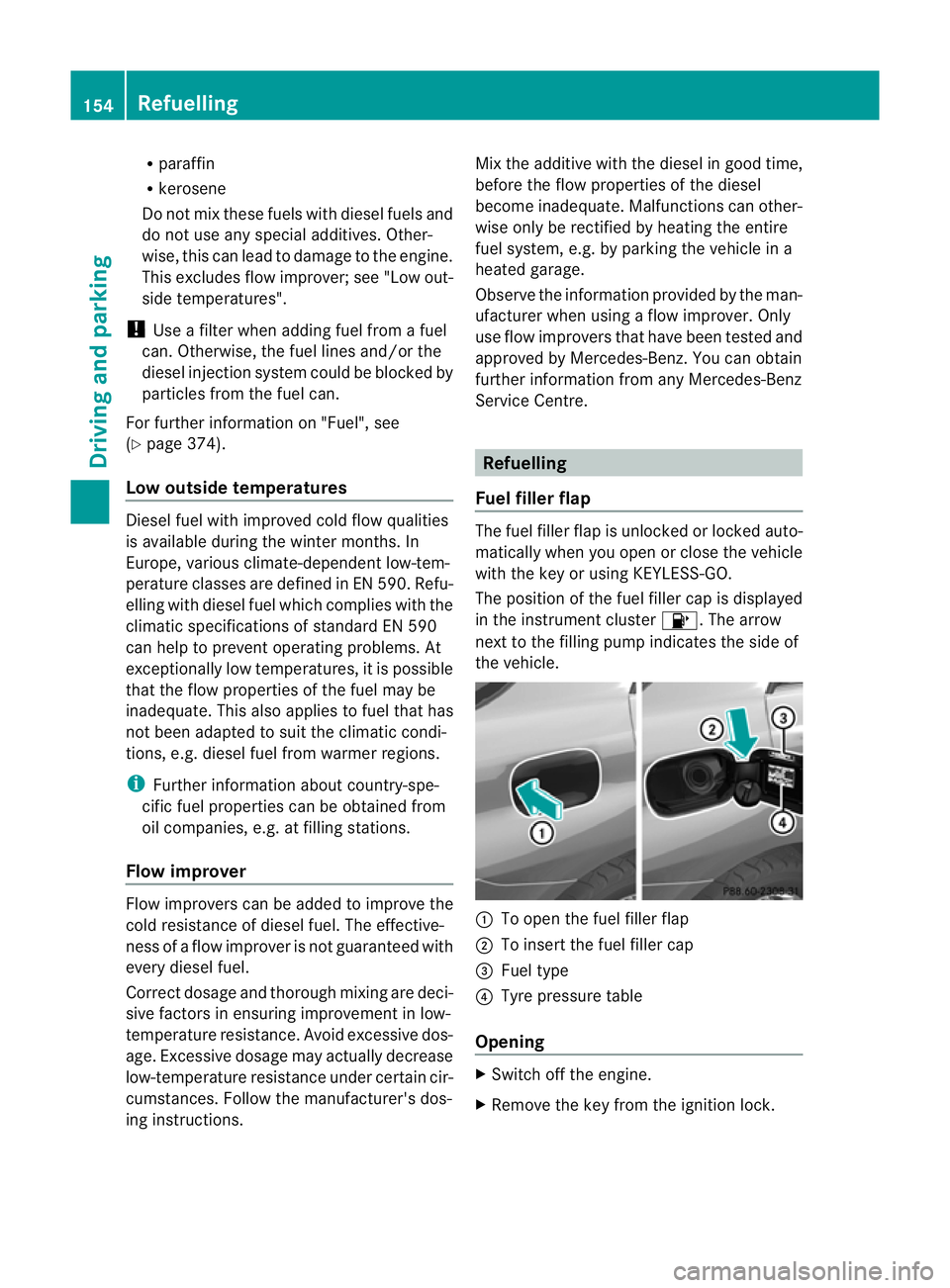
Fuel filler flap The fuel filler fla
pisunlocke dorlockedauto-
matically when you open or close the vehicle
with the key or using KEYLESS-GO.
The position of the fuel filler cap is displayed
in the instrument cluster 8.The arrow
nex ttot he filling pum pindicate sthe side of
the vehicle. :
To open the fuel filler flap
; To inser tthe fuel filler cap
= Fue ltype
? Tyre pressure table
Opening X
Switch off the engine.
X Remove the key from the ignitio nlock. 154
RefuellingDriving and parking
Page 170 of 389
safety reasons, get out of the vehicle first
and survey the off-road route.
R chec kthe depth of water before fording
river sand streams.
R loo kout for obstacle ssuch as rocks, holes,
tree stumps and furrows.
R take care when turning on an uphil lor
downhill slope and when turning at sharp
angles. The vehicle could otherwise tip
over.
R always keep the side windows and the pan-
oram asliding sunroof closed during the
journey.
R do not stray from marked routes or paths.
i Information abou tretrofitting special all-
ter rain tyres is available from any
Mercedes-Benz Service Centre. H
Environmental note
Protection of the environmen tisofprimary
importance .Trea tnature with respect.
Observe all prohibiting signs.
Checklist before drivin goff-road X
Engine oi llevel: checkthe engin eoil and
top it up if necessary.
When drivin gonsteep gradients, the oil
level must be sufficiently hig htoensure a
correct oil supply in the vehicle.
X AdBlue ®
tank (BlueTEC vehicl es):check
the fluid leve land, if necessary, refill to the
maximum (13 l) (Y page157).
X Tyre-chang etool kit: check that the jack
is working and make sure you have the
wheelbrace, arobust tow cabl eand afold-
ing spade in the vehicle.
X Wheels and tyres: checkthe tyr etread
depth and tyre pressure.
X Check for damag eand remove any foreign
objects, e.g. small stones, from the
wheels/tyres.
X Repl acea ny missing valve caps. X
Repl aced ented or damaged wheels.
X Wheels: dented or bent wheels can lead to
al oss of tyr epressure and damag etot he
tyr eb ead. Before driving off-road, check
the wheels and replace them if necessary.
Checklist after driving off-road !
If you detect damage to the vehicle after
driving off-road, have the vehicle checked
immediately at aqualified specialist work-
shop.
Driving over rough terrain places greater
demands on your vehicle than driving on nor-
mal roads. After driving off-road, check the
vehicle. This allow syou to detec tdamage
promptly and reduce the risk of an accident
to yourself and other road users.
X Vehicles with the ON&OFFROAD pack-
age: activate the on-road program
(Y page 222).
X Vehicles without the ON&OFFROAD
package: deactivate the on-road program
(Y page 222).
X Deactivate the LOW RANGE off-road gear
(Y page 223).
X Deactivate DSR (Y page 220).
X Lower the vehicle level again to alevel suit-
able to the road conditions, e.g. to the high-
way/high-speed level.
X Clean the headlamps and rear lights and
check for damage.
X Clean the front and rear licence plates.
X Clean the wheels/tyres with awater jet and
remove any foreign objects.
X Clea nthe wheels, wheel arches and the
vehicle underside with awater jet; check
for any foreign objects and damage.
X Check whethe rtwigs or other parts of
plants have become trapped. These
increase the risk of fire and can damage
fuel pipes, brake hose sorthe rubber bel-
lows of the axl ejoint sand propeller shafts.
X After the trip, examine without fail the
entire undercarriage, wheels ,tyres, brakes, Driving tips
167Drivingand park ing Z
Page 230 of 389
Do not exceed the maximum noseweight.
When driving with aloaded carriersystem,
always adjust your drivin gstyle to th eprevail-
ing road, traffic and weather conditions and
drive par ticularly carefully.
You can use carrier sys tems, e.g. bi cycle
racks or load-bea ringimplements on th eball
coupling. The maximum noseweight of 75 kg
applies when usin gcarrier system sontheball
coupling.
General information i
Chec kthe tyr epressure when towin ga
trailer. You will find the values in the tyre
pressure table in the fuel filler flap of the
vehicle (Y page 359).
You will find installation dimensions and loads
in the "Technical data" section
(Y page 378).
The maximum noseweight of the trailer draw-
bar on the ball coupling is 18
.H owever, the
actual noseweight must not exceed the value
given on the trailer tow hitc hortrailer identi-
ficatio nplates. The lowest weight applies.
! Use anoseweight as close as possible to
the maximum permissible noseweight .Do
not use anoseweight of less than 50 kg,
otherwise the trailer ma ycome loose.
Bear in min dthat the payload and the rear
axl eload ar ereduced by the actual nose-
weight.
Please note that when towing atrailer, PARK-
TRONIC (Y page 191) and Blind Spo tAssist
(Y page 208) ar eonly available with limita-
tions ,orn ot at all.
i On vehicles withou tlevel control, the
height of the ball couplin gwill alter accord-
ing to the load placed on the vehicle. If nec-
essary, use atrailer wit haheight-adjusta-
ble drawbar. Driving tips i
Observ ethe information on ESP ®
trailer
stabilisation (Y page 65)and on pull ing
away with atrailer. (Y page 141).
Vehicles wit hthe ON&OFFROAD package:
selec tthe trailer program (Y page 219) with
the off-road program selector wheel in the
cen treconsole.
Th em aximum permissible spee dfor vehicle/
trailer combination sdepends on the type of
trailer .Befor ebeginning the journey, check
the trailer's documents to see what the max-
imu mpermitted speed is. Observ ethe legally
prescribed maximum speed in the relevant
country.
For certai nMercedes-Ben zvehicles, the max-
imu mp ermissible rear axle load is inc reased
when towing atrailer. Refer to th e"Techni cal
data" section to fin dout whether this applies
to your vehicle. If you utilise any of the added
maximum rear axle load when towing atrailer,
th ev ehicle/trailer combination may not
exceed amaximum spee dof100 km/ hfor
reasons concer ning the operating permit.
Thi salso applies in countries in which the
permissible maximum speed for vehicle/
trailer combinations is above 100 km/h.
When towing atrailer, your vehicle's handling
characteristics will be differe ntin comparison
to when drivin gwithout atrailer and it will
consume more fuel.
On long and stee pdownhil lgradients ,you
must select shift range 1,2or 3in good time.
i This also applies if you have activated
cruise con trol, SPEEDTRONIC or DI S-
TRONIC PLUS.
This will use the brakin geffect of th eengine,
so les sbraking wil lberequired to maintain
the speed. This relieves the load on the brake
system and prevent sthe brakes from over-
heating and wearing too quickly .Ifyou need
additional braking, depress the brake pedal
repeatedly rather than con tinuously.
18 Data unavailable at time of going to print. Towing
atrailer
227Driving andparki ng Z
Page 340 of 389
tems mus
tbec arrie dout at aquali fieds pe-
cialist workshop.
Ty re pressure of 180 kPa (1.8 bar/
26 psi) is reached X
Switch off the tyre inflation compressor.
X Unscrew the fille rhose from the valve of
the faulty tyre.
! Afteru se, excess TIREFIT ma yrun out of
the filler hose. This may cause stains.
Therefore, place the filler hos einthe plastic
bag whic hcontained the TIREFIT kit.
X Stow the tyr esealan tbottle, the tyr einfla-
tion compresso rand the warning triangle.
X Pull away immediately. G
WARNING
Do not exceed the maximum speed of
80 km/h.
The "max. 80 km/h" labe lmust be affixed in
the driver's field of vision.
The vehicle's handling characteristic smay be
affected.
X Stop after driving for approximately ten
minutes and check the tyre pressure with
the tyre inflation compressor. G
WARNING
If the tyre pressure is less than 130 kPa
(1.3 bar/2 0psi), the tyr eistoo severely dam-
aged. Do not driv eany further. Consult a
qualified specialis tworkshop which has the
necessary specialist knowledge and tools to
carry out the work required .Mercedes-Benz
recommends that you use aMercedes-Benz
Ser vice Centre for thi spurpose. In particular,
work relevant to safety or on safety-related
systems must be carried out at aqualified
specialist workshop.
X Correct the tyre pressure if it is still at least
130 kPa (1.3 bar/20 psi) (for the values,
see the fuel filler flap). X
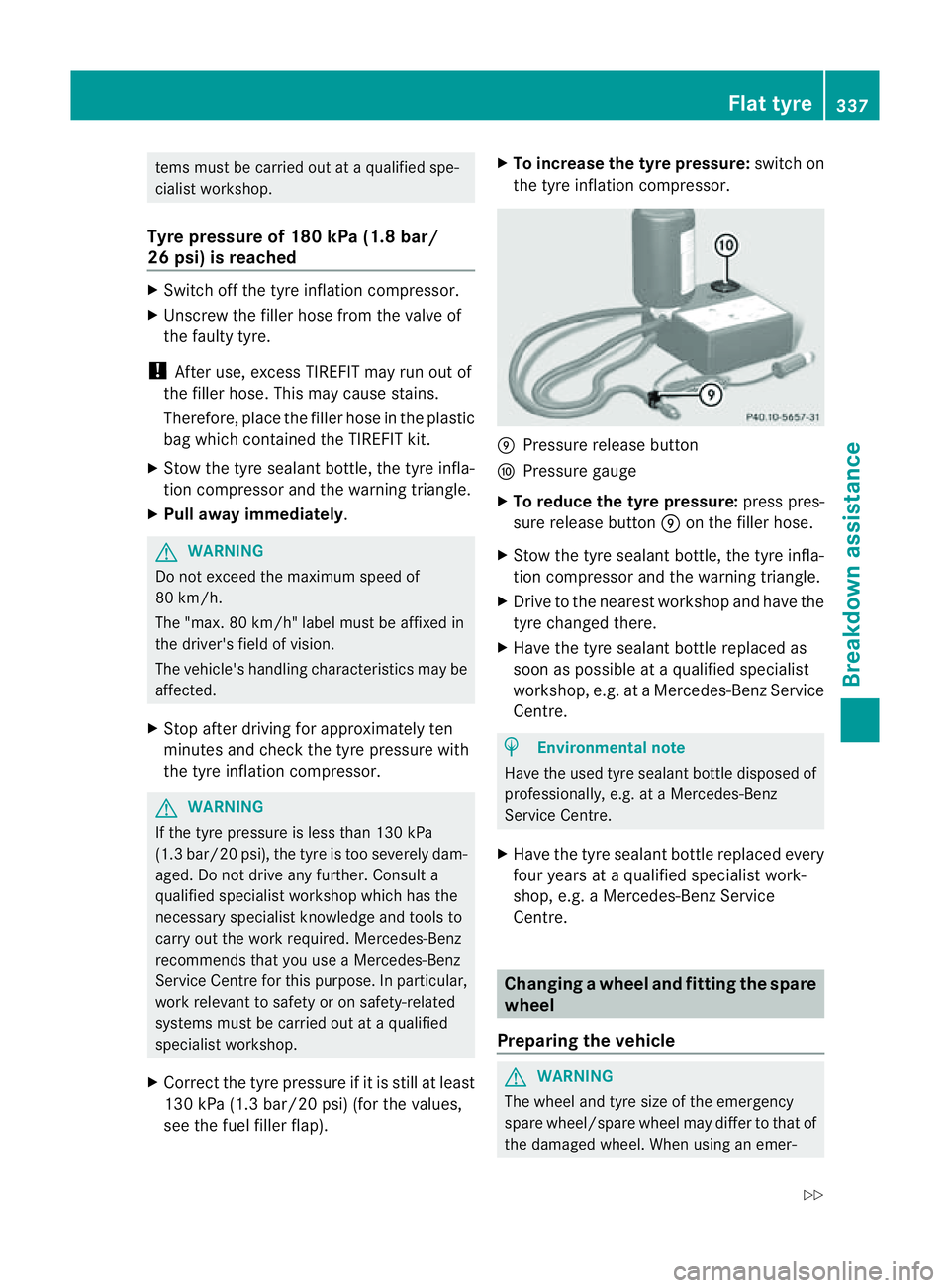
To increase the tyr epressure: switchon
the tyre inflation compressor. E
Pressure releas ebutton
F Pressure gauge
X To reduce the tyr epressur e:press pres-
sure release button Eon the filler hose.
X Stow the tyr esealan tbottle, the tyr einfla-
tion compresso rand the warning triangle.
X Drive to the neares tworkshop and have the
tyr ec hange dthere.
X Hav ethe tyr esealan tbottle replaced as
soon as possible at aqualified specialist
workshop, e.g. at aMercedes-Benz Ser vice
Centre. H
Environmental note
Have the use dtyre sealant bottle dispose dof
professionally, e.g. at aMercedes-Benz
Ser vice Centre.
X Have the tyre sealant bottle replaced every
four years at aqualified specialist work-
shop, e.g. aMercedes-Benz Ser vice
Centre. Changing
awhee land fitting th espare
wheel
Preparing the vehicle G
WARNING
The wheel and tyre size of the emergency
spare wheel/s pare wh eelm ay differ to tha tof
the damaged wheel. Whe nusing an emer- Flat ty
re
337Breakd ownassistance
Z
Page 362 of 389
On vehicle
swith the AIRMATIC package, you
must drive at raised vehicle level if snow
chains have been fitted (Y page 188).
Do not exceed the maximum permissible
speed of 50 km/h.
i You may wish to deactivate
ESP ®
(Y page 63) when pulling away with
snow chains fitted. This way you can allow
the wheels to spin in acontrolled manner,
achievin ganincrease ddriving force (cut-
tin ga ction). Tyre pressure
Tyre pressure specifications
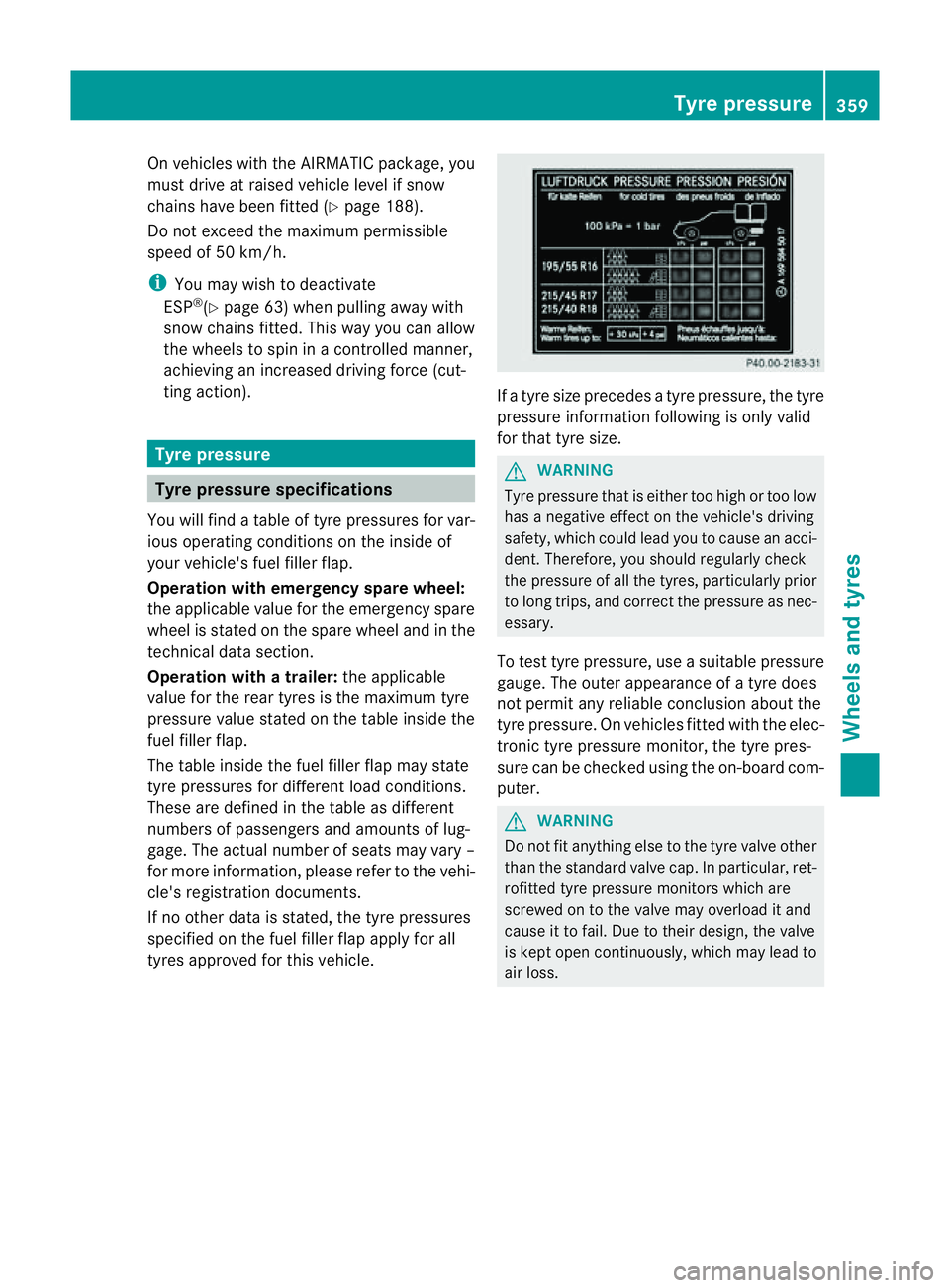
You wil lfind atable of tyre pressures for var-
ious operating conditions on the inside of
your vehicle's fuel filler flap.
Operation with emergency spare wheel:
the applicable value for the emergency spare
wheel is stated on the spare wheel and in the
technical data section.
Operation with atrailer: the applicable
value for the rear tyres is the maximum tyre
pressure value stated on the table insid ethe
fuel filler flap.
The tabl einsid ethe fuel filler fla pmay state
tyre pressures for different load conditions.
Thes eare define dinthe tabl easdifferent
number sofpassengers and amounts of lug-
gage. The actual number of seats may vary –
for more information, please refer to the vehi-
cle's registration documents.
If no other data is stated, the tyre pressures
specified on the fuel filler flap appl yfor all
tyres approved for this vehicle. If
at yre size precede satyre pressure, the tyre
pressure information following is only valid
for that tyre size. G
WARNING
Tyre pressure that is eithe rtoo high or too low
has anegativ eeffect on the vehicle's driving
safety ,which coul dlead you to cause an acci-
dent. Therefore, you should regularly check
the pressur eofall the tyres, particularly prior
to long trips, and correct the pressure as nec-
essary.
To test tyre pressure, use asuitabl epressure
gaug e. Th eouter appearance of atyre does
not permit any reliabl econclusion about the
tyr ep ressure. On vehicles fitted wit hthe elec-
tronic tyr epressure monitor, th etyre pres-
sure can be checked using the on-board com-
puter. G
WARNING
Do not fit anything else to the tyre valve other
than the standard valve cap. In particular, ret-
rofitted tyre pressure monitors which are
screwed on to the valve may overload it and
cause it to fail. Due to their design, the valve
is kept open continuousl y, whichmay lead to
air loss. Tyr
epressure
359Wheels and tyres Z
Page 363 of 389
G
WARNING
Shoul dthe tyr epressure dro prepeatedly:
R check the tyr efor foreign bodies.
R check whether the wheel is losing air or the
valve is leaking.
R make sure that only avalve cap approved
by Mercedes-Benz is fitted on the tyre
valve.
Tyre pressures that are too low have anega-
tiv ee ffect on vehicl esafety, which could lead
you to cause an accident.
If possible, only correc ttyre pressures when
the tyres are cold.
The tyres are cold:
R if the vehicl ehas been parked wit hthe tyres
out of direc tsunlight for at least three
hours and
R if the vehicle has not been driven further
than 1. 6km
Depe nding on the ambient temperature, the
speed you are drivin gatand the load on the
tyres, the tyre temperature and thus the tyre
pressure may chang ebyapproximately
10 kPa (0. 1bar/1 .5psi) per 10 †. Take this
int oa ccount whe nchecking the pressur eof
warm tyres and only correc titifitist oo low
for the curren toperating conditions.
Drivin gwith tyre pressure that is too high or
too low can:
R shorten the servic elife of the tyres
R cause increased tyre damage
R have anegativ eeffect on handling charac-
teristics and thus th edriving safet y(e.g. by
causin gaquaplaning)
i The tyr epressure values given for low
load sare minimum values which offe ryou
good rid ecomfort characteristics.
However, you can also use the values given
for higher loads. These ar epermissible and
will not adversely affect the running of the
vehicle. H
Environmenta
lnote
Check the tyre pressure regularly, at least
every 14 days.
You will find information on tyre pressures for
the vehicle's factory-mounted tyres on the
plates described here. Tyr
epressure loss warning system
Important safety notes Whil
ethe vehicle is in motion, the tyr epres-
sure loss warning system monitors th eset
tyr ep ressure using th erotational speed of
the wheels. This enables the system to detect
significant pressure loss in atyre. If the speed
of rotation of awheel changes as aresult of
al oss of pressure, acorrespondin gwarning
message will appea rinthe multifunction dis-
play. G
WARNING
The tyr epressure loss warning system does
not warn you of an incorrectly se ttyre pres-
sure. The table on the insid eofthe fuel filler
fla pw ill help you decide whether the tyre
pressures should be corrected.
The tyre pressure loss warnin gsystem does
not replace the need to regularly check your
vehicle's tyre pressures, since an even loss of
pressure on several tyres at the same time
cannot be detecte dbythe tyr epressure loss
warning system.
Th et yre pressure monitor is not able to warn
you of asudden loss of pressure, e.g. if the
tyre is penetrated by aforeign objec t.
In the event of asudden loss of pressure, bring
the vehicle to ahalt by braking carefully. Do
not make any sudden steering movements
when doing so.
The function of the tyre pressure loss warning
system is limited or delayed if:
R snow chains are fitted to your vehicle's
tyres.
R road conditions are wintry. 360
Tyr
epressureWheels and tyres
Page 364 of 389
R
you are drivin gonsandorg ravel.
R yo ua dopt averys porty driv ings tyle (cor-
nering at hig hspeeds or driv ingw ith high
rates of acceleration).
R you are towing avery heavy or lar getrailer.
R you are driving with aheavy load (in the
vehic le oron the roof).
Restarting th etyre pressure lo sswarn-
ing system Restart the tyre press
urel oss warnin gsystem
if you have:
R changed the tyre press ure
R changed the whe elso rtyres
R fitted new wheels or tyres
X Before restarting, consult the table of tyre
press ures on the inside of the fuel filler flap
to ensur ethat the tyr epressure in all four
tyre siss et correctly for the respective
operating conditions.
X Observ ethe notes in the section on tyre
pressures (Y page 359). G
WARNING
The tyr epressure loss warn ings ystem can
only give reliabl ewarnings if you have set the
correct tyre pressure.
If an incorrect tyre pressure is set, these
incorrect values wil lbemonitored.
At yre with insufficient pressure results in
vehicle instability when driving, thu sincreas-
ing the risk of an accident.
X Make sure that the key is in pos i-
tion 2(Ypage139) in the igniti onlock.
X Press =or; on the steering wheel
to select the Serv. menu.
X Press 9or: to select Tyre pres‐ sure .
X Press the abutton.
The RunF lat Indicato ractive Restart with OK message ap
pears in the
multifunction display. If you wis
htoconfirm the restart:
X Press the abutton.
The Tyre press. no wOK? message
ap pe ars in the multifunction display.
X Press the 9or: button to select
Yes .
X Press the abutton.
The RunF lat Indicato rrestarted message ap
pears in the multifunction dis-
play.
After ateach-in period, the tyr epressure
loss warn ings ystem wil lmonitor the set
tyr ep ressures of all fou rtyres.
If you wis htocancel the restart:
X Press the %button.
or
X If the Tyre press. now OK? message
appears ,press 9 or: to select
Cancel .
X Press the abutton.
Th et yre press urev alues stored at the last
restart wil lcontinue to be monitored. Tyre pressur
emonitor
Important safety notes If
at yre press urem onitor system is fitted, the
vehicle's wheels have sensor sfitted that
monitor the tyre pressures in all four tyres.
The tyre pressure monitor warns you when
the pressure drops in one or more of the
tyres. The tyre pressure monitor only func-
tions if the correct sensors are fitted to all
wheels. G
WARNING
The tyre pressure monitor does not warn you
of an incorrectly set tyre pressure. The table
on the inside of the fuel filler flap wil lhelp you
decide whether the tyre pressures should be
correc ted.
The tyr epressure monitor is not abl etow arn
you of asudden loss of pressure, e.g. if the Tyr
epressure
361Wheels and tyres
Z