buttons MERCEDES-BENZ METRIS 2016 MY16 Operator’s Manual
[x] Cancel search | Manufacturer: MERCEDES-BENZ, Model Year: 2016, Model line: METRIS, Model: MERCEDES-BENZ METRIS 2016Pages: 310, PDF Size: 7.28 MB
Page 218 of 310
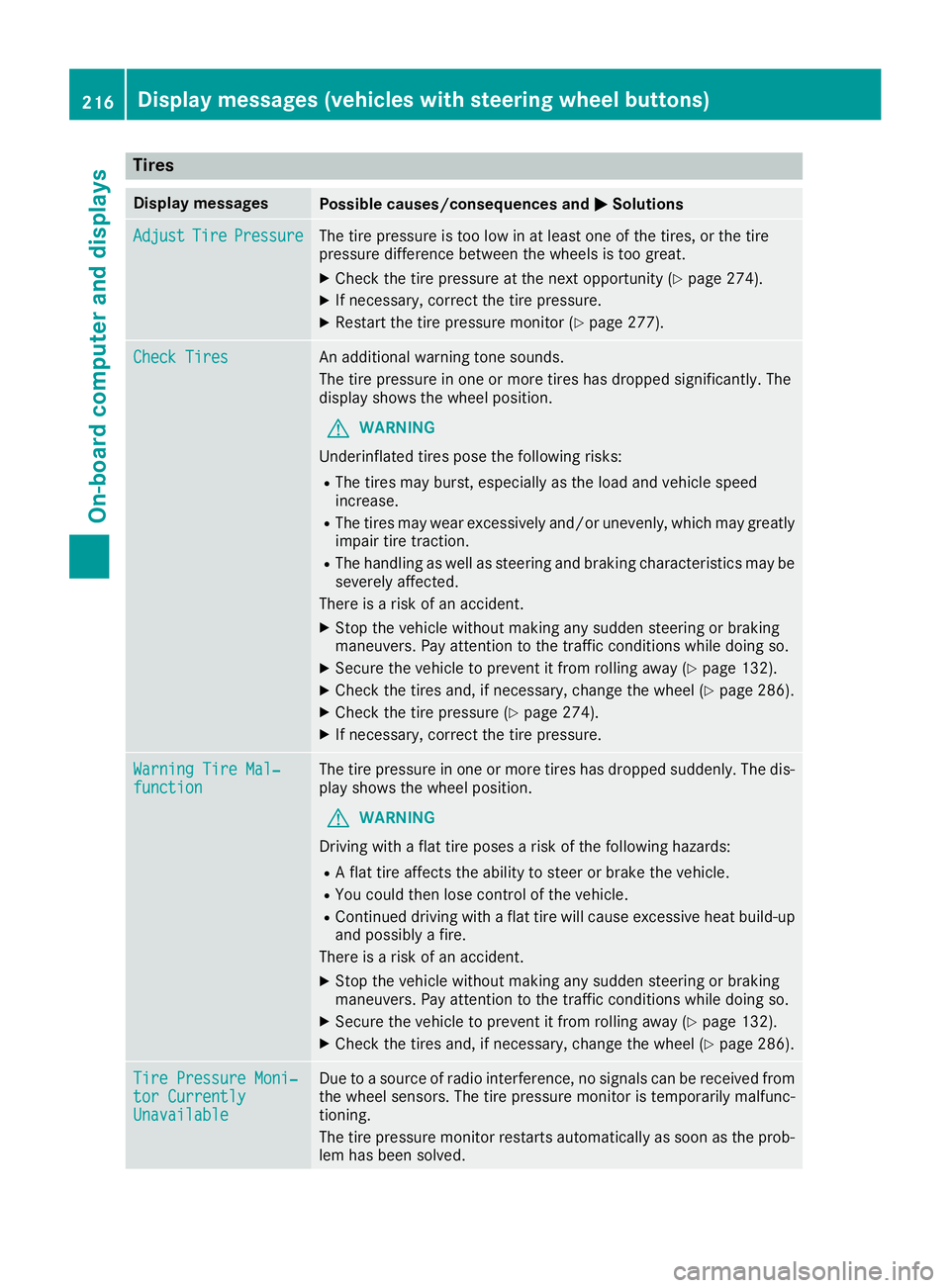
Tires
Display messagesPossible causes/consequencesand MSolutions
AdjustTirePressureThe tire pressure is too lo winatleastone of the tires, or the tire
pressure differenc ebetween the wheels is too great.
XCheck the tire pressure at the next opportunity (Ypage 274).
XIf necessary,c orrect the tire pressure.
XRestart the tire pressure monitor (Ypage 277).
Check TiresAn additional warning tone sounds.
The tire pressure in one or mor etiresh asdropped significantly. The
displa yshows the whee lposit ion.
GWARNING
Underinflated tire sposet he following risks:
RThe tire smayburst, especially as the load and vehicl espeed
increase.
RThe tire smaywear excessivel yand/or unevenly, which mayg reatly
impai rtire traction.
RThe handling as well as steerin gand braking characteristics mayb e
severely affected.
There is ariskofana ccident.
XStop the vehicl ewithou tmaking any sudden steerin gorbraking
maneuvers. Pa yattentio ntothe trafficc onditions whil edoing so.
XSecure the vehicl etoprevent it fromr olling away (Ypage 132).
XCheck the tiresand,ifn ecessary,c hange the whee l(Ypage 286).
XCheck the tire pressure (Ypage 274).
XIf necessary,correct the tire pressure.
WarningTireM al‐functionThe tire pressure in one or mor etire sh asdropped suddenly. The dis-
play shows the whee lposit ion.
GWARNING
Driving with aflatt ire poses ariskoft he following hazards:
RAflatt ire affects the ability to stee rorbrake the vehicle.
RYouc ould thenl osec ontro lofthe vehicle.
RContinued drivin gwithaf latt ire will cause excessive heat build-up
and possibl yafire.
There is ariskofana ccident.
XStop the vehicl ewithou tmaking any sudden steerin gorbraking
maneuvers. Pa yattentio ntothe trafficc onditions whil edoing so.
XSecure the vehicl etoprevent it fromr olling away (Ypage 132).
XCheck the tiresand,ifn ecessary,c hange the whee l(Ypage 286).
TirePressure Moni‐tor CurrentlyUnavailable
Due to asource of radi ointerference, no signals can be receive dfrom
the whee lsensors. The tire pressure monitor is temporaril ymalfunc-
tioning.
The tire pressure monitor restarts automaticall yassoona sthe prob-
le mh asbeen solved.
216Displa ymessage s(vehicles wit hsteering whee lbuttons)
On-board computera nd displays
Page 219 of 310
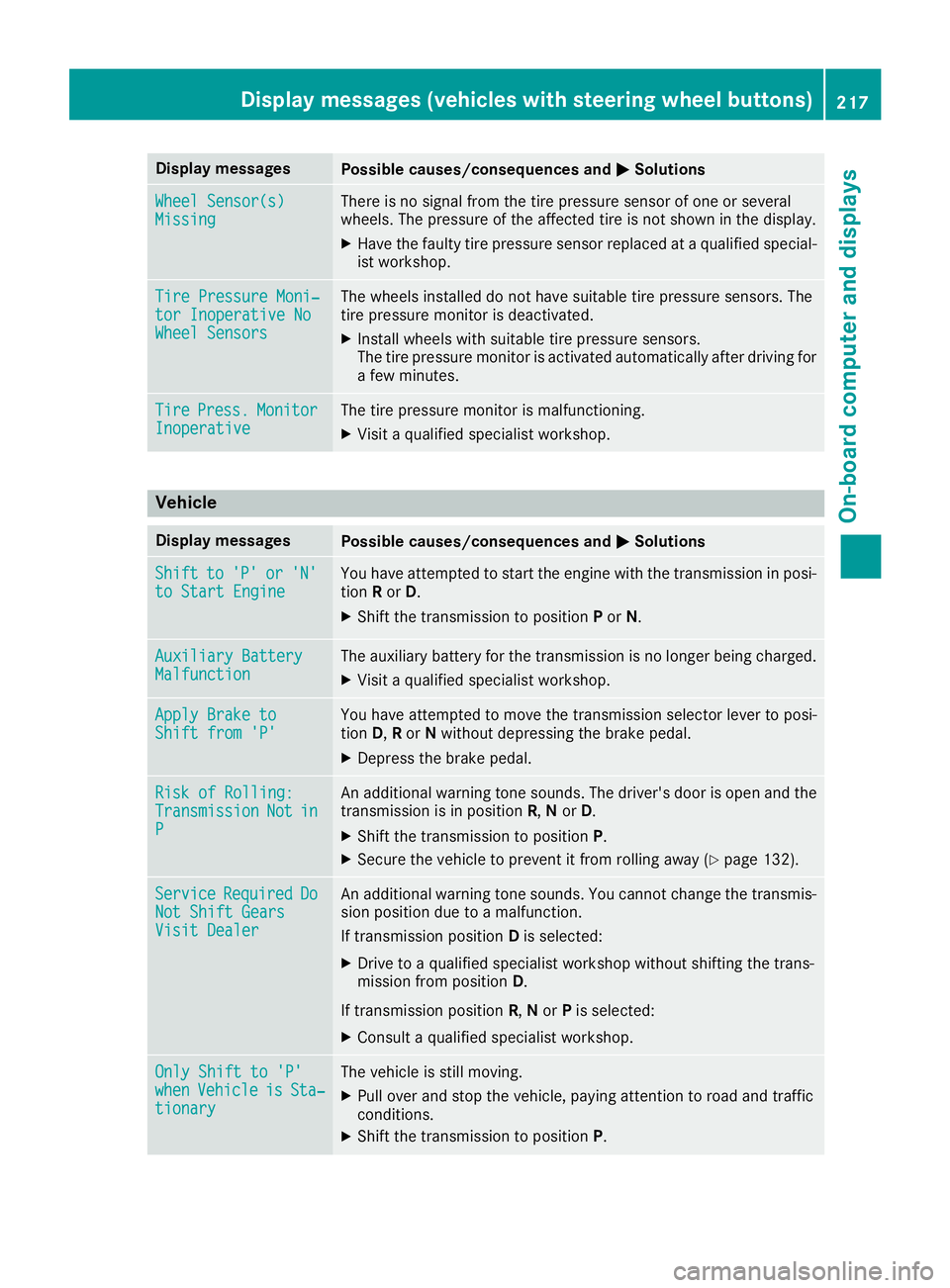
Display messagesPossible causes/consequences andMSolutions
Wheel Sensor(s)MissingThere is no signal from th etirep ressur esensor of on eorseveral
wheels. The pressur eoftheaffecte dtireisn otshown in th edisplay.
XHav ethe fault ytirep ressur esensor replace dataqualified special -
ist workshop .
TirePressure Moni‐tor Inoperative NoWheel Sensor s
The wheels installed do no thaves uitable tire pressur esensors. The
tire pressur emonitor is deactivated.
XInstall wheels wit hsuitable tire pressur esensors.
The tire pressur emonitor is activated automatically after drivin gfor
af ew minutes.
Tir ePress.Monito rInoperativeThe tire pressur emonitor is malfunctioning .
XVisitaqualified specialist workshop .
Vehicle
Display messagesPossible causes/consequences and MSolutions
Shiftto'P'or'N'to Start EngineYou haveattempte dtostart th eenginew itht he transmission in posi-
tion Ror D.
XShift th etransmission to position Por N.
Auxiliary Batter yMalfunctionThe auxiliary battery for th etransmission is no longer bein gcharged.
XVisit aqualified specialist workshop .
Apply Brake toShift from'P'You hav eattempte dtomovet he transmission selector lever to posi-
tion D,Ror Nwithout depressing th ebrak epedal .
XDepress th ebrak epedal .
RiskofR olling:TransmissionNotinP
An additional warning tone sounds. The driver's door is open and th e
transmission is in position R,N or D.
XShift th etransmission to position P.
XSecurethe vehicl etopreventitfromr ollin gaway (Ypage 132).
Servic eRequiredDoNot Shift GearsVisit Dealer
An additional warning tone sounds. You canno tchang et he transmis -
sion position due to amalfunction .
If transmission position Dis selected:
XDrive to aqualified specialist workshop without shifting th etrans -
mission from position D.
If transmission position R,N or Pis selected:
XConsult aqualified specialist workshop .
OnlyShift to 'P'whenVehicl eisSta‐tionar y
The vehicl eisstill moving .
XPull overand stop th evehicle, payin gattention to roa dand traffic
conditions.
XShift th etransmission to position P.
Display messages(vehicles wit hsteering whee lbuttons)21 7
On-board computera nd displays
Z
Page 225 of 310
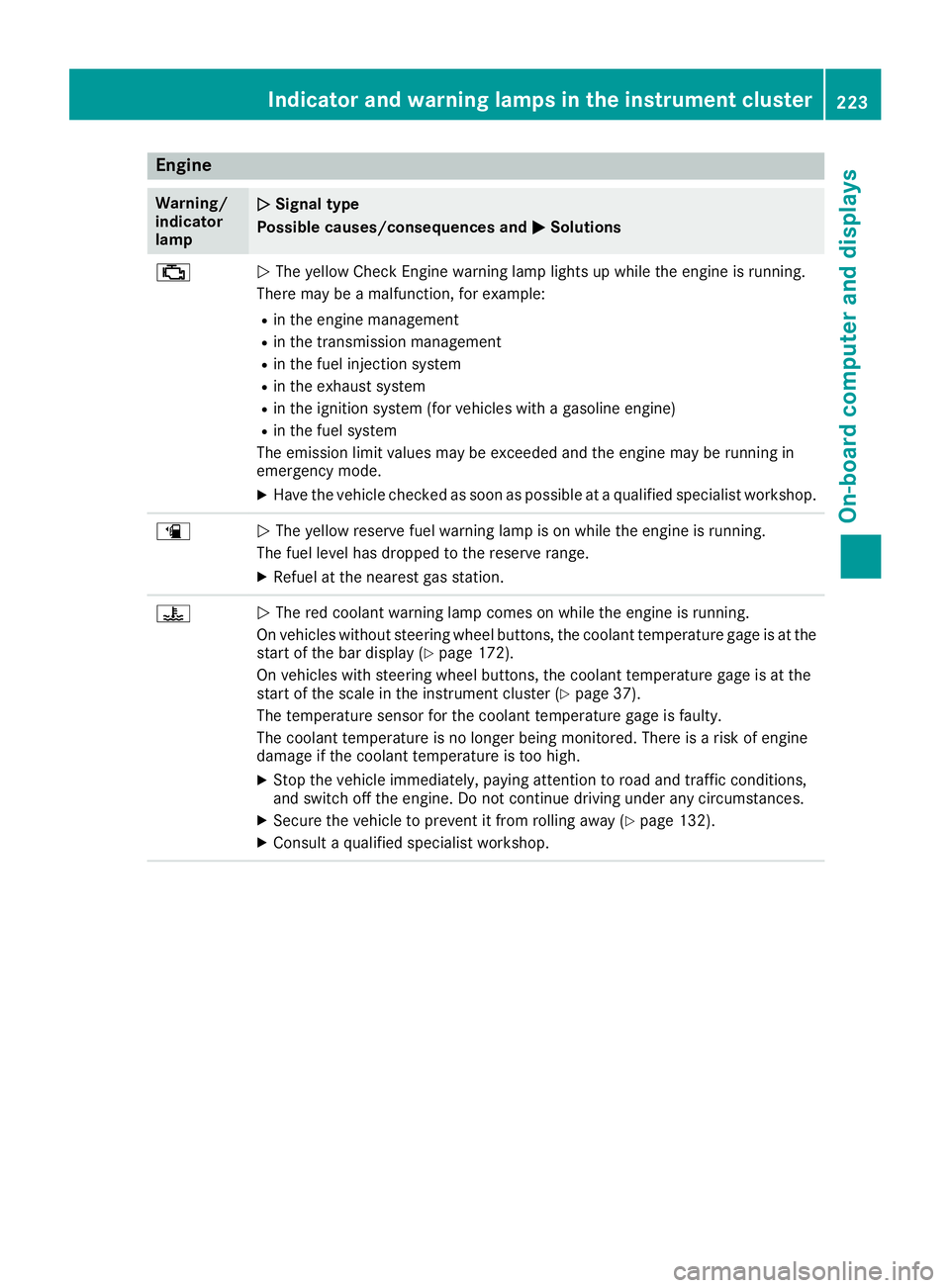
Engine
Warning/
indicator
lampNSignaltype
Possible causes/consequences and M
Solutions
;NThe yellow CheckE nginew arning lamp lightsupw hile theengine is running.
Therem ay beamalfunction, for example:
Rin th eengine management
Rin th etransmission management
Rin th efuel injection system
Rin th eexhaust system
Rin th eignition system (for vehicle swithagasoline engine)
Rin th efuel system
The emission limit values may be exceeded and th eengine may be runnin gin
emergency mode.
XHav ethe vehicle checked as soon as possible at aqualified specialist workshop.
æNThe yellow reservef uel warning lamp is on while th eengine is running.
The fuel leve lhas dropped to th ereserver ange.
XRefuel at th enearest gas station.
?NThe red coolant warning lamp comes on while th eengine is running.
On vehicle swithout steering wheel buttons, th ecoolant temperatur egage is at the
start of th ebar display (
Ypage 172).
On vehicle swith steering wheel buttons ,the coolant temperatur egage is at the
start of th escale in th einstrumentc luster(
Ypage 37).
The temperatur esensor for th ecoolant temperatur egage is faulty.
The coolant temperatur eisnolonger beingm onitored. Thereisar isk of engine
damag eifthecoolant temperatur eistoohigh.
XStop th evehicle immediately, payinga ttention to road and traffic conditions,
and switch off th eengine .Don otcontinue driving unde rany circumstances.
XSecure th evehicle to prevent it from rolling away (Ypage 132).
XConsult aqualified specialist workshop.
Indicator and warning lamps in th einstrumen tcluster223
On-boardc omputer and displays
Z
Page 226 of 310
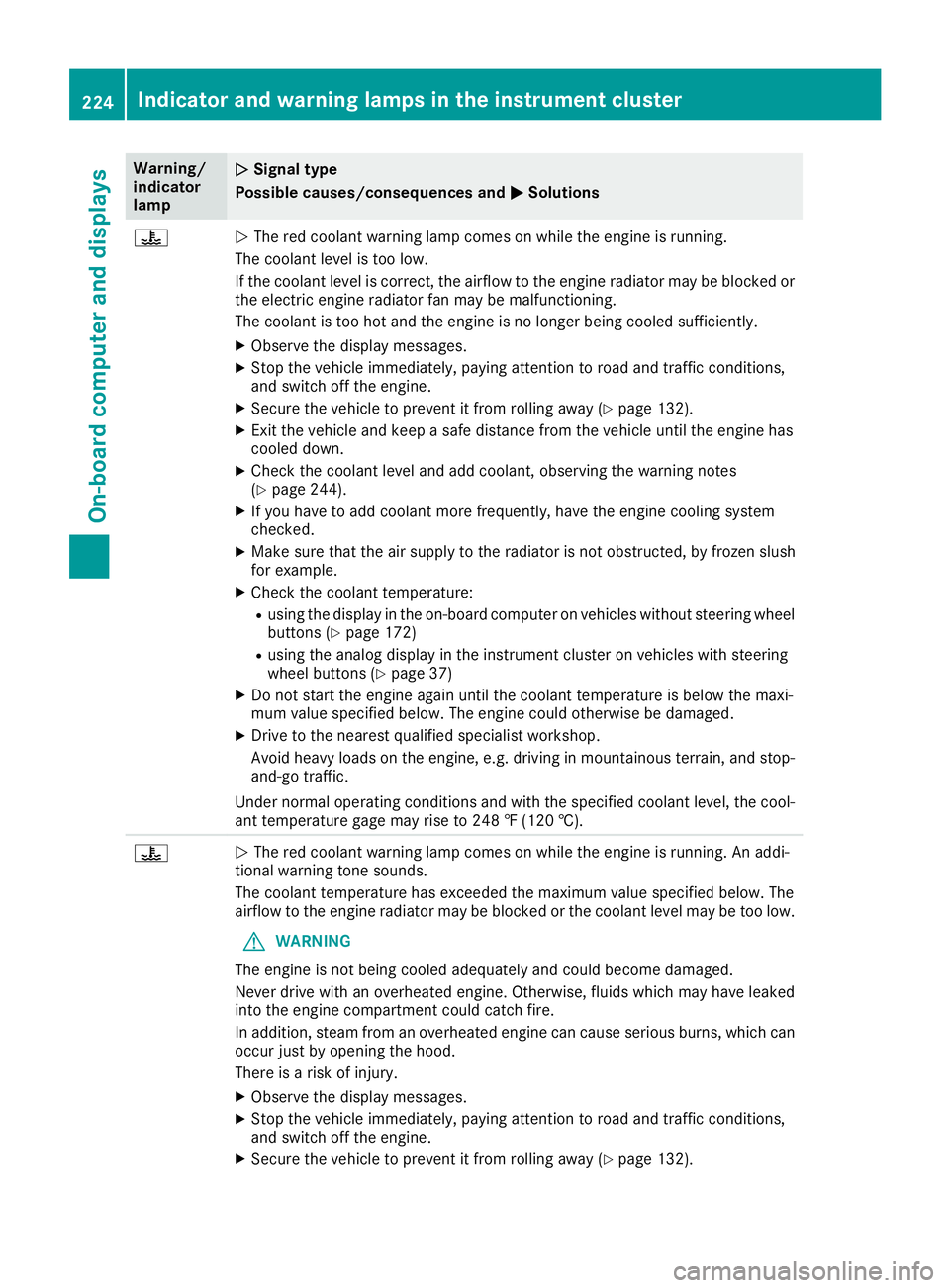
Warning/
indicator
lampNSignal type
Possiblec auses/consequences and M
Solutions
?NThe red coolant warning lamp comes on while the engine is running.
The coolant leve listoo low.
If the coolant leve liscorrect, the airflow to the engine radiator may be blocked or
the electric engine radiator fan may be malfunctioning.
The coolant is too hot and the engine is no longer being cooleds ufficiently.
XObserve the display messages.
XStop the vehicleimmediately, paying attention to road and traffic conditions,
and switch off the engine.
XSecure the vehicletop revent it from rolling awa y(Ypage132).
XExit the vehiclea nd keepasafe distance from the vehicleu ntil the engine has
cooledd own.
XCheck the coolant leve land add coolant, observing the warning notes
(Ypag e244).
XIf you have to add coolant more frequently, have the engine cooling system
checked.
XMake sure that the air supply to the radiator is not obstructed ,byfrozen slush
for example.
XCheck the coolant temperature:
Rusing the display in the on-board computer on vehicles without steering wheel
buttons (Ypag e172)
Rusing the analog display in the instrument cluster on vehicles with steering
whee lbuttons (Ypag e37)
XDo not start the engine again until the coolant temperature is below the maxi-
mum valu especified below. The engine coul dotherwise be damaged.
XDrive to the neares tqualified specialist workshop.
Avoid heavy loads on the engine, e.g. driving in mountainous terrain, and stop-
and-go traffic.
Under normal operating conditions and with the specified coolant level, the cool-
ant temperature gage may rise to 248 ‡(120 †).
?NThe red coolant warning lamp comes on while the engine is running. An addi-
tional warning tone sounds.
The coolant temperature has exceededt he maximumvaluespecified below. The
airflow to the engine radiator may be blocked or the coolant leve lmay be too low.
GWARNING
The engine is not being cooleda dequately and couldbecome damaged.
Never drive with an overheated engine. Otherwise, fluids which may have leaked
into the engine compartment coul dcatch fire.
In addition, steam from an overheated engine can caus eserious burns, which can
occur just by opening the hood.
There is arisk of injury.
XObserve the display messages.
XStop the vehiclei mmediately, paying attention to road and traffic conditions,
and switch off the engine.
XSecure the vehicletop revent it from rolling awa y(Ypage 132).
224Indicator and warning lamps in the instrument cluster
On-board computer and displays
Page 227 of 310
Warning/
indicator
lampNSignal type
Possiblec auses/consequences and M
Solutions
XExit the vehicleand keepasafe distance from the vehicleu ntil the engine has
cooledd own.
XCheck the coolant leve land add coolant, observing the warning notes
(Ypag e244).
XIf you have to add coolant more frequently, have the engine cooling system
checked.
XMake sure that the air supply to the radiator is not obstructed ,byfrozen slush
for example.
XCheck the coolant temperature:
Rusing the display in the on-board computer on vehicles without steering wheel
buttons (Ypag e172)
Rusing the analog display in the instrument cluster on vehicles with steering
whee lbuttons (Ypag e37)
XIf the coolant temperature is below the maximu mvaluespecified below, you can
continue driving to the neares tqualified specialist workshop.
Avoid heavy loads on the engine, e.g. driving in mountainous terrain, and stop-
and-go traffic.
Under normal operating conditions and with the specified coolant level, the cool-
ant temperature gage may rise to 248 ‡(120 †).
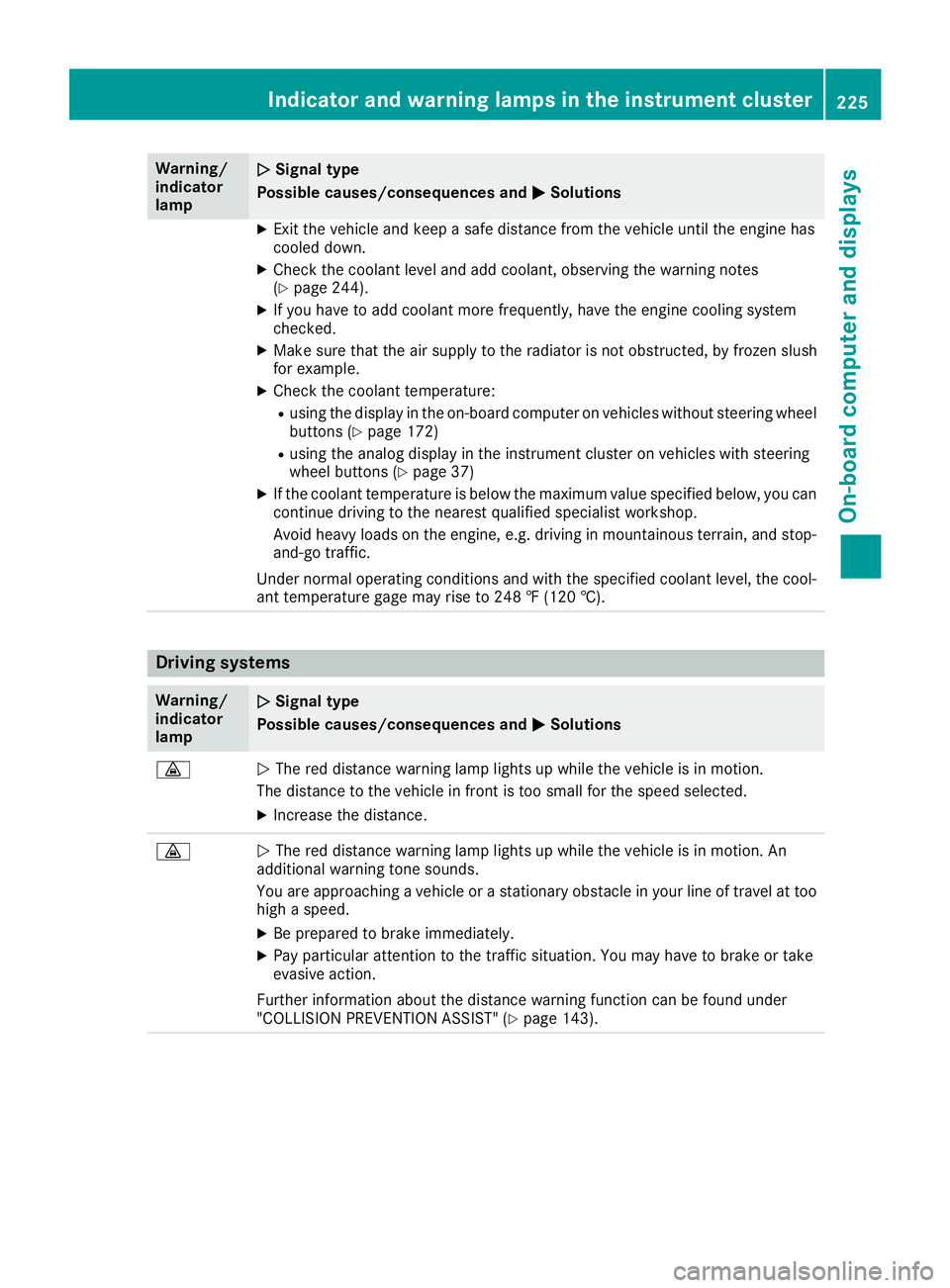
Driving systems
Warning/
indicator
lampNSignal type
Possiblec auses/consequences and M
Solutions
·NThe red distance warning lamp lights up while the vehicleisinm otion.
The distance to the vehicleinf ront is too smallfor the speeds elected.
XIncrease the distance.
·NThe red distance warning lamp lights up while the vehicleisinm otion. An
additiona lwarning tone sounds.
You are approaching avehicl eoras tationary obstacl einyourline of travel at too
high aspeed.
XBe prepared to brake immediately.
XPay particular attention to the traffic situation. You may have to brake or take
evasive action.
Further information about the distance warning function can be found under
"COLLISION PREVENTION ASSIST" (
Ypag e143).
Indicator and warning lamps in the instrument cluster225
On-board computer and displays
Z
Page 228 of 310
Tires
Warning/
indicator
lampNSignal type
Possible causes/consequence sand M
Solutions
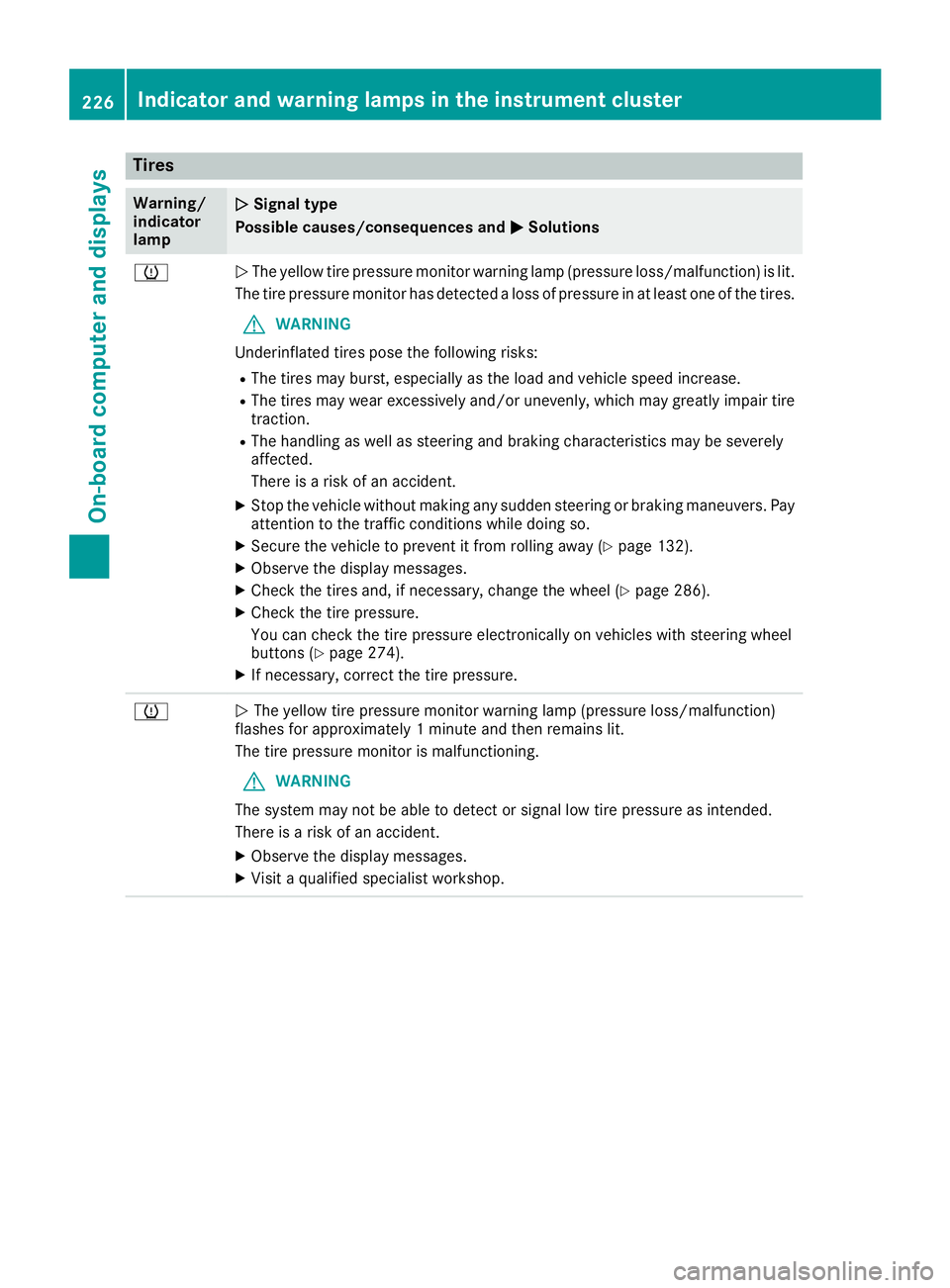
hNThe yellow tire pressure monitor warning lamp (pressure loss/malfunction) is lit.
The tire pressure monitor hasd etecte dalossofp ressure in at leas tone of the tires.
GWARNING
Underinflated tire sposet he following risks:
RThe tire smayburst, especially as the load and vehicl espeed increase.
RThe tire smaywear excessivel yand/or unevenly, which mayg reatlyimpai rtire
traction.
RThe handling as well as steerin gand braking characteristics maybes everely
affected.
There is ariskofana ccident.
XStop the vehicl ewithou tmaking any sudden steerin gorbraking maneuvers. Pay
attentio ntothe trafficc onditions whil edoing so.
XSecure the vehicl etoprevent it fromr olling away (Ypage 132).
XObserve the displa ymessages.
XCheck the tire sand,ifn ecessary,c hange the whee l(Ypage 286).
XCheck the tire pressure.
Youc an check the tire pressure electronicall yonvehicles with steerin gwheel
buttons (
Ypage 274).
XIf necessary,c orrect the tire pressure.
hNThe yellow tire pressure monitor warning lamp (pressure loss/malfunction)
flashe sfor approximately 1minute and thenr emains lit.
The tire pressure monitor is malfunctioning.
GWARNING
The system mayn ot be able to detect or signa llow tire pressure as intended.
There is ariskofana ccident.
XObserve the displa ymessages.
XVisitaq ualified specialis tworkshop.
226Indicator and warninglamps in the instrumen tcluster
On-board computera nd displays
Page 250 of 310
service interval displayshould therefore not
be confused with the engine oil level display.
For example, the displays hows one of the fol-
lowing service messages for afew seconds:
RNext Service Ain..Days
RServiceADueorService ADue
RServ. AExceed. by .. Days
Then either the remaining time or distance until
the next service due date is displayed. If the
service due date has been exceeded, the
elapsedt ime or distance traveled after the over-
due service date is shown. The letter in the dis-
play message indicates which service is due. A
stands foraminor service and Bforam ajor ser-
vice.
Aq ualified specialist workshop, e.g. an author-
ized Mercedes-Benz Commercial Van Center,
will reset the service interval displaya fter the
service work has been carried out. You can also
obtain further information on maintenance
work, for example.
The prescribed service interval is based on nor- mal vehicle use. Service work will need to be
performed more frequently than prescribed if
the vehicle is operated under more arduousc on-
ditions or with higher loads. Such arduousc on-
ditions include:
Rregularc ity driving with frequent intermediate
stops
Rdriving predominantly short distances
Rfrequent operation in mountainous terrain or
on poor road surfaces
Rleaving the engine idling for long periods on a frequent basis
In these or similar operating conditions, have
the air filter, engine oil and oil filter, for example,
replaced more frequently. Under more arduous
operating conditions, the tires must be checked more often. Further information can be obtained
at aq ualified specialist workshop, e.g. an
authorized Mercedes-Benz Commercial Van
Center.
Hiding service messages
Vehicles without steering wheel buttons
XPress the 3button on the instrument clus-
ter.
Vehicles with steering wheel buttons
XPress the aor% button on the steering
wheel.
Callingupt he service due date
Vehicles without steering wheel buttons
The vehicle must be stationary. Use the buttons
in the instrument cluster.
XTurn the key to position 2in the ignition lock.
XPress Èto select the service display.
The displays howsapossible service mes-
sage.
Vehicles with steering wheel buttons
Using the steering wheel buttons
XTurn the key to position 2in the ignition lock.
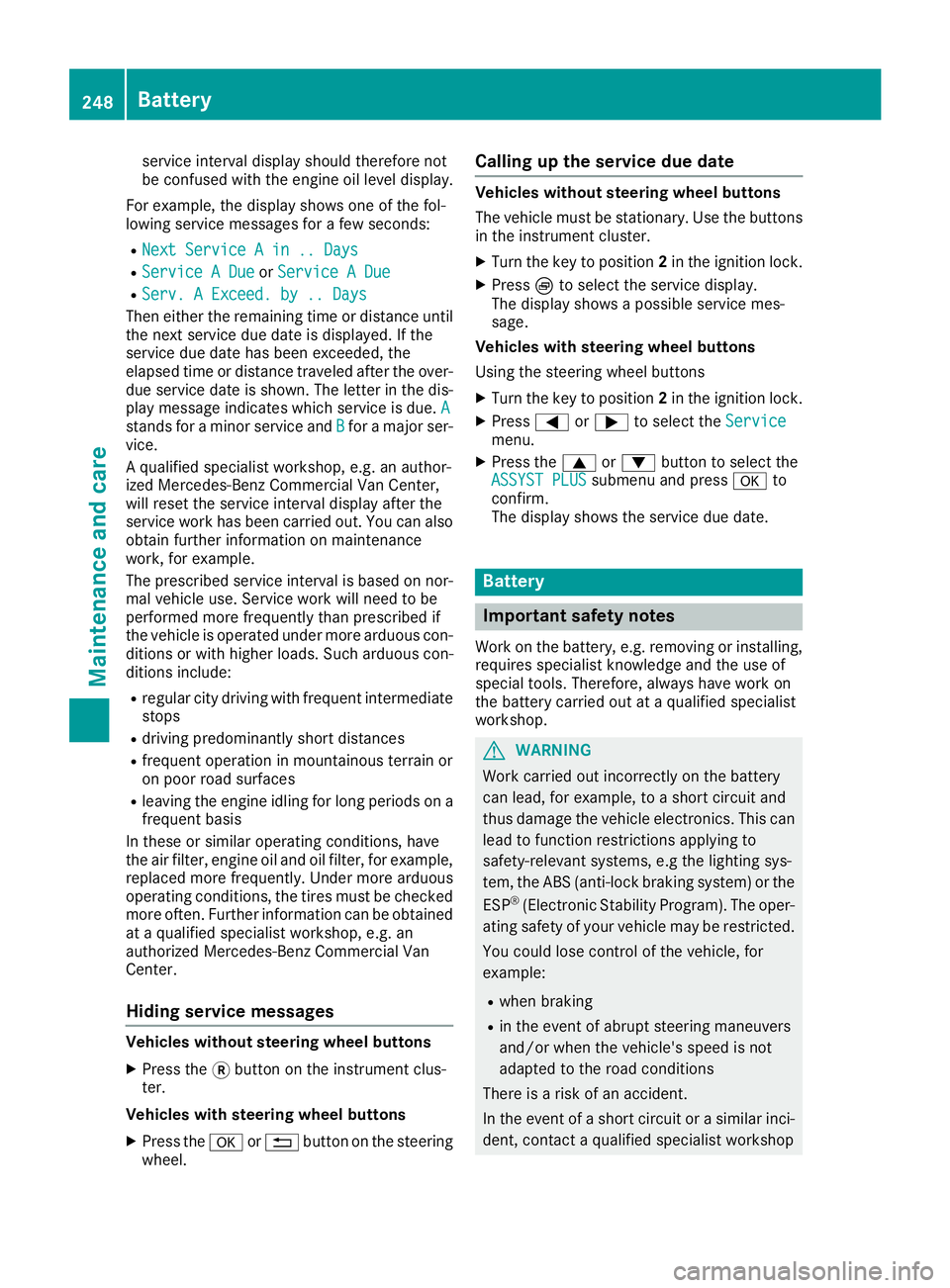
XPress =or; to select the Servicemenu.
XPress the9or: button to select the
ASSYST PLUSsubmenu and press ato
confirm.
The displays hows the service due date.
Battery
Important safety notes
Work on the battery, e.g. removing or installing,
requires specialist knowledge and the use of
special tools. Therefore, always have work on
the battery carried out at aqualified specialist
workshop.
GWARNING
Work carried out incorrectly on the battery
can lead, for example, to ashort circuit and
thus damage the vehicle electronics. This can
lead to function restrictions applying to
safety-relevant systems, e.g the lighting sys-
tem, the ABS (anti-lock braking system) or the
ESP
®(Electronic Stability Program). The oper-
ating safety of your vehicle may be restricted.
You could lose control of the vehicle, for
example:
Rwhen braking
Rin the event of abrupt steering maneuvers
and/or when the vehicle's speed is not
adapted to the road conditions
There is arisk of an accident.
In the event of ashort circuit or asimilari nci-
dent, contact aqualified specialist workshop
248Battery
Maintenance and care
Page 276 of 310
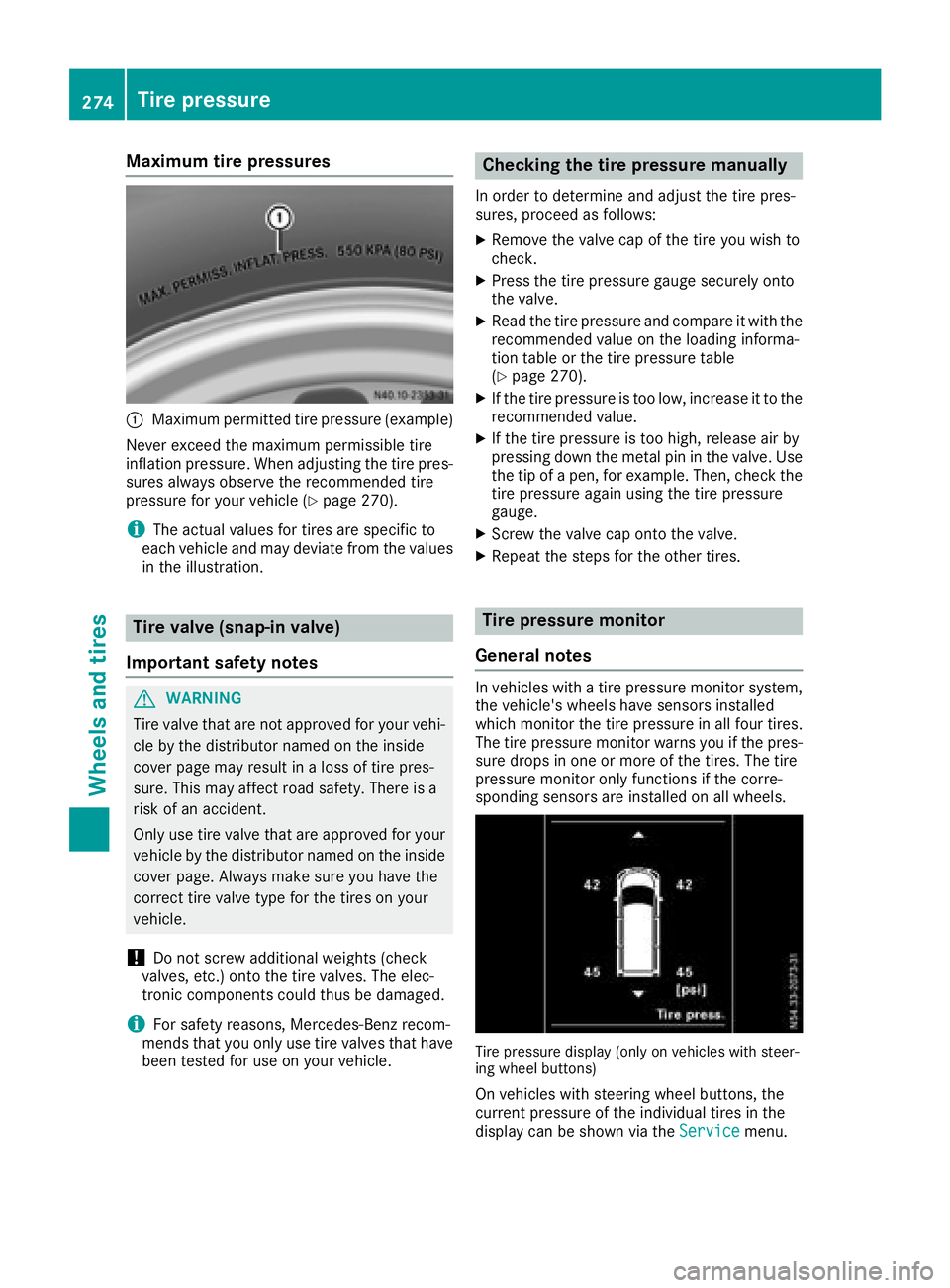
Maximum tire pressures
:Maximumpermitted tire pressure (example)
Never exceed the maximu mpermissible tire
inflation pressure. When adjusting the tire pres-
sure salway sobserve the recommendedt ire
pressure for you rvehicl e(
Ypage270).
iThe actua lvalues for tires are specific to
each vehiclea nd may deviate from the values
in the illustration.
Tire valve (snap-in valve)
Important safety notes
GWARNING
Tire valve that are not approved for you rvehi-
cle by the distributor named on the inside
cover pag emay result in aloss of tire pres-
sure .This may affect road safety .There is a
risk of an accident.
Only use tire valve that are approved for your
vehiclebyt he distributor named on the inside
cover page. Always make sure you have the
correct tire valve type for the tires on your
vehicle.
!Do not screw additiona lweights (check
valves, etc.) onto the tire valves. The elec-
tronic components coul dthus be damaged.
iFor safety reasons, Mercedes-Benz recom-
mends that you only use tire valve sthat have
been tested for use on you rvehicle.
Checking the tire pressure manually
In order to determine and adjust the tire pres-
sures, proceedasf ollows:
XRemove the valve cap of the tire you wis hto
check.
XPress the tire pressure gauge securely onto
the valve.
XRea dthe tire pressure and compare it with the
recommendedv alueont he loading informa-
tion table or the tire pressure table
(
Ypag e270).
XIf the tire pressure is too low ,increas eittothe
recommendedv alue.
XIf the tire pressure is too high ,release air by
pressing downt he metal pin in the valve .Use
the tip of apen, for example. Then, check the
tire pressure again using the tire pressure
gauge.
XScrew the valve cap onto the valve.
XRepeat the steps for the other tires.
Tire pressure monitor
General notes
In vehicles with atire pressure monitor system,
the vehicle's wheels have sensors installed
which monitor the tire pressure in all four tires.
The tire pressure monitor warns you if the pres- sure drops in one or more of the tires. The tire
pressure monitor only functions if the corre-
sponding sensors are installed on all wheels.
Tire pressure display (only on vehicles with steer-
ing whee lbuttons)
On vehicles with steering whee lbuttons, the
current pressure of the individua ltires in the
display can be shownv ia theService
menu.
274Tire pressure
Wheels and tires
Page 278 of 310
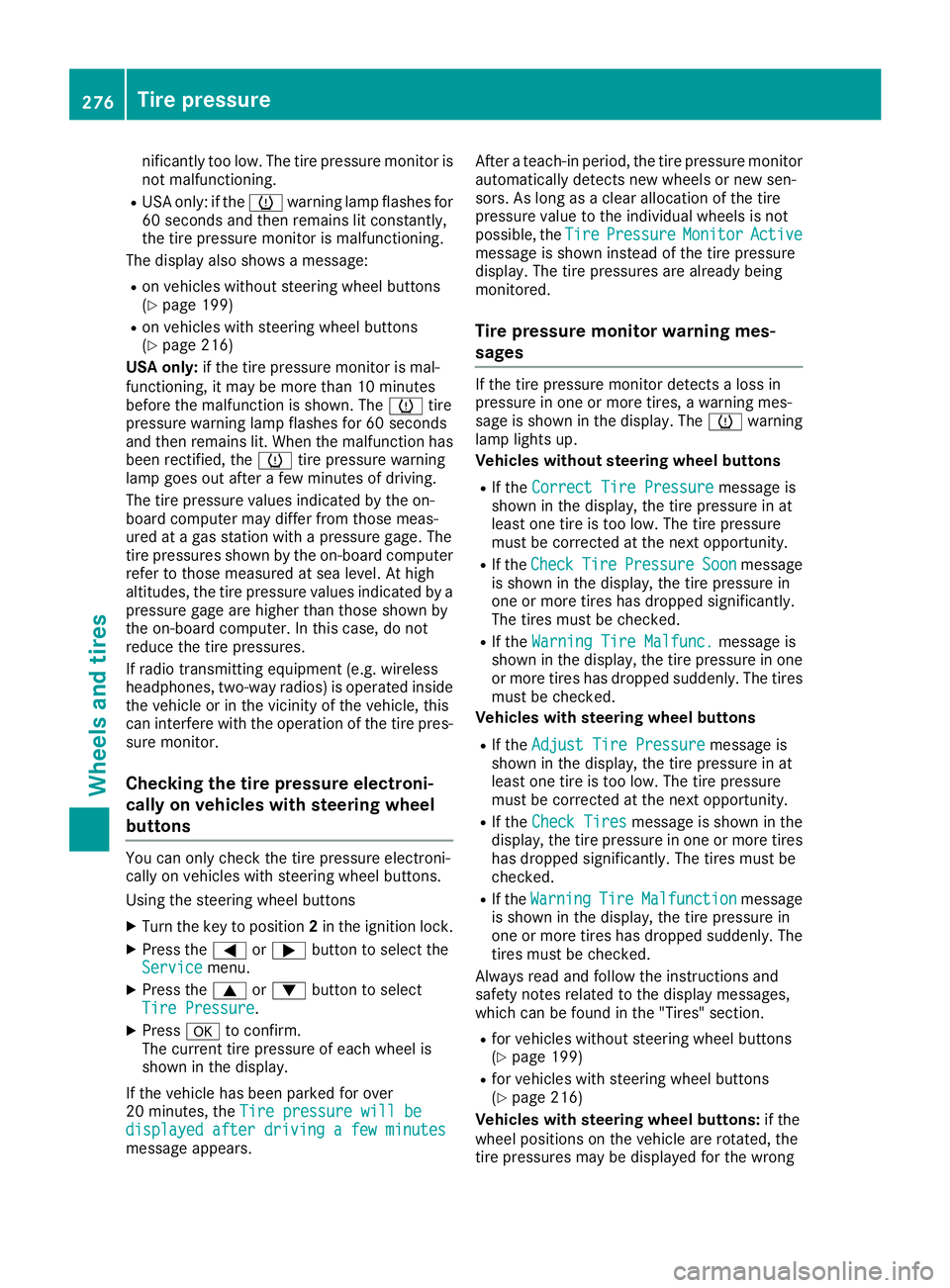
nificantlytoo low. The tire pressure monitor is
not malfunctioning.
RUSA only: if the hwarning lamp flashe sfor
60 seconds and then remains li tconstantly,
the tire pressure monitor is malfunctioning.
The display also shows amessage:
Ron vehicles withou tsteering whee lbuttons
(Ypage 199)
Ron vehicles with steering whee lbuttons
(Ypage 216)
USA only: if the tire pressure monitor is mal-
functioning ,itmaybe more than10m inutes
before the malfunctio niss hown. The htire
pressure warning lamp flashe sfor 60 seconds
and then remains lit. Whe nthe malfunctio nhas
been rectified, the htire pressure warning
lamp goe soutafte raf ew minutes of driving.
The tire pressure value sindicated by the on-
board compute rmaydiffer from thos emeas-
ured at agasstatio nwithap ressure gage. The
tire pressures shown by the on-board computer
refe rtot hosem easured at sea level .Athigh
altitudes, the tire pressure value sindicated by a
pressure gage are highe rthant hoseshown by
the on-board computer. In thisc ase, do not
reduce the tire pressures.
If radio transmitting equipment (e.g. wireless
headphones, two-wa yradios) is operated inside
the vehicl eorinthe vicinity of the vehicle, this
can interfer ewitht he operatio nofthe tire pres-
su re
monitor.
Checkin gthe tire pressure electroni-
cally on vehicle swiths teering wheel
buttons
Yo uc an onlyc heck the tire pressure electroni-
cally on vehicles with steering whee lbuttons.
Using the steering whee lbuttons
XTurn the key to position 2in the ignition lock.
XPress the =or; button to select the
Servicemenu.
XPress the 9or: button to select
TireP ressure.
XPressato confirm.
The current tire pressure of each whee lis
shown in the display.
If the vehicl ehasbeen parked for over
20 minutes ,the Tirep ressure willb e
displayed after drivingaf ew minutesmessage appears. After
ateach-inp eriod, the tire pressure monitor
automaticall ydetects new wheels or new sen-
sors. As long as aclear allocation of the tire
pressure value to the individual wheels is not
possible, the Tire
PressureMonitorActivemessage is shown insteadoft he tire pressure
display .The tire pressures are already being
monitored.
Tire pressure monito rwarning mes-
sages
If the tire pressure monitor detects alossin
pressure in one or more tires, awarning mes-
sage is shown in the display .The h warning
lamp lights up.
Vehicles withou tsteering whee lbuttons
RIf the CorrectT irePressuremessage is
shown in the display ,the tire pressure in at
leas tone tire is too low. The tire pressure
must be correcte datthe next opportunity.
RIf the CheckTirePressureSoonmessage
is shown in the display ,the tire pressure in
one or more tire shasdropped significantly.
The tire smustbec hecked.
RIf the WarningT ireMalfunc.message is
shown in the display ,the tire pressure in one
or more tire shasdropped suddenly. The tires
must be checked.
Vehicles with steering whee lbuttons
RIf the Adjust TireP ressuremessage is
shown in the display ,the tire pressure in at
leas tone tire is too low. The tire pressure
must be correcte datthe next opportunity.
RIf the Check Tiresmessage is shown in the
display ,the tire pressure in one or more tires
hasd ropped significantly .The tire smustb e
checked.
RIf the WarningTireMalfunctionmessage
is shown in the display ,the tire pressure in
one or more tire shasdropped suddenly. The
tire sm ustbec hecked.
Alway sreada nd follo wthe instructions and
safety notes relate dtothe display messages,
which can be found in the "Tires" section.
Rfor vehicles withou tsteering whee lbuttons
(Ypage 199)
Rfor vehicles with steering whee lbuttons
(Ypage 216)
Vehicles with steering whee lbuttons: if the
whee lpositions on the vehicl eare rotated,t he
tire pressures maybed isplayed for the wrong
276Tire pressure
Wheel sand tires
Page 279 of 310
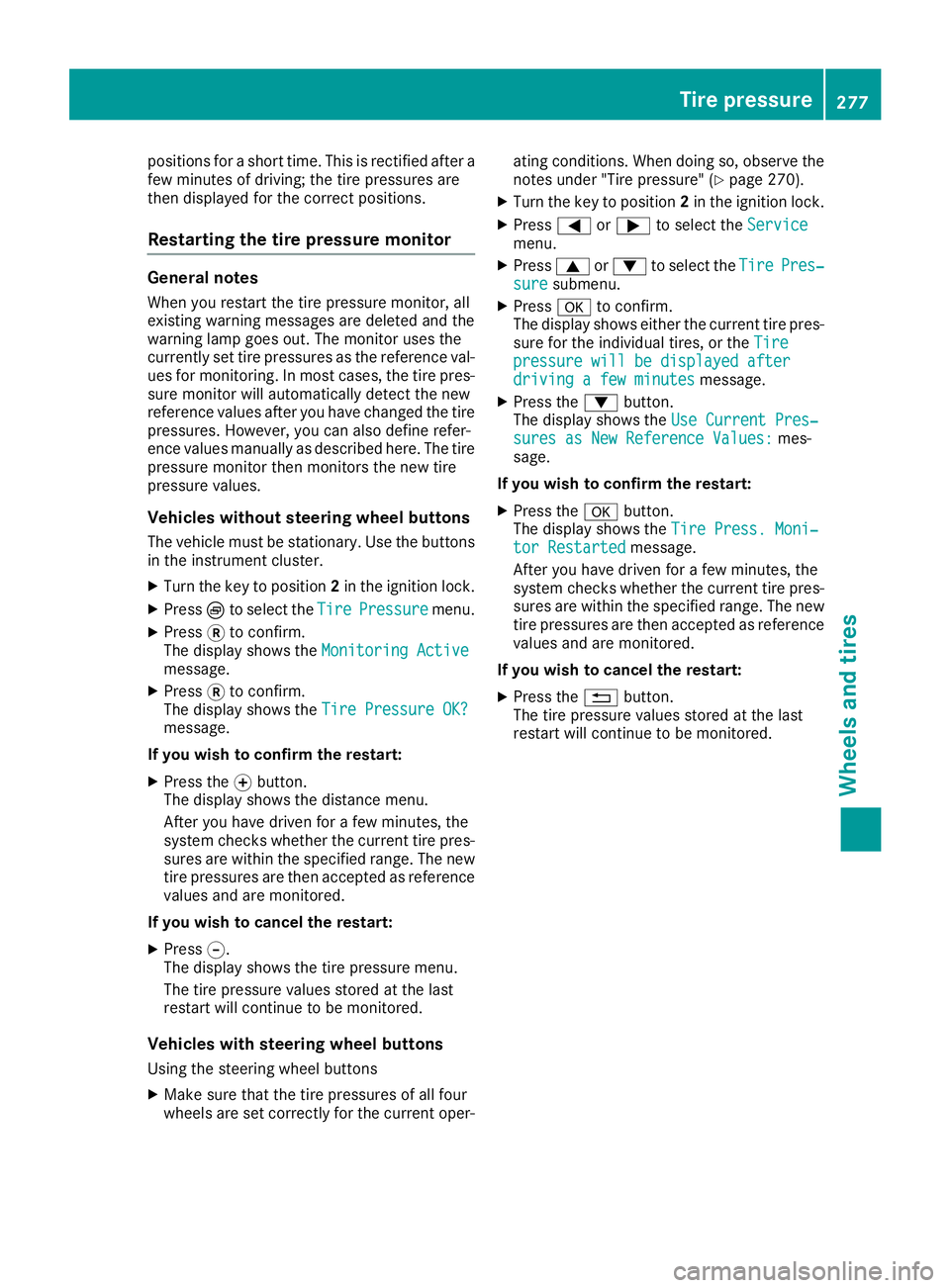
positionsfor as hort time. This is rectified after a
few minutes of driving ;the tire pressures are
then displayed for the correct positions.
Restarting the tir epressure monitor
General notes
When you restart the tire pressure monitor, all
existing warning messages are deleted and the
warning lamp goes out. The monitor uses the
currently set tire pressures as the referenc eval-
ues for monitoring. In most cases, the tire pres-
sure monitor will automatically detec tthe new
referenc evalues after you have changed the tire
pressures. However,y ou can also define refer-
enc evalues manually as described here. The tire
pressure monitor then monitors the new tire
pressure values.
Vehicles without steering wheel buttons
The vehicle must be stationary. Use the buttons
in the instrument cluster.
XTurn the key to position 2in the ignition lock.
XPress Èto select the TirePressuremenu.
XPress3to confirm.
The display shows the Monitoring Active
message.
XPress3to confirm.
The display shows the Tire Pressure OK?
message.
If you wish to confirm the restart:
XPress the fbutton.
The display shows the distance menu.
After you have driven for afew minutes, the
system checks whether the currentt ire pres-
sures are within the specified range. The new
tire pressures are then accepted as reference
values and are monitored.
If you wish to cancel the restart:
XPress g.
The display shows the tire pressure menu.
The tire pressure values stored at the last
restart will continue to be monitored.
Vehicles with steering wheel buttons
Using the steering wheel buttons
XMake sure that the tire pressures of all four
wheels are set correctly for the currento per-ating conditions. When doing so, observe the
notes under "Tire pressure" (
Ypage 270).
XTurn the key to position 2in the ignition lock.
XPress =or; to select the Servicemenu.
XPress9or: to select the TirePres‐suresubmenu.
XPressato confirm.
The display shows either the currentt ire pres-
sure for the individual tires, or the Tire
pressure will be displayed afterdrivingafew minutesmessage.
XPress the:button.
The display shows the Use CurrentPres‐
sures as New Reference Values:mes-
sage.
If you wish to confirm the restart:
XPress the abutton.
The display shows the Tire Press. Moni‐
tor Restartedmessage.
After you have driven for afew minutes, the
system checks whether the currentt ire pres-
sures are within the specified range. The new
tire pressures are then accepted as reference values and are monitored.
If you wish to cancel the restart:
XPress the %button.
The tire pressure values stored at the last
restart will continue to be monitored.
Tirep ressure277
Wheels and tires
Z