steering MERCEDES-BENZ METRIS 2016 MY16 Operator’s Manual
[x] Cancel search | Manufacturer: MERCEDES-BENZ, Model Year: 2016, Model line: METRIS, Model: MERCEDES-BENZ METRIS 2016Pages: 310, PDF Size: 7.28 MB
Page 250 of 310
service interval displayshould therefore not
be confused with the engine oil level display.
For example, the displays hows one of the fol-
lowing service messages for afew seconds:
RNext Service Ain..Days
RServiceADueorService ADue
RServ. AExceed. by .. Days
Then either the remaining time or distance until
the next service due date is displayed. If the
service due date has been exceeded, the
elapsedt ime or distance traveled after the over-
due service date is shown. The letter in the dis-
play message indicates which service is due. A
stands foraminor service and Bforam ajor ser-
vice.
Aq ualified specialist workshop, e.g. an author-
ized Mercedes-Benz Commercial Van Center,
will reset the service interval displaya fter the
service work has been carried out. You can also
obtain further information on maintenance
work, for example.
The prescribed service interval is based on nor- mal vehicle use. Service work will need to be
performed more frequently than prescribed if
the vehicle is operated under more arduousc on-
ditions or with higher loads. Such arduousc on-
ditions include:
Rregularc ity driving with frequent intermediate
stops
Rdriving predominantly short distances
Rfrequent operation in mountainous terrain or
on poor road surfaces
Rleaving the engine idling for long periods on a frequent basis
In these or similar operating conditions, have
the air filter, engine oil and oil filter, for example,
replaced more frequently. Under more arduous
operating conditions, the tires must be checked more often. Further information can be obtained
at aq ualified specialist workshop, e.g. an
authorized Mercedes-Benz Commercial Van
Center.
Hiding service messages
Vehicles without steering wheel buttons
XPress the 3button on the instrument clus-
ter.
Vehicles with steering wheel buttons
XPress the aor% button on the steering
wheel.
Callingupt he service due date
Vehicles without steering wheel buttons
The vehicle must be stationary. Use the buttons
in the instrument cluster.
XTurn the key to position 2in the ignition lock.
XPress Èto select the service display.
The displays howsapossible service mes-
sage.
Vehicles with steering wheel buttons
Using the steering wheel buttons
XTurn the key to position 2in the ignition lock.
XPress =or; to select the Servicemenu.
XPress the9or: button to select the
ASSYST PLUSsubmenu and press ato
confirm.
The displays hows the service due date.
Battery
Important safety notes
Work on the battery, e.g. removing or installing,
requires specialist knowledge and the use of
special tools. Therefore, always have work on
the battery carried out at aqualified specialist
workshop.
GWARNING
Work carried out incorrectly on the battery
can lead, for example, to ashort circuit and
thus damage the vehicle electronics. This can
lead to function restrictions applying to
safety-relevant systems, e.g the lighting sys-
tem, the ABS (anti-lock braking system) or the
ESP
®(Electronic Stability Program). The oper-
ating safety of your vehicle may be restricted.
You could lose control of the vehicle, for
example:
Rwhen braking
Rin the event of abrupt steering maneuvers
and/or when the vehicle's speed is not
adapted to the road conditions
There is arisk of an accident.
In the event of ashort circuit or asimilari nci-
dent, contact aqualified specialist workshop
248Battery
Maintenance and care
Page 261 of 310
Cleaning thesteering wheel and selec-
tor lever
XThoroughlyw ipe withadamp cloth.
XVehicles with leather upholstery: after
cleaning, use leather car eagents that have
been recommended and approved by
Mercedes-Benz.
Cleaning th etrime lements
!Do no tuse solvent-based cleanin gagents
suchast ar remover, wheel cleaners, polishes
or waxes. Thereiso therwise ariskofd amag-
ing th esurface.
XWipe th etrime lements withad amp, lint-free
cloth ,e.g.am icrofiber cloth.
XHeavy soiling: use careproduct sand clean-
ing agents recommended and approved by
Mercedes-Benz.
Cleaning th eseat covers
!Do no tuse microfiber cloth stoclean genu-
ine leather or artificial leather covers.Ifu sed
often,am icrofiber cloth can damag ethe
cover.
!Clean:
Rartificial leather covers withac loth mois-
tene dwithas olution containing 1% deter-
gent, e.g .dish washingl iquid.
Rcloth covers witham icrofiber cloth mois-
tene dwithas olution containing 1% deter-
gent, e.g .dish washingl iquid. Wipe entire
seat sections carefull ytoa void leaving visi-
ble lines. Leavet heseat to dry afterwards.
Cleaning results dependont hetype of dirt
and how longith as been there.
Rgenuine leather covers carefull ywitha
damp cloth ,the nw ipe th ecovers down
withad ry cloth.Makes ure that th eleather
does no tbecome soaked. Otherwise, the
leather coul dbecome roug horcracked.
Only use leather car eagents that have
been tested and approved by Mercedes-
Benz. You can obtain these from aqualified
specialist workshop.
iPleasek eepinm indt hat:
Rleather covers are anatural product and ,as
such, are subject to anatural agingp roc-
ess.L eather may reac tdifferently (e.g. increased wrinkling
)tocertain environ-
mental influences (suchash igh humidity or
intense heat).
Rregular car eisessential to mak esure that
th ea ppearanc eand comfor tofthecovers
are retaine dovertime.
Cleaning th eseat belts
GWARNING
Seat beltsc an become severely weakened if
bleached or dyed. This coul dcaus ethe seat
beltstot earorf ail, for instance, in th eevent of
an accident. This posesani ncreased riskof
injury or fatal injury.
Never bleachord ye theseat belts.
!Do no tclean th eseat beltsu singchemical
cleanin gagents .Don otdry th eseat beltsb y
heating at temperatures above1 76‡(80 †)
or in direct sunlight.
Remove any stains or dirt immediately .This will
avoi dresidue or damage.
XUse clean, lukewarm water and soaps olution.
Cleaning the headliner and carpets
XHeadliner:if it is very dirty ,use asoft brus hor
dry shampoo.
XCarpets: use the carpe tand textile cleaning
agents recommended and approved by
Mercedes-Benz.
Care259
Maintenancea nd care
Z
Page 266 of 310
XConnect thenegative terminal clam pofthe
jumper cabl etonegative terminal ;of the
donor veh icle's battery, and then to earth
contact ?of your own veh icle.
XInsertt hekeyintot he ignition locka nd start
th ee ngine.
You can no wswitch electrical consumers
back on excep tthe lighting system.
XBefore disconnecting th ejumper cables, let
th ee nginer un for several minutes.
XDisconnect th enegative terminal of the
jumper cabl efrome arthc ontac t? and then
from negative terminal ;of th edonor veh i-
cle's battery.
XDisconnect th epositiv etermi nal clam pofthe
jumper cabl efromp ositiv etermi nalAon the
jump-startin gconnectio npoint, and then
from positiv etermi nal=of th edonor veh i-
cle's battery.
Contac tprotection cover :isautomatically
returned forwards to its original positio nby
th es pring force and th ejump-startin gcon-
nection pointisc losed.
XPositio nthe cover on positiv etermi nal=of
th ed onor veh icle's battery.
You can no wswitch on th elighting system.
XHav ethe battery checked at aqualified spe-
cialist workshop.
Tow-startin gand towin gaway
Important safety notes
GWAR NING
Functionsr elevanttosafety are restricted or
no longer availab leif:
Rthee ngineisn otrunning.
Rtheb rak esystem or th epower steering is
malfunctioning.
Rthere isam alfunctio ninthevoltage supply
or th evehicle 's electrical system.
If your veh icle is bein gtow ed, muc hmore
force may benecessary to steer or brake.
Thereisar iskofana cciden t.
In suchc ases, use atow bar. Before to wing,
mak esure that th esteering moves freely.
GWARNING
You can no longer steer th evehicle ifthe
steering wheel lockh as been engaged.There
is ar iskofana ccident.
Alwa ysswit ch off th eignition when to wingthe
vehicle withat owcabl eorat owbar.
GWARNING
When to wingor tow-startin ganother vehicle
and its weightisg reatertha nt he permissible
gross weightofy our vehicle,the :
Rthet ow ing eye could detach itself
Rthev ehicle /traile rcom binatio ncould roll-
over.
Thereisar iskofana ccident.
When towing or tow-startin ganother vehicle,
its weights hould notbegreatertha nt he per-
missible gross weightofy our vehicle.
In formation on th egross vehicle weightc anbe
foun dont hevehicle identification plate
(
Ypage 294).
!Secure th etow rop eort owbar to th etow ing
eye or trailer to whitch only. Otherwise, the
vehicle could become damaged.
!Do no tuse th etow ing eye for recovery, this
could damag ethe vehicle .Ifindoubt,recover
th ev ehicle withac rane.
!Drive slowlya nd smoothly when to wing.
Excessivet ractive power could otherwise
damag ethe vehicles.
!Shift th eautomatic transmission to Nand
do noto pen th edriver' sorf rontpassenger's
door durin gtow ing .The automatic transmis-
sion may otherwise shifttop ositionP,which
could damag ethe transmission.
!The vehicle can be towed amaximum of
30 mile s(50km ).The to wingspeedof30m ph
(50 km/h) must no tbeexceeded.
If th evehicle has to betowed mor ethan
30 mile s(50km) ,the entire vehicl emus
tbe
ra
ised and transported.
When towing away, you must observet helegal
requirement sfor th ecountr yinw hichy ou are
currently driving.
It is bette rtohave th evehicle transported than
to have it towed.
264Tow-startin gand towing away
Breakdown assistance
Page 276 of 310
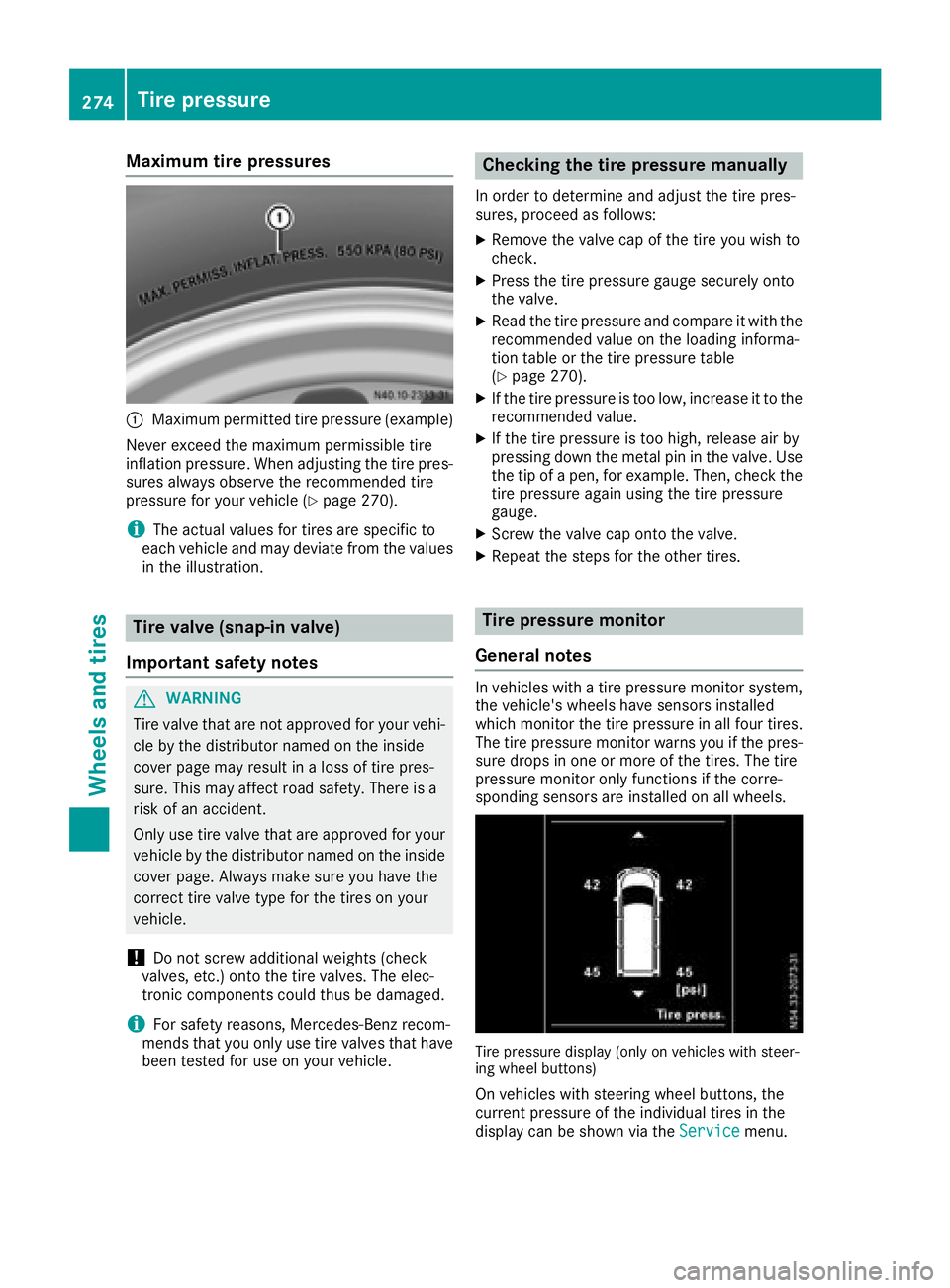
Maximum tire pressures
:Maximumpermitted tire pressure (example)
Never exceed the maximu mpermissible tire
inflation pressure. When adjusting the tire pres-
sure salway sobserve the recommendedt ire
pressure for you rvehicl e(
Ypage270).
iThe actua lvalues for tires are specific to
each vehiclea nd may deviate from the values
in the illustration.
Tire valve (snap-in valve)
Important safety notes
GWARNING
Tire valve that are not approved for you rvehi-
cle by the distributor named on the inside
cover pag emay result in aloss of tire pres-
sure .This may affect road safety .There is a
risk of an accident.
Only use tire valve that are approved for your
vehiclebyt he distributor named on the inside
cover page. Always make sure you have the
correct tire valve type for the tires on your
vehicle.
!Do not screw additiona lweights (check
valves, etc.) onto the tire valves. The elec-
tronic components coul dthus be damaged.
iFor safety reasons, Mercedes-Benz recom-
mends that you only use tire valve sthat have
been tested for use on you rvehicle.
Checking the tire pressure manually
In order to determine and adjust the tire pres-
sures, proceedasf ollows:
XRemove the valve cap of the tire you wis hto
check.
XPress the tire pressure gauge securely onto
the valve.
XRea dthe tire pressure and compare it with the
recommendedv alueont he loading informa-
tion table or the tire pressure table
(
Ypag e270).
XIf the tire pressure is too low ,increas eittothe
recommendedv alue.
XIf the tire pressure is too high ,release air by
pressing downt he metal pin in the valve .Use
the tip of apen, for example. Then, check the
tire pressure again using the tire pressure
gauge.
XScrew the valve cap onto the valve.
XRepeat the steps for the other tires.
Tire pressure monitor
General notes
In vehicles with atire pressure monitor system,
the vehicle's wheels have sensors installed
which monitor the tire pressure in all four tires.
The tire pressure monitor warns you if the pres- sure drops in one or more of the tires. The tire
pressure monitor only functions if the corre-
sponding sensors are installed on all wheels.
Tire pressure display (only on vehicles with steer-
ing whee lbuttons)
On vehicles with steering whee lbuttons, the
current pressure of the individua ltires in the
display can be shownv ia theService
menu.
274Tire pressure
Wheels and tires
Page 277 of 310
For further information on displaying the current
tire pressures, referto"Checking the tire pres-
sur eelectronically" (
Ypage 276).
Important safety notes
GWARNING
Each tire, including the spare (ifp rovided),
should be checked at least once amonth
whe ncold and inflated to the pressure rec-
ommended by the vehicle manufacturer on
the Tir eand Loading Information placard on
the driver's doo rB-pilla rort he tire pressure
label on the inside of the fue lfiller flap. If your
vehicle has tires of adifferent size than the
size indicated on the Tir eand Loading Infor-
mation placard or the tire pressure label ,you
should determine the proper tire pressure for
those tires.
As an added safety feature ,you rv ehicle has
bee nequipped with atire pressure monitoring
system (TPMS) that illuminates alow tire pres-
sur etelltal ewheno ne or more of your tires
are significantly underinflated. Accordingly,
whe nthe low tire pressure telltal eillumi nates,
yo us hould stop and check your tires as soon
as possible, and inflate them to the proper
pressure. Driving on asignificantly underin-
flated tire causes the tire to overheata nd can
lea dtot ire failure. Underinflation also
reduce sfue lefficiency and tire treadl ife, and
may affect the vehicle' shandling and stop-
ping ability.
Please note that the TPMSisn otas ubstitute
for proper tire maintenance, and it is the driv-
er's responsibility to maintain correct tire
pressure, even if underinflation has not
reached the level to trigger illumination of the
TPMSl ow tire pressure telltale.
USA only:
You rvehicle has also bee
nequipped with a
TPM
Sm alfunction indicator to indicate if the
system is not operating properly. The TPMS
malfunction indicator is combined with the
low tire pressure telltale. Whe nthe system
detects amalfunction, the warning lamp will
flash for approximately aminute and then
remain continuously illuminated. This
sequence will be repeated ever ytime the vehi-
cle is starte daslong as the malfunction
exists.
Whe nthe malfunction indicator is illuminated,
the system may not be able to detect or signal
low tire pressure as intended. TPMSm alfunc-
tions may occur for avariety of reasons,
including the mounting of incompatible
replacement or alternate tires or wheels on
the vehicle that prevent the TPMSf rom func-
tioning properly. Alway scheck the TPMSm al-
function telltal eafterreplacing one or more
tires or wheels on your vehicle to ensure that the replacement or alternate tires and wheels
allow the TPMStoc ontinuetofunction prop-
erly.
It is the driver's responsibility to set the tire
pressure to the recommende dcold tire pressure
suitabl efor the operating conditions
(
Ypage 270).
Note that the correct tire pressure for the cur-
rent operating conditions mus tfirs tb ep ro-
gramed into the tire pressure monitor. If there is
as ubstantial los sofpressure, the warning
threshol dfor the warning messag eisaligne dto
the reference value sprograme din. Restart the
tire pressure monito rafte radjusting the cold
tire pressure (
Ypage 277). The current pres-
sures are saved as new reference values. This
will ensure that awarning messag ewillo nly
appea rifthe tire pressure drop ssignificantly.
The tire pressure monito rdoesn ot warn yo uifa
tire pressure is incorrect. Observe the notes on
the
recommende dtire pressure (Ypage 270).
The tire pressure monito risnot able to warn you
of as udden los sofpressure, e.g. following pen-
etration by aforeign object. In this event, brake
the vehicle until it comes to astandstill. Avoid
sudden steering movements.
The tire pressure monito rhas ayello wh
warning lamp in the instrument cluster for indi-
cating pressure loss/malfunctions (USA) or
pressure los s(Ca nada). Depending on how the
warning lamp flashesorl ights up ,anunderin-
flated tire or amalfunction in the tire pressure
monito risdisplayed:
Rif the h warning lamp is li tcontinuously,
the tire pressure on one or more tires is sig-
Tire pressure275
Wheels and tires
Z
Page 278 of 310
nificantlytoo low. The tire pressure monitor is
not malfunctioning.
RUSA only: if the hwarning lamp flashe sfor
60 seconds and then remains li tconstantly,
the tire pressure monitor is malfunctioning.
The display also shows amessage:
Ron vehicles withou tsteering whee lbuttons
(Ypage 199)
Ron vehicles with steering whee lbuttons
(Ypage 216)
USA only: if the tire pressure monitor is mal-
functioning ,itmaybe more than10m inutes
before the malfunctio niss hown. The htire
pressure warning lamp flashe sfor 60 seconds
and then remains lit. Whe nthe malfunctio nhas
been rectified, the htire pressure warning
lamp goe soutafte raf ew minutes of driving.
The tire pressure value sindicated by the on-
board compute rmaydiffer from thos emeas-
ured at agasstatio nwithap ressure gage. The
tire pressures shown by the on-board computer
refe rtot hosem easured at sea level .Athigh
altitudes, the tire pressure value sindicated by a
pressure gage are highe rthant hoseshown by
the on-board computer. In thisc ase, do not
reduce the tire pressures.
If radio transmitting equipment (e.g. wireless
headphones, two-wa yradios) is operated inside
the vehicl eorinthe vicinity of the vehicle, this
can interfer ewitht he operatio nofthe tire pres-
su re
monitor.
Checkin gthe tire pressure electroni-
cally on vehicle swiths teering wheel
buttons
Yo uc an onlyc heck the tire pressure electroni-
cally on vehicles with steering whee lbuttons.
Using the steering whee lbuttons
XTurn the key to position 2in the ignition lock.
XPress the =or; button to select the
Servicemenu.
XPress the 9or: button to select
TireP ressure.
XPressato confirm.
The current tire pressure of each whee lis
shown in the display.
If the vehicl ehasbeen parked for over
20 minutes ,the Tirep ressure willb e
displayed after drivingaf ew minutesmessage appears. After
ateach-inp eriod, the tire pressure monitor
automaticall ydetects new wheels or new sen-
sors. As long as aclear allocation of the tire
pressure value to the individual wheels is not
possible, the Tire
PressureMonitorActivemessage is shown insteadoft he tire pressure
display .The tire pressures are already being
monitored.
Tire pressure monito rwarning mes-
sages
If the tire pressure monitor detects alossin
pressure in one or more tires, awarning mes-
sage is shown in the display .The h warning
lamp lights up.
Vehicles withou tsteering whee lbuttons
RIf the CorrectT irePressuremessage is
shown in the display ,the tire pressure in at
leas tone tire is too low. The tire pressure
must be correcte datthe next opportunity.
RIf the CheckTirePressureSoonmessage
is shown in the display ,the tire pressure in
one or more tire shasdropped significantly.
The tire smustbec hecked.
RIf the WarningT ireMalfunc.message is
shown in the display ,the tire pressure in one
or more tire shasdropped suddenly. The tires
must be checked.
Vehicles with steering whee lbuttons
RIf the Adjust TireP ressuremessage is
shown in the display ,the tire pressure in at
leas tone tire is too low. The tire pressure
must be correcte datthe next opportunity.
RIf the Check Tiresmessage is shown in the
display ,the tire pressure in one or more tires
hasd ropped significantly .The tire smustb e
checked.
RIf the WarningTireMalfunctionmessage
is shown in the display ,the tire pressure in
one or more tire shasdropped suddenly. The
tire sm ustbec hecked.
Alway sreada nd follo wthe instructions and
safety notes relate dtothe display messages,
which can be found in the "Tires" section.
Rfor vehicles withou tsteering whee lbuttons
(Ypage 199)
Rfor vehicles with steering whee lbuttons
(Ypage 216)
Vehicles with steering whee lbuttons: if the
whee lpositions on the vehicl eare rotated,t he
tire pressures maybed isplayed for the wrong
276Tire pressure
Wheel sand tires
Page 279 of 310
positionsfor as hort time. This is rectified after a
few minutes of driving ;the tire pressures are
then displayed for the correct positions.
Restarting the tir epressure monitor
General notes
When you restart the tire pressure monitor, all
existing warning messages are deleted and the
warning lamp goes out. The monitor uses the
currently set tire pressures as the referenc eval-
ues for monitoring. In most cases, the tire pres-
sure monitor will automatically detec tthe new
referenc evalues after you have changed the tire
pressures. However,y ou can also define refer-
enc evalues manually as described here. The tire
pressure monitor then monitors the new tire
pressure values.
Vehicles without steering wheel buttons
The vehicle must be stationary. Use the buttons
in the instrument cluster.
XTurn the key to position 2in the ignition lock.
XPress Èto select the TirePressuremenu.
XPress3to confirm.
The display shows the Monitoring Active
message.
XPress3to confirm.
The display shows the Tire Pressure OK?
message.
If you wish to confirm the restart:
XPress the fbutton.
The display shows the distance menu.
After you have driven for afew minutes, the
system checks whether the currentt ire pres-
sures are within the specified range. The new
tire pressures are then accepted as reference
values and are monitored.
If you wish to cancel the restart:
XPress g.
The display shows the tire pressure menu.
The tire pressure values stored at the last
restart will continue to be monitored.
Vehicles with steering wheel buttons
Using the steering wheel buttons
XMake sure that the tire pressures of all four
wheels are set correctly for the currento per-ating conditions. When doing so, observe the
notes under "Tire pressure" (
Ypage 270).
XTurn the key to position 2in the ignition lock.
XPress =or; to select the Servicemenu.
XPress9or: to select the TirePres‐suresubmenu.
XPressato confirm.
The display shows either the currentt ire pres-
sure for the individual tires, or the Tire
pressure will be displayed afterdrivingafew minutesmessage.
XPress the:button.
The display shows the Use CurrentPres‐
sures as New Reference Values:mes-
sage.
If you wish to confirm the restart:
XPress the abutton.
The display shows the Tire Press. Moni‐
tor Restartedmessage.
After you have driven for afew minutes, the
system checks whether the currentt ire pres-
sures are within the specified range. The new
tire pressures are then accepted as reference values and are monitored.
If you wish to cancel the restart:
XPress the %button.
The tire pressure values stored at the last
restart will continue to be monitored.
Tirep ressure277
Wheels and tires
Z
Page 280 of 310
Tire pressure tables
Vehicle swithag ross vehicle weight of 6,724 lb s(3.05 t)
!The pressure differenc ebetween tire sonany one axl emustbenog reaterthan1 0kPa (0.1 ba r/
1.5 psi).
The following tire pressure values apply to vehicles with:
Rag ross vehicle weight of 6,724 lbs (3.05 t)
Ragross axle weight rating of 3,418 lbs(1,550 kg)on the rear axle and
Rthe tires referredtounder"Wheel and tire combinations" (Ypag e291).
Always observe the notes unde r"Information on tire pressures "(
Ypage270).
The tire pressure for the spare wheelis 340 kPa (3.4 bar/49 psi).
Partiallyladen vehicleFully laden vehicle
Tire sizeFron taxleRear axleFron taxleRear axle
225/55 R17RF270 kPa
(2.7 bar/ 39 psi)270 kPa
(2.7 bar/ 39 psi)300 kPa
(3.0 bar/ 44 psi)310 kPa
(3.1 bar/45 psi)
Loading the vehicle
Instruction labels for tires and loads
GWARNING
Overloaded tires can overheat, causing a
blowout. Overloaded tires can also impair the steering and driving characteristics and lead
to brake failure. There is arisk of accident.
Observe the loa drating of the tires. The load
rating must be at least hal fofthe GAWR of
you rvehicle. Never overload the tires by
exceeding the maximu mload.
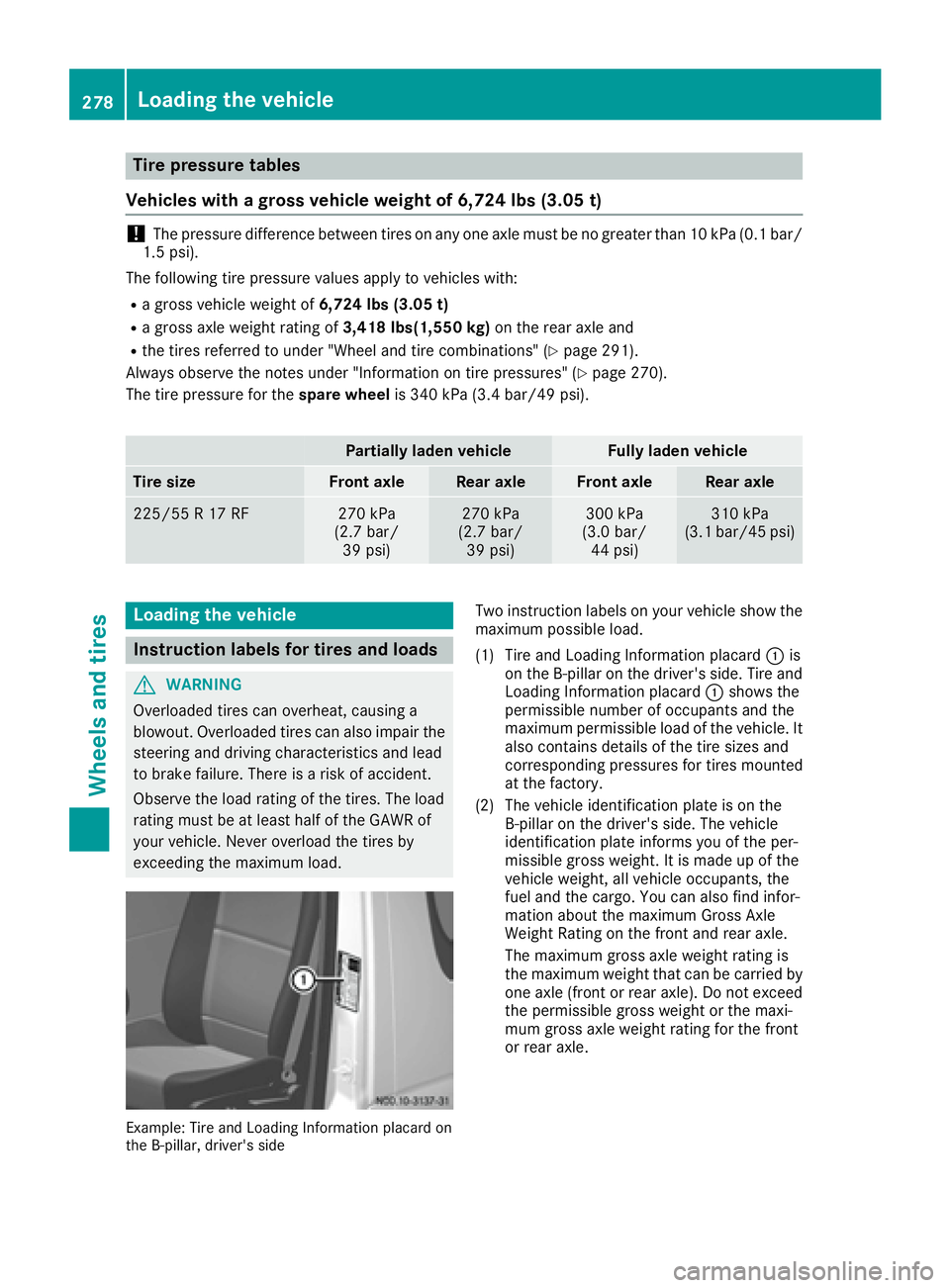
Example: Tire and Loading Information placard on
the B-pillar, driver's side
Two instructio nlab elsony ourvehicle show the
maximu mpossibl eload.
(1) Tire and Loading Information placard :is
on the B-pillar on the driver's side .Tire and
Loading Information placard :showst he
permissible numbe rofoccupants and the
maximu mpermissible loa dofthe vehicle. It
also contains details of the tire sizes and
corresponding pressures for tires mounted
at the factory.
(2) The vehicle identification plate is on the B-pillar on the driver's side .The vehicle
identification plate informs you of the per-
missible gross weight. It is made up of the
vehicle weight, al lvehicle occupants, the
fuel and the cargo .You can also find infor-
matio nabout the maximu mGrossAxle
Weight Rating on the front and rear axle.
The maximu mgross axle weight rating is
the maximu mweight that can be carrie dby
one axle (front or rear axle). Do not exceed the permissible gross weight or the maxi-
mum gross axle weight rating for the front
or rear axle.
278Loading the vehicle
Wheels and tires
Page 301 of 310
Additives
!Do notuse any additive sintheengin eoil.
This could damag ethe engine.
Engineo il viscosity
!If theSAE viscosit yclassoft heengin eoil
used does no tcover th eoutside temperature
range in whic hyou are operating th evehicle,
it mus tbechanged in goo dtime, in particular
before th ecolds eason commences. Using an
engin eoil that does no thavea dequate tem-
peratur echaracteristics can lead to engin e
damage.
The temperature range information of th eSAE
classification always refers to that of fresh oil.
The temperature characteristics of th eengine
oil may deteriorat esignificantly due to agin g
in use, especially at low outside tempera-
tures.
We recommen dthaty ou chang ethe engin e
oil before th ecolds eason commences. Use
an approve dengineo il of th especifie dSAE
class.
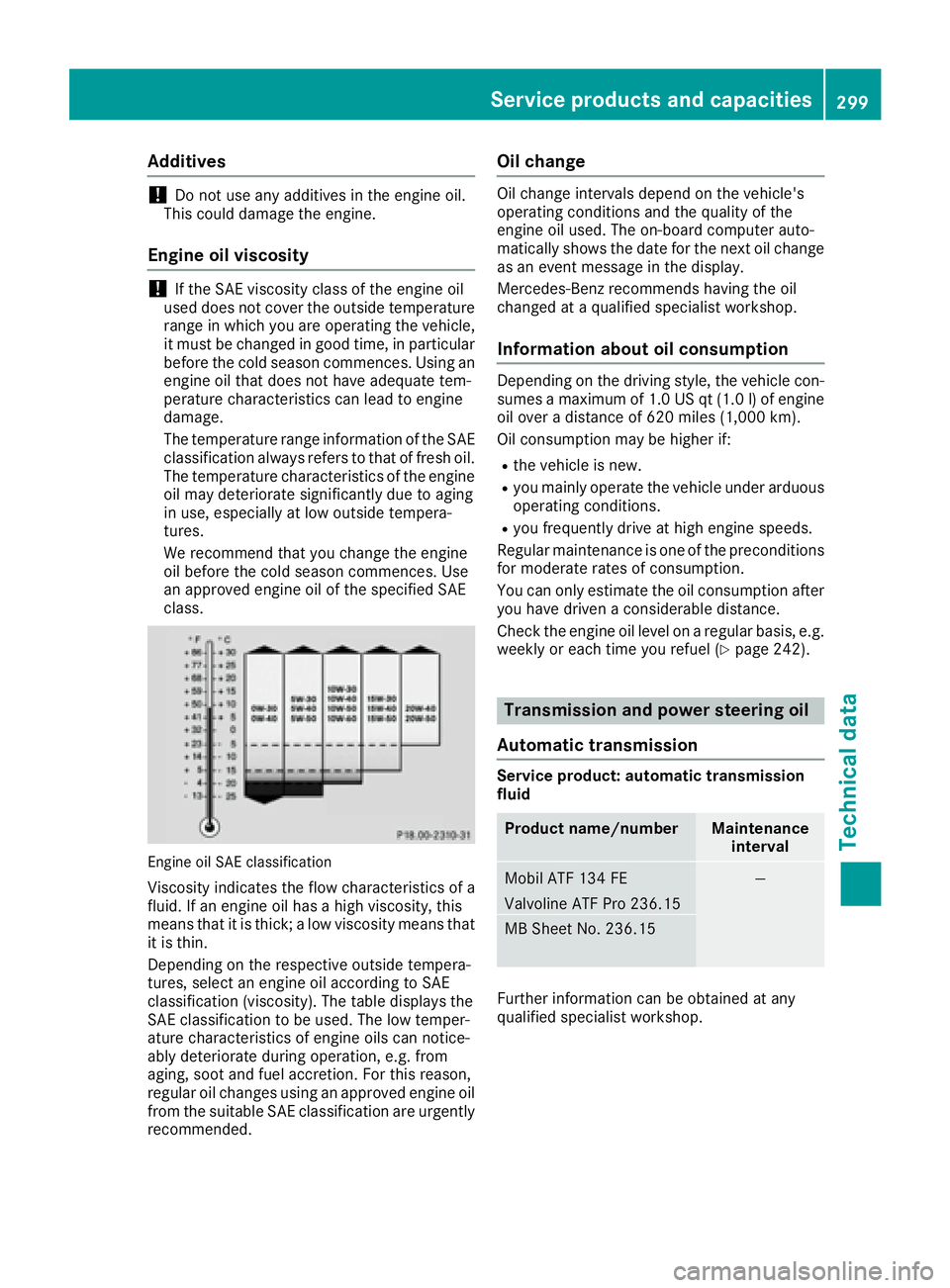
Engin eoil SA Eclassification
Viscosit yindicates th eflowc haracteristics of a
fluid .Ifane ngineo il has ahigh viscosity, this
mean stha titi sthick ;al ow viscosit ymean stha t
it is thin.
Dependin gontherespective outside tempera-
tures, select an engin eoil according to SA E
classification (viscosity). The table displays th e
SA Ec lassification to be used .The low temper-
atur echaracteristics of engin eoils can notice -
ably deteriorat eduring operation ,e.g.f ro m
aging, soo tand fuel accretion .For this reason ,
regular oil changes usin ganapprove dengineo il
from th esuitable SA Eclassification are urgently
recommended.
Oil change
Oil chang eintervals depend on th evehicle's
operating condition sand th equalit yoft he
engin eoil used .The on-board computer auto -
matically shows th edatef or th enexto il chang e
as an event message in th edisplay.
Mercedes-Benz recommends having th eoil
changed at aqualified specialist workshop .
Information abou toil consump tion
Dependin gonthedrivin gstyle, th evehicl econ-
sumes amaximum of 1. 0USqt(1.0l )ofe ngine
oil over adistance of 620 miles (1,000 km).
Oil consumption may be higher if:
Rthe vehicle is new.
Ryou mainly operate the vehicle under arduous
operating conditions.
Ryou frequently drive at high engine speeds.
Regularm aintenance is one of the preconditions
for moderate rates of consumption.
You can only estimate the oil consumption after
you have driven aconsiderable distance.
Check the engine oil level on aregular basis, e.g.
weekly or each time you refuel (
Ypage 242).
Transmission and power steering oil
Automatic transmission
Service product: automatic transmission
fluid
Product name/numberMaintenance interval
Mobil ATF 134 FE
Valvoline ATF Pro 236.15—
MB Sheet No. 236.15
Further information can be obtained at any
qualified specialist workshop.
Service products and capacities299
Technical data
Z
Page 306 of 310
Cargo tie-down points and carriersys-
tems
Cargo tie-down points
General notes
!Observ ethe informatio nonthemaximum
loadingc apacity of th eindividua lcargo tie-
down points.
If you use several cargo tie-down points to
secure aload, you must always tak ethe max-
imum loadingc apacity of theweakest cargo
tie-down pointi ntoa ccount.
If you brak ehard ,for example ,the forces act-
ing coul dbeuptos everal times th eweight
force of th eload. Always use multiple cargo
tie-down points in order to distribut ethe force
absorption.L oad theanchorages evenly.
You will fin dadditional informatio nabout cargo
tie-down points and cargo tie-down rings in the
"Securin gloads"s ection(
Ypage 234).
Cargo tie-down rings
The maximum tensile load of th ecargo tie-down
rings is:
Cargo tie-down
ringsPermissible nomi- nal tensile load
Passenger Vans786. 5lbf
(35 0daN)
Cargo Van1124.0 lbf
(50 0daN)
Guide/load rails
The maximum tensile load for th ecargo tie-
down points on aguide/load rail is:
Cargo tie-down
pointPermissible nomi-
nal tensile load
Guide rail786. 5lbf
(35 0daN)
Load rails on cargo
compartmen tfloor1124.0 lbf
(50 0daN)
Load rail on sidewall225. 0lbf
(10 0daN)
The values specifie dapply only to loads placed
on th ecargo compartmen tfloo rif:
Rth el oad is secured to two cargo tie-down
points on th erail and
Rthed istanc etotheneares tload-securing
pointont hesame rail is approximately 3ft
(1 m).
Roo fracks and rear racks
GWARNING
If yo uuseopenings in the bodywork or
detachabl eparts as steps, yo ucould:
Rslipa nd/or fall
Rdamag ethe vehicl eand cause yourselft o
fall.
There is ariskofi njury.
Alway susesecure climbing aids, e.g. asuita-
bl el adde r.
!Do not us ethe lowe rsliding doo rguide (car-
riage) as astep .Otherwise, yo ucould damage
the paneling and/or the sliding doo rmecha-
nism.
GWARNING
Whe nyou load the roof, the center of gravity
of the vehicl erises and the driving character-
istics change. If yo uexcee dthe maximum roof
load ,the driving characteristics, as well as
steering and braking, will be greatl yimpaired.
There is ariskofana ccident.
Neve rexcee dthe maximum roo floa da nd
adjust your driving style.
!The weight of any load carrie donthe roof,
including the roo fcarrier, mus tnot exceed
the maximum permissible roo fload.
The roo fcarrie rsuppo rts mus tbem ounted at
equal distances.
Install rai lcarriers in front of and behind the
middl eprop.
!For safety reasons,M ercedes-Benz recom-
mend sthat yo uonly us eroofcarrie rsystems
which have bee nteste dand approved for
Mercedes-Benz vehicles. Thi swillh elpt o
avoid damage.
304Vehicl edata
Technical data