WINDOW MERCEDES-BENZ METRIS 2016 MY16 Operator’s Manual
[x] Cancel search | Manufacturer: MERCEDES-BENZ, Model Year: 2016, Model line: METRIS, Model: MERCEDES-BENZ METRIS 2016Pages: 310, PDF Size: 7.28 MB
Page 44 of 310
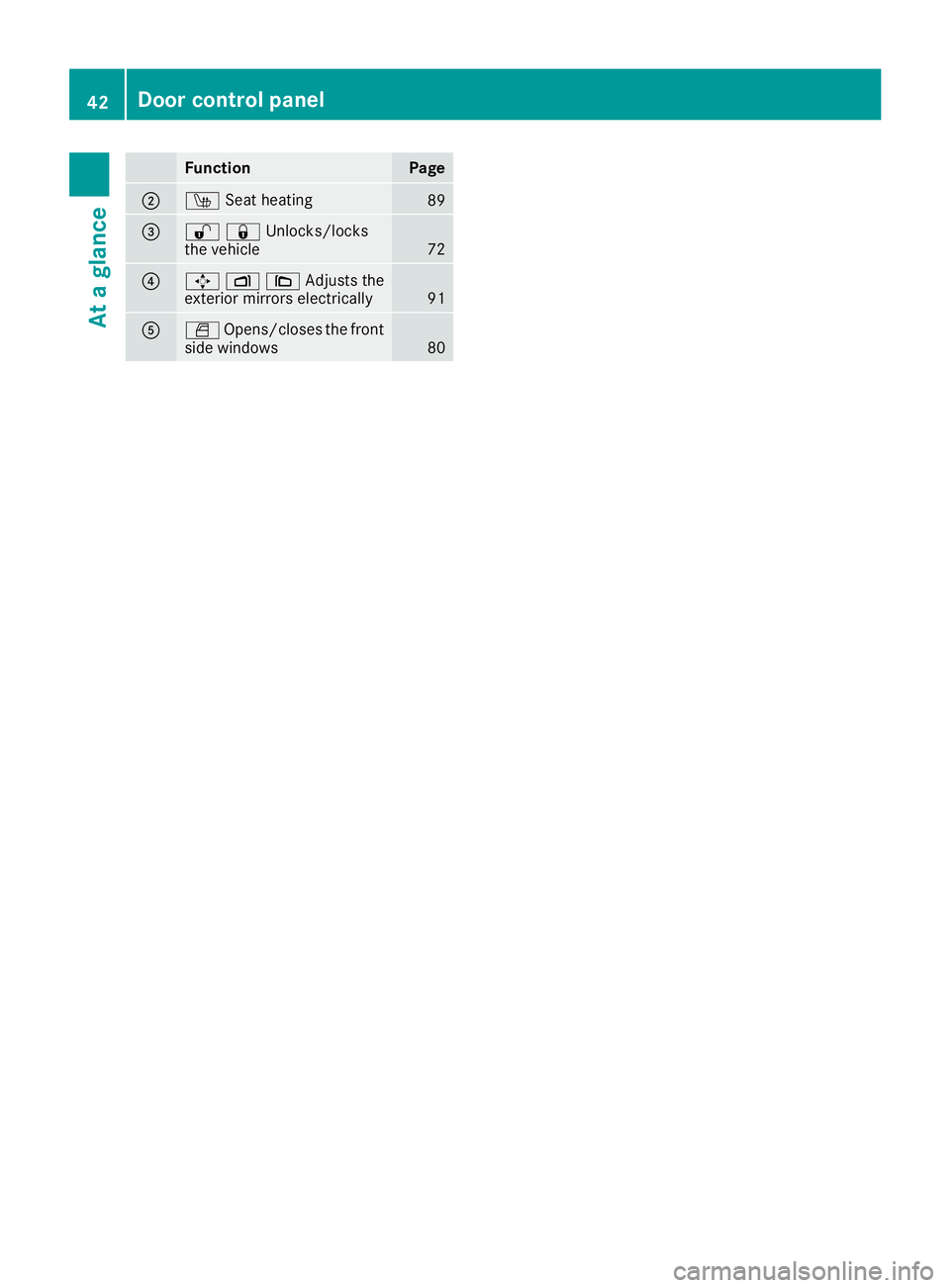
FunctionPage
;ÍSeat heating89
=%&Unlocks/locks
the vehicle72
?7Z\Adjusts the
exterio rmirrors electrically91
AW Opens/close sthe front
side windows80
42Door controlp anel
Atag lance
Page 50 of 310
There is, however, no system availabletoday
that can completely rule out injury or death.
It is also not possible to rule out arisk of injury
caused by an air bag due to the high speed at
which the air bag must be deployed.
Important safety notes
GWARNING
If you do not sit in the corrects eat position,
the air bag cannot protec tasintended and
could even cause additional injury when
deployed. This poses an increased risk of
injury or even fatal injury.
To avoid hazardous situations, alwaysm ake
sure that all of the vehicle's occupants:
Rhave fastened their seat belts correctly,
including pregnant women
Rare sittin gcorrectly and maintain the great-
est possible distance to the air bags
Rfollow the following instructions
Always make sure that there are no objects
between the air bag and the vehicle's occu-
pants.
RCorrectly adjust the seats before driving off.
Always make sure the seat backrest sare
positioned as close to the vertical as possible.
The center of the head restraints should sup-
port the back of the head at about eye level.
RMove the driver's and front-passenger seat as
far back as possible. The driver's seat position
must be such that the vehicle can be driven
safely.
RKeep hands on the outside of the steering
wheel rim. This allows the air bag to deploy
fully.
RAlways sit with your back against the seat
backrest when driving. Do not lean forward,
on the door or against the side window. Oth-
erwise, you are in the air bag deployment
area.
RAlways keep your feet in the footwell in front
of the seat. Do not,f or example, place your
feet on the dashboard. Otherwise, your feet
are in the air bag deployment area.
RSuitable restraint systems must alwaysb e
used for persons under 5ft(1.50 m) in height.
The seat belt cannot be worn correctly by
persons who do not reach this height. If children are also traveling in the vehicle,
please take note of the followingp
oints.
RChild restraint systems should preferably be
installed on the rear seats.
ROnly secureachild on the front-passenger
seat in arearward-facing child restraint sys-
tem if the front-passenger front air bag is
deactivated. If the PASSENGER AIR BAG OFF
indicator lamp is permanently lit, the front-
passenger front air bag is deactivated
(
Ypage 44).
RMake sure you observe the instructions and
safety notes on "Occupan t Classification Sys-
tem (OCS)" (Ypage 50) and "Children in the
vehicle" (Ypage 56), as well as the child
restraint system manufacturer's installation
instructions.
Objects in the passenger compartment
could prevent an air bag from functioning
properly. To prevent risks due to the required
air bag speed after deployment, ensure the fol-
lowing before starting the journey:
Rthere are no persons, animals or objects
between the vehicle occupantsa nd an air
bag.
Rthere are no object sbetween the seat, door
and B-pillar.
Rno hard objects, e.g. coat hangers, hang on
the grab handles or coat hooks.
Rno accessories, such as cup holders, are
attached to the vehicle within the deployment
area of an air bag, e.g. to doors or side win-
dows.
Rthere are no heavy, sharp or fragile object sin
the pocketsofi tems of clothing. Such items
should be suitably stowed elsewhere.
GWARNING
If you modify the air bag cover or affix objects
such as stickers to it, the air bag can no longer
function correctly. There is an increased risk
of injury.
Never modify an air bag cover or affix objects
to it.
Vehicles with window curtain air bags for all
rows of seats:
GWARNING
Sensorstoc ontrol the air bags are located in
the doors. Modifications or work not per-
48Occupant safety
Safety
Page 52 of 310
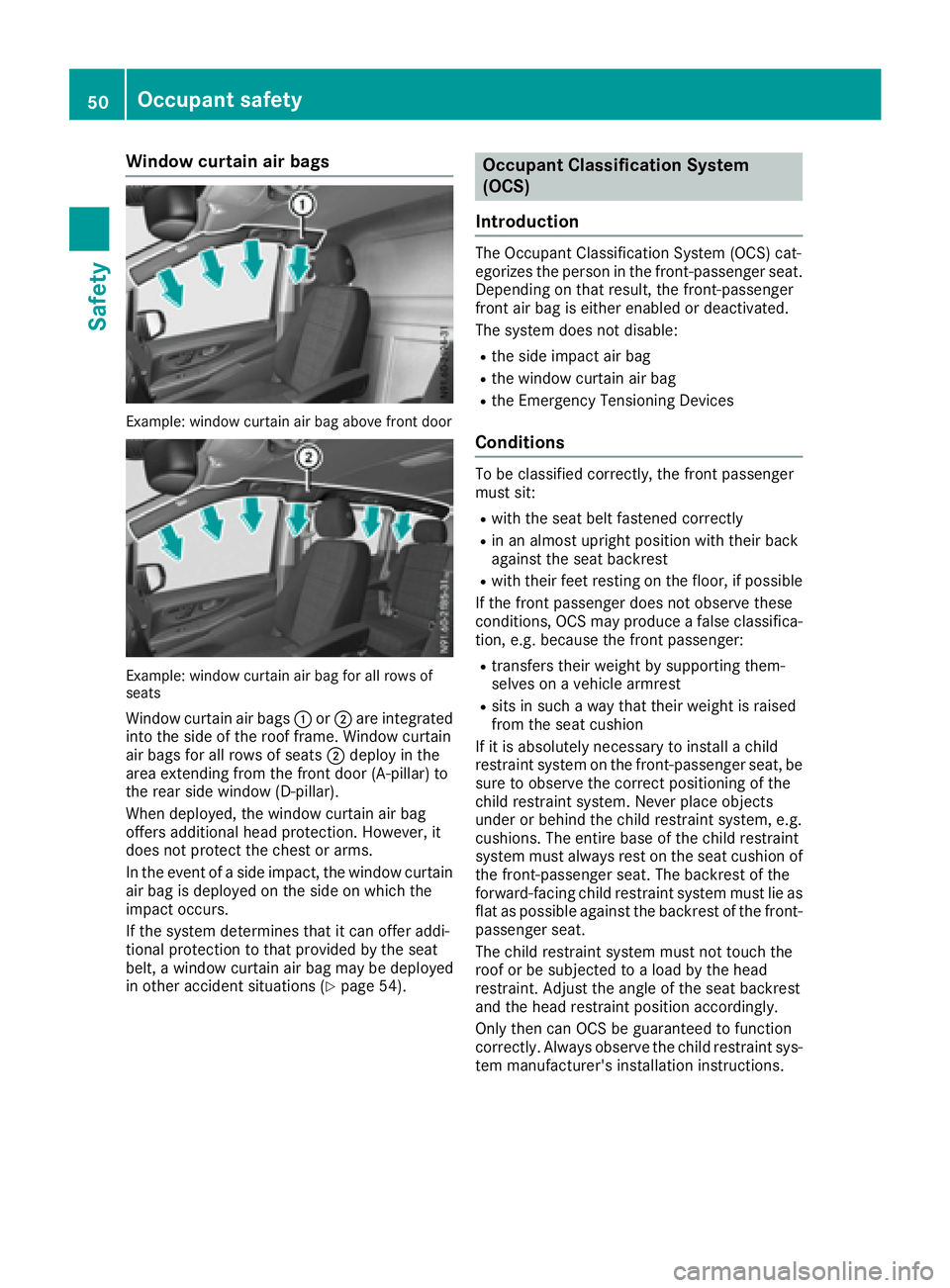
Windowcurtain air bags
Example:window curtai nair bag above front door
Example :window curtai nair bag for all rows of
seats
Windo wcurtai nair bags :or; are integrated
into the side of the roof frame. Windo wcurtain
air bag sfor all rows of seats ;deploy in the
area extending from the front door (A-pillar) to
the rear side window (D-pillar).
When deployed, the window curtai nair bag
offers additiona lheadp rotection. However, it
does not protect the chest or arms.
In the event of aside impact, the window curtain
air bag is deploye donthe side on which the
impact occurs.
If the syste mdetermines that it can offer addi-
tional protection to that provided by the seat
belt, awindow curtai nair bag may be deployed
in other accident situations (
Ypag e54).
Occupant Classificatio nSystem
(OCS)
Introduction
The Occupant Classification System (OCS) cat-
egorizes the personint he front-passenger seat.
Depending on that result, the front-passenger
front air bag is either enabled or deactivated.
The syste mdoes not disable:
Rthe side impact air bag
Rthe window curtai nair bag
Rthe Emergency Tensioning Devices
Conditions
To be classified correctly ,the front passenger
must sit:
Rwith the seatb eltfastened correctly
Rin an almost upright position with their back
against the seatb ackrest
Rwith their feet resting on the floor, if possible
If the front passenger does not observe these
conditions, OCS may produce afals ec lassifica-
tion, e.g. because the front passenger:
Rtransfers their weight by supporting them-
selve sonav ehiclea rmrest
Rsits in such awaythat their weight is raised
from the seatc ushion
If it is absolutely necessary to instal lachild
restraint syste monthe front-passenger seat, be
sure to observe the correct positioning of the
child restraint system. Never place objects
under or behind the child restraint system, e.g.
cushions. The entire bas eofthe child restraint
syste mmust alway srest on the seatc ushion of
the front-passenger seat. The backres tofthe
forward-facing child restraint syste mmust lie as
flat as possible against the backres tofthe front-
passenger seat.
The child restraint syste mmust not touch the
roof or be subjected to aloadbyt he head
restraint. Adjust the angl eofthe seatb ackrest
and the headr estraint position accordingly.
Only then can OCS be guaranteed to function
correctly .Always observe the child restraint sys-
tem manufacturer's installation instructions.
50Occupant safety
Safety
Page 57 of 310
Have the vehicle towedtoaqualifiedspecial-
ist workshop in orde rtohavead eployed air
bagr eplaced.
It is important for your safety and that of any
passengers to hav edeployed ai rbagsr eplaced
and to hav eany malfunctioning ai rbags
repaired. Thisw illh elptom ake surethe ai rbags
continuetop erform theirp rotective functio nfor
the vehicle occupants in the event of acrash.
GWARNING
PyrotechnicE mergency Tensioning Devices
that hav ebeend eployed are no longer opera-
tiona land are unable to perform theiri nten-
ded protective function. Thisp oses an
increased risk of injury or even fata linjury.
Therefore, hav epyrotechnicE mergency Ten-
sioning Device swhich hav ebeent riggered
immediately replaced at aqualifie dspecialist
workshop.
If the Emergency Tensioning Device sorairbags
are deployed, yo uwillh earab angandasmall
amount of powder may also be released.T he
6 restraint system warning lamp will light up.
Only in rare case swillt he bang affect your hear-
ing. The powder released is generally not haz-
ardous to health, it coul dhowever cause short-
term breathing difficultie sinpeople with asthma
or other respiratory problems. If it is safe to do
so, yo ushould leave the vehicle immediately or
openaw indow in orde rtoprevent breathing
difficulties.
Air bags and pyrotechni cEmergency Tensioning
Device s(ETDs) contai nperchlorate material,
which may require specialh andling and regard
for the environment. Check with your loca lgov-
ernment’sd isposal guidelines .Calif ornia resi-
dents, see www.dtsc.ca.gov/
HazardousWaste/Perchlorate/index.cfm .
Methodofoperation
During the first stag eofacollision, the restraint
system control uni tevaluates important physi-
cal data relating to vehicle deceleratio noraccel-
eration, such as:
RDuration
RDirection
RIntensity Base
dont he evaluatio nofthis data, the
restraint system control uni ttriggers the Emer-
gency Tensioning Device sinthe event of afron-
tal or rear-end collision.
An Emergency Tensioning Device can only be
triggered if:
Rthe ignition is switched on
Rthe components of the restraint system are
operational .You can find furthe rinformation
unde r"Re straint system warning lamp"
(
Ypage 43)
Rthe bel ttongueisi nserted into the buckle on
the respective front seat
If the restraint system control uni tdetects ahigh
accident severity,a dditional components of the
restraint system are deployed independently of
one anothe rincertainfrontal collision situa-
tions:
RFront ai rbags
RWindow curtain ai rbag,ift he system deter-
mines that it can offer additional protection to
that provided by the seatb elt
Depending on the person occupying the front-
passenger seat, the front-passenger ai rbag is
activated or deactivated. The front-passenger
front ai rbag can only be deployed in an accident
if the PASSENGER AIR BAG OFF indicator lamp
is off. Observe the informatio nonthe
PASSENGER AIR BAG OFF indicator lamp
(
Ypage 44).
You rvehicle has dual-stage front ai rbags. Dur-
ing the first deployment stage, the front ai rbag
fills with propellant gas which reduces the risk of
injury .The second stag eisthen triggered withi
n
mi
lliseconds, filling the front ai rbag with the
maximum amount of propellant gas.
The deployment threshold sfor the Emergency
Tensioning Device sand ai rbagsa re calculated
on the basis of the vehicle deceleratio noraccel-
eration occurring at various points in the vehi-
cle. Thisp rocess is pre-emptiv einnature. The
ai rb ag mus tbed eployed on time, at the start of
the collision.
The rate of vehicle deceleratio noracceleration
and the directio nofthe force are essentially
determine dby:
Rdistribution of the force during the impact
Rcollision angle
Rdeformation characteristics of the vehicle
Rcharacteristics of the object with which the
vehicle has collided
Occupants afety55
Safety
Z
Page 58 of 310
Factors which can only be seenand measured
afte rthe collision has occurred do not pla ya
decisive roleint he deployment of an ai rbag,nor
do they provide an indication of ai rbag deploy-
ment.
The vehicle may be considerably deformed with-
outana irbagb eing deployed. Thisist he case if
only relativelye asilyd eformable parts have
bee nhit and ahighr ate of deceleration has not
bee nreached .Conversely ,anairbagm ay be
deployed even though the vehicle suffers only
minor deformation. Thisist he case if, for exam-
ple ,very rigid vehicle parts such as the longitu-
dina lbodym embers are hit in an accident and
the rate of deceleration is sufficient.
If the restraint system control uni tdetects aside
impact or that the vehicle is rolling over,t he rel-
evant restraint system components are
deployed independently of one another depend-
ing on the anticipated typ eofaccident.
RSide impact ai rbag and pelvis ai rbag on the
sid eonw hich an impact occurs, independ-
ently of the Emergency Tensioning Device and sea tbeltu sage
The sid eimpact ai rbag on the front-
passenger sid edeploy sunder the following
conditions:
-the OCS system detects that the front-
passenger sea tisoccupied or
-the bel ttongueh as engaged in the belt
buckle of the front-passenger seat.
RWindow curtain ai rbag on the sid eofthe col-
lision, regardless of sea tbeltu se and whether
front-passeng er se
ati
so ccupied
REmergency Tensioning Devices, if the system
determinesthat they can offera dditional pro-
tection for the vehicle occupants in this sit-
uation
RWindow curtain ai rbagsont he driver's and
front-passenger sides in certain rollover sit-
uations if the system determine sthat they
can offera dditional protection to that provi-
ded by the sea tbelt
iNot al lairbags are deployed in an accident.
The variousa irbags ystems wor kindepend-
ently of each other. How the ai
rbag system works is determined
by the severity of the accident detected,
especiall ythe vehicle deceleration or accel-
eration, and the apparent typ eofaccident:
Rfrontalc ollision
Rsideimpact
Rrollover
Automatic measures after an acci-
dent
Immediately afte ranaccident, the following
measures are implemented ,depending on the
typ eand severity of the impact:
Rthe hazard warning lamps are activated
Rthe emergency lighting is activated
Rthe vehicle doors are unlocked
Rthe front sid ewindow sare lowered
Rthe engine is switched off and the fue lsupply
is cut off
Children in the vehicle
Important safety notes
Accident statistics show that childre nsecured
in the rears eats are safer than childre nsecured
in the front seats. For this reason, Mercedes-
Benz stronglya dvise sthat yo uinstall achild
restraint system on arears eat. Children are
generally better protected there.
If ac hildy ounge rthan twelve years and under
5ft( 1.50 m) in height is traveling in the vehicle:
Ralways securethisc hild in arestraint system
approved for Mercedes-Benz vehicles .The
child restraint systemm ustbea ppropriate to
the age, weight and size of the child.
Rbe sure to observe the instructions and safety
note sint hissectio nina dditiontot he child
restraint systemm anufacturer's installation
instructions.
Ralways observe the instructions and safety
note sont he "Occupant Classification System
(OCS) "(
Ypage 50).
56Children in the vehicle
Safety
Page 82 of 310
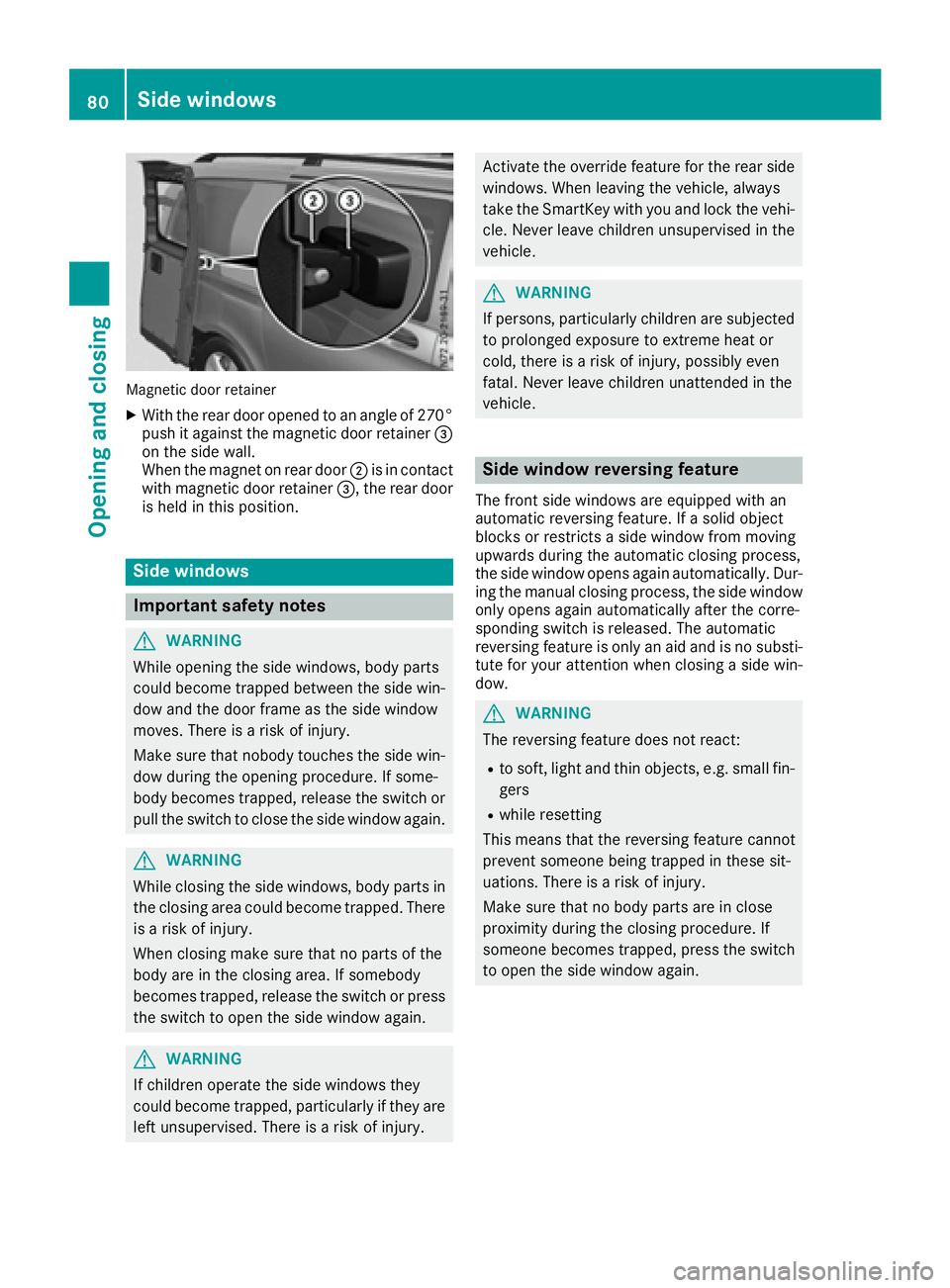
Magnetic door retainer
XWith the rear door opened to an angle of 270°push it against the magnetic door retainer =
on the side wall.
When the magnet on rear door ;is in contact
with magnetic door retainer =,the rear door
is held in this position.
Side windows
Important safety notes
GWARNING
While opening the side windows, body parts
could become trapped between the side win-
dow and the door frame as the side window
moves. There is arisk of injury.
Make sure that nobody touches the side win-
dow during the opening procedure. If some-
body becomes trapped, release the switch or
pull the switch to close the side window again.
GWARNING
While closing the side windows, body parts in
the closing area could become trapped. There is ar isk of injury.
When closing make sure that no parts of the
body are in the closing area. If somebody
becomes trapped, release the switch or press
the switch to open the side window again.
GWARNING
If children operate the side windows they
could become trapped, particularly if they are left unsupervised. There is arisk of injury.
Activate the override feature for the rear side
windows. When leaving the vehicle, always
take the SmartKey with you and lock the vehi-
cle. Never leave children unsupervised in the
vehicle.
GWARNING
If persons, particularly children are subjected to prolonged exposure to extrem eheat or
cold, there is arisk of injury, possibly even
fatal. Never leave children unattended in the
vehicle.
Side window reversing feature
The front side windows are equipped with an
automatic reversing feature. If asolid object
blocks or restrictsas ide window from moving
upwards during the automatic closing process,
the side window opens again automatically .Dur-
ing the manual closing process, the side window
only opens again automatically after the corre-
sponding switch is released. The automatic
reversing feature is only an aid and is no substi-
tute for your attention when closing aside win-
dow.
GWARNING
The reversing feature does not react:
Rto soft, light and thin objects, e.g. small fin-
gers
Rwhile resetting
This means that the reversing feature cannot
prevent someone being trapped in these sit-
uations. There is arisk of injury.
Make sure that no body parts are in close
proximity during the closing procedure. If
someone becomes trapped, press the switch
to open the side window again.
80Side windows
Opening and closing
Page 83 of 310
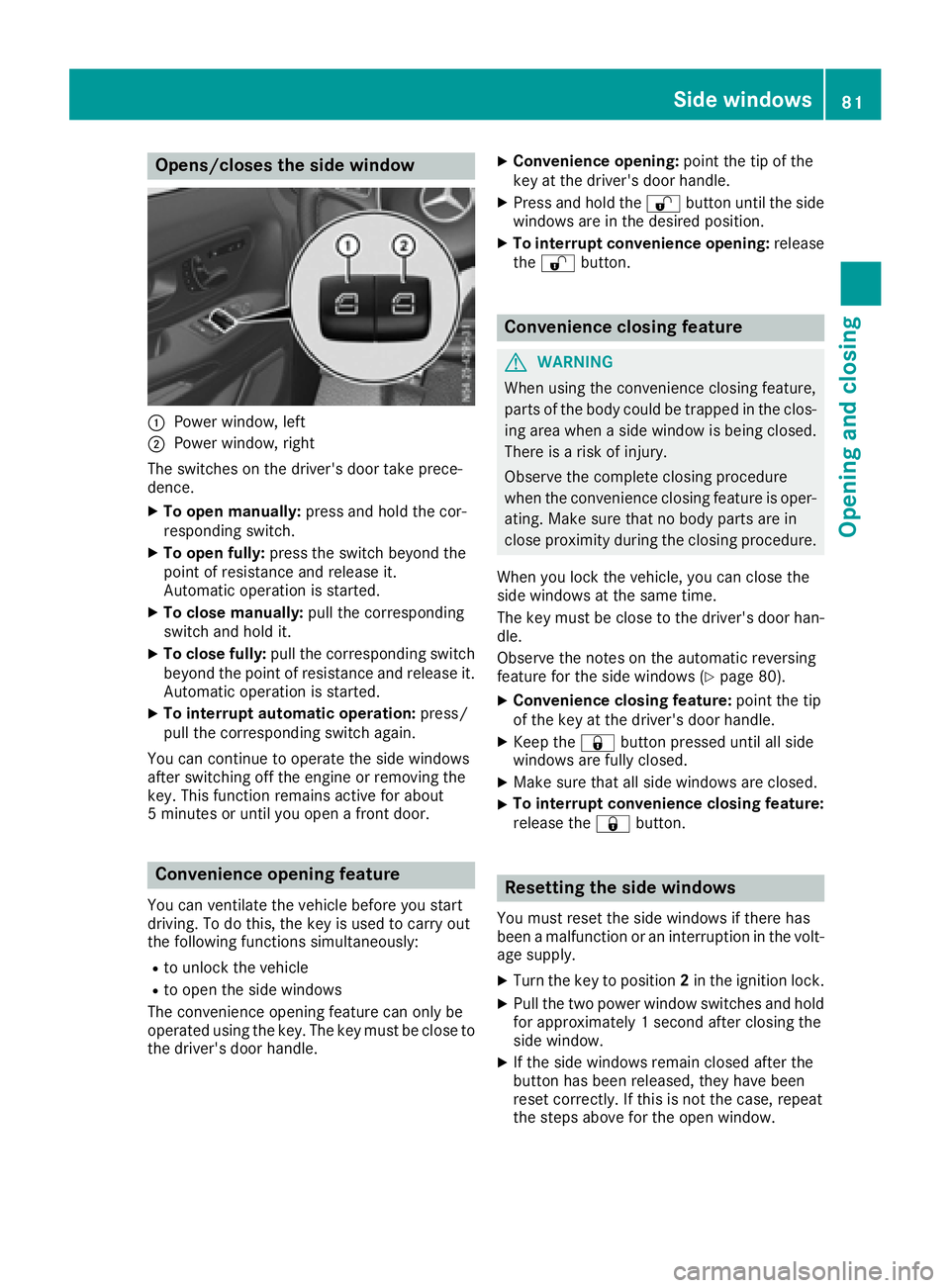
Opens/closes the side window
:Power window, left
;Power window, right
The switches on the driver's door take prece-
dence.
XTo open manually: press and hold the cor-
respondin gswitch.
XTo open fully: press the switch beyond the
point of resistance and release it.
Automatic operation is started.
XTo close manually: pull the corresponding
switch and hold it.
XTo close fully: pull the correspondin gswitch
beyond the point of resistance and release it.
Automatic operation is started.
XTo interrupt automatic operation: press/
pull the correspondin gswitch again.
You can continue to operate the side windows
after switchin goff the engine or removingt he
key. This function remains active for about
5m inutes or until you open afrontd oor.
Convenienceo pening feature
You can ventilate the vehicle before you start
driving. To do this, the key is used to carry out
the following function ssimultaneously:
Rto unlock the vehicle
Rto open the side windows
The convenience opening feature can only be
operated using the key. The key must be close to
the driver's door handle.
XConvenience opening: point the tip of the
key at the driver's door handle.
XPress and hold the %button until the side
windows are in the desired position.
XTo interrupt convenience opening: release
the % button.
Conveniencec losing feature
GWARNING
When using the convenience closing feature,
parts of the body could be trapped in the clos-
ing area when aside window is being closed.
There is arisk of injury.
Observe the completec losing procedure
when the convenience closing feature is oper-
ating. Make sure that no body parts are in
close proximity during the closing procedure.
When you lock the vehicle, you can close the
side windows at the same time.
The key must be close to the driver's door han-
dle.
Observe the notes on the automatic reversing
feature for the side windows (
Ypage 80).
XConvenience closing feature: point the tip
of the key at the driver's door handle.
XKeep the &button pressed until all side
windows are fully closed.
XMake sure that all side windows are closed.
XTo interrupt convenience closing feature:
release the &button.
Resetting the side windows
You must reset the side windows if there has
beenamalfunction or an interruption in the volt-
age supply.
XTurn the key to position 2in the ignition lock.
XPull the two power window switches and hold
for approximately 1seconda fter closing the
side window.
XIf the side windows remain closed after the
button has been released, they have been
reset correctly. If this is not the case, repeat
the steps above for the open window.
Side windows81
Opening and closing
Z
Page 84 of 310
Problems with the side windows
GWARNING
If you close aside window again immediately
after it has been blocked or reset, the side
window closes with increased or maximum
force. The reversing feature is then not active. Parts of the body could be trapped in the clos-
ing area in the process. This poses an
increased risk of injury or even fatal injury.
Make sure that no parts of the body are in the
closing area. To stop the closing process,
release the switch or push the switch again to
reopen the side window.
If you cannot completely open or close aside
window:
If there are no object sorleaves in the window
guide that prevent the sliding sunroof from clos-
ing, there has been amalfunction or the on-
board voltage has been interrupted.
XReset the side window (Ypage 81).
82Side windows
Opening and closing
Page 104 of 310
lected on the windshield can scratchthe glass
if wiping takes place when the windshield is
dry.
If it is necessary to switc honthe windshield
wipers in dry weathe rconditions, always use
washer fluid when operating the windshield
wipers.
!If the windshield wipers leave smearsont he
windshield after the vehicle has been washed
in an automatic car wash, wax or other resi-
dues may be the reason for this .Clean the
windshield using washer fluid after washing
the vehicle in an automatic car wash.
!Intermitten twiping with rain sensor: due to
optical influences and the windshield becom-
ing dirtyind ry weatherconditions, the wind-
shield wipers may be activate dinadvertently.
This could the ndamage the windshield wiper
blades or scratc hthe windshield.
For this reason,y ou should always switc hoff
the windshield wipers in dry weather.
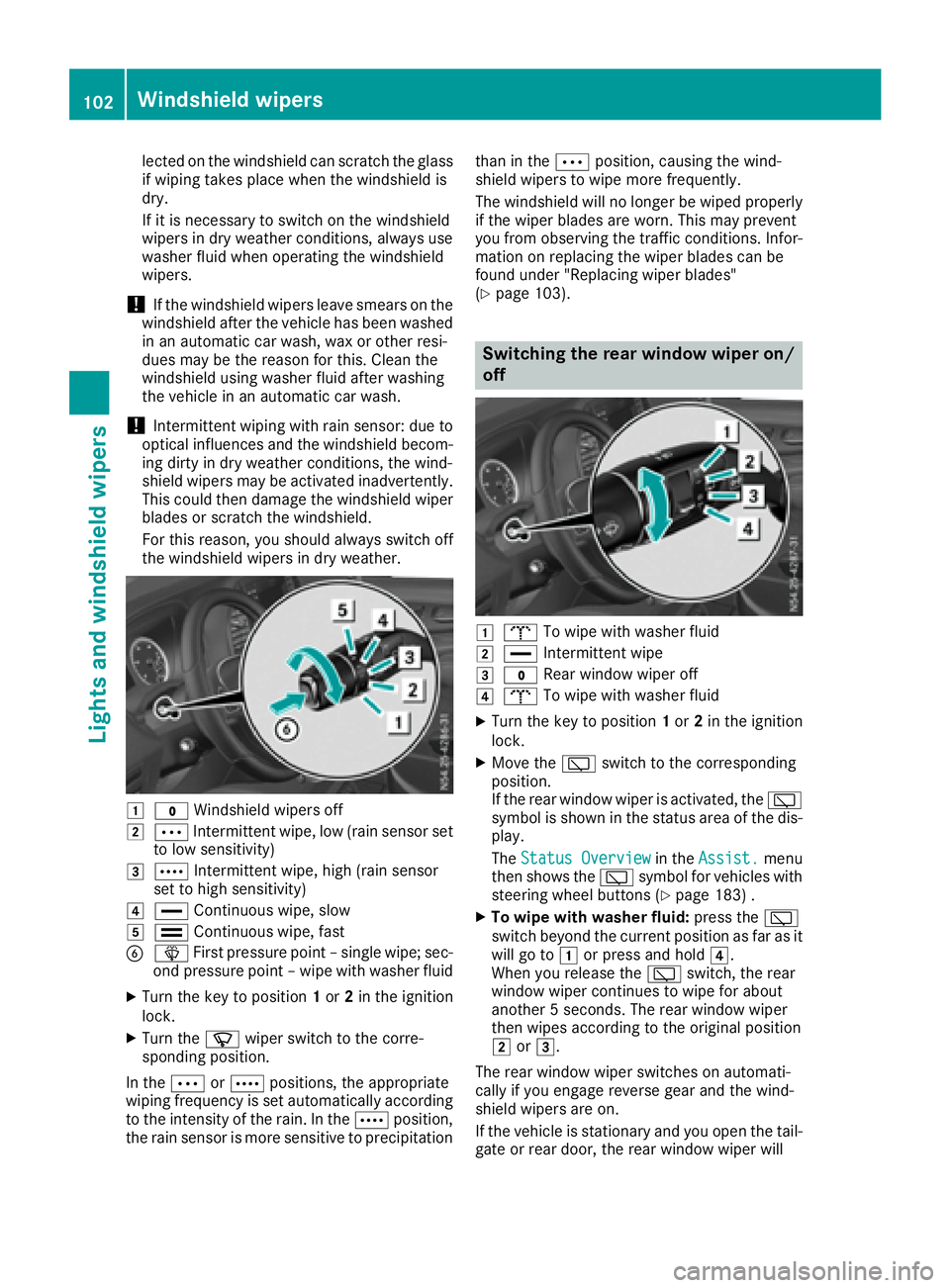
1$ Windshield wipers off
2ÄIntermitten twipe, low (rain sensor set
to low sensitivity)
3Å Intermitten twipe, high (rain sensor
set to high sensitivity)
4° Continuous wipe, slow
5¯Continuous wipe, fast
BîFirstpressure point –single wipe; sec-
ond pressure point –wipe with washer fluid
XTurn the key to position 1or 2in the ignition
lock.
XTurn the íwiper switc htothe corre-
sponding position.
In the ÄorÅ positions ,the appropriate
wiping frequenc yisset automatically according
to the intensity of the rain. In the Åposition,
the rain sensor is more sensitiv etoprecipitation than in the
Äposition, causin gthe wind-
shield wipers to wipe more frequently.
The windshield will no longer be wiped properly
if the wiper blades are worn.T his may prevent
you fromo bservingthe traffic conditions. Infor-
matio nonr eplacing the wiper blades can be
foundu nder "Replacingw iper blades"
(
Ypage 103).
Switchin gthe rea rwindow wiper on/
off
1b To wipe with washer fluid
2°Intermitten twipe
3$ Rear window wiper off
4bTo wipe with washer fluid
XTurn the key to position 1or 2in the ignition
lock.
XMove the èswitchtot he corresponding
position.
If the rear window wiper is activated, the è
symbol is shown in the status area of the dis-
play.
The Status Overview
in the Assist.menu
the nshows the èsymbol for vehicles with
steeringw heel buttons (
Ypage 183) .
XTo wipe with washer fluid: press theè
switc hbeyond the current position as far as it
will go to 1or press and hold 4.
When you release the èswitch, the rear
window wiper continues to wipe for about
another 5seconds. The rear window wiper
the nw ipes accordingtot he original position
2 or3.
The rear window wiper switches on automati-
cally if you engag ereverse gear and the wind-
shield wipers are on.
If the vehicle is stationar yand you open the tail-
gate or rear door, the rear window wiper will
102Windshield wipers
Lightsa nd windshield wipers
Page 105 of 310
stop automatically.The rear window wiper will
only resume wiping againw hen the tailgate and
rear door are closed and you pull awaya gain.
The rear window will no longer be wiped properly
if the wiper blade is worn. This may prevent you
from observing the traffic conditions. Informa-
tion on replacing the wiper blade can be found
under "Replacing wiper blades" (
Ypage 103).
Replacing the wiper blades
Important safety notes
GWARNING
If the windshieldw ipers begin to move while
you are changing the wiper blades, you could be trapped by the wiper arm. There is arisk of
injury.
Always switch off the windshieldw ipers and
ignition before changing the wiper blades.
!Never open the hood/tailgate or rear doors
if aw indshieldw iper arm has been folded
awayf rom the windshield/rear window.
Never fold awindshieldw iper arm without a
wiper blade back onto the windshield/rear
window.
Hold the windshieldw iper arm firmly when
you change the wiper blade.Ify ou release the
windshieldw iper arm without awiper blade
and it falls onto the windshield/rear window,
the windshield/rear window may be damaged
by the force of the impact.
Mercedes-Benz recommends that you have
the wiper bladesc hanged ataqualified spe-
cialist workshop.
!Only hold the wiper blade by the wiper arm.
You could otherwise damage the wiper rub-
ber.
Wiper bladesa re wear parts. The windshieldw ill
no longer be wiped properly if the wiper blades
are worn. This may prevent you from observing
the traffic conditions.
Please observe the service indicator after
changing the wiper bladesoft he windshield
wiper.
Service indicator
Replacement wiper bladesf or the windshield
wiper have aservice indicator on the tip of the
wiper blade.
Depending on the amount of use, the service
indicator will change color from black to yellow.
Change the wiper blade if:
Rthe wiper blade is damaged
Rthe service indicator has turned yellow
In order to activate the service indicator, you
have to remove the protective film
(
Ypage 103).
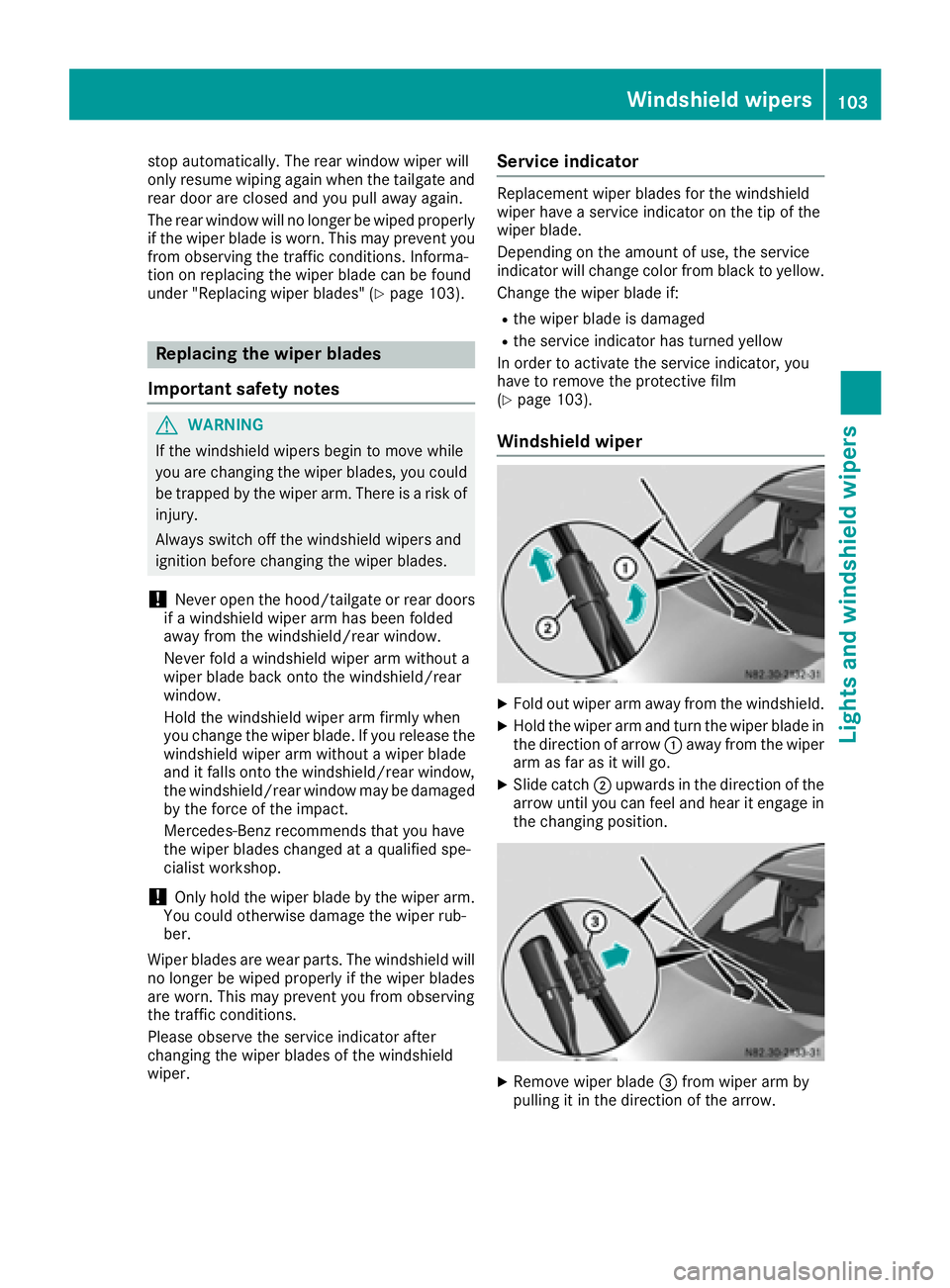
Windshield wiper
XFold out wiper arm awayf rom the windshield.
XHold the wiper arm and turn the wiper blade in
the direction of arrow:awayf rom the wiper
arm as far as it will go.
XSlide catch ;upwards in the direction of the
arrow until you can feel and hear it engage in
the changing position.
XRemove wiper blade =from wiper arm by
pulling it in the direction of the arrow.
Windshield wipers103
Lights and windshield wipers
Z