cooling MERCEDES-BENZ METRIS 2016 MY16 Operator’s Manual
[x] Cancel search | Manufacturer: MERCEDES-BENZ, Model Year: 2016, Model line: METRIS, Model: MERCEDES-BENZ METRIS 2016Pages: 310, PDF Size: 7.28 MB
Page 119 of 310
Make sure that all vehicle occupants always
maintainasufficient distance to the air out-
lets. If necessary, redirect the airflow to
another area of the vehicle interior.
The center and side air vents are adjustable.
The air vents can also be adjusted on vehicles
with rear-compartment air conditioning.
In order to ensure the direct flow of fresh air
through the air vents into the vehicle interior,
please observe the following notes:
Rkeep the air inlet between the windshield and
the hood free of blockages, such as ice, snow
or leaves.
Rnever cover the vents or the ventilation grilles
in the vehicle interior.
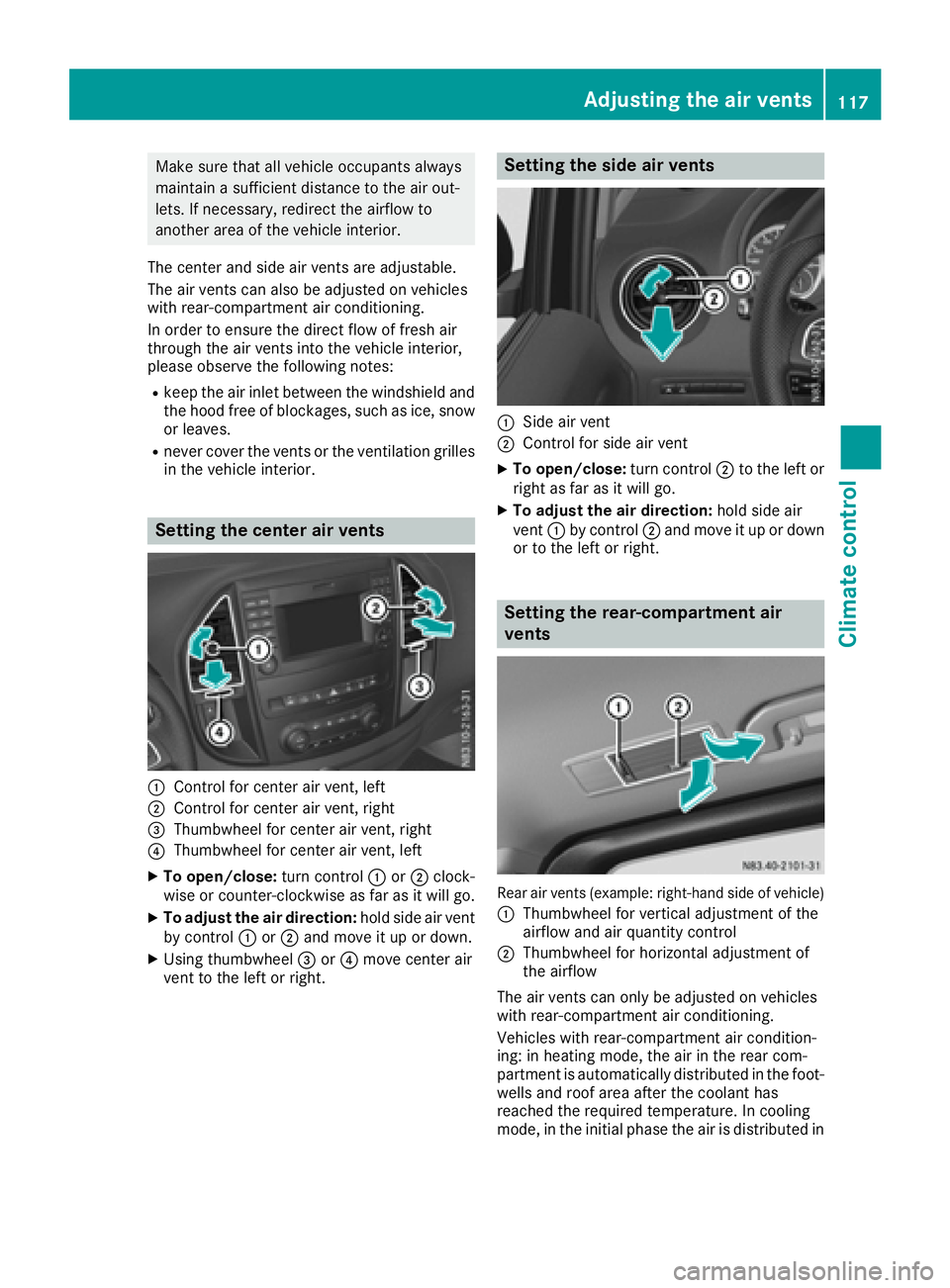
Setting the center air vents
:Control for center air vent, left
;Control for center air vent, right
=Thumbwheel for center air vent, right
?Thumbwheel for center air vent, left
XTo open/close: turn control:or; clock-
wise or counter-clockwise as far as it will go.
XTo adjust the air direction: hold side air vent
by control :or; and move it up or down.
XUsing thumbwheel =or? move center air
vent to the left or right.
Setting the side air vents
:Side air vent
;Control for side air vent
XTo open/close: turn control;to the left or
right as far as it will go.
XTo adjust the air direction: hold side air
vent :by control ;and move it up or down
or to the left or right.
Setting the rear-compartment air
vents
Rear air vents (example: right-hand side of vehicle)
:
Thumbwheel for vertical adjustment of the
airflow and air quantity control
;Thumbwheel for horizontal adjustment of
the airflow
The air vents can only be adjusted on vehicles
with rear-compartment air conditioning.
Vehicles with rear-compartment air condition-
ing: in heating mode, the air in the rear com-
partment is automatically distributed in the foot-
wells and roof area after the coolant has
reached the required temperature. In cooling
mode, in the initial phase the air is distributed in
Adjusting the air vents117
Climatec ontrol
Z
Page 200 of 310
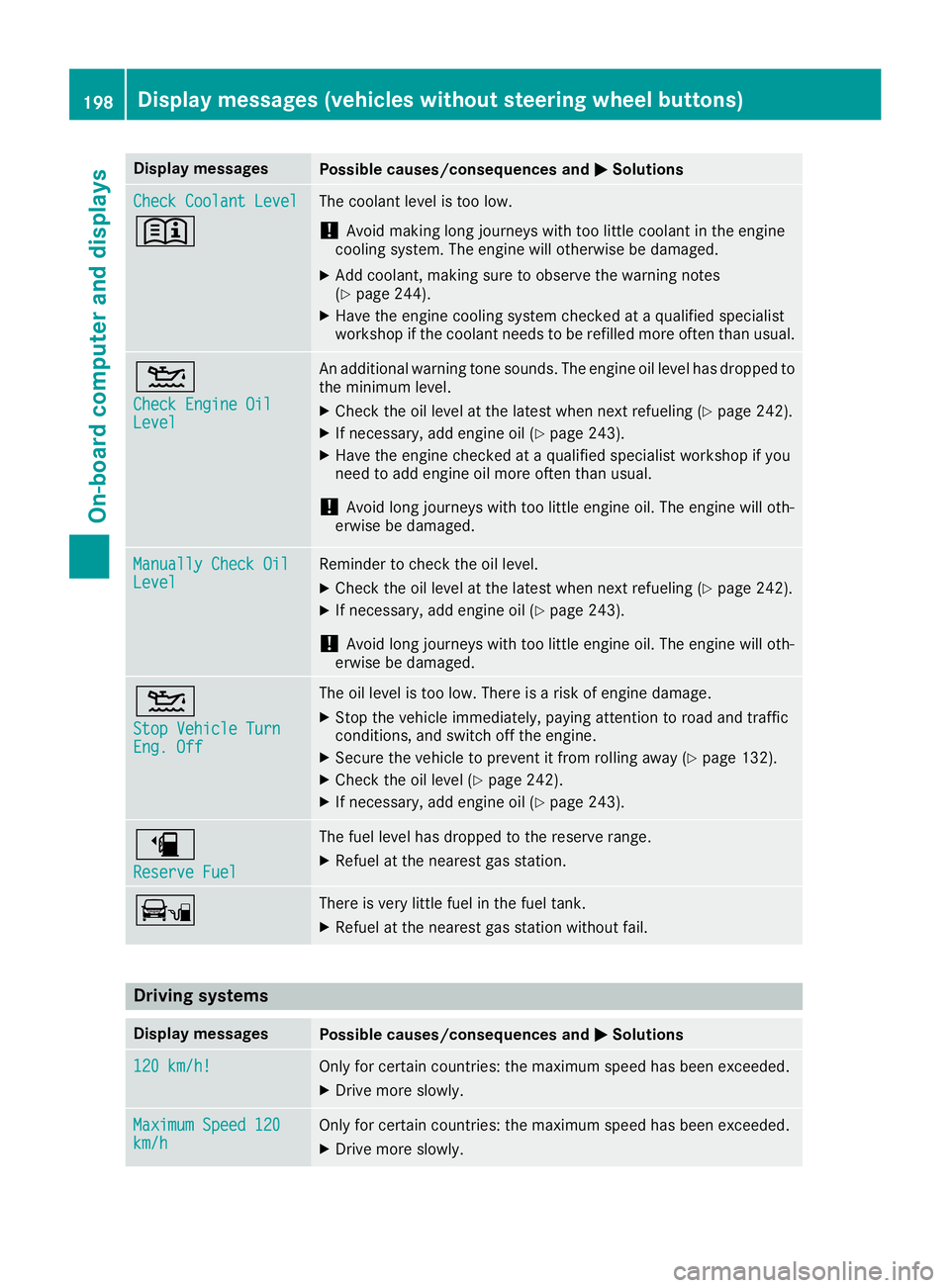
Display messagesPossible causes/consequences andMSolutions
Check CoolantLevel
+
The coolan tlevel is to olow.
!Avoid making lon gjou rneys wit htoo littl ecoolan tint heengin e
coolin gsystem. The engin ewill otherwise be damaged.
XAddc oolant, making sur etoobservethe warning note s
(Ypage 244).
XHav ethe engin ecoolings ystem checke dataqualified specialist
workshop if th ecoolan tneeds to be refilled mor eoften than usual.
4
Check Engine OilLevel
An additional warning tone sounds. The engin eoil level has dropped to
th em inimum level.
XChec kthe oil level at th elatest when next refuelin g(Ypage 242).
XIf necessary, add engineoil(Ypage 243).
XHav ethe engin echecked ataq ualified specialist workshop if you
need to add engin eoil mor eoften than usual.
!Avoid lon gjou rneys wit htoo littl eengineo il. The engin ewill oth-
erwise be damaged.
Manually Check OilLevelReminder to chec kthe oil level.
XChec kthe oil level at th elatest when next refuelin g(Ypage 242).
XIf necessary, add engineoil(Ypage 243).
!Avoid lon gjou rneys wit htoo littl eengineo il. The engin ewill oth-
erwise be damaged.
4
Sto pVehicl eTurnEng .Off
The oil level is to olow. There is ariskofe ngined amage.
XStop th evehicl eimmediately, payin gattention to roa dand traffic
conditions, and switch off th eengine.
XSecur ethe vehicl etopreventitfromr ollin gaway (Ypage 132).
XChec kthe oil level (Ypage 242).
XIf necessary, add engin eoil(Ypage 243).
æ
Reserv eFuel
The fuel level has dropped to th ereserv erange.
XRefue lattheneares tgas station .
ÏThere is ver ylittl efuel in th efuel tank.
XRefue lattheneares tgas station without fail .
Driving systems
Display messagesPossible causes/consequences and MSolutions
120 km/h!Only for certain countries: themaximum speed has been exceeded .
XDrive moreslowly.
Maximu mSpeed 120km/hOnly for certain countries: th emaximum speed has been exceeded .
XDrive moreslowly.
198Display message s(vehicles withou tsteering wheelbuttons)
On-board computera nd displays
Page 214 of 310
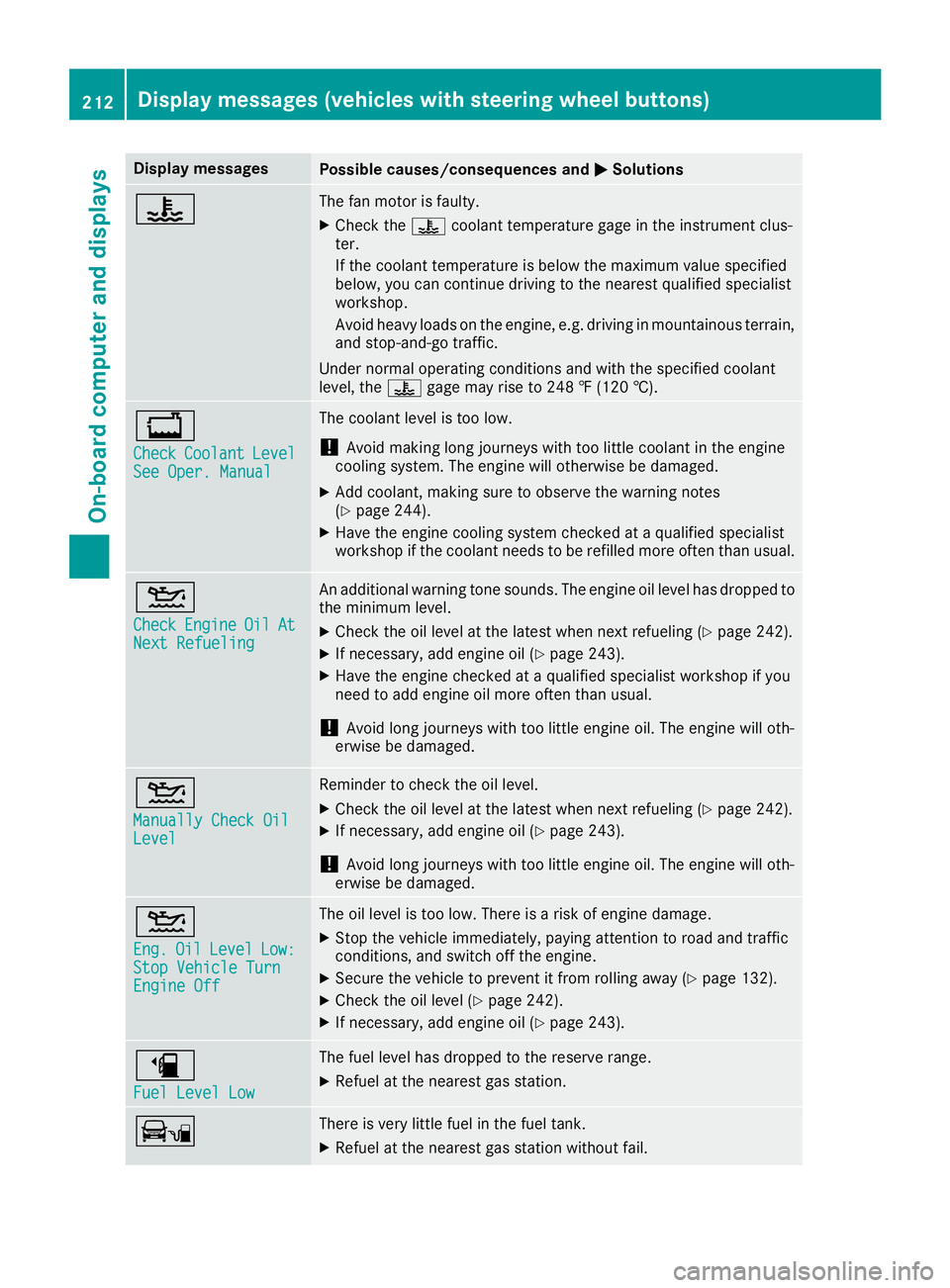
Display messagesPossible causes/consequences andMSolutions
?The fan motor is faulty.
XCheckthe ? coolan ttem perature gage in th einstrumen tclus -
ter.
If th ecoolan ttem perature is belo wthe maximum value specified
below, you can continu edrivin gtot heneares tqualified specialist
workshop .
Avoid heav yloads on th eengine, e.g. drivin ginmountainous terrain ,
and stop-and-g otraffic.
Under normal operating condition sand wit hthe specified coolan t
level, th e? gage may ris eto2 48 ‡(120† ).
+
CheckCoolan tLevelSee Oper. Manual
The coolan tlevel is to olow.
!Avoid making lon gjou rneys wit htoo littl ecoolan tint heengin e
coolin gsystem. The engin ewill otherwise be damaged.
XAddc oolant, making sur etoobservethe warning note s
(Ypage 244).
XHav ethe engin ecoolings ystem checke dataqualified specialist
workshop if th ecoolan tneeds to be refilled mor eoften than usual.
4
CheckEngineOilAtNex tRefueling
An additional warning tone sounds. The engin eoil level has dropped to
th em inimum level.
XChec kthe oil level at th elatest when next refuelin g(Ypage 242).
XIf necessary, add engineoil(Ypage 243).
XHav ethe engin echecked ataq ualified specialist workshop if you
need to add engin eoil mor eoften than usual.
!Avoid lon gjou rneys wit htoo littl eengineo il. The engin ewill oth-
erwise be damaged.
4
Manually Check OilLevel
Reminder to chec kthe oil level.
XChec kthe oil level at th elatest when next refuelin g(Ypage 242).
XIf necessary, add engineoil(Ypage 243).
!Avoid lon gjou rneys wit htoo littl eengineo il. The engin ewill oth-
erwise be damaged.
4
Eng .OilLevelLow:StopVehicl eTurnEngine Off
The oil level is to olow. There is ariskofe ngined amage.
XStop th evehicl eimmediately, payin gattention to roa dand traffic
conditions, and switch off th eengine.
XSecur ethe vehicl etopreventitfromr ollin gaway (Ypage 132).
XChec kthe oil level (Ypage 242).
XIf necessary, add engin eoil(Ypage 243).
æ
Fue lLevel Low
The fuel level has dropped to th ereserv erange.
XRefue lattheneares tgas station .
ÏThere is ver ylittl efuel in th efuel tank.
XRefue lattheneares tgas station without fail .
212Display messages(vehicles wit hsteering whee lbuttons)
On-board computera nd displays
Page 226 of 310
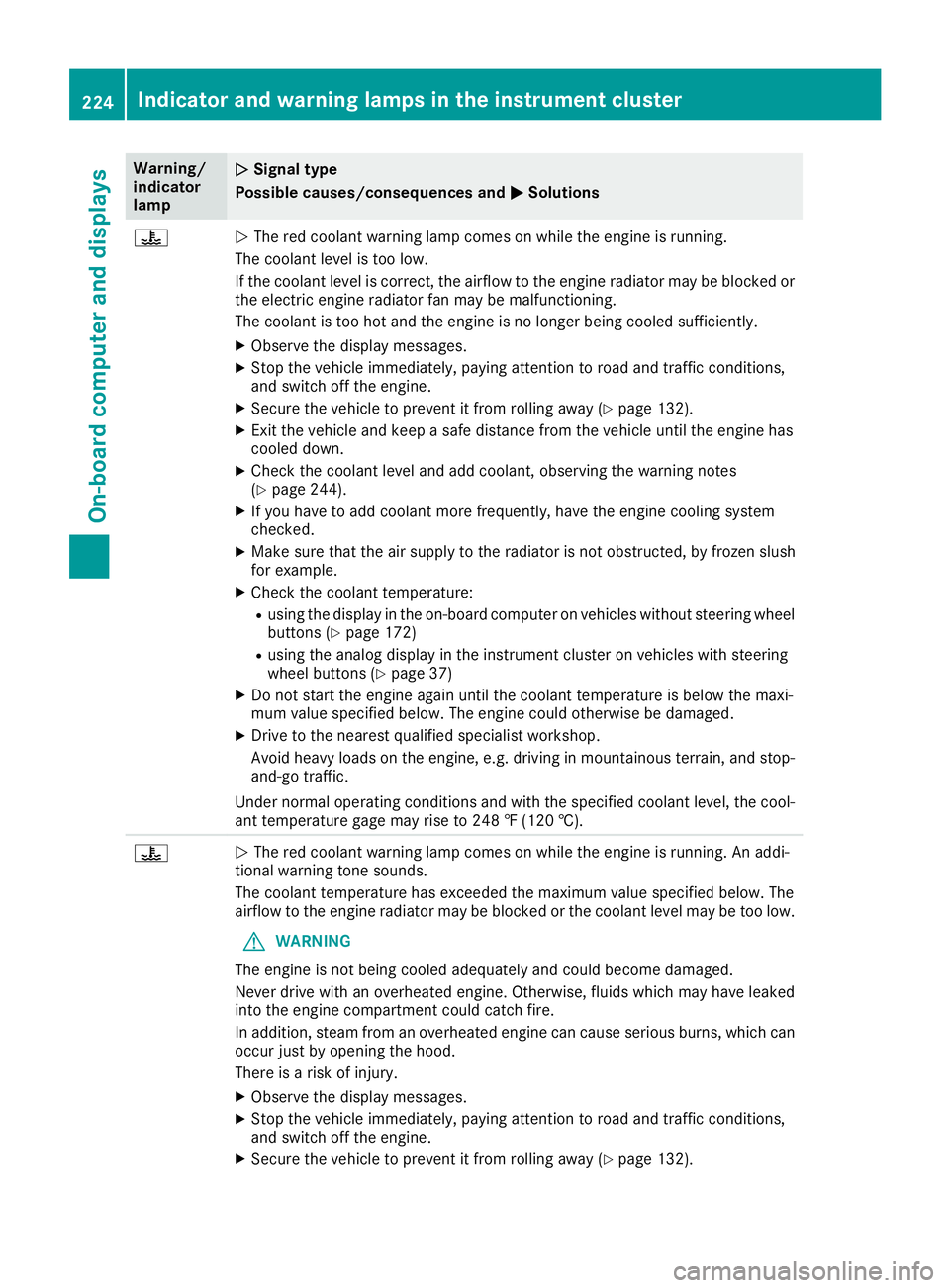
Warning/
indicator
lampNSignal type
Possiblec auses/consequences and M
Solutions
?NThe red coolant warning lamp comes on while the engine is running.
The coolant leve listoo low.
If the coolant leve liscorrect, the airflow to the engine radiator may be blocked or
the electric engine radiator fan may be malfunctioning.
The coolant is too hot and the engine is no longer being cooleds ufficiently.
XObserve the display messages.
XStop the vehicleimmediately, paying attention to road and traffic conditions,
and switch off the engine.
XSecure the vehicletop revent it from rolling awa y(Ypage132).
XExit the vehiclea nd keepasafe distance from the vehicleu ntil the engine has
cooledd own.
XCheck the coolant leve land add coolant, observing the warning notes
(Ypag e244).
XIf you have to add coolant more frequently, have the engine cooling system
checked.
XMake sure that the air supply to the radiator is not obstructed ,byfrozen slush
for example.
XCheck the coolant temperature:
Rusing the display in the on-board computer on vehicles without steering wheel
buttons (Ypag e172)
Rusing the analog display in the instrument cluster on vehicles with steering
whee lbuttons (Ypag e37)
XDo not start the engine again until the coolant temperature is below the maxi-
mum valu especified below. The engine coul dotherwise be damaged.
XDrive to the neares tqualified specialist workshop.
Avoid heavy loads on the engine, e.g. driving in mountainous terrain, and stop-
and-go traffic.
Under normal operating conditions and with the specified coolant level, the cool-
ant temperature gage may rise to 248 ‡(120 †).
?NThe red coolant warning lamp comes on while the engine is running. An addi-
tional warning tone sounds.
The coolant temperature has exceededt he maximumvaluespecified below. The
airflow to the engine radiator may be blocked or the coolant leve lmay be too low.
GWARNING
The engine is not being cooleda dequately and couldbecome damaged.
Never drive with an overheated engine. Otherwise, fluids which may have leaked
into the engine compartment coul dcatch fire.
In addition, steam from an overheated engine can caus eserious burns, which can
occur just by opening the hood.
There is arisk of injury.
XObserve the display messages.
XStop the vehiclei mmediately, paying attention to road and traffic conditions,
and switch off the engine.
XSecure the vehicletop revent it from rolling awa y(Ypage 132).
224Indicator and warning lamps in the instrument cluster
On-board computer and displays
Page 227 of 310
Warning/
indicator
lampNSignal type
Possiblec auses/consequences and M
Solutions
XExit the vehicleand keepasafe distance from the vehicleu ntil the engine has
cooledd own.
XCheck the coolant leve land add coolant, observing the warning notes
(Ypag e244).
XIf you have to add coolant more frequently, have the engine cooling system
checked.
XMake sure that the air supply to the radiator is not obstructed ,byfrozen slush
for example.
XCheck the coolant temperature:
Rusing the display in the on-board computer on vehicles without steering wheel
buttons (Ypag e172)
Rusing the analog display in the instrument cluster on vehicles with steering
whee lbuttons (Ypag e37)
XIf the coolant temperature is below the maximu mvaluespecified below, you can
continue driving to the neares tqualified specialist workshop.
Avoid heavy loads on the engine, e.g. driving in mountainous terrain, and stop-
and-go traffic.
Under normal operating conditions and with the specified coolant level, the cool-
ant temperature gage may rise to 248 ‡(120 †).
Driving systems
Warning/
indicator
lampNSignal type
Possiblec auses/consequences and M
Solutions
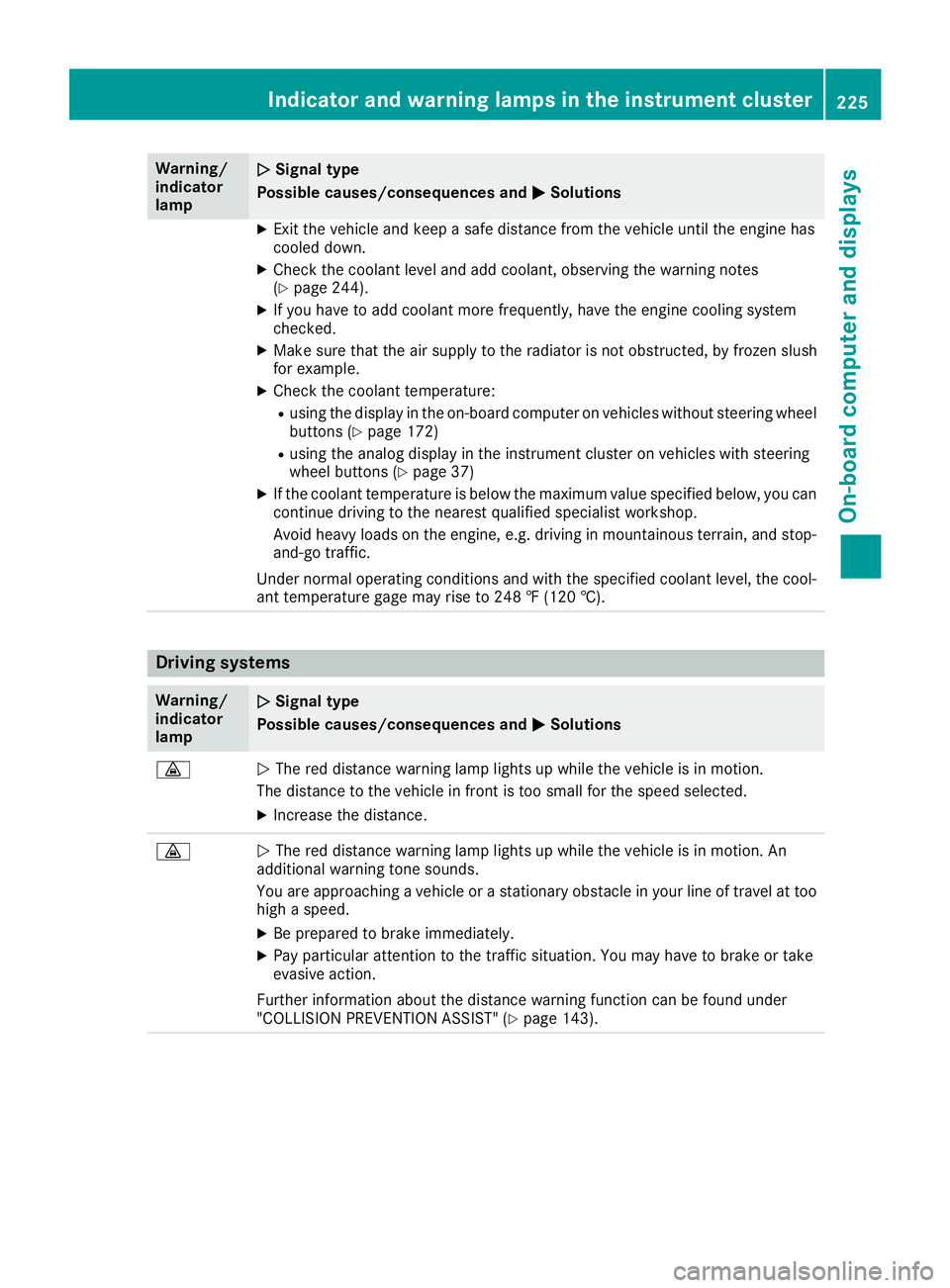
·NThe red distance warning lamp lights up while the vehicleisinm otion.
The distance to the vehicleinf ront is too smallfor the speeds elected.
XIncrease the distance.
·NThe red distance warning lamp lights up while the vehicleisinm otion. An
additiona lwarning tone sounds.
You are approaching avehicl eoras tationary obstacl einyourline of travel at too
high aspeed.
XBe prepared to brake immediately.
XPay particular attention to the traffic situation. You may have to brake or take
evasive action.
Further information about the distance warning function can be found under
"COLLISION PREVENTION ASSIST" (
Ypag e143).
Indicator and warning lamps in the instrument cluster225
On-board computer and displays
Z
Page 246 of 310
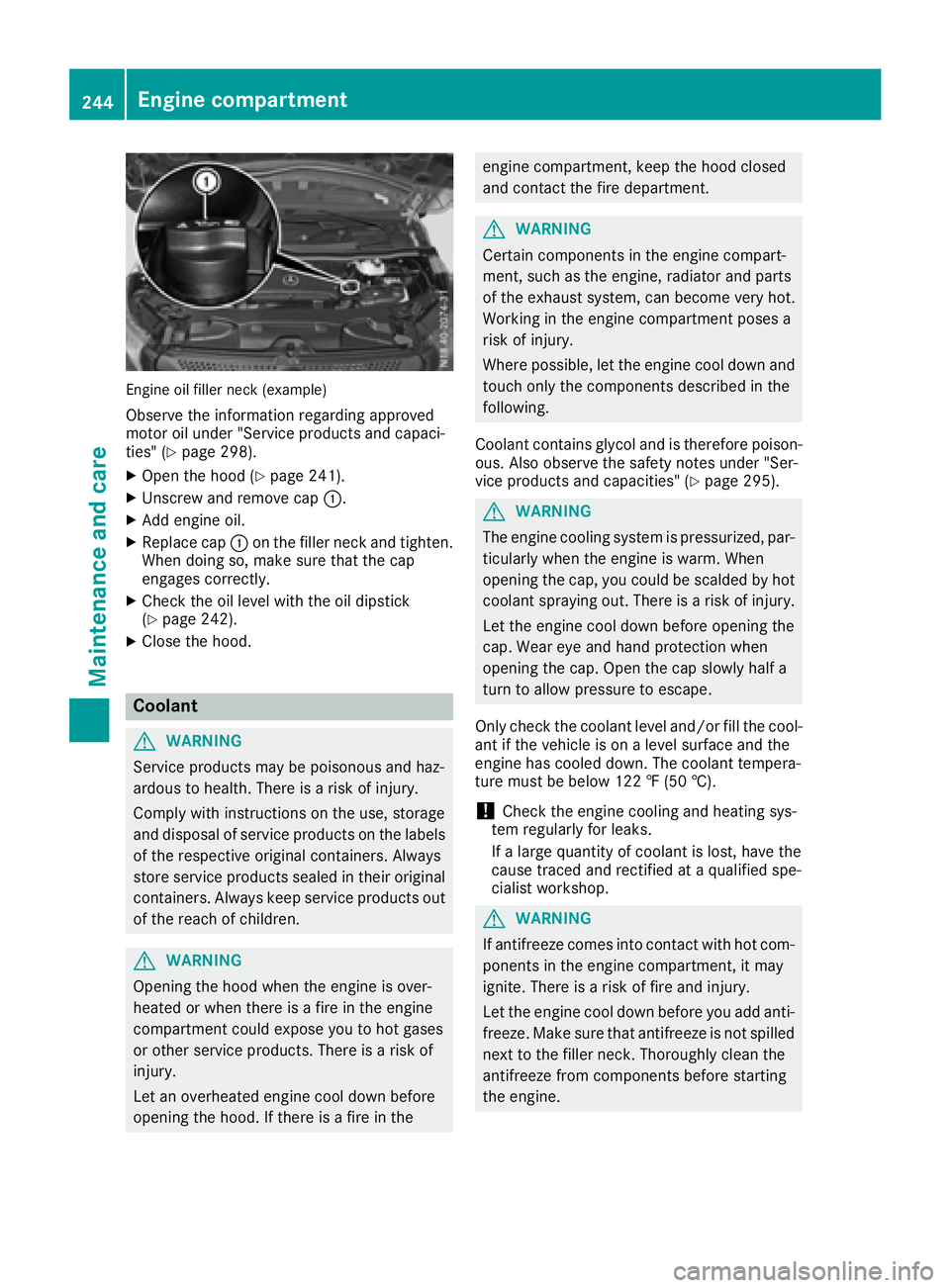
Engine oilfille rneck (example)
Observ ethe informatio nregarding approved
moto roilunder "Service products and capaci-
ties" (
Ypage 298).
XOpe nthe hoo d(Ypage 241).
XUnscrew and remove cap :.
XAdd engine oil.
XReplace cap:on the fille rneck and tighten.
Whe ndoing so, make sure thatt he cap
engages correctly.
XCheck the oill evel with the oild ipstick
(Ypage 242).
XClose the hood.
Coolant
GWARNING
Service products maybep oisonousand haz-
ardous to health .There is ariskofi njury.
Compl ywithi nstructions on the use, storage
and disposalofs erviceproducts on the labels
of the respective original containers. Always
stor eservic eproducts seale dintheiroriginal
containers. Alway skeeps ervic eproducts out
of the reach of children.
GWARNING
Opening the hoo dwhent he engine is over-
heated or when ther eisafireint he engine
compartment could expose yo utohot gases
or othe rservic eproducts. There is arisko f
injury.
Let an overheate dengine coo ldow nb efore
opening the hood. If ther eisafireint he
engine compartment, kee pthe hoo dclosed
and contact the fir edepart ment.
GWARNING
Certai ncomponents in the engine compart-
ment, such as the engine ,radiator and parts
of the exhaust system ,can become ver yhot.
Working in the engine compartment poses a
ris kofi njury.
Where possible, le tthe engine coo ldow na nd
touch onl ythe components describe dinthe
following.
Coolant contains glyco land is therefore poison-
ous. Als oobserve the safety notes under "Ser-
vic ep roducts and capacities" (
Ypage 295).
GWARNING
The engine cooling system is pressurized, par-
ticularly when the engine is warm. When
opening the cap ,you could be scalded by hot
coolant spraying out. There is ariskofi njury.
Let the engine coo ldow nb efore opening the
cap .Weare ye and hand protection when
opening the cap .Opent he cap slowly half a
tur ntoa llowpressure to escape.
Onlyc heck the coolant level and/or fil lthe cool-
ant if the vehicl eisonalevel surface and the
engine hasc ooleddown. The coolant tempera-
tur em ustbeb elow122‡(50 †).
!Check the engine cooling and heating sys-
tem regularly for leaks.
If al arge quantity of coolant is lost, have the
cause traced and rectifie dataqualified spe-
cialist workshop.
GWARNING
If antifreeze come sinto contact with hot com-
ponents in the engine compartment, it may
ignite .There is ariskoff irea nd injury.
Let the engine coo ldow nb efore yo uadd anti-
freeze .Makes uret hata ntifreeze is not spilled
next to the fille rneck. Thoroughl yclean the
antifreeze from components before starting
the engine.
244Engine compartment
Maintenance and care
Page 247 of 310
!Take care not to spill any coolant on painted
surfaces. You could otherwise damage the
paintwork.
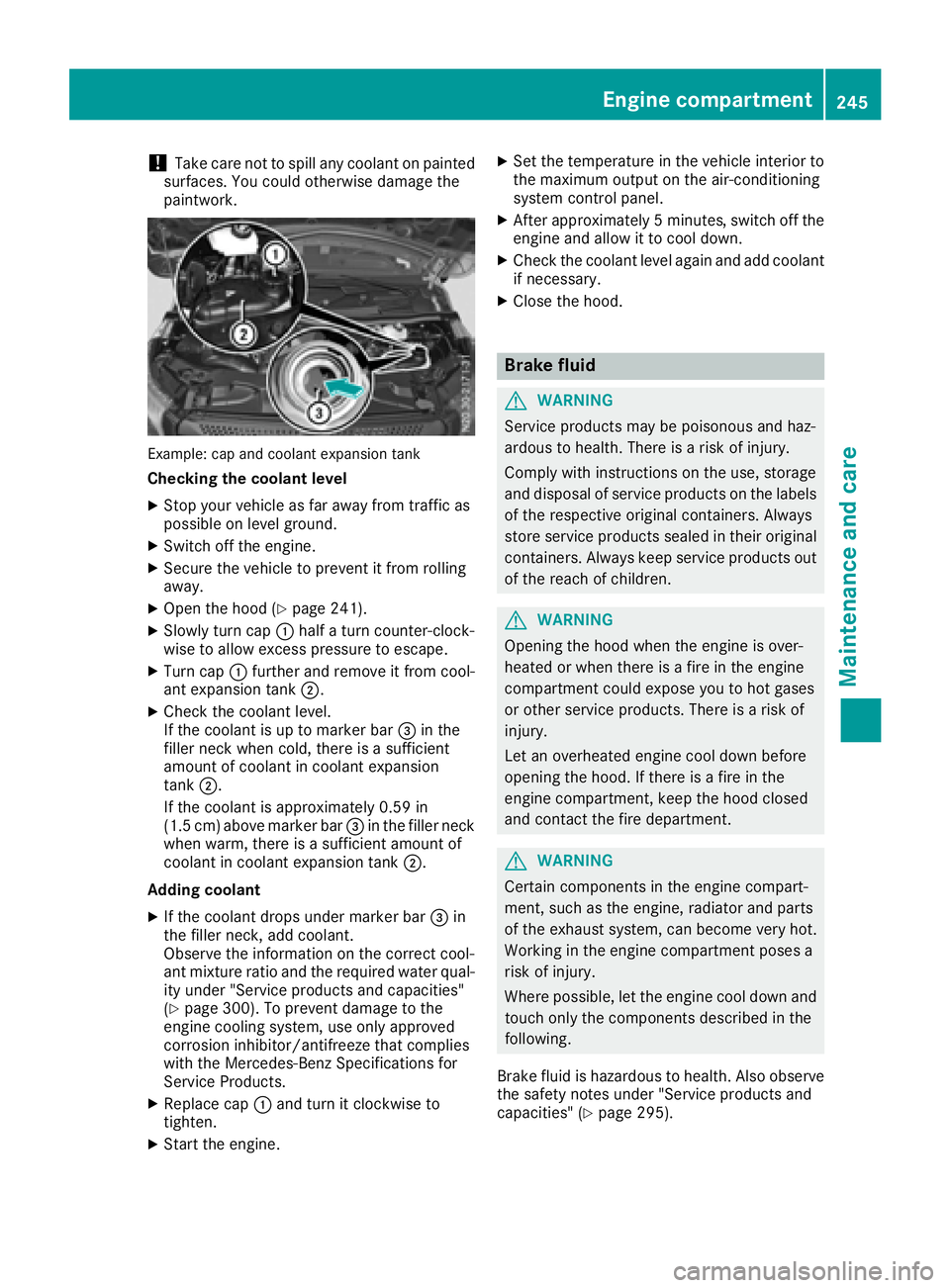
Example: cap and coolant expansion tank
Checkingt he coolant level
XStop your vehicle as far awayf rom traffic as
possible on level ground.
XSwitch off the engine.
XSecure the vehicle to prevent it from rolling
away.
XOpen the hood (Ypage 241).
XSlowly turn cap :half aturn counter-clock-
wise to allow excess pressure to escape.
XTurn cap :further and remove it from cool-
ant expansion tank ;.
XCheck the coolant level.
If the coolant is up to marker bar =in the
filler neck when cold, there is asufficient
amount of coolant in coolant expansion
tank ;.
If the coolant is approximately 0.59 in
(1.5 cm) above marker bar =in the filler neck
when warm, there is asufficient amount of
coolant in coolant expansion tank ;.
Adding coolant
XIf the coolant drops under marker bar =in
the filler neck, add coolant.
Observe the information on the correct cool-
ant mixture ratio and the required water qual-
ity under "Service products and capacities"
(
Ypage 300). To prevent damage to the
engine cooling system, use only approved
corrosion inhibitor/antifreeze that complies
with the Mercedes-Benz Specifications for
Service Products.
XReplace cap :and turn it clockwise to
tighten.
XStart the engine.
XSet the temperature in the vehicle interior to
the maximum output on the air-conditioning
system control panel.
XAfter approximately 5minutes ,switch off the
engine and allow it to cool down.
XCheck the coolant level againa nd add coolant
if necessary.
XClose the hood.
Brake fluid
GWARNING
Service products may be poisonous and haz-
ardous to health. There is arisk of injury.
Comply with instructionsont he use, storage
and disposalofs ervice products on the labels
of the respective original containers. Always
store service products sealed in their original
containers. Alwaysk eep service products out
of the reach of children.
GWARNING
Opening the hood when the engine is over-
heated or when there is afire in the engine
compartment could expose you to hot gases
or other service products. There is arisk of
injury.
Let an overheated engine cool down before
opening the hood. If there is afire in the
engine compartment,k eep the hood closed
and contact the fire department.
GWARNING
Certain componentsint he engine compart-
ment, such as the engine, radiator and parts
of the exhaust system, can become very hot.
Working in the engine compartment poses a
risk of injury.
Where possible,l et the engine cool down and
touch only the componentsd escribed in the
following.
Brake fluid is hazardous to health. Also observe the safety notes under "Service products and
capacities" (
Ypage 295).
Engine compartment245
Maintenance and care
Z
Page 303 of 310
.
The coolant is amixture of water and antifreeze
and corrosion inhibitor. It performs the following
tasks:
Rcorrosion protection
Rantifreeze protection
Rraises the boiling point
When the vehicl eisfirst delivered, it is filled with
ac oolant mixture that ensure sadequate anti-
freeze and corrosion protection. Coolant must
remai ninthe engine cooling system all year
round to ensure anti-corrosion protection and a
higher boiling point, even in countries with high
outside temperatures.
To prevent damage to the engine cooling sys-
tem, use only approved antifreeze and corrosion
inhibitor that complies with the Mercedes-Benz Specifications for Service Products.
Mercedes-Benz recommends an antifreeze and
corrosion inhibitor that meets the requirements
in the Mercedes-Benz Specifications for Service
Products Sheet Number 325.
Check the antifreeze/corrosio ninhibitor con-
centration in the coolant every six months.
The percentag eofcorrosion inhibitor/anti-
freeze additive in the engine cooling system
should:
Rbe at least 50%. This way, the engine cooling
system is protected against freezing downt o
approximately -35 ‡(-37 †).
Rnot exceed 55% (antifreeze protection down
to -49 ‡[-45 †]) .Otherwise, hea twilln ot be
dissipated as effectively.
If ther ehasbeen coolant loss, do not refill only
with water. If the vehicl ehaslost coolant, add
equa lparts water and antifreeze/corrosion
inhibitor. The water used as part of the coolant
mixture must fulfil lcertain requirements; these
are usuall yfulfille dbyd rinking water. If the
water quality is not sufficient, yo umusttrea tthe
water.
Mor einformatio ncan be obtaine datany qual i-
fi eds p
ecialist workshop.
Servic eproduct: coolant
Productn ame/number
Zerex G40-91, The Valvoline Company
MB SheetNo. 325.5
Maintenance interval
Hav ethe coolant renewe devery 15 years .
Capacities
Engine coolin gsystem
CoolantApprox. 11 US qt
(10.4l)
Clim ate control systemr efrigerants
Important safety notes
The climate control system of you rvehicle is fil-
led with the refrigerant R ‑134a.
The warning label for the refrigerant being used
can be found on the radiator cross member.
!Only the refrigerant R ‑134a and the PAG oil
approved by Mercedes-Benz may be used.
The approved PAG oil may not be mixed with
any other PAG oil that is not approved for
R-134a refrigerant. Otherwise ,the climate
control system may be damaged.
Maintenance work such as adding refrigerant or
replacing components may only be carried out
by aq ualified specialist workshop. All applicable
regulations thereto and the SAE standard J639
need to be respected.
All work on the climate control system should
always be carried out at qualified specialist
workshop.
Service products and capacities301
Technical data
Z