roof MERCEDES-BENZ METRIS 2016 MY16 Operator’s Manual
[x] Cancel search | Manufacturer: MERCEDES-BENZ, Model Year: 2016, Model line: METRIS, Model: MERCEDES-BENZ METRIS 2016Pages: 310, PDF Size: 7.28 MB
Page 78 of 310
You can only openasliding door from the inside
if the child-proof lock shave not been activated.
If the sliding door is locked, the sliding door
must firstbeu nlocked.
The sliding door is equipped with an active
retainer, which engage sthe door at the end stop
when opened.
XTo open: briefly press the respective Åor
Æ sliding door button in the center con-
sole.
or
XBriefly press sliding door button in the door
frame A.
or
XBriefly pull back rocker switch =.
If the sliding door is unlocked, automatic
operation is started and the sliding door
opens.
If you use the ÅorÆ sliding door but-
ton in the center console you will hear two
warnin gsignals during the openin gproce-
dure.
The indicator lamp in the ÅorÆ sliding
door button in the center console flashes for
the duratio nofautomatic operation.
The indicator lamp in the ÅorÆ sliding
door button in the center console is lit when-
ever the respectiv esliding door is open.
Depending on the vehicle equipment, the dis-
play can also show the Sliding door open
message.
XTo close:briefly press the respective Åor
Æ sliding door button in the center con-
sole.
or
XBriefly press sliding door button in the door
frame A.
or
XBriefly press rocker switch =forwards.
The sliding door is released from its lock and
automatic operation is started. The sliding
door closes.
If you use the ÅorÆ sliding door but-
ton in the center console you will hear two
warnin gsignals during the openin gproce-
dure.
The indicator lamp in the respective Åor
Æ sliding door button in the center console
goes out whenever the sliding door is closed.
XTo interrupt automatic operation: press
the respective ÅorÆ sliding door but-
ton in the center console again.
or
XPress sliding door button in the door frame
A.
or
XBriefly pull back rocker switch =.
iIn unfavorable operating conditions, e.g.
frost, ice or heavy soiling ,you can press and
hold the relevants liding door button. The
electric sliding door movesw ith increased
force. Observe that ,insuch circumstances,
the obstacle detection is less sensitive. To
sto pthe movement, release the sliding door
button.
Programming th ekey button for the
sliding door
If the vehicle is fitted with two electric sliding
doors,t he5 sliding door button on the key
can only be programmed for one of the two slid-
ing doors.Y ou can thenopen or close the selec-
ted sliding door with the 5button on the key.
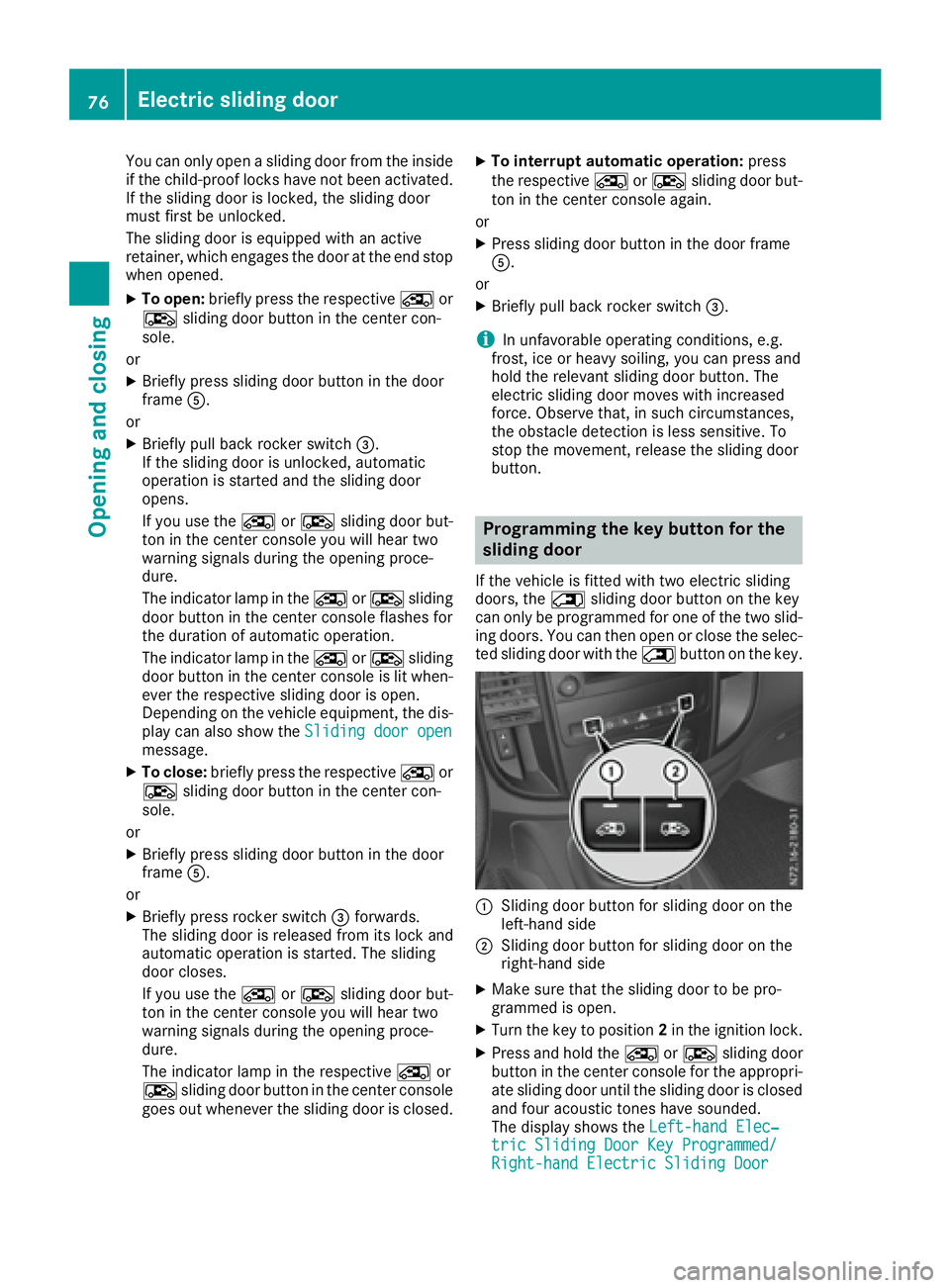
:Slidingdoor button for sliding door on the
left-han dside
;Slidin gdoor button for sliding door on the
right-han dside
XMake sure that the sliding door to be pro-
grammed is open.
XTurn the key to position 2in the ignition lock.
XPress and hold the ÅorÆ sliding door
button in the center console for the appropri-
ate sliding door until the sliding door is closed
and four acoustic tones have sounded.
The display shows the Left-handElec‐
tric Sliding Door Key Programmed/Right-hand Electric Sliding Door
76Electric sliding door
Opening and closing
Page 81 of 310
XMake sure that the right-hand rear door is
open and engaged.
XPull release handle:in the direction of the
arrow.
XSwing the rear door to the side until it
engages.
The rear door can also be opened beyond 90
degrees (
Ypage 79).
Closing the rear doors from the outside
XIf necessary, pull the rear door away from the
magnetic door retainer (Ypage 79).
XClose the left-hand rear door firmly from the
outside.
XClose the right-hand rear door firmly from the outside.
Opening/closing from the inside
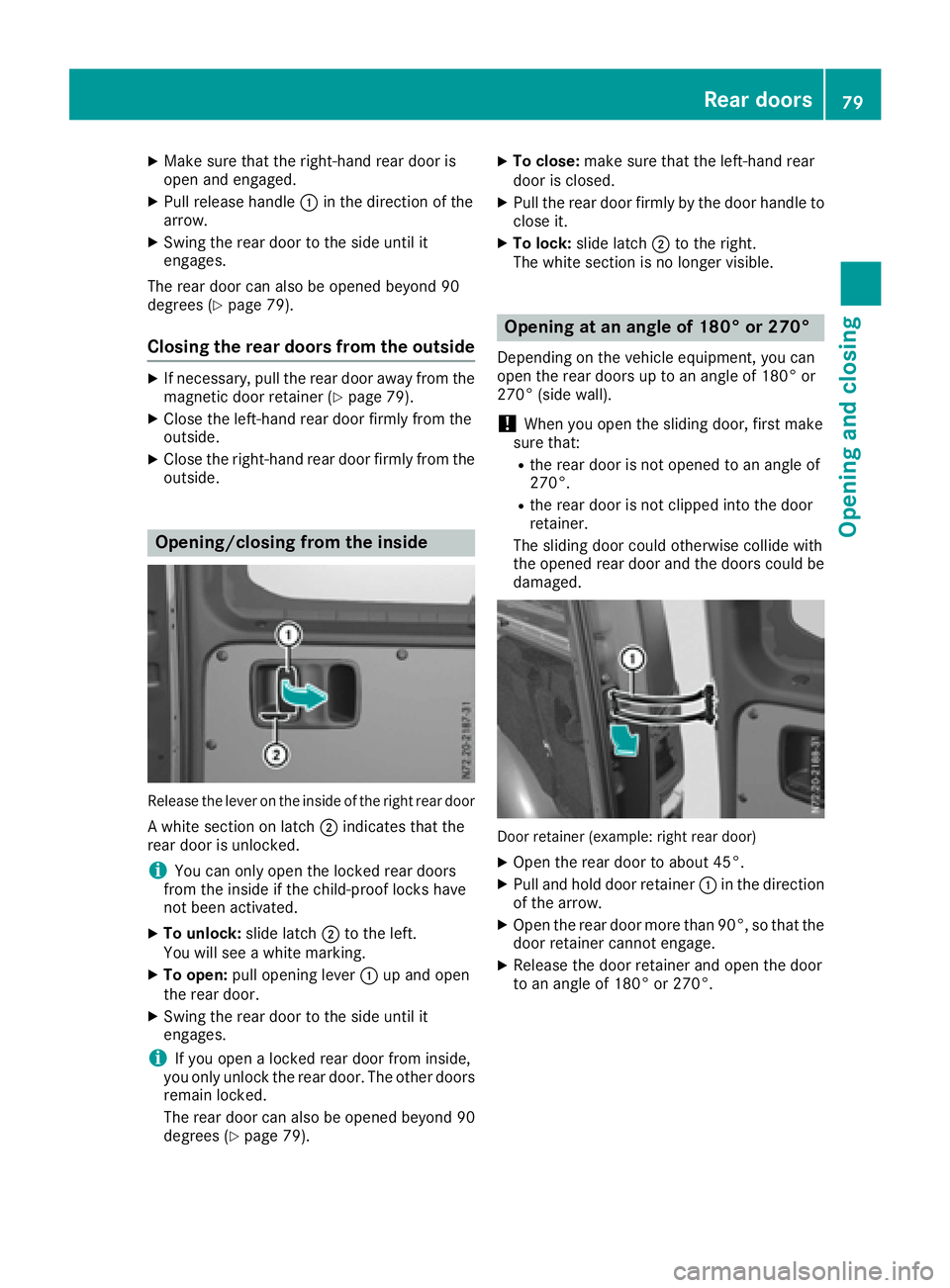
Release the lever on the inside of the right rear door
Aw hite section on latch ;indicates that the
rear door is unlocked.
iYou can only open the locked rear doors
from the inside if the child-proof locks have
not been activated.
XTo unlock: slide latch;to the left.
You will see awhite marking.
XTo open: pull opening lever :up and open
the rear door.
XSwing the rear door to the side until it
engages.
iIf you open alocked rear door from inside,
you only unlock the rear door. The other doors
remain locked.
The rear door can also be opened beyond 90
degrees (
Ypage 79).
XTo close: make sure that the left-hand rear
door is closed.
XPull the rear door firmly by the door handle to
close it.
XTo lock: slide latch ;to the right.
The white section is no longer visible.
Opening at an angle of 180° or 270°
Depending on the vehicle equipment, you can
open the rear doors up to an angle of 180° or
270° (side wall).
!When you open the sliding door, first make
sure that:
Rthe rear door is not opened to an angle of
270°.
Rthe rear door is not clipped into the door
retainer.
The sliding door could otherwise collide with
the opened rear door and the doors could be
damaged.
Door retainer (example: right rear door)
XOpen the rear door to about 45°.
XPull and hold door retainer :in the direction
of the arrow.
XOpen the rear door more than 90°, so that the
door retainer cannot engage.
XRelease the door retainer and open the door
to an angle of 180° or 270°.
Rear doors79
Opening and closing
Z
Page 84 of 310
Problems with the side windows
GWARNING
If you close aside window again immediately
after it has been blocked or reset, the side
window closes with increased or maximum
force. The reversing feature is then not active. Parts of the body could be trapped in the clos-
ing area in the process. This poses an
increased risk of injury or even fatal injury.
Make sure that no parts of the body are in the
closing area. To stop the closing process,
release the switch or push the switch again to
reopen the side window.
If you cannot completely open or close aside
window:
If there are no object sorleaves in the window
guide that prevent the sliding sunroof from clos-
ing, there has been amalfunction or the on-
board voltage has been interrupted.
XReset the side window (Ypage 81).
82Side windows
Opening and closing
Page 119 of 310
Make sure that all vehicle occupants always
maintainasufficient distance to the air out-
lets. If necessary, redirect the airflow to
another area of the vehicle interior.
The center and side air vents are adjustable.
The air vents can also be adjusted on vehicles
with rear-compartment air conditioning.
In order to ensure the direct flow of fresh air
through the air vents into the vehicle interior,
please observe the following notes:
Rkeep the air inlet between the windshield and
the hood free of blockages, such as ice, snow
or leaves.
Rnever cover the vents or the ventilation grilles
in the vehicle interior.
Setting the center air vents
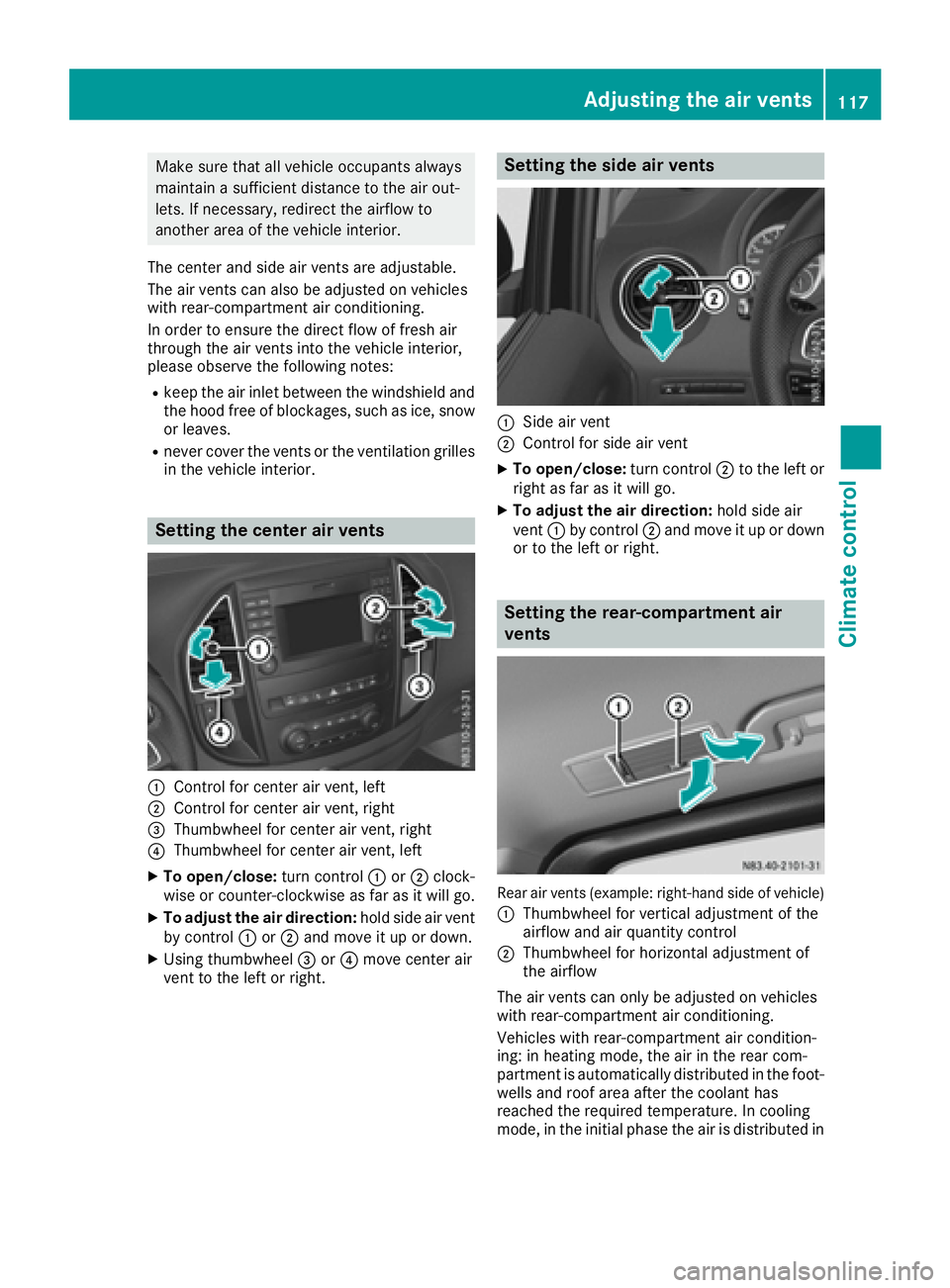
:Control for center air vent, left
;Control for center air vent, right
=Thumbwheel for center air vent, right
?Thumbwheel for center air vent, left
XTo open/close: turn control:or; clock-
wise or counter-clockwise as far as it will go.
XTo adjust the air direction: hold side air vent
by control :or; and move it up or down.
XUsing thumbwheel =or? move center air
vent to the left or right.
Setting the side air vents
:Side air vent
;Control for side air vent
XTo open/close: turn control;to the left or
right as far as it will go.
XTo adjust the air direction: hold side air
vent :by control ;and move it up or down
or to the left or right.
Setting the rear-compartment air
vents
Rear air vents (example: right-hand side of vehicle)
:
Thumbwheel for vertical adjustment of the
airflow and air quantity control
;Thumbwheel for horizontal adjustment of
the airflow
The air vents can only be adjusted on vehicles
with rear-compartment air conditioning.
Vehicles with rear-compartment air condition-
ing: in heating mode, the air in the rear com-
partment is automatically distributed in the foot-
wells and roof area after the coolant has
reached the required temperature. In cooling
mode, in the initial phase the air is distributed in
Adjusting the air vents117
Climatec ontrol
Z
Page 137 of 310
Alwaysusethe hands-free system for telephon-
ing whil edriving .Onlyu sethe telephone if road
traffic conditions permit. If thisisn ot the case,
pull ove rtoasafel oc ation before using the tele-
phone.
Bea rinm ind thatata speed of just30mph
(approximately5 0km/h), your vehicl eiscov-
ering adistance of 44 fee t(approximately 14 m)
every second.
Drive sensibly –save fuel
In order to save fuel, observe the following tips:
XThe tires should alwaysbei nflated to the rec-
ommended tire pressure.
XRemove unnecessary loads.
XRemove roof carriers when they are not nee-
ded.
XWarm up the engine at low engine speeds.
XAvoid frequent acceleration or braking.
XHave all maintenanc ework carried out as
indicated by the servicei ntervals in the Main-
tenance Booklet or by the servicei nterval dis-
play.
Fuel consumption also increases when driving in cold weather, in stop-start traffic and in moun-
tainous terrain.
Overrun cutoff
If you are in overrun mode and take your foot off
the accelerator pedal, the fuel supply is cut off
when the engine speed is out of the idle speed
control range.
Drinking and driving
GWARNING
Drinking and driving and/or takin gdrugs and
driving are very dangerous combinations.
Even asmall amount of alcohol or drugs can
affect your reflexes ,perceptions and judg-
ment.
The possibility of aserious or even fatal acci-
dent is greatly increased when you drink or
take drugs and drive.
Do not drink or take drugs and drive or allow
anyone to drive who has been drinking or tak-
ing drugs.
Emission control
GWARNING
Combustion engines emit poisonous exhaust
gases such as carbon monoxide. Inhaling
these exhaust gases leads to poisoning. There
is ar isk of fatal injury. Thereforen ever leave
the engine running in enclosed spaces with-
out sufficien tventilation.
Certain engine systems are designed to keep
the level of poisonous substances in exhaust
fumes within legal limits.
These systems only work optimally if they are
maintained exactly in accordance with the man-
ufacturer's specifications. An ywork on the
engine should therefore be carried out by quali-
fied and authorized Mercedes-Benz technicians.
The engine settings must not be changed under
any circumstances. In addition, all specific
maintenanc ework must be carried out at regu-
lar intervals and in accordance with the service
requirement softhe dealer listed here on the
inside title page. Details can be found in the
Maintenance Booklet.
Speed limiter
GWARNING
Exceeding the stated tire load-bearing capa-
city and the approved maximum speed could
lead to tire damage or the tire bursting. There is ar isk of accident.
Therefore, only use tire types and sizes
approved for your vehicle model. Observe the
tire load ratin gand speed ratin grequired for
your vehicle.
As the driver, you must be aware of the maxi-
mum design speed of the vehicle and the maxi- mum permissible speed based on the tires (tire
and tire pressure). In particular, also observe the tire approval regulations for each country.
You must, under no circumstances, exceed the
speed limit for the tires specified by the speed
index. The speed ratin gisstated in the tire
tables (
Ypage 291).
You can permanently limit the maximum speed
of your vehicle, e.g. for driving on winter tires.
Driving tips135
Driving and parking
Z
Page 140 of 310
have sufficient tread depth, depending on the
depth of water on the road. There isarisk of
an accident.
For this reason, avoid tire ruts and brake care-
fully.
Therefore, in heavy rain or other conditions in
which hydroplaning can occur, drive as follows:
Rreduce your speed
Ravoid tire ruts
Rapply the brakes with care
Driving on flooded roads
!Do not drive through flooded areas. Check
the depth of any water before driving through
it. Drive slowly through standing water. Oth-
erwise, water may enter the vehicle interior or
the engine compartment. This can damage
the electronic components in the engine or
the automatic transmission. Water can also
be drawn in by the engine's air suction nozzles
and this can cause engine damage.
If you have to drive on stretches of road on which
water has collected, please bear in mind that:
Rthe water level of standing water should not
be above the lower edge of the front bumper
Rdo not drive faster than walking speed
Driving in winter
GWARNING
If you shift down on aslippery road surface in
an attempt to increase the engine's braking
effect,t he drive wheels could lose their grip.
There is an increased danger of skidding and
accidents.
Do not shift down for additional engine brak-
ing on aslippery road surface.
!Vehicles with automatic transmission may
roll only briefly in the neutral position N.Pro-
longed rolling of the wheels, e.g. when being
towed, will result in transmission damage.
Have your vehicle winterproofed at aqualified
specialist workshop at the onset of winter. Drive particularly carefully on slippery roads.
Avoid sudden acceleration, steering and braking
maneuvers. Do not use cruise control.
If the vehicle threaten stoskid or cannot be
stopped when moving at low speed:
XShift the transmission to position N.
XTry to maintain control of the vehicle using
corrective steering.
The outside temperature indicator is not
designed to serve as an ice-warning device and
is therefore unsuitable for that purpose.
Changes in the outside temperature are dis-
played after ashort delay.
Indicated temperatures just above the freezing
point do not guarantee that the road surface is
free of ice. The road may still be icy, especially in
wooded areas or on bridges. If you do not adjust
your driving style, the vehicle may start to skid.
Always adapt your driving style and drive at a
speed to suit the prevailing weather conditions.
You should pay special attention to road condi-
tions when temperatures are around freezing
point.
You can find further information under:
R"M+S tires" (Ypage 269)
R"Snow chains" (Ypage 270)
R"Driving with summer tires" (Ypage 269)
Also observe the notes under "Winter operation" (
Ypage 269).
Driving off-road
Important safety notes
GWARNING
If you drive on asteep incline at an angle or
turn when driving on an incline, the vehicle
could slip sideways, tip and rollover. There is a risk of an accident.
Always drive on asteep incline in the line of
fall (straight up or down) and do not turn the
vehicle.
GWARNING
When driving off-road, your body is subject to
forces from all directions, due to the uneven
surface. You could be thrown from your seat,
for instance. There is arisk of injury.
138Driving tips
Driving and parking
Page 234 of 310
Useful information
This Operator's Manual describes all models as
well as standard and optional equipment of your
vehicle that were available at the time of going
to print.Country-specific variation sare possi-
ble. Note that your vehicle may not be equipped
with all of the described functions. This also
applies to system sand function srelevantt o
safety.
Read the information on qualified specialist
workshops (
Ypage 29).
Loading guidelines
Important safetyn otes
GWARNING
When objects are unsecured or inadequately
secured, they can slip, turn over or be thrown
about, strikin gvehicle occupants .This also
applies to:
Rluggage or loads
Rseats which have been removed and are
being transported in the vehicle in an
exceptional case.
There is arisk of injury, particularly in the
eventofab rakingmaneuver or abrupt change
in direction.
Always stow objects in such away that they
cannot be tossed about. Beforet raveling,
secure objects, luggage or loads to prevent
them slipping or tippin gover. If you removea
seat, stor eitpreferably outside the vehicle.
GWARNING
As aresult of improperly placed or unevenly
distributed loads, the center of gravityoft he
load being transported may be too high or too
far back. This can significantly impair handling
as well as steering and brakin gcharacteris-
tics. There is arisk of an accident.
Always make sure that the center of gravityo f
the load is:
Rbetween the axles
and
Ras low as possible, near the rear axle.
GWARNING
When the permissible wheel loads, axle loads
and/o rthe maximum permissible gross vehi-
cle weight are exceeded, drivings afetyis
compromised. The handlin gaswell as steer-
ing and brakin gcharacteristic smay be signif-
icantly impaired. Overloaded tires may over-
heat, causing them to burst. There is arisk of
an accident.
When transporting aload, always observet he
permissible wheel loads, axle loads and the
maximum permissible gross vehicle weight
for the vehicle (includin goccupants).
!If you are using aroof carrier,o bservethe
maximum roof load and maximum roof carrier
load.
RDo not stac kluggage or loads higher than the
backrests.
RObjects to be transported should preferably
be stowed in the cargo compartment.
RWhen transporting luggage, always use the
cargo tie-down rings for securingl oads and a
cargo net ,ifinstalled.
RUse cargo tie-down rings and fasteners which
are suitable for the weight and size of the
load.
When using suitable load securin gaids and tie
downs, always follow the manufacturer's oper-
ating instructions, in particular the notes on dis-
card criteria contained therein.
Load securin gaids or tie downs must not be
used if:
Ridentification marksa re missingorillegible
Rthereare yarn breakages ,damage to bearing
seams or other signs of tearing
Rther eare signs of shearing, deformation,
pinching or other damage
Rther eisd amage to clampingorc onnecting
elements
Load securinga ids and tie downs in this condi-
tion are ready for discard and must be replaced.
If you use load securinga ids or tie downs which
are worn out, the load may not be sufficiently
secured and could cause damage to property.
232Loading guidelines
Transporting loads
Page 235 of 310
In the event of an accident, haveadamaged
cargo compartment floor or loading area ,the
cargo tie-down rings and the tie down checked
at as pecialist workshop. Otherwise ,the load
may not be correctly secured the next time any-
thing is stowed.
Even if you follow all loading guidelines, the load
increases the risk of injury in the event of an
accident. Observe the information in the "Secur- ing aload "(
Ypage 234) and "Loa ddistribution"
(Ypage 233) sections.
You wil lfind information abou tthe maximum
roof load and maximum tailgate load in the
"Cargo tie-down points and carrier systems"
section (
Ypage 304). You wil lfind information
abou troof carriers under "Carrier systems"
(
Ypage 238).
Before loading
!
The anti-slip mats cannot be used for secur-
ing goods and must be replaced when they
show signs of:
RPermanent deformatio nand crushing
RCrack formation
RCuts
XTire pressure: check the tire pressure and
correct if necessary (Ypage 270).
XCargo compartment floor: clean the cargo
compartment floor.
The cargo compartment floor must be free
from oil and dust, dry and swept clean to pre-
vent the load from slipping.
XPlace non-slip mats (anti-slip mats) on the
cargo compartment floor if necessary.
During loading
XObserve the gross axle weight rating and per-
missible gross vehicle weight for you rvehicle.
Take into account that you rvehicle's curb
weight is increased if accessorie soroptional equipment are installed. The maximum pay-
load is thus reduced.
XObserve the notes on load distribution
(Ypage 233).
The overal lcenter of gravity of the load should
always be as low as possible, centered and
betwee nthe axles near the rear axle.
XObserve the legalr equirements of the country
in which you are currently driving.
Checks after loading
GWARNING
Combustion engines emit poisonous exhaust
gases such as carbon monoxide. If the tail-
gate/rear door is open when the engine is
running, particularly if the vehicle is moving,
exhaust fumes could enter the passenger
compartment. There is arisk of poisoning.
Turn off the engine before opening the tail-
gate/rear door. Never drive off with the tail-
gate/rear door open.
XSecuring luggage/loads: make sure that
the luggage and/or load is secure before
every journey and at regular intervals during a
long journey, and correct it if necessary.
XDoors/tailgate: close the sliding doors and
tailgate/door.
XTire pressure: adjust the tire pressure
according to the vehicle load (Ypage 270).
XDrivin gstyle: adapt you rdriving style
according to the vehicle load.
Load distribution
General notes
!
Excessive load sonindividual points of the
cargo floor or on the load surface impair vehi-
cle handling characteristics and could cause
damage to the floor covering.
The overal lcenter of gravity of the load should
always be as low as possible, centered and
betwee nthe axles near the rear axle.
Load distribution233
Transporting loads
Z
Page 240 of 310
GWARNING
If vehicleo ccupants are seated behind aload
protection net, they may be squeezed up
against the loa dprotection net. There is arisk
of injury,p articularlyinthe event of braking
maneuvers or abrupt changes in direction.
Never allow vehicleo ccupants to sit behind
the loa dprotection net.
The loa dprotection net borders the cargo com-
partment. It protects vehicleo ccupants from
light objects and/or luggage slipping or tipping
over. Always observe the notes on securing
loads (
Ypag e234).
You can instal lthe loa dprotection net at an
angle behind the front seats or behind the first
row of back seats.
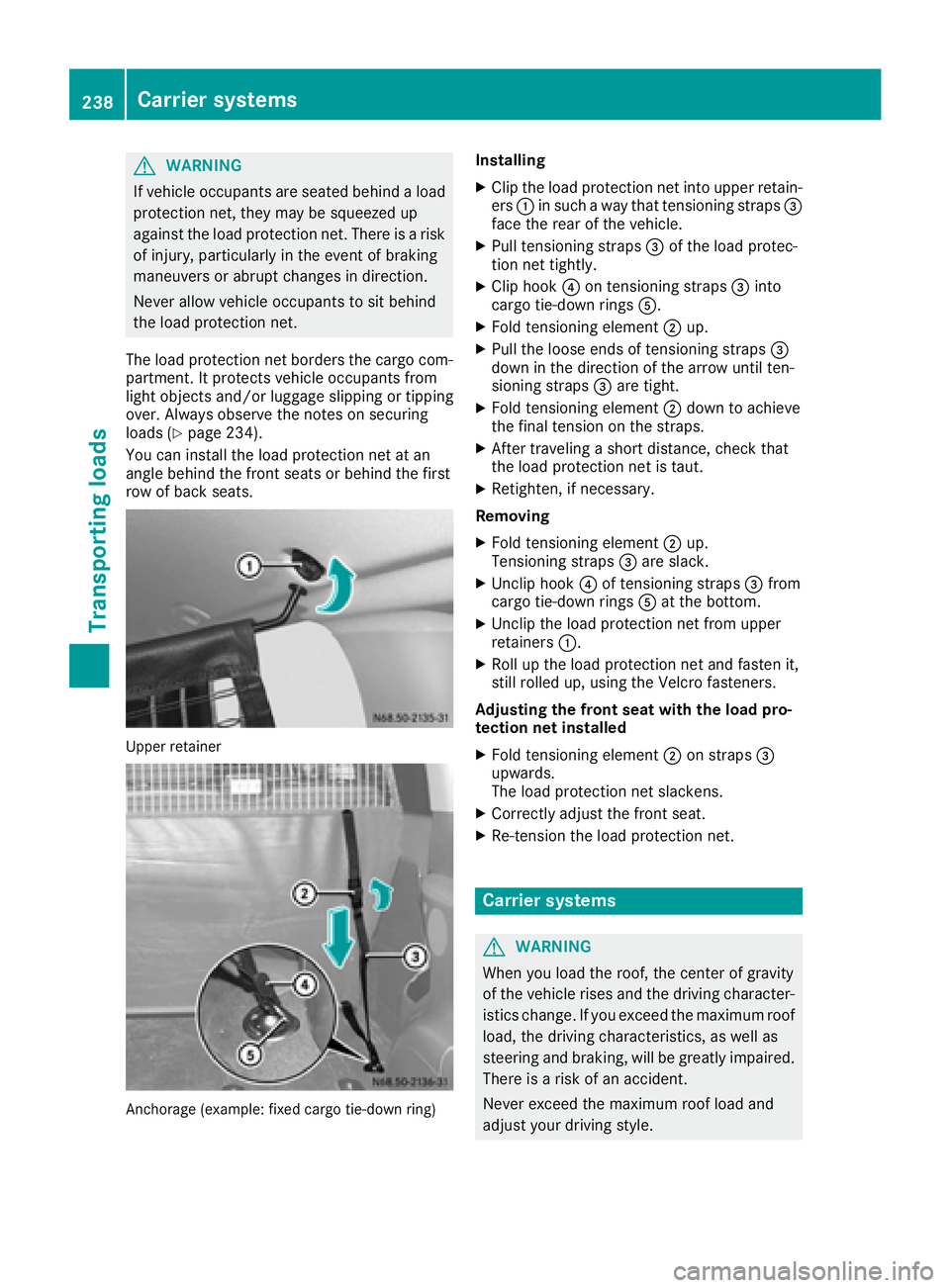
Upperr etainer
Anchorage (example: fixed cargo tie-downr ing)
Installing
XClipthe loa dprotection net into upper retain-
ers :in such away that tensioning straps =
face the rear of the vehicle.
XPul ltensioning straps =of the loa dprotec-
tion net tightly.
XCli ph ook ?on tensioning straps =into
cargo tie-downr ingsA.
XFold tensioning element ;up.
XPullthe loos eends of tensioning straps =
downint he direction of the arrow until ten-
sioning straps =are tight.
XFold tensioning element ;downtoa chieve
the final tension on the straps.
XAfter traveling ashort distance, check that
the loa dprotection net is taut.
XRetighten, if necessary.
Removing
XFold tensioning element ;up.
Tensioning straps =are slack.
XUnclip hook ?of tensioning straps =from
cargo tie-dow nrings Aat the bottom.
XUnclip the loa dprotection net from upper
retainers :.
XRollupt he loa dprotection net and fasten it,
still rolled up, using the Velcro fasteners.
Adjusting the front seat with the load pro-
tectio nnet installed
XFold tensioning element ;on straps =
upwards.
The loa dprotection net slackens.
XCorrectly adjust the front seat.
XRe-tensio nthe loa dprotection net.
Carrier systems
GWARNING
When you loa dthe roof, the center of gravity
of the vehicler ises and the driving character-
istics change. If you exceed the maximu mroof
load, the driving characteristics, as wel las
steering and braking, wil lbegreatly impaired.
There is arisk of an accident.
Never exceed the maximu mroof loa dand
adjust you rdriving style.
238Carrier systems
Transporting loads
Page 241 of 310
You will findinformation about the maximum
roof load and maximum tailgat eload under
"Cargo tie-down point sand carrier systems"
(
Ypage 304).
!Make sure that:
Rthe screws of the roof carrier are tightened
to am aximum torque of 7.4l b-ft(10 Nm) in
the threaded hole sprovided and
Rthere is aminimu mboltp enetration of
4t urns.
Only instal lroof carriers and rear racks that
have beena pproved or recommended for
Mercedes-Benz vehicles. This wil lhelpa void
damage to the vehicle.
You can instal laroof carrie ronthe roof and, for
example, arear-mounted cycle rack on the tail-
gate.
Install the protective caps on the securing
thread safter you have removedt he roof carrier.
If you have installed arear rack on the tailgate,
the additiona lweight reduces the assistance
provided by the gas pressure springs whe nthe
tailgate is opened. You wil lthen need more force
to open the tailgate. At low outside tempera-
tures below freezing you wil lneed to provide
extra support for the tailgate to prevent it from
sinking unintentionally.
Carrier systems239
Transporting loads
Z