seats MERCEDES-BENZ METRIS 2016 MY16 Operator’s Manual
[x] Cancel search | Manufacturer: MERCEDES-BENZ, Model Year: 2016, Model line: METRIS, Model: MERCEDES-BENZ METRIS 2016Pages: 310, PDF Size: 7.28 MB
Page 59 of 310
GWARNING
If you leave children unsupervised in the vehi-
cle, they coul dset it in motion by, for example:
Rrelease the parking brake.
Rshift the automatic transmission out of the
parking position P.
Rstart the engine.
In addition, they may operate vehiclee quip-
ment and become trapped. There is arisk of
an accident and injury.
When leaving the vehicle, alway stake the
SmartKey with you and lock the vehicle. Never
leave children unsupervised in the vehicle.
GWARNING
If persons, particularl ychildren are subjected
to prolonged exposure to extreme heato r
cold, there is arisk of injury ,possibly even
fatal .Never leave children unattended in the
vehicle.
GWARNING
If the child restraint system is subjected to
direct sunlight, parts may get very hot. Chil-
dren may burn themselves on these parts,
particularl yonthe metal parts of the child
restraint system. There is arisk of injury.
If you leave the vehicle, taking the child with
you ,alway sensure that the child restraint
system is not exposedtod irect sunlight. Pro-
tect it with ablanket, for example. If the child
restraint system has been exposedtod irect
sunlight, let it cool downb efore securing the
child in it. Never leave children unattended in
the vehicle.
Always make sure that all vehicleo ccupants are
positioned properly in their seats and have cor-
rectly fastened their seat belts. Take particular
care with children.
Please take note of the safety notes on seat
belts (
Ypag e45) and the notes on their correct
use (Ypag e45).
Ab ooster seat may be necessary to achieve
propers eat beltp ositioning for children over
41 lbs (18 kg )until they reach aheight where a lap/shoulder beltc
an be installed properly with-
out abooster seat.
Special seat bel tretractor
GWARNING
If the seat beltisr eleased while driving, the
child restraint system wil lnolonger be
secure dproperly.T he special seat beltr etrac-
tor is disableda nd the inertia real draw sina
portion of the seat belt. The seat beltc annot
be immediatel yrefastened. There is an
increased risk of injury ,possibly even fatal.
Stop the vehiclei mmediately, paying atten-
tion to road and traffic conditions. Reactivate
the special seat beltr etractor and secure the
child restraint system properly.
All seat belts in the vehicle, except the driver's
seat belt, are equipped with aspecial seat belt
retractor. When activated, the special seat belt
retractor ensure sthat the seat beltc annot
slacken once the child seat is secured.
Installing achild restraint system:
XMake sure you observe the child restraint
system manufacturer's installation instruc-
tions.
XPul lthe seat belts moothly from the belto ut-
let.
XEngage seat beltt ongue in beltbuckle.
Activating the special seat beltr etractor:
XPullthe seat belto ut fullyand let the inertia
reel retract it again.
Whil ethe seat beltisr etracting, you should
hear aratcheting sound .The special seat belt
retractor is enabled.
XPush the child restraint system downsot hat
the seat beltist ight and does not loosen.
Removing the child restraint system and deac-
tivating the special seat beltr etractor:
XMake sure you observe the child restraint
system manufacturer's installation instruc-
tions.
XPress the release button of the seat belt
buckle and guide the seat beltt ongue back
toward sthe belts ash guide.
The special seat beltr etractor is deactivated.
Children in the vehicle57
Safety
Z
Page 61 of 310
restraint system. You willalsof ind the state-
ment in the instruction manua lprovided with the
child restraint system.
Observe the warning labels in the vehicl einte-
rior and on the child restraint system.
LATCH-type (ISOFIX) chil dseat secur-
ing system
GWARNING
LATCH-type (ISOFIX) child restraint systems
do not offer sufficient protective effect for
children whose weight is greater than 48 lbs
(22 kg )who are secure dusing the safety belt
integrated in the child restraint system. In the
event of an accident, achild might not be
restrained correctly. This poses an increased
risk of injury or even fatal injury.
If the child weighs more than 48 lbs (22 kg),
only use LATCH-type (ISOFIX) child restraint
systems with which the child is als osecured
with the vehicl eseat belt. Also secure the
child restraint system with the Top Tether
belt, if available.
Make sure you observe the manufacturer's
installation and operating instructions of the
child restraint system used.
Before each journey ,make sure that the LATCH-
type (ISOFIX) child restraint system is properly
engage dinboth LATCH-type (ISOFIX) securing
rings.
!When fitting the child restraint system in
vehicles with arear bench seat, make sure
that the seat belt for the center seat does not
get trapped. Otherwise, the seat belt could be
damaged.
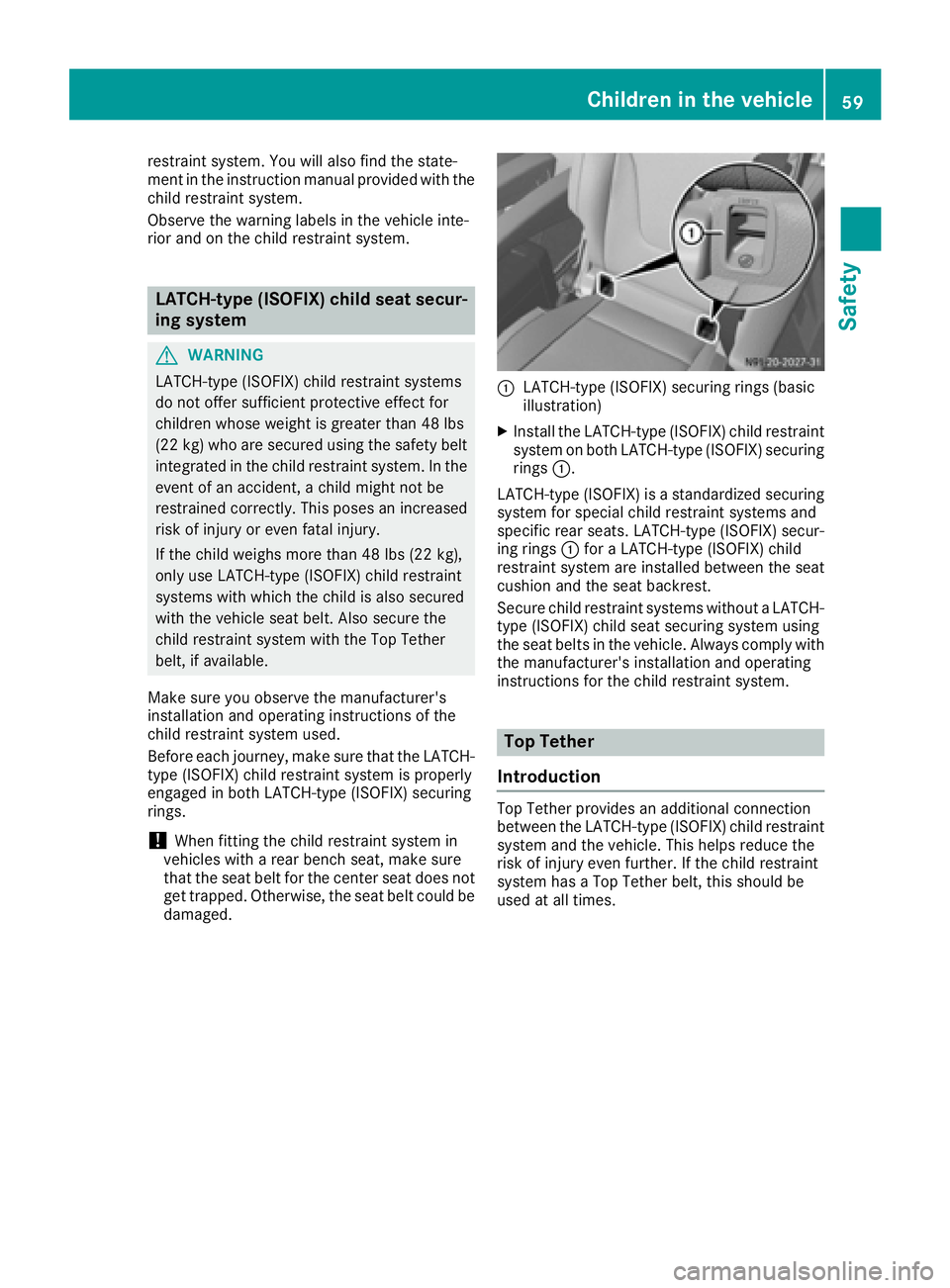
:LATCH-type (ISOFIX) securing rings (basic
illustration)
XInstall the LATCH-type (ISOFIX) child restraint system on both LATCH-type (ISOFIX) securing
rings :.
LATCH-type (ISOFIX) is astandardized securing
system for specia lchild restraint systems and
specifi crear seats. LATCH-type (ISOFIX) secur-
ing rings :for aLATCH-type (ISOFIX) child
restraint system are installed between the seat
cushion and the seat backrest.
Secure child restraint systems withou taLATCH-
type (ISOFIX) child seat securing system using
the seat belts in the vehicle. Always comply with
the manufacturer's installation and operating
instructions for the child restraint system.
Top Tether
Introduction
Top Tether provides an additional connection
between the LATCH-type (ISOFIX) child restraint system and the vehicle. This help sreduce the
risk of injury even further. If the child restraint
system has aTop Tether belt, this should be
used at all times.
Children in the vehicle59
Safety
Z
Page 62 of 310
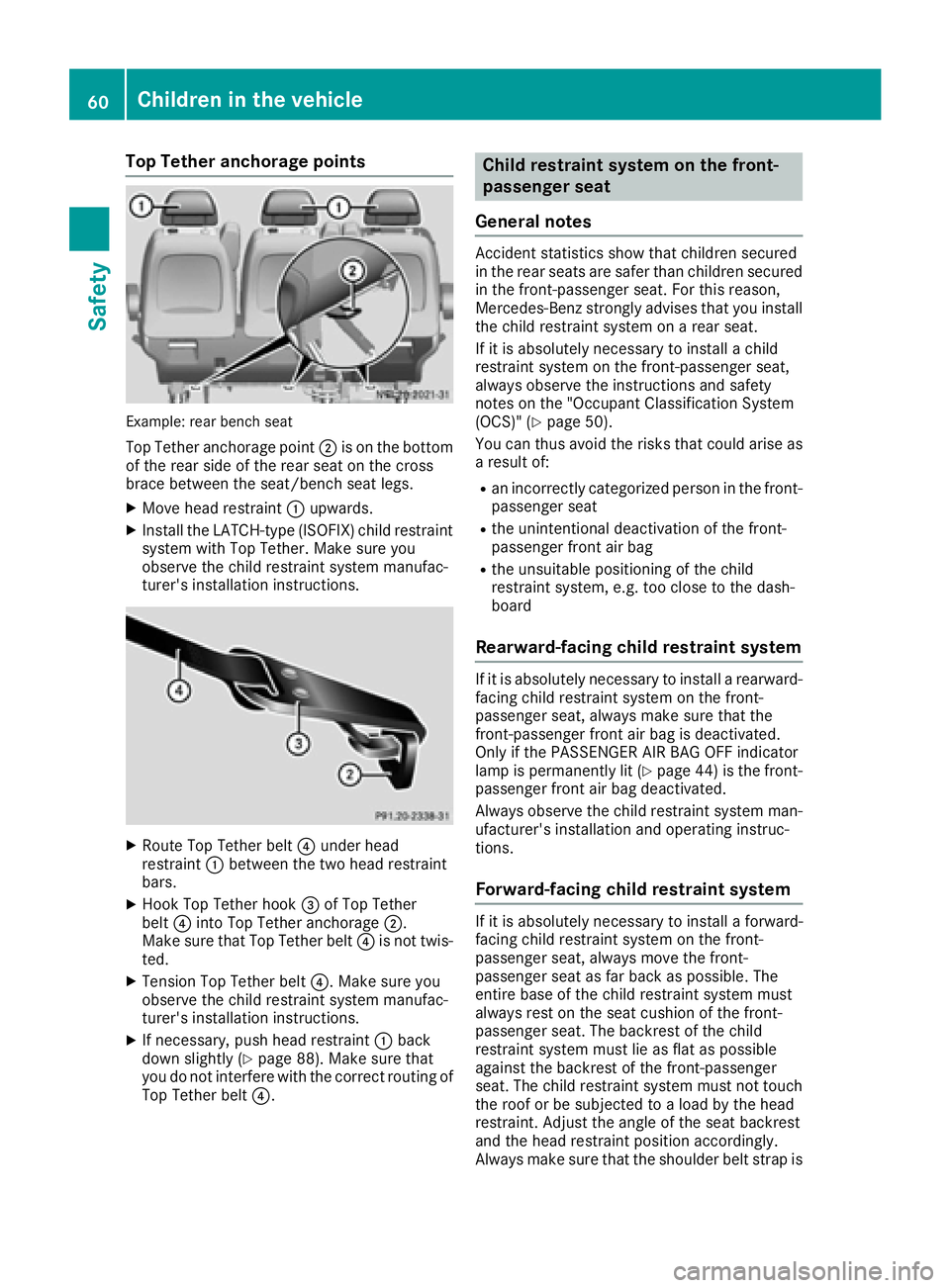
Top Tether anchorage points
Example: rearbench seat
TopT ethera nchorage point ;is on the bottom
of the rea rsideoft he rea rseatont he cross
brace between the seat/bench sea tleg s.
XMov eheadr estraint :upwards.
XInstall the LATCH-type (ISOFIX )child restraint
system with To pTether. Make sure you
observe the child restraint system manufac-
turer' sinstallatio ninstructions.
XRoute To pTetherb elt? under head
restraint :between the two head restraint
bars.
XHoo kTop Tetherh ook=of To pTether
belt ?into To pTethera nchorage ;.
Make sure thatT opTetherb elt? is not twis-
ted.
XTension To pTetherb elt?.M akesurey ou
observe the child restraint system manufac-
turer' sinstallatio ninstructions.
XIf necessary,p ushh eadr estraint :back
down slightly(Ypage 88). Make sure that
yo udon ot interfere with the correct routing of
To pT etherb elt?.
Chil drestrain tsystem on the front-
passenge rseat
General notes
Accident statistics sho wthatc hildren secured
in the rea rseats ar esafer thanc hildren secured
in the front-passenge rseat. For thisr eason,
Mercedes-Benz strongl yadvises thaty ouinstall
the child restraint system on arears eat.
If it is absolutely necessary to instal lachild
restraint system on the front-passenge rseat,
always observe the instructions and safety
note sont he "Occupant Classification System
(OCS) "(
Ypage 50).
Yo uc an thusa voidthe risks thatc ould ariseas
ar esul tof:
Ran incorrectly categorize dperso nint he front-
passenge rseat
Rthe unintentiona ldeactivatio nofthe front-
passenge rfront ai rbag
Rthe unsuitable positioning of the child
restraint system ,e.g.t oo close to the dash-
board
Rearward-facin gchild restrain tsystem
If it is absolutely necessary to instal larearward-
facing child restraint system on the front-
passenge rseat, always make sure thatt he
front-passenge rfront ai rbag is deactivated.
Onlyift he PASSENGER AIR BAG OFF indicator
lamp is permanentl ylit(
Ypage 44 )isthe front-
passenger front air bag deactivated.
Always observe the child restraint system man-
ufacturer's installation and operating instruc-
tions.
Forward-facing child restraint system
If it is absolutely necessary to install aforward-
facing child restraint system on the front-
passenger seat, always move the front-
passenger seat as far back as possible.T he
entire base of the child restraint system must
always rest on the seat cushion of the front-
passenger seat. The backrest of the child
restraint system must lie as flat as possible
against the backrest of the front-passenger
seat. The child restraint system must not touch
the roof or be subjected to aload by the head
restraint. Adjust the angle of the seat backrest
and the head restraint position accordingly.
Always make sure that the shoulderb elt strap is
60Children in the vehicle
Safety
Page 85 of 310
Useful information
This Operator's Manual describes all models as
well as standard and optional equipment of your
vehicle that were available at the time of going
to print.Country-specific variation sare possi-
ble. Note that your vehicle may not be equipped
with all of the described functions. This also
applies to system sand function srelevantt o
safety.
Read the information on qualified specialist
workshops (
Ypage 29).
Seats
Driver' sand front-passenger seat
Important safetyn otes
GWARNING
Children could become trapped if they adjust
the seats, particularly when unattended.
There is arisk of injury.
When leaving the vehicle, always tak ethe
SmartKey with you and lock the vehicle. Never
leave children unsupervised in the vehicle.
GWARNING
You could lose contro lofyour vehicle if you do
the following while driving:
Radjust the driver'ss eat, head restraint,
steering wheel or mirrors
Rfaste nthe seat belt
There is arisk of an accident.
Adjust the driver'ss eat, head restraint,steer-
ing wheel and mirrora nd fastenyour seat belt
before starting the engine.
GWARNING
When you adjust aseat, you or other vehicle
occupants could become trapped, e.g. on the seat guide rail. There is arisk of injury.
Make sure when adjusting aseat that no one
has any body parts in the sweep of the seat.
GWARNING
If the driver'ss eat is not engaged, it could
move unexpectedly while the vehicle is in
motion. This could cause you to lose contro lof
the vehicle. There is arisk of an accident.
Always make sure that the driver'ss eat is
engaged before starting the vehicle.
GWARNING
The front-air bags for could also injure the
vehicle occupants in the frontIft he front
seats are positioned too close to the dash-
board or steering wheel. This poses an
increased risk of injury or even fatal injury.
Always adjust the fronts eats so that they are
as far from the fronta ir bags as possible. Also
observet he notes on the correct adjustment
of the seats.
GWARNING
The seat belt does not offer the intended level of protection if you have not moved the back-
rest to an almost vertical position .When brak-
ing or in the eventofana ccident, you could
slide underneath the seat belt and sustain
abdomen or nec kinjuries, for example. This
poses an increased risk of injury or even fatal injury.
Adjust the seat properly before beginning
your journey. Always ensure that the backrest
is in an almost vertical position and that the
shoulder section of your seat belt is routed
across the center of your shoulder.
GWARNING
If the head restraint sare not installed or not
adjusted correctly, they cannot provide pro-
tection as intended. There is an increased risk
of injury in the head and nec karea, e.g. in the
eventofana ccidentorwhen braking.
Always drive with the head restraint sinstal-
led. Befored rivingoff, make sure for every
vehicle occupant that the center of the head
restraint supportst he back of the head at
about eye level.
Seats83
Seats, steering wheel and mirrors
Z
Page 86 of 310
!To avoid damage to the seats and the seat
heating, observe the following information:
Rkeep liquids from spilling on the seats. If
liquid is spilledont he seats, dry them as
soon as possible.
Rif the seat covers are damp or wet, do not
switch on the seat heating. The seat heat-
ing should also not be used to dry the seats.
Rclean the seat covers as recommended;
see the "Interior care" section.
Rdo not transport heavy loads on the seats.
Do not place sharp objects on the seat
cushions, e.g. knives, nails or tools. The
seats should only be occupied by passen-
gers, if possible.
Rwhen the seat heating is in operation, do
not cover the seats with insulating materi-
als, e.g. blankets, coats, bags, seat covers,
child seats or booster seats.
Your seat must be adjusted in such away that
you can wear the seat belt correctly.
Observe the following points:
RPosition the backrest in an almost vertical
position so that you are sitting virtually
upright. Do not drive with the backrest
reclined too far back.
RYour arms should be slightly bent when you
are holding the steering wheel.
RAvoid seat positions that prevent the seat belt
from being correctly routed. The shoulder
section of the belt must be routed over the
middle of your shouldera nd be pulled tight
against your upper body. The lap belt must
always pass across your lap as low down as
possible,i .e. over your hip joints.
RAdjust the head restraint so that it supports
the back of the head at eye level.
RThe distance from the pedalss hould be such
that you can depress them fully.
Please also observe the important safety notes
on "Air bags" (
Ypage 48), "Seat belts"
(Ypage 45) and "Child restraint systems"
(Ypage 58).
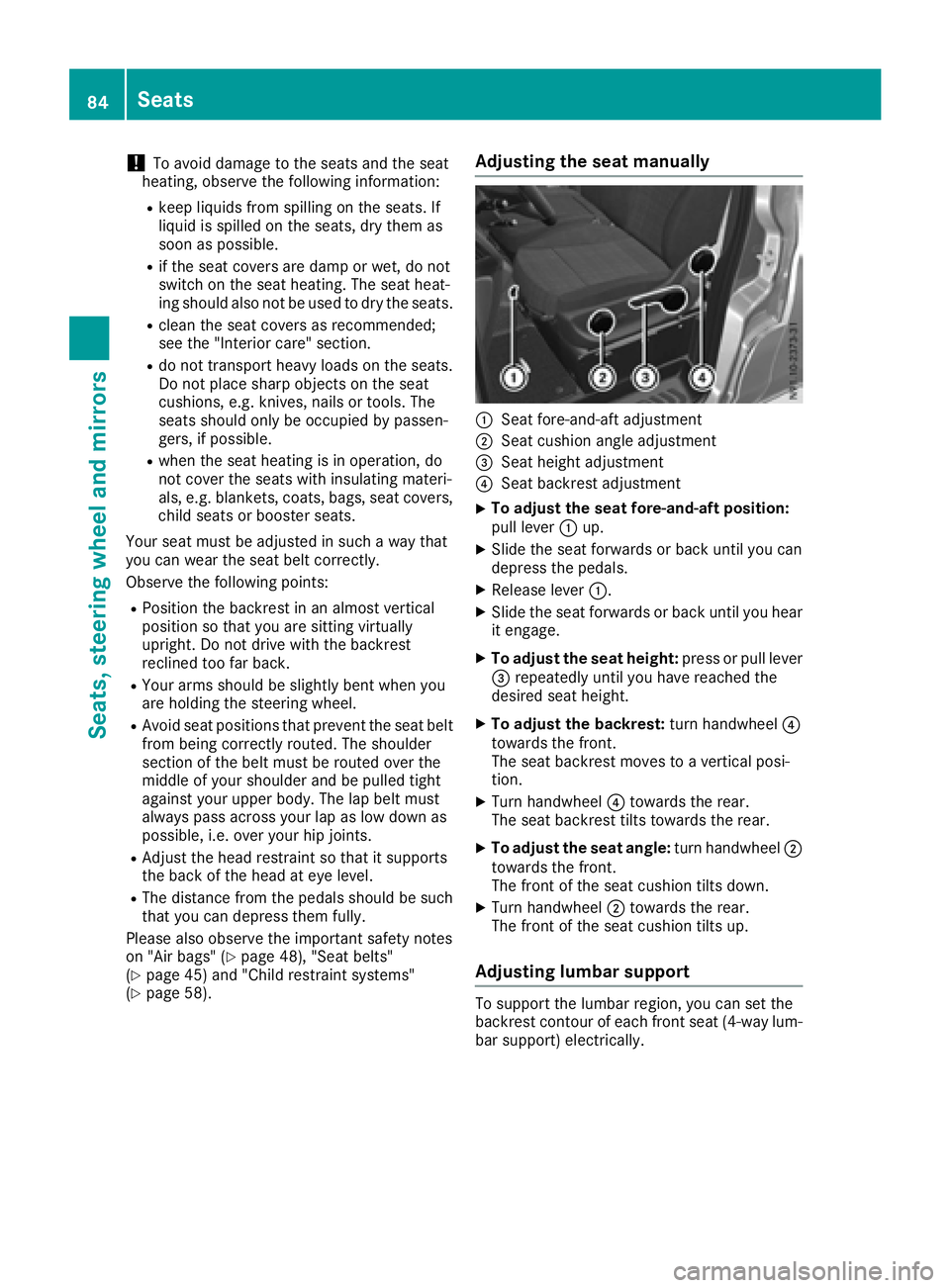
Adjusting the seat manually
:Seat fore-and-aft adjustment
;Seat cushion angle adjustment
=Seat height adjustment
?Seat backrest adjustment
XTo adjust the seat fore-and-aft position:
pull lever :up.
XSlide the seat forwards or back until you can
depress the pedals.
XRelease lever :.
XSlide the seat forwards or back until you hear
it engage.
XTo adjust the seat height: press or pull lever
= repeatedly until you have reached the
desired seat height.
XTo adjust the backrest: turn handwheel?
towards the front.
The seat backrest moves to avertical posi-
tion.
XTurn handwheel ?towards the rear.
The seat backrest tilts towards the rear.
XTo adjust the seat angle: turn handwheel;
towards the front.
The front of the seat cushion tilts down.
XTurn handwheel ;towards the rear.
The front of the seat cushion tilts up.
Adjusting lumbar support
To support the lumbarr egion, you can set the
backrest contour of each front seat (4-way lum-
bar support) electrically.
84Seats
Seats, steering whee land mirrors
Page 87 of 310
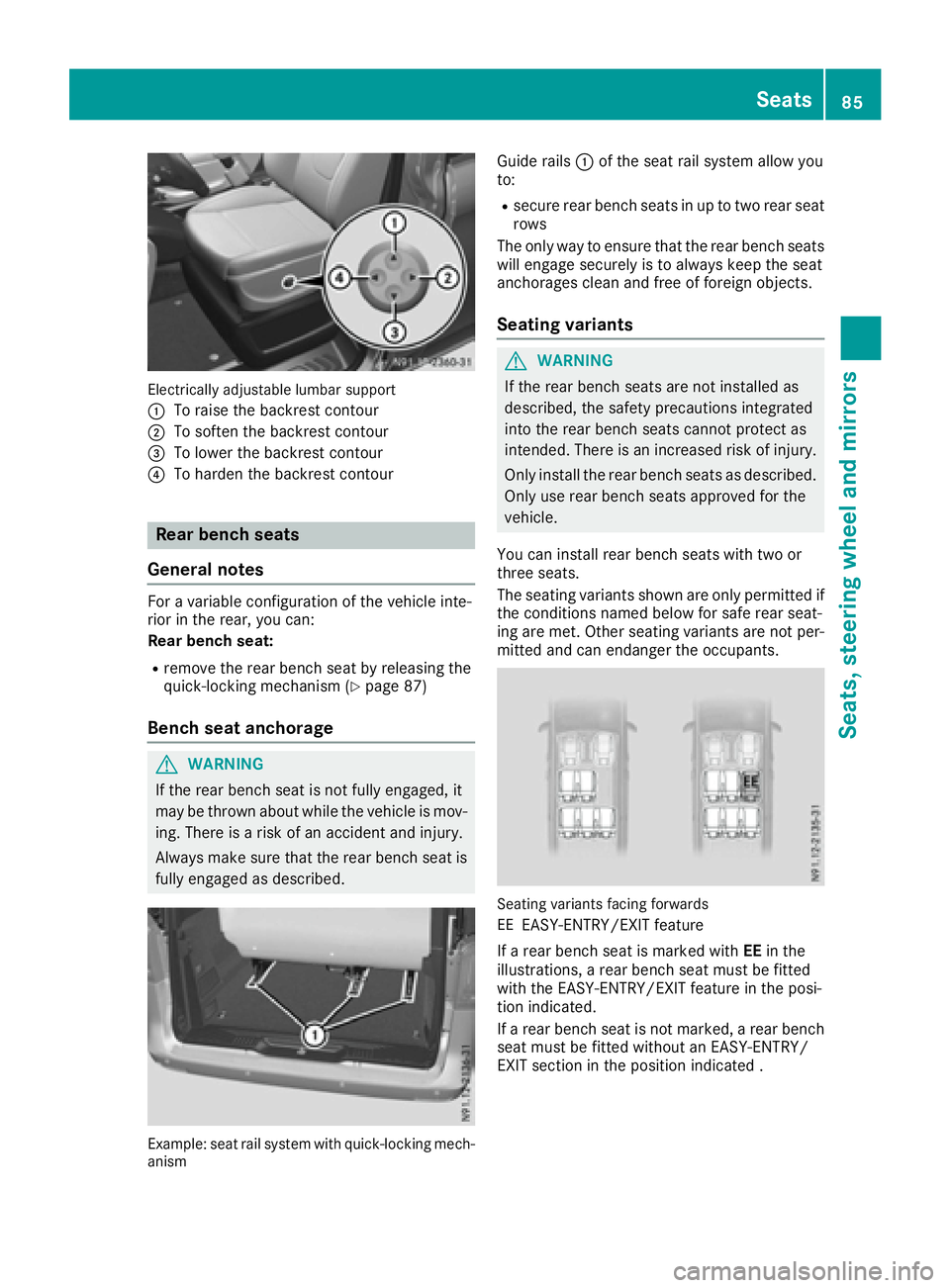
Electrically adjustable lumbarsuppo rt
:
To rais ethe backres tcontour
;To soften the backres tcontour
=To lowe rthe backres tcontour
?To harde nthe backres tcontour
Rear benchs eats
General notes
For avariabl econfiguratio nofthe vehicl einte-
rio rint he rear, yo ucan:
Rea rbench seat:
Rremove the rea rbench sea tbyreleasing the
quick-locking mechanism (Ypage 87)
Bench seat anchorage
GWARNING
If the rea rbench sea tisn ot full yengaged ,it
maybet hrown aboutw hilethe vehicl eismov-
ing .There is ariskofana ccident and injury.
Alway smakes uret hatt he rea rbench sea tis
full yengaged as described.
Example: sea trails ys tem with quick-locking mech-
anism
Guid erails :of the sea trails ystem allo wyou
to:
Rsecur erearb ench seats in up to two rea rseat
rows
The onl ywayto ensure thatt he rearbench seats
will engag esecurel yistoa lwayskeept he seat
anchoragesc lean and freeoff oreignobjects.
Seatin gvariants
GWARNING
If the rea rbench seats ar enot installe das
described, the safety precautions integrated
into the rea rbench seats canno tprotect as
intended. There is an increased ris kofinjury.
Onlyi nstallthe rea rbench seats as described.
Onlyu serea rbench seats approved for the
vehicle.
Yo uc an instal lrea rb ench seats with two or
threes eats.
The seating variants shown ar eonlyp ermitted if
the conditions named belo wfor safe rea rseat-
ing ar emet. Othe rseating variants ar enot per-
mitte dand can endanger the occupants.
Seating variants facing forwards
EE
EASY-ENTRY/EXIT feature
If ar earb ench sea tism arked with EEin the
illustrations, arearb ench sea tmustbef itted
with the EASY-ENTRY/EXIT featur einthe posi-
tio nindicated.
If ar earb ench sea tisn ot marked ,arearb ench
sea tmustbef ittedw ithou tanE ASY-ENTRY/
EXIT sectio ninthe positio nindicated .
Seats85
Seats, steering wheel andmirrors
Z
Page 88 of 310
Please observe the following conditions for safe
rear seating:
ROnly use rear bench seats approved for the
vehicle.
RArear bench seat with three seats withoutan
EASY-ENTRY/EXIT section may only be fitted
in there is no other row of rear seats behind it.
RPassengers may only use the seats if the rear
bench seat has engaged correctly
(
Ypage 87).
EASY-ENTRY/EXIT feature
GWARNING
If the rear bench seat is not fully engaged, it
may be thrown about while the vehicle is mov-
ing. There is arisk of an accident and injury.
Always make sure that the rear bench seat is
fully engaged as described.
GWARNING
When you adjust aseat, you or other vehicle
occupantsc ould become trapped, e.g. on the
seat guide rail. There is arisk of injury.
Make sure when adjusting aseat that no one
has any body parts in the sweep of the seat.
GWARNING
The rear bench seat will not engage when fol-
ded forward. The rear bench seat may inad-
vertently fold backward while accelerating,
braking, changin gdirection suddenly or in the
event of an accident ,for example. People
within the sweep of the rear bench seat may
become trapped. There is arisk of injury.
Before driving off, alwaysf old back the rear
bench seat if it is folded forward. Make sure
that the rear bench seat is fully engaged.
The only way to ensure that the rear bench seat
will engage securely is to alwaysk eep the seat
anchorages clean and free of foreign objects.
The rear seat anchorage is only engaged when
the red indicator tab is no longer visible and is
fully retracted into the seat anchorage.
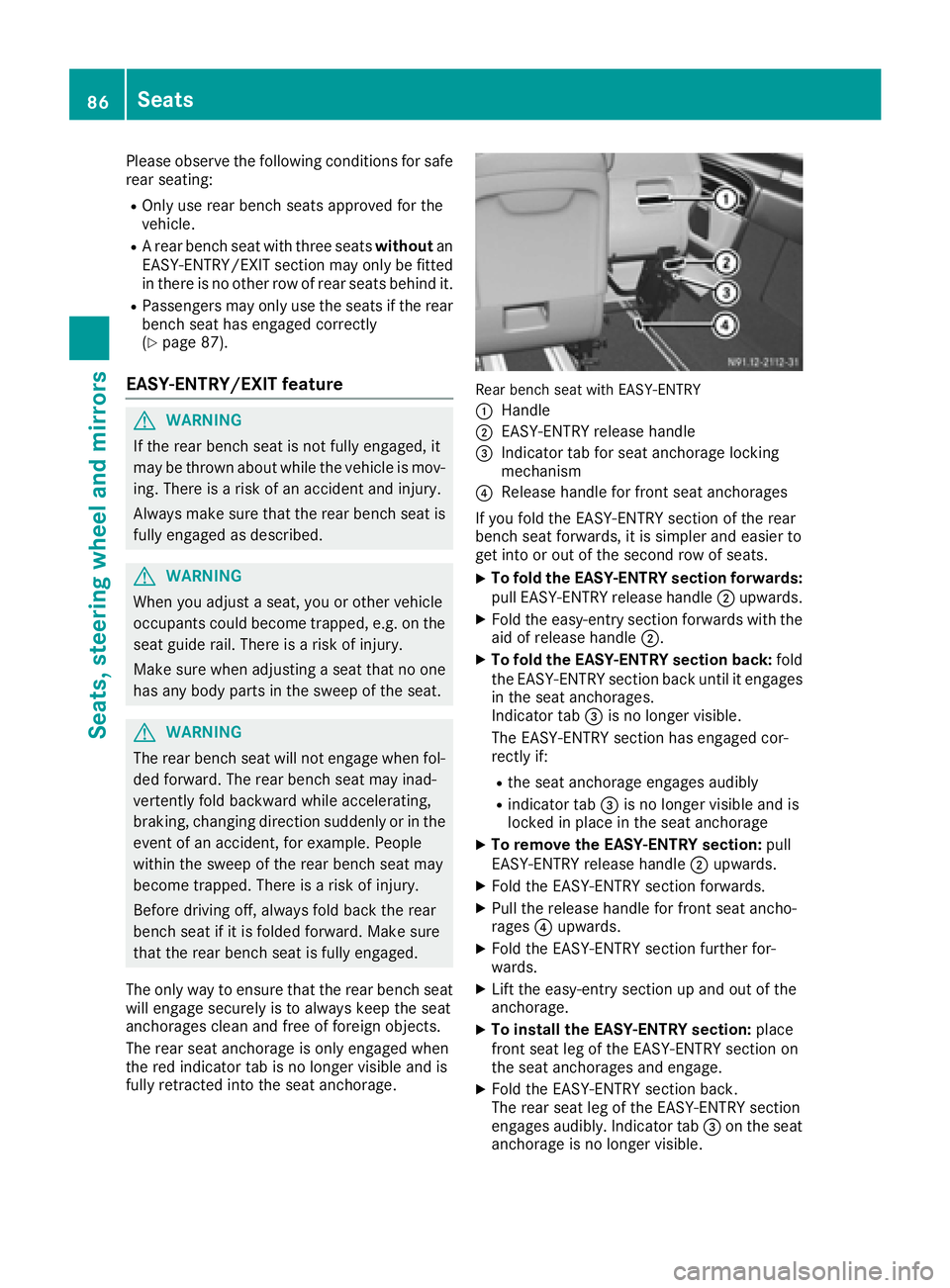
Rear bench seat with EASY-ENTRY
:
Handle
;EASY-ENTRY release handle
=Indicator tab for seat anchorage locking
mechanism
?Release handle for fronts eat anchorages
If you fold the EASY-ENTRY section of the rear
bench seat forwards, it is simpler and easier to
get into or out of the second row of seats.
XTo fold the EASY-ENTRY section forwards:
pull EASY-ENTRY release handle ;upwards.
XFold the easy-entr ysection forwards with the
aid of release handle ;.
XTo fold the EASY-ENTRY section back: fold
the EASY-ENTRY section back until it engages
in the seat anchorages.
Indicator tab =is no longer visible.
The EASY-ENTRY section has engaged cor-
rectly if:
Rthe seat anchorage engages audibly
Rindicator tab =is no longer visible and is
locked in place in the seat anchorage
XTo remove the EASY-ENTRY section: pull
EASY-ENTRY release handle ;upwards.
XFold the EASY-ENTRY section forwards.
XPull the release handle for fronts eat ancho-
rages ?upwards.
XFold the EASY-ENTRY section further for-
wards.
XLift the easy-entr ysection up and out of the
anchorage.
XTo install the EASY-ENTRY section: place
fronts eat leg of the EASY-ENTRY section on
the seat anchorages and engage.
XFold the EASY-ENTRY section back.
The rear seat leg of the EASY-ENTRY section
engages audibly.I ndicator tab=on the seat
anchorage is no longer visible.
86Seats
Seats, steering wheel and mirrors
Page 89 of 310
The EASY-ENTRY section has engaged cor-
rectly if:
Rthe seat anchorage engages audibly
Rindicator tab=is no longer visible and is
fully retracted into the seat anchorage
If the EASY-ENTRY section has not engaged cor-
rectly:
XFold the EASY-ENTRY section forwards.
XFold the EASY-ENTRY section backwards
again and check the lockingm echanism.
Removing/installing the rear bench
seat
Standard rear bench seat:
GWARNING
If the rear bench seat is not fully engaged, it
may be thrown about while the vehicle is mov-
ing. There is arisk of an accident and injury.
Always make sure that the rear bench seat is
fully engaged as described.
GWARNING
If the rear bench seat is not installed as descri- bed or an unsuitable rear bench seat is instal-
led, the seat belts may not provide protection
as intended. There is an increased risk of
injury.
Install the rear bench seat as described. Only
use rear bench seats that are approved for
your vehicle by the distributor named on the
inside cover page.
The only way to ensure that the rear bench seat
will engage securely is to alwaysk eep the seat
anchorages clean and free of foreign objects.
Always observe the notes about the seating var-
iants (
Ypage 85).
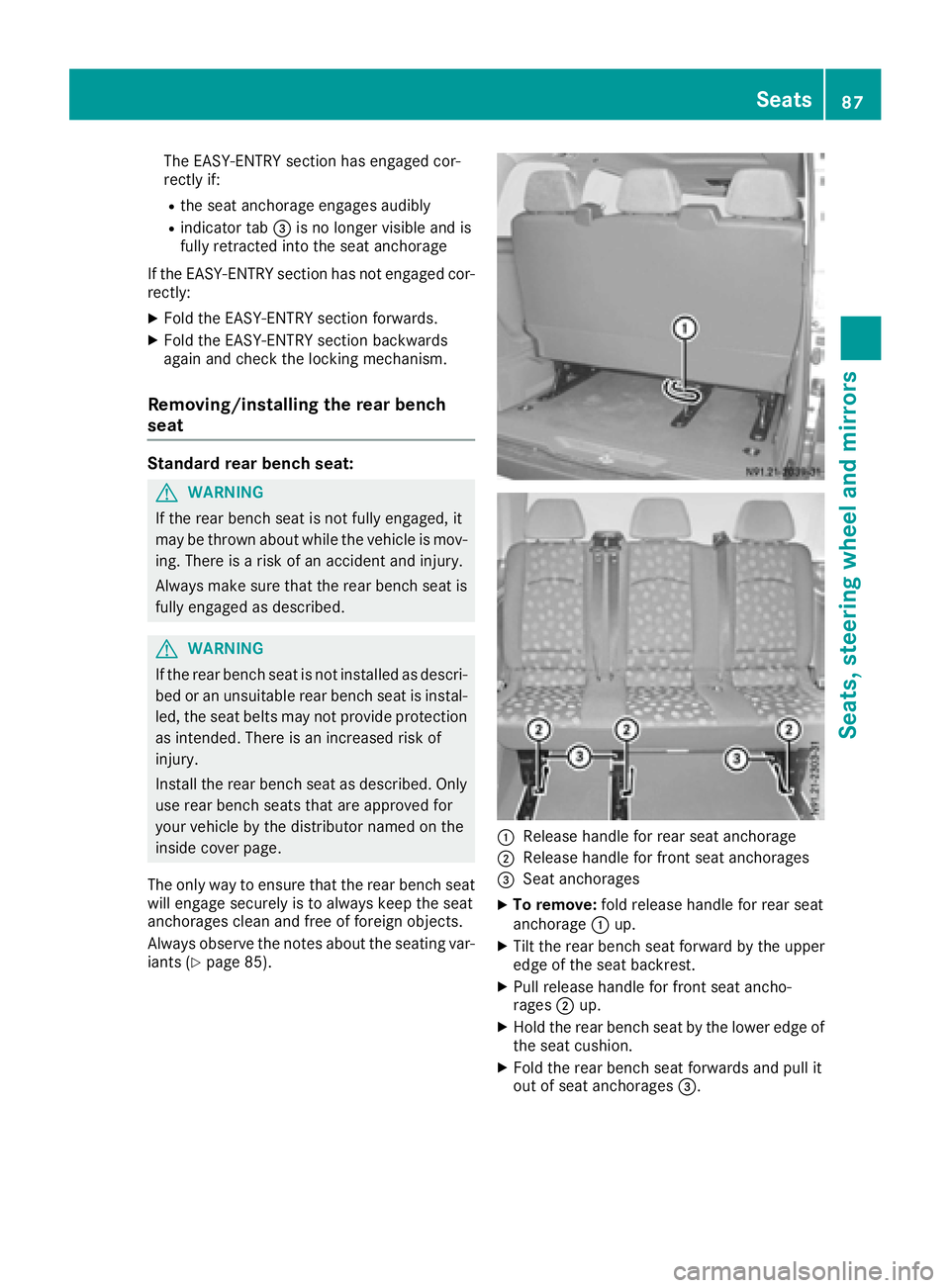
:Release handle for rear seat anchorage
;Release handle for front seat anchorages
=Seat anchorages
XTo remove: fold release handle for rear seat
anchorage :up.
XTilt the rear bench seat forward by the upper
edge of the seat backrest.
XPull release handle for front seat ancho-
rages ;up.
XHold the rear bench seat by the lower edge of
the seat cushion.
XFold the rear bench seat forwards and pull it
out of seat anchorages =.
Seats87
Seats, steering wheel and mirrors
Z
Page 90 of 310
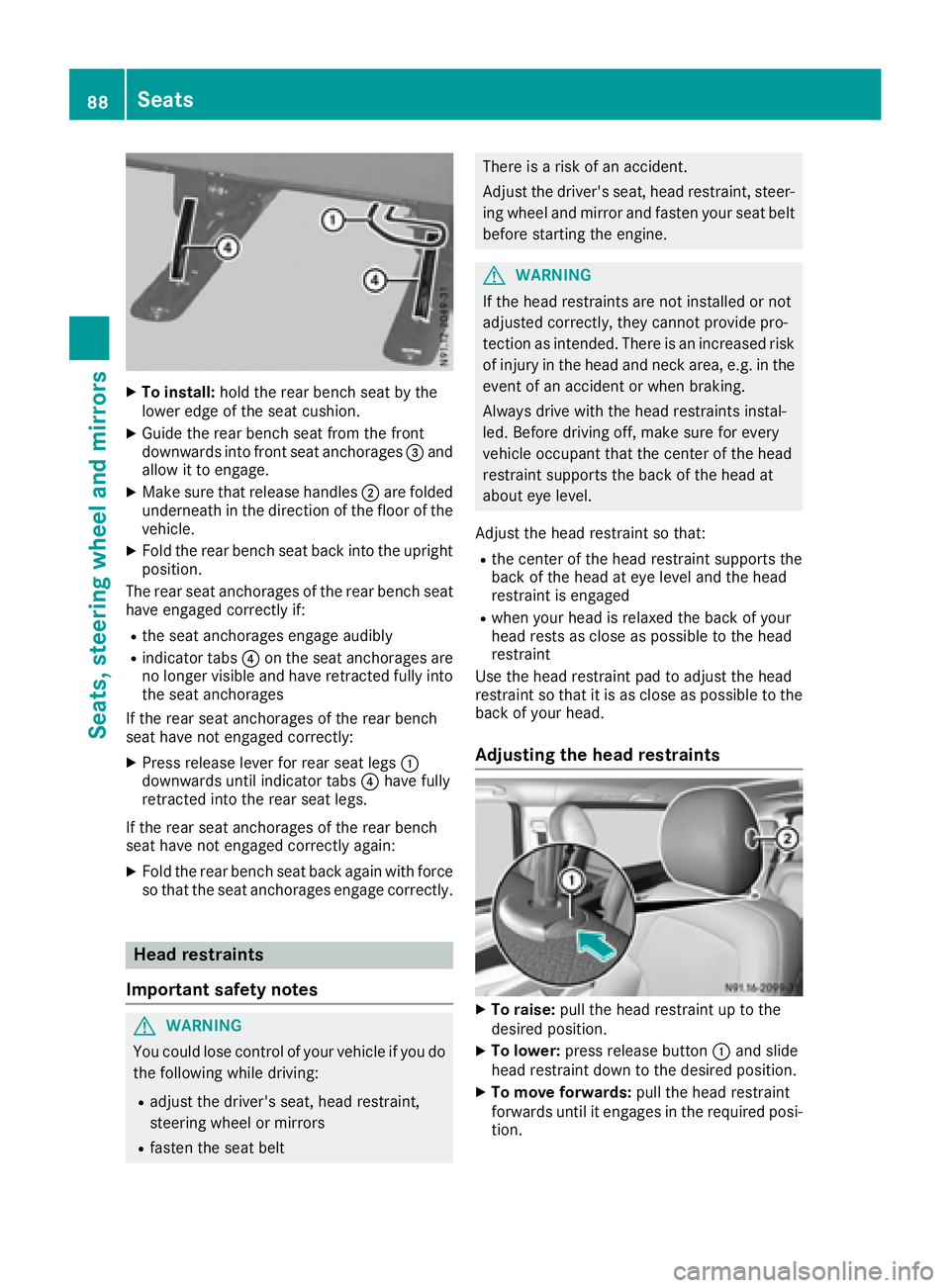
XTo install:holdthe rea rbench sea tbythe
lowe redgeoft he sea tcushion.
XGuid ethe rea rbench sea tfrom the front
downward sinto front sea tanchorages =and
allo wittoe ngage.
XMake sure thatr elease handles;are folded
underneath in the direction of the floor of the
vehicle.
XFol dthe rea rbench sea tbackinto the upright
position.
The rea rseata nchorages of the rea rbench seat
have engaged correctl yif:
Rthe sea tanchorages engage audibly
Rindicator tabs ?on the sea tanchorages are
no longer visible and have retracted fully into
the sea tanchorages
If the rea rseata nchorages of the rea rbench
sea thaven ot engaged correctly:
XPress release lever for rea rseatleg s:
downward suntilindicator tabs ?have fully
retracted into the rea rseatleg s.
If the rea rseata nchorages of the rea rbench
sea thaven ot engaged correctl yagain :
XFoldthe rea rbench sea tbacka gain with force
so thatt he seatanchorages engage correctly.
Hea drestraints
Important safety notes
GWARNING
Yo uc ould lose contro lofyourvehicl eifyoudo
the following whil edriving:
Radjus tthe driver's seat, hea drestraint,
steering whee lormirrors
Rfasten the sea tbelt
There is ariskofana ccident.
Adjust the driver' sseat, hea drestraint, steer-
ing whee land mirror and fasten your sea tbelt
before starting the engine.
GWARNING
If the hea drestraints are not installe dornot
adjusted correctly, they canno tprovid epro-
tection as intended. There is an increased risk
of injury in the hea dand neck area, e.g .inthe
event of an accident or when braking.
Alway sdrive with the hea drestraints instal-
led. Before driving off, make sure for every
vehicl eoccupant thatt he centerofthe head
restraint supports the back of the hea dat
aboute yelevel.
Adjust the hea drestraint so that:
Rthe cente rofthe hea drestraint supports the
back of the hea dateyelevel and the head
restraint is engaged
Rwhen your hea disrelaxe dthe back of your
hea drests as close as possibl etothe head
restraint
Use the hea drestraint pa dtoadjus tthe head
restraint so thatiti sasclose as possibl etothe
back of your head.
Adjustin gthe hea drestraints
XTo raise: pull the hea drestraint up to the
desired position.
XTo lower: press release button :and slide
hea drestraint down to the desired position.
XTo mov eforwards: pull the hea drestraint
forward suntilite ngages in the required posi-
tion.
88Seats
Seats, steering wheel andmirrors
Page 91 of 310
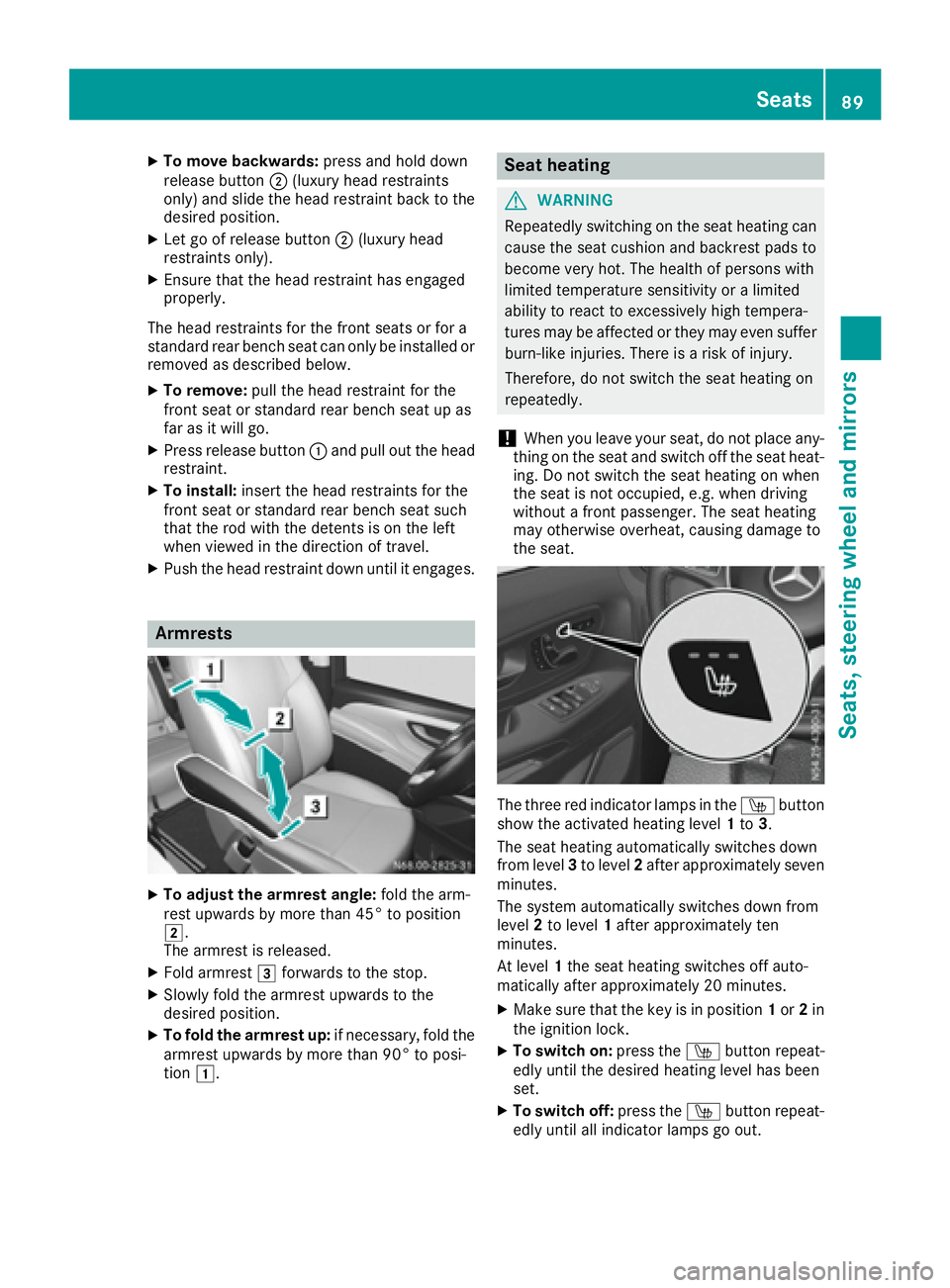
XTo movebackwards: press and hol ddown
release button ;(luxury hea drestraints
only) and slid ethe hea drestraint back to the
desired position.
XLet go of release button ;(luxury head
restraints only).
XEnsure thatt he headrestraint hase ngaged
properly.
The hea drestraints for the front seats or for a
standard rea rben ch sea tcan onlybei nstalledor
remove dasdescribe dbelow .
XTo remove: pull the headrestraint for the
front sea torstandard rea rbench sea tupa s
far as it will go.
XPress release button :and pull outt he head
restraint.
XTo install: insert the hea drestraints for the
front sea torstandard rea rbench sea tsuch
thatt he rod with the detents is on the left
when viewe dinthe direction of travel.
XPush the hea drestraint down unti litengages.
Armrests
XTo adjust the armres tangle: foldt he arm-
res tupwar ds by more than4 5° to position
2.
The armres tisr eleased.
XFol da rmrest 3forward stothe stop.
XSlowl yfoldt he armres tupwar ds to the
desired position.
XTo fol dthe armres tup:if necessary,f oldt he
armres tupwar ds by more than9 0° to posi-
tion 1.
Seat heating
GWARNING
Repeatedl yswitching on the sea theating can
cause the sea tcushion and backres tpadst o
become very hot. The health of persons with
limite dtemperature sensitivity or alim ited
ability to react to excessivel yhight empera-
ture smaybe affecte dorthey maye vens uffer
burn-like injuries. There is ariskofi njury.
Therefore, do not switch the sea theating on
repeatedly.
!Whe nyou leave your seat, do not place any-
thing on the sea tand switch off the sea theat-
ing .Don ot switch the sea theating on when
the sea tisn ot occupied ,e.g.w hend riving
withou tafront passenger .The sea theating
mayo therwise overheat, causing damag eto
the seat.
The thre ered indicator lamps in the Íbutton
sho wthe activate dheating level 1to 3.
The sea theating automaticall yswitches down
from level 3to level 2afte rapp roximatelys even
minutes.
The system automaticall yswitches down from
level 2to level 1afte rapproximatelyt en
minutes.
At level 1the sea theating switches off auto-
maticall yafterapproximately2 0minutes.
XMake sure thatt he key is in position 1or 2in
the ignition lock.
XTo switc hon:press the Íbutton repeat-
edly unti lthe desired heating level hasb een
set.
XTo switc hoff:press the Íbutton repeat-
edly unti lallindicator lamps go out.
Seats89
Seats, steering wheel andmirrors
Z