seats MERCEDES-BENZ METRIS 2016 MY16 Operator’s Manual
[x] Cancel search | Manufacturer: MERCEDES-BENZ, Model Year: 2016, Model line: METRIS, Model: MERCEDES-BENZ METRIS 2016Pages: 310, PDF Size: 7.28 MB
Page 92 of 310
If the on-board voltage is too low, the seat heat-
ing willeither switch itself off prematurely or not
come on at all .Inthis case, too many electrical
consumers are switched on or the battery
charge is not sufficient. The seat heating will
automatically switch back to the current heating
level when enough on-board voltage is available
again.
Steering wheel
GWARNING
You could lose control of you rvehicle if you do
the following whil edriving:
Radjust the driver's seat, head restraint,
steering wheel or mirrors
Rfasten the seat belt
There is arisk of an accident.
Adjust the driver's seat, head restraint, steer-
ing wheel and mirror and fasten you rseat belt
before starting the engine.
GWARNING
If the steering wheel is unlocked whil ethe
vehicle is in motion, it could change position
unexpectedly .This could cause you to lose
control of the vehicle.T here isarisk of an
accident.
Before starting off, make sure the steering
wheel is locked. Never unlock the steering
wheel whil ethe vehicle is in motion.
GWARNING
Children could injure themselves if they
adjust the steering wheel .There is arisk of
injury.
When leaving the vehicle,a lways take the
SmartKey with you and lock the vehicle.N ever
leave childrenu nsupervised in the vehicle.
The steering wheel can still be adjusted if the
key has been removed.
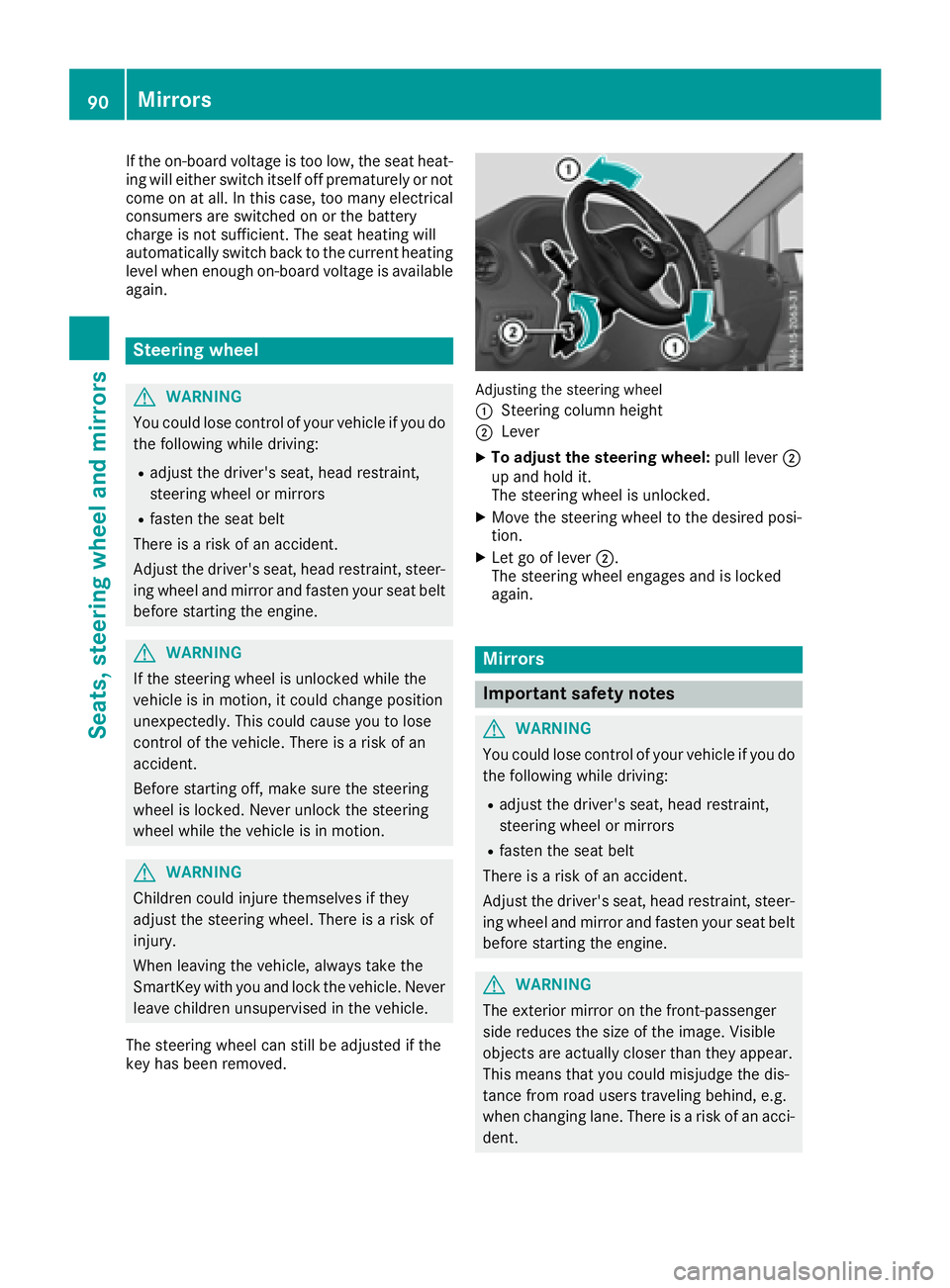
Adjusting the steering wheel
:
Steering column height
;Lever
XTo adjust the steering wheel: pulllever ;
up and hold it.
The steering wheel is unlocked.
XMove the steering wheel to the desiredp osi-
tion.
XLet go of lever ;.
The steering wheel engages and is locked
again.
Mirrors
Important safety notes
GWARNING
You could lose control of you rvehicle if you do
the following whil edriving:
Radjust the driver's seat, head restraint,
steering wheel or mirrors
Rfasten the seat belt
There is arisk of an accident.
Adjust the driver's seat, head restraint, steer-
ing wheel and mirror and fasten you rseat belt
before starting the engine.
GWARNING
The exterior mirror on the front-passenger
side reduces the size of the image .Visible
objects are actually closer than they appear.
This means that you could misjudge the dis-
tance from road users traveling behind, e.g.
when changing lane. There is arisk of an acci-
dent.
90Mirrors
Seats, steerin gwheel and mirrors
Page 93 of 310
For this reason, always make sureofthe
actual distance from the roadu sers traveling
behind by glancing over your shoulder.
Rear-view mirror
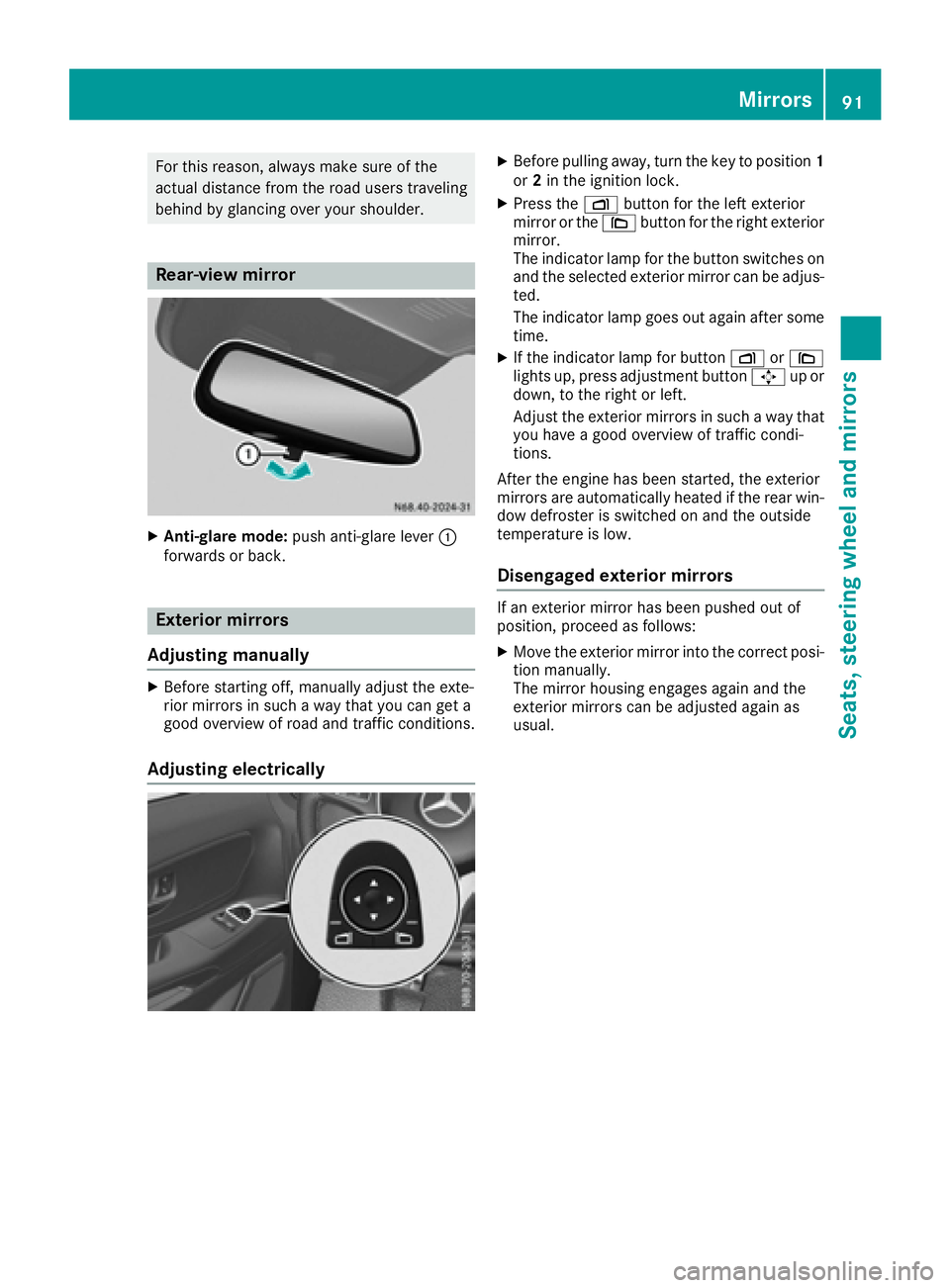
XAnti-glare mode: push anti-glare lever :
forward sorback.
Exterior mirrors
Adjusting manually
XBefores tarting off, manually adjust the exte-
rio rm irrors in such awaythat yo ucan get a
goodo verviewofroadand traffi cconditions.
Adjusting electrically
XBeforep ulling away ,turn the key to position 1
or 2in the ignition lock.
XPres sthe Z button for the lef texterior
mirro rorthe\ button for the right exterior
mirror.
The indicator lamp for the button switches on
and the selected exterior mirro rcan be adjus-
ted.
The indicator lamp goeso utagai naftersome
time.
XIf the indicator lamp for button Zor\
lights up ,press adjustment button 7up or
down, to the right or left.
Adjus tthe exterior mirrors in such awaythat
yo uh aveag oodo vervie woftrafficcondi-
tions.
After the engine has bee nstarted, the exterior
mirrors are automaticall yheated if the rearw in-
dow defroster is switched on and the outside
temperature is low.
Disengaged exterior mirrors
If an exterior mirro rhas bee npushedo utof
position, proceed as follows:
XMove the exterior mirro rinto the correct posi-
tion manually.
The mirro rhousing engages agai nand the
exterior mirrors can be adjuste dagain as
usual.
Mirrors91
Seats, steering wheel and mirrors
Z
Page 234 of 310
Useful information
This Operator's Manual describes all models as
well as standard and optional equipment of your
vehicle that were available at the time of going
to print.Country-specific variation sare possi-
ble. Note that your vehicle may not be equipped
with all of the described functions. This also
applies to system sand function srelevantt o
safety.
Read the information on qualified specialist
workshops (
Ypage 29).
Loading guidelines
Important safetyn otes
GWARNING
When objects are unsecured or inadequately
secured, they can slip, turn over or be thrown
about, strikin gvehicle occupants .This also
applies to:
Rluggage or loads
Rseats which have been removed and are
being transported in the vehicle in an
exceptional case.
There is arisk of injury, particularly in the
eventofab rakingmaneuver or abrupt change
in direction.
Always stow objects in such away that they
cannot be tossed about. Beforet raveling,
secure objects, luggage or loads to prevent
them slipping or tippin gover. If you removea
seat, stor eitpreferably outside the vehicle.
GWARNING
As aresult of improperly placed or unevenly
distributed loads, the center of gravityoft he
load being transported may be too high or too
far back. This can significantly impair handling
as well as steering and brakin gcharacteris-
tics. There is arisk of an accident.
Always make sure that the center of gravityo f
the load is:
Rbetween the axles
and
Ras low as possible, near the rear axle.
GWARNING
When the permissible wheel loads, axle loads
and/o rthe maximum permissible gross vehi-
cle weight are exceeded, drivings afetyis
compromised. The handlin gaswell as steer-
ing and brakin gcharacteristic smay be signif-
icantly impaired. Overloaded tires may over-
heat, causing them to burst. There is arisk of
an accident.
When transporting aload, always observet he
permissible wheel loads, axle loads and the
maximum permissible gross vehicle weight
for the vehicle (includin goccupants).
!If you are using aroof carrier,o bservethe
maximum roof load and maximum roof carrier
load.
RDo not stac kluggage or loads higher than the
backrests.
RObjects to be transported should preferably
be stowed in the cargo compartment.
RWhen transporting luggage, always use the
cargo tie-down rings for securingl oads and a
cargo net ,ifinstalled.
RUse cargo tie-down rings and fasteners which
are suitable for the weight and size of the
load.
When using suitable load securin gaids and tie
downs, always follow the manufacturer's oper-
ating instructions, in particular the notes on dis-
card criteria contained therein.
Load securin gaids or tie downs must not be
used if:
Ridentification marksa re missingorillegible
Rthereare yarn breakages ,damage to bearing
seams or other signs of tearing
Rther eare signs of shearing, deformation,
pinching or other damage
Rther eisd amage to clampingorc onnecting
elements
Load securinga ids and tie downs in this condi-
tion are ready for discard and must be replaced.
If you use load securinga ids or tie downs which
are worn out, the load may not be sufficiently
secured and could cause damage to property.
232Loading guidelines
Transporting loads
Page 236 of 310
XAlwaystransport load sinthe cargo compart-
ment and with the sea tbackrests folde dup
and properly locked in position.
XAlway splace the load against the backrests of
the front or rea rseats.
XMov elarge and heavy load sasfar towards the
front of the vehicl easpossibl eagain st the
front or rea rseats. Stow the load flush with
the rea rorfront seats.
XAlway saddit ionally secur ethe load with suit-
able load-securing aids or tie downs.
Observ ethe following notes:
RDo not stack load shighe rthant he uppe redg e
of the backrests.
RTransport load sbehin dseats thata renot
occupied.
RIf the rea rbench sea tisn ot occupied ,insert
the sea tbelts crosswis einto the buckle of the
opposite sea tbelt.
Carg ocom partmen tvariations
Youc an vary the cargo compartment according
to your transportation requirements as follows:
Rby folding the sea tbackrests forwar dtothe
table position.
Rby removing the rea rbench seat.
Yo uw illf ind informatio nabout rearbench seats
in the "Rea rbench seats" sectio n(
Ypage 85).
Securingloa ds
Important safety notes
GWARNING
If yo uattach the tie-down incorrectly when
securing the load ,the following mayo ccurin
the event of abrupt changesind irection, brak-
ing maneuver soranaccident:
Rthe cargo tie-down ring smaybecome
detached or the tie-down mayt earifthe
permissibl eloa dise xceeded
Rthe load mayn ot be restrained.
Thi sm aycause the load to slip ,tip ove rorbe
tossed about, striking vehicl eoccupants.
There is ariskofana ccident and injury.
Alwaystension the tie-downs in the proper
manner and onlyb etween the described
cargo tie-down rings. Alway susetie-downs
designeds pecifically for the loads.
!Observethe informatio nonthe maximum
loading capacity of the individual cargo tie-
down points.
If yo uusesevera lcargo tie-down points to
secur eaload, youm usta lway stake the max-
imu mloadin gcapacity of the weakest cargo
tie-down point into account.
If yo ubrake hard, for example, the forces act-
ing could be up to severa ltime sthe weight
forc eoft he load .Alway susemultipl ecargo
tie-down points in order to distribute the force
absorption. Loa dthe anchorages evenly.
Spread the load evenly across the cargo tie-
down points/cargo tie-down rings. Yo uwillf ind
informatio nonthe maximu mloadin gcapacity of
the cargo tie-down points under "Cargo tie-
down points and carrie rsystems" (
Ypage 304).
Do not attempt to modify or repai rthe cargo tie-
down points/cargo tie-down ring sortie downs.
Read the informatio nonqualified specialist
workshops: (
Ypage 29).
As the driver ,you arer esponsibl efor ensuring
that:
RThe load is secured against slipping, tipping,
rolling or falling off in norma l traffic condi-
ti
ons, shoul dthe vehicl eswervetoa voidan
obstacle ,inthe event of full brake application
and on poor roa dsurfaces.
RThe applicabl erequirements and guidelines
relating to load-securing practice smustb e
met.
If thisisn ot the case, thism ayconstitute a
punishabl eoffense, depending on local legis-
latio nand any ensuing consequences.
Alway sobserve the legalr equirements for the
country yo uarecurrentl yin.
Make sure thatt he load is securebefore every
journey and at regular intervals during alon g
journey .Correct an incorrectly or inadequately
secured load if necessary.
Alway sobserve the operating instructions or the
notes of the lashing strapm anufacturer for the
operatio nofthe lashing strap.
Yo uc an obtai ninformatio nabout securing the
load correctl yfrom the manufacturer of the load
securing aids or tie down for securing the load.
234Securingl oads
Transporting loads
Page 240 of 310
GWARNING
If vehicleo ccupants are seated behind aload
protection net, they may be squeezed up
against the loa dprotection net. There is arisk
of injury,p articularlyinthe event of braking
maneuvers or abrupt changes in direction.
Never allow vehicleo ccupants to sit behind
the loa dprotection net.
The loa dprotection net borders the cargo com-
partment. It protects vehicleo ccupants from
light objects and/or luggage slipping or tipping
over. Always observe the notes on securing
loads (
Ypag e234).
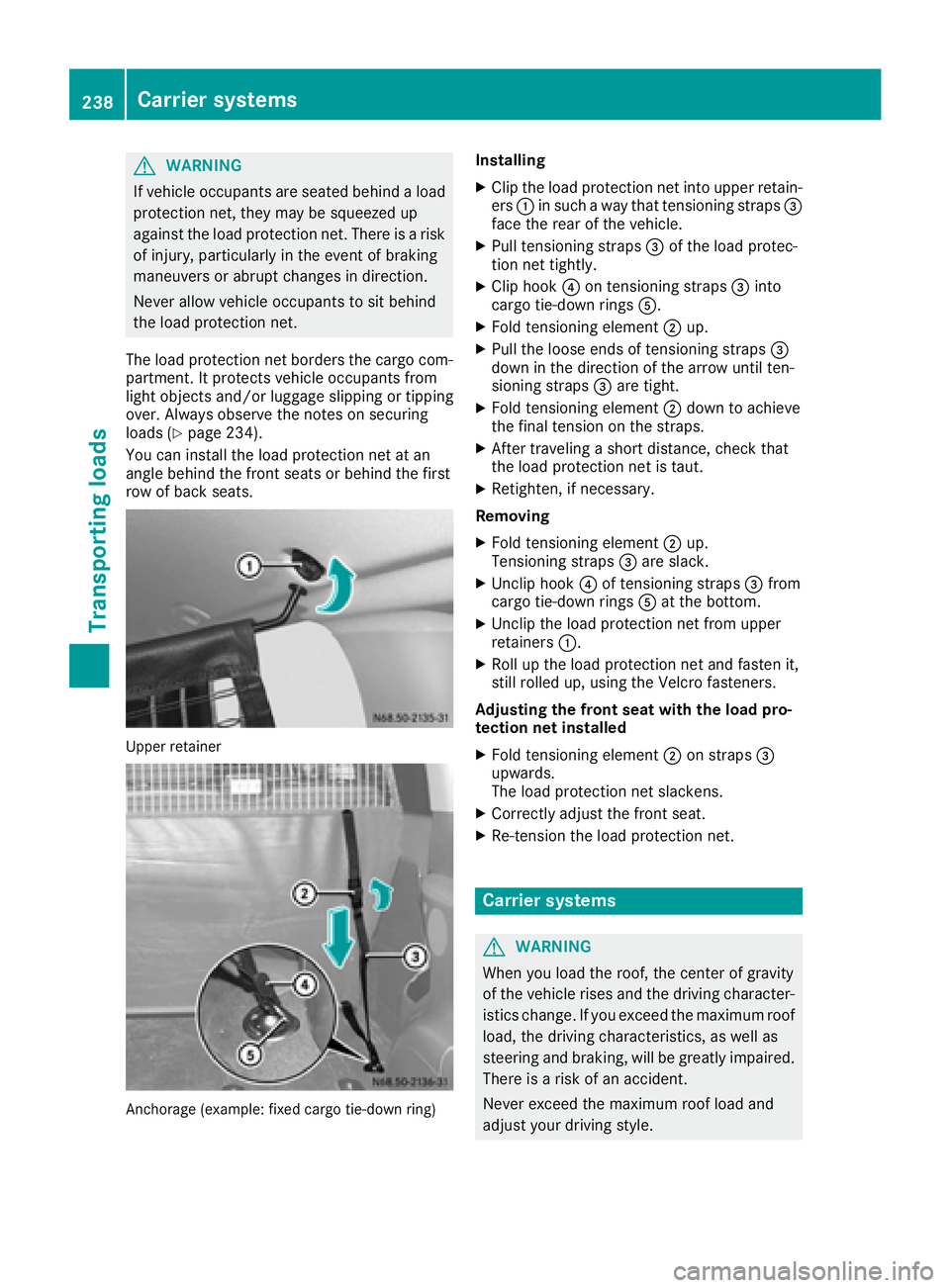
You can instal lthe loa dprotection net at an
angle behind the front seats or behind the first
row of back seats.
Upperr etainer
Anchorage (example: fixed cargo tie-downr ing)
Installing
XClipthe loa dprotection net into upper retain-
ers :in such away that tensioning straps =
face the rear of the vehicle.
XPul ltensioning straps =of the loa dprotec-
tion net tightly.
XCli ph ook ?on tensioning straps =into
cargo tie-downr ingsA.
XFold tensioning element ;up.
XPullthe loos eends of tensioning straps =
downint he direction of the arrow until ten-
sioning straps =are tight.
XFold tensioning element ;downtoa chieve
the final tension on the straps.
XAfter traveling ashort distance, check that
the loa dprotection net is taut.
XRetighten, if necessary.
Removing
XFold tensioning element ;up.
Tensioning straps =are slack.
XUnclip hook ?of tensioning straps =from
cargo tie-dow nrings Aat the bottom.
XUnclip the loa dprotection net from upper
retainers :.
XRollupt he loa dprotection net and fasten it,
still rolled up, using the Velcro fasteners.
Adjusting the front seat with the load pro-
tectio nnet installed
XFold tensioning element ;on straps =
upwards.
The loa dprotection net slackens.
XCorrectly adjust the front seat.
XRe-tensio nthe loa dprotection net.
Carrier systems
GWARNING
When you loa dthe roof, the center of gravity
of the vehicler ises and the driving character-
istics change. If you exceed the maximu mroof
load, the driving characteristics, as wel las
steering and braking, wil lbegreatly impaired.
There is arisk of an accident.
Never exceed the maximu mroof loa dand
adjust you rdriving style.
238Carrier systems
Transporting loads
Page 274 of 310
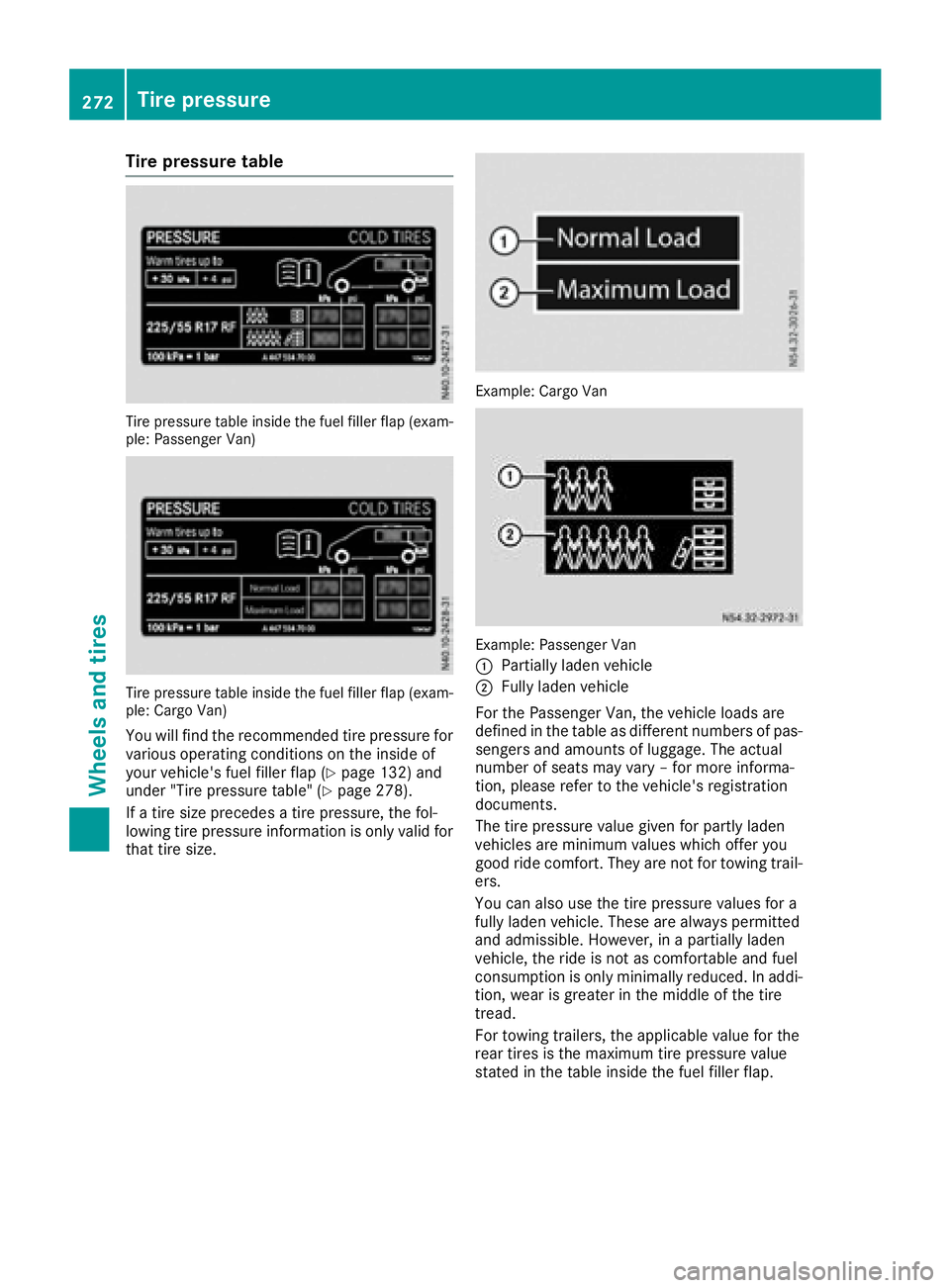
Tire pressure table
Tire pressure table insidethe fuel fille rflap( exam-
ple: Passenge rVan)
Tire pressure table insid ethe fuel fille rflap( exam-
ple: Cargo Van)
Yo uw illf ind the recommende dtire pressure for
various operating conditions on the insid eof
your vehicle's fuel fille rflap(
Ypage 132 )and
under "Tire pressure table "(Ypage 278).
If at ire size precedes atire pressure, the fol-
lowing tire pressure informatio niso nlyv alid for
thatt ire size.
Example: Cargo Van
Example: Passenge rVan
:
Partiall yladen vehicle
;Fully lade nvehicle
For the Passenge rVan,the vehicl eloads are
define dinthe table as different numbers of pas-
sengers and amounts of luggage.T he actual
numbe rofseats mayv ary–f or mor einforma-
tion, please refer to the vehicle's registration
documents.
The tire pressure valu egiven for partly laden
vehicles ar eminimu mvalues which offer you
good rid ecomfort. The yarenot for towing trail-
ers.
Yo uc an also us ethe tire pressure values for a
full yladen vehicle. These ar ealway spermitted
and admissible. However, in apartiall yladen
vehicle, the rid eisnot as comfortabl eand fuel
consumption is onl yminimall yreduced. In addi-
tion, wear is greate rinthe middl eofthe tire
tread.
For towing trailers ,the applicabl evalue for the
rea rtire sist he maximum tire pressure value
stated in the table insid ethe fuel fille rflap.
272Tire pressure
Wheel sand tires
Page 281 of 310
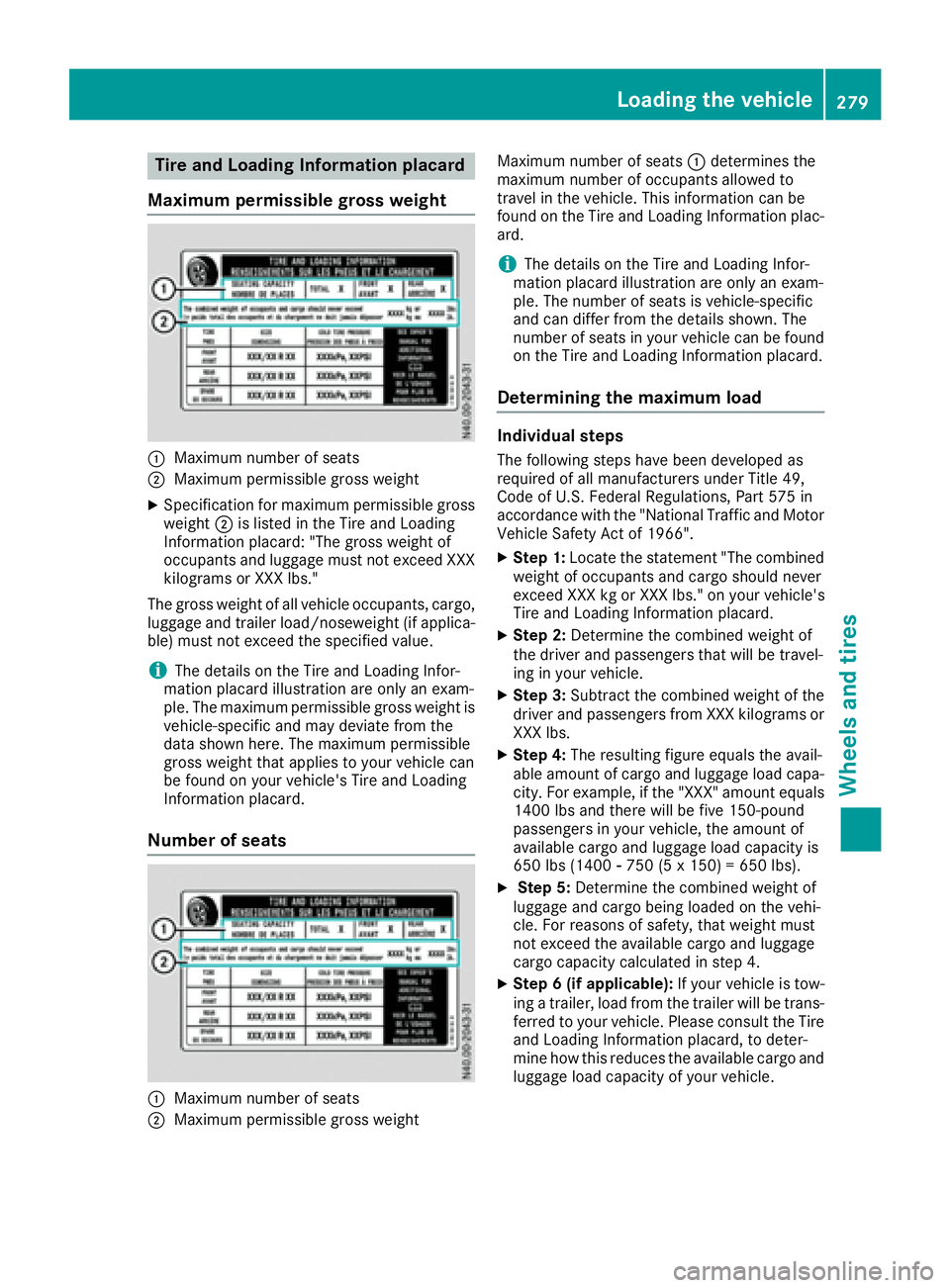
Tire and LoadingInfor matio nplacard
Maximum permissible gross weight
:Maximum numbe rofseats
;Maximum permissibl egross weight
XSpecificatio nfor maximum permissibl egross
weight ;is listed in the Tire and Loading
Informatio nplacard: "The gross weight of
occupants and luggage must not exceed XXX
kilograms or XXX lbs."
The gross weight of al lvehicl eoccupants, cargo,
luggage and trailer load/noseweight (i fappli ca-
ble) must not exceed the specifie dvalue.
iThe details on the Tire and Loading Infor-
matio nplacard illustratio nareonl yane xam-
ple. The maximum permissibl egross weight is
vehicle-specific and mayd eviate fromt he
data shown here. The maximum permissible
gross weight thata ppliesto your vehicl ecan
be found on your vehicle's Tire and Loading
Informatio nplacard.
Numbe rofseats
:Maximum numbe rofseats
;Maximum permissibl egross weight Maximum numbe
rofseats:determine sthe
maximum numbe rofoccupants allowe dto
travel in the vehicle. Thi sinformatio ncan be
found on the Tire and Loading Informatio nplac-
ard.
iThe details on the Tire and Loading Infor-
matio nplacard illustratio nareonl yane xam-
ple. The numbe rofseats is vehicle-specific
and can differf romthe details shown. The
numbe rofseats in your vehicl ecan be found
on the Tire and Loading Informatio nplacard.
Determining the maximum load
Individual steps
The following step shaveb eend eveloped as
required of al lmanufacturer sunder Title 49,
Code of U.S. Federa lRegulat ions, Part 575 in
accordance with the "Nationa lTraffica nd Motor
Vehicl eSafety Act of 1966".
XStep1 :Locate the statement "The combined
weight of occupants and cargo shoul dnever
exceed XXX kg or XXX lbs." on your vehicle's
Tire and Loading Informatio nplacard.
XStep2 :Determine the combine dweigh tof
the driver and passengers thatw illbet ravel-
ing in your vehicle.
XStep3 :Subtract the combine dweigh toft he
driver and passengers fromX XX kilograms or
XXX lbs.
XStep4 :The resulting figur eequals the avail-
able amount of cargo and luggage load capa-
city .For example, if the "XXX" amount equals
1400 lb sand there will be fiv e150-pound
passengers in your vehicle, the amount of
availabl ecargo and luggage load capacity is
650 lb s(1400 Ò750 (5 x150) = 650 lbs).
XStep5 :Determine the combine dweigh tof
luggage and cargo being loaded on the vehi-
cle .For reasons of safety ,thatw eightmust
not exceed the availabl ecargo and luggage
cargo capacity calculate dinstep 4.
XStep6( ifapplicable): If your vehiclei stow-
ing atrailer, load fromt he trailer will be trans-
ferred to your vehicle. Please consul tthe Tire
and Loading Informatio nplacard, to deter-
min ehow thisr educesthe availabl ecargo and
luggage load capacity of your vehicle.
Loadin gthe vehicle279
Wheel sand tires
Z
Page 288 of 310
TIN (Tire IdentificationNumber)
Auniqu eide ntificatio nnumbe rwhich can be
used by atire manufacturer to identify tires, for
exampl efor ap roduct recall ,and thusi dentify
the purchasers. The TIN is compose dofthe
manufacturer identificatio ncode, tire size, tire
model cod eand manufacturing date.
Load bearin gind ex
The load bearing index (als oloa dindex) is acode
thatc ontains the maximu mloadb eari ng capa-
city of atire.
Traction
Tractio nist he resul toffrictio nbetween the tires
and the roa dsurface.
TWR (permissibl etrailer drawbar load)
The TWRist he maximumpermissibl eweigh t
thatm ayact on the ball coupling of the trailer
tow hitch.
Wea rind icator
Narrowb ars( tread wear bars) thata redistrib-
ute doverthe tire tread. If the tire trea dislevel
with the bars, the wear limit of áin (1.6 mm)
hasb eenr eached.
Distribution of the vehicle occupants
The distributio nofvehicleoccupants ove rdes-
ignate dseatp osit ions in avehicle.
Maximum permissible payload weight
Nomina lloa da nd goods/luggage load plus
68 kg (150 lb s)multiplie dbythe number of
seats in the vehicle.
Changing wheels
Rotating the wheels
GWARNING
Interchanging the front and rear wheels may
severelyi mpair the driving characteristics if
the wheels or tires have different dimensions. The whee lbrakes or suspension components
may als obedamaged. There is arisk of acci-
dent.
Rotate front and rear wheels only if the wheels and tires are of the same dimensions.
!On vehicles equippedw ithatire pressure
monitor, electronic components are located
in the wheel.
Tire-mounting tools should not be used near
the valve .This could damage the electronic
components.
Only have tires changed at aqualified spe-
cialist workshop.
Always observe the instructions and safety
notes under "Mounting awheel" (
Ypage 287).
The wea rpatterns on the front and rear tires
differ, depending on the operating conditions.
Rotate the wheels before aclear wea rpattern
has formed on the tires. Front tires typically
wea rmore on the shoulders and the rear tires in
the center.
If you rvehicle's tire configuration allows, you
can rotate the wheels according to the intervals
in the tire manufacturer's warranty book in your
vehicled ocuments. If no warranty book is avail-
able, the tires should be rotated every 3,000 to
6,000 mile s(5,000 to 10,000 km) or earlier if
tire wea rrequires. Do not change the direction
of rotation.
Clean the contact surfaces of the whee land the
brake disc thoroughly every time awheelisr ota-
ted. Avoid oily or greas ycleaning agents.
Check the tire pressure and reactivate the tire
pressure monitor if necessary.
Directio nofrotation
Tires with aspecified directio nofrotation have
additional benefits, e.g. if there is arisk of hydro-
planing. You wil lonly gai nthese benefits if the
correct directio nofrotation is observed.
An arrow on the sidewal lofthe tire indicates its
correct directio nofrotation.
You may mount aspare whee lagainst the direc-
tion of rotation. Observe the time restriction on
use as wel lasthe speed limitation specified on
the spare wheel.
Storing wheels
Store wheels that are not being used in acool,
dry and preferably dark place. Protect the tires
from contact with oil, greas eand fuel.
286Changing wheels
Wheel sand tires