wheel size MERCEDES-BENZ METRIS 2016 MY16 Operator’s Manual
[x] Cancel search | Manufacturer: MERCEDES-BENZ, Model Year: 2016, Model line: METRIS, Model: MERCEDES-BENZ METRIS 2016Pages: 310, PDF Size: 7.28 MB
Page 171 of 310
On vehicles with steering wheel buttons, the
light sensor in the instrument cluster automati-
cally controls the brightness of the displaylight-
ing.
While the lights are on, the brightness is depend-
ent upon the brightness of the ambient light.
You can also adjust the brightness of the instru-
ment lighting and the displayl ighting
Rby pressing thefand gbuttons on the
instrument cluster on vehicles without steer-
ing wheel buttons (not in the Settings
menu)
Rby turning control:on vehicles with steer-
ing wheel buttons.
Speedometer
If you change the wheel size on your vehicle,
make sure it is assigned to the correct wheel
size category (
Ypage 267). If you change wheel
size category without recoding the control unit,
the speedometer indication will be inaccurate.
The current vehicle speed may then be higher
than the speed displayed in the speedometer.
The speed can also be shown in the displayi n
the form of adigital speedometer:
Ron vehicles without steering wheel buttons
(Ypage 172)
Ron vehicles with steering wheel buttons
(Ypage 178)
iIn some countries, awarning sounds and/or
the displays howsamessage when the vehi-
cle reaches the maximum legally permissible
speed limit, e.g. at 75 mph (120 km/h).
Tachometer
!
Do not drive in the overrevving range, as this
could damage the engine.
HEnvironmental note
Avoid driving at high engine speeds. This
unnecessarily increases the fuel consumption
of your vehicle and harms the environment as
ar esult of increased emissions.
The red band in the tachometer indicates the
engine's overrevving range.
To protect the engine, the fuel supply is inter-
rupted when the red band is reached.
Outside temperatured isplay
You should pay special attention to road condi-
tions when temperatures are around freezing
point.
Please bear in mind that the outside tempera-
ture displayshows the air temperature meas-
ured and not the road temperature.
The displays hows the outside temperature in
the header:
Ron vehicles without steering-wheel buttons
(Ypage 170)
Ron vehicles with steering wheel buttons
(Ypage 176).
Changes in the outside temperature are dis-
played after ashort delay.
Coolant temperatureg auge
GWARNING
Opening the hood when the engine is over-
heated or when there is afire in the engine
compartment could expose you to hot gases
or other service products. There is arisk of
injury.
Let an overheated engine cool down before
opening the hood. If there is afire in the
engine compartment,k eep the hood closed
and contact the fire department.
On vehicles without steering wheel buttons, you
can have the coolant temperature shown in the
display(
Ypage 172).
On vehicles with steering wheel buttons, an ana-
log coolant temperature gage is located in the
tachometer in the instrument cluster
(
Ypage 37).
Under normal operating conditions and with the
specified coolant level, the gage may rise to
248 ‡(120† ).
Display and operation169
On-board computer and displays
Z
Page 234 of 310
Useful information
This Operator's Manual describes all models as
well as standard and optional equipment of your
vehicle that were available at the time of going
to print.Country-specific variation sare possi-
ble. Note that your vehicle may not be equipped
with all of the described functions. This also
applies to system sand function srelevantt o
safety.
Read the information on qualified specialist
workshops (
Ypage 29).
Loading guidelines
Important safetyn otes
GWARNING
When objects are unsecured or inadequately
secured, they can slip, turn over or be thrown
about, strikin gvehicle occupants .This also
applies to:
Rluggage or loads
Rseats which have been removed and are
being transported in the vehicle in an
exceptional case.
There is arisk of injury, particularly in the
eventofab rakingmaneuver or abrupt change
in direction.
Always stow objects in such away that they
cannot be tossed about. Beforet raveling,
secure objects, luggage or loads to prevent
them slipping or tippin gover. If you removea
seat, stor eitpreferably outside the vehicle.
GWARNING
As aresult of improperly placed or unevenly
distributed loads, the center of gravityoft he
load being transported may be too high or too
far back. This can significantly impair handling
as well as steering and brakin gcharacteris-
tics. There is arisk of an accident.
Always make sure that the center of gravityo f
the load is:
Rbetween the axles
and
Ras low as possible, near the rear axle.
GWARNING
When the permissible wheel loads, axle loads
and/o rthe maximum permissible gross vehi-
cle weight are exceeded, drivings afetyis
compromised. The handlin gaswell as steer-
ing and brakin gcharacteristic smay be signif-
icantly impaired. Overloaded tires may over-
heat, causing them to burst. There is arisk of
an accident.
When transporting aload, always observet he
permissible wheel loads, axle loads and the
maximum permissible gross vehicle weight
for the vehicle (includin goccupants).
!If you are using aroof carrier,o bservethe
maximum roof load and maximum roof carrier
load.
RDo not stac kluggage or loads higher than the
backrests.
RObjects to be transported should preferably
be stowed in the cargo compartment.
RWhen transporting luggage, always use the
cargo tie-down rings for securingl oads and a
cargo net ,ifinstalled.
RUse cargo tie-down rings and fasteners which
are suitable for the weight and size of the
load.
When using suitable load securin gaids and tie
downs, always follow the manufacturer's oper-
ating instructions, in particular the notes on dis-
card criteria contained therein.
Load securin gaids or tie downs must not be
used if:
Ridentification marksa re missingorillegible
Rthereare yarn breakages ,damage to bearing
seams or other signs of tearing
Rther eare signs of shearing, deformation,
pinching or other damage
Rther eisd amage to clampingorc onnecting
elements
Load securinga ids and tie downs in this condi-
tion are ready for discard and must be replaced.
If you use load securinga ids or tie downs which
are worn out, the load may not be sufficiently
secured and could cause damage to property.
232Loading guidelines
Transporting loads
Page 256 of 310
Care
Notes on care
GWARNING
If you use opening sinthebodywork or
detachable part sassteps, you could:
Rslip and/or fall
Rdamag ethe vehicle and caus eyourself to
fall.
Thereisar iskofi njury.
Always use secure climbinga ids, e.g.asuita-
ble ladder.
!Do no tuse th elower slidingd oor guide (car-
riage )asas tep. Otherwise, you coul ddamage
th ep anelinga nd/or theslidingd oor mecha-
nism.
!For cleanin gyour vehicle ,donotuse any of
th ef ollowing:
Rdry, roug horhard cloths
Rabrasive cleanin gagents
Rsolvents
Rcleanin gagents containing solvents
Do no tscrub.
Do no ttou ch th esurfaces or protective films
withh ard objects, e.g .aringori ce scraper.
You coul dotherwise scratch or damag ethe
surfaces and protective film.
!Do no tpark th evehicle for an extended
period straigh tafter cleanin git, particularly
after having cleane dthe wheelsw ithwheel
cleaner. Wheelc leaners couldcause
increased corrosion of th ebrak ediscsa nd
brak epads/linings. For this reason,y ou
should driv efor afew minute safter cleaning.
Brakin gheatst hebrak ediscsa nd thebrake
pads/linings, thus dryin gthem. The vehicle
can then be parked.
HEnvironmental note
Only clean your vehicle at specially designed
wash bays. Dispose of emptyc ontainers and
used cleanin gproduct sinane nvironmentally
responsible manner.
HEnvironmental note
Dispose of emptyp ackagingand cleaning
cloth sinane nvironmentall yresponsible man-
ner.
Regular car eofyour vehicle is acondition for
retaining th equalityint helongt erm.
Use car eproduct sand cleanin gagents recom-
mended and approved by Mercedes-Benz.
Washingt hevehicle and cleaning the
paintwork
Automatic car wash
GWARNING
Brakin gefficienc yisreduced after washing
th ev ehicle .Thereisar iskofana ccident.
Afte rthe vehicle has been washed, brake
carefull ywhile payinga ttentiontothetraffic
conditionsu ntil full braking power is restored.
!Makesure that th eautomatic car wash is
suitable for th esizeoft hevehicle.
Before washingt hevehicle in an automatic
car wash, fold in th eexteri or mirror sand
remove any additional antennas .Otherwise,
th ee xteri or mirror ,antenna or th evehicle
itself coul dbedamaged.
Makes ure that th eexteri or mirror sare fully
folded out again and that any additional
antennas are re-installed when you leave the
automatic car wash.
!Makes ure that:
Rthes ide windows and th eroofa re com-
pletely closed
Rth ec limate control blower is switched off
Rthew indshield wiper switch is at position 0
The vehicle coul dotherwise be damaged.
You can wash th evehicle in an automatic car
wash from th everys tart.
Wash off exces sdirt before cleanin gthe vehicle
in an automatic car wash.
Afte rputtin gthe vehicle throug hanautomatic
car wash, wipe off wax from:
Rth ew indshield
Rthew indshield wiper blades
254Care
Maintenance and care
Page 269 of 310
Useful information
This Operator's Manual describes all models as
well as standard and optional equipment of your
vehicle that were available at the time of going
to print.Country-specific variation sare possi-
ble. Note that your vehicle may not be equipped
with all of the described functions. This also
applies to system sand function srelevantt o
safety.
Read the information on qualified specialist
workshops (
Ypage 29).
Important safetyn otes
GWarning
Af lat tire severely impairs the driving, steer-
ing and brakin gcharacteristic softhe vehicle.
There is arisk of an accident.
do not drive with aflat tire. Immediately
replace the flat tire with your spare wheel, or
consult aqualified specialist workshop.
GWARNING
If wheels and tires of the wrong size are used, the wheel brakes or suspensio ncomponents
may be damaged. There is arisk of an acci-
dent.
Always replace wheels and tires with those
that fulfill the specification softhe original
part.
When replacingw heels, make sure to use the
correct:
Rdesignation
Rmodel
When replacingt ires,make sure to use the
correct:
Rdesignation
Rmanufacturer
Rmodel
Accessories that are not approved for your vehi-
cle by Mercedes-Benz or are not being used cor-
rectly can impair operatin gsafety. Beforep
urchasin gand using non-approved
accessories, visit aqualified specialist work-
shop and inquire about:
Rsuitability
Rlegal stipulations
Rfactory recommendations
Information on the dimensions and types of
wheels and tires for your vehicle can be found
under "Wheel and tire combinations"
(
Ypage 290).
Information on your vehicle' stire pressure can
be found:
Rin the Tire and Loading Information placard on
the B-pillar, driver'ss ide
Rin the tire pressure table inside the fuel filler
flap (Ypage 271)
Runder "Tire pressure tables" (Ypage 278)
Runder "Tire pressure" (Ypage 270)
Modifications to the brake system or wheels are not permitted. The use of aspacer and brake
dust shields is not permitted. This invalidates
the general operatin gpermit for the vehicle.
Further information on wheels and tires can be
obtained at any qualified specialist workshop.
Operation
Information for ajourney
If the vehicle is heavily laden, checkt he tire
pressures,a nd correct them ,ifnecessary
(
Ypage 270).
While driving, pay attention to vibrations, noises
and unusual handling characteristics, e.g. pull-
ing to one side. This may indicat ethat the
wheels or tires are damaged. If you suspect that
at ire is defective, reduce your speed immedi-
ately. Stop the vehicle as soon as possible to
checkt he wheels and tires for damage. Hidden
tire damage could also be causing the unusual
handling characteristics. If you find no signs of
damage, have the tires and wheels checked at a
qualified specialist workshop.
When parkin gyour vehicle, make sure that the
tires do not get deformed by the curb or other
obstacles. If it is necessary to drive over curbs,
speed humps or similar elevations, try to do so
slowly and not at asharp angle. Otherwise, the
tires ,particularly the sidewalls, can get dam-
aged.
Operation267
Wheels and tires
Z
Page 270 of 310
Regular wheel and tire checks
GWARNING
Damaged tire scan cause tire inflation pres-
sure loss. As aresult, yo ucould lose control of
your vehicle. There is ariskofa ccident.
Check the tire sregularl yfor signs of damage
and replace any damaged tire simmediately.
Check the wheel sand tire sofyourv ehicl efor
damag eregularly, i.e .atleast every two weeks,
as well as afte rdriving off-road or on rough
roads. Damaged wheel scan cause alos soft ire
pressure. Payp articula rattention to damage
such as:
Rcuts in the tires
Rpunctures
Rtears in the tires
Rbulges on tires
Rdeformation or severe corrosio nonwheels
Regularly check the tire trea ddepth and the
condition of the trea dacross the wholew idth of
the tire (
Ypage 268). If necessary, turn the
front wheel stofullloc kino rder to inspect the
inner sid eofthe tire surface.
All wheel smusth aveav alve cap to protect the
valve against dirt and moisture. Do not install
anything onto the valve othe rthan the standard
valve cap or othe rvalve cap sapproved for your
vehicl ebyd ealers listed on the inside of the
front cover. Do not install any othe rvalve caps
or systems ,e.g. tire pressure monitor systems.
Regularly check the pressure of al lthe tires,
particularly prior to long trips. Adjust the tire
pressure if neces sary (
Ypage 270).
The service life of tire sdepends on various fac-
tors, including the following:
Rdriving style
Rtire pressure
Rmileage
Tire tread
GWARNING
Insufficient tire trea dwillr educe tire traction.
The tire is no longer able to dissipate water.
Thi sm eans that on we troa ds urfaces, the risk
of hydroplaning increases, in particula rwhere
speed is not adapted to suit the driving con-
ditions .There is ariskofa ccident.
If the tire pressure is too hig hortoo low, tires
may exhibi tdifferent level sofwearatd iffer-
ent locations on the tire tread. Thus, you
shoul dregularl ycheck the trea ddepth and
the condition of the trea dacross the entire
width of al ltires.
Minimum tire trea ddepth for:
RSummer tires: âin (3 mm)
RM+S tires: ãin (4 mm)
For safety reasons,r eplace the tiresbefore
the legall yprescribed limit for the minimum
tire trea ddepth is reached.
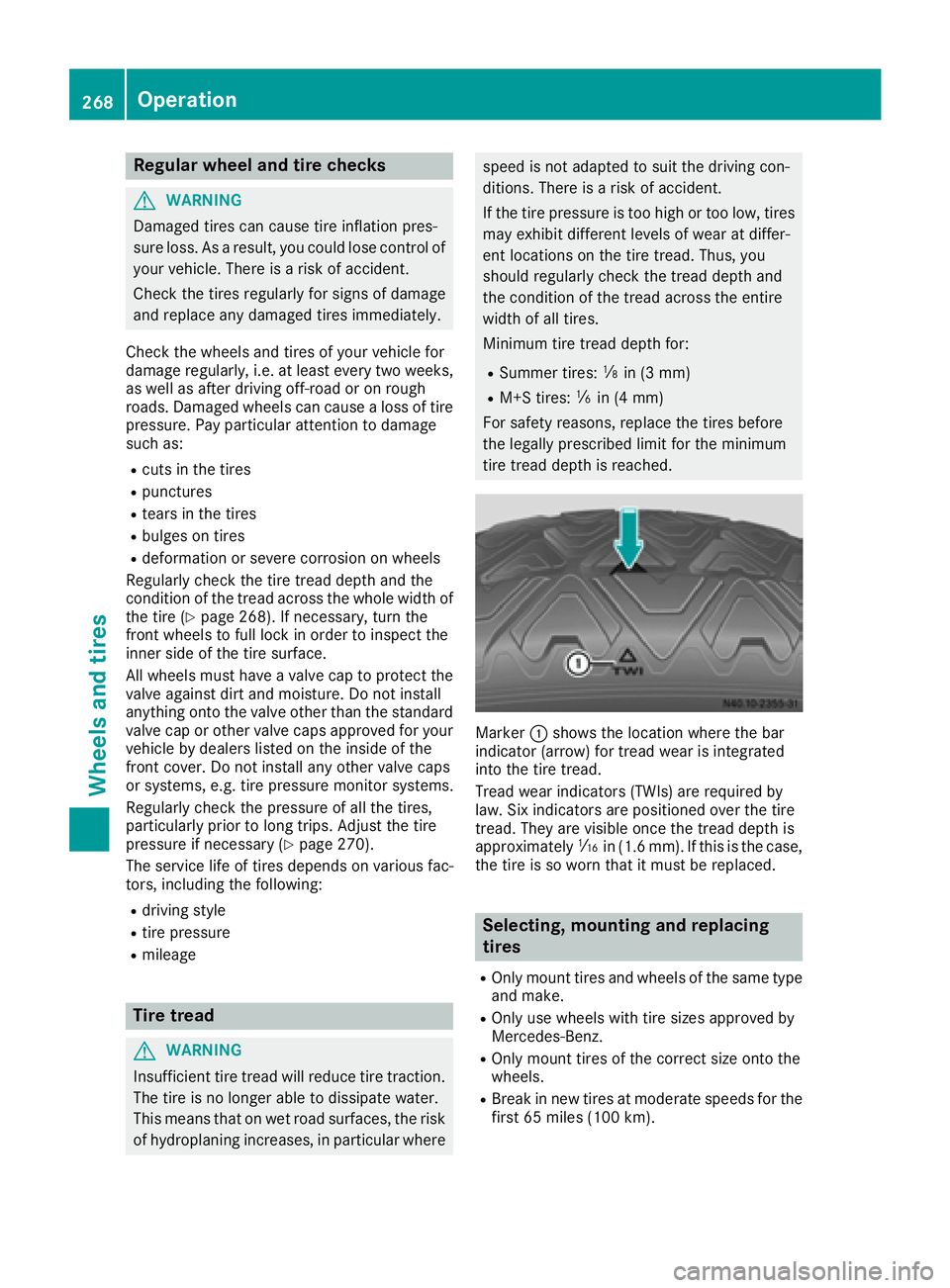
Marker :shows the location where the bar
indicator (arrow )for trea dwearisi ntegrated
into the tire tread.
Tread wear indicators (TWIs) are required by
law. Six indicators are positioned ove rthe tire
tread. The yare visible once the trea ddepth is
approximately áin (1.6 mm). If this is the case,
the tire is so worn that it mus tbereplaced.
Selecting,m ounting and replacing
tires
ROnly mount tire sand wheel softhe same type
and make.
ROnly us ewheelsw itht ire size sapproved by
Mercedes-Benz.
ROnly mount tire softhe correct size onto the
wheels.
RBrea kinn ew tire satmoderate speeds for the
firs t65m iles (100 km).
268Operation
Wheel sand tires
Page 271 of 310
RDo not drive with tireswhich have too little
trea ddepth,ast hissignificantl yreduce sthe
tractio nonw etroads (hydroplaning).
RReplace the tire safter 6y ears at the latest,
regardless of wear .Thisa lsoa pplies to the
spar ewheel .
Operatio ninwinter
General notes
Hav eyourv ehicl ewinterproofed at aquali fied
specialis tworkshop at the onse tofwinter.
Onlyu sewheels with tire sizes approved by
Mercedes-Benz.
Prior to the onse tofwinter, ensur ethats now
chains ar estowed in the vehicl e(
Ypage 270).
Snow chains canno tbem ounted on al lwheel /
tire combinations. Observe the restrictions on
the us eofsnow chains under "Wheel/tir ecom-
binations" (
Ypage 291).
Als oo bserve the note sinthe "Changing a
wheel" sectio n(
Ypage 286).
Driving with summe rtires
At temperatures belo w45‡(+7 †),summer
tire slos ee last icity and therefore tractio nand
braking power. Chang ethe tire sonyourvehicle
to M+S tire s. Usingsumme rtires at very cold
temperatures could cause tears to form,
thereby damaging the tires permanently.
Mercedes-Benz cannot accept responsibility for
this type of damage.
M+S tires
GWARNING
Wheel and tire dimensions as wel lasthe type
of tire can vary betwee nthe spare whee land
the whee ltobereplaced. When the spare
whee lismounted, driving characteristics may
be severelya ffected. There is arisk of an acci-
dent.
In order to reduce risks:
Ryou should therefore adapt you rdriving
style and drive carefully.
Rnever mount more than one spare wheel
that differs from the whee ltobereplaced.
Ronly use aspare whee lthat differs from the
whee ltober eplaced for ashort time.
Rhave aspare whee lthat differs from the
whee lthat has been changed replaced at
the nearest qualified specialist workshop.
You must observe the correct whee land
tire dimensions as wel lasthe whee ltype.
GWARNING
M+S tires with atire tread depth of less than
ã in (4 mm) are not suitable for use in winter
and do not provid esufficient traction. There is
ar isk of an accident.
M+S tires with atread depth of less than ãin
(4 mm) must be replaced immediately.
Use winter tires or all-season tires at tempera-
tures below4 5‡(+7 †). Both types of tire are
identified by the M+S marking.
Only winter tires bearing the isnowflake
symbo linaddition to the M+S marking provide
the best possible grip in wintry road conditions.
Only these tires wil lallow driving safety systems
such as ABS and ESP
®to function optimally in
winter. These tires have been developed specif-
ically for driving in snow.
For safe driving, use M+S tires of the same make
and tread pattern on all wheels.
Always observe the maximu mpermissible
speed specified for the M+S tires you have
mounted.
If you mount M+S tires that have alower maxi-
mum permissibl espeed than the maximum
design speed of the vehicle, affix acorrespond-
ing warning label in the driver' sfieldofv ision.
You can obtai nthis at aqualified specialist work-
shop.
Once you have mounted the winter tires:
XCheck the tire pressure (Ypage 270).
XRestart the tire pressure monitor
(Ypage 277).
Operation in winter269
Wheel sand tires
Z
Page 274 of 310
Tire pressure table
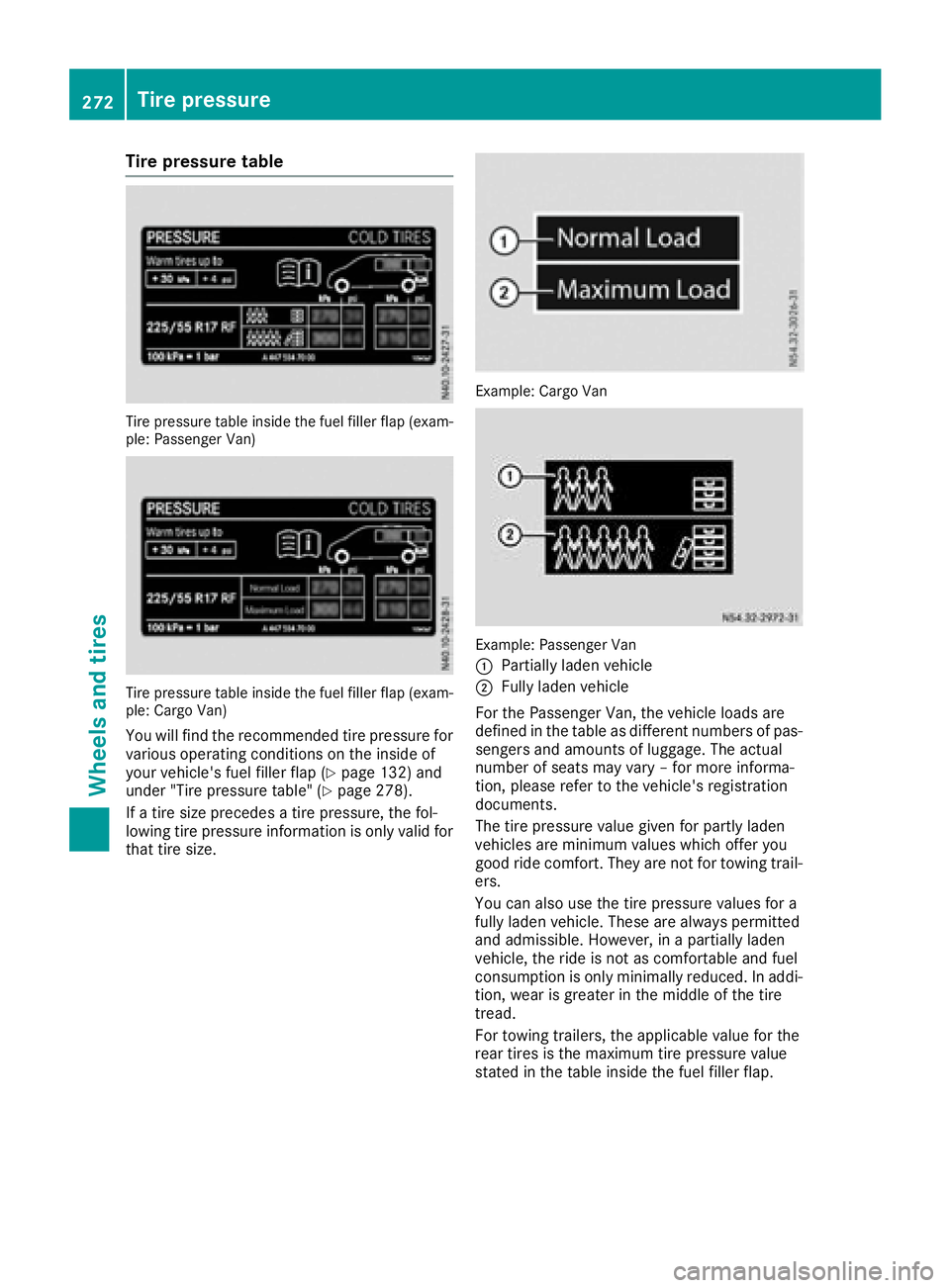
Tire pressure table insidethe fuel fille rflap( exam-
ple: Passenge rVan)
Tire pressure table insid ethe fuel fille rflap( exam-
ple: Cargo Van)
Yo uw illf ind the recommende dtire pressure for
various operating conditions on the insid eof
your vehicle's fuel fille rflap(
Ypage 132 )and
under "Tire pressure table "(Ypage 278).
If at ire size precedes atire pressure, the fol-
lowing tire pressure informatio niso nlyv alid for
thatt ire size.
Example: Cargo Van
Example: Passenge rVan
:
Partiall yladen vehicle
;Fully lade nvehicle
For the Passenge rVan,the vehicl eloads are
define dinthe table as different numbers of pas-
sengers and amounts of luggage.T he actual
numbe rofseats mayv ary–f or mor einforma-
tion, please refer to the vehicle's registration
documents.
The tire pressure valu egiven for partly laden
vehicles ar eminimu mvalues which offer you
good rid ecomfort. The yarenot for towing trail-
ers.
Yo uc an also us ethe tire pressure values for a
full yladen vehicle. These ar ealway spermitted
and admissible. However, in apartiall yladen
vehicle, the rid eisnot as comfortabl eand fuel
consumption is onl yminimall yreduced. In addi-
tion, wear is greate rinthe middl eofthe tire
tread.
For towing trailers ,the applicabl evalue for the
rea rtire sist he maximum tire pressure value
stated in the table insid ethe fuel fille rflap.
272Tire pressure
Wheel sand tires
Page 277 of 310
For further information on displaying the current
tire pressures, referto"Checking the tire pres-
sur eelectronically" (
Ypage 276).
Important safety notes
GWARNING
Each tire, including the spare (ifp rovided),
should be checked at least once amonth
whe ncold and inflated to the pressure rec-
ommended by the vehicle manufacturer on
the Tir eand Loading Information placard on
the driver's doo rB-pilla rort he tire pressure
label on the inside of the fue lfiller flap. If your
vehicle has tires of adifferent size than the
size indicated on the Tir eand Loading Infor-
mation placard or the tire pressure label ,you
should determine the proper tire pressure for
those tires.
As an added safety feature ,you rv ehicle has
bee nequipped with atire pressure monitoring
system (TPMS) that illuminates alow tire pres-
sur etelltal ewheno ne or more of your tires
are significantly underinflated. Accordingly,
whe nthe low tire pressure telltal eillumi nates,
yo us hould stop and check your tires as soon
as possible, and inflate them to the proper
pressure. Driving on asignificantly underin-
flated tire causes the tire to overheata nd can
lea dtot ire failure. Underinflation also
reduce sfue lefficiency and tire treadl ife, and
may affect the vehicle' shandling and stop-
ping ability.
Please note that the TPMSisn otas ubstitute
for proper tire maintenance, and it is the driv-
er's responsibility to maintain correct tire
pressure, even if underinflation has not
reached the level to trigger illumination of the
TPMSl ow tire pressure telltale.
USA only:
You rvehicle has also bee
nequipped with a
TPM
Sm alfunction indicator to indicate if the
system is not operating properly. The TPMS
malfunction indicator is combined with the
low tire pressure telltale. Whe nthe system
detects amalfunction, the warning lamp will
flash for approximately aminute and then
remain continuously illuminated. This
sequence will be repeated ever ytime the vehi-
cle is starte daslong as the malfunction
exists.
Whe nthe malfunction indicator is illuminated,
the system may not be able to detect or signal
low tire pressure as intended. TPMSm alfunc-
tions may occur for avariety of reasons,
including the mounting of incompatible
replacement or alternate tires or wheels on
the vehicle that prevent the TPMSf rom func-
tioning properly. Alway scheck the TPMSm al-
function telltal eafterreplacing one or more
tires or wheels on your vehicle to ensure that the replacement or alternate tires and wheels
allow the TPMStoc ontinuetofunction prop-
erly.
It is the driver's responsibility to set the tire
pressure to the recommende dcold tire pressure
suitabl efor the operating conditions
(
Ypage 270).
Note that the correct tire pressure for the cur-
rent operating conditions mus tfirs tb ep ro-
gramed into the tire pressure monitor. If there is
as ubstantial los sofpressure, the warning
threshol dfor the warning messag eisaligne dto
the reference value sprograme din. Restart the
tire pressure monito rafte radjusting the cold
tire pressure (
Ypage 277). The current pres-
sures are saved as new reference values. This
will ensure that awarning messag ewillo nly
appea rifthe tire pressure drop ssignificantly.
The tire pressure monito rdoesn ot warn yo uifa
tire pressure is incorrect. Observe the notes on
the
recommende dtire pressure (Ypage 270).
The tire pressure monito risnot able to warn you
of as udden los sofpressure, e.g. following pen-
etration by aforeign object. In this event, brake
the vehicle until it comes to astandstill. Avoid
sudden steering movements.
The tire pressure monito rhas ayello wh
warning lamp in the instrument cluster for indi-
cating pressure loss/malfunctions (USA) or
pressure los s(Ca nada). Depending on how the
warning lamp flashesorl ights up ,anunderin-
flated tire or amalfunction in the tire pressure
monito risdisplayed:
Rif the h warning lamp is li tcontinuously,
the tire pressure on one or more tires is sig-
Tire pressure275
Wheels and tires
Z
Page 280 of 310
Tire pressure tables
Vehicle swithag ross vehicle weight of 6,724 lb s(3.05 t)
!The pressure differenc ebetween tire sonany one axl emustbenog reaterthan1 0kPa (0.1 ba r/
1.5 psi).
The following tire pressure values apply to vehicles with:
Rag ross vehicle weight of 6,724 lbs (3.05 t)
Ragross axle weight rating of 3,418 lbs(1,550 kg)on the rear axle and
Rthe tires referredtounder"Wheel and tire combinations" (Ypag e291).
Always observe the notes unde r"Information on tire pressures "(
Ypage270).
The tire pressure for the spare wheelis 340 kPa (3.4 bar/49 psi).
Partiallyladen vehicleFully laden vehicle
Tire sizeFron taxleRear axleFron taxleRear axle
225/55 R17RF270 kPa
(2.7 bar/ 39 psi)270 kPa
(2.7 bar/ 39 psi)300 kPa
(3.0 bar/ 44 psi)310 kPa
(3.1 bar/45 psi)
Loading the vehicle
Instruction labels for tires and loads
GWARNING
Overloaded tires can overheat, causing a
blowout. Overloaded tires can also impair the steering and driving characteristics and lead
to brake failure. There is arisk of accident.
Observe the loa drating of the tires. The load
rating must be at least hal fofthe GAWR of
you rvehicle. Never overload the tires by
exceeding the maximu mload.
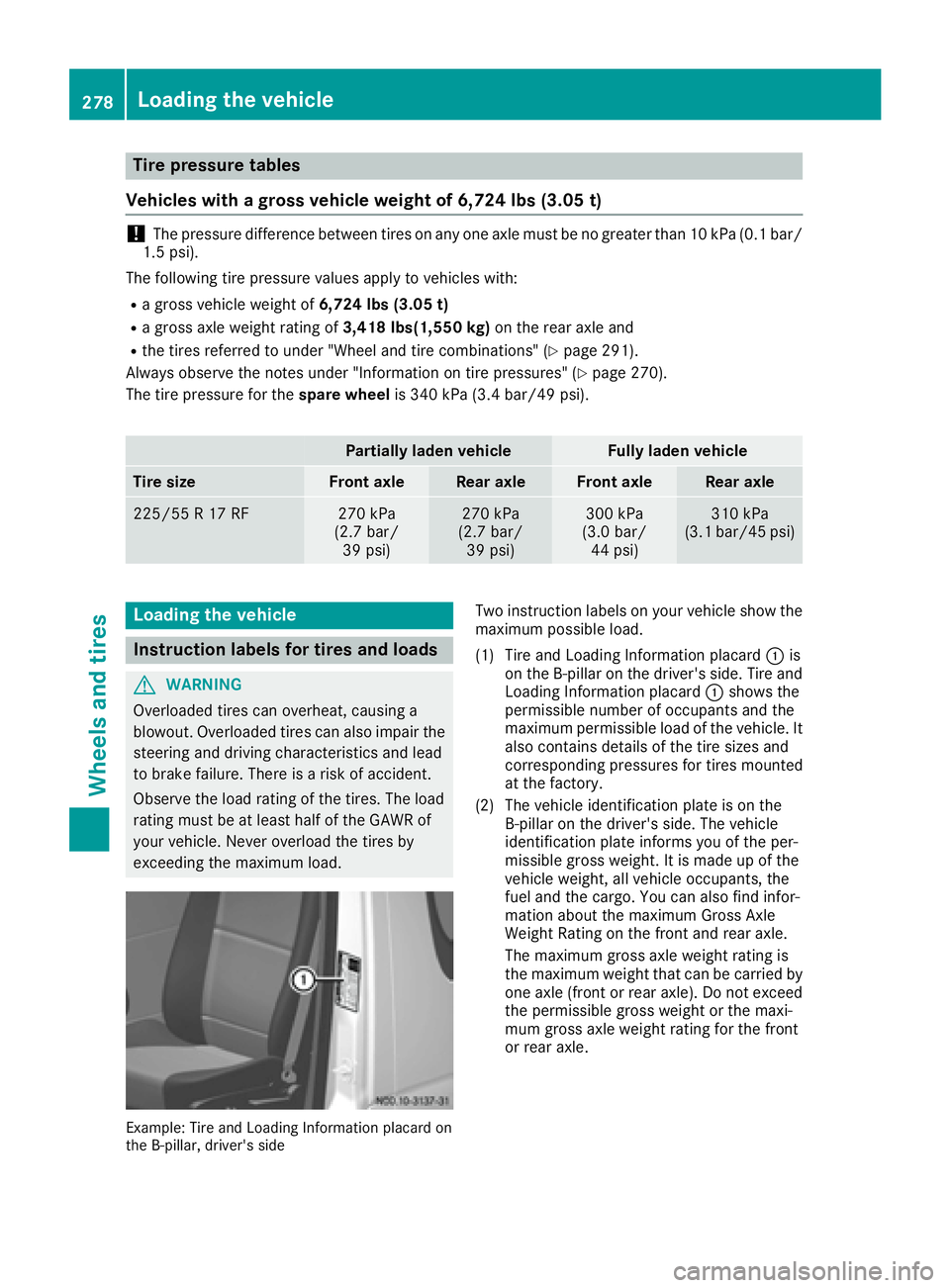
Example: Tire and Loading Information placard on
the B-pillar, driver's side
Two instructio nlab elsony ourvehicle show the
maximu mpossibl eload.
(1) Tire and Loading Information placard :is
on the B-pillar on the driver's side .Tire and
Loading Information placard :showst he
permissible numbe rofoccupants and the
maximu mpermissible loa dofthe vehicle. It
also contains details of the tire sizes and
corresponding pressures for tires mounted
at the factory.
(2) The vehicle identification plate is on the B-pillar on the driver's side .The vehicle
identification plate informs you of the per-
missible gross weight. It is made up of the
vehicle weight, al lvehicle occupants, the
fuel and the cargo .You can also find infor-
matio nabout the maximu mGrossAxle
Weight Rating on the front and rear axle.
The maximu mgross axle weight rating is
the maximu mweight that can be carrie dby
one axle (front or rear axle). Do not exceed the permissible gross weight or the maxi-
mum gross axle weight rating for the front
or rear axle.
278Loading the vehicle
Wheels and tires
Page 282 of 310
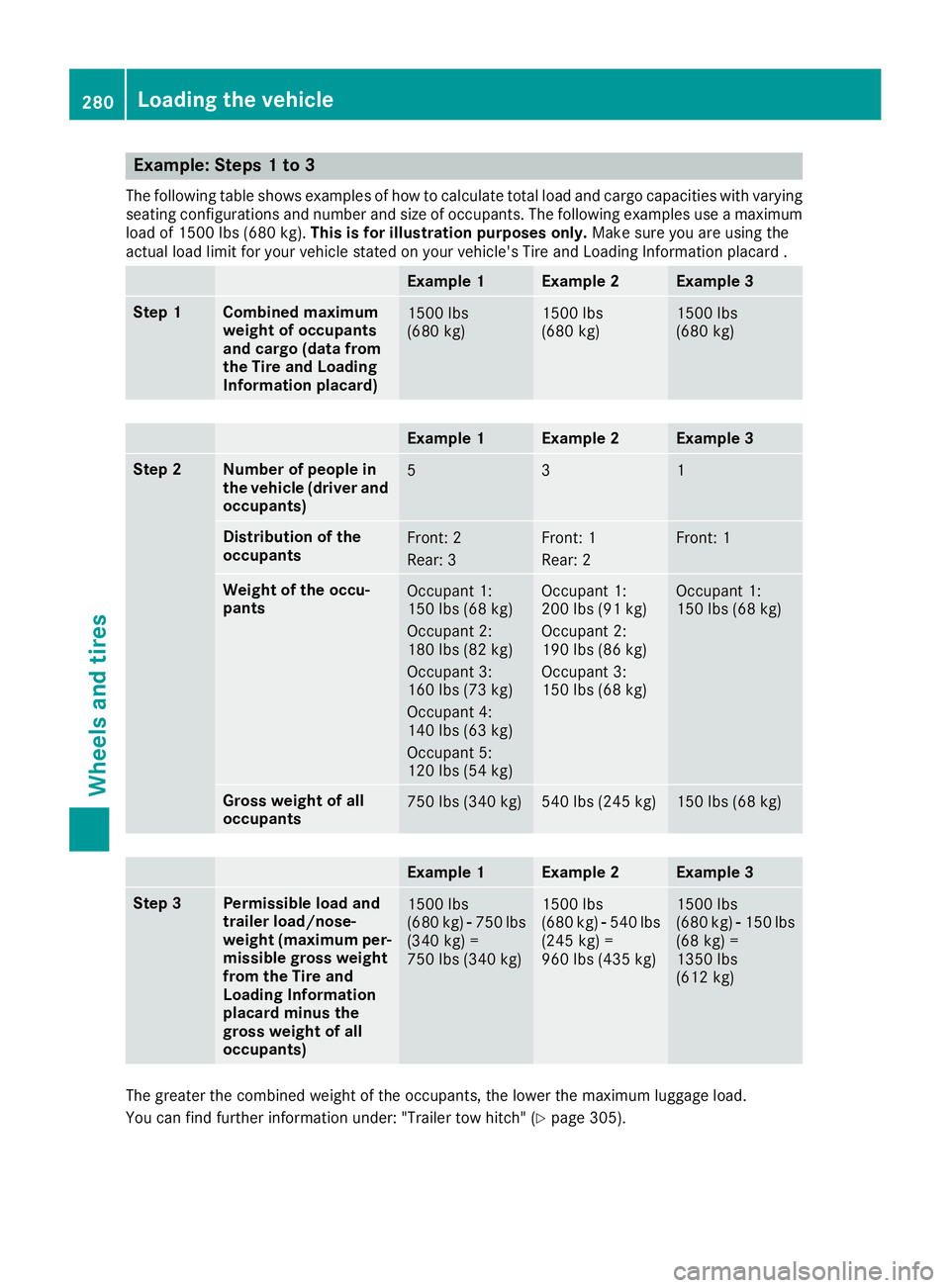
Example: Steps1to3
The followingtable showsexamples of how to calculate total load and cargo capacities with varying
seating configurations and number and sizeofo ccupants. The followingexamples useamaximum
load of 1500 lbs (68 0kg). This is for illustration purposes only. Makesure you are usingt he
actual load limit for your vehicle state donyour vehicle's Tire and Loading Information placard .
Example 1Example 2Example 3
Step 1Combined maximum
weight of occupants
and cargo (data from
theT irea nd Loading
Information placard)1500 lbs
(68 0kg)1500 lbs
(68 0kg)1500 lbs
(68 0kg)
Example 1Example 2Example 3
Step 2Number of people in
thev ehicle (driver and
occupants)531
Distribution of the
occupantsFront: 2
Rear: 3Front: 1
Rear: 2Front: 1
Weigh toftheoccu-
pantsOccupan t1:
15 0lbs (68 kg)
Occupan t2:
18 0lbs (82 kg)
Occupan t3:
16 0lbs (73 kg)
Occupan t4:
14 0lbs (63 kg)
Occupan t5:
12 0lbs (54 kg)Occupan t1:
20 0lbs (91 kg)
Occupan t2:
19 0lbs (86 kg)
Occupan t3:
15 0lbs (68 kg)Occupan t1:
15 0lbs (68 kg)
Gross weight of all
occupants75 0lbs (34 0kg)540lbs (24 5kg)150lbs (68 kg)
Example 1Example 2Example 3
Step 3Permissible load and
trailer load/nose-
weight (maximum per-
missible gross weight
from th eTirea nd
Loading Information
placar dminus the
gross weight of all
occupants)1500 lbs
(68 0kg)Ò75 0lbs
(34 0kg) =
75 0lbs (34 0kg)1500 lbs
(68 0kg)Ò54 0lbs
(24 5kg) =
96 0lbs (43 5kg)1500 lbs
(68 0kg)Ò15 0lbs
(68 kg) =
1350 lbs
(61 2kg)
The greate rthe combined weightoft heoccupants, th elower th emaximum luggage load.
You can fin dfurther informatio nunder: "Trailer to whitch "(
Ypage 305).
280Loading th evehicle
Wheels and tires