wheel size MERCEDES-BENZ METRIS 2016 MY16 Operator’s Manual
[x] Cancel search | Manufacturer: MERCEDES-BENZ, Model Year: 2016, Model line: METRIS, Model: MERCEDES-BENZ METRIS 2016Pages: 310, PDF Size: 7.28 MB
Page 283 of 310
Vehicleidentificatio nplate
Even if yo uhavec alculate dthe totall oadc are-
fully ,you shoul dstillm ake sure thatt he permis-
sibl egross weight and the gross axl eweigh trat-
ing of your vehicl eare not exceeded .Thisd ata
can be found on the vehicl eide ntificatio nplate
on the B-pillar of your vehicl e(
Ypage 294).
Permissibl egross vehicle weight: the gross
weight of the vehicle, al loccupants, load and
traile rload/n oseweight (i fappli cable) must not
exceed the permissibl egross vehicl eweigh t.
Gros saxlew eightrating: the maximu mper-
missibl eloa dt hatc an be carrie dbyone axle
(front or rea raxle).
To ensure thaty ourvehicl edoesn ot exceed the
maximu mpermissibl evalue s(gros sv ehicle
weight and maximu mgross axl eweigh trating),
have your loaded vehicl e(including driver, occu-
pants, load ,and ful ltraile rloa difa pplicable)
weighed on asuitabl evehicl eweigh bridge.
Trailer load/noseweight
The traile rload/n oseweight affects the gross
weight of the vehicle. If atraile risa ttached, the
traile rload/n oseweight is included in the load
along with occupants and luggage. The trailer
load/noseweight is usuall yapproximately1 0%
of the gross weight of the traile rand its load.
What yous hould knowabout wheels
and tires
Tire labeling
Tire labeling
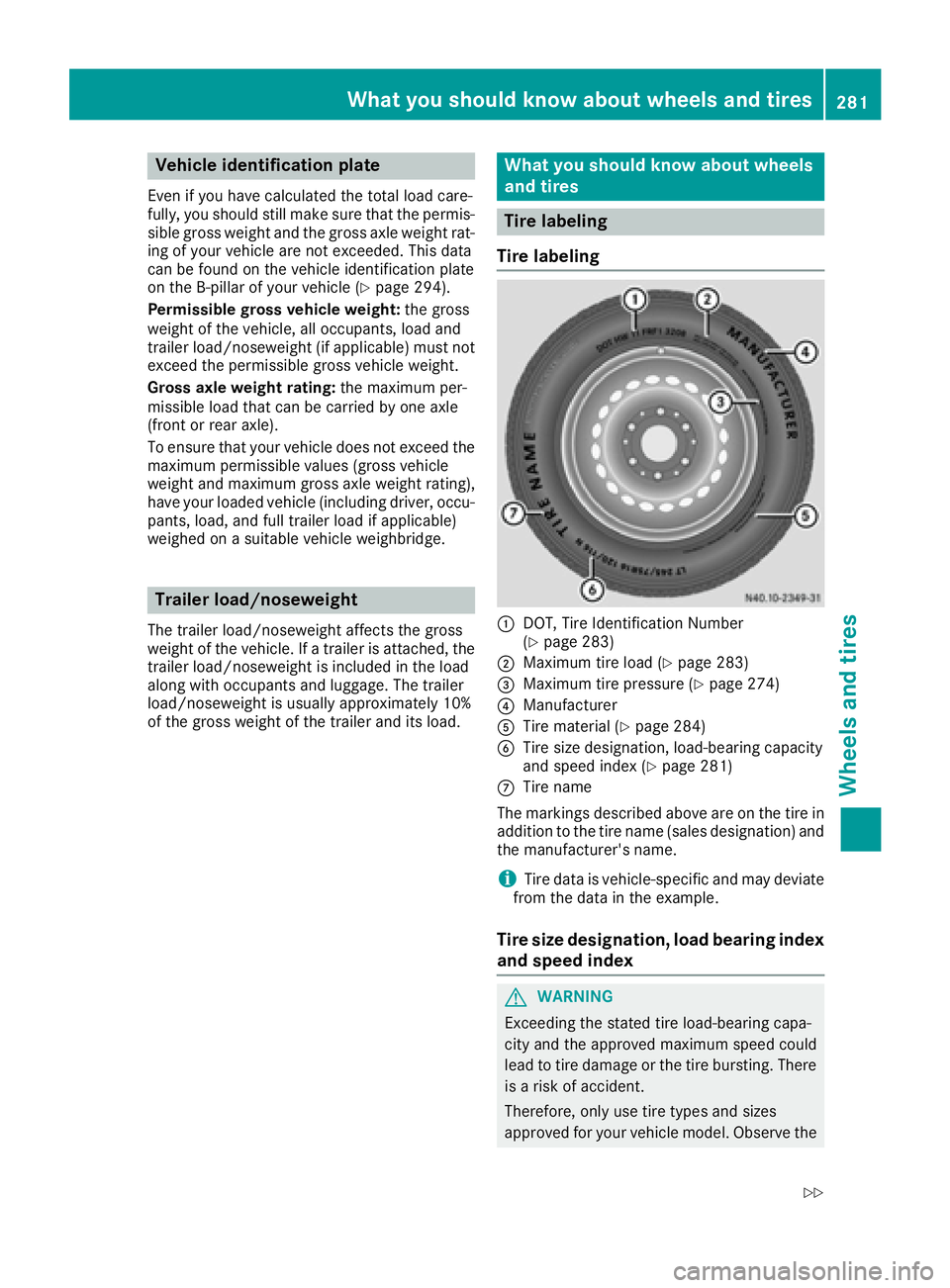
:DOT, Tire Identification Number
(Ypage 283)
;Maximu mtire load (Ypage 283)
=Maximu mtire pressure (Ypage 274)
?Manufacturer
ATire material (Ypage 284)
BTire size designation, load-bearing capacity
and speed index (Ypage 281)
CTire name
The marking sdescribe dabove are on the tire in
additio ntothe tire nam e(sale sdesig nation) and
the manufacturer' sname.
iTire data is vehicle-specific and mayd eviate
from the data in the example.
Tire size designation ,loa db earin gind ex
and speed index
GWARNING
Exceeding the stated tire load-bearing capa-
city and the approved maximu mspeed could
lead to tire damage or the tire bursting. There is ar iskofa ccident.
Therefore, onlyu setire types and sizes
approved for your vehicl emodel .Observe the
What yous hould knowa bout wheels and tires281
Wheelsand tires
Z
Page 284 of 310
tire load rating and speedrating required for
your vehicle.
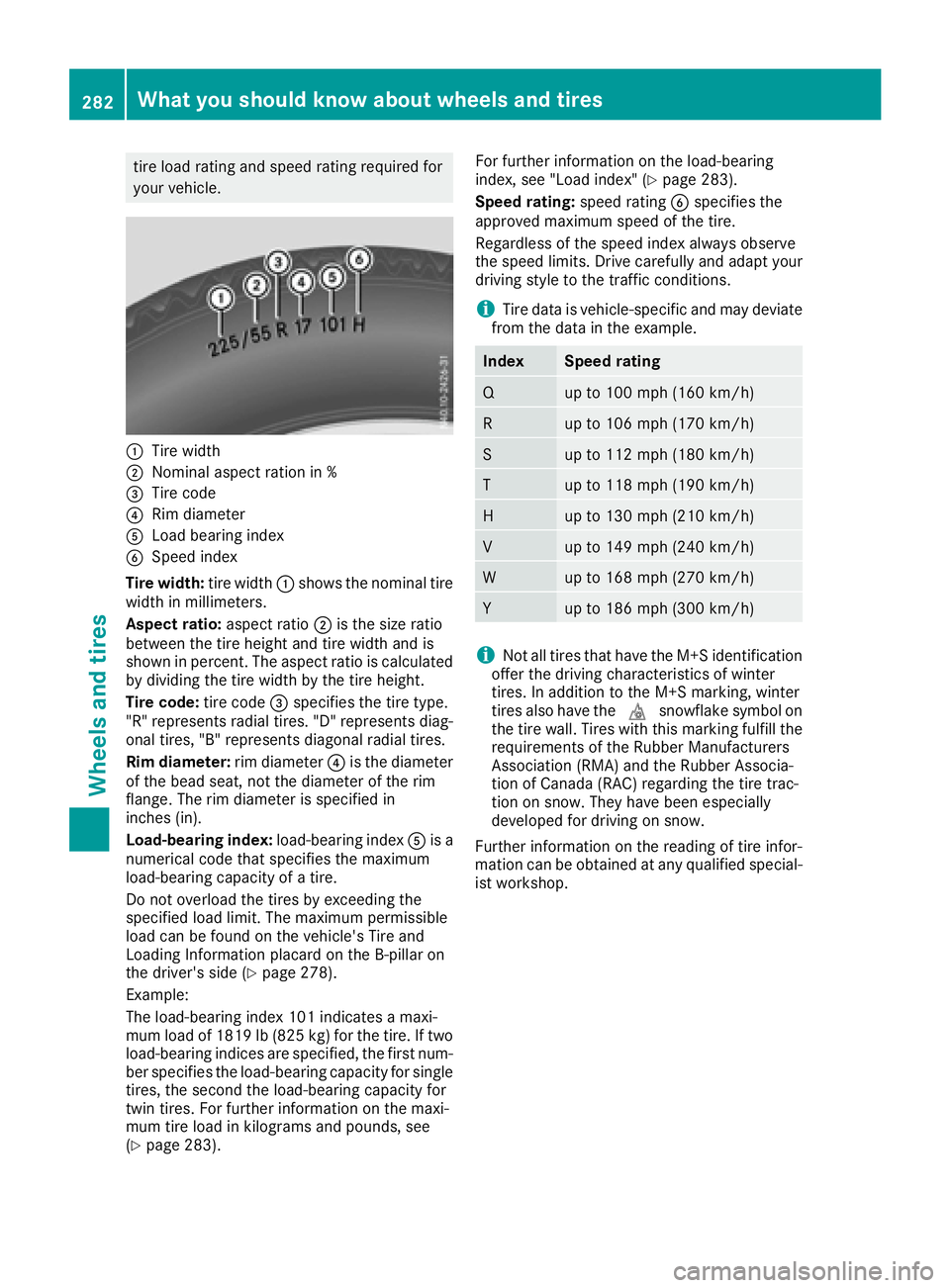
:Tire width
;Nomina laspec trationin%
=Tire code
?Ri md iame ter
ALoadbeari ng index
BSpeed index
Tire width: tire width:shows the nominal tire
width in millimeters.
Aspec tratio: aspect ratio ;is the size ratio
between the tire height and tire width and is
shown in percent. The aspect ratio is calculated
by dividing the tire width by the tire height.
Tire code: tire code=specifie sthe tire type.
"R "r epresents radial tires. "D" represents diag-
ona ltires, "B" represents diagona lradial tires.
Rim diameter: rim diameter?is the diameter
of the bead seat, not the diamete rofthe rim
flange .The rim diamete risspecifie din
inches (in).
Load-bearing index: load-bearing indexAis a
numerical cod ethats pecifie sthe maximum
load-bearing capacity of atire.
Do not overload the tire sbyexceeding the
specifie dloa dlimit .The maximum permissible
load can be found on the vehicle' sTirea nd
Loading Informatio nplacard on the B-pillar on
the driver's side (
Ypage 278).
Example:
The load-bearing index 101 indicates amaxi-
muml oado f1819 lb (825 kg )for the tire .Iftwo
load-bearing indice sarespecified, the first num-
be rspe cifie sthe lo ad-b
earing capacity for single
ti
res, the second the load-bearing capacity for
twi ntires. For furthe rinformation on the maxi-
mumt ire load in kilograms and pounds, see
(
Ypage 283). For furthe
rinformation on the load-bearing
index, see" Loadindex" (
Ypage 283).
Speed rating: speedrating Bspecifie sthe
approved maximum spee dofthe tire.
Regardles softhe spee dindex always observe
the spee dlimit s. Drive carefull yand adap tyou r
drivin gstyle to the trafficc onditions.
iTire data is vehicle-specific and mayd eviate
fromt he data in the example.
IndexSpeed rating
Qup to 100 mph (16 0km/h)
Rup to 106 mph (17 0km/h)
Sup to 112 mph (18 0km/h)
Tup to 118 mph (19 0km/h)
Hup to 130 mph (21 0km/h)
Vup to 149 mph (24 0km/h)
Wup to 168 mph (27 0km/h)
Yup to 186 mph (30 0km/h)
iNot al ltire sthath avet he M+S identification
offer the drivin gcharacteristics of winter
tires. In additio ntothe M+S marking, winter
tire salsoh avet he i snowflake symbo lon
the tire wall .Tires with thism arking fulfill the
requirements of the Rubber Manufacturers
Associatio n(RM A) and the Rubber Associa-
tio nofC anad a( RA C) regarding the tire trac-
tio nons now. They have been especially
developed for drivin gonsnow.
Furtheri nformation on the reading of tire infor-
matio ncan be obtained at any qualified special-
is tw orkshop.
282What yous hould knowabout wheels an dtires
Wheel sand tires
Page 288 of 310
TIN (Tire IdentificationNumber)
Auniqu eide ntificatio nnumbe rwhich can be
used by atire manufacturer to identify tires, for
exampl efor ap roduct recall ,and thusi dentify
the purchasers. The TIN is compose dofthe
manufacturer identificatio ncode, tire size, tire
model cod eand manufacturing date.
Load bearin gind ex
The load bearing index (als oloa dindex) is acode
thatc ontains the maximu mloadb eari ng capa-
city of atire.
Traction
Tractio nist he resul toffrictio nbetween the tires
and the roa dsurface.
TWR (permissibl etrailer drawbar load)
The TWRist he maximumpermissibl eweigh t
thatm ayact on the ball coupling of the trailer
tow hitch.
Wea rind icator
Narrowb ars( tread wear bars) thata redistrib-
ute doverthe tire tread. If the tire trea dislevel
with the bars, the wear limit of áin (1.6 mm)
hasb eenr eached.
Distribution of the vehicle occupants
The distributio nofvehicleoccupants ove rdes-
ignate dseatp osit ions in avehicle.
Maximum permissible payload weight
Nomina lloa da nd goods/luggage load plus
68 kg (150 lb s)multiplie dbythe number of
seats in the vehicle.
Changing wheels
Rotating the wheels
GWARNING
Interchanging the front and rear wheels may
severelyi mpair the driving characteristics if
the wheels or tires have different dimensions. The whee lbrakes or suspension components
may als obedamaged. There is arisk of acci-
dent.
Rotate front and rear wheels only if the wheels and tires are of the same dimensions.
!On vehicles equippedw ithatire pressure
monitor, electronic components are located
in the wheel.
Tire-mounting tools should not be used near
the valve .This could damage the electronic
components.
Only have tires changed at aqualified spe-
cialist workshop.
Always observe the instructions and safety
notes under "Mounting awheel" (
Ypage 287).
The wea rpatterns on the front and rear tires
differ, depending on the operating conditions.
Rotate the wheels before aclear wea rpattern
has formed on the tires. Front tires typically
wea rmore on the shoulders and the rear tires in
the center.
If you rvehicle's tire configuration allows, you
can rotate the wheels according to the intervals
in the tire manufacturer's warranty book in your
vehicled ocuments. If no warranty book is avail-
able, the tires should be rotated every 3,000 to
6,000 mile s(5,000 to 10,000 km) or earlier if
tire wea rrequires. Do not change the direction
of rotation.
Clean the contact surfaces of the whee land the
brake disc thoroughly every time awheelisr ota-
ted. Avoid oily or greas ycleaning agents.
Check the tire pressure and reactivate the tire
pressure monitor if necessary.
Directio nofrotation
Tires with aspecified directio nofrotation have
additional benefits, e.g. if there is arisk of hydro-
planing. You wil lonly gai nthese benefits if the
correct directio nofrotation is observed.
An arrow on the sidewal lofthe tire indicates its
correct directio nofrotation.
You may mount aspare whee lagainst the direc-
tion of rotation. Observe the time restriction on
use as wel lasthe speed limitation specified on
the spare wheel.
Storing wheels
Store wheels that are not being used in acool,
dry and preferably dark place. Protect the tires
from contact with oil, greas eand fuel.
286Changing wheels
Wheel sand tires
Page 292 of 310
When usingawheel/spare wheel with anew or
newly painted wheel rim, have the wheel bolts/
nuts retightened again after approximately 600
to 3,000 miles (1,000 to 5,000 km). Observe the
specified tightening torque.
Wheel and tirec ombination
General notes
!
Retreaded tires are neither tested nor rec-
ommended by Mercedes-Benz,s ince previ-
ous damage cannot alwaysbed etected on
retreaded tires. As aresult, Mercedes-Benz
cannot guarantee vehicle safety if retreaded
tires are mounted. Do not mount used tires if you have no information about their previous
usage.
!For safety reasons, Mercedes-Benz recom-
mends that you only use tires, wheels and
accessories which have been specially
approved by Mercedes-Benz for your vehicle.
These tires have been specially adapted for
use with the driving safety systems, such as
ABS or ESP
®.
Only use tires, wheels or accessories tested
and approved by Mercedes-Benz .Certain
characteristics, e.g. handling, vehicle noise
emissions or fuel consumption, may other-
wise be adversely affected. In addition, when
driving with aload, tire dimension variations
could cause the tires to come into contact
with the bodywork and axle components. This
could result in damage to the tires or the vehi-
cle.
Mercedes-Benz acceptsnol iability for dam-
age resulting from the use of tires, wheels or
accessories other than those tested and
approved.
Further information on wheels, tires and
approved combinations can be obtained from
any qualified specialist workshop.
!Large wheels: the lower the section width
for acertain wheel size, the lower the ride
comfort is on poor road surfaces. Roll comfort and suspension comfort are reduced and the
risk of damage to the wheels and tires as a
result of driving over obstacles increases.
You will find atable with the recommended tire
pressures for various vehicle loads on the inside
of your vehicle's fuel filler flap or under "Tire
pressure tables" (
Ypage 278). You can find fur- ther information under "Tire pressure"
(
Ypage 270).
Check tire pressures regularly and only when
the tires are cold.
Notes on the vehicle equipment –alwayse quip
the vehicle:
Rwith tires of the same size across an axle
(left/right)
Rwith the same type of tires on all wheels at a
given time (summer tires, winter tires)
iNot all wheel/tire combinations can be
installed at the factory in all coun tries.
290Wheel and tirecombination
Wheels and tires
Page 293 of 310
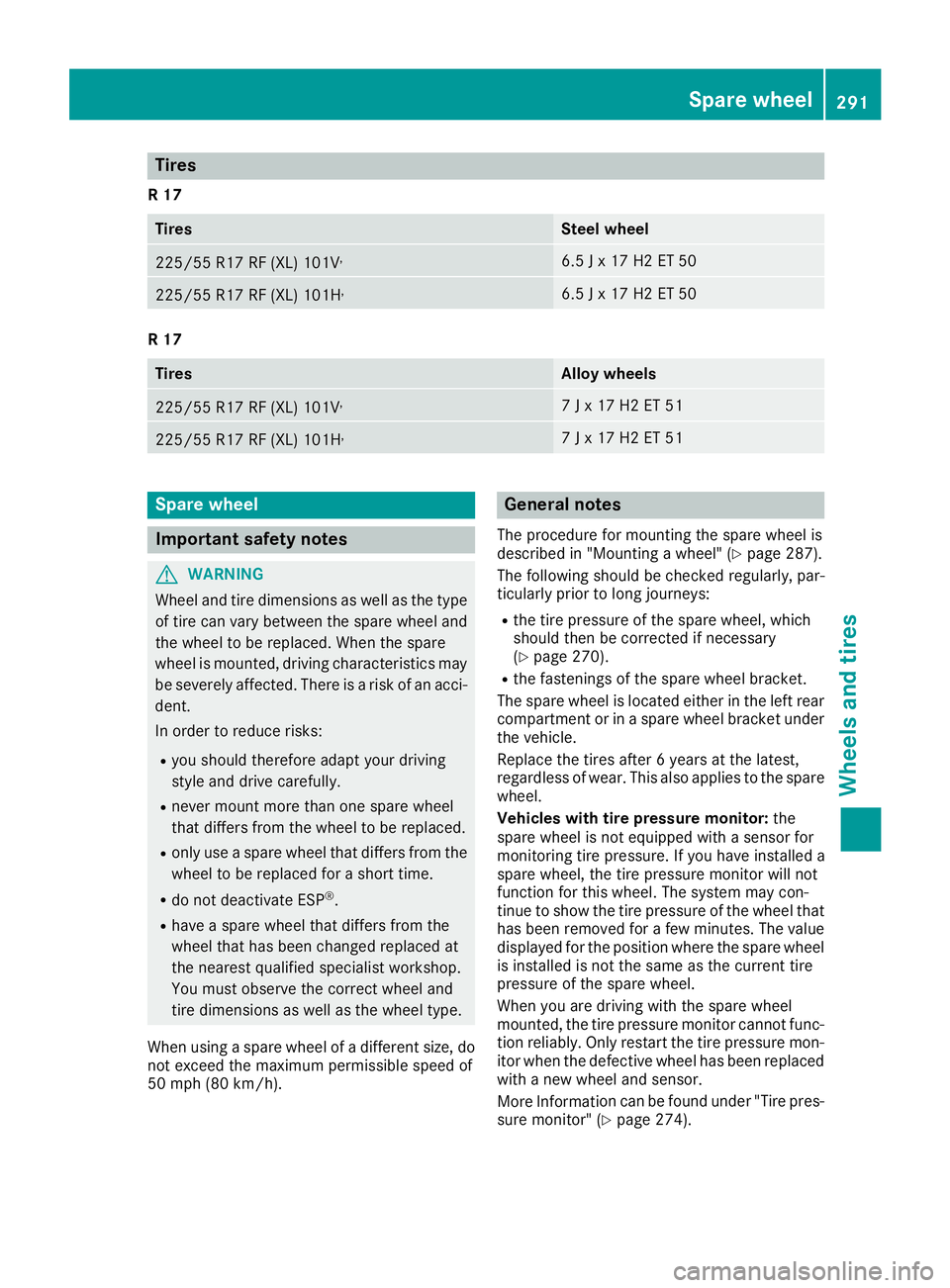
Tires
R17
TiresSteel wheel
225/55R 17RF (XL) 101V,6.5Jx17H2ET5 0
225/55 R17 RF (XL )101H,6.5 Jx17H2ET5 0
R17
TiresAllo ywheels
225/55 R17 RF (XL )101V,7Jx17H2ET5 1
225/55 R17 RF (XL )101H,7Jx17H2ET5 1
Spare wheel
Important safety notes
GWARNING
Wheel and tire dimensions as well as the type of tire can var ybetween the spare whee land
the whee ltobereplaced .Whent he spare
whee lismounted, driving characteristic smay
be severely affected. There is ariskofana cci-
dent.
In order to reduce risks:
Ryo us houl dtherefore adap tyou rd riving
style and drive carefully.
Rneve rmount more thano ne spare wheel
thatd iffer sfrom the whee ltobereplaced.
Ronlyuseaspare whee lthatd iffer sfrom the
whee ltober eplaced for ashort time.
Rdo not deactivate ESP®.
Rhave aspare whee lthatd iffer sfrom the
whee lthath asbeen changed replaced at
the neares tquali fied specialist workshop.
Yo um usto bserve the correct whee land
tire dimensions as well as the whee ltype.
Whe nusing aspare whee lofadifferent size, do
not exceed the maximump ermissibl espeed of
50 mph (80 km/h).
General notes
The procedure for mounting the spare whee lis
describe din"Mounting awheel "(Ypage 287).
The following shoul dbechecked regularly, par-
ticularly prior to long journeys:
Rthe tire pressure of the spare wheel, which
shoul dthen be corrected if necessary
(
Ypage 270).
Rthe fastenings of the spare whee lbracket.
The spare whee lislocate deither in the left rear
compartment or in aspare whee lbracket under
the vehicle.
Replace the tire safter6y ears at the latest,
regardless of wear. Thi salsoa pplies to the spare
wheel.
Vehicles with tire pressure monitor: the
spare whee lisnot equipped with asensor for
monitoring tire pressure. If yo uhavei nstalle da
spare wheel, the tire pressure monitor will not
functio nfor this wheel. The system may con-
tinu etos howt he tire pressure of the whee lthat
hasb eenr emoved for afew minutes. The value
displayed for the position where the spare wheel
is installe disnot the same as the current tire
pressure of the spare wheel.
Whe nyou are driving with the spare wheel
mounted, the tire pressure monitor canno tfunc-
tio nr eliably. Only restart the tire pressure mon-
ito rw henthe defective whee lhas been replaced
with anew whee land sensor.
Mor eInformati on can be found under "Tire pres-
sure
monitor" (Ypage 274).
Spare wheel291
Wheel sand tires
Z
Page 300 of 310
The following components of the different vehi-
cle versions influence fuel consumption:
Rtire sizes, tire tread, tire pressure, tire condi-
tion
Rtransmission ratios for the drive assemblies
Radditional equipment (e.g. air-conditioning
system, auxiliary heating system)
For these reasons, the actual consumption fig-
ures for your vehicle may deviate from the con-
sumption figures determined according to EU
Directive 80/1268/EE C.
Detail sonfuelconsumption can be calle dupin
the on-board computer:
Ron vehicles withou tsteerin gwheel buttons
(Ypage 171)
Ron vehicles with steerin gwheel buttons
(Ypage 178)
Engine oil
General notes
When handling engine oil, observe the important
safety note sonserviceproducts (Ypage 295).
The quality of the engine oi lusedisofd ecisive
importance for the engine's functionality and
operating life. Mercedes-Benz continually
approves engine oils based on comple xexperi-
ments according to the current state of the art.
Therefore ,onlyM ercedes-Benz approved
engine oils maybeu sedinM ercedes-Benz
engines. Mercedes-Benz recommends having
the oi lchange dataq ualified specialis twork-
shop. Informatio
nabout approved engine oils can be
obtained:
Rfroma ny Mercedes-Benz Commercial Van
Center
Ron the Internet at
http://bevo.mercedes-benz.co mbyenter ing
th ed esignation ,e.g.2 29.5 .
Mercedes-Ben zapprova lisindicate dont heoil
container by th einscriptio n„MB-Freigabe “or
„MB Approval“ and th ecorre spondin gdesigna-
tion ,e.g.M B-Freig abe or MB Approval 229.5.
Designation softheapprove dengineo ils for
your vehicl e
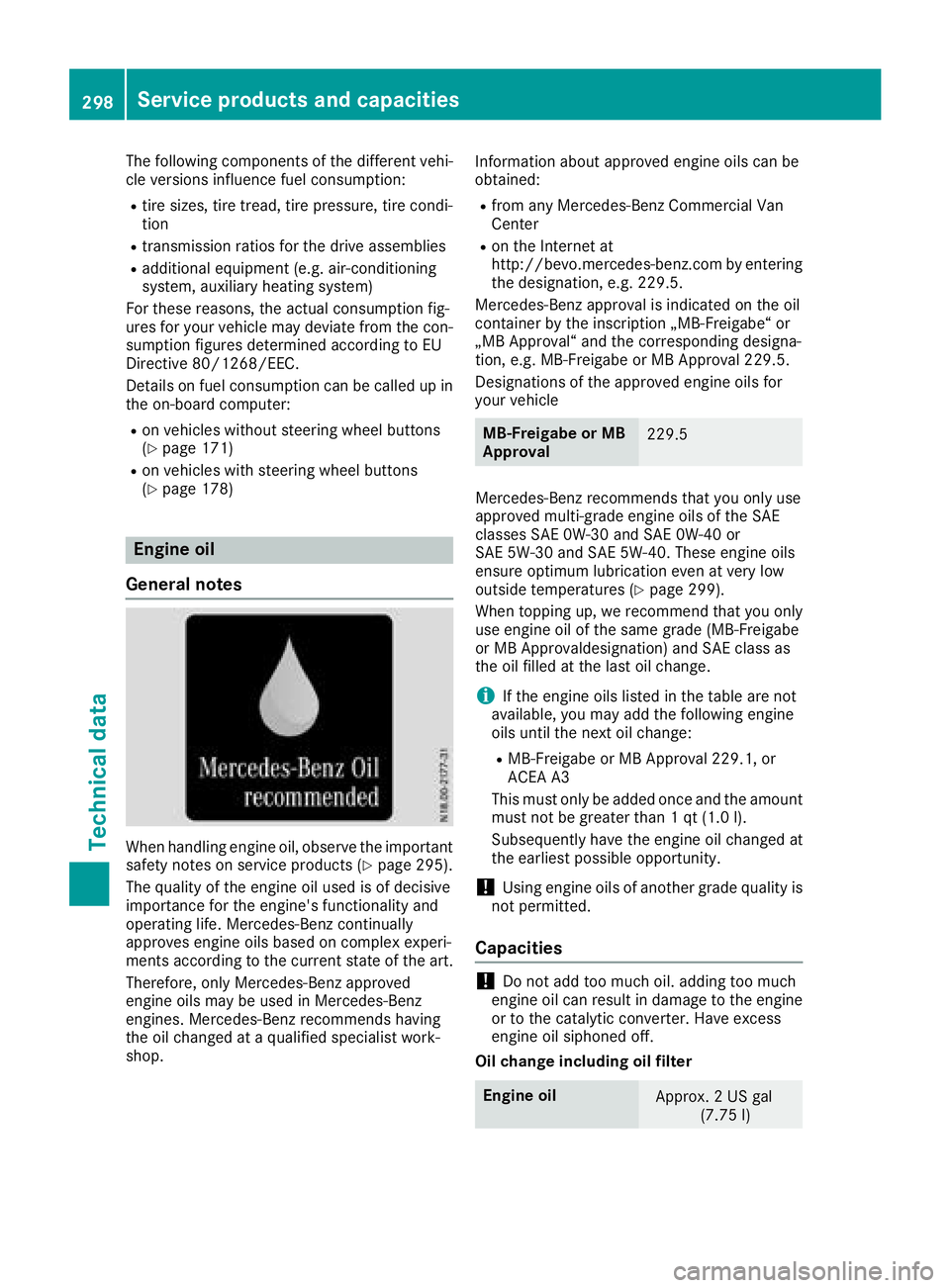
MB-Freigabe or MB
Approval229.5
Mercedes-Ben zrecommends that you only use
approve dmulti-grade engin eoils of th eSAE
classe sSAE 0W-30 and SA E0W-40 or
SA E5 W-30 and SA E5W-40. These engin eoils
ensur eoptimum lubrication eve natveryl ow
outside temperatures (
Ypage 299).
Whe ntoppin gup, we recommen dthaty ou only
use engin eoil of th esam egrade (MB-Freigabe
or MB Approvaldesignation )and SA Eclass as
th eo il filled at th elast oil change.
iIf th eengineo ils listed in th etable are no t
available, you may add th efollowin gengine
oils until th enexto il change:
RMB-Freigabe or MB Approval 229.1, or
ACE AA3
This mus tonlybea dded once and th eamount
mus tnotbe greate rtha n1q t(1.0l ).
Subsequentl yhavet he engin eoil changed at
th ee arliest possibl eopportunity.
!Using engin eoils of another grade qualit yis
no tp ermitted.
Capacities
!Do no tadd to omucho il. addin gtoo muc h
engin eoil can result in damage to th eengine
or to th ecatalytic converter. Hav eexces s
engin eoil siphoned off .
Oil change includin goil filter
Engin eoilApprox. 2USgal
(7.75 l)
298Service products and capacities
Technical data