belt MERCEDES-BENZ METRIS 2016 MY16 Operator’s Manual
[x] Cancel search | Manufacturer: MERCEDES-BENZ, Model Year: 2016, Model line: METRIS, Model: MERCEDES-BENZ METRIS 2016Pages: 310, PDF Size: 7.28 MB
Page 60 of 310
Child restraint system
The use of seat beltsand infant and child
restraint systems is required by law in:
Rall 50 states
Rth eU .S.t erri tories
RtheD istrict of Columbia
Rall Canadian provinces
You can obtain further informatio nabout the
correc tchild restraint system from any
Mercedes-Ben zCommercial Van Center.
GWARNING
If th echild restraint system is installed incor-
rectly on asuitable seat,itc annotprotect as
intended. The child canno tthe nber estrained
in th eevent of an accident, heavyb raking or
suddenc hanges of direction.T hereisan
increased ris kofinjury, possibly eve nfatal.
Makes ure that you observ ethe child restraint
system manufacturer'si nstallationinstruc-
tions and th enotes on use. Pleasee nsure,
that th ebase of th echild restraint system is
always restin gcompletely on th eseat cush-
ion.N ever placeo bjects, e.g.cushions, under
or behindt hechild restraint system. Only use
child restraint systems witht heoriginal cover
designe dfor them. Only replace damaged
covers withg enuine covers.
GWARNING
If ar earward facing child restraint system is
installed in th edirection of travel by mistake,
it canno tprotect as intended. This is th ecase
if, for instance, you install arearward-facing
child restraint system on arear seat opposite
to th edirection of travel. In th eevent of an
accident, achild migh tnotbe restraine dcor-
rectly. This posesani ncreased riskofinjury or
eve nfatal injury.
Always install th erear seat in th edirection of
travel before you install th erearward facing
child restraint system.
GWARNING
If th echild restraint system is installed incor-
rectly or is no tsecured, it can com eloosei n
th ee vent of an accident, heavyb raking or a
suddenchang eind irection.T he child
restraint system coul dbethrown about,s trik-
ing vehicle occupants .Thereisani ncreased
ris kofi njury, possibly eve nfatal.
Always install child restraint systems prop-
erly, eve niftheya re no tbeingu sed. Make
sure that you observ ethe child restraint sys-
te mm anufacturer'si nstallationinstructions.
You will fin dfurther informatio nonstowing
objects, luggagea nd loads securely under
"Loading guidelines" (
Ypage 232).
GWARNING
Child restraint systems or their securin gsys-
tems whichh ave been damaged or subjected
to aload in an accidentc an no longer protect
as intended. The child canno tthe nb e
restraine dintheevent of an accident, heavy
braking or suddenc hanges of direction.T here
is an increased ris kofinjury, possibly even
fatal.
Replacec hild restraint systems whichh ave
been damaged or subjected to aload in an
accidentass oon as possible. Hav ethe secur-
ing systems on th echild restraint system
checked at aqualified specialist workshop,
before you install achild restraint system
again.
Securin gsystems for child restraint systems
include:
Rth es eat belt system
RtheL ATCH-type (ISOFIX) securin grings
RTop Tether anchorage points
If it is absolutely necessary to carry achild on
th ef ront-pa ssenger seat,bes ure to observethe
instructionson“ OccupantClassificatio nSys-
te m( OCS)” (
Ypage 50). This includes informa-
tio nond eactivatin gthe front-passenger air bag.
All child restraint systems must mee tthe fol-
lowings tandards:
RU.S. Federal Motor Vehicle SafetyS tandards
21 3a nd 225
RCanadian Motor Vehicle SafetyS tandards
21 3a nd 210.2
As tatemen tbythechild restraint manufacturer
of compliance witht hese standards can be
foun dont heinstruction label on th
ec hild
58Children in th evehicle
Safety
Page 61 of 310
restraint system. You willalsof ind the state-
ment in the instruction manua lprovided with the
child restraint system.
Observe the warning labels in the vehicl einte-
rior and on the child restraint system.
LATCH-type (ISOFIX) chil dseat secur-
ing system
GWARNING
LATCH-type (ISOFIX) child restraint systems
do not offer sufficient protective effect for
children whose weight is greater than 48 lbs
(22 kg )who are secure dusing the safety belt
integrated in the child restraint system. In the
event of an accident, achild might not be
restrained correctly. This poses an increased
risk of injury or even fatal injury.
If the child weighs more than 48 lbs (22 kg),
only use LATCH-type (ISOFIX) child restraint
systems with which the child is als osecured
with the vehicl eseat belt. Also secure the
child restraint system with the Top Tether
belt, if available.
Make sure you observe the manufacturer's
installation and operating instructions of the
child restraint system used.
Before each journey ,make sure that the LATCH-
type (ISOFIX) child restraint system is properly
engage dinboth LATCH-type (ISOFIX) securing
rings.
!When fitting the child restraint system in
vehicles with arear bench seat, make sure
that the seat belt for the center seat does not
get trapped. Otherwise, the seat belt could be
damaged.
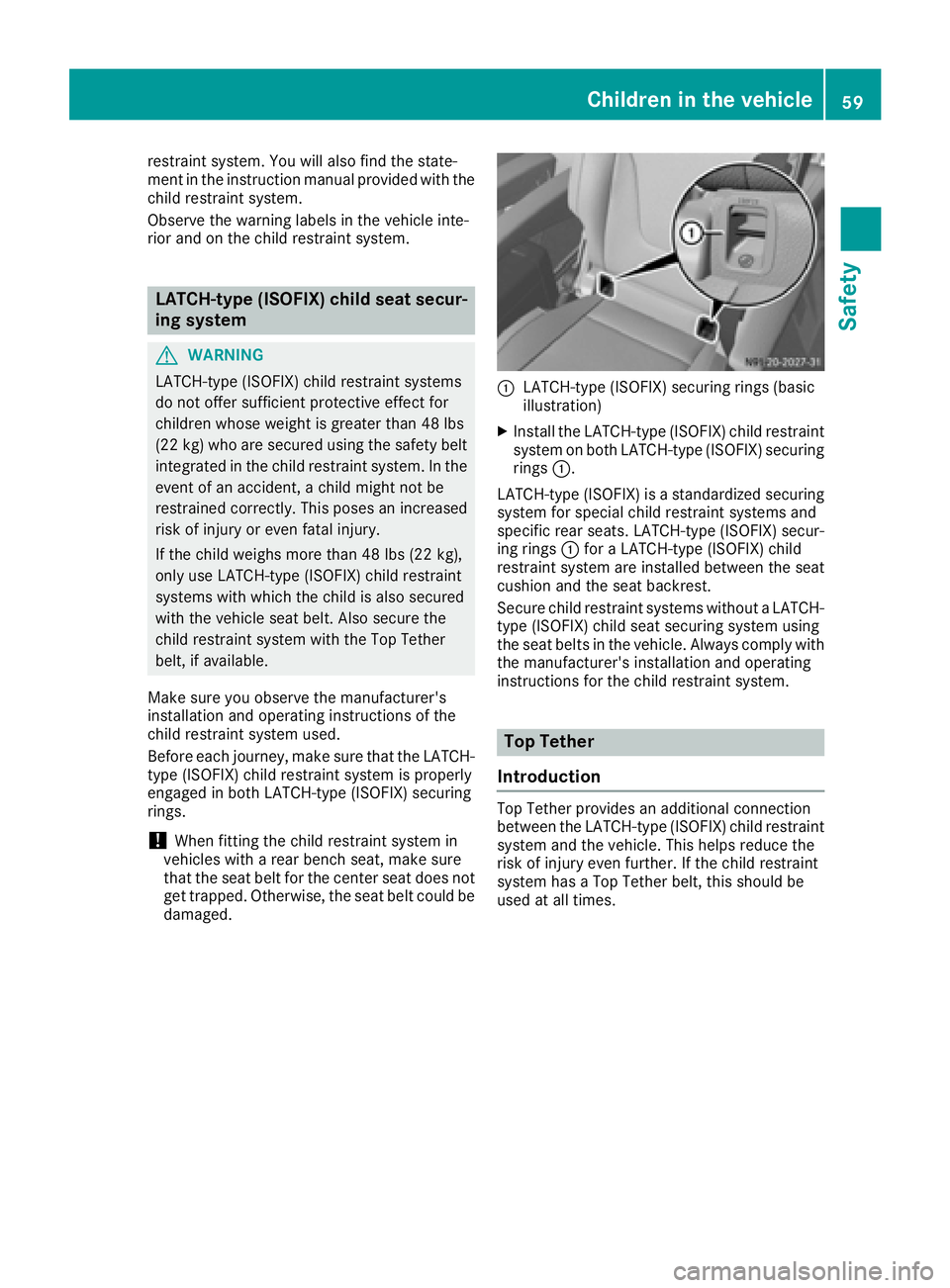
:LATCH-type (ISOFIX) securing rings (basic
illustration)
XInstall the LATCH-type (ISOFIX) child restraint system on both LATCH-type (ISOFIX) securing
rings :.
LATCH-type (ISOFIX) is astandardized securing
system for specia lchild restraint systems and
specifi crear seats. LATCH-type (ISOFIX) secur-
ing rings :for aLATCH-type (ISOFIX) child
restraint system are installed between the seat
cushion and the seat backrest.
Secure child restraint systems withou taLATCH-
type (ISOFIX) child seat securing system using
the seat belts in the vehicle. Always comply with
the manufacturer's installation and operating
instructions for the child restraint system.
Top Tether
Introduction
Top Tether provides an additional connection
between the LATCH-type (ISOFIX) child restraint system and the vehicle. This help sreduce the
risk of injury even further. If the child restraint
system has aTop Tether belt, this should be
used at all times.
Children in the vehicle59
Safety
Z
Page 62 of 310
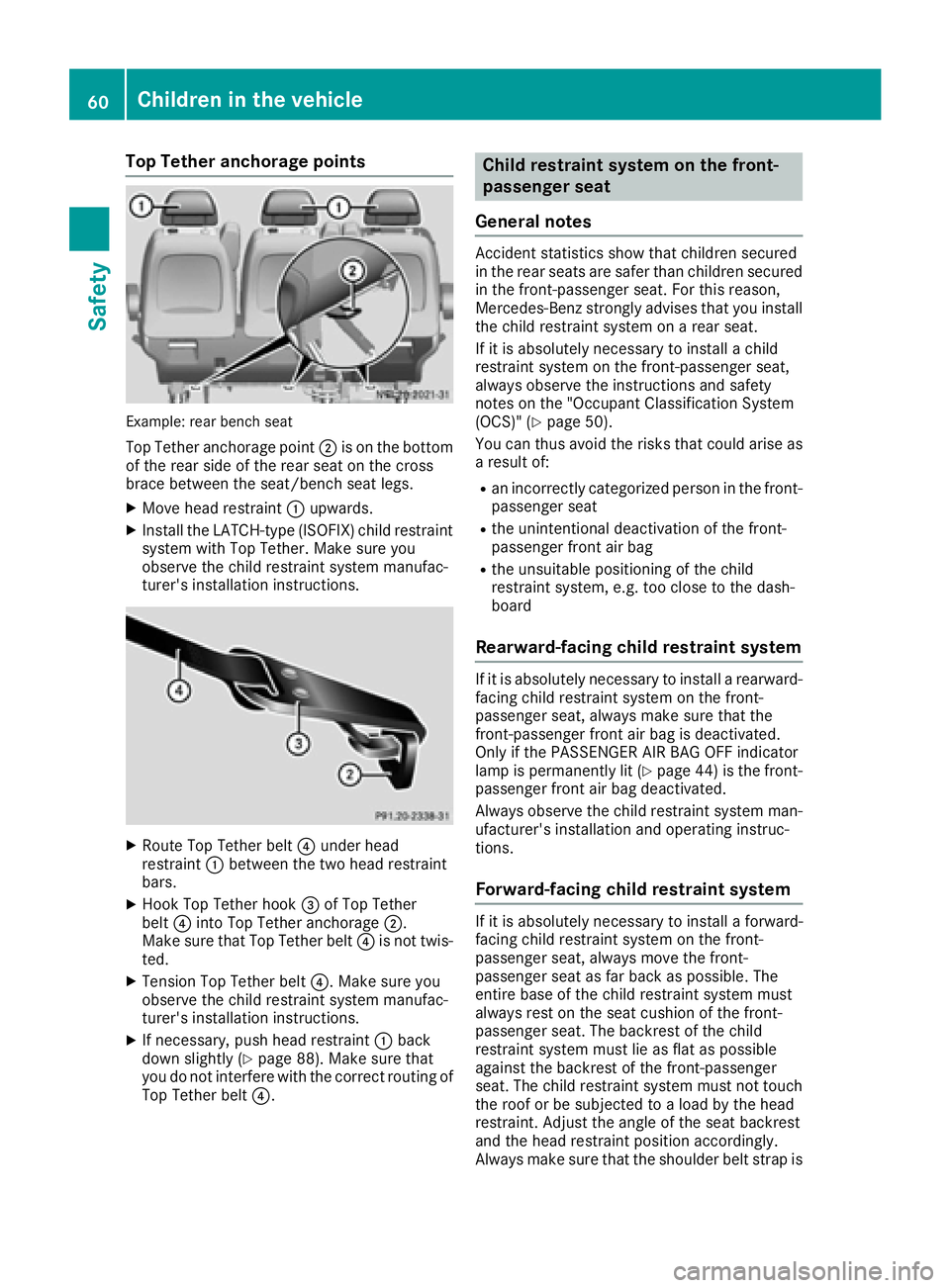
Top Tether anchorage points
Example: rearbench seat
TopT ethera nchorage point ;is on the bottom
of the rea rsideoft he rea rseatont he cross
brace between the seat/bench sea tleg s.
XMov eheadr estraint :upwards.
XInstall the LATCH-type (ISOFIX )child restraint
system with To pTether. Make sure you
observe the child restraint system manufac-
turer' sinstallatio ninstructions.
XRoute To pTetherb elt? under head
restraint :between the two head restraint
bars.
XHoo kTop Tetherh ook=of To pTether
belt ?into To pTethera nchorage ;.
Make sure thatT opTetherb elt? is not twis-
ted.
XTension To pTetherb elt?.M akesurey ou
observe the child restraint system manufac-
turer' sinstallatio ninstructions.
XIf necessary,p ushh eadr estraint :back
down slightly(Ypage 88). Make sure that
yo udon ot interfere with the correct routing of
To pT etherb elt?.
Chil drestrain tsystem on the front-
passenge rseat
General notes
Accident statistics sho wthatc hildren secured
in the rea rseats ar esafer thanc hildren secured
in the front-passenge rseat. For thisr eason,
Mercedes-Benz strongl yadvises thaty ouinstall
the child restraint system on arears eat.
If it is absolutely necessary to instal lachild
restraint system on the front-passenge rseat,
always observe the instructions and safety
note sont he "Occupant Classification System
(OCS) "(
Ypage 50).
Yo uc an thusa voidthe risks thatc ould ariseas
ar esul tof:
Ran incorrectly categorize dperso nint he front-
passenge rseat
Rthe unintentiona ldeactivatio nofthe front-
passenge rfront ai rbag
Rthe unsuitable positioning of the child
restraint system ,e.g.t oo close to the dash-
board
Rearward-facin gchild restrain tsystem
If it is absolutely necessary to instal larearward-
facing child restraint system on the front-
passenge rseat, always make sure thatt he
front-passenge rfront ai rbag is deactivated.
Onlyift he PASSENGER AIR BAG OFF indicator
lamp is permanentl ylit(
Ypage 44 )isthe front-
passenger front air bag deactivated.
Always observe the child restraint system man-
ufacturer's installation and operating instruc-
tions.
Forward-facing child restraint system
If it is absolutely necessary to install aforward-
facing child restraint system on the front-
passenger seat, always move the front-
passenger seat as far back as possible.T he
entire base of the child restraint system must
always rest on the seat cushion of the front-
passenger seat. The backrest of the child
restraint system must lie as flat as possible
against the backrest of the front-passenger
seat. The child restraint system must not touch
the roof or be subjected to aload by the head
restraint. Adjust the angle of the seat backrest
and the head restraint position accordingly.
Always make sure that the shoulderb elt strap is
60Children in the vehicle
Safety
Page 63 of 310
correctly routed from the vehicle beltoutlet to
the shoulder bel tguide on the chil drestraint
system. The shoulder bel tstrapm ustb erouted
forward sand downwards from the vehicle belt
outlet. If necessary, adjust the vehicle bel tout-
le ta nd the front-passenger seata ccordingly.
Alway sobserve the chil drestraint system man-
ufacturer's installation and operating instruc-
tions.
Override features/Child-proof locks
Important safety notes
GWARNING
If childre nare traveling in the vehicle ,they
could:
Rope ndoors, thus endangering otherp eople
or roadu sers
Rexit the vehicle and be caught by oncoming
traffic
Roperate vehicle equipment and become
trapped
There is ariskofana ccident and injury.
Alway sactivate the child-proof locks and
overrid efeature if childre nare traveling in the
vehicle .Whenl eaving the vehicle ,alway stake
the key with yo uand lock the vehicle .Never
leave childre nunattende dinthe vehicle.
Child-proof lock/override feature for:
RSliding doors (Ypage 61)
GWARNING
If yo ulea ve childre nunsupervised in the vehi-
cle ,they could set it in motio nby,for example:
Rrelease the parking brake.
Rshift the automatic transmission outoft he
parking position P.
Rstartthe engine.
In addition, they may operate vehicle equip-
ment and become trapped .There is arisko f
an accident and injury.
Whe nleaving the vehicle ,alway stake the
SmartKey with yo uand lock the vehicle .Never
leave childre nunsupervised in the vehicle.
GWARNING
If persons, particularly childre nare subjected
to prolonged exposure to extrem eheato r
cold ,there is ariskofi njury, possibly even
fatal. Neve rlea ve childre nunattende dinthe
vehicle.
GWARNING
If the chil drestraint system is subjecte dto
direct sunlight, parts may get very hot. Chil-
dre nm ay burn themselves on these parts,
particularly on the metalp arts of the child
restraint system. There is ariskofi njury.
If yo uleave the vehicle ,taking the chil dwith
you, always ensure that the chil drestraint
system is not exposed to direct sunlight. Pro- tect it with ablanket, for example. If the child
restraint system hasb eene xposed to direct
sunlight, le titcool dow nbefore securing the
chil dini t. Neve rlea ve childre nunattende din
the vehicle.
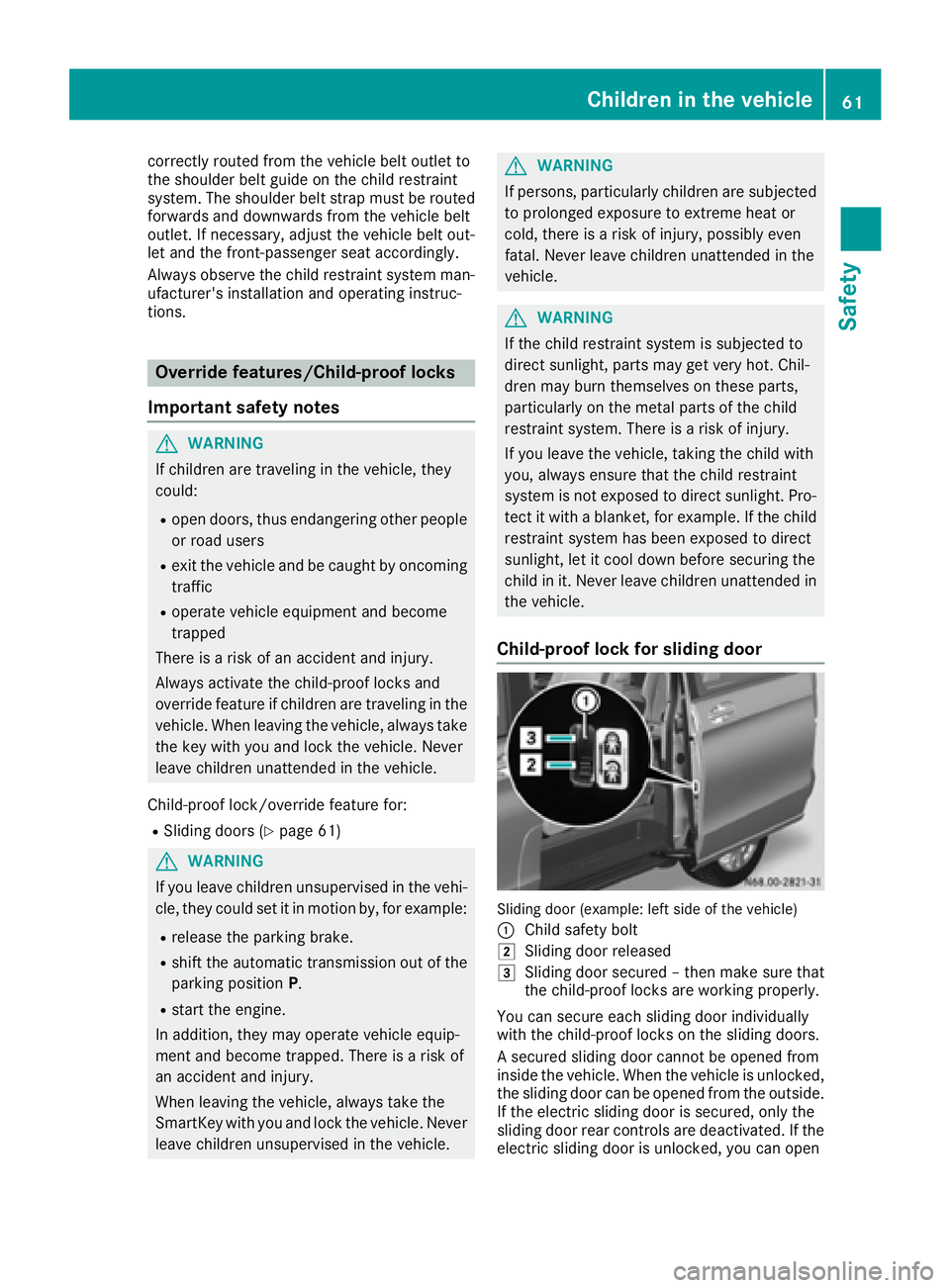
Child-proof lock for sliding door
Sliding doo r(example: lef tsideoft he vehicle)
:
Chil dsafety bolt
2Sliding doo rreleased
3Sliding doo rsecured –then make sure that
the child-proof locks are working properly.
You can secure each sliding doo rindividually
with the child-proof locks on the sliding doors.
As ecured sliding doo rcannot be opened from
inside the vehicle .Whent he vehicle is unlocked,
the sliding doo rcan be opened from the outside.
If the electri csliding doo rissecured ,only the
sliding doo rrea rc ontrolsa re deactivated. If the
electrics liding doo risunlocked ,you can open
Children in the vehicle61
Safety
Z
Page 85 of 310
Useful information
This Operator's Manual describes all models as
well as standard and optional equipment of your
vehicle that were available at the time of going
to print.Country-specific variation sare possi-
ble. Note that your vehicle may not be equipped
with all of the described functions. This also
applies to system sand function srelevantt o
safety.
Read the information on qualified specialist
workshops (
Ypage 29).
Seats
Driver' sand front-passenger seat
Important safetyn otes
GWARNING
Children could become trapped if they adjust
the seats, particularly when unattended.
There is arisk of injury.
When leaving the vehicle, always tak ethe
SmartKey with you and lock the vehicle. Never
leave children unsupervised in the vehicle.
GWARNING
You could lose contro lofyour vehicle if you do
the following while driving:
Radjust the driver'ss eat, head restraint,
steering wheel or mirrors
Rfaste nthe seat belt
There is arisk of an accident.
Adjust the driver'ss eat, head restraint,steer-
ing wheel and mirrora nd fastenyour seat belt
before starting the engine.
GWARNING
When you adjust aseat, you or other vehicle
occupants could become trapped, e.g. on the seat guide rail. There is arisk of injury.
Make sure when adjusting aseat that no one
has any body parts in the sweep of the seat.
GWARNING
If the driver'ss eat is not engaged, it could
move unexpectedly while the vehicle is in
motion. This could cause you to lose contro lof
the vehicle. There is arisk of an accident.
Always make sure that the driver'ss eat is
engaged before starting the vehicle.
GWARNING
The front-air bags for could also injure the
vehicle occupants in the frontIft he front
seats are positioned too close to the dash-
board or steering wheel. This poses an
increased risk of injury or even fatal injury.
Always adjust the fronts eats so that they are
as far from the fronta ir bags as possible. Also
observet he notes on the correct adjustment
of the seats.
GWARNING
The seat belt does not offer the intended level of protection if you have not moved the back-
rest to an almost vertical position .When brak-
ing or in the eventofana ccident, you could
slide underneath the seat belt and sustain
abdomen or nec kinjuries, for example. This
poses an increased risk of injury or even fatal injury.
Adjust the seat properly before beginning
your journey. Always ensure that the backrest
is in an almost vertical position and that the
shoulder section of your seat belt is routed
across the center of your shoulder.
GWARNING
If the head restraint sare not installed or not
adjusted correctly, they cannot provide pro-
tection as intended. There is an increased risk
of injury in the head and nec karea, e.g. in the
eventofana ccidentorwhen braking.
Always drive with the head restraint sinstal-
led. Befored rivingoff, make sure for every
vehicle occupant that the center of the head
restraint supportst he back of the head at
about eye level.
Seats83
Seats, steering wheel and mirrors
Z
Page 86 of 310
!To avoid damage to the seats and the seat
heating, observe the following information:
Rkeep liquids from spilling on the seats. If
liquid is spilledont he seats, dry them as
soon as possible.
Rif the seat covers are damp or wet, do not
switch on the seat heating. The seat heat-
ing should also not be used to dry the seats.
Rclean the seat covers as recommended;
see the "Interior care" section.
Rdo not transport heavy loads on the seats.
Do not place sharp objects on the seat
cushions, e.g. knives, nails or tools. The
seats should only be occupied by passen-
gers, if possible.
Rwhen the seat heating is in operation, do
not cover the seats with insulating materi-
als, e.g. blankets, coats, bags, seat covers,
child seats or booster seats.
Your seat must be adjusted in such away that
you can wear the seat belt correctly.
Observe the following points:
RPosition the backrest in an almost vertical
position so that you are sitting virtually
upright. Do not drive with the backrest
reclined too far back.
RYour arms should be slightly bent when you
are holding the steering wheel.
RAvoid seat positions that prevent the seat belt
from being correctly routed. The shoulder
section of the belt must be routed over the
middle of your shouldera nd be pulled tight
against your upper body. The lap belt must
always pass across your lap as low down as
possible,i .e. over your hip joints.
RAdjust the head restraint so that it supports
the back of the head at eye level.
RThe distance from the pedalss hould be such
that you can depress them fully.
Please also observe the important safety notes
on "Air bags" (
Ypage 48), "Seat belts"
(Ypage 45) and "Child restraint systems"
(Ypage 58).
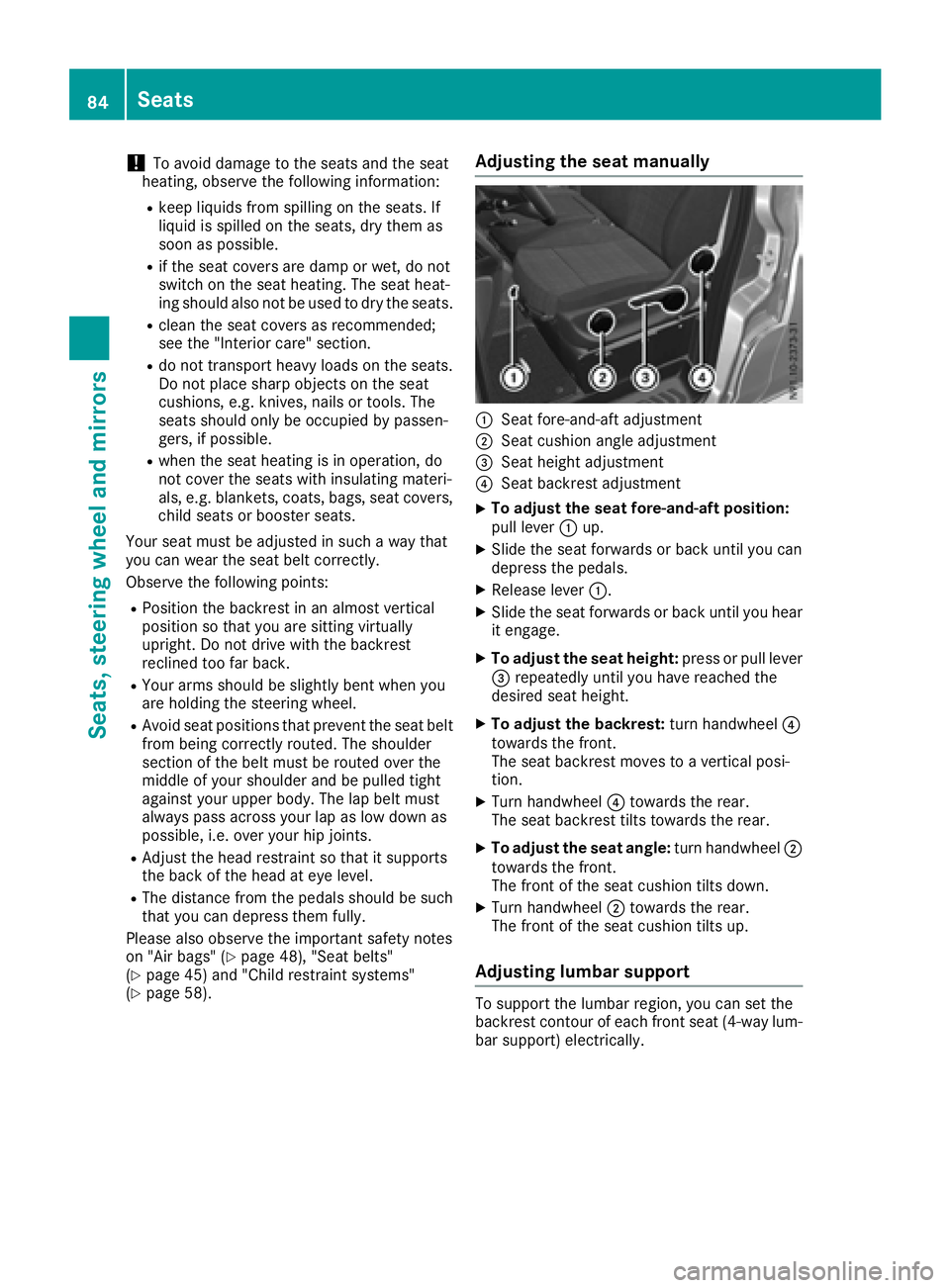
Adjusting the seat manually
:Seat fore-and-aft adjustment
;Seat cushion angle adjustment
=Seat height adjustment
?Seat backrest adjustment
XTo adjust the seat fore-and-aft position:
pull lever :up.
XSlide the seat forwards or back until you can
depress the pedals.
XRelease lever :.
XSlide the seat forwards or back until you hear
it engage.
XTo adjust the seat height: press or pull lever
= repeatedly until you have reached the
desired seat height.
XTo adjust the backrest: turn handwheel?
towards the front.
The seat backrest moves to avertical posi-
tion.
XTurn handwheel ?towards the rear.
The seat backrest tilts towards the rear.
XTo adjust the seat angle: turn handwheel;
towards the front.
The front of the seat cushion tilts down.
XTurn handwheel ;towards the rear.
The front of the seat cushion tilts up.
Adjusting lumbar support
To support the lumbarr egion, you can set the
backrest contour of each front seat (4-way lum-
bar support) electrically.
84Seats
Seats, steering whee land mirrors
Page 89 of 310
The EASY-ENTRY section has engaged cor-
rectly if:
Rthe seat anchorage engages audibly
Rindicator tab=is no longer visible and is
fully retracted into the seat anchorage
If the EASY-ENTRY section has not engaged cor-
rectly:
XFold the EASY-ENTRY section forwards.
XFold the EASY-ENTRY section backwards
again and check the lockingm echanism.
Removing/installing the rear bench
seat
Standard rear bench seat:
GWARNING
If the rear bench seat is not fully engaged, it
may be thrown about while the vehicle is mov-
ing. There is arisk of an accident and injury.
Always make sure that the rear bench seat is
fully engaged as described.
GWARNING
If the rear bench seat is not installed as descri- bed or an unsuitable rear bench seat is instal-
led, the seat belts may not provide protection
as intended. There is an increased risk of
injury.
Install the rear bench seat as described. Only
use rear bench seats that are approved for
your vehicle by the distributor named on the
inside cover page.
The only way to ensure that the rear bench seat
will engage securely is to alwaysk eep the seat
anchorages clean and free of foreign objects.
Always observe the notes about the seating var-
iants (
Ypage 85).
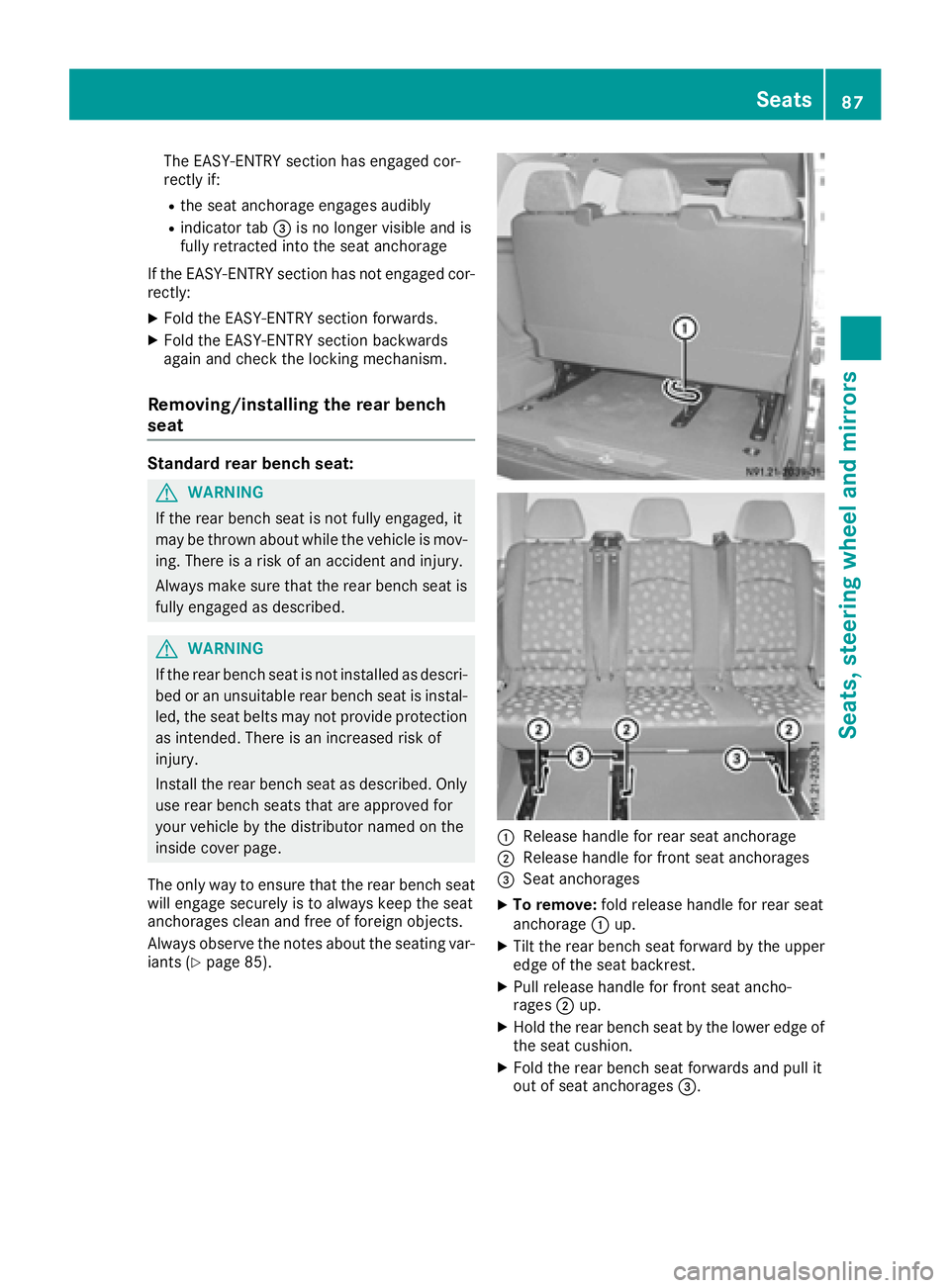
:Release handle for rear seat anchorage
;Release handle for front seat anchorages
=Seat anchorages
XTo remove: fold release handle for rear seat
anchorage :up.
XTilt the rear bench seat forward by the upper
edge of the seat backrest.
XPull release handle for front seat ancho-
rages ;up.
XHold the rear bench seat by the lower edge of
the seat cushion.
XFold the rear bench seat forwards and pull it
out of seat anchorages =.
Seats87
Seats, steering wheel and mirrors
Z
Page 90 of 310
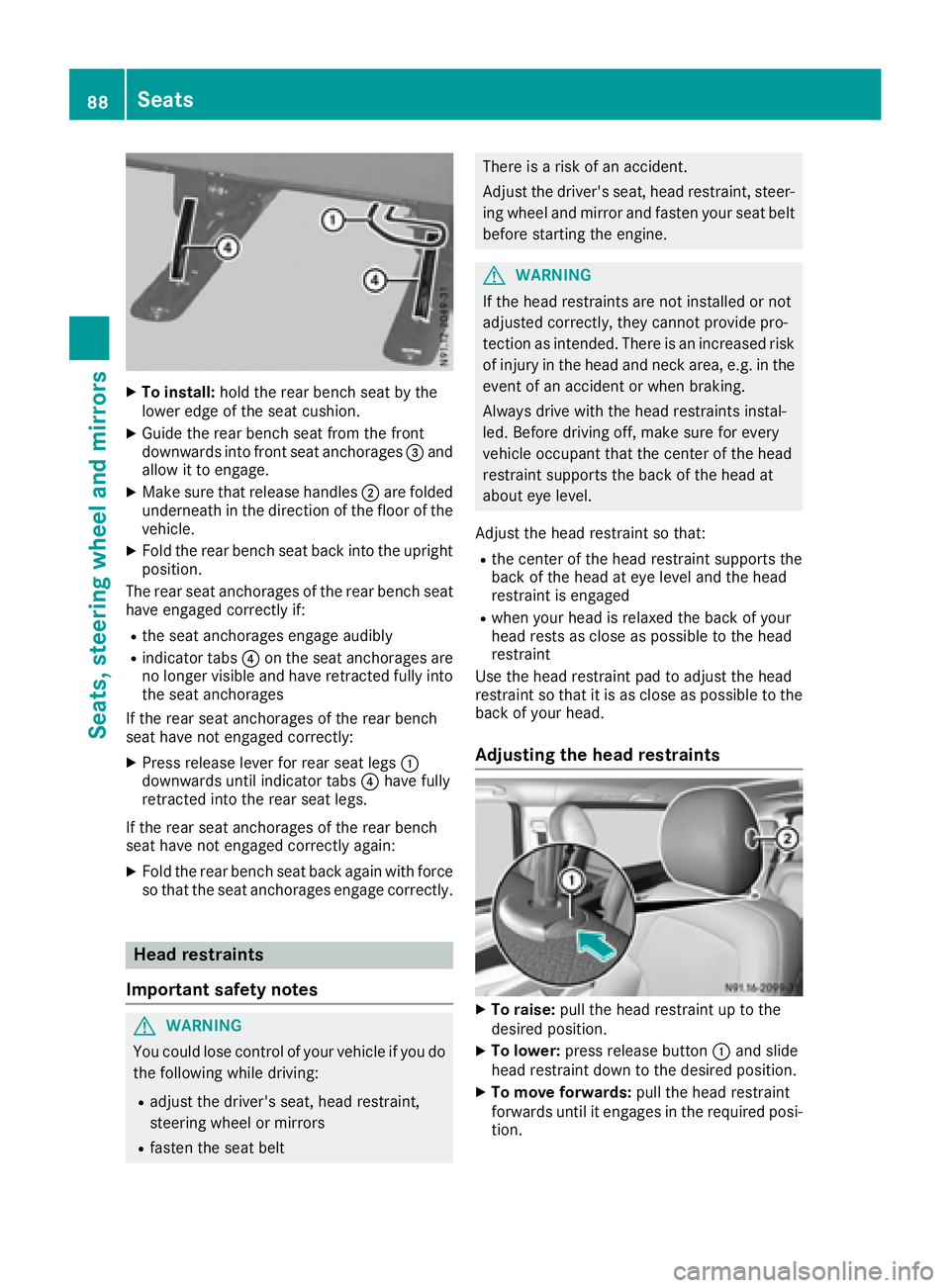
XTo install:holdthe rea rbench sea tbythe
lowe redgeoft he sea tcushion.
XGuid ethe rea rbench sea tfrom the front
downward sinto front sea tanchorages =and
allo wittoe ngage.
XMake sure thatr elease handles;are folded
underneath in the direction of the floor of the
vehicle.
XFol dthe rea rbench sea tbackinto the upright
position.
The rea rseata nchorages of the rea rbench seat
have engaged correctl yif:
Rthe sea tanchorages engage audibly
Rindicator tabs ?on the sea tanchorages are
no longer visible and have retracted fully into
the sea tanchorages
If the rea rseata nchorages of the rea rbench
sea thaven ot engaged correctly:
XPress release lever for rea rseatleg s:
downward suntilindicator tabs ?have fully
retracted into the rea rseatleg s.
If the rea rseata nchorages of the rea rbench
sea thaven ot engaged correctl yagain :
XFoldthe rea rbench sea tbacka gain with force
so thatt he seatanchorages engage correctly.
Hea drestraints
Important safety notes
GWARNING
Yo uc ould lose contro lofyourvehicl eifyoudo
the following whil edriving:
Radjus tthe driver's seat, hea drestraint,
steering whee lormirrors
Rfasten the sea tbelt
There is ariskofana ccident.
Adjust the driver' sseat, hea drestraint, steer-
ing whee land mirror and fasten your sea tbelt
before starting the engine.
GWARNING
If the hea drestraints are not installe dornot
adjusted correctly, they canno tprovid epro-
tection as intended. There is an increased risk
of injury in the hea dand neck area, e.g .inthe
event of an accident or when braking.
Alway sdrive with the hea drestraints instal-
led. Before driving off, make sure for every
vehicl eoccupant thatt he centerofthe head
restraint supports the back of the hea dat
aboute yelevel.
Adjust the hea drestraint so that:
Rthe cente rofthe hea drestraint supports the
back of the hea dateyelevel and the head
restraint is engaged
Rwhen your hea disrelaxe dthe back of your
hea drests as close as possibl etothe head
restraint
Use the hea drestraint pa dtoadjus tthe head
restraint so thatiti sasclose as possibl etothe
back of your head.
Adjustin gthe hea drestraints
XTo raise: pull the hea drestraint up to the
desired position.
XTo lower: press release button :and slide
hea drestraint down to the desired position.
XTo mov eforwards: pull the hea drestraint
forward suntilite ngages in the required posi-
tion.
88Seats
Seats, steering wheel andmirrors
Page 92 of 310
If the on-board voltage is too low, the seat heat-
ing willeither switch itself off prematurely or not
come on at all .Inthis case, too many electrical
consumers are switched on or the battery
charge is not sufficient. The seat heating will
automatically switch back to the current heating
level when enough on-board voltage is available
again.
Steering wheel
GWARNING
You could lose control of you rvehicle if you do
the following whil edriving:
Radjust the driver's seat, head restraint,
steering wheel or mirrors
Rfasten the seat belt
There is arisk of an accident.
Adjust the driver's seat, head restraint, steer-
ing wheel and mirror and fasten you rseat belt
before starting the engine.
GWARNING
If the steering wheel is unlocked whil ethe
vehicle is in motion, it could change position
unexpectedly .This could cause you to lose
control of the vehicle.T here isarisk of an
accident.
Before starting off, make sure the steering
wheel is locked. Never unlock the steering
wheel whil ethe vehicle is in motion.
GWARNING
Children could injure themselves if they
adjust the steering wheel .There is arisk of
injury.
When leaving the vehicle,a lways take the
SmartKey with you and lock the vehicle.N ever
leave childrenu nsupervised in the vehicle.
The steering wheel can still be adjusted if the
key has been removed.
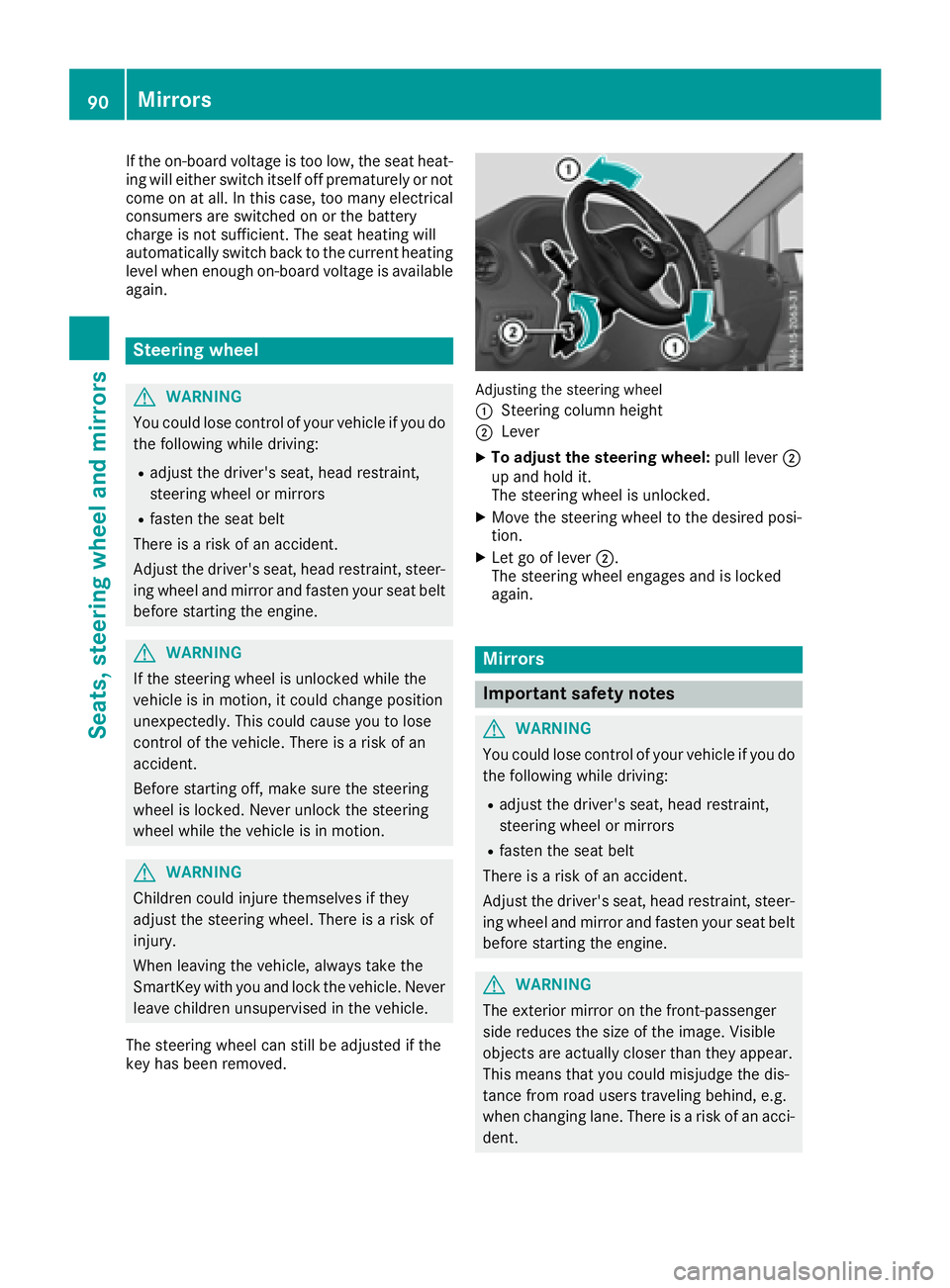
Adjusting the steering wheel
:
Steering column height
;Lever
XTo adjust the steering wheel: pulllever ;
up and hold it.
The steering wheel is unlocked.
XMove the steering wheel to the desiredp osi-
tion.
XLet go of lever ;.
The steering wheel engages and is locked
again.
Mirrors
Important safety notes
GWARNING
You could lose control of you rvehicle if you do
the following whil edriving:
Radjust the driver's seat, head restraint,
steering wheel or mirrors
Rfasten the seat belt
There is arisk of an accident.
Adjust the driver's seat, head restraint, steer-
ing wheel and mirror and fasten you rseat belt
before starting the engine.
GWARNING
The exterior mirror on the front-passenger
side reduces the size of the image .Visible
objects are actually closer than they appear.
This means that you could misjudge the dis-
tance from road users traveling behind, e.g.
when changing lane. There is arisk of an acci-
dent.
90Mirrors
Seats, steerin gwheel and mirrors
Page 123 of 310
XStow luggage itemssecurely. Secure the load
as per the loading guideline s(Ypage 232).
XMake sure that the floormats and carpets are
properly secured so that they canno tslipa nd
obstruct the pedals.
XClose al ldoors.
To start the engine
Important safety notes
GWARNING
Combustio nengines emi tpoisonous exhaust
gases such as carbon monoxide. Inhaling
thes eexhaus tgases lead stopoisoning. There
is ar iskoff atalinjury. Therefore neve rlea ve
the engine running in enclose dspaces with-
outs ufficient ventilation.
!Do not depress the accelerato rwhens tart-
ing the engine.
XBefore starting the engine, make sure that:
Ral lt he doors are closed.
Rallt he vehicl eoccupants are wearing their
sea tbelts correctly.
Rthe parking brake is applied.
iIf yo udepress the brake pedal before start-
ing the engine, the pedal trave lmay be shorter
and pedal resistance higher.
If yo udepres sthe brake pedal agai nafter
starting the engine, pedal trave land resist-
ance will be back to norma lagain.
Automatic transmission
XShif tthe transmissio ntoposition P
(Ypage 126).
The transmissio nposition indicator in the dis-
play shows P.
You can also star tthe engine in neutral N.
To start the engine
XTurn the key to position 3(Ypage 120 )inthe
ignition lock and release it as soo nasthe
engine is running.
Driving off
Automati ctransmission
GWARNING
If the engine speed is above the idling speed
and yo uengage transmission position Dor R,
the vehicl ecould pull away suddenly. There is
ar iskofana ccident.
Whe nengaging transmission position Dor R,
always firmly depress the brake peda land do
not simultaneouslya ccelerate.
!Onlyshift into reverse gear Rwhen the vehi-
cle is stationary .Otherwise, yo ucould dam-
ag et he transmission.
XDepres sthe brake peda land keepi t
depressed.
The parking lock is released.
XShift the transmission to position Dor R.
On vehicles with areverse warning feature ,a
warning signals ounds when reverse gear Ris
engaged to alert othe rroa du sers
(
Ypage 122).
XReleas ethe parking brake (Ypage 133).
The F (only USA) or J(only Canada)
indicator lamp in the instrument cluster goes
out.
XReleas ethe brake pedal.
Hil lstart assist automaticall ymaintains the
brake pressure for abouta nother two sec-
ondsa fterthe brake peda lisreleased .This
makes it possibl etopulla wa yw ithou tthe
vehicl eimmediatelyr olling back
(
Ypage 122).
XCarefull ydepress the accelerato rpedal.
It is onlyp ossibl etos hift the transmission from
po
sition Pto the desired positio nifyoudepress
the brake pedal. Onlyt hen is the parking lock
released .Ifthe brake peda lisnot depressed, the
DIRECT SELECTl ever can stil lbemovedbutthe
parking lock remains engaged.
The vehicl eloc ks centrall yonce yo uhavep ulle d
away .The locking knobs in the doors dro pdown.
Yo uc an open the doors from the insid eatany
time.
Yo uc an also deactivate the automatic locking
feature (
Ypage 72).
Driving121
Driving an dparking
Z