coolant MERCEDES-BENZ METRIS 2016 MY16 Operator’s Manual
[x] Cancel search | Manufacturer: MERCEDES-BENZ, Model Year: 2016, Model line: METRIS, Model: MERCEDES-BENZ METRIS 2016Pages: 310, PDF Size: 7.28 MB
Page 258 of 310
XRemove impurities immediately, wherepos-
sible, whils tavoidin grubbing to ohard.
XSoak insec tremain swithi nsec tremove rand
rinse off th etreated areas afterwards .
XSoak bird droppings wit hwater and rinse off
th et reated areas afterwards .
XRemove coolant, brakefluid ,tre er esin, oils ,
fuel sand greases by rubbing gentl ywitha
cloth soaked in petroleum ether or lighte r
fluid .
XUse tar remove rtoremove tar stains.
XUse silicon eremove rtoremove wax.
Cleaning th ewindows
GWARNIN G
You could become trapped by th ewindshield
wiper siftheys tart moving while cleaning th e
windshield or wiper blades. There is arisko f
injury.
Always switch off th ewindshield wiper sand
th ei gnition before cleaning th ewindshield or
wiper blades.
!Do no tfoldt he windshield wiper saway from
th ew indshield unless th ehoodisc losed. Oth-
erwise, you could damag ethe hood.
!Hold th ewiper arm securel ywhen foldin g
back. The windshield could be damaged if th e
wiper arm smack sagainst it suddenly.
!Do no tuse dry cloths, abrasive products ,
solvents or cleaning agents containing sol-
vents to clean th einside of th ewindows .Do
no ttou ch th einsides of th ewindows wit h
har dobjects ,e.g.ani ce scrape rorring. There
is otherwise ariskofd amaging th ewindows .
!Clean th ewater drainag echannels of th e
windshield and th erear window at regular
intervals. Deposit ssuchasl eaves, petals and
polle nmay under certain circumstances pre -
ven twater from drainin gaway. This can lead
to corrosio ndamag eand damag etoelec-
tronic components.
XClean th einside and outside of th ewindows
wit had amp cloth and acleaning agen ttha tis
recommended and approve dbyMercedes-
Benz.
Exterior
Cleaning th ewheels
!Do no tuse any acidic or alkalin ecleaning
agents .The yc an caus ecorro sionont he
whee lbolt sort heretainer spring sfor th e
wheel-balancin gweights .
!Do notpark th evehicl efor an extended
period straight after cleaning it ,particularly
after having cleane dthe wheels wit hwhee l
cleaner. Whee lcleaners could caus e
increased corrosio nofthebrak ediscsa nd
brak epads/linings. Fo rthisr eason ,you
should driv efor afew minute safter cleaning .
Braking heat sthe brak ediscsa nd th ebrak e
pads/linings, thus dryin gthem. The vehicl e
can then be parked.
If you clean th ewheels wit hapower washer,
observ ethe safet ynotes for th epower washe r
(
Ypage 255). You could otherwise damag ethe
tires .
Cleaning th ewiper blades
GWARNIN G
You could become trapped by th ewindshield
wiper siftheys tart moving while cleaning th e
windshield or wiper blades. There is arisko f
injury.
Always switch off th ewindshield wiper sand
th ei gnition before cleaning th ewindshield or
wiper blades.
!Do no tfoldt he windshield wiper saway from
th ew indshield unless th ehoodisc losed. Oth-
erwise, you could damag ethe hood.
!Do no tpull th ewiper blade .Otherwise, th e
wiper blade could be damaged.
!Do no tclean wiper blade stoo often and do
no trub them to ohard. Otherwise, th egraph-
it ec oating could be damaged. This could
caus ewiper noise.
!Hold th ewiper arm securel ywhen foldin g
back. The windshield could be damaged if th e
wiper arm smack sagainst it suddenly.
XTurn th ekeyto position 0in th eignition loc k
or remove it .
XFold thewindshield wiper arm saway from th e
windshield until you fee lthe me ngage .
256Care
Maintenance and care
Page 287 of 310
GVW (Gross VehicleWeight)
The gross vehicle weight includes the weight of
the vehicle including fuel ,tools, spare wheel,
accessories installed, occupants, luggage and
the drawbar noseweight if applicable. The gross
vehicle weight must never exceed the permissi-
ble gross weight (GVWR) specified on the
B-pilla ronthe driver's side (
Ypage 294).
GVWR (Gross Vehicl eWeight Rating)
The GVWR is the maximu mpermitted gross
weight of the full yladen vehicle (weight of the
vehicle including all accessories, occupants,
fuel ,luggage and the drawbar noseweight if
applicable).T he permissibleg ross weight is
specified on the vehicle identification plate on
the B-pilla ronthe driver's side (
Ypage 294).
Maximum weight of the laden vehicle
The maximu mweight is the sum of:
Rthe curb weight of the vehicle
Rthe weight of the accessories
Rthe loadl imit
Rthe weight of the factory installed optional
equipment
Kilopascal (kPa)
Metric unit for tire pressure. 6.9 kPa are the
equivalent of 1psi.A nother tire pressure unit is
bar. 100 kilopascals (kPa) are the equivalent of
1b ar.
Load index
In addition to the loadb earing index,aload
index can be stamped onto the sidewal lofthe
tire. It specifies the load-bearing capacity of the
tire more precisely.
Curb weight
The weight of avehicle with standard equipment
including the maximu mfilling capacity of fuel,
oil, and coolant. It also includes the air-condi-
tioning system and optional equipment if these
are installed on the vehicle ,but does not include
passengers or luggage.
Maximum tire load
The maximu mtire loadink ilograms or pounds is
the maximu mweight for which atire is
approved.
Maximum permissiblet ire pressure
Maximumpermissiblet ire pressure for one tire.
Maximum load on one tire
Maximumloadono ne tire. This is calculated by
dividing
the maximu maxle loadofo ne axle by
two.
PSI (Pounds per square inch)
Standard unit of measurement for tire pressure.
Aspec tratio
Relationshi pbetwee ntire heighta nd width in
percent.
Tire pressure
Pressure inside the tire applying an outward
force to every square inch of the tire's surface.
Tire pressure is specified in pounds per square
inch (psi), in kilopascal (kPa) or in bar. Tire pres-
sure shoul donly be corrected when the tires are
cold.
Col dtire pressure
The tires are cold:
Rif the vehicle has been parked for at least
three hours withou tdirect sunlight on the
tires, and
Rif the vehicle has not been driven further than
1m ile (1.6 km)
Tire tread
The part of the tire that comes into contact with
the road.
Tire bead
The tire beade nsures that the tire sits securely
on the wheel. There are severals teel wiresinthe
beadtop revent the tire from coming loose from
the whee lrim.
Sidewall
The part of the tire betwee nthe tread and the
tire bead.
Weight of optional extras
The combined weight of those optional extras
that weigh more than the replaced standard
parts and more than 2.3 kg (5 lbs). These
optional extras, such as high-performance
brakes, aroof rack or ahigh-performance bat-
tery, are not included in the curb weight and the weight of the accessories.
What you shouldk now about wheels and tires285
Wheelsand tires
Z
Page 297 of 310
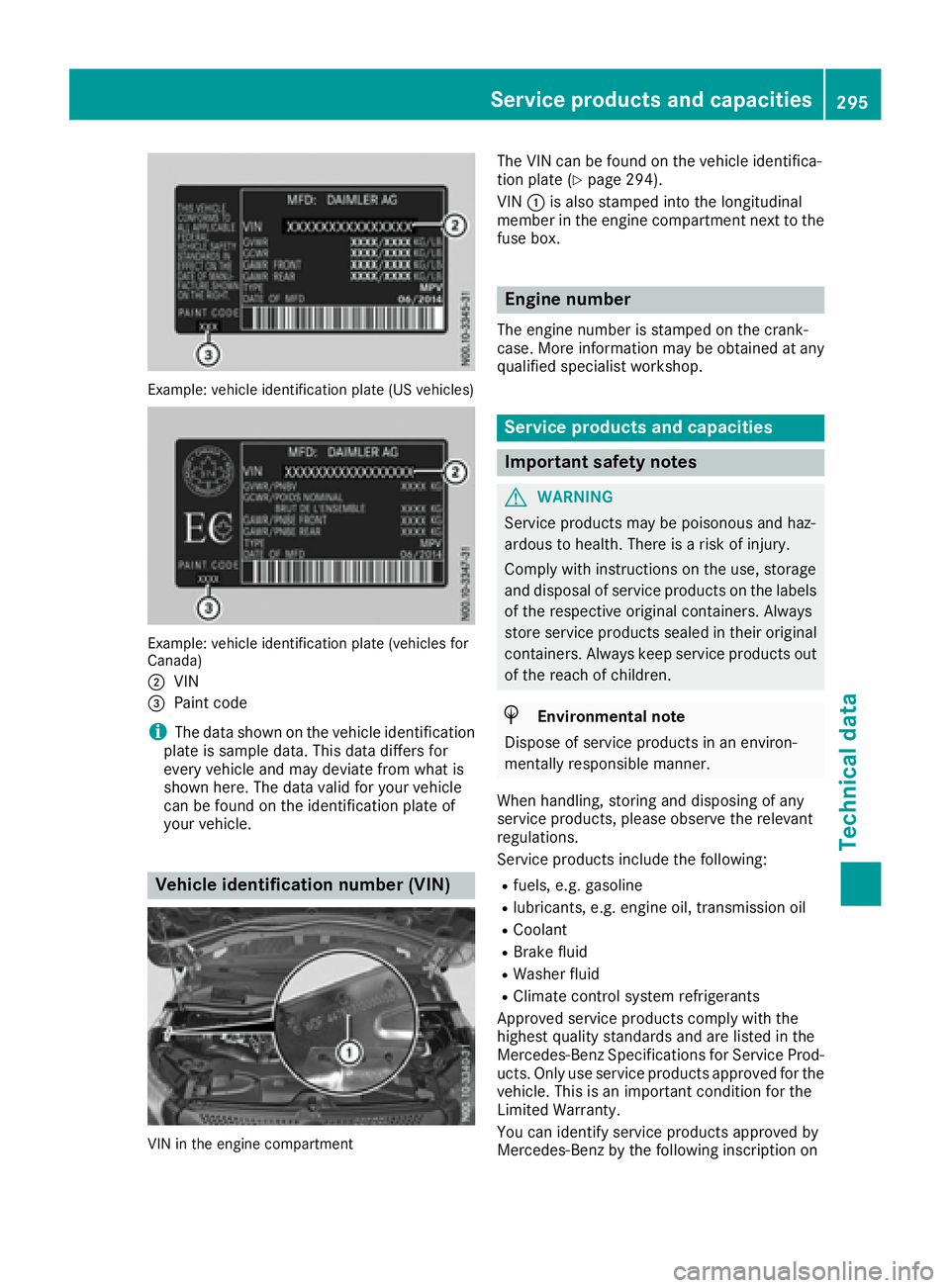
Example: vehicleide ntification plate (US vehicles)
Example: vehicl eide ntification plate (vehicle sfor
Canada)
;
VIN
=Paint code
iThe data shown on the vehicl eide ntification
plate is sampl edata. Thi sdatad iffers for
every vehicl eand mayd eviate from what is
shown here. The data vali dfor your vehicle
can be found on the identificatio nplate of
your vehicle.
Vehicl eidentificatio nnumber (VIN)
VIN in the engine compartment
The VIN can be found on the vehicl eide ntifica-
tio np late (Ypage 294).
VIN :is also stampe dinto the longitudinal
membe rinthe engine compartment next to the
fuse box.
Engine number
The engine numbe risstampe donthe crank-
case. Mor einformatio nmaybe obtained at any
qualified specialist workshop.
Service products and capacities
Important safety notes
GWARNING
Service products maybep oisonousand haz-
ardous to health .There is ariskofi njury.
Compl ywithi nstructions on the use, storage
and disposalofs erviceproducts on the labels
of the respective original containers. Always
stor eservic eproducts seale dintheiroriginal
containers. Alway skeeps ervic eproducts out
of the reach of children.
HEnvironmental note
Dispose of servic eproducts in an environ-
mentall yresponsibl emanner.
Whe nhandling ,storing and disposing of any
servic eproducts, please observe the relevant
regulations.
Service products includ ethe following:
Rfuels, e.g .gasoline
Rlubricants ,e.g.e ngine oil, transmission oil
RCoolant
RBrake fluid
RWashe rfluid
RClimate contro lsystem refrigerants
Approve dservic eproducts comply with the
highest quality standards and ar elisted in the
Mercedes-Benz Specifications for Service Prod-
ucts .Onlyu seservic eproducts approved for the
vehicle. Thi sisanimportant condition for the
Limite dWarranty.
Yo uc an identify servic eproducts approved by
Mercedes-Benz by the following inscription on
Servic eproducts and capacities295
Technica ldata
Z
Page 302 of 310
Rear axle
Serviceproduct: transmission oil
Product name/numberMaintenance
interval
Mobilub eFE 75-W-85
Mobilube FE Plus NG
MB Shee tNo. 235.7—
Further information can be obtained at any
qualified specialist workshop.
Brake fluid
GWARNING
The brake fluid constantly absorbsm oisture
from the air. Thi slowers the boiling point of
the brake fluid .Ifthe boiling point of the brake
fluid is too low, vapor pockets may form in the
brake system when the brakes are applied
hard. Thi swould impai rbraking efficiency.
There is ariskofana ccident.
Yo us houl dhavet he brake fluid renewe dat
the specified intervals.
!Brake fluid corrodes paint, plastic and rub-
ber .Ifp aint, plastic or rubber hasc ome into
contact with brake fluid ,rins ew ithw ater
immediately.
Whe nhandling, storing and disposing of brake
fluid ,pleas eobserve the relevant regulations
and the important safety notes for service prod-
ucts (
Ypage 295).
Overap eriodoft ime,the brake fluid absorbs
moistur efrom the air. Thi sreduce sits boiling
point.
Have the brake fluid renewe devery 2years at a
qualified specialist workshop.
iThere is usuall yanotice in the engine com-
partment to remind yo uwhent he next brake
fluid change is due.
Use only approved brake fluid sthat comply with
the Mercedes-Benz Specifications for Service
Products. Alway scheck for the identification
DOT 4plus.
Information abouta pproved brake fluid scan be
obtained:
Rat any qualified specialist workshop
Ron the Interne tat
http://bevo.merced es-benz.com.
Coolant
Important safety notes
GWARNING
If antifreezec omes intocontac twithh ot com-
ponents in th eenginec ompartment, it may
ignite .Thereisar iskoff irea nd injury.
Let th eenginec ooldown before you add anti-
freeze. Makes ure that antifreezeisn otspilled
next to th efille rneck. Thoroughlyc lean the
antifreezef romc omponents before starting
th ee ngine.
!Takec aren otto spill any coolant on painted
surfaces .You coul dotherwise damag ethe
paintwork.
When handling, storin gand disposingofc oolant
and antifreeze, please observ ethe relevan treg-
ulationsa nd theimportant safety note sfor ser-
vic ep roduct s(
Ypage 295).
Coolan tadditive with corrosion and
antifreeze protection
!Use only approved antifreeze/corrosion
inhibitor that complies withMBS pecification
300Service products and capacities
Technical data
for Service Products, Sheet Number 325.
Using other, non-approved antifreeze/corro-
sion inhibitors may causedamage to the cool-
ant system and reduce the engine' sservice
life
Page 303 of 310
.
The coolant is amixture of water and antifreeze
and corrosion inhibitor. It performs the following
tasks:
Rcorrosion protection
Rantifreeze protection
Rraises the boiling point
When the vehicl eisfirst delivered, it is filled with
ac oolant mixture that ensure sadequate anti-
freeze and corrosion protection. Coolant must
remai ninthe engine cooling system all year
round to ensure anti-corrosion protection and a
higher boiling point, even in countries with high
outside temperatures.
To prevent damage to the engine cooling sys-
tem, use only approved antifreeze and corrosion
inhibitor that complies with the Mercedes-Benz Specifications for Service Products.
Mercedes-Benz recommends an antifreeze and
corrosion inhibitor that meets the requirements
in the Mercedes-Benz Specifications for Service
Products Sheet Number 325.
Check the antifreeze/corrosio ninhibitor con-
centration in the coolant every six months.
The percentag eofcorrosion inhibitor/anti-
freeze additive in the engine cooling system
should:
Rbe at least 50%. This way, the engine cooling
system is protected against freezing downt o
approximately -35 ‡(-37 †).
Rnot exceed 55% (antifreeze protection down
to -49 ‡[-45 †]) .Otherwise, hea twilln ot be
dissipated as effectively.
If ther ehasbeen coolant loss, do not refill only
with water. If the vehicl ehaslost coolant, add
equa lparts water and antifreeze/corrosion
inhibitor. The water used as part of the coolant
mixture must fulfil lcertain requirements; these
are usuall yfulfille dbyd rinking water. If the
water quality is not sufficient, yo umusttrea tthe
water.
Mor einformatio ncan be obtaine datany qual i-
fi eds p
ecialist workshop.
Servic eproduct: coolant
Productn ame/number
Zerex G40-91, The Valvoline Company
MB SheetNo. 325.5
Maintenance interval
Hav ethe coolant renewe devery 15 years .
Capacities
Engine coolin gsystem
CoolantApprox. 11 US qt
(10.4l)
Clim ate control systemr efrigerants
Important safety notes
The climate control system of you rvehicle is fil-
led with the refrigerant R ‑134a.
The warning label for the refrigerant being used
can be found on the radiator cross member.
!Only the refrigerant R ‑134a and the PAG oil
approved by Mercedes-Benz may be used.
The approved PAG oil may not be mixed with
any other PAG oil that is not approved for
R-134a refrigerant. Otherwise ,the climate
control system may be damaged.
Maintenance work such as adding refrigerant or
replacing components may only be carried out
by aq ualified specialist workshop. All applicable
regulations thereto and the SAE standard J639
need to be respected.
All work on the climate control system should
always be carried out at qualified specialist
workshop.
Service products and capacities301
Technical data
Z