ignition MERCEDES-BENZ METRIS 2016 MY16 Operator’s Manual
[x] Cancel search | Manufacturer: MERCEDES-BENZ, Model Year: 2016, Model line: METRIS, Model: MERCEDES-BENZ METRIS 2016Pages: 310, PDF Size: 7.28 MB
Page 105 of 310
stop automatically.The rear window wiper will
only resume wiping againw hen the tailgate and
rear door are closed and you pull awaya gain.
The rear window will no longer be wiped properly
if the wiper blade is worn. This may prevent you
from observing the traffic conditions. Informa-
tion on replacing the wiper blade can be found
under "Replacing wiper blades" (
Ypage 103).
Replacing the wiper blades
Important safety notes
GWARNING
If the windshieldw ipers begin to move while
you are changing the wiper blades, you could be trapped by the wiper arm. There is arisk of
injury.
Always switch off the windshieldw ipers and
ignition before changing the wiper blades.
!Never open the hood/tailgate or rear doors
if aw indshieldw iper arm has been folded
awayf rom the windshield/rear window.
Never fold awindshieldw iper arm without a
wiper blade back onto the windshield/rear
window.
Hold the windshieldw iper arm firmly when
you change the wiper blade.Ify ou release the
windshieldw iper arm without awiper blade
and it falls onto the windshield/rear window,
the windshield/rear window may be damaged
by the force of the impact.
Mercedes-Benz recommends that you have
the wiper bladesc hanged ataqualified spe-
cialist workshop.
!Only hold the wiper blade by the wiper arm.
You could otherwise damage the wiper rub-
ber.
Wiper bladesa re wear parts. The windshieldw ill
no longer be wiped properly if the wiper blades
are worn. This may prevent you from observing
the traffic conditions.
Please observe the service indicator after
changing the wiper bladesoft he windshield
wiper.
Service indicator
Replacement wiper bladesf or the windshield
wiper have aservice indicator on the tip of the
wiper blade.
Depending on the amount of use, the service
indicator will change color from black to yellow.
Change the wiper blade if:
Rthe wiper blade is damaged
Rthe service indicator has turned yellow
In order to activate the service indicator, you
have to remove the protective film
(
Ypage 103).
Windshield wiper
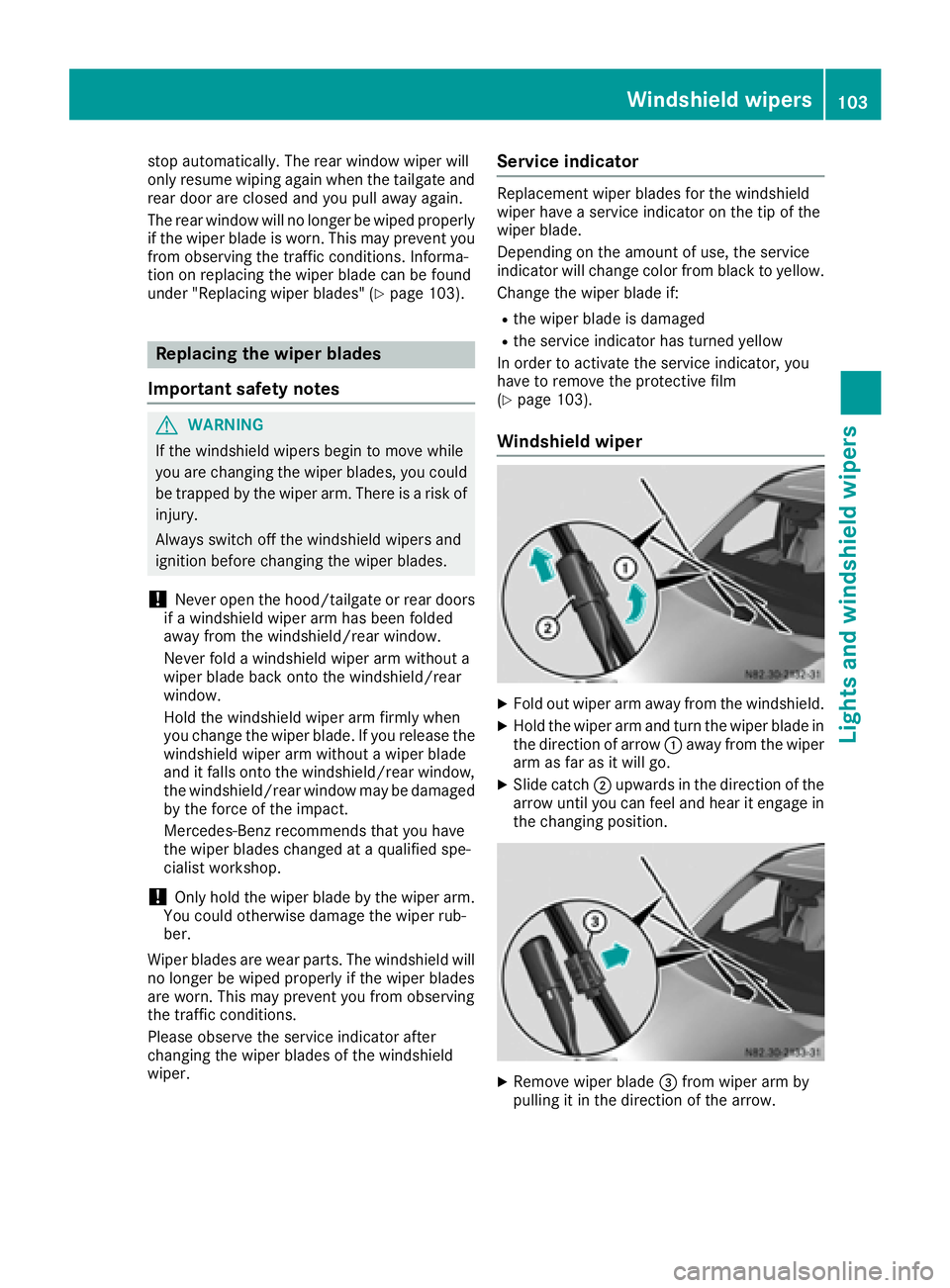
XFold out wiper arm awayf rom the windshield.
XHold the wiper arm and turn the wiper blade in
the direction of arrow:awayf rom the wiper
arm as far as it will go.
XSlide catch ;upwards in the direction of the
arrow until you can feel and hear it engage in
the changing position.
XRemove wiper blade =from wiper arm by
pulling it in the direction of the arrow.
Windshield wipers103
Lights and windshield wipers
Z
Page 108 of 310
Problems with the windshield wipers
ProblemPossible causes/consequences andMSolutions
The windshield wiper
jams.Leaves or snow, for example, may be obstructing the windshield wiper
movement.The wiper motor has switched off.
XStop the vehicle as soon as possible, paying attention to road and
traffic conditions.
XFor safety reasons, you should remove the key from the ignition
lock.
XRemove the cause of the obstruction.
XSwitch on the windshield wipers again.
The windshield wiper
does not move at all.There isamalfunction in the windshield wiper drive.
XSelect another wiper speed on the combination switch.
XHave the windshield wipers checked at aqualified specialist work-
shop.
The windshield washer
fluid from the spray noz-
zles no longer hits the
center of the wind-
shield/rear window.The spray nozzles are misaligned.
XHave the spray nozzles checked at aqualified specialist workshop.
106Windshield wipers
Lights and windshieldw ipers
Page 112 of 310
RIf you wish to use the driver's side settings on
the front-passenger side and, for vehicles
with rear-compartment air conditioning, for
the rear compartment as well,use the "Syn-
chronization" function. The indicator lamp in
the 0 button comes on when the function
is switched on.
RAfter long journeys, you can use the residual
heat of the engine to heat the stationary vehi-
cle. The residual heat function can only be
switched on or off whilet he ignition is
switched off. The indicator lamp in the Ì
button comes on when the function is
switched on.
Approximatel y60minutes after parking the
vehicle,a utomatic climate control can switch on
automatically ,depending on the outsid etem-
perature. The vehicle is then ventilated for about
30 minutes at low fan setting and the automatic
climate control system is dried out.
During automatic engine switch-off, the climate control system only operates at areduced capa-
city. Further information on the automatic
engine switch-off can be found under "ECO
start/stop function" (
Ypage 122).
Information on rear-compartment air
conditioning
Vehicles with TEMPMATIC air-conditioning
system
Switch the rear-compartment air-conditioning
system on and off using the TEMPMATIC air-
conditioning system control panel. When you
switch on the rear-compartment heating, the
settings for temperature ,airflow and air distri-
bution are automatically adopted on the control
panel for the rear-compartment heating.
The indicator lamp in the /button comes on
when the rear-compartment air-conditioning is
switched on (
Ypage 108).
Vehicles with automatic climate control
To operate the rear-compartment air condition-
ing, use the control panel of the automatic cli-
mate control system. When you switch on the
rear-compartment air conditioning, you can set
the temperature and airflow separately on the
control panel .The airflow setting is automati-
cally adopted for the rear-compartment air con-
ditioning. When automatic climate control is in
à automatic mode, the air distribution of the
rear-compartment air conditioning is also auto-
matically adjusted. When you set the temperature and airflow of the
rear-compartment air conditioning, the indica-
tor lamp of the
/button (
Ypage 109)
flashes. When the rear-compartment air condi-
tioning is switched on, the indicator lamp on
the / button lights up.
For optimum climate control, set the tempera-
ture to 72 ‡(22 †) and switch on Ãauto-
matic mode. Only change the temperature in
small increments.
Operating the climate control system
Switching the climate control on/off
Important safety notes
When the climate control is switched off, air
intake and air circulation also stop. Only use this
setting for abrief period.O therwise,the win-
dows could fog up.
Air-conditioning system
XTurn the key to position 2in the ignition lock.
XTo switch on: turn airflow control Aclock-
wise to at least level 1–(Ypage 108).
XTo switch off: turn airflow control Acoun-
ter-clockwise to position 0.
Automatic climate control
XTurn the key to position2in the ignition lock.
XTo switch on: press theÃbutton.
The indicator lamp in the Ãbutton and the
display are switched on. The climate control is
automatically adjusted depending on the set
temperature (
Ypage 112).
or
XPress the Kbutton and set blower setting
1ora bove.
The blower settings are shown in the display
as ab ar graph.
XTo switch off: press theIbutton and,
after reaching the lowest blower speed,p ress
it again.
The control panel display goes off.
Preferably switch on climate control using the
à button.
110Operating the climatec ontrol system
Climate control
Page 117 of 310
Clearing condensation from thewin-
dows
Windows fogged up on th einside
Air-conditioning system
You should only selectt hiss ettin guntil th ewin-
dows are clear again.
XSwitch on th erear window defroste rifnec-
essary (Ypage 115).
XSwitch on climate control (Ypage 110).
XSwitch off air-recirculation mode
(Ypage 115).
XTurn temperatur econtrol :clockwise to a
higher temperatur eand air flow control Ato
ab lower speedb etween3and 6
(
Ypage 108).
XIf possible, only selectt he¯ settingofthe
air distribution (Ypage 113).
Only th eindicator lamp in the ¯button
lightsu p.
XSwitch on th ecoolingw ithair dehumidifica-
tio nfunction (Ypage 111).
XIf th ewindows still fog up, set th eclimate
control functionsasd escribedfor defrosting
of th ewindshield (
Ypage 114).
Automatic climat econtrol
You should only selectt hiss ettin guntil th ewin-
dows are clear again.
XSwitch on th erear window defroste rifnec-
essary (Ypage 115).
XSwitch on climate control (Ypage 110).
XSwitch off air-recirculation mode
(Ypage 115).
XSwitch on th ecoolingw ithair dehumidifica-
tio nfunction (Ypage 111).
XSwitch on automatic mod e(Ypage 112).
XIf thewindows continue to fog up, switch on
th ew indshield defrostin gfunction
(
Ypage 114).
Windows fogged up on th eoutside
You should only selectt hiss ettin guntil the
windshield is clear again.
XSwitch on th ewindshield wipers
(Ypage 101).
XSwitch on climate control (Ypage 110).
XIn warm and damp weather,don otallow cold
air to flow onto th ewindows. Close th eside
air vents if required (
Ypage 116).
Switching th erearw indow defroster
on/off
General notes
The rear window defroste rconsume salot of
power.Y ou should therefor eswitch off th erear
window defroste rassoon as th erear window is
clear.
XTurn th ekeyto position 2in th eignition lock.
XPress the ¤buttonont hecontrol panel.
If th eindicator lamp in the ¤buttonlights
up, th erear window defroste risswitched on.
The rear window defroste rswitches off auto-
maticall yafter afew minutes.
Problemsw ith therearw indow
defroster
The rear window defroste rhas switched off pre-
maturely or canno tbeactivated.
The vehicle starter battery is no tsufficiently
charged.
XSwitch off any consumers that are not
required, e.g .reading lamps ,interiorl ighting
or seat heating.
When th ebattery is sufficiently charged, the
rear window defroste rcan be activated again.
Switching air-recirculation mode
on/off
Important safety notes
You can deactivate th eintake of fresh air if
unpleasanto dorsenterthev ehicle from out-
side. The air inside th evehicle will only be cir-
culated.
When you switch on air-recirculation mode, the
side windows and windows coul dfog up more
quickly, in particular at low outside tempera-
tures. Only switch on air-recirculation mod efor
as hort time.
Operatin gthe climatec ontrol system115
Climate control
Page 118 of 310
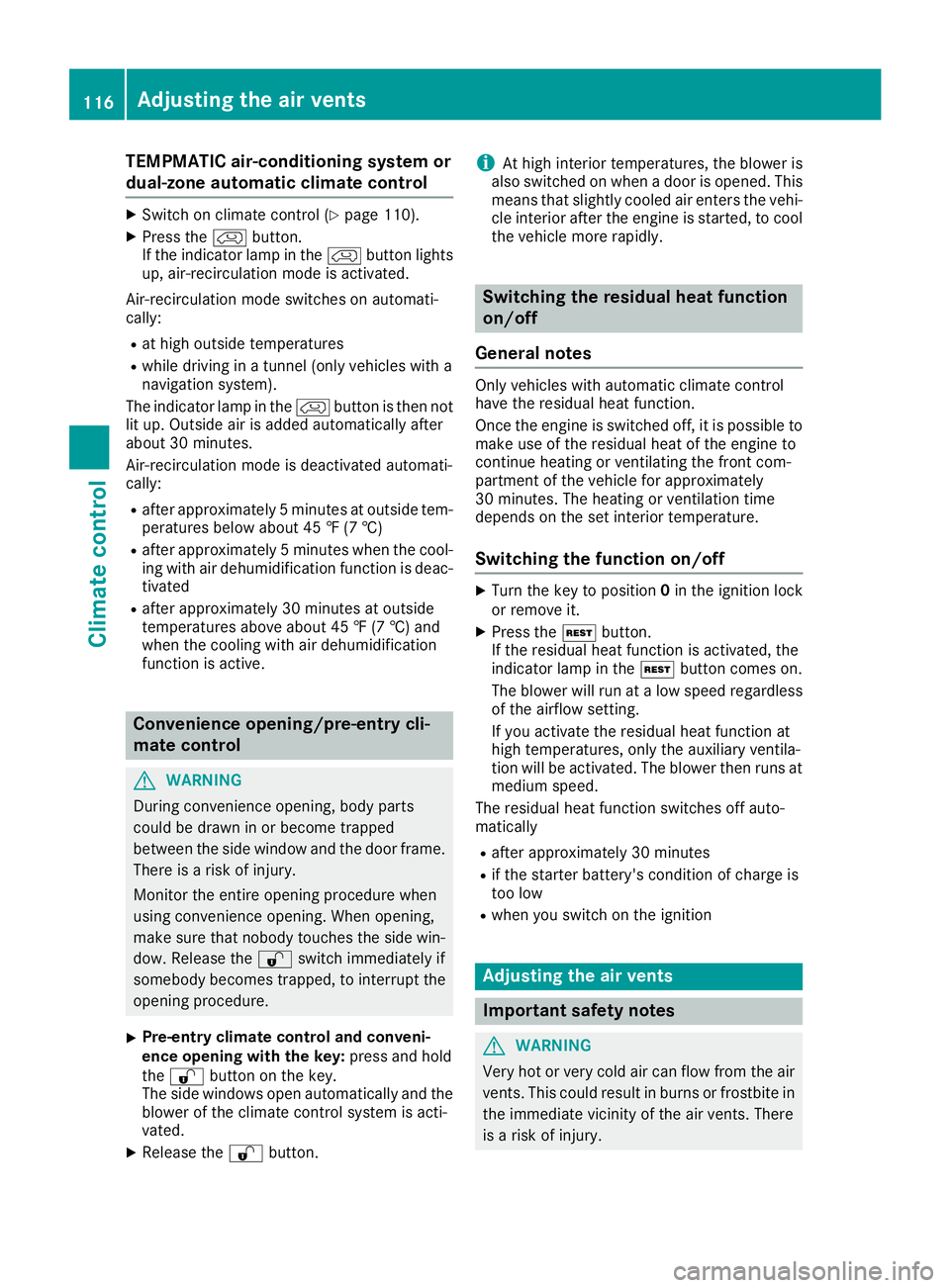
TEMPMATIC air-conditioning system or
dual-zone automatic climate control
XSwitch on climate control(Ypage 110).
XPress thehbutton.
If the indicator lamp in the hbutton lights
up ,air-recirculation mod eisactivated.
Air-recirculation mod eswitches on automati-
cally:
Rat high outside temperatures
Rwhil edrivin ginat unnel(on ly vehicles with a
navigation system).
The indicator lamp in the hbutton is thenn ot
li tu p.Outside ai risadded automaticall yafter
abou t30m inutes.
Air-recirculation mod eisdeactivated automati-
cally:
Rafter approximately 5minute satoutside tem-
peratures belo wabout 45‡(7† )
Rafter approximately 5minute sw hen the cool-
ing with air dehumidification function is deac-
tivated
Rafter approximately 30 minutes at outside
temperatures above about 45 ‡(7†)and
when the cooling with air dehumidification
function is active.
Convenienceo pening/pre-entryc li-
matec ontrol
GWARNING
During convenience opening, body parts
could be drawn in or become trapped
between the side window and the door frame.
There is arisk of injury.
Monitor the entire opening procedure when
using convenience opening. When opening,
make sure that nobody touches the side win- dow. Release the %switch immediately if
somebody becomes trapped, to interrupt the
opening procedure.
XPre-entry climate control and conveni-
ence opening with the key: press and hold
the % button on the key.
The side windows open automatically and the
blower of the climate control system is acti-
vated.
XRelease the %button.
iAt high interior temperatures, the blower is
also switched on when adoor is opened. This
means that slightly cooled air enters the vehi-
cle interior after the engine is started, to cool
the vehicle more rapidly.
Switching the residual heat function
on/off
General notes
Only vehicles with automatic climate control
have the residual heat function.
Once the engine is switched off, it is possible to
make use of the residual heat of the engine to
continue heating or ventilating the front com-
partment of the vehicle for approximately
30 minutes. The heating or ventilation time
depends on the set interior temperature.
Switching the function on/off
XTurn the key to position 0in the ignition lock
or remove it.
XPress the Ìbutton.
If the residual heat function is activated, the
indicator lamp in the Ìbutton comes on.
The blower will run at alow speed regardless
of the airflow setting.
If you activate the residual heat function at
high temperatures, only the auxiliary ventila-
tion will be activated. The blower then runs at
medium speed.
The residual heat function switches off auto-
matically
Rafter approximately 30 minutes
Rif the starter battery's condition of charge is
too low
Rwhen you switch on the ignition
Adjusting the air vents
Important safety notes
GWARNING
Very hot or very cold air can flow from the air
vents .This could result in burns or frostbite in
the immediate vicinity of the air vents.T here
is ar isk of injury.
116Adjusting the air vents
Climatec ontrol
Page 121 of 310
Useful information
This Operator's Manual describes all models as
well as standard and optional equipment of your
vehicle that were available at the time of going
to print.Country-specific variation sare possi-
ble. Note that your vehicle may not be equipped
with all of the described functions. This also
applies to system sand function srelevantt o
safety.
Read the information on qualified specialist
workshops (
Ypage 29).
Breaking-in notes
Important safetyn otes
In certain drivingand drivingsafetysystems, the
sensors adjust automatically while acertain dis-
tance is being driven after the vehicle has been
delivered or after repairs. Full system effective- ness is not reached until the end of this teach-in
procedure.
New or replaced brake pads and brake discs
only reach their optimal brakin geffecta fter a
few hundred kilometers of driving. Until then,
compensat efor this by applying greater forcet o
the brake pedal.
The first 1000 miles (1500 km)
For the servicel ife and economy of your vehicle
it is crucial that you break in the engin ewith due
care.
RTherefore, protect the engin efor the first
1000m iles (1500k m) by drivingatv arying
vehicle and engin espeeds.
RAvoid overstraining the vehicle and high
engin espeeds during this period, e.g. driving
at full throttle. Do not exceed Øof the max-
imum speed for each gear.
RDo not change down agear manually in order
to brake.
RTry to avoid depressingt he accelerator pedal
beyond the point of resistance (kickdown).
After 1000m iles (1500km), you can increase
the engin espeed gradually and accelerate the
vehicle to full speed.
iYou should also observet hesenotes on
breaking-in if the engin eorparts of the drive
train on your vehicle have been replaced.
Driving
Important safetyn otes
GWARNING
Flammable materials introduced through
environmental influence or by animals can
ignit eifinc ontact with the exhaust system or
parts of the engin ethat heat up. There is arisk
of fire.
Carry out regular checks to make sure that
ther eare no flammable foreign materials in
the engin ecompartmen torinthe exhaust
system.
GWARNING
If you switc hoff the ignition while driving,
safety-relevant function sare only available
with limitations, or not at all. This could affect, for example, the power steering and the brake
boosting effect. You will require considerably
more efforttos teer and brake. There is arisk
of an accident.
Do not switc hoff the ignition while driving.
GWARNING
If the parkin gbrake has not been fully
released when driving, the parkin gbrake can:
Roverheat and cause afire
Rlose its hold function.
There is arisk of fire and an accident. Release
the parkin gbrake fully before drivingo ff.
!Warm up the enginequickly. Do not use the
engine's full performanc euntil it has reached
operatin gtemperature.
Only shift the automatic transmission to the
desired drive position when the vehicle is sta-
tionary.
Where possible, avoid spinning the drive
wheels when pulling away on slippery roads.
You could otherwise damage the drive train.
Driving119
Driving and parking
Z
Page 122 of 310
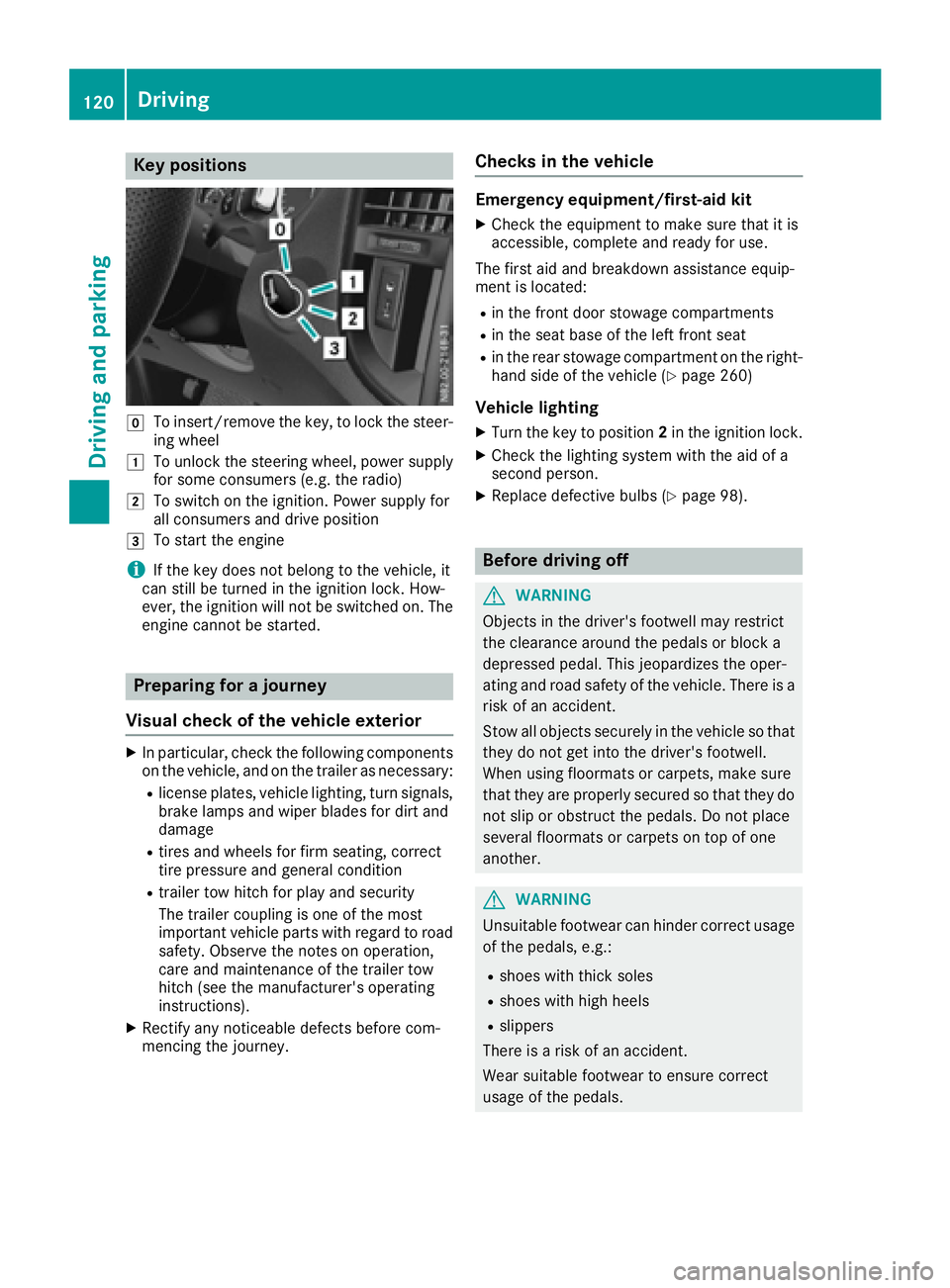
Key positions
gTo insert/remove thekey,tol oc kt he steer -
ing whee l
1To unlockthe steering wheel, powe rsupply
for som econsum ers( e.g. th eradio)
2To switch on th eignition .Powe rsupply for
all consumer sand drive position
3To start th eengine
iIf th ekeydoes no tbelong to th evehicle, it
can still be turne dintheignition lock. How-
ever, th eignition will no tbeswitched on .The
engin ecanno tbes tarted.
Prepa ring for ajourne y
Visua lcheck ofthev ehicle exteri or
XIn particular, chec kthe followin gcom ponent s
on th evehicle, and on th etrailer as necessary:
Rlicense plates, vehicl elighting ,tur ns ignals,
brak elamp sand wiper blade sfor dir tand
damag e
Rtires and wheels for fir mseating ,correct
tire pressur eand general condition
Rtrailer to whitch for play and securit y
The trailer couplin gisoneof th emost
important vehicl epartsw ithr egard to roa d
safety. Observ ethe note sono peration ,
car eand maintenance of th etrailer to w
hitch (see th emanufacturer' soperating
instructions).
XRectify any noticeable defects before com-
mencin gthe journey.
Check sinthevehicle
Emergency equipment/first-aid kit
XChec kthe equipmen ttomakes uret hatiti s
accessible, complet eand read yfor use.
The first aid and breakdown assistanc eequip -
men tislocated:
Rin th efront door stowage compartments
Rin theseat base of th eleftf ront seat
Rin therear stowage compartmen tontheright -
han dside of th evehicl e(Ypage 260)
Vehicle lighting
XTurn th ekeyto position 2in th eignition lock.
XChec kthe lighting system wit hthe aid of a
secon dperson .
XReplac edefective bulbs (Ypage 98).
Before drivingo ff
GWARNING
Objects in th edriver's footwell may restrict
th ec learance around th epedal sorb locka
depressed pedal .This jeopardizes th eoper -
ating and roa dsafet yoft hevehicle. There is a
ris kofana ccident.
Stow all objects securel yint he vehicl esothat
they do no tget int othe driver's footwell.
Whe nusingfloormats or carpets, mak esure
that they are properly secured so that they do no tslip or obstruct th epedals. Do no tplac e
several floormats or carpet sontopof on e
another.
GWARNIN G
Unsuitable footwear can hinder correc tusage
of th epedals, e.g. :
Rshoes withthick sole s
Rshoes wit hhigh heel s
Rslippers
There is ariskofana ccident.
Wear suitable footwear to ensur ecorrect
usage of th epedals.
120Driving
Driving and parking
Page 123 of 310
XStow luggage itemssecurely. Secure the load
as per the loading guideline s(Ypage 232).
XMake sure that the floormats and carpets are
properly secured so that they canno tslipa nd
obstruct the pedals.
XClose al ldoors.
To start the engine
Important safety notes
GWARNING
Combustio nengines emi tpoisonous exhaust
gases such as carbon monoxide. Inhaling
thes eexhaus tgases lead stopoisoning. There
is ar iskoff atalinjury. Therefore neve rlea ve
the engine running in enclose dspaces with-
outs ufficient ventilation.
!Do not depress the accelerato rwhens tart-
ing the engine.
XBefore starting the engine, make sure that:
Ral lt he doors are closed.
Rallt he vehicl eoccupants are wearing their
sea tbelts correctly.
Rthe parking brake is applied.
iIf yo udepress the brake pedal before start-
ing the engine, the pedal trave lmay be shorter
and pedal resistance higher.
If yo udepres sthe brake pedal agai nafter
starting the engine, pedal trave land resist-
ance will be back to norma lagain.
Automatic transmission
XShif tthe transmissio ntoposition P
(Ypage 126).
The transmissio nposition indicator in the dis-
play shows P.
You can also star tthe engine in neutral N.
To start the engine
XTurn the key to position 3(Ypage 120 )inthe
ignition lock and release it as soo nasthe
engine is running.
Driving off
Automati ctransmission
GWARNING
If the engine speed is above the idling speed
and yo uengage transmission position Dor R,
the vehicl ecould pull away suddenly. There is
ar iskofana ccident.
Whe nengaging transmission position Dor R,
always firmly depress the brake peda land do
not simultaneouslya ccelerate.
!Onlyshift into reverse gear Rwhen the vehi-
cle is stationary .Otherwise, yo ucould dam-
ag et he transmission.
XDepres sthe brake peda land keepi t
depressed.
The parking lock is released.
XShift the transmission to position Dor R.
On vehicles with areverse warning feature ,a
warning signals ounds when reverse gear Ris
engaged to alert othe rroa du sers
(
Ypage 122).
XReleas ethe parking brake (Ypage 133).
The F (only USA) or J(only Canada)
indicator lamp in the instrument cluster goes
out.
XReleas ethe brake pedal.
Hil lstart assist automaticall ymaintains the
brake pressure for abouta nother two sec-
ondsa fterthe brake peda lisreleased .This
makes it possibl etopulla wa yw ithou tthe
vehicl eimmediatelyr olling back
(
Ypage 122).
XCarefull ydepress the accelerato rpedal.
It is onlyp ossibl etos hift the transmission from
po
sition Pto the desired positio nifyoudepress
the brake pedal. Onlyt hen is the parking lock
released .Ifthe brake peda lisnot depressed, the
DIRECT SELECTl ever can stil lbemovedbutthe
parking lock remains engaged.
The vehicl eloc ks centrall yonce yo uhavep ulle d
away .The locking knobs in the doors dro pdown.
Yo uc an open the doors from the insid eatany
time.
Yo uc an also deactivate the automatic locking
feature (
Ypage 72).
Driving121
Driving an dparking
Z
Page 125 of 310
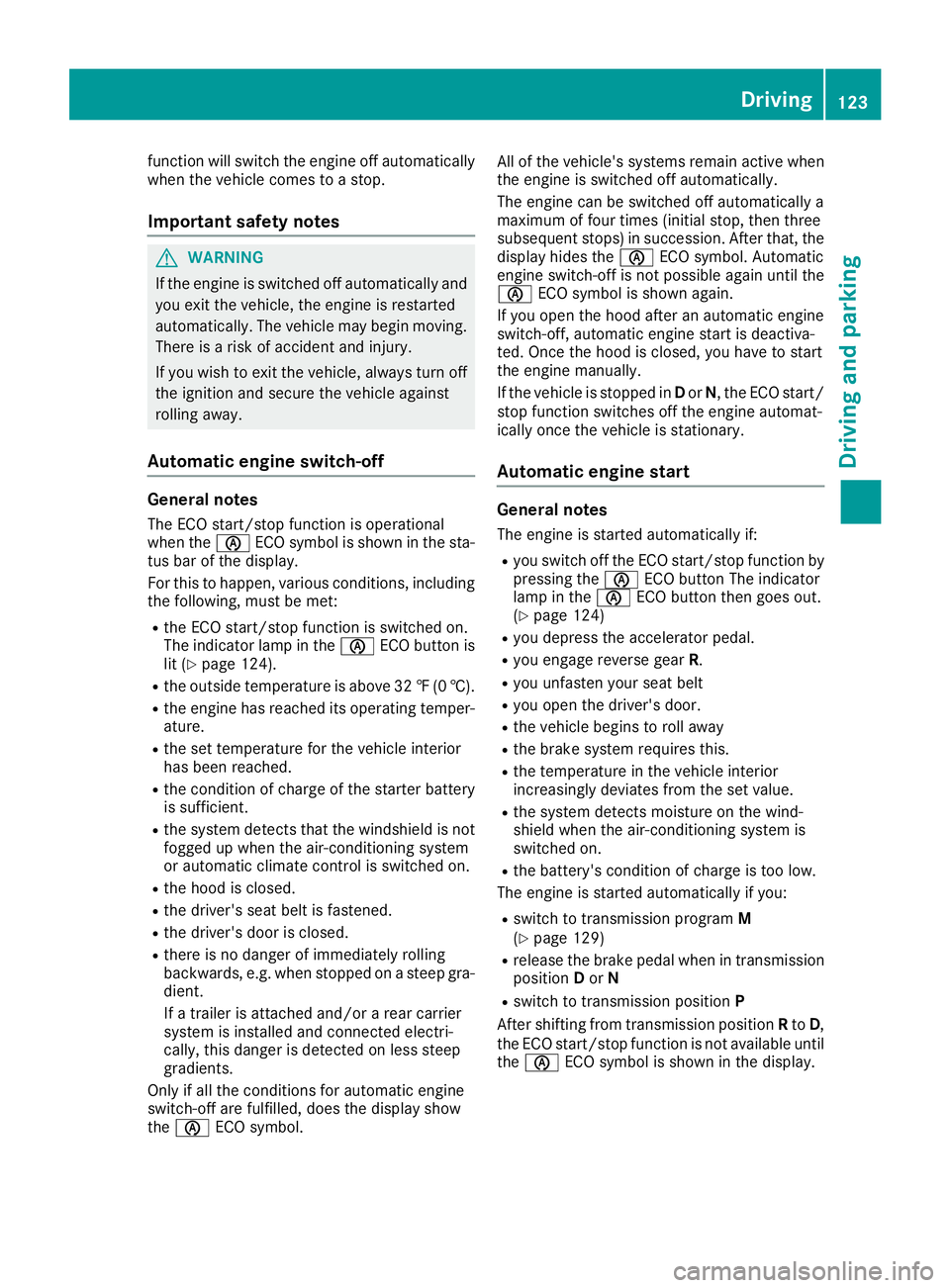
function willswitch the engine off automatically
when the vehicl ecomes to astop.
Important safety notes
GWARNING
If the engine is switched off automatically and
you exit the vehicle, the engine is restarted
automatically .The vehicl emay beginm oving.
There is arisk of accident and injury.
If you wis htoexit the vehicle, alway sturn off
the ignition and secure the vehicl eagainst
rolling away.
Automatic engine switch-off
General notes
The ECO start/stop function is operational
when the èECO symbol is shownint he sta-
tus bar of the display.
For this to happen, various conditions, including the following, must be met:
Rthe ECO start/stop function is switched on.
The indicator lam pintheè ECO button is
lit (
Ypag e124).
Rthe outside temperature is above 32 ‡(0†).
Rthe engine has reached its operating temper-
ature.
Rthe set temperature for the vehicle interior
has beenr eached.
Rthe conditio nofcharge of the starter battery
is sufficient.
Rthe system detects that the windshield is not
foggedupw hent he air-conditioning system
or automatic climate control is switched on.
Rthe hood is closed.
Rthe driver's seatb eltisfastened.
Rthe driver's door is closed.
Rthere is no dange rofimmediately rolling
backwards ,e.g. whe nstoppedonas teep gra-
dient.
If at railer is attache dand/or arear carrier
system is installed and connected electri-
cally, this dange risdetected on less steep
gradients.
Only if al lthe conditions for automatic engine
switch-off are fulfilled, does the displays how
the è ECO symbol. All of the vehicle's systems remai
nactive when
the engine is switched off automatically.
The engine can be switched off automatically a
maximu moffour times (initial stop, then three
subsequent stops) in succession. After that, the
displayh ides theèECO symbol. Automatic
engine switch-off is not possibl eagain until the
è ECO symbol is showna gain.
If you open the hood after an automatic engine
switch-off, automatic engine start is deactiva-
ted. Once the hood is closed, you have to start
the engine manually.
If the vehicle is stoppedi
nD or N,t he
ECO start/
stop function switches off the engine automat-
ically once the vehicle is stationary.
Automatic engine start
General notes
The engine is started automatically if:
Ryou switch off the ECO start/stop function by pressing the èECO button The indicator
lamp in the èECO button then goes out.
(
Ypag e124)
Ryou depress the accelerator pedal.
Ryou engag ereverse gear R.
Ryou unfasten you rseatb elt
Ryou open the driver's door.
Rthe vehicle begins to roll away
Rthe brake system requires this.
Rthe temperature in the vehicle interior
increasingl ydeviates from the set value.
Rthe system detects moisture on the wind-
shield whe nthe air-conditioning system is
switched on.
Rthe battery's conditio nofcharge is too low.
The engine is started automatically if you:
Rswitch to transmission program M
(Ypag e129)
Rrelease the brake pedal whe nintransmission
position Dor N
Rswitch to transmission position P
After shifting from transmission position Rto D,
the ECO start/stop function is not available until
the è ECO symbol is shownint he display.
Driving123
Driving and parking
Z
Page 127 of 310
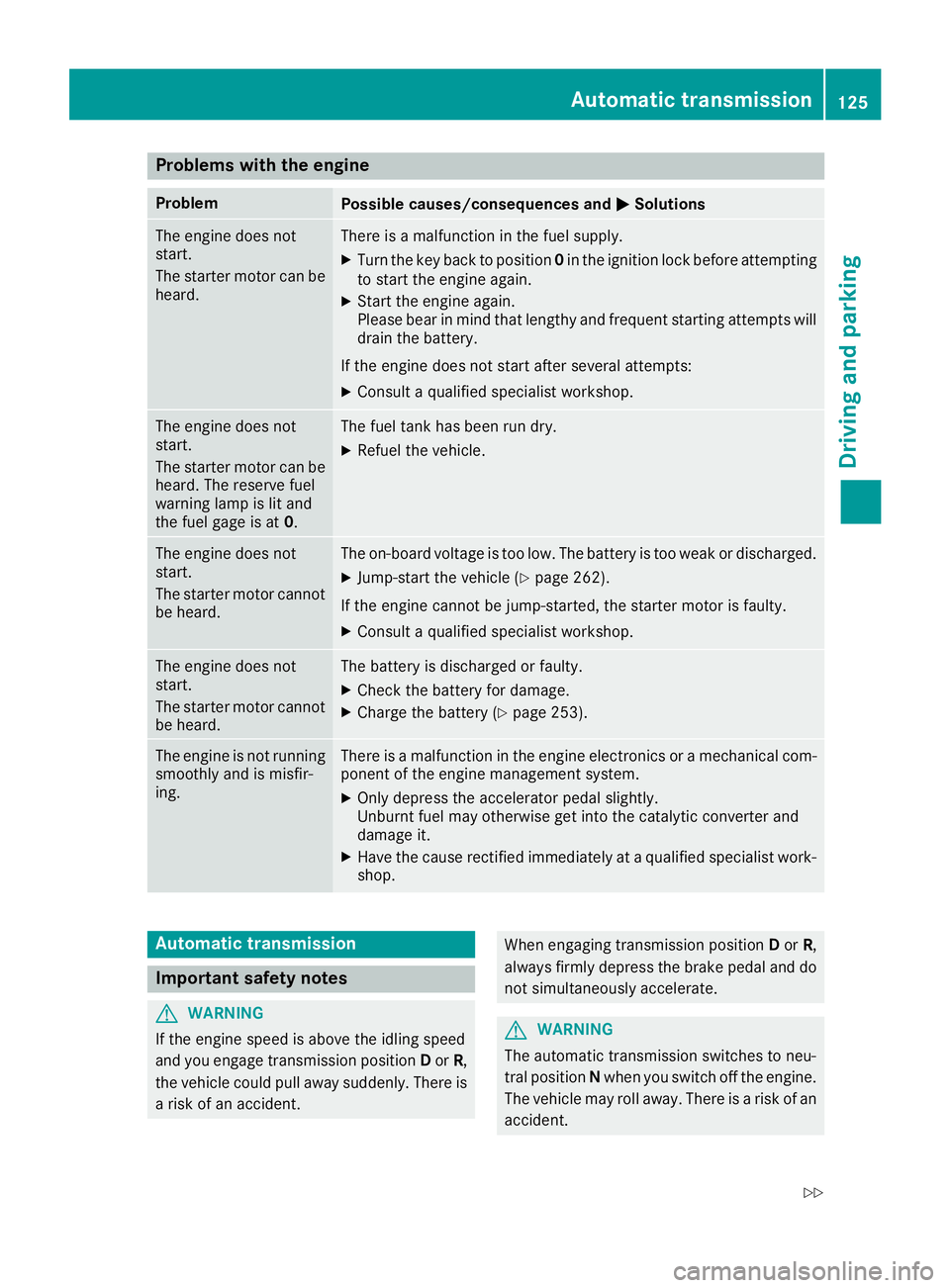
Problems with the engine
ProblemPossible causes/consequences andMSolutions
The engine does not
start.
The starter motor can be
heard.There isamalfunction in the fuel supply.
XTurn the key back to position 0in the ignition lock before attempting
to start the engine again.
XStart the engine again.
Please bear in mind that lengthy and frequent startin gattempt swill
drain the battery.
If the engine does not start after several attempts:
XConsult aqualified specialist workshop.
The engine does not
start.
The starter motor can be
heard. The reserve fuel
warning lamp is lit and
the fuel gage is at 0.The fuel tank has been run dry.
XRefuel the vehicle.
The engine does not
start.
The starter motor cannot
be heard.The on-board voltage is too low. The battery is too weak or discharged.
XJump-start the vehicle (Ypage 262).
If the engine cannot be jump-started, the starter motor is faulty.
XConsult aqualified specialist workshop.
The engine does not
start.
The starter motor cannot
be heard.The battery is discharged or faulty.
XCheck the battery for damage.
XCharge the battery (Ypage 253).
The engine is not running
smoothly and is misfir-
ing.There is amalfunction in the engine electronics or amechanical com-
ponent of the engine management system.
XOnly depress the accelerator pedal slightly.
Unburnt fuel may otherwise get into the catalytic converter and
damage it.
XHave the cause rectified immediately at aqualified specialist work-
shop.
Automatic transmission
Important safety notes
GWARNING
If the engine speed is above the idling speed
and you engage transmission position Dor R,
the vehicle could pull away suddenly. There is
ar isk of an accident.
When engaging transmission position Dor R,
always firmly depress the brake pedal and do
not simultaneously accelerate.
GWARNING
The automatic transmission switches to neu-
tral position Nwhen you switch off the engine.
The vehicle may roll away.T here isarisk of an
accident.
Automatic transmission125
Driving and parking
Z