tailgate MERCEDES-BENZ METRIS 2016 MY16 Operator’s Manual
[x] Cancel search | Manufacturer: MERCEDES-BENZ, Model Year: 2016, Model line: METRIS, Model: MERCEDES-BENZ METRIS 2016Pages: 310, PDF Size: 7.28 MB
Page 235 of 310
In the event of an accident, haveadamaged
cargo compartment floor or loading area ,the
cargo tie-down rings and the tie down checked
at as pecialist workshop. Otherwise ,the load
may not be correctly secured the next time any-
thing is stowed.
Even if you follow all loading guidelines, the load
increases the risk of injury in the event of an
accident. Observe the information in the "Secur- ing aload "(
Ypage 234) and "Loa ddistribution"
(Ypage 233) sections.
You wil lfind information abou tthe maximum
roof load and maximum tailgate load in the
"Cargo tie-down points and carrier systems"
section (
Ypage 304). You wil lfind information
abou troof carriers under "Carrier systems"
(
Ypage 238).
Before loading
!
The anti-slip mats cannot be used for secur-
ing goods and must be replaced when they
show signs of:
RPermanent deformatio nand crushing
RCrack formation
RCuts
XTire pressure: check the tire pressure and
correct if necessary (Ypage 270).
XCargo compartment floor: clean the cargo
compartment floor.
The cargo compartment floor must be free
from oil and dust, dry and swept clean to pre-
vent the load from slipping.
XPlace non-slip mats (anti-slip mats) on the
cargo compartment floor if necessary.
During loading
XObserve the gross axle weight rating and per-
missible gross vehicle weight for you rvehicle.
Take into account that you rvehicle's curb
weight is increased if accessorie soroptional equipment are installed. The maximum pay-
load is thus reduced.
XObserve the notes on load distribution
(Ypage 233).
The overal lcenter of gravity of the load should
always be as low as possible, centered and
betwee nthe axles near the rear axle.
XObserve the legalr equirements of the country
in which you are currently driving.
Checks after loading
GWARNING
Combustion engines emit poisonous exhaust
gases such as carbon monoxide. If the tail-
gate/rear door is open when the engine is
running, particularly if the vehicle is moving,
exhaust fumes could enter the passenger
compartment. There is arisk of poisoning.
Turn off the engine before opening the tail-
gate/rear door. Never drive off with the tail-
gate/rear door open.
XSecuring luggage/loads: make sure that
the luggage and/or load is secure before
every journey and at regular intervals during a
long journey, and correct it if necessary.
XDoors/tailgate: close the sliding doors and
tailgate/door.
XTire pressure: adjust the tire pressure
according to the vehicle load (Ypage 270).
XDrivin gstyle: adapt you rdriving style
according to the vehicle load.
Load distribution
General notes
!
Excessive load sonindividual points of the
cargo floor or on the load surface impair vehi-
cle handling characteristics and could cause
damage to the floor covering.
The overal lcenter of gravity of the load should
always be as low as possible, centered and
betwee nthe axles near the rear axle.
Load distribution233
Transporting loads
Z
Page 241 of 310
You will findinformation about the maximum
roof load and maximum tailgat eload under
"Cargo tie-down point sand carrier systems"
(
Ypage 304).
!Make sure that:
Rthe screws of the roof carrier are tightened
to am aximum torque of 7.4l b-ft(10 Nm) in
the threaded hole sprovided and
Rthere is aminimu mboltp enetration of
4t urns.
Only instal lroof carriers and rear racks that
have beena pproved or recommended for
Mercedes-Benz vehicles. This wil lhelpa void
damage to the vehicle.
You can instal laroof carrie ronthe roof and, for
example, arear-mounted cycle rack on the tail-
gate.
Install the protective caps on the securing
thread safter you have removedt he roof carrier.
If you have installed arear rack on the tailgate,
the additiona lweight reduces the assistance
provided by the gas pressure springs whe nthe
tailgate is opened. You wil lthen need more force
to open the tailgate. At low outside tempera-
tures below freezing you wil lneed to provide
extra support for the tailgate to prevent it from
sinking unintentionally.
Carrier systems239
Transporting loads
Z
Page 259 of 310
XCarefullyclean th ewiper blades wit hadamp
cloth.
XFol db ack th ewiper armsbefore switching on
th ei gnition.
Cleaning th eexterior lighting
!Only use cleanin gagents or cleanin gcloths
whic hare suitable for plasticlight lenses.
Unsuitable cleaningagents or cleanin gcloths
could scratch or damag ethe plastic light len-
ses.
XClean th eplastic coversoftheexterior light-
ing withad amp sponge and amildcleaning
agent, e.g .Mercedes-Ben zcar shampoo, or
wit hc leanin gcloths.
Cleaning th esensors
!Do no tuse dry, coarse or hard cloth sand do
no tscrub. You willotherwise scratch or dam-
age th esensors.
If you clean th esensorsw ithap ower washer
or steam cleaner, observ ethe information
provide dbythemanufacturer regardin gthe
dist ancetobem aintained between th evehi-
cle and th enozzle of thepower washer.
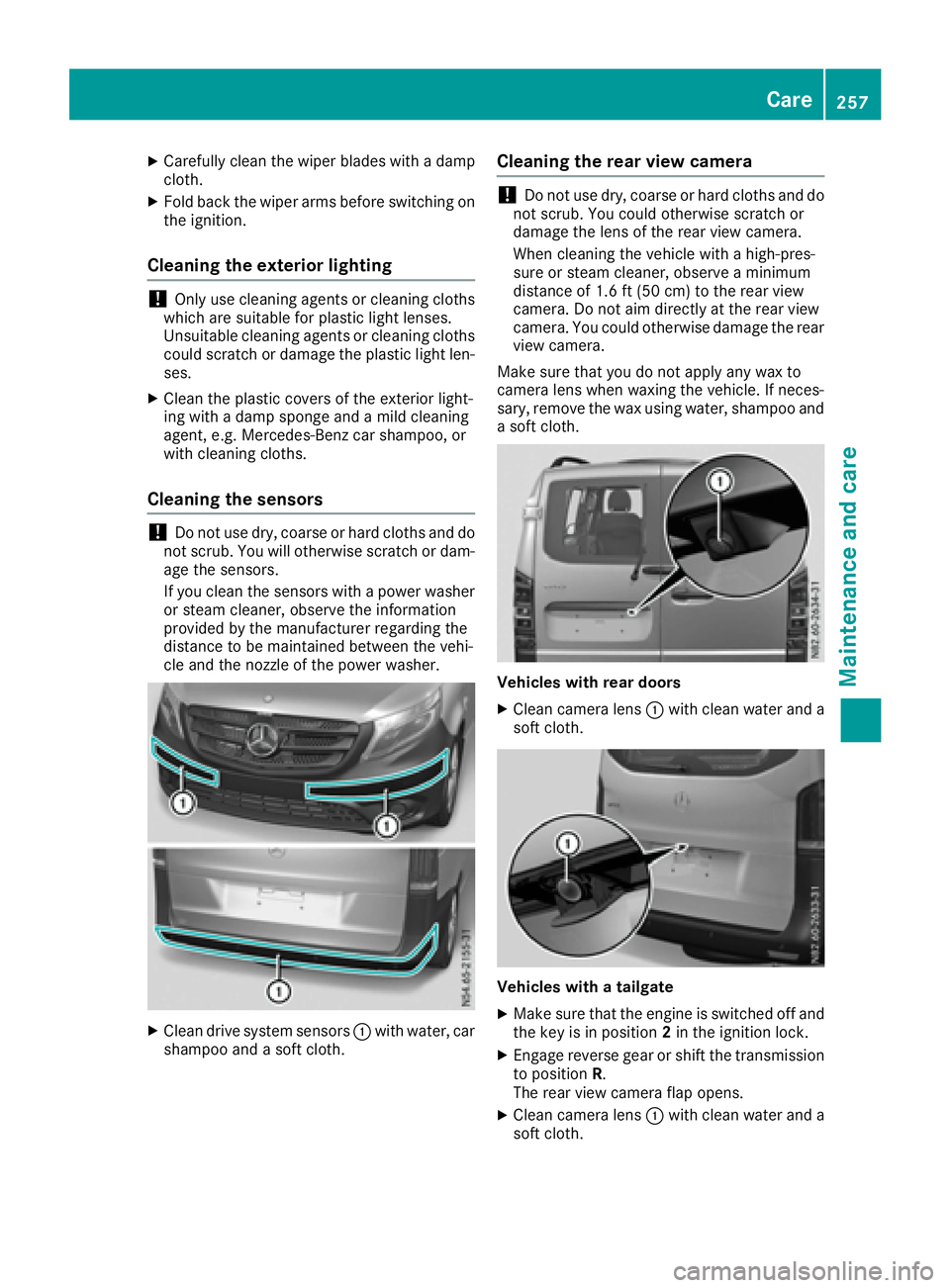
XClean drivesystem sensors :withw ater, car
shampoo and asoftc loth.
Cleaning th erearv iew camera
!Do no tuse dry, coarse or hard cloth sand do
no tscrub. You could otherwise scratch or
damag ethe lensoft herear view camera.
When cleanin gthe vehicle withah igh-pres-
sure or steam cleaner, observ eaminimum
distanc eof1.6ft (50 cm )totherear view
camera. Do no taim directly at th erear view
camera. You could otherwise damag ethe rear
view camera.
Makes ure that you do no tapply any wax to
camera lensw hen waxingthe vehicle .Ifneces-
sary, remove th ewax usingw ater, shampoo and
as oftc loth.
Vehicles with rea rdoor s
XClean camera lens :withc lean wate rand a
softc loth.
Vehicles with atailgate
XMakes ure that th eengineiss witched off and
th ek eyisin position 2in th eignition lock.
XEngage revers egear or shiftt hetransmission
to position R.
The rear view camera flap opens.
XClean camera lens :withc lean wate rand a
softc loth.
Care257
Maintenance and care
Z
Page 262 of 310
Useful information
This Operator's Manual describes all models as
well as standard and optional equipment of your
vehicle that were available at the time of going
to print.Country-specific variation sare possi-
ble. Note that your vehicle may not be equipped
with all of the described functions. This also
applies to system sand function srelevantt o
safety.
Read the information on qualified specialist
workshops (
Ypage 29).
Wherew illIfind...?
Vehicle tool kit
Genera lnotes
Depending on the equipment version of the vehi-
cle, the vehicle tool kit is:
Rin the seat base of the left fronts eat
Rin the rear stowage compartment
Rin the tool holder in the cargo compartment
Apart from some country-specific variants, vehi-
cles without aspare wheel are not equipped
with tire-changing tools. If your vehicle is equip-
ped with tire-changing tools, thes eare in the
vehicle tool kit .Ifthe vehicle tool kit is stowed in
the driver'ss eat base, the jack is in aseparate
holder in the cargo compartmen tonthe right-
hand side of the vehicle nex ttothe tailgate/rear
door (
Ypage 262).
Some tools for changing awheel are specific to
the vehicle. For more information on which tools are required and approved to performaw heel
change on your vehicle, consult aqualified spe-
cialist workshop.
Necessary tire-changing tools can include, for
example:
RJack
RLug wrench
RRatchet wrench
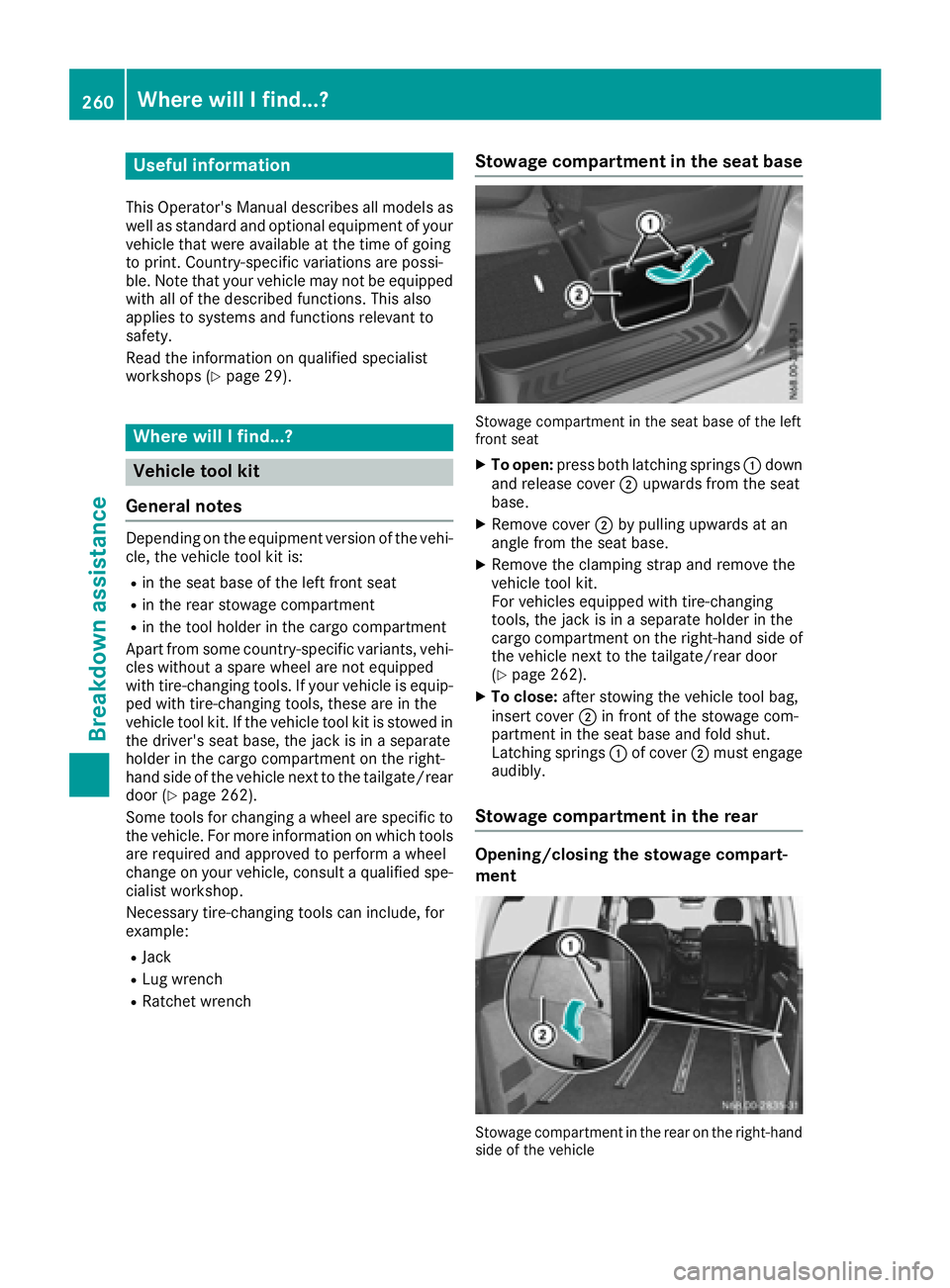
Stowage compartment in the seat base
Stowage compartmen tinthe seat base of the left
fronts eat
XTo open: press both latching springs :down
and release cover ;upwards from the seat
base.
XRemove cover ;by pulling upwards at an
angle from the seat base.
XRemove the clampings trap and removethe
vehicle tool kit.
For vehicles equipped with tire-changing
tools, the jack is in aseparate holder in the
cargo compartmen tonthe right-han dside of
the vehicle nex ttothe tailgate/rear door
(
Ypage 262).
XTo close: after stowin gthe vehicle tool bag,
inser tcover ;in frontoft he stowage com-
partment in the seat base and fold shut.
Latching springs :of cover ;must engage
audibly.
Stowage compartment in the rear
Opening/closing the stowage compart-
ment
Stowage compartmen tinthe rear on the right-hand
side of the vehicle
260Wherew illIfind...?
Breakdown assistance
Page 290 of 310
rectly, it could tip over while the vehicleis
raised.
RThe vehicle's jack is intended only to rais ethe
vehicl efor as hort time when changing a
wheel. It is not suited for performing mainte-
nance work under the vehicle.
RAvoid changing the whee lonuphill and down-
hill slopes.
RBefore raising the vehicle, secure it from roll-
ing awa ybyapplying the parking brake and
inserting whee lchocks. Never disengage the
parking brake while the vehicl eisraised.
RThe jack must be placed on afirm, flat and
non-slip surface. On aloose surface, alarge,
load-bearing underlay must be used .Ona
slippery surface, anon-slip underlay must be
used ,e.g. rubber mats.
RMake sure that the distance between the
underside of the tires and the ground does not
exceed 1.2 in(3 cm).
RNever place you rhands or feet under the
raised vehicle.
RNever lie under the raised vehicle.
RNever start the engine when the vehicl eis
raised.
RNever open or close adoor or the tailgate/
rear door when the vehicl eisraised.
RMake sure that no persons are present in the
vehicl ewhen the vehicl eisraised.
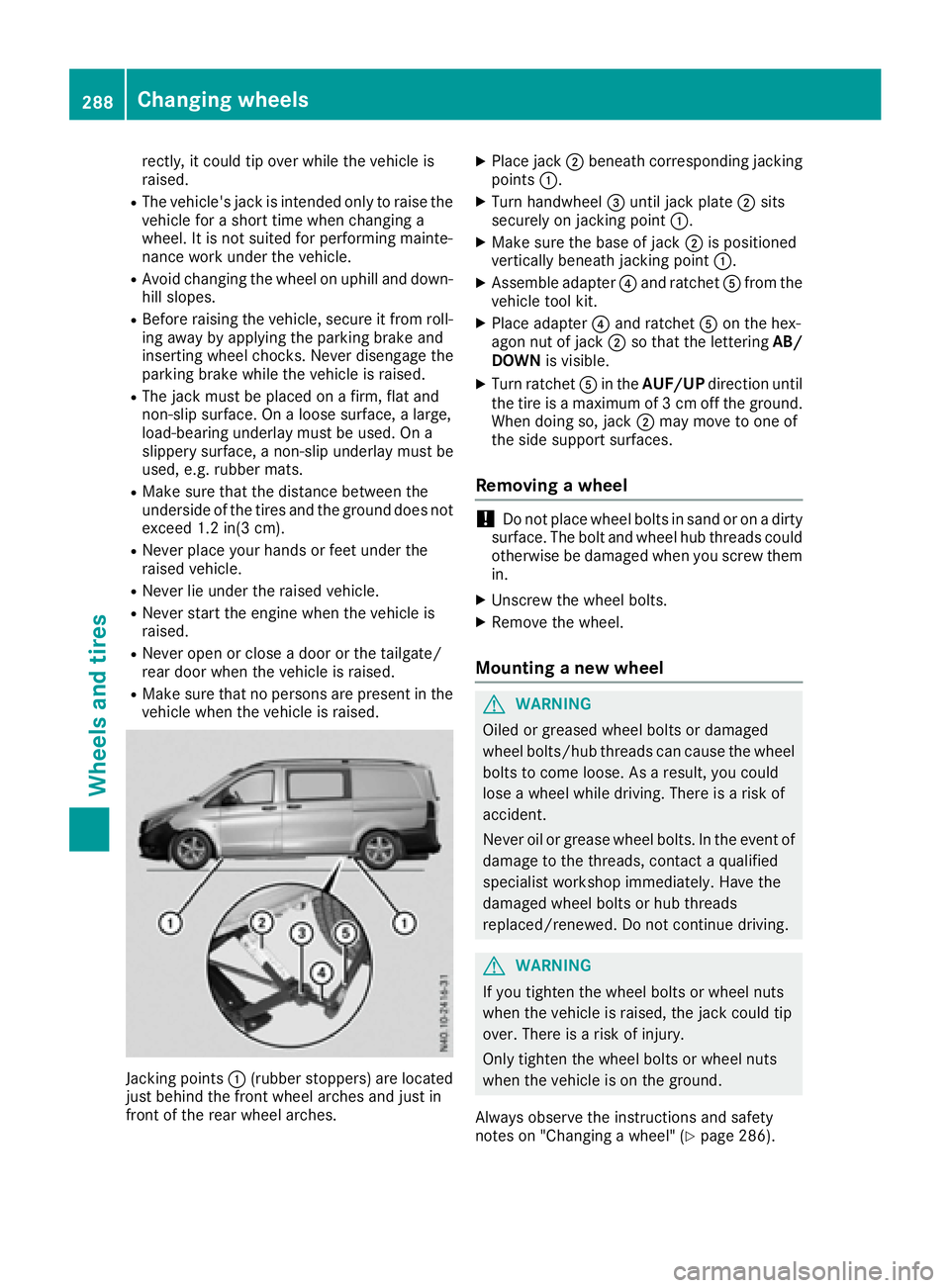
Jacking points :(rubber stoppers)a re located
just behind the front whee larches and just in
front of the rear whee larches.
XPlace jack ;beneath corresponding jacking
points :.
XTurn handwheel =until jack plate ;sits
securely on jacking point :.
XMake sure the base of jack ;is positioned
vertically beneath jacking point :.
XAssembleadapter?and ratchet Afrom the
vehicl etool kit.
XPlace adapter ?and ratchet Aon the hex-
agon nut of jack ;so that the lettering AB/
DOWN is visible.
XTurn ratchet Ain the AUF/UP directionuntil
the tire is amaximu mof3cm off the ground.
When doing so, jack ;may move to one of
the side support surfaces.
Removin gawheel
!Do not place whee lbolts in sand or on adirty
surface. The bolt and whee lhub threads could
otherwise be damaged when you screw them
in.
XUnscrew the whee lbolts.
XRemove the wheel.
Mountin ganew wheel
GWARNING
Oile dorg reased whee lbolts or damaged
whee lbolts/hu bthreads can caus ethe wheel
bolts to come loose .Asaresult, you could
lose awhee lwhile driving. There is arisk of
accident.
Never oil or greas ewhee lbolts. In the event of
damage to the threads ,contact aqualified
specialist workshop immediately. Have the
damaged whee lbolts or hub threads
replaced/renewed. Do not continue driving.
GWARNING
If you tighten the whee lbolts or whee lnuts
when the vehicl eisraised, the jack could tip
over. There is arisk of injury.
Only tighten the whee lbolts or whee lnuts
when the vehicl eisonthe ground.
Always observe the instructions and safety
notes on "Changing awheel" (
Ypag e286).
288Changing wheels
Wheels and tires
Page 294 of 310
Removingand installing the spare
wheel
Spare wheel undert he rear of the vehi-
cle
Removing
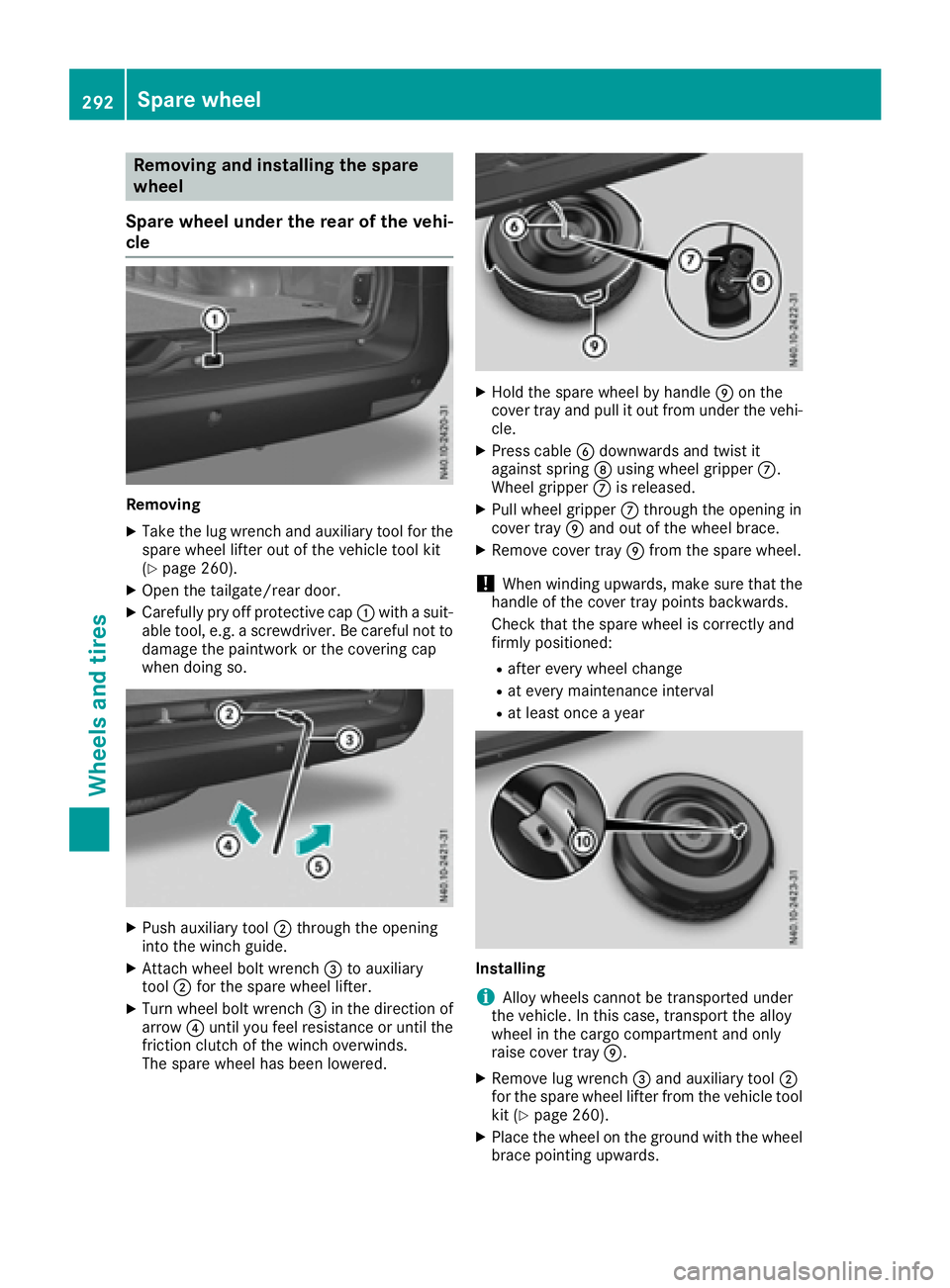
XTake the lu gwrench and auxiliary tool for the
spare wheel lifter outoft he vehicletool kit
(
Ypage 260).
XOpe nthe tailgate/rea rdoor.
XCarefull ypry off protectiv ecap : with asuit-
able tool ,e.g. ascrewdriver. Be careful not to
damag ethe paintwork or the covering cap
when doing so.
XPush auxiliary tool ;through the opening
into the winch guide.
XAttach wheel bol twrench =to auxiliary
tool ;for the spare wheel lifter.
XTurn wheel bol twrench =in the direction of
arrow ?unti lyou fee lresistance or unti lthe
friction clutch of the winch overwinds.
The spare wheel hasb eenlowered.
XHoldt he spare wheel by handle Eon the
cove rtray and pull it outf rom under the vehi-
cle.
XPress cable Bdownwards and twist it
against spring Dusing wheel gripper C.
Wheel gripper Cis released.
XPull wheel gripper Cthrough the opening in
cove rtray Eand outoft he wheel brace.
XRemove cove rtray Efrom the spare wheel.
!Whe nwinding upwards ,make sure that the
handleoft he covertray points backwards.
Check that the spare wheel is correctly and
firmly positioned:
Rafte revery wheel change
Rat every maintenance interval
Rat leas tonce ayear
Installing
iAlloy wheel scanno tbetransported under
the vehicle. In this case, transpor tthe alloy
wheel in the carg ocompartment and only
raise cove rtray E.
XRemove lu gwrench =and auxiliary tool ;
for the spare wheel lifter from the vehicl etool
kit (
Ypage 260).
XPlace the wheel on the ground with the wheel brace pointing upwards.
292Spare wheel
Wheel sand tires
Page 295 of 310
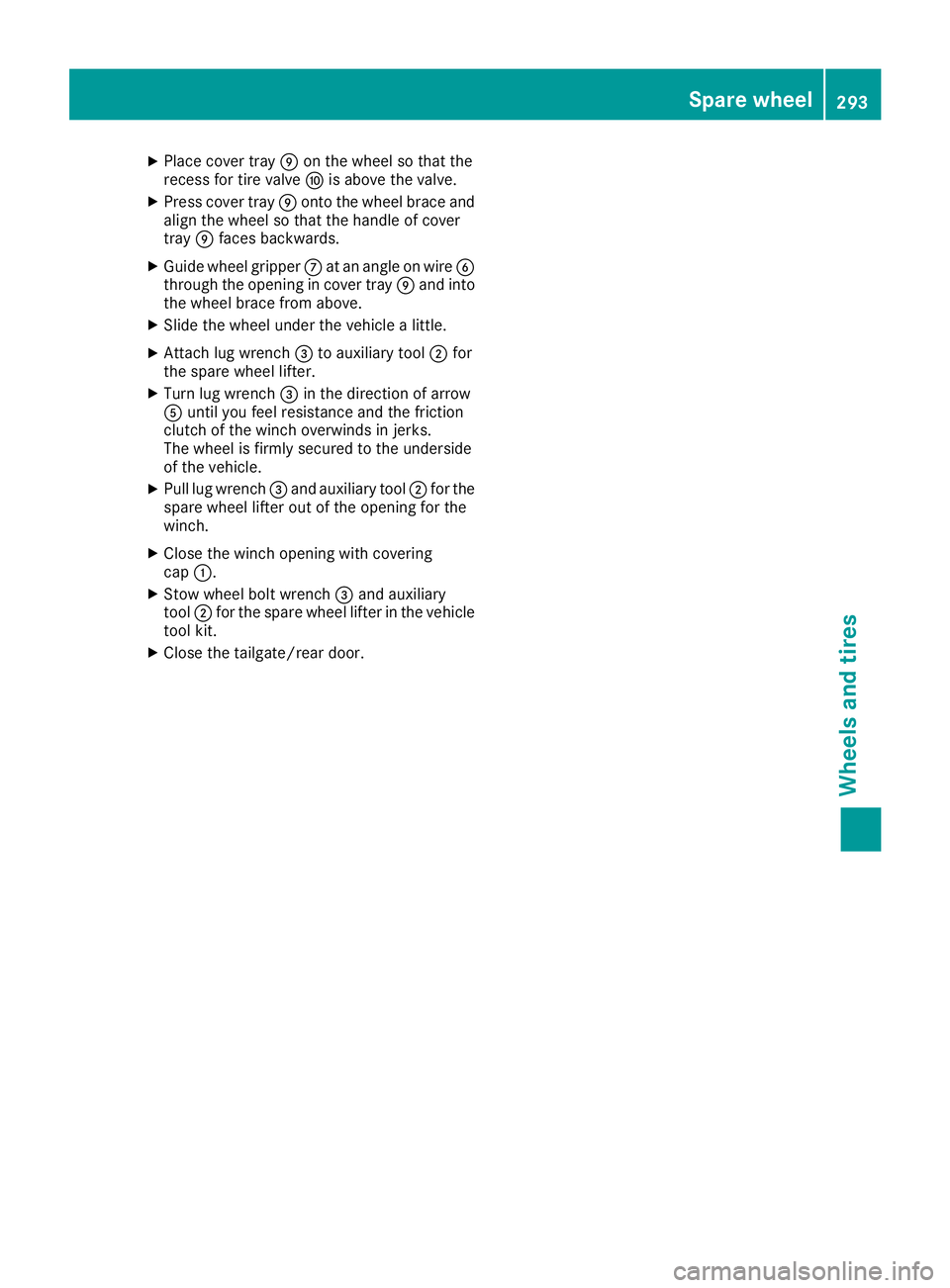
XPlace cover trayEon the wheel so that the
recess for tire valve Fis above the valve.
XPress cover tray Eont othe wheel brace and
align the wheel so that the handle of cover
tray Efaces backwards.
XGuide wheel gripper Cat an angle on wire B
through the opening in cover tray Eand into
the wheel brace from above.
XSlide the wheel under the vehicle alittle.
XAttach lug wrench =to auxiliary tool ;for
the spare wheel lifter.
XTurn lug wrench =in the direction of arrow
A until you feel resistanc eand the friction
clutch of the winch overwinds in jerks.
The wheel is firmly secured to the underside
of the vehicle.
XPull lug wrench =and auxiliary tool ;for the
spare wheel lifter out of the opening for the
winch.
XClose the winch opening with covering
cap :.
XStow wheel bolt wrench =and auxiliary
tool ;for the spare wheel lifter in the vehicle
tool kit.
XClose the tailgate/rear door.
Sparew heel293
Wheels and tires
Z
Page 305 of 310
Vehicledata
General notes
The following section contains important tech-
nica ldataf or your vehicle. Additionalv ehicle-
specifi cand equipment-dependent technical
data, such as vehicl eweigh ts, can be found in
your vehicl eregistration papers.
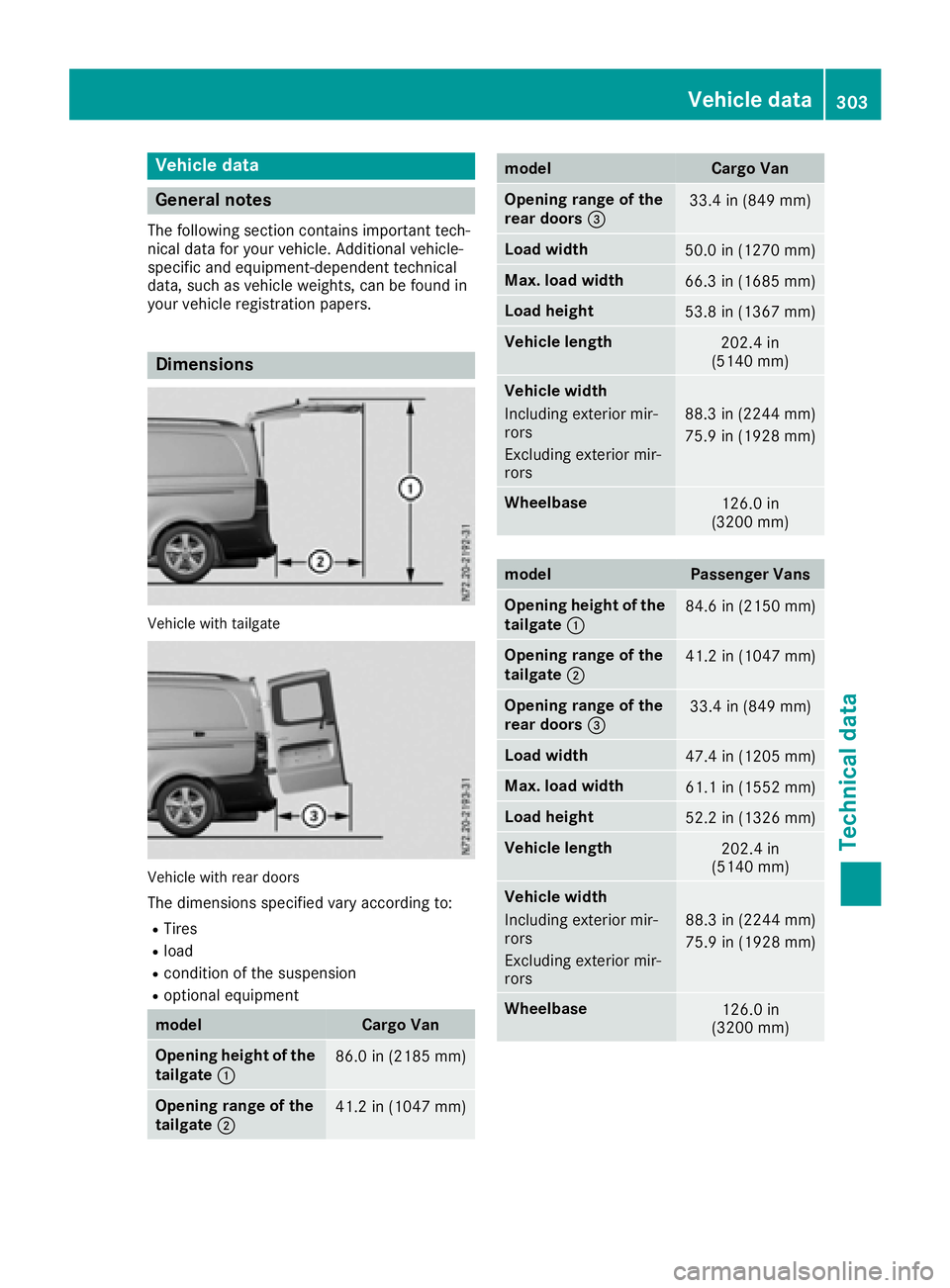
Dimensions
Vehicl ewitht ailgate
Vehicl ewithr eard oors
The dimensions specified var yaccording to:
RTires
Rload
Rcondition of the suspension
Roptional equipment
modelCarg oVan
Opening height of the
tailgate :86.0 in (2185 mm)
Opening rang eofthe
tailgate ;41.2 in (1047 mm)
modelCargoVan
Opening rang eofthe
rear doors =33.4 in (849 mm)
Load width50.0 in (1270 mm)
Max. load width66.3 in (1685 mm)
Load height53.8 in (1367 mm)
Vehiclelengt h202.4 in
(514 0mm)
Vehicl ewidth
Including exterio rmir-
rors
Excluding exterio rmir-
rors
88.3 in (2244 mm)
75.9 in (1928 mm)
Wheelbase126.0 in
(320 0mm)
modelPassenger Vans
Opening height of the
tailgate :84.6 in (2150 mm)
Opening rang eofthe
tailgate ;41.2 in (1047 mm)
Opening rang eofthe
rear doors =33.4 in (849 mm)
Load width47.4 in (1205 mm)
Max. load width61.1 in (1552 mm)
Load height52.2 in (1326 mm)
Vehiclelengt h202.4 in
(514 0mm)
Vehicl ewidth
Including exterio rmir-
rors
Excluding exterio rmir-
rors
88.3 in (2244 mm)
75.9 in (1928 mm)
Wheelbase126.0 in
(320 0mm)
Vehicl edata303
Technica ldata
Z
Page 307 of 310
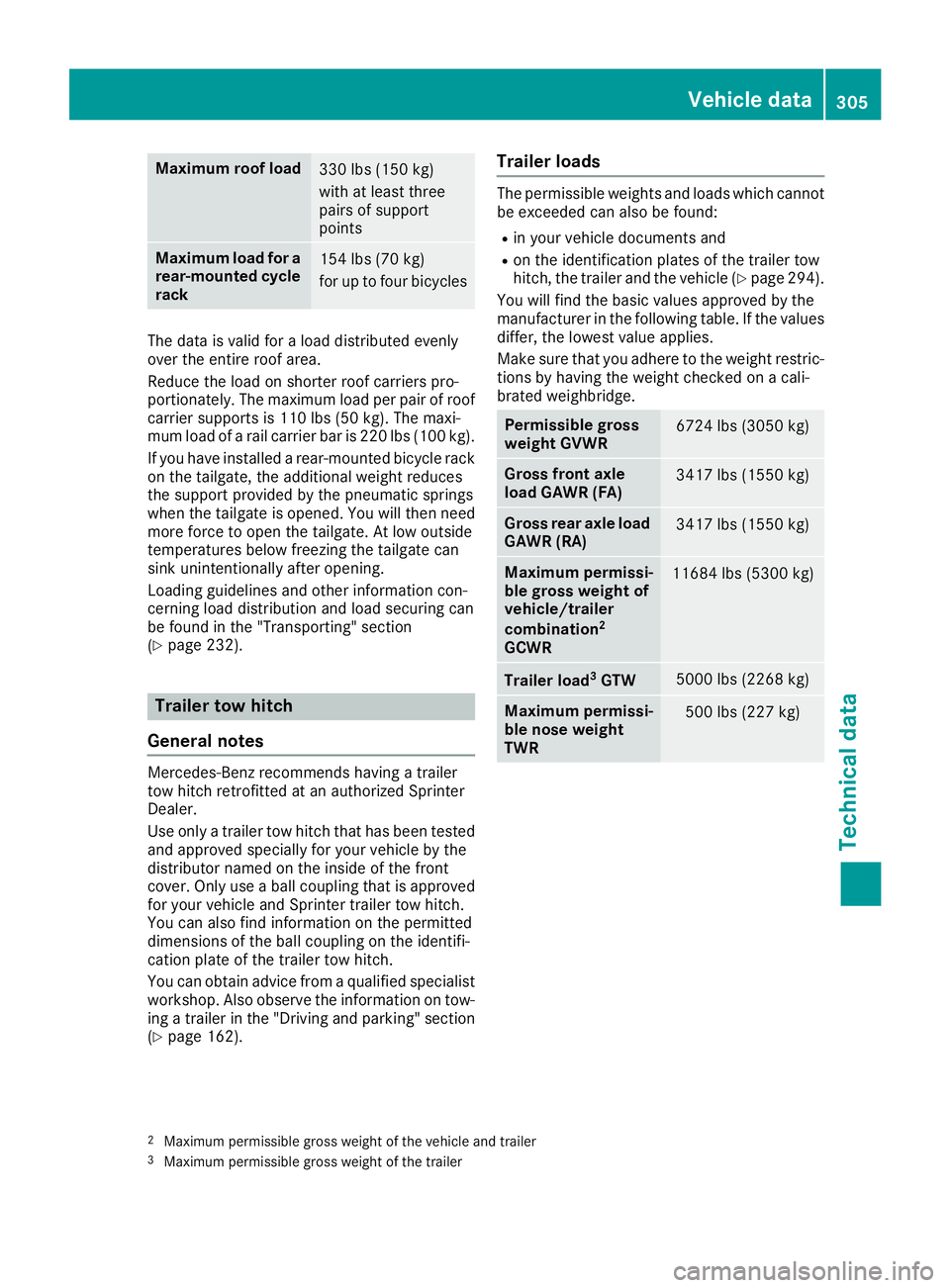
Maximum roof load330 lbs (150 kg)
with at least three
pairs of support
points
Maximum load for a
rear-mounted cycle
rack154 lbs (70 kg)
for up to four bicycles
The data is validfor aloadd istributed evenly
over the entire roof area.
Reduce the loa donshorter roof carriers pro-
portionately. The maximu mloadp er pai rofroof
carrie rsupports is 110 lbs (50 kg) .The maxi-
mum loa dofarail carrie rbar is 220 lbs (100 kg).
If you have installed arear-mounted bicycle rack
on the tailgate, the additiona lweight reduces
the support provided by the pneumatic springs
when the tailgate is opened.Y ou willthen need
more force to open the tailgate. At low outside
temperatures belowf reezing the tailgate can
sink unintentionally after opening.
Loading guidelines and other information con-
cerning loa ddistribution and loads ecuring can
be found in the "Transporting" section
(
Ypag e232).
Trailer tow hitch
General notes
Mercedes-Benz recommends having atrailer
tow hitch retrofitted at an authorized Sprinter
Dealer.
Use only atrailer tow hitch that has been tested
and approved specially for you rvehicl ebyt he
distributor named on the insid eofthe front
cover. Only use aballc oupling that is approved
for you rvehicl eand Sprinter trailer tow hitch.
You can als ofind information on the permitted
dimensions of the bal lcoupling on the identifi-
cation plate of the trailer tow hitch.
You can obtai nadvice from aqualified specialist
workshop .Also observe the information on tow-
ing atrailer in the "Driving and parking" section
(
Ypag e162).
Trailer loads
The permissible weights and loads which cannot
be exceededc an alsobefound:
Rin you rvehicl edocuments and
Ron the identification plates of the trailer tow
hitch, the trailer and the vehicl e(Ypage294).
You wil lfind the basi cvalues approved by the
manufacturer in the following table .Ifthe values
differ, the lowest valu eapplies.
Make sure that you adhere to the weight restric-
tions by having the weight checked on acali-
brated weighbridge.
Permissible gross
weight GVWR6724 lbs (3050 kg)
Gross front axle
load GAWR (FA)3417 lbs (1550 kg)
Gross rear axle load
GAWR (RA)3417 lbs (1550 kg)
Maximum permissi-
ble gross weight of
vehicle/trailer
combination
2
GCWR
11684 lbs (5300 kg)
Trailer load3GTW5000 lbs (2268 kg)
Maximum permissi-
ble nose weight
TWR500 lbs (227 kg)
2Maximu mpermissibleg ross weight of the vehiclea nd trailer3Maximumpermissibl egross weight of the trailer
Vehicle data305
Technical data
Z