trailer MERCEDES-BENZ METRIS 2016 MY16 Operator’s Manual
[x] Cancel search | Manufacturer: MERCEDES-BENZ, Model Year: 2016, Model line: METRIS, Model: MERCEDES-BENZ METRIS 2016Pages: 310, PDF Size: 7.28 MB
Page 267 of 310
Have the vehicle transported onatransporter or
trailer if it has transmission damage.
Whent owing, the automati ctransmission must
be in position N.Ifthe automati ctransmission
cannot be shifted to position N,havet he vehicle
transported on atransporter or trailer.
The battery mus tbeconnected and charged.
Otherwise ,you :
Rcannot turn the key to position 2in the igni-
tion lock
Rcannot shift the transmission to position N
Before the vehicle is towed, switch off the auto-
mati clocking feature (
Ypage 72). You could
otherwise lock yourself out of the vehicle when
pushing or towing away the vehicle.
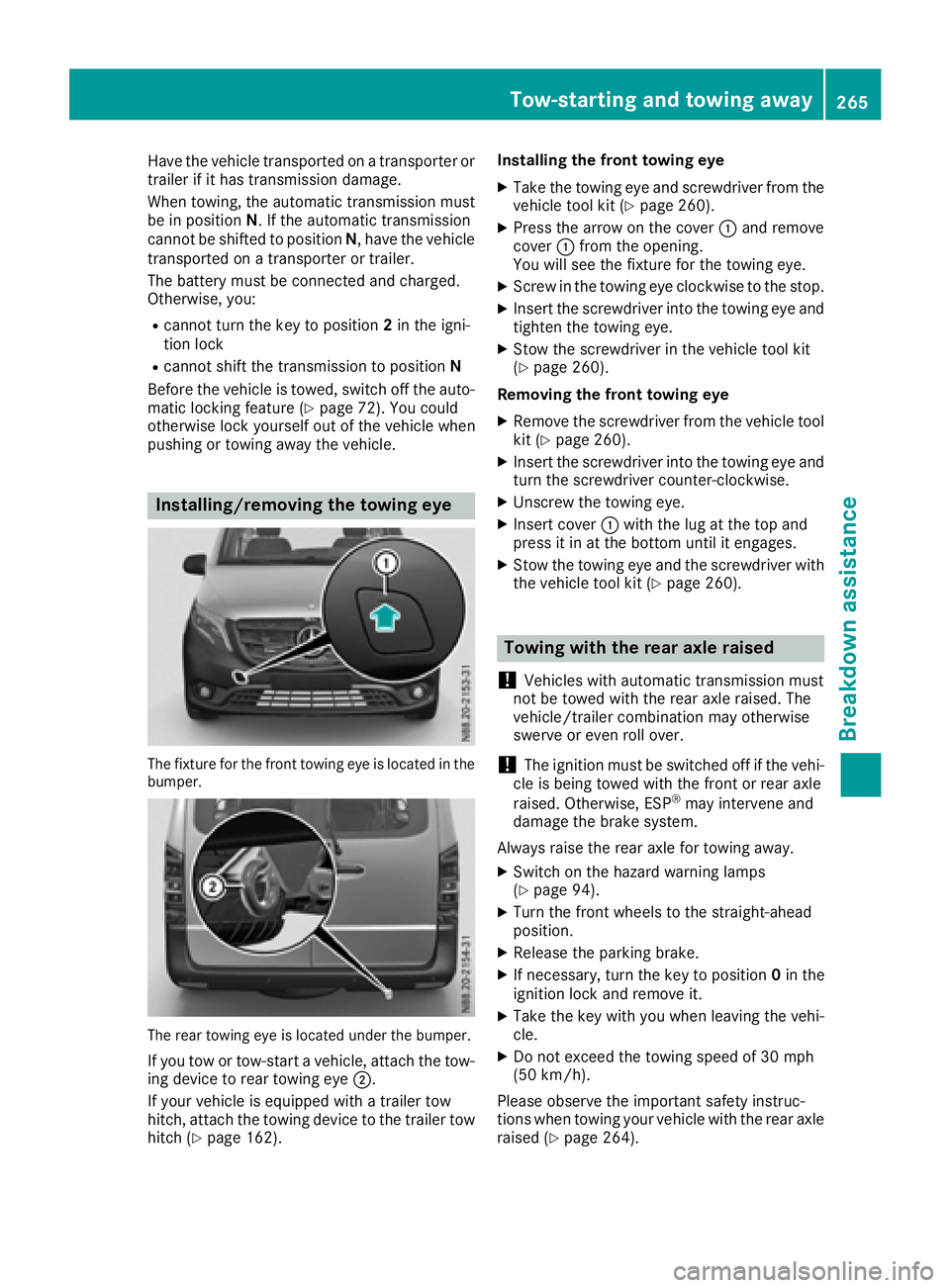
Installing/removin gthe towing eye
The fixtur efor the front towing eyeisl ocated in the
bumper.
The rea rtowing eyeisl ocated underthe bumper.
If yo utow or tow-start avehicle, attach the tow-
ing device to rea rtowing eye ;.
If your vehicle is equipped with atrailer tow
hitch, attach the towing device to the trailer tow
hitch (
Ypage 162). Installing the front towing eye
XTake the towing eyea
nd screwdriver from the
vehicle tool kit (Ypage 260).
XPres sthe arro wonthe cover :and remove
cover :from the opening.
You will see the fixtur efor the towing eye.
XScrew in the towing eyec lockwise to the stop.
XInsert the screwdriver into the towing eyea nd
tighte nthe towing eye.
XStow the screwdriver in the vehicle tool kit
(Ypage 260).
Removing the front towing eye
XRemove the screwdriver from the vehicle tool
kit (Ypage 260).
XInsert the screwdriver into the towing eyea nd
turn the screwdriver counter-clockwise.
XUnscrew the towing eye.
XInsert cover :with the lu gatthe top and
pres sitinatt he bottom until it engages.
XStow the towing eyea nd the screwdriver with
the vehicle tool kit (Ypage 260).
Towing with the rear axle raised
!
Vehicles with automati ctransmission must
not be towe dwitht he rea raxler aised.T he
vehicle/trailer combinatio nmay otherwise
swerve or even roll over.
!The ignition mus tbeswitched off if the vehi-
cle is being towe dwitht he front or rea raxle
raised.O therwise,ESP
®may intervene and
damag ethe brake system.
Always raise the rea raxlef or towing away.
XSwitch on the hazard warning lamps
(Ypage 94).
XTur nthe front wheels to the straight-ahead
position.
XRelease the parking brake.
XIf necessary ,turn the key to position 0in the
ignition lock and remov eit.
XTake the key with yo uwhenleaving the vehi-
cle.
XDo not excee dthe towing speed of 30 mph
(50 km/h).
Please observe the important safety instruc-
tions whe ntowing your vehicle with the rea raxle
raised (
Ypage 264).
Tow-starting and towing away265
Breakdow nassistance
Z
Page 268 of 310
Towingthe vehicle with both axles on
the ground
Important safety notes
GWARNING
Yo uc an no longe rstee rthe vehicl eifthe
steerin gwheel lock hasb eene ngaged .There
is ar iskofana ccident.
Alway sswitch off the ignition when towing the
vehicl ewithat ow cable or atow bar.
!Do not exceed the towing spee dof30mph
(50 km/h). Yo ucould otherwis edamag ethe
transmission.
Please observe the important safety notes
befor etowing your vehicl e(
Ypage 264).
Towingvehicle switha utomatic trans-
mission
XTurn the key to position 2in the ignition lock.
XDepres sthe brake peda land kee pit
depressed.
XShift the automatic transmission to position
N.
XLeave the key in position 2in the ignition lock.
XSwitch on the hazar dwarning lamps
(Ypage 94).
XReleas ethe parkin gbrake.
XReleas ethe brake pedal.
XDo not exceed the towing spee dof30m ph
(50 km/h).
Recovering avehicle that is stuck
!
When recovering avehicl ethath asbecome
stuck, pull it as smoothl yand evenly as pos-
sible. Excessive tractiv epower could damage
the vehicles.
If the drive wheels gett rapped on loose or
mudd yground ,recover the vehicl ewitht he
utmost care. Thi sisespecially the cas eifthe
vehicl eisladen .
Never attempt to recover avehicl ewithat railer
attached.
Pull ou tthe vehicl ebackwards ,ifpossible, using
the tracks it made when it becam estuck.
Transporting the vehicle
!
Yo um ayonl ysecur ethe vehicl ebythe
wheels ,not by parts of the vehicl esucha s
axl eors teerin gcomponents. Otherwise, the
vehicl ecould be damaged.
The towing ey eortrailer tow hitch can be used
to pull the vehicl eonto atrailer or transporte rif
yo uw ishtot ransport it.
XTurn the key to position 2in the ignition lock.
XShift the transmission to position N.
XReleasethe parkin gbrake.
If the vehicle is loaded:
XShift the transmission to position P.
XTurn the key to position 0in the ignition lock
and remove it.
XMake sure the parkin gbrake is applied.
XLash down the vehicle.
Tow-starting (emergency engine
starting)
Vehicle switha utomatic transmission
!Vehicles with automatic transmission must
not be tow-started .You could otherwis edam -
ag et he automatic transmission.
Yo uc an find informatio nonjump-starting under
"Jump-starting “(
Ypage 262).
Electrical fuses
The fuse allocation chart and important safety
informationonthe fuses can be found in the
"Fuse allocation chart" supplement.
266Electrical fuses
Breakdow nassistance
Page 274 of 310
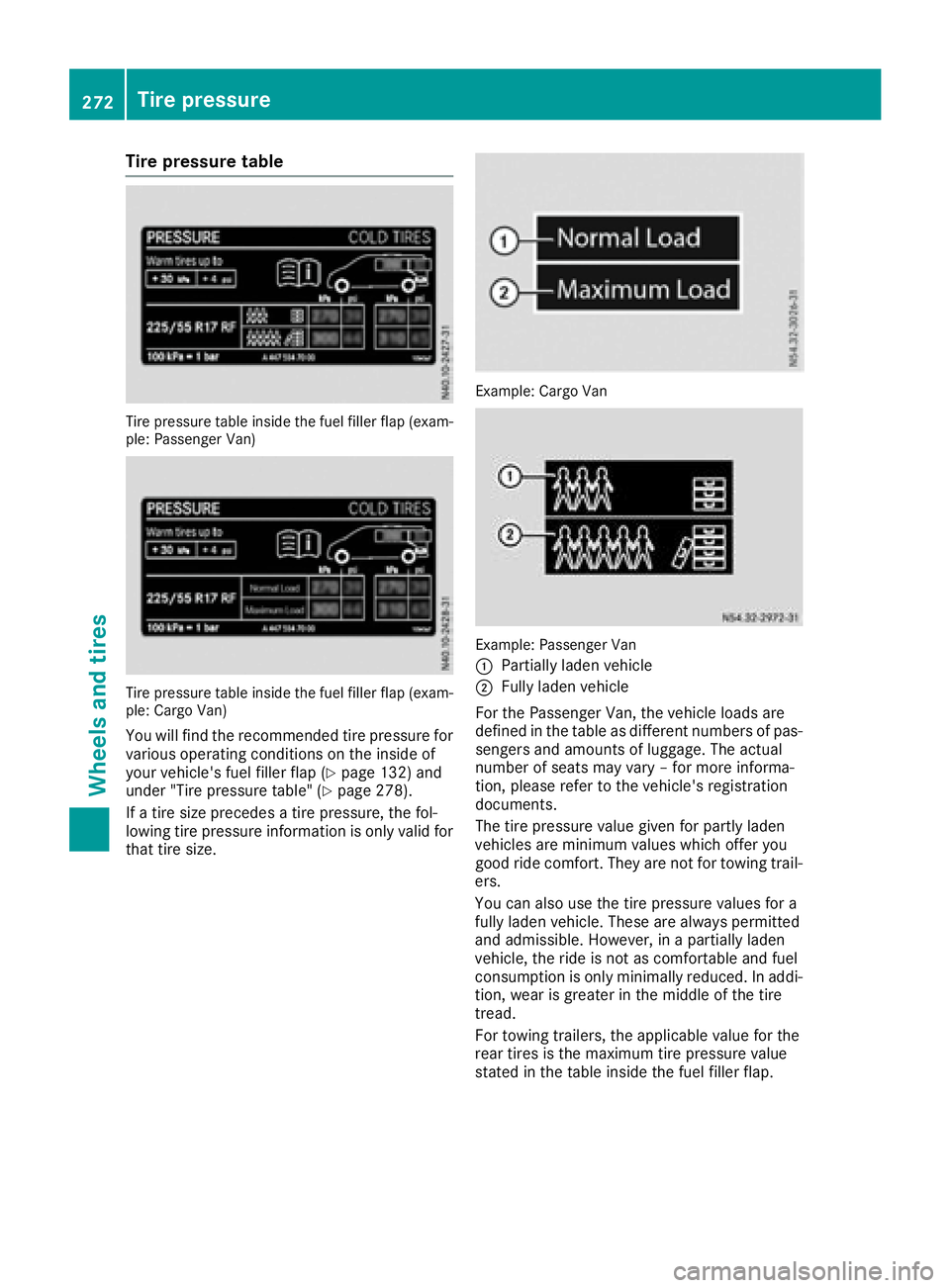
Tire pressure table
Tire pressure table insidethe fuel fille rflap( exam-
ple: Passenge rVan)
Tire pressure table insid ethe fuel fille rflap( exam-
ple: Cargo Van)
Yo uw illf ind the recommende dtire pressure for
various operating conditions on the insid eof
your vehicle's fuel fille rflap(
Ypage 132 )and
under "Tire pressure table "(Ypage 278).
If at ire size precedes atire pressure, the fol-
lowing tire pressure informatio niso nlyv alid for
thatt ire size.
Example: Cargo Van
Example: Passenge rVan
:
Partiall yladen vehicle
;Fully lade nvehicle
For the Passenge rVan,the vehicl eloads are
define dinthe table as different numbers of pas-
sengers and amounts of luggage.T he actual
numbe rofseats mayv ary–f or mor einforma-
tion, please refer to the vehicle's registration
documents.
The tire pressure valu egiven for partly laden
vehicles ar eminimu mvalues which offer you
good rid ecomfort. The yarenot for towing trail-
ers.
Yo uc an also us ethe tire pressure values for a
full yladen vehicle. These ar ealway spermitted
and admissible. However, in apartiall yladen
vehicle, the rid eisnot as comfortabl eand fuel
consumption is onl yminimall yreduced. In addi-
tion, wear is greate rinthe middl eofthe tire
tread.
For towing trailers ,the applicabl evalue for the
rea rtire sist he maximum tire pressure value
stated in the table insid ethe fuel fille rflap.
272Tire pressure
Wheel sand tires
Page 281 of 310
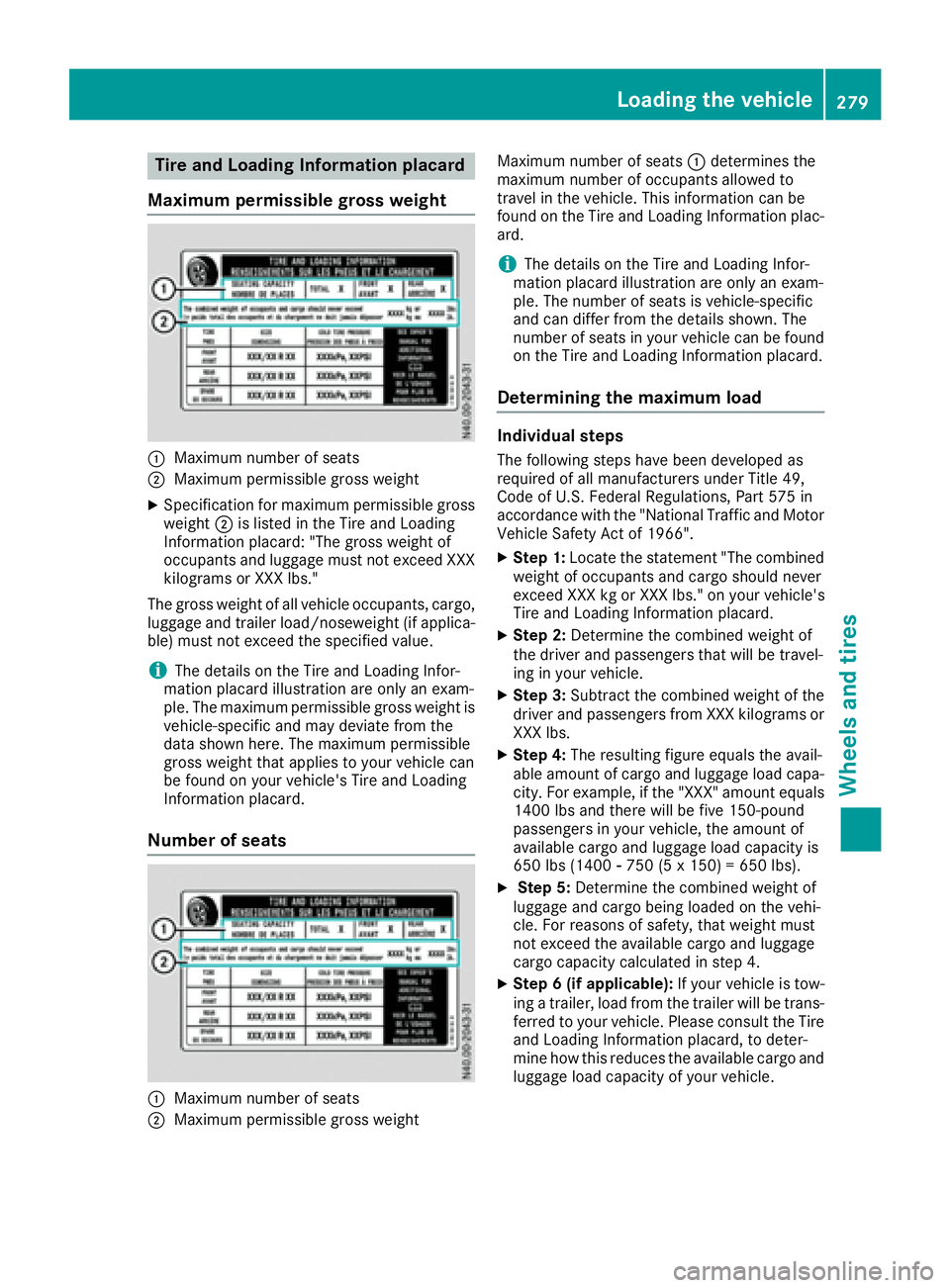
Tire and LoadingInfor matio nplacard
Maximum permissible gross weight
:Maximum numbe rofseats
;Maximum permissibl egross weight
XSpecificatio nfor maximum permissibl egross
weight ;is listed in the Tire and Loading
Informatio nplacard: "The gross weight of
occupants and luggage must not exceed XXX
kilograms or XXX lbs."
The gross weight of al lvehicl eoccupants, cargo,
luggage and trailer load/noseweight (i fappli ca-
ble) must not exceed the specifie dvalue.
iThe details on the Tire and Loading Infor-
matio nplacard illustratio nareonl yane xam-
ple. The maximum permissibl egross weight is
vehicle-specific and mayd eviate fromt he
data shown here. The maximum permissible
gross weight thata ppliesto your vehicl ecan
be found on your vehicle's Tire and Loading
Informatio nplacard.
Numbe rofseats
:Maximum numbe rofseats
;Maximum permissibl egross weight Maximum numbe
rofseats:determine sthe
maximum numbe rofoccupants allowe dto
travel in the vehicle. Thi sinformatio ncan be
found on the Tire and Loading Informatio nplac-
ard.
iThe details on the Tire and Loading Infor-
matio nplacard illustratio nareonl yane xam-
ple. The numbe rofseats is vehicle-specific
and can differf romthe details shown. The
numbe rofseats in your vehicl ecan be found
on the Tire and Loading Informatio nplacard.
Determining the maximum load
Individual steps
The following step shaveb eend eveloped as
required of al lmanufacturer sunder Title 49,
Code of U.S. Federa lRegulat ions, Part 575 in
accordance with the "Nationa lTraffica nd Motor
Vehicl eSafety Act of 1966".
XStep1 :Locate the statement "The combined
weight of occupants and cargo shoul dnever
exceed XXX kg or XXX lbs." on your vehicle's
Tire and Loading Informatio nplacard.
XStep2 :Determine the combine dweigh tof
the driver and passengers thatw illbet ravel-
ing in your vehicle.
XStep3 :Subtract the combine dweigh toft he
driver and passengers fromX XX kilograms or
XXX lbs.
XStep4 :The resulting figur eequals the avail-
able amount of cargo and luggage load capa-
city .For example, if the "XXX" amount equals
1400 lb sand there will be fiv e150-pound
passengers in your vehicle, the amount of
availabl ecargo and luggage load capacity is
650 lb s(1400 Ò750 (5 x150) = 650 lbs).
XStep5 :Determine the combine dweigh tof
luggage and cargo being loaded on the vehi-
cle .For reasons of safety ,thatw eightmust
not exceed the availabl ecargo and luggage
cargo capacity calculate dinstep 4.
XStep6( ifapplicable): If your vehiclei stow-
ing atrailer, load fromt he trailer will be trans-
ferred to your vehicle. Please consul tthe Tire
and Loading Informatio nplacard, to deter-
min ehow thisr educesthe availabl ecargo and
luggage load capacity of your vehicle.
Loadin gthe vehicle279
Wheel sand tires
Z
Page 282 of 310
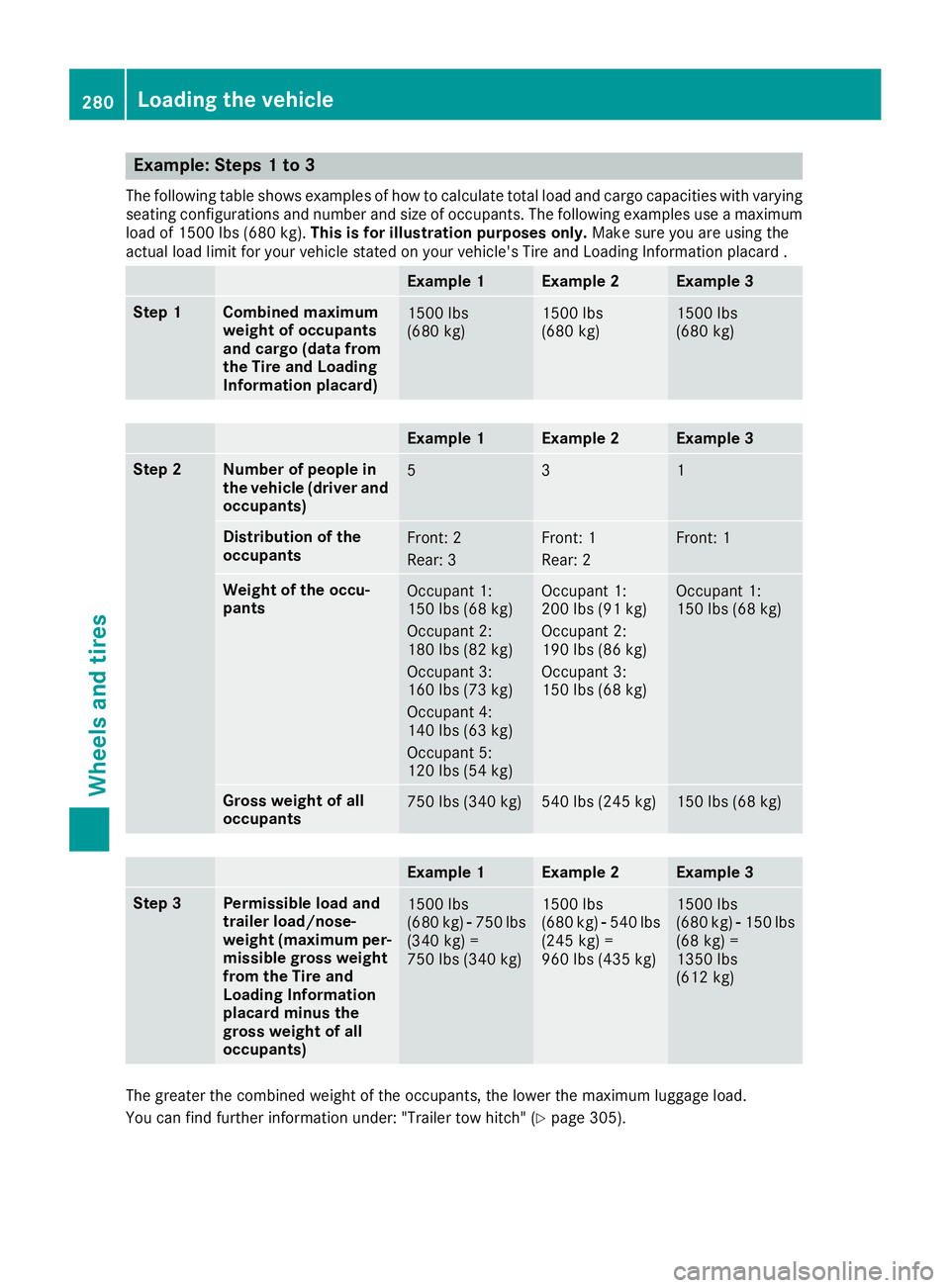
Example: Steps1to3
The followingtable showsexamples of how to calculate total load and cargo capacities with varying
seating configurations and number and sizeofo ccupants. The followingexamples useamaximum
load of 1500 lbs (68 0kg). This is for illustration purposes only. Makesure you are usingt he
actual load limit for your vehicle state donyour vehicle's Tire and Loading Information placard .
Example 1Example 2Example 3
Step 1Combined maximum
weight of occupants
and cargo (data from
theT irea nd Loading
Information placard)1500 lbs
(68 0kg)1500 lbs
(68 0kg)1500 lbs
(68 0kg)
Example 1Example 2Example 3
Step 2Number of people in
thev ehicle (driver and
occupants)531
Distribution of the
occupantsFront: 2
Rear: 3Front: 1
Rear: 2Front: 1
Weigh toftheoccu-
pantsOccupan t1:
15 0lbs (68 kg)
Occupan t2:
18 0lbs (82 kg)
Occupan t3:
16 0lbs (73 kg)
Occupan t4:
14 0lbs (63 kg)
Occupan t5:
12 0lbs (54 kg)Occupan t1:
20 0lbs (91 kg)
Occupan t2:
19 0lbs (86 kg)
Occupan t3:
15 0lbs (68 kg)Occupan t1:
15 0lbs (68 kg)
Gross weight of all
occupants75 0lbs (34 0kg)540lbs (24 5kg)150lbs (68 kg)
Example 1Example 2Example 3
Step 3Permissible load and
trailer load/nose-
weight (maximum per-
missible gross weight
from th eTirea nd
Loading Information
placar dminus the
gross weight of all
occupants)1500 lbs
(68 0kg)Ò75 0lbs
(34 0kg) =
75 0lbs (34 0kg)1500 lbs
(68 0kg)Ò54 0lbs
(24 5kg) =
96 0lbs (43 5kg)1500 lbs
(68 0kg)Ò15 0lbs
(68 kg) =
1350 lbs
(61 2kg)
The greate rthe combined weightoft heoccupants, th elower th emaximum luggage load.
You can fin dfurther informatio nunder: "Trailer to whitch "(
Ypage 305).
280Loading th evehicle
Wheels and tires
Page 283 of 310
Vehicleidentificatio nplate
Even if yo uhavec alculate dthe totall oadc are-
fully ,you shoul dstillm ake sure thatt he permis-
sibl egross weight and the gross axl eweigh trat-
ing of your vehicl eare not exceeded .Thisd ata
can be found on the vehicl eide ntificatio nplate
on the B-pillar of your vehicl e(
Ypage 294).
Permissibl egross vehicle weight: the gross
weight of the vehicle, al loccupants, load and
traile rload/n oseweight (i fappli cable) must not
exceed the permissibl egross vehicl eweigh t.
Gros saxlew eightrating: the maximu mper-
missibl eloa dt hatc an be carrie dbyone axle
(front or rea raxle).
To ensure thaty ourvehicl edoesn ot exceed the
maximu mpermissibl evalue s(gros sv ehicle
weight and maximu mgross axl eweigh trating),
have your loaded vehicl e(including driver, occu-
pants, load ,and ful ltraile rloa difa pplicable)
weighed on asuitabl evehicl eweigh bridge.
Trailer load/noseweight
The traile rload/n oseweight affects the gross
weight of the vehicle. If atraile risa ttached, the
traile rload/n oseweight is included in the load
along with occupants and luggage. The trailer
load/noseweight is usuall yapproximately1 0%
of the gross weight of the traile rand its load.
What yous hould knowabout wheels
and tires
Tire labeling
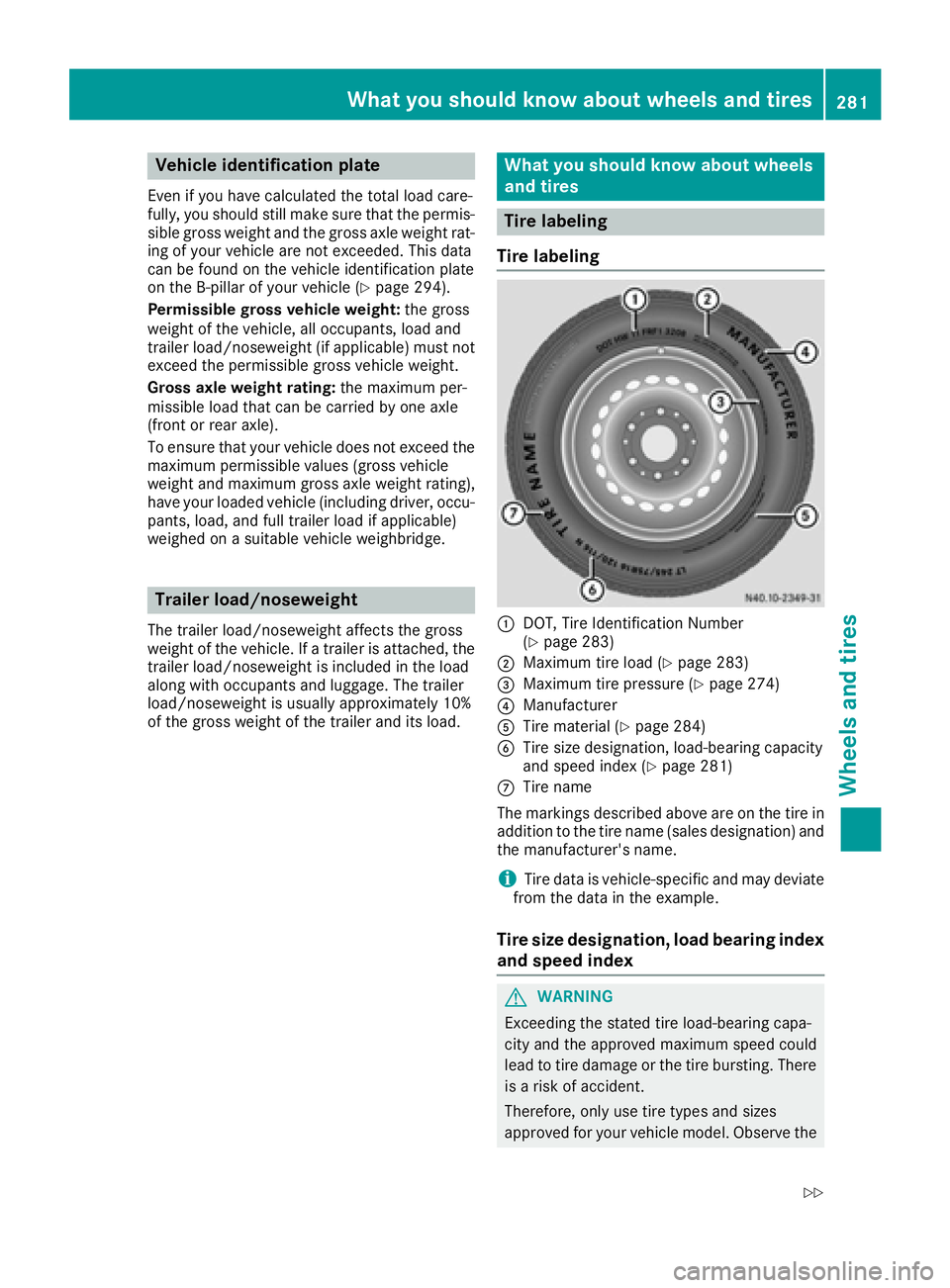
Tire labeling
:DOT, Tire Identification Number
(Ypage 283)
;Maximu mtire load (Ypage 283)
=Maximu mtire pressure (Ypage 274)
?Manufacturer
ATire material (Ypage 284)
BTire size designation, load-bearing capacity
and speed index (Ypage 281)
CTire name
The marking sdescribe dabove are on the tire in
additio ntothe tire nam e(sale sdesig nation) and
the manufacturer' sname.
iTire data is vehicle-specific and mayd eviate
from the data in the example.
Tire size designation ,loa db earin gind ex
and speed index
GWARNING
Exceeding the stated tire load-bearing capa-
city and the approved maximu mspeed could
lead to tire damage or the tire bursting. There is ar iskofa ccident.
Therefore, onlyu setire types and sizes
approved for your vehicl emodel .Observe the
What yous hould knowa bout wheels and tires281
Wheelsand tires
Z
Page 286 of 310
the year of manufacture. For example,atire that
is marked with "3208" wa smanufactured in
week 32 in 2008.
iTire data is vehicle-specific and mayd eviate
fromt he data in the example.
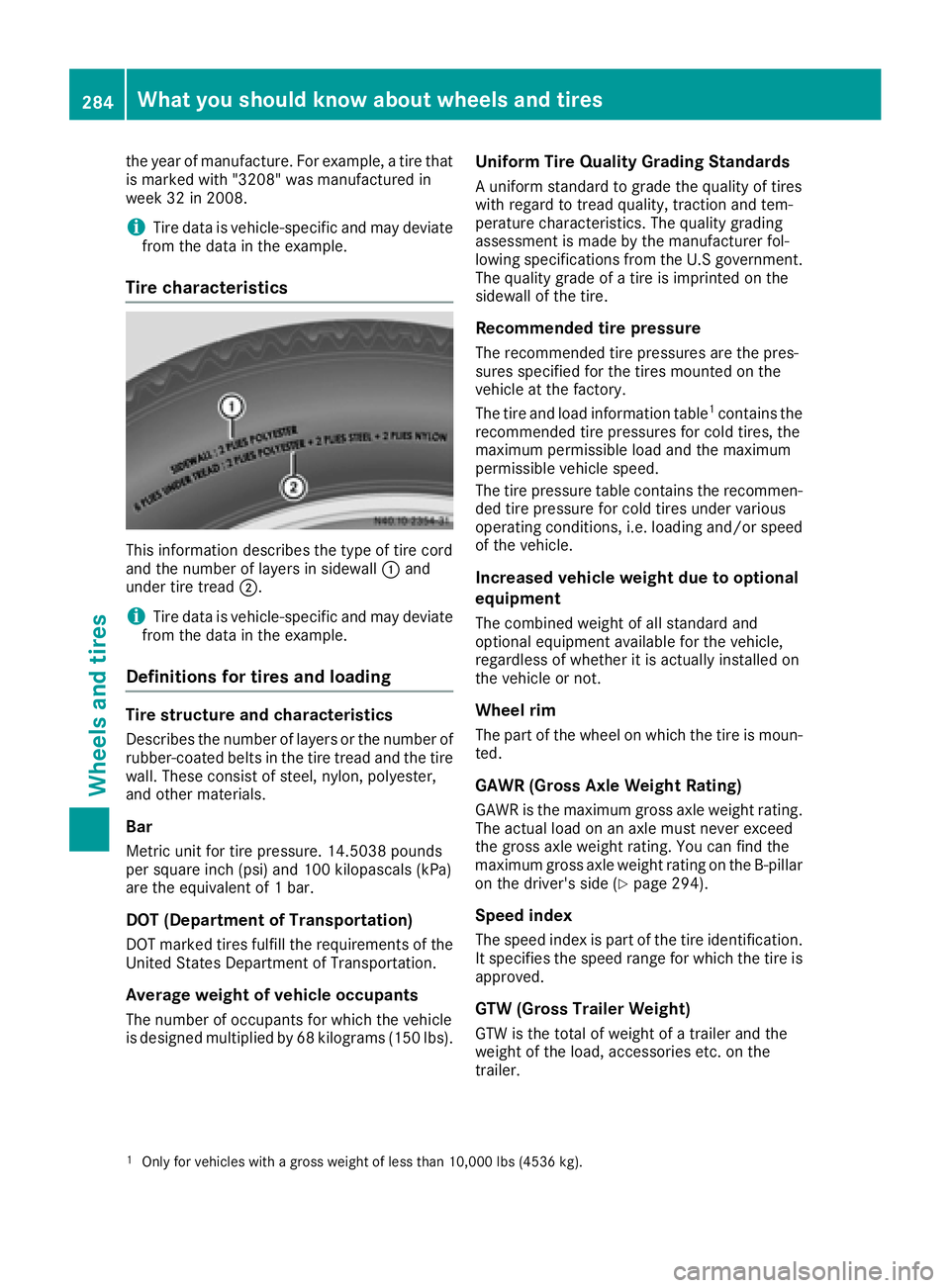
Tire characteristics
Thisinformation describe sthe typ eoftire cord
and the numbe roflayersins idewall :and
under tire tread ;.
iTire data is vehicle-specific and mayd eviate
fromt he data in the example.
Definition sfor tire sand loading
Tire structure and characteristics
Describe sthe numbe roflayer sort he numbe rof
rubber-coated belts in the tire trea dand the tire
wall .These consis tofsteel,nylon, polyester,
and othe rmaterials.
Bar
Metric uni tfor tire pressure. 14.5038 pounds
pe rs quare inch (psi)a nd 100 kilopascal s(kPa)
ar et he equivalent of 1bar.
DO T(De partmen tofTransportation)
DOT marked tire sfulfill the requirements of the
United State sDepartment of Transportation.
Averag eweigh tofv ehicle occupants
The numbe rofoccupants for which the vehicle
is designe dmultiplie dby68k ilograms (15 0lbs).
Uniform Tire Quality Grading Standards
Au nifor mstandard to grade the quality of tires
with regar dtotreadquali ty,t ractio nand tem-
peratur echaracteristics .The qualit ygrading
assessment is made by the manufacturer fol-
lowing specifications fromt he U.S government.
The quality grade of atire is imprinted on the
sidewall of the tire.
Recommende dtire pressure
The recommended tire pressures ar ethe pres-
sures specifie dfor the tire smounted on the
vehicl eatthe factory.
The tire and load information table
1contains the
recommende dtire pressures for col dtires, the
maximum permissibl eloa da nd the maximum
permis sibleve
hiclespeed.
The tire pressure table contains the recommen-
de dt ire pressure for col dtiresu nder various
operating conditions ,i.e .loadi ng and/or speed
of the vehicle.
Increase dvehicle weight due to optional
equipment
The combine dweigh tofa llstandard and
optional equipment availabl efor the vehicle,
regardles sofwhether it is actually installe don
the vehicl eornot.
Wheel rim
The part of the whee lonwhich the tire is moun-
ted.
GAWR (Gros sAxleW eight Rating)
GAWRisthe maximum gross axl eweigh trating.
The actual load on an axl emustn eve rexceed
the gross axl eweigh trating .You can fin dthe
maximum gross axl eweigh trating on the B-pillar
on the driver's side (
Ypage 294).
Speed index
The spee dindex is part of the tire identification.
It specifie sthe spee drange for which the tire is
approved.
GTW (Gros sTrailer Weight)
GTWist he tota lofweightofat railer and the
weight of the load ,accessorie setc. on the
trailer.
1Onl yfor vehicles with agross weight of less tha n10,000 lb s(4536 kg).
284What yous hould knowabout wheels an dtires
Wheel sand tires
Page 288 of 310
TIN (Tire IdentificationNumber)
Auniqu eide ntificatio nnumbe rwhich can be
used by atire manufacturer to identify tires, for
exampl efor ap roduct recall ,and thusi dentify
the purchasers. The TIN is compose dofthe
manufacturer identificatio ncode, tire size, tire
model cod eand manufacturing date.
Load bearin gind ex
The load bearing index (als oloa dindex) is acode
thatc ontains the maximu mloadb eari ng capa-
city of atire.
Traction
Tractio nist he resul toffrictio nbetween the tires
and the roa dsurface.
TWR (permissibl etrailer drawbar load)
The TWRist he maximumpermissibl eweigh t
thatm ayact on the ball coupling of the trailer
tow hitch.
Wea rind icator
Narrowb ars( tread wear bars) thata redistrib-
ute doverthe tire tread. If the tire trea dislevel
with the bars, the wear limit of áin (1.6 mm)
hasb eenr eached.
Distribution of the vehicle occupants
The distributio nofvehicleoccupants ove rdes-
ignate dseatp osit ions in avehicle.
Maximum permissible payload weight
Nomina lloa da nd goods/luggage load plus
68 kg (150 lb s)multiplie dbythe number of
seats in the vehicle.
Changing wheels
Rotating the wheels
GWARNING
Interchanging the front and rear wheels may
severelyi mpair the driving characteristics if
the wheels or tires have different dimensions. The whee lbrakes or suspension components
may als obedamaged. There is arisk of acci-
dent.
Rotate front and rear wheels only if the wheels and tires are of the same dimensions.
!On vehicles equippedw ithatire pressure
monitor, electronic components are located
in the wheel.
Tire-mounting tools should not be used near
the valve .This could damage the electronic
components.
Only have tires changed at aqualified spe-
cialist workshop.
Always observe the instructions and safety
notes under "Mounting awheel" (
Ypage 287).
The wea rpatterns on the front and rear tires
differ, depending on the operating conditions.
Rotate the wheels before aclear wea rpattern
has formed on the tires. Front tires typically
wea rmore on the shoulders and the rear tires in
the center.
If you rvehicle's tire configuration allows, you
can rotate the wheels according to the intervals
in the tire manufacturer's warranty book in your
vehicled ocuments. If no warranty book is avail-
able, the tires should be rotated every 3,000 to
6,000 mile s(5,000 to 10,000 km) or earlier if
tire wea rrequires. Do not change the direction
of rotation.
Clean the contact surfaces of the whee land the
brake disc thoroughly every time awheelisr ota-
ted. Avoid oily or greas ycleaning agents.
Check the tire pressure and reactivate the tire
pressure monitor if necessary.
Directio nofrotation
Tires with aspecified directio nofrotation have
additional benefits, e.g. if there is arisk of hydro-
planing. You wil lonly gai nthese benefits if the
correct directio nofrotation is observed.
An arrow on the sidewal lofthe tire indicates its
correct directio nofrotation.
You may mount aspare whee lagainst the direc-
tion of rotation. Observe the time restriction on
use as wel lasthe speed limitation specified on
the spare wheel.
Storing wheels
Store wheels that are not being used in acool,
dry and preferably dark place. Protect the tires
from contact with oil, greas eand fuel.
286Changing wheels
Wheel sand tires
Page 299 of 310
iYou will generally findinformation about the
fuel grade on the filling pump. If there is no
identification on the filling pump, consult a
gas station attendant.
As atemporary measure, if the recommended
fuel is not available, you may also use regular
unleaded gasolinew ith an octane ratingof
87 AKI/91R ON. This may reduce the engine's
performance and increase fuel consumption.
Avoid drivingatf ull throttle and sudden accel-
eration. Never refuel using fuel with alower
AKI/RON rating.
iIn some countries, the available gasoline
may not be sufficiently low in sulfur. This fuel
can temporarily produceu npleasantodors,
especially on shortj ourneys. The odors are
reduce dassoon as sulfur-free fuel (sulfur
conten t<10 ppm) is used again for refueling.
For more information about refueling
(
Ypage 131).
Fuel additives
!Operating the engin ewith subsequently
added fuel additives can cause engin edam-
age. Do not mix fuel additives with fuel. This
does not include additives for the removal and
prevention of deposits. Gasoline can only be
mixe dwith additives recommended by
Mercedes-Benz. Follow the instructions in the
productd escription .You can findf urther
information on recommended additives in any
Mercedes-Ben zCommercial Van Center.
Mercedes-Ben zrecommends using brand-name
fuels with additives.
If you use fuels without these additives for along
period of time, depositsc an form.This primarily
formsont he inlet valve and in the combustion
chamber.
In some countries, the available fuel grade may
be inadequate. Residue could build up in the fuel
injection syste masaresult.Int his case, in con-
sultation with aMercedes-Ben zCommercial
Van Center, the fuel should be mixe dwith the
cleaning additiv
erecommen ded
by Mercedes-
Benz. You must observet he notes and mixing
ratio sindicated on the container.
Do not add other fuel additives to the fuel. This
resultsinu nnecessary cost sand can damage
the engine.
Information on fuel consumption
HEnvironmental note
CO
2(carbo ndioxide )isthe gas which scien-
tist sbelieve to be principally responsible for
global warming( the greenhouse effect). Your
vehicle's CO
2emissions are directly related to
fuel consumption and therefore dependo n:
Refficient use of the fuel by the engine
Rdrivingstyle
Rother non-technical factors, such as envi-
ronmental influences, road condition sor
traffic flow
You can minimize your vehicle's CO
2emis-
sionsbyd rivingcarefully and havingits erv-
iced regularly.
Only for certain countries: the respectiv ecur-
rentc onsumption and emissionv alues of your
vehicle can be foundint he COC papers (EC
CERTIFICATE OF CONFORMITY). These docu-
ments are supplied when the vehicle is deliv-
ered.
Consumption figures were foundint he currently
valid respectiv eversion:
Rfor vehicles up to and including the Euro 4
standard accordingtoEUD irective
80/1268/EEC
Rfor vehicles from the Euro 5standar daccord-
ing to regulation (EC )no. 715/2007
Rfor vehicles fromt he Euro6standard accord-
ing to regulation (EC )no. 595/2009
Fue lconsumption depends on:
Rthe vehicl eversion
Rthe style of driving
Rthe operating conditions
Rthe typ eorquality of the fuel used
The vehicl ewillu se mor efuelthanu sualin the
following situations:
Rat ver ylow outside temperatures
Rin city traffic
Rdurin gshort journeys
Ron mountainou sterrain
Rwhen towing atrailer
Observe the advic einthe "Protectio no
fthe
environment" sectio ntokeepf uelconsumption
lo w(
Ypage 27).
Service products and capacities297
Technica ldata
Z
Page 307 of 310
Maximum roof load330 lbs (150 kg)
with at least three
pairs of support
points
Maximum load for a
rear-mounted cycle
rack154 lbs (70 kg)
for up to four bicycles
The data is validfor aloadd istributed evenly
over the entire roof area.
Reduce the loa donshorter roof carriers pro-
portionately. The maximu mloadp er pai rofroof
carrie rsupports is 110 lbs (50 kg) .The maxi-
mum loa dofarail carrie rbar is 220 lbs (100 kg).
If you have installed arear-mounted bicycle rack
on the tailgate, the additiona lweight reduces
the support provided by the pneumatic springs
when the tailgate is opened.Y ou willthen need
more force to open the tailgate. At low outside
temperatures belowf reezing the tailgate can
sink unintentionally after opening.
Loading guidelines and other information con-
cerning loa ddistribution and loads ecuring can
be found in the "Transporting" section
(
Ypag e232).
Trailer tow hitch
General notes
Mercedes-Benz recommends having atrailer
tow hitch retrofitted at an authorized Sprinter
Dealer.
Use only atrailer tow hitch that has been tested
and approved specially for you rvehicl ebyt he
distributor named on the insid eofthe front
cover. Only use aballc oupling that is approved
for you rvehicl eand Sprinter trailer tow hitch.
You can als ofind information on the permitted
dimensions of the bal lcoupling on the identifi-
cation plate of the trailer tow hitch.
You can obtai nadvice from aqualified specialist
workshop .Also observe the information on tow-
ing atrailer in the "Driving and parking" section
(
Ypag e162).
Trailer loads
The permissible weights and loads which cannot
be exceededc an alsobefound:
Rin you rvehicl edocuments and
Ron the identification plates of the trailer tow
hitch, the trailer and the vehicl e(Ypage294).
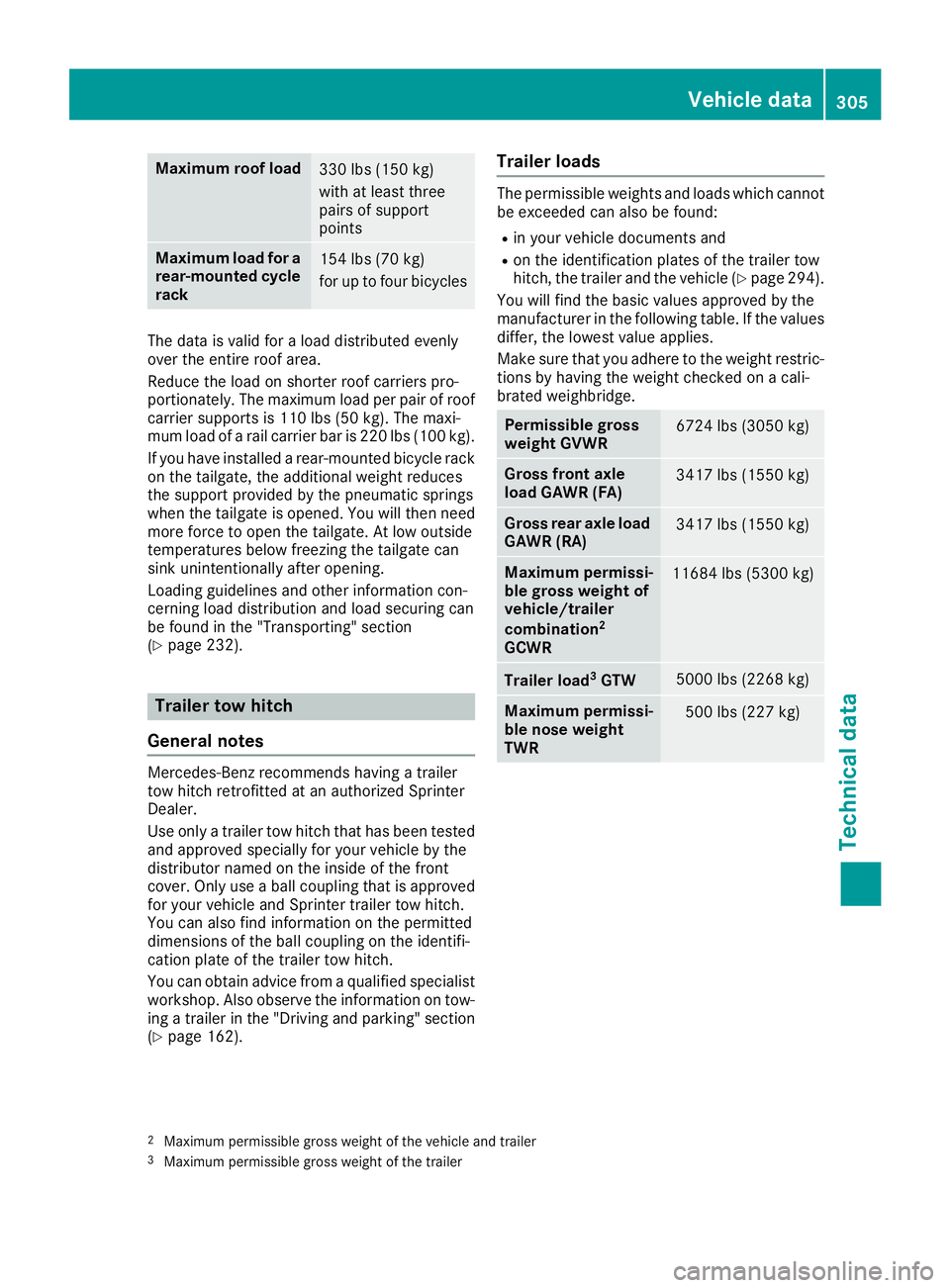
You wil lfind the basi cvalues approved by the
manufacturer in the following table .Ifthe values
differ, the lowest valu eapplies.
Make sure that you adhere to the weight restric-
tions by having the weight checked on acali-
brated weighbridge.
Permissible gross
weight GVWR6724 lbs (3050 kg)
Gross front axle
load GAWR (FA)3417 lbs (1550 kg)
Gross rear axle load
GAWR (RA)3417 lbs (1550 kg)
Maximum permissi-
ble gross weight of
vehicle/trailer
combination
2
GCWR
11684 lbs (5300 kg)
Trailer load3GTW5000 lbs (2268 kg)
Maximum permissi-
ble nose weight
TWR500 lbs (227 kg)
2Maximu mpermissibleg ross weight of the vehiclea nd trailer3Maximumpermissibl egross weight of the trailer
Vehicle data305
Technical data
Z