transmission MERCEDES-BENZ METRIS 2016 MY16 Operator’s Manual
[x] Cancel search | Manufacturer: MERCEDES-BENZ, Model Year: 2016, Model line: METRIS, Model: MERCEDES-BENZ METRIS 2016Pages: 310, PDF Size: 7.28 MB
Page 259 of 310
XCarefullyclean th ewiper blades wit hadamp
cloth.
XFol db ack th ewiper armsbefore switching on
th ei gnition.
Cleaning th eexterior lighting
!Only use cleanin gagents or cleanin gcloths
whic hare suitable for plasticlight lenses.
Unsuitable cleaningagents or cleanin gcloths
could scratch or damag ethe plastic light len-
ses.
XClean th eplastic coversoftheexterior light-
ing withad amp sponge and amildcleaning
agent, e.g .Mercedes-Ben zcar shampoo, or
wit hc leanin gcloths.
Cleaning th esensors
!Do no tuse dry, coarse or hard cloth sand do
no tscrub. You willotherwise scratch or dam-
age th esensors.
If you clean th esensorsw ithap ower washer
or steam cleaner, observ ethe information
provide dbythemanufacturer regardin gthe
dist ancetobem aintained between th evehi-
cle and th enozzle of thepower washer.
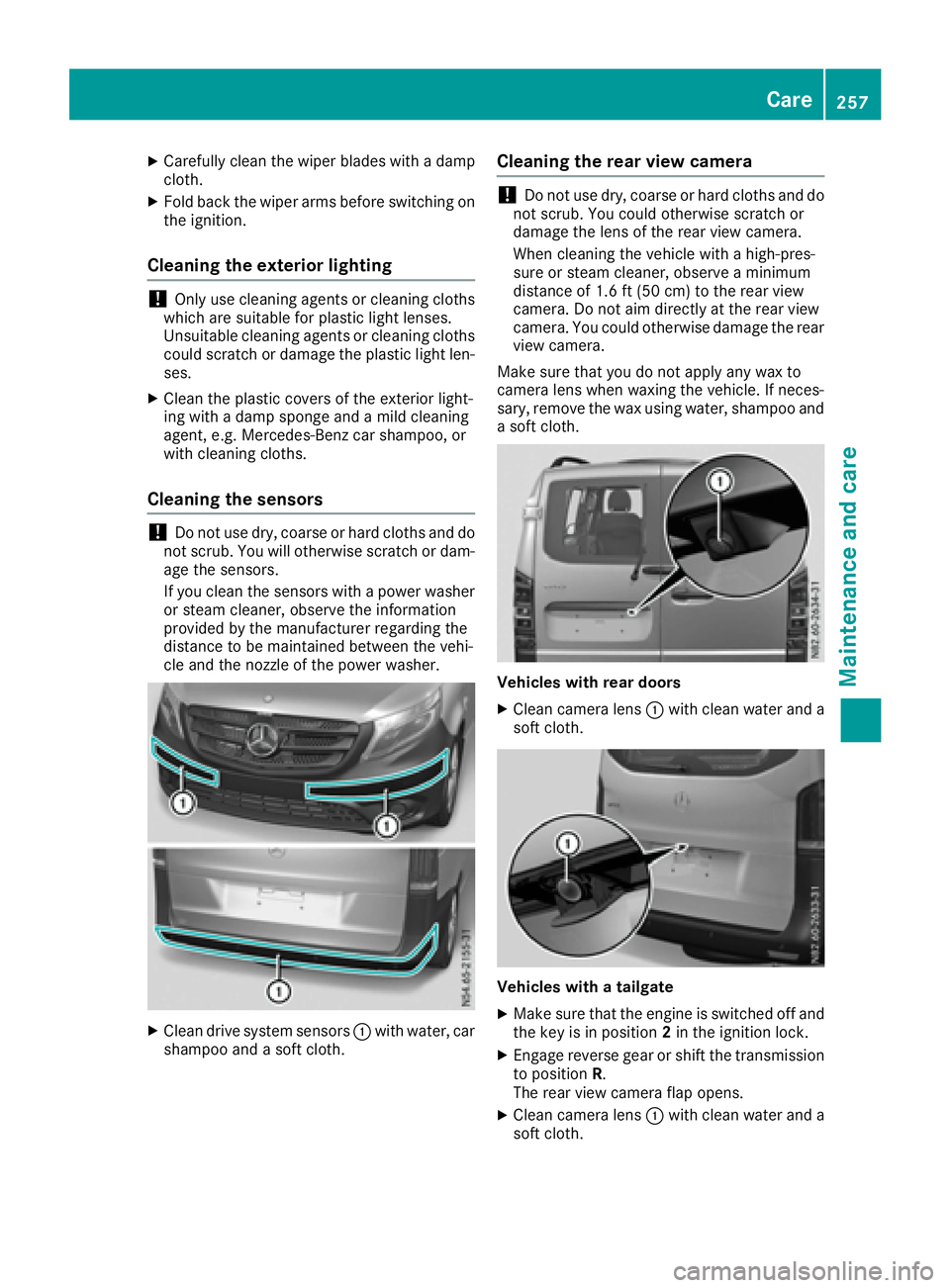
XClean drivesystem sensors :withw ater, car
shampoo and asoftc loth.
Cleaning th erearv iew camera
!Do no tuse dry, coarse or hard cloth sand do
no tscrub. You could otherwise scratch or
damag ethe lensoft herear view camera.
When cleanin gthe vehicle withah igh-pres-
sure or steam cleaner, observ eaminimum
distanc eof1.6ft (50 cm )totherear view
camera. Do no taim directly at th erear view
camera. You could otherwise damag ethe rear
view camera.
Makes ure that you do no tapply any wax to
camera lensw hen waxingthe vehicle .Ifneces-
sary, remove th ewax usingw ater, shampoo and
as oftc loth.
Vehicles with rea rdoor s
XClean camera lens :withc lean wate rand a
softc loth.
Vehicles with atailgate
XMakes ure that th eengineiss witched off and
th ek eyisin position 2in th eignition lock.
XEngage revers egear or shiftt hetransmission
to position R.
The rear view camera flap opens.
XClean camera lens :withc lean wate rand a
softc loth.
Care257
Maintenance and care
Z
Page 265 of 310
!Vehicles withagasolinee ngine:avoid
repeated and lengthy starting attempts. Oth-
erwise, the catalytic converter could be dam-
aged by non-combusted fuel.
If the indicator and warning lamps in the instru-
ment cluster do not light up at low tempera-
tures, the discharged battery may have frozen.
In this case you may neither charge the battery
nor jump-start the vehicle. The service life of a
thawed battery may be shorter. Start-up behav-
ior may deteriorate, in particular at low temper-
atures. Have the thawed battery checked at a
qualified specialist workshop.
Do not use arapid charging device to start the
vehicle. If your vehicle's battery is discharged,
the engine can be jump-started from another
vehicle or from adonor battery using jumper
cables. For this purpose, the vehicle has ajump-
starting connection point in the engine com-
partment.
When jump-starting, observe the following
points:
RThe battery is not accessible in all vehicles. If
the other vehicle's battery is not accessible,
jump-start the vehicle using adonor battery
or ajump-startingd evice.
RYou may only jump-start the vehicle when the
engine and exhaust system are cold.
RDo not start the engine if the battery is frozen.
Let the battery thaw first.
RJump-starting may only be performed from
batteries with anominal voltage of 12 V.
ROnly use jumper cables that have asufficient
cross-section and insulated terminal clamps.
RIf the battery is fully discharged, attach the
battery of another vehicle for afew minutes
before attempting to start. This charges the
empty battery alittle.
RMake sure that the two vehicles do not touch.
Make sure that:
Rthe jumper cables are not damaged.
Rbare parts of the terminal clamps do not come
into contact with other metal parts while the
jumper cables are connected to the battery.
Rthe jumper cables cannot come into contact
with parts such as the V-belt pulley or the fan.
These parts move when the engine is started
and while it is running.
Jumper cables and further information regarding
jump starting can be obtained at any qualified
specialist workshop.
Before connecting the jumper cables
XApply the parking brake.
XShift the transmission to position P.
XSwitch off all electrical consumers, e.g. audio
equipment, blower.
XTurn key to position 0in the ignition lock and
remove it.
XOpen the hood (Ypage 241).
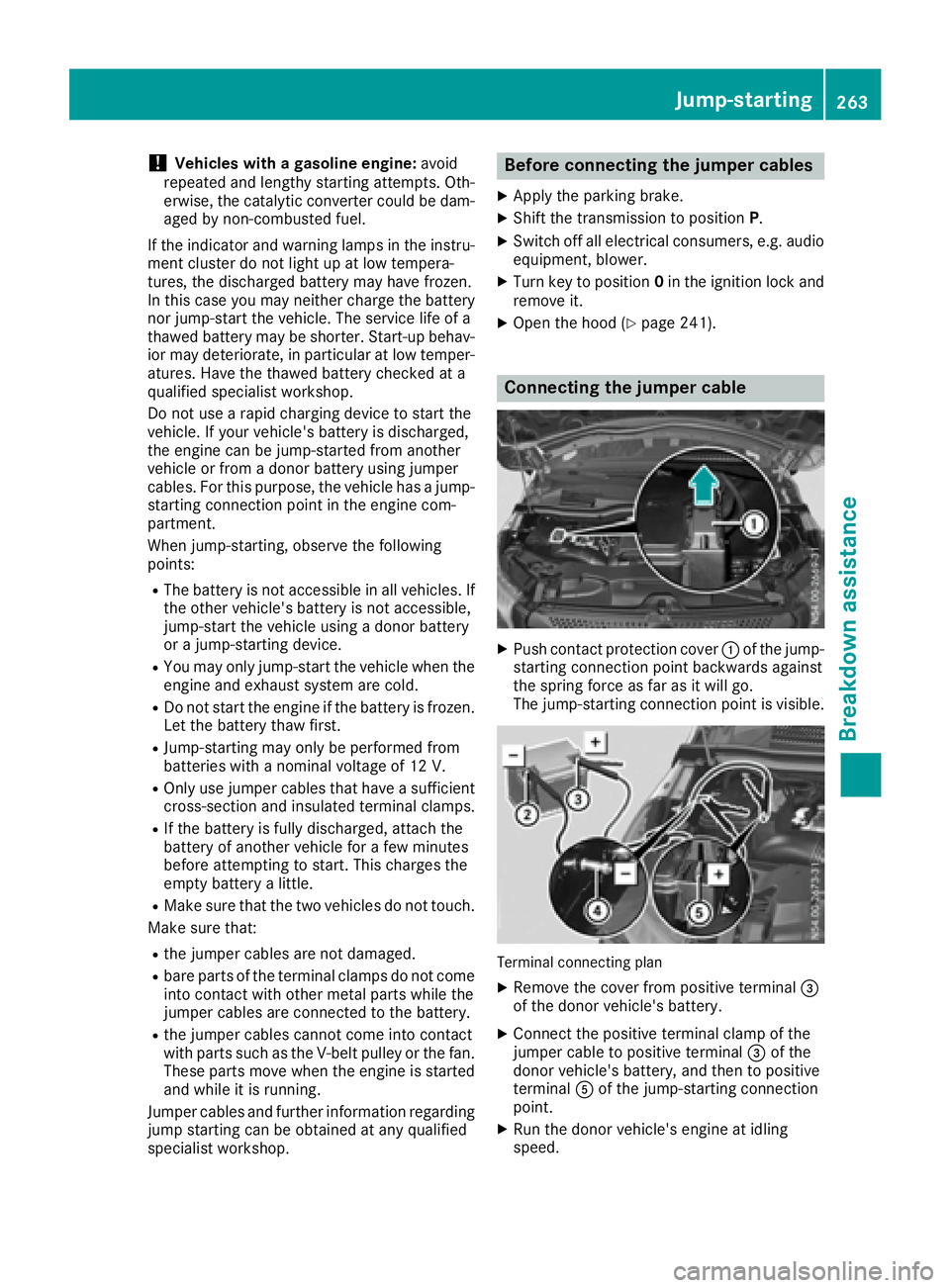
Connecting the jumper cable
XPush contact protection cover :of the jump-
starting connection point backwards against
the spring force as far as it will go.
The jump-startingc onnection point is visible.
Terminal connecting plan
XRemove the cover from positive terminal =
of the donor vehicle's battery.
XConnect the positive terminal clamp of the
jumper cable to positive terminal =of the
donor vehicle's battery, and then to positive
terminal Aof the jump-startingc onnection
point.
XRun the donor vehicle's engine at idling
speed.
Jump-starting263
Breakdown assistance
Z
Page 266 of 310
XConnect thenegative terminal clam pofthe
jumper cabl etonegative terminal ;of the
donor veh icle's battery, and then to earth
contact ?of your own veh icle.
XInsertt hekeyintot he ignition locka nd start
th ee ngine.
You can no wswitch electrical consumers
back on excep tthe lighting system.
XBefore disconnecting th ejumper cables, let
th ee nginer un for several minutes.
XDisconnect th enegative terminal of the
jumper cabl efrome arthc ontac t? and then
from negative terminal ;of th edonor veh i-
cle's battery.
XDisconnect th epositiv etermi nal clam pofthe
jumper cabl efromp ositiv etermi nalAon the
jump-startin gconnectio npoint, and then
from positiv etermi nal=of th edonor veh i-
cle's battery.
Contac tprotection cover :isautomatically
returned forwards to its original positio nby
th es pring force and th ejump-startin gcon-
nection pointisc losed.
XPositio nthe cover on positiv etermi nal=of
th ed onor veh icle's battery.
You can no wswitch on th elighting system.
XHav ethe battery checked at aqualified spe-
cialist workshop.
Tow-startin gand towin gaway
Important safety notes
GWAR NING
Functionsr elevanttosafety are restricted or
no longer availab leif:
Rthee ngineisn otrunning.
Rtheb rak esystem or th epower steering is
malfunctioning.
Rthere isam alfunctio ninthevoltage supply
or th evehicle 's electrical system.
If your veh icle is bein gtow ed, muc hmore
force may benecessary to steer or brake.
Thereisar iskofana cciden t.
In suchc ases, use atow bar. Before to wing,
mak esure that th esteering moves freely.
GWARNING
You can no longer steer th evehicle ifthe
steering wheel lockh as been engaged.There
is ar iskofana ccident.
Alwa ysswit ch off th eignition when to wingthe
vehicle withat owcabl eorat owbar.
GWARNING
When to wingor tow-startin ganother vehicle
and its weightisg reatertha nt he permissible
gross weightofy our vehicle,the :
Rthet ow ing eye could detach itself
Rthev ehicle /traile rcom binatio ncould roll-
over.
Thereisar iskofana ccident.
When towing or tow-startin ganother vehicle,
its weights hould notbegreatertha nt he per-
missible gross weightofy our vehicle.
In formation on th egross vehicle weightc anbe
foun dont hevehicle identification plate
(
Ypage 294).
!Secure th etow rop eort owbar to th etow ing
eye or trailer to whitch only. Otherwise, the
vehicle could become damaged.
!Do no tuse th etow ing eye for recovery, this
could damag ethe vehicle .Ifindoubt,recover
th ev ehicle withac rane.
!Drive slowlya nd smoothly when to wing.
Excessivet ractive power could otherwise
damag ethe vehicles.
!Shift th eautomatic transmission to Nand
do noto pen th edriver' sorf rontpassenger's
door durin gtow ing .The automatic transmis-
sion may otherwise shifttop ositionP,which
could damag ethe transmission.
!The vehicle can be towed amaximum of
30 mile s(50km ).The to wingspeedof30m ph
(50 km/h) must no tbeexceeded.
If th evehicle has to betowed mor ethan
30 mile s(50km) ,the entire vehicl emus
tbe
ra
ised and transported.
When towing away, you must observet helegal
requirement sfor th ecountr yinw hichy ou are
currently driving.
It is bette rtohave th evehicle transported than
to have it towed.
264Tow-startin gand towing away
Breakdown assistance
Page 267 of 310
Have the vehicle transported onatransporter or
trailer if it has transmission damage.
Whent owing, the automati ctransmission must
be in position N.Ifthe automati ctransmission
cannot be shifted to position N,havet he vehicle
transported on atransporter or trailer.
The battery mus tbeconnected and charged.
Otherwise ,you :
Rcannot turn the key to position 2in the igni-
tion lock
Rcannot shift the transmission to position N
Before the vehicle is towed, switch off the auto-
mati clocking feature (
Ypage 72). You could
otherwise lock yourself out of the vehicle when
pushing or towing away the vehicle.
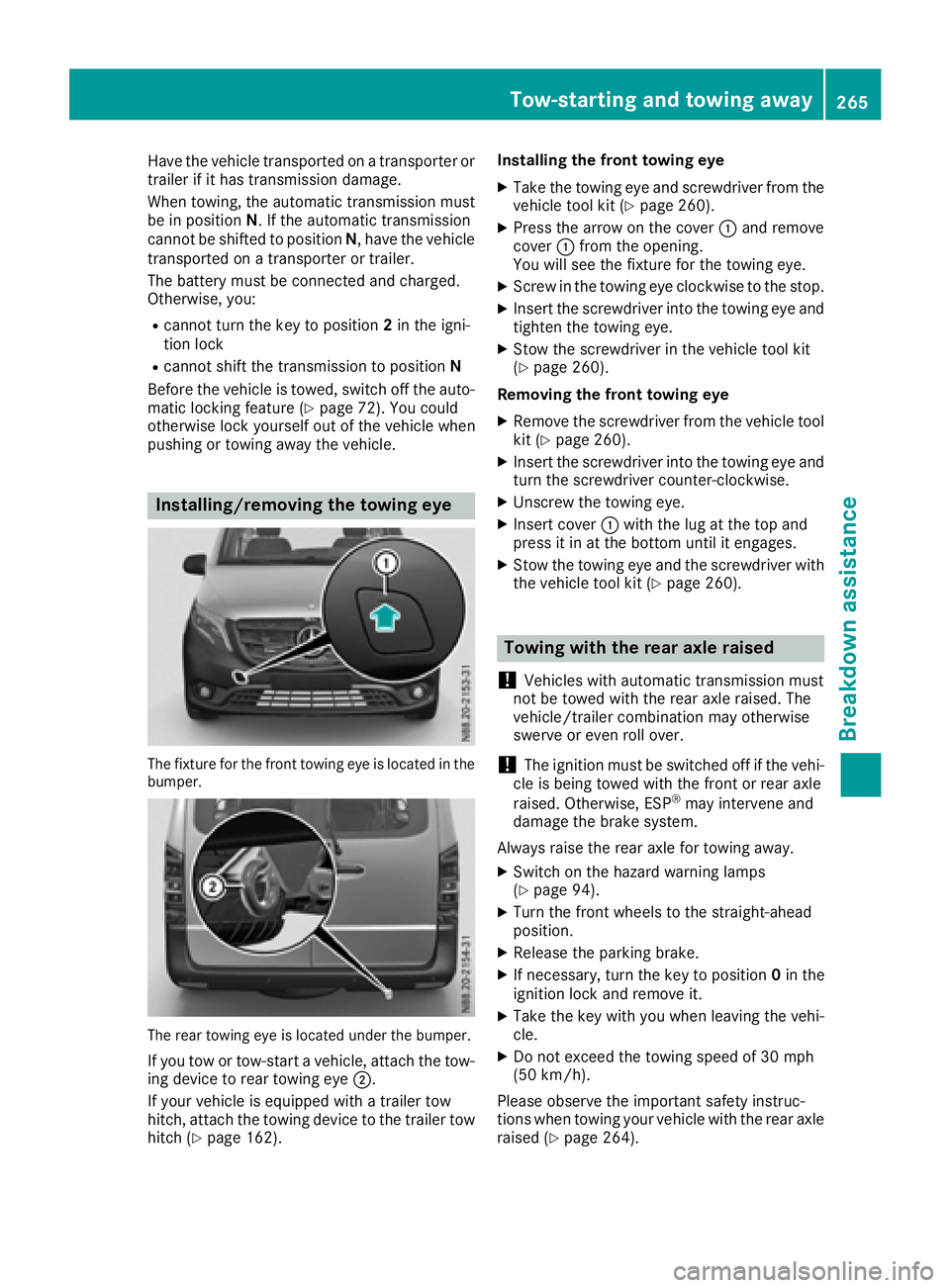
Installing/removin gthe towing eye
The fixtur efor the front towing eyeisl ocated in the
bumper.
The rea rtowing eyeisl ocated underthe bumper.
If yo utow or tow-start avehicle, attach the tow-
ing device to rea rtowing eye ;.
If your vehicle is equipped with atrailer tow
hitch, attach the towing device to the trailer tow
hitch (
Ypage 162). Installing the front towing eye
XTake the towing eyea
nd screwdriver from the
vehicle tool kit (Ypage 260).
XPres sthe arro wonthe cover :and remove
cover :from the opening.
You will see the fixtur efor the towing eye.
XScrew in the towing eyec lockwise to the stop.
XInsert the screwdriver into the towing eyea nd
tighte nthe towing eye.
XStow the screwdriver in the vehicle tool kit
(Ypage 260).
Removing the front towing eye
XRemove the screwdriver from the vehicle tool
kit (Ypage 260).
XInsert the screwdriver into the towing eyea nd
turn the screwdriver counter-clockwise.
XUnscrew the towing eye.
XInsert cover :with the lu gatthe top and
pres sitinatt he bottom until it engages.
XStow the towing eyea nd the screwdriver with
the vehicle tool kit (Ypage 260).
Towing with the rear axle raised
!
Vehicles with automati ctransmission must
not be towe dwitht he rea raxler aised.T he
vehicle/trailer combinatio nmay otherwise
swerve or even roll over.
!The ignition mus tbeswitched off if the vehi-
cle is being towe dwitht he front or rea raxle
raised.O therwise,ESP
®may intervene and
damag ethe brake system.
Always raise the rea raxlef or towing away.
XSwitch on the hazard warning lamps
(Ypage 94).
XTur nthe front wheels to the straight-ahead
position.
XRelease the parking brake.
XIf necessary ,turn the key to position 0in the
ignition lock and remov eit.
XTake the key with yo uwhenleaving the vehi-
cle.
XDo not excee dthe towing speed of 30 mph
(50 km/h).
Please observe the important safety instruc-
tions whe ntowing your vehicle with the rea raxle
raised (
Ypage 264).
Tow-starting and towing away265
Breakdow nassistance
Z
Page 268 of 310
Towingthe vehicle with both axles on
the ground
Important safety notes
GWARNING
Yo uc an no longe rstee rthe vehicl eifthe
steerin gwheel lock hasb eene ngaged .There
is ar iskofana ccident.
Alway sswitch off the ignition when towing the
vehicl ewithat ow cable or atow bar.
!Do not exceed the towing spee dof30mph
(50 km/h). Yo ucould otherwis edamag ethe
transmission.
Please observe the important safety notes
befor etowing your vehicl e(
Ypage 264).
Towingvehicle switha utomatic trans-
mission
XTurn the key to position 2in the ignition lock.
XDepres sthe brake peda land kee pit
depressed.
XShift the automatic transmission to position
N.
XLeave the key in position 2in the ignition lock.
XSwitch on the hazar dwarning lamps
(Ypage 94).
XReleas ethe parkin gbrake.
XReleas ethe brake pedal.
XDo not exceed the towing spee dof30m ph
(50 km/h).
Recovering avehicle that is stuck
!
When recovering avehicl ethath asbecome
stuck, pull it as smoothl yand evenly as pos-
sible. Excessive tractiv epower could damage
the vehicles.
If the drive wheels gett rapped on loose or
mudd yground ,recover the vehicl ewitht he
utmost care. Thi sisespecially the cas eifthe
vehicl eisladen .
Never attempt to recover avehicl ewithat railer
attached.
Pull ou tthe vehicl ebackwards ,ifpossible, using
the tracks it made when it becam estuck.
Transporting the vehicle
!
Yo um ayonl ysecur ethe vehicl ebythe
wheels ,not by parts of the vehicl esucha s
axl eors teerin gcomponents. Otherwise, the
vehicl ecould be damaged.
The towing ey eortrailer tow hitch can be used
to pull the vehicl eonto atrailer or transporte rif
yo uw ishtot ransport it.
XTurn the key to position 2in the ignition lock.
XShift the transmission to position N.
XReleasethe parkin gbrake.
If the vehicle is loaded:
XShift the transmission to position P.
XTurn the key to position 0in the ignition lock
and remove it.
XMake sure the parkin gbrake is applied.
XLash down the vehicle.
Tow-starting (emergency engine
starting)
Vehicle switha utomatic transmission
!Vehicles with automatic transmission must
not be tow-started .You could otherwis edam -
ag et he automatic transmission.
Yo uc an find informatio nonjump-starting under
"Jump-starting “(
Ypage 262).
Electrical fuses
The fuse allocation chart and important safety
informationonthe fuses can be found in the
"Fuse allocation chart" supplement.
266Electrical fuses
Breakdow nassistance
Page 289 of 310
Mountingawheel
Vehicle preparation
XStop the vehicleasf ar awayaspossible from
traffic and on alevel, firm and non-slip sur-
face.
XIf you rvehicl eposesar isk to approaching
traffic, switch on the hazar dwarning lamps.
XApply the parking brake.
XTurn the front wheels to the straight-ahead
position.
XShift the transmission to position P.
XSwitch off the engine.
XPassengers should leave the vehicle. Make
sure that the passengers are not endangered
as they do so.
XMake sure that no one is near the dange rarea
while the whee lisbeing changed .Anyone
who is not directly assisting in the wheel
change should, for example, stand behind the
barrier.
XPlace the warning triangl eorwarning lamp at
as uitable distance.
Observe the lega lrequirements on the cor-
rect use of the warning triangl eorwarning
lamp for the country in which you are cur-
rently driving
XSecure the vehicletop revent it from rolling
away.
Observe the safety notes on parking under
"Driving and parking" (
Ypag e132)
XOn level terrain: place chocks or other suit-
abl eo bjects under the front and rear of the
whee lthat is diagonally opposite the whee lto
be changed.
XOn slight inclines: place chocks or other
suitable objects under the wheels on the front and rear axle sopposite the whee ltobe
changed.
XIf included in the vehiclee quipment, take the
tire-changing tool kit out of the vehiclet ool kit
(
Ypag e260).
Apart from some country-specific variants,
vehicles are not equipped with tire-changing
tools. Some tools for changing awhee lare
specific to the vehicle. Consult aqualified
specialist worksho pfor more information on
which tools are required to perform awheel
change on you rv
ehi cle.
XIf included in the vehiclee quipment, remove
the spare whee lfrom the spare whee lbracket (
Ypag
e292) .Observe the safety notes listed
under "Spare wheel" (Ypag e291).
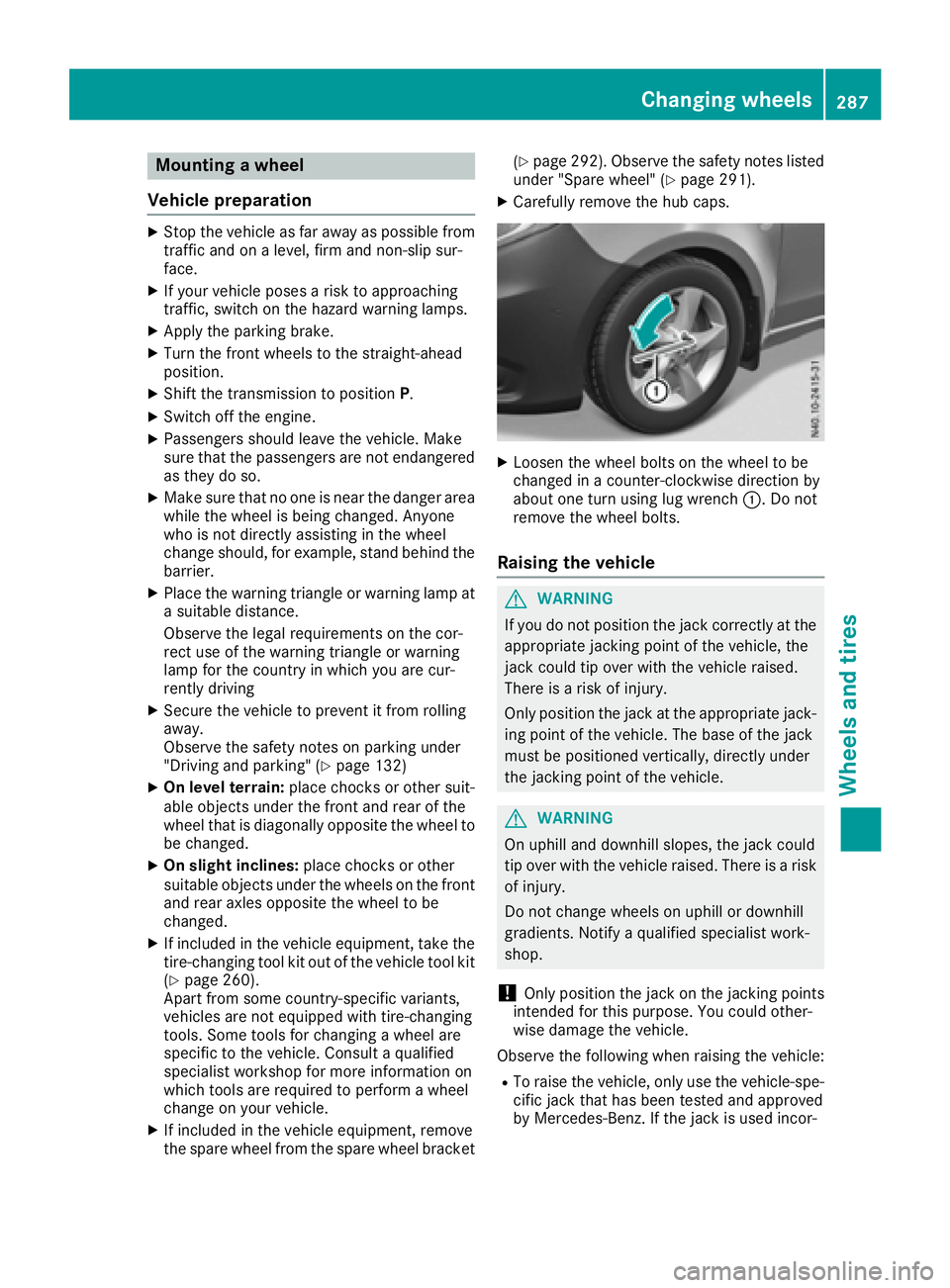
XCarefully remove the hub caps.
XLoosen the whee lbolts on the whee ltobe
changed in acounter-clockwise direction by
about one turn using lug wrench :.Donot
remove the whee lbolts.
Raisingt he vehicle
GWARNING
If you do not position the jack correctly at the
appropriate jacking point of the vehicle, the
jack coul dtip over with the vehicler aised.
There is arisk of injury.
Only position the jack at the appropriate jack-
ing point of the vehicle. The bas eofthe jack
must be positioned vertically,d irectly under
the jacking point of the vehicle.
GWARNING
On uphill and downhill slopes, the jack could
tip over with the vehicler aised. There isarisk
of injury.
Do not change wheels on uphill or downhill
gradients. Notify aqualified specialist work-
shop.
!Only position the jack on the jacking points
intended for this purpose. You coul dother-
wis edamage the vehicle.
Observe the following when raising the vehicle:
RTo rais ethe vehicle, only use the vehicle-spe-
cific jack that has been tested and approved
by Mercedes-Benz. If the jack is use dincor-
Changing wheels287
Wheels and tires
Z
Page 296 of 310

Useful information
This Operator's Manual describes all models as
well as standard and optional equipment of your
vehicle that were available at the time of going
to print.Country-specific variation sare possi-
ble. Note that your vehicle may not be equipped
with all of the described functions. This also
applies to system sand function srelevantt o
safety.
Read the information on qualified specialist
workshops (
Ypage 29).
Vehicle electronics
Tampering with the engine electron-
ics
!
Only have engin eelectronics and the corre-
spondin gparts, such as contro lunits ,actua-
tors, sensors or connector leads, serviced at a
qualified specialist workshop. Otherwise, the
vehicle parts may wear more quickly. This can
lead to loss of the New Vehicle Limited War-
ranty.
Installing electrical or electronic
equipment
You and other scan suffer health-related dam-
age through electromagnetic radiation .Byusing
an exterior antenna, apossible health risk
caused by electromagnetic fields, as discussed
in scientific circles, is taken int oaccount. Only
have the exterior antenn ainstalled by aqualified
specialist workshop.
Electrical and electronic devices may have a
detrimental effectonb oth the comfort and the
operatin gsafetyoft he vehicle. If equipment of
this kin disinstalled, its electromagnetic com-
patibility must be checked and verified.
If thes edevices are linked to function sassoci-
ated with resistance to interference, they must
have type approval. This applies to the device or
its interfaces to the vehicle electronics, e.g.
chargingb rackets.
At elephon eortwo-way radio to be installed in
the vehicle must be approved. Further informa-
tion can be found in any Mercedes-Benz Com-
mercial Van Center. For operatio
nofmobile phones and two-way
radios, Mercedes-Benz recommends connec-
tion to an approved exterior antenna. This is the
only way to ensure optimum reception quality
inside the vehicle and to minimize mutual inter-
ference between the vehicle electronics, mobile
phones and two-way radios.
The transmission output of the mobile phone or
two-way radio may not exceed the following
maximum transmission output (PEAK):
Frequency rangeMaximum trans-
mission output
(PEAK)
Shortwave
(f <50M Hz)100 W
4mwaveband30 W
2mwaveband50 W
Trunked radio/Tetra35 W
70 cm waveband35 W
GSM/UMTS/LTE10 W
Identification plates
Vehicle identification platew ith vehi-
cle identification number (VIN)
Vehicle identification plate on the driver's side B-
pillar
XOpen the driver’s door.
You will see vehicle identification plate :
with the vehicle identification number (VIN),
the paint code and the permissible weight
data.
294Identification plates
Technical data
Page 297 of 310
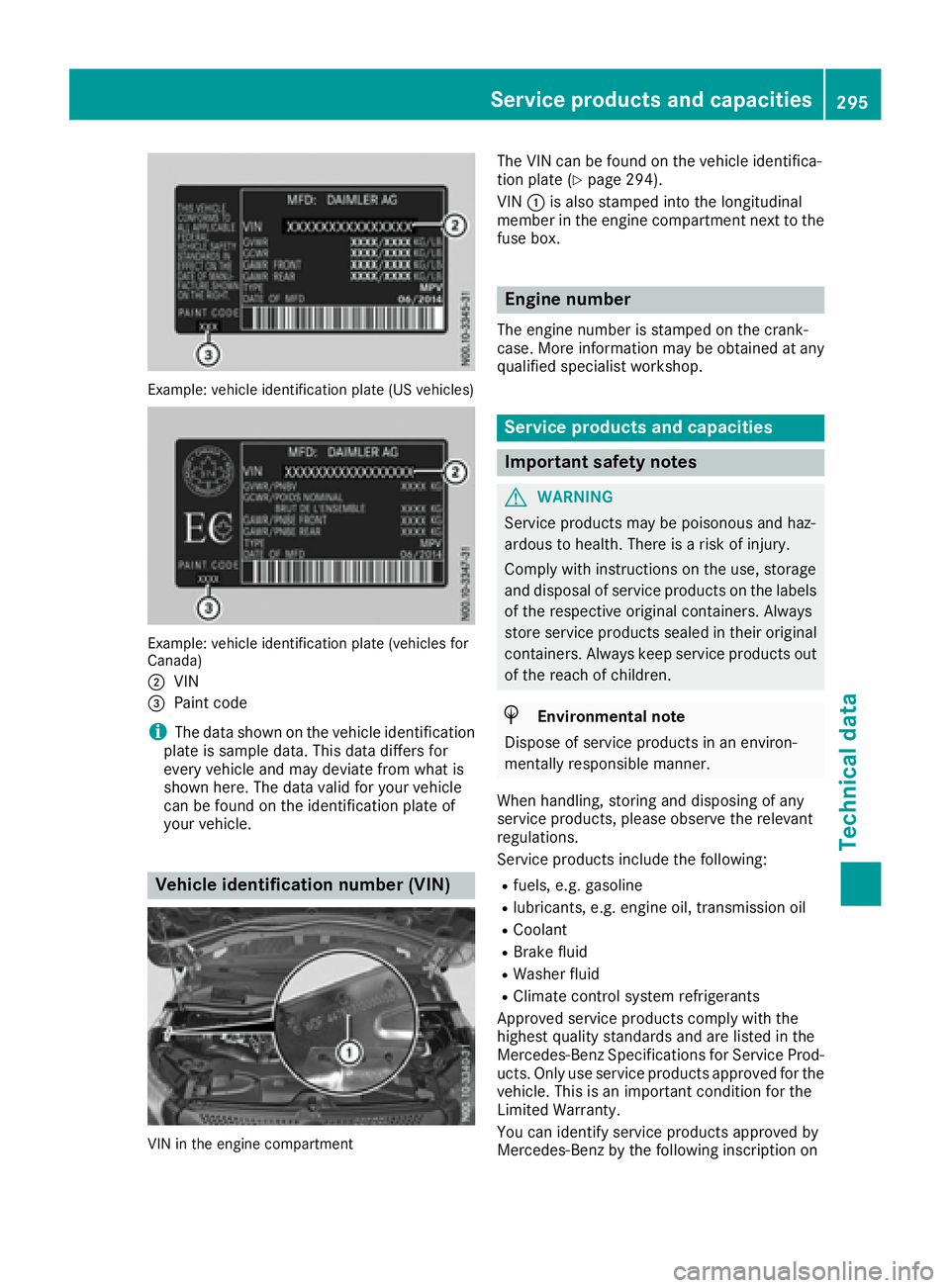
Example: vehicleide ntification plate (US vehicles)
Example: vehicl eide ntification plate (vehicle sfor
Canada)
;
VIN
=Paint code
iThe data shown on the vehicl eide ntification
plate is sampl edata. Thi sdatad iffers for
every vehicl eand mayd eviate from what is
shown here. The data vali dfor your vehicle
can be found on the identificatio nplate of
your vehicle.
Vehicl eidentificatio nnumber (VIN)
VIN in the engine compartment
The VIN can be found on the vehicl eide ntifica-
tio np late (Ypage 294).
VIN :is also stampe dinto the longitudinal
membe rinthe engine compartment next to the
fuse box.
Engine number
The engine numbe risstampe donthe crank-
case. Mor einformatio nmaybe obtained at any
qualified specialist workshop.
Service products and capacities
Important safety notes
GWARNING
Service products maybep oisonousand haz-
ardous to health .There is ariskofi njury.
Compl ywithi nstructions on the use, storage
and disposalofs erviceproducts on the labels
of the respective original containers. Always
stor eservic eproducts seale dintheiroriginal
containers. Alway skeeps ervic eproducts out
of the reach of children.
HEnvironmental note
Dispose of servic eproducts in an environ-
mentall yresponsibl emanner.
Whe nhandling ,storing and disposing of any
servic eproducts, please observe the relevant
regulations.
Service products includ ethe following:
Rfuels, e.g .gasoline
Rlubricants ,e.g.e ngine oil, transmission oil
RCoolant
RBrake fluid
RWashe rfluid
RClimate contro lsystem refrigerants
Approve dservic eproducts comply with the
highest quality standards and ar elisted in the
Mercedes-Benz Specifications for Service Prod-
ucts .Onlyu seservic eproducts approved for the
vehicle. Thi sisanimportant condition for the
Limite dWarranty.
Yo uc an identify servic eproducts approved by
Mercedes-Benz by the following inscription on
Servic eproducts and capacities295
Technica ldata
Z
Page 300 of 310
The following components of the different vehi-
cle versions influence fuel consumption:
Rtire sizes, tire tread, tire pressure, tire condi-
tion
Rtransmission ratios for the drive assemblies
Radditional equipment (e.g. air-conditioning
system, auxiliary heating system)
For these reasons, the actual consumption fig-
ures for your vehicle may deviate from the con-
sumption figures determined according to EU
Directive 80/1268/EE C.
Detail sonfuelconsumption can be calle dupin
the on-board computer:
Ron vehicles withou tsteerin gwheel buttons
(Ypage 171)
Ron vehicles with steerin gwheel buttons
(Ypage 178)
Engine oil
General notes
When handling engine oil, observe the important
safety note sonserviceproducts (Ypage 295).
The quality of the engine oi lusedisofd ecisive
importance for the engine's functionality and
operating life. Mercedes-Benz continually
approves engine oils based on comple xexperi-
ments according to the current state of the art.
Therefore ,onlyM ercedes-Benz approved
engine oils maybeu sedinM ercedes-Benz
engines. Mercedes-Benz recommends having
the oi lchange dataq ualified specialis twork-
shop. Informatio
nabout approved engine oils can be
obtained:
Rfroma ny Mercedes-Benz Commercial Van
Center
Ron the Internet at
http://bevo.mercedes-benz.co mbyenter ing
th ed esignation ,e.g.2 29.5 .
Mercedes-Ben zapprova lisindicate dont heoil
container by th einscriptio n„MB-Freigabe “or
„MB Approval“ and th ecorre spondin gdesigna-
tion ,e.g.M B-Freig abe or MB Approval 229.5.
Designation softheapprove dengineo ils for
your vehicl e
MB-Freigabe or MB
Approval229.5
Mercedes-Ben zrecommends that you only use
approve dmulti-grade engin eoils of th eSAE
classe sSAE 0W-30 and SA E0W-40 or
SA E5 W-30 and SA E5W-40. These engin eoils
ensur eoptimum lubrication eve natveryl ow
outside temperatures (
Ypage 299).
Whe ntoppin gup, we recommen dthaty ou only
use engin eoil of th esam egrade (MB-Freigabe
or MB Approvaldesignation )and SA Eclass as
th eo il filled at th elast oil change.
iIf th eengineo ils listed in th etable are no t
available, you may add th efollowin gengine
oils until th enexto il change:
RMB-Freigabe or MB Approval 229.1, or
ACE AA3
This mus tonlybea dded once and th eamount
mus tnotbe greate rtha n1q t(1.0l ).
Subsequentl yhavet he engin eoil changed at
th ee arliest possibl eopportunity.
!Using engin eoils of another grade qualit yis
no tp ermitted.
Capacities
!Do no tadd to omucho il. addin gtoo muc h
engin eoil can result in damage to th eengine
or to th ecatalytic converter. Hav eexces s
engin eoil siphoned off .
Oil change includin goil filter
Engin eoilApprox. 2USgal
(7.75 l)
298Service products and capacities
Technical data
Page 301 of 310
Additives
!Do notuse any additive sintheengin eoil.
This could damag ethe engine.
Engineo il viscosity
!If theSAE viscosit yclassoft heengin eoil
used does no tcover th eoutside temperature
range in whic hyou are operating th evehicle,
it mus tbechanged in goo dtime, in particular
before th ecolds eason commences. Using an
engin eoil that does no thavea dequate tem-
peratur echaracteristics can lead to engin e
damage.
The temperature range information of th eSAE
classification always refers to that of fresh oil.
The temperature characteristics of th eengine
oil may deteriorat esignificantly due to agin g
in use, especially at low outside tempera-
tures.
We recommen dthaty ou chang ethe engin e
oil before th ecolds eason commences. Use
an approve dengineo il of th especifie dSAE
class.
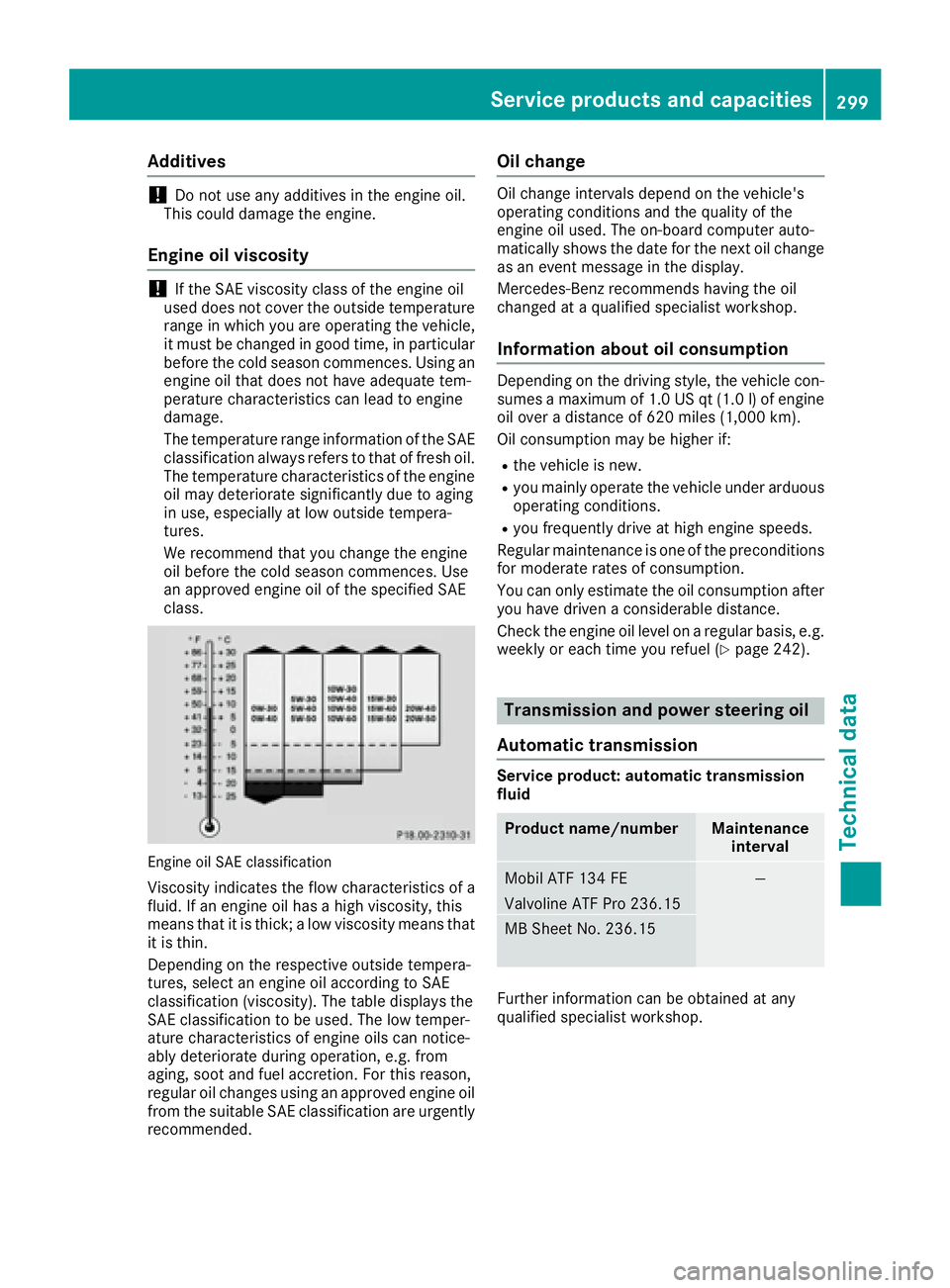
Engin eoil SA Eclassification
Viscosit yindicates th eflowc haracteristics of a
fluid .Ifane ngineo il has ahigh viscosity, this
mean stha titi sthick ;al ow viscosit ymean stha t
it is thin.
Dependin gontherespective outside tempera-
tures, select an engin eoil according to SA E
classification (viscosity). The table displays th e
SA Ec lassification to be used .The low temper-
atur echaracteristics of engin eoils can notice -
ably deteriorat eduring operation ,e.g.f ro m
aging, soo tand fuel accretion .For this reason ,
regular oil changes usin ganapprove dengineo il
from th esuitable SA Eclassification are urgently
recommended.
Oil change
Oil chang eintervals depend on th evehicle's
operating condition sand th equalit yoft he
engin eoil used .The on-board computer auto -
matically shows th edatef or th enexto il chang e
as an event message in th edisplay.
Mercedes-Benz recommends having th eoil
changed at aqualified specialist workshop .
Information abou toil consump tion
Dependin gonthedrivin gstyle, th evehicl econ-
sumes amaximum of 1. 0USqt(1.0l )ofe ngine
oil over adistance of 620 miles (1,000 km).
Oil consumption may be higher if:
Rthe vehicle is new.
Ryou mainly operate the vehicle under arduous
operating conditions.
Ryou frequently drive at high engine speeds.
Regularm aintenance is one of the preconditions
for moderate rates of consumption.
You can only estimate the oil consumption after
you have driven aconsiderable distance.
Check the engine oil level on aregular basis, e.g.
weekly or each time you refuel (
Ypage 242).
Transmission and power steering oil
Automatic transmission
Service product: automatic transmission
fluid
Product name/numberMaintenance interval
Mobil ATF 134 FE
Valvoline ATF Pro 236.15—
MB Sheet No. 236.15
Further information can be obtained at any
qualified specialist workshop.
Service products and capacities299
Technical data
Z