brake MERCEDES-BENZ METRIS 2016 MY16 Operator’s Manual
[x] Cancel search | Manufacturer: MERCEDES-BENZ, Model Year: 2016, Model line: METRIS, Model: MERCEDES-BENZ METRIS 2016Pages: 310, PDF Size: 7.28 MB
Page 252 of 310
connection point in the engine compartment
(Ypage 262).
RHave the battery removed ataquali fied spe-
cialist workshop.
Installationl ocations
You rvehicle may be equipped with three bat-
teries, depending on the equipment version:
RStarter battery in the seatb aseoft he right-
hand front seat
RAuxiliary battery in the seatb aseoft he right-
hand front seat
RAdditiona lbattery in the seatb aseoft he left-
hand front seat
Disconnecting and removing
GWARNING
During the charging process ,abattery produ-
ces hydrogen gas. If ashort circuit occurs or
sparks are created, the hydrogen gasc an
ignite. There is ariskofane xplosion.
RMake sure that the positive terminal of a
connected battery doe snot come into con-
tact with vehicle parts.
RNeve rplace metalo bjects or toolsonab at-
tery.
RIt is important that yo uobserve the descri-
bed order of the battery terminal swhen
connecting and disconnecting abattery.
RWhe njump-starting, make sure that the
battery poles with identica lpolarity are
connected.
RIt is particularly important to observe the
described order whe nconnecting and dis-
connecting the jumper cables.
RNeve rconnect or disconnect the battery
terminal swhile the engine is running.
GWARNING
Batter yacidisc austic. There is ariskofi njury.
Avoidc ontact with skin, eyes or clothing. Do
not inhale any battery gases .Donot lean over
the battery.K eepc hildre nawayfrom batter-
ies. Wash away battery aci dimmediatel ywith
plenty of clean water and seekm edicalatten-
tion.
!You shoul dhavea llwork involving the bat-
tery carrie doutataq uali fied specialist work-
shop.
If, in exceptiona lcircumstances, yo uneed to
disconnect the battery yourself, please make
sure that:
RSecure the vehicle to prevent it from rolling
away.
RYou have switched off the engine and
removed the key.M akes uret he ignition is
switched off. Check to see that there are no indicator lamps lighting in the instrument
cluster. Electronic components such as the
alternator may otherwise be damaged.
RAfter the battery hasb eend isconnected,
the parking brake is automatically
engaged .You can then no longer move the
vehicle.
RFor vehicle switha utomatic transmission,
the transmission is locke dinposition P
afte rdisconnecting the battery.Y ou can
then no longer move the vehicle.
RYou have firs tremoved the negative termi-
nal and then the positive terminal .Never
mix up the terminal clamp disconnection/
connection order and never mix up the ter-
mina lclamps. The vehicle's electronics
may otherwise be damaged.
The battery and the cover of the positive ter-
mina lclamp mus tbeinstalled securel yduring
operation.
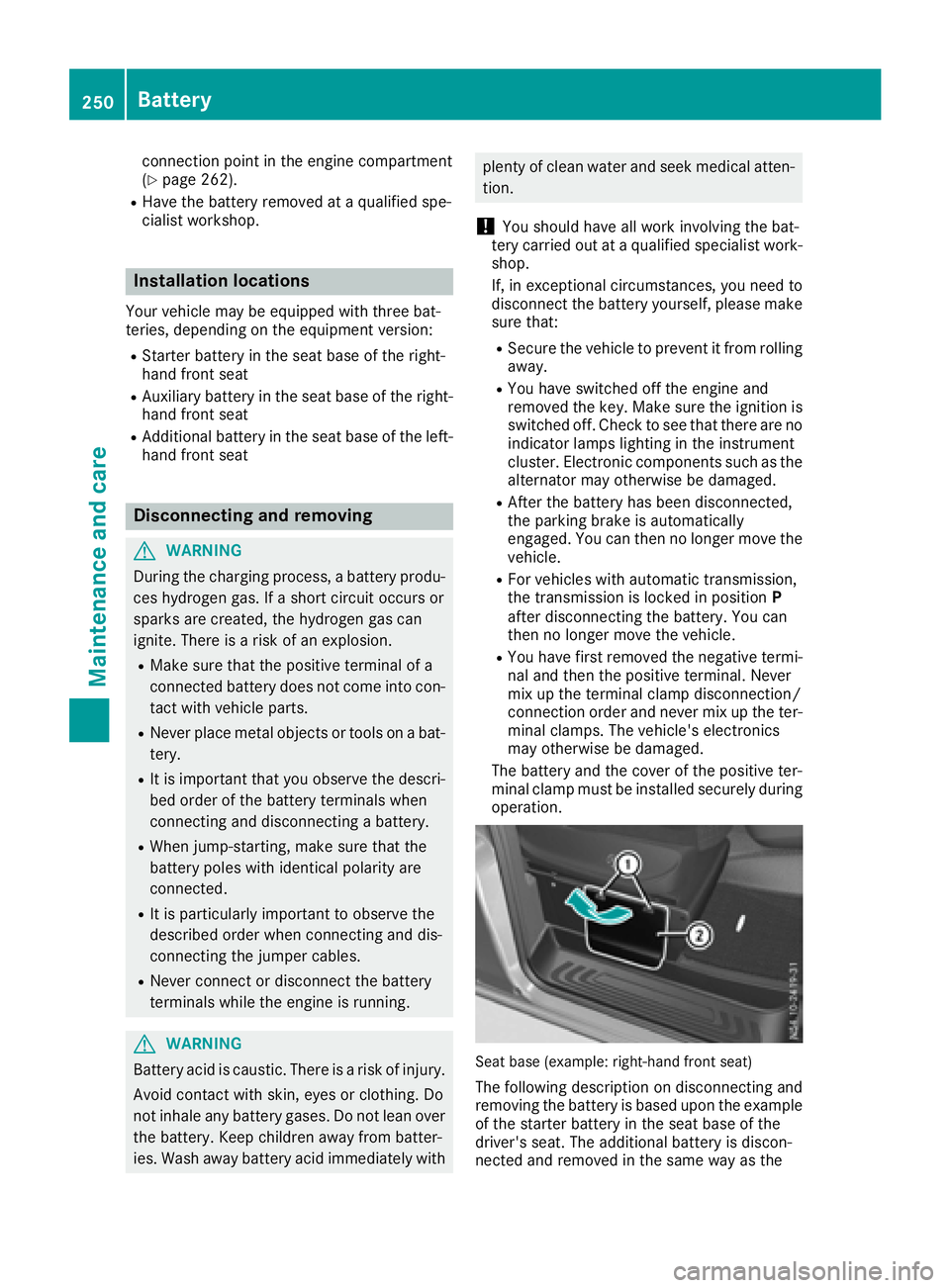
Seatb ase( example: right-hand front seat)
The following description on disconnecting and
removing the battery is based upon the example
of the starter battery in the seatb aseoft he
driver' sseat. The additiona lbattery is discon-
nected and removed in the sam ewayas the
250Battery
Maintenancea nd care
Page 256 of 310
Care
Notes on care
GWARNING
If you use opening sinthebodywork or
detachable part sassteps, you could:
Rslip and/or fall
Rdamag ethe vehicle and caus eyourself to
fall.
Thereisar iskofi njury.
Always use secure climbinga ids, e.g.asuita-
ble ladder.
!Do no tuse th elower slidingd oor guide (car-
riage )asas tep. Otherwise, you coul ddamage
th ep anelinga nd/or theslidingd oor mecha-
nism.
!For cleanin gyour vehicle ,donotuse any of
th ef ollowing:
Rdry, roug horhard cloths
Rabrasive cleanin gagents
Rsolvents
Rcleanin gagents containing solvents
Do no tscrub.
Do no ttou ch th esurfaces or protective films
withh ard objects, e.g .aringori ce scraper.
You coul dotherwise scratch or damag ethe
surfaces and protective film.
!Do no tpark th evehicle for an extended
period straigh tafter cleanin git, particularly
after having cleane dthe wheelsw ithwheel
cleaner. Wheelc leaners couldcause
increased corrosion of th ebrak ediscsa nd
brak epads/linings. For this reason,y ou
should driv efor afew minute safter cleaning.
Brakin gheatst hebrak ediscsa nd thebrake
pads/linings, thus dryin gthem. The vehicle
can then be parked.
HEnvironmental note
Only clean your vehicle at specially designed
wash bays. Dispose of emptyc ontainers and
used cleanin gproduct sinane nvironmentally
responsible manner.
HEnvironmental note
Dispose of emptyp ackagingand cleaning
cloth sinane nvironmentall yresponsible man-
ner.
Regular car eofyour vehicle is acondition for
retaining th equalityint helongt erm.
Use car eproduct sand cleanin gagents recom-
mended and approved by Mercedes-Benz.
Washingt hevehicle and cleaning the
paintwork
Automatic car wash
GWARNING
Brakin gefficienc yisreduced after washing
th ev ehicle .Thereisar iskofana ccident.
Afte rthe vehicle has been washed, brake
carefull ywhile payinga ttentiontothetraffic
conditionsu ntil full braking power is restored.
!Makesure that th eautomatic car wash is
suitable for th esizeoft hevehicle.
Before washingt hevehicle in an automatic
car wash, fold in th eexteri or mirror sand
remove any additional antennas .Otherwise,
th ee xteri or mirror ,antenna or th evehicle
itself coul dbedamaged.
Makes ure that th eexteri or mirror sare fully
folded out again and that any additional
antennas are re-installed when you leave the
automatic car wash.
!Makes ure that:
Rthes ide windows and th eroofa re com-
pletely closed
Rth ec limate control blower is switched off
Rthew indshield wiper switch is at position 0
The vehicle coul dotherwise be damaged.
You can wash th evehicle in an automatic car
wash from th everys tart.
Wash off exces sdirt before cleanin gthe vehicle
in an automatic car wash.
Afte rputtin gthe vehicle throug hanautomatic
car wash, wipe off wax from:
Rth ew indshield
Rthew indshield wiper blades
254Care
Maintenance and care
Page 257 of 310
This will prevent smears and reduce wiping
noises caused by residue on the windshield.
Ron vehicles with rear doors, from the rear view
camera lens in the top of the license plate
molding (
Ypage 257)
Washing by hand
In some countries, washing by hand is only
allowed at specially equipped washing bays.
Observe the legal requirementsofthe country
you are currently in when washing by hand.
XDo not use hot water and do not wash the
vehicle in direct sunlight.
XUse asoft car sponge.
XUse amild cleaning agent, e.g. aMercedes-
Benz approved car shampoo.
XThoroughly hose down the vehicle with agen-
tle jet of water.
XDo not point the water jet directly towards the
air inlets.
XUse plenty of water and rinse out the sponge
frequently.
XRinse the vehicle with clean water and dry
thoroughly with achamois.
XDo not let the cleaning agents dry on the
paintwork.
When using the vehicle in winter, remove all
traces of road salt deposits carefully and as
soon as possible.
Power washers
GWARNING
The water jet from acircular jet nozzle (dirt
blasters) can cause invisible exterior damage
to the tires or chassis components .Compo-
nentsd amaged in this way may fail unexpect-
edly. There is arisk of an accident.
Do not use power washers with circular jet
nozzles to clean the vehicle. Have damaged
tires or chassis components replaced imme-
diately.
!Under no circumstances use power washers
in the vehicle interior. The pressurized water
and associated spray produced by the power
washer could cause extensive damage to the
vehicle.
!When using high-pressure cleaning equip-
ment,m aintainaminimum distance of
approx. 1ft(30 cm) between the spray nozzle
and the vehicle parts. Do not use apower
washer with around-jet nozzle. You could
damage the vehicle or engine parts.
!Keep the water jet moving constantly while
cleaning. This will avoid causing damage to
the vehicle.
Do not point the water jet at:
Rdoor joints
Rrear view camera
Rair bellows
Rbrake hoses
Rwheel balance weights
Relectrical components
Relectrical connections
Rseals
Rdrive train, especially not at the intermedi-
ate bearing of the propeller shaft
Cleaning the engine
!Water must not enter intak eorventilation
openings. When cleaning with high pressure
water or steam cleaners, the spray must not
be aimed directly at electrical components or the terminals of electrical lines.
Preserve the engine after the engine has been
cleaned. Protectt he belt drive system from
exposure to the preservative agent.
Also observe the information under "Power
washers" (
Ypage 255).
Cleaning the paintwork
!Do not affix:
Rstickers
Rfilms
Rmagnetic plates or similar items
to painted surfaces. You could otherwise
damage the paintwork.
Scratches, corrosived eposits, areas affected by
corrosion and damage caused by inadequate
care cannot alwaysbec ompletely repaired. In
such cases, visit aqualified specialist workshop.
Care255
Maintenance and care
Z
Page 258 of 310
XRemove impurities immediately, wherepos-
sible, whils tavoidin grubbing to ohard.
XSoak insec tremain swithi nsec tremove rand
rinse off th etreated areas afterwards .
XSoak bird droppings wit hwater and rinse off
th et reated areas afterwards .
XRemove coolant, brakefluid ,tre er esin, oils ,
fuel sand greases by rubbing gentl ywitha
cloth soaked in petroleum ether or lighte r
fluid .
XUse tar remove rtoremove tar stains.
XUse silicon eremove rtoremove wax.
Cleaning th ewindows
GWARNIN G
You could become trapped by th ewindshield
wiper siftheys tart moving while cleaning th e
windshield or wiper blades. There is arisko f
injury.
Always switch off th ewindshield wiper sand
th ei gnition before cleaning th ewindshield or
wiper blades.
!Do no tfoldt he windshield wiper saway from
th ew indshield unless th ehoodisc losed. Oth-
erwise, you could damag ethe hood.
!Hold th ewiper arm securel ywhen foldin g
back. The windshield could be damaged if th e
wiper arm smack sagainst it suddenly.
!Do no tuse dry cloths, abrasive products ,
solvents or cleaning agents containing sol-
vents to clean th einside of th ewindows .Do
no ttou ch th einsides of th ewindows wit h
har dobjects ,e.g.ani ce scrape rorring. There
is otherwise ariskofd amaging th ewindows .
!Clean th ewater drainag echannels of th e
windshield and th erear window at regular
intervals. Deposit ssuchasl eaves, petals and
polle nmay under certain circumstances pre -
ven twater from drainin gaway. This can lead
to corrosio ndamag eand damag etoelec-
tronic components.
XClean th einside and outside of th ewindows
wit had amp cloth and acleaning agen ttha tis
recommended and approve dbyMercedes-
Benz.
Exterior
Cleaning th ewheels
!Do no tuse any acidic or alkalin ecleaning
agents .The yc an caus ecorro sionont he
whee lbolt sort heretainer spring sfor th e
wheel-balancin gweights .
!Do notpark th evehicl efor an extended
period straight after cleaning it ,particularly
after having cleane dthe wheels wit hwhee l
cleaner. Whee lcleaners could caus e
increased corrosio nofthebrak ediscsa nd
brak epads/linings. Fo rthisr eason ,you
should driv efor afew minute safter cleaning .
Braking heat sthe brak ediscsa nd th ebrak e
pads/linings, thus dryin gthem. The vehicl e
can then be parked.
If you clean th ewheels wit hapower washer,
observ ethe safet ynotes for th epower washe r
(
Ypage 255). You could otherwise damag ethe
tires .
Cleaning th ewiper blades
GWARNIN G
You could become trapped by th ewindshield
wiper siftheys tart moving while cleaning th e
windshield or wiper blades. There is arisko f
injury.
Always switch off th ewindshield wiper sand
th ei gnition before cleaning th ewindshield or
wiper blades.
!Do no tfoldt he windshield wiper saway from
th ew indshield unless th ehoodisc losed. Oth-
erwise, you could damag ethe hood.
!Do no tpull th ewiper blade .Otherwise, th e
wiper blade could be damaged.
!Do no tclean wiper blade stoo often and do
no trub them to ohard. Otherwise, th egraph-
it ec oating could be damaged. This could
caus ewiper noise.
!Hold th ewiper arm securel ywhen foldin g
back. The windshield could be damaged if th e
wiper arm smack sagainst it suddenly.
XTurn th ekeyto position 0in th eignition loc k
or remove it .
XFold thewindshield wiper arm saway from th e
windshield until you fee lthe me ngage .
256Care
Maintenance and care
Page 265 of 310
!Vehicles withagasolinee ngine:avoid
repeated and lengthy starting attempts. Oth-
erwise, the catalytic converter could be dam-
aged by non-combusted fuel.
If the indicator and warning lamps in the instru-
ment cluster do not light up at low tempera-
tures, the discharged battery may have frozen.
In this case you may neither charge the battery
nor jump-start the vehicle. The service life of a
thawed battery may be shorter. Start-up behav-
ior may deteriorate, in particular at low temper-
atures. Have the thawed battery checked at a
qualified specialist workshop.
Do not use arapid charging device to start the
vehicle. If your vehicle's battery is discharged,
the engine can be jump-started from another
vehicle or from adonor battery using jumper
cables. For this purpose, the vehicle has ajump-
starting connection point in the engine com-
partment.
When jump-starting, observe the following
points:
RThe battery is not accessible in all vehicles. If
the other vehicle's battery is not accessible,
jump-start the vehicle using adonor battery
or ajump-startingd evice.
RYou may only jump-start the vehicle when the
engine and exhaust system are cold.
RDo not start the engine if the battery is frozen.
Let the battery thaw first.
RJump-starting may only be performed from
batteries with anominal voltage of 12 V.
ROnly use jumper cables that have asufficient
cross-section and insulated terminal clamps.
RIf the battery is fully discharged, attach the
battery of another vehicle for afew minutes
before attempting to start. This charges the
empty battery alittle.
RMake sure that the two vehicles do not touch.
Make sure that:
Rthe jumper cables are not damaged.
Rbare parts of the terminal clamps do not come
into contact with other metal parts while the
jumper cables are connected to the battery.
Rthe jumper cables cannot come into contact
with parts such as the V-belt pulley or the fan.
These parts move when the engine is started
and while it is running.
Jumper cables and further information regarding
jump starting can be obtained at any qualified
specialist workshop.
Before connecting the jumper cables
XApply the parking brake.
XShift the transmission to position P.
XSwitch off all electrical consumers, e.g. audio
equipment, blower.
XTurn key to position 0in the ignition lock and
remove it.
XOpen the hood (Ypage 241).
Connecting the jumper cable
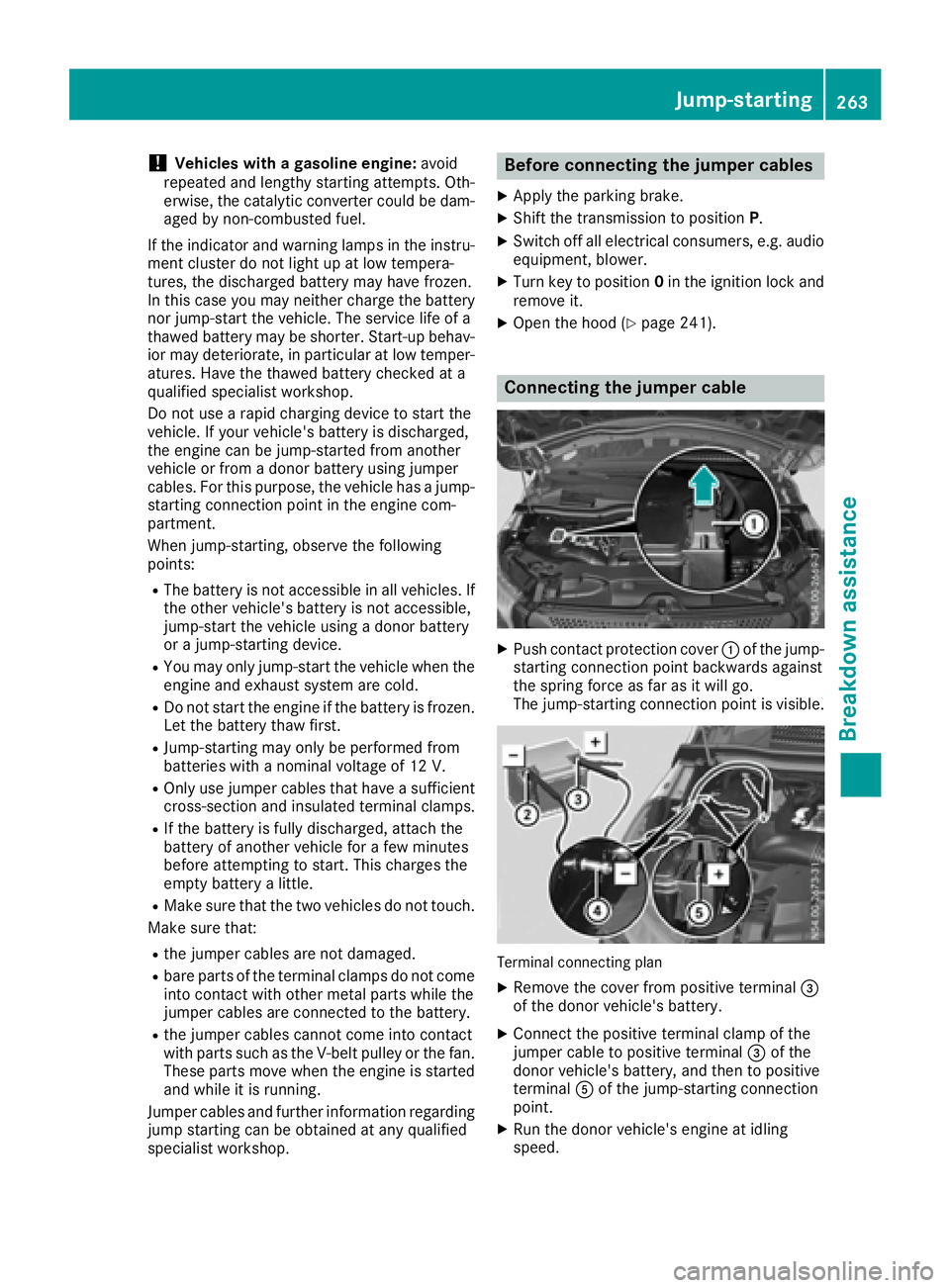
XPush contact protection cover :of the jump-
starting connection point backwards against
the spring force as far as it will go.
The jump-startingc onnection point is visible.
Terminal connecting plan
XRemove the cover from positive terminal =
of the donor vehicle's battery.
XConnect the positive terminal clamp of the
jumper cable to positive terminal =of the
donor vehicle's battery, and then to positive
terminal Aof the jump-startingc onnection
point.
XRun the donor vehicle's engine at idling
speed.
Jump-starting263
Breakdown assistance
Z
Page 266 of 310
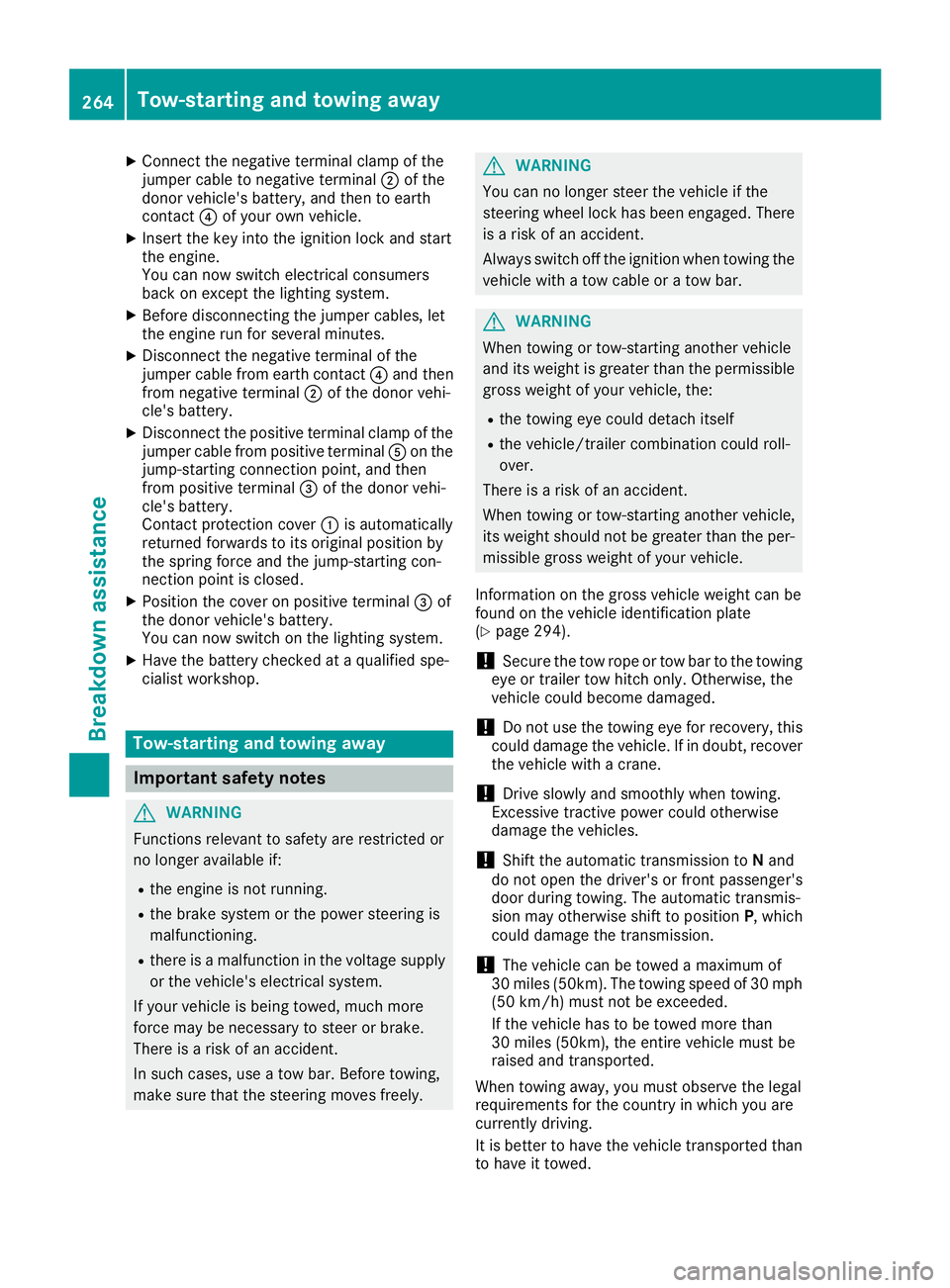
XConnect thenegative terminal clam pofthe
jumper cabl etonegative terminal ;of the
donor veh icle's battery, and then to earth
contact ?of your own veh icle.
XInsertt hekeyintot he ignition locka nd start
th ee ngine.
You can no wswitch electrical consumers
back on excep tthe lighting system.
XBefore disconnecting th ejumper cables, let
th ee nginer un for several minutes.
XDisconnect th enegative terminal of the
jumper cabl efrome arthc ontac t? and then
from negative terminal ;of th edonor veh i-
cle's battery.
XDisconnect th epositiv etermi nal clam pofthe
jumper cabl efromp ositiv etermi nalAon the
jump-startin gconnectio npoint, and then
from positiv etermi nal=of th edonor veh i-
cle's battery.
Contac tprotection cover :isautomatically
returned forwards to its original positio nby
th es pring force and th ejump-startin gcon-
nection pointisc losed.
XPositio nthe cover on positiv etermi nal=of
th ed onor veh icle's battery.
You can no wswitch on th elighting system.
XHav ethe battery checked at aqualified spe-
cialist workshop.
Tow-startin gand towin gaway
Important safety notes
GWAR NING
Functionsr elevanttosafety are restricted or
no longer availab leif:
Rthee ngineisn otrunning.
Rtheb rak esystem or th epower steering is
malfunctioning.
Rthere isam alfunctio ninthevoltage supply
or th evehicle 's electrical system.
If your veh icle is bein gtow ed, muc hmore
force may benecessary to steer or brake.
Thereisar iskofana cciden t.
In suchc ases, use atow bar. Before to wing,
mak esure that th esteering moves freely.
GWARNING
You can no longer steer th evehicle ifthe
steering wheel lockh as been engaged.There
is ar iskofana ccident.
Alwa ysswit ch off th eignition when to wingthe
vehicle withat owcabl eorat owbar.
GWARNING
When to wingor tow-startin ganother vehicle
and its weightisg reatertha nt he permissible
gross weightofy our vehicle,the :
Rthet ow ing eye could detach itself
Rthev ehicle /traile rcom binatio ncould roll-
over.
Thereisar iskofana ccident.
When towing or tow-startin ganother vehicle,
its weights hould notbegreatertha nt he per-
missible gross weightofy our vehicle.
In formation on th egross vehicle weightc anbe
foun dont hevehicle identification plate
(
Ypage 294).
!Secure th etow rop eort owbar to th etow ing
eye or trailer to whitch only. Otherwise, the
vehicle could become damaged.
!Do no tuse th etow ing eye for recovery, this
could damag ethe vehicle .Ifindoubt,recover
th ev ehicle withac rane.
!Drive slowlya nd smoothly when to wing.
Excessivet ractive power could otherwise
damag ethe vehicles.
!Shift th eautomatic transmission to Nand
do noto pen th edriver' sorf rontpassenger's
door durin gtow ing .The automatic transmis-
sion may otherwise shifttop ositionP,which
could damag ethe transmission.
!The vehicle can be towed amaximum of
30 mile s(50km ).The to wingspeedof30m ph
(50 km/h) must no tbeexceeded.
If th evehicle has to betowed mor ethan
30 mile s(50km) ,the entire vehicl emus
tbe
ra
ised and transported.
When towing away, you must observet helegal
requirement sfor th ecountr yinw hichy ou are
currently driving.
It is bette rtohave th evehicle transported than
to have it towed.
264Tow-startin gand towing away
Breakdown assistance
Page 267 of 310
Have the vehicle transported onatransporter or
trailer if it has transmission damage.
Whent owing, the automati ctransmission must
be in position N.Ifthe automati ctransmission
cannot be shifted to position N,havet he vehicle
transported on atransporter or trailer.
The battery mus tbeconnected and charged.
Otherwise ,you :
Rcannot turn the key to position 2in the igni-
tion lock
Rcannot shift the transmission to position N
Before the vehicle is towed, switch off the auto-
mati clocking feature (
Ypage 72). You could
otherwise lock yourself out of the vehicle when
pushing or towing away the vehicle.
Installing/removin gthe towing eye
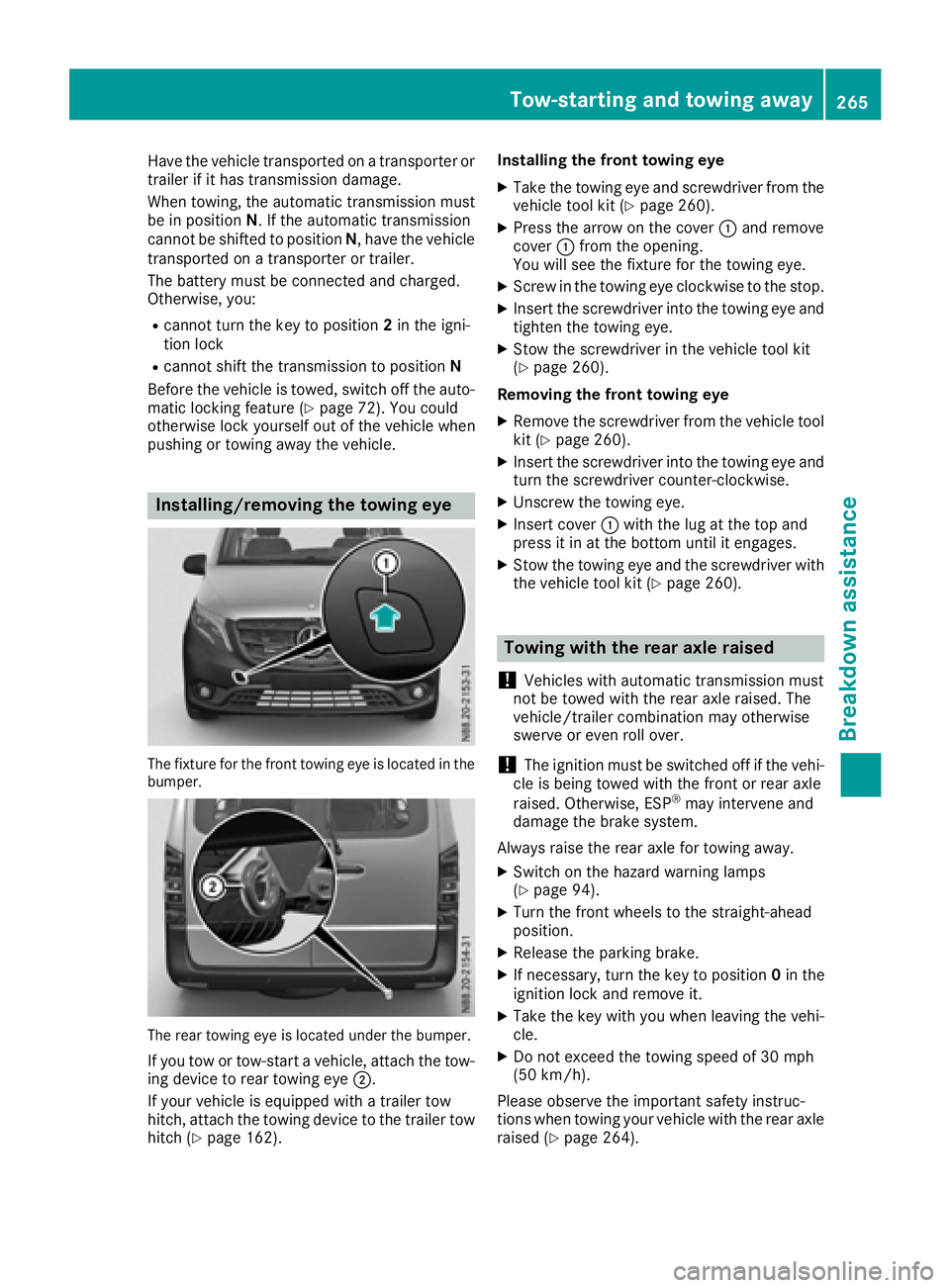
The fixtur efor the front towing eyeisl ocated in the
bumper.
The rea rtowing eyeisl ocated underthe bumper.
If yo utow or tow-start avehicle, attach the tow-
ing device to rea rtowing eye ;.
If your vehicle is equipped with atrailer tow
hitch, attach the towing device to the trailer tow
hitch (
Ypage 162). Installing the front towing eye
XTake the towing eyea
nd screwdriver from the
vehicle tool kit (Ypage 260).
XPres sthe arro wonthe cover :and remove
cover :from the opening.
You will see the fixtur efor the towing eye.
XScrew in the towing eyec lockwise to the stop.
XInsert the screwdriver into the towing eyea nd
tighte nthe towing eye.
XStow the screwdriver in the vehicle tool kit
(Ypage 260).
Removing the front towing eye
XRemove the screwdriver from the vehicle tool
kit (Ypage 260).
XInsert the screwdriver into the towing eyea nd
turn the screwdriver counter-clockwise.
XUnscrew the towing eye.
XInsert cover :with the lu gatthe top and
pres sitinatt he bottom until it engages.
XStow the towing eyea nd the screwdriver with
the vehicle tool kit (Ypage 260).
Towing with the rear axle raised
!
Vehicles with automati ctransmission must
not be towe dwitht he rea raxler aised.T he
vehicle/trailer combinatio nmay otherwise
swerve or even roll over.
!The ignition mus tbeswitched off if the vehi-
cle is being towe dwitht he front or rea raxle
raised.O therwise,ESP
®may intervene and
damag ethe brake system.
Always raise the rea raxlef or towing away.
XSwitch on the hazard warning lamps
(Ypage 94).
XTur nthe front wheels to the straight-ahead
position.
XRelease the parking brake.
XIf necessary ,turn the key to position 0in the
ignition lock and remov eit.
XTake the key with yo uwhenleaving the vehi-
cle.
XDo not excee dthe towing speed of 30 mph
(50 km/h).
Please observe the important safety instruc-
tions whe ntowing your vehicle with the rea raxle
raised (
Ypage 264).
Tow-starting and towing away265
Breakdow nassistance
Z
Page 268 of 310
Towingthe vehicle with both axles on
the ground
Important safety notes
GWARNING
Yo uc an no longe rstee rthe vehicl eifthe
steerin gwheel lock hasb eene ngaged .There
is ar iskofana ccident.
Alway sswitch off the ignition when towing the
vehicl ewithat ow cable or atow bar.
!Do not exceed the towing spee dof30mph
(50 km/h). Yo ucould otherwis edamag ethe
transmission.
Please observe the important safety notes
befor etowing your vehicl e(
Ypage 264).
Towingvehicle switha utomatic trans-
mission
XTurn the key to position 2in the ignition lock.
XDepres sthe brake peda land kee pit
depressed.
XShift the automatic transmission to position
N.
XLeave the key in position 2in the ignition lock.
XSwitch on the hazar dwarning lamps
(Ypage 94).
XReleas ethe parkin gbrake.
XReleas ethe brake pedal.
XDo not exceed the towing spee dof30m ph
(50 km/h).
Recovering avehicle that is stuck
!
When recovering avehicl ethath asbecome
stuck, pull it as smoothl yand evenly as pos-
sible. Excessive tractiv epower could damage
the vehicles.
If the drive wheels gett rapped on loose or
mudd yground ,recover the vehicl ewitht he
utmost care. Thi sisespecially the cas eifthe
vehicl eisladen .
Never attempt to recover avehicl ewithat railer
attached.
Pull ou tthe vehicl ebackwards ,ifpossible, using
the tracks it made when it becam estuck.
Transporting the vehicle
!
Yo um ayonl ysecur ethe vehicl ebythe
wheels ,not by parts of the vehicl esucha s
axl eors teerin gcomponents. Otherwise, the
vehicl ecould be damaged.
The towing ey eortrailer tow hitch can be used
to pull the vehicl eonto atrailer or transporte rif
yo uw ishtot ransport it.
XTurn the key to position 2in the ignition lock.
XShift the transmission to position N.
XReleasethe parkin gbrake.
If the vehicle is loaded:
XShift the transmission to position P.
XTurn the key to position 0in the ignition lock
and remove it.
XMake sure the parkin gbrake is applied.
XLash down the vehicle.
Tow-starting (emergency engine
starting)
Vehicle switha utomatic transmission
!Vehicles with automatic transmission must
not be tow-started .You could otherwis edam -
ag et he automatic transmission.
Yo uc an find informatio nonjump-starting under
"Jump-starting “(
Ypage 262).
Electrical fuses
The fuse allocation chart and important safety
informationonthe fuses can be found in the
"Fuse allocation chart" supplement.
266Electrical fuses
Breakdow nassistance
Page 269 of 310
Useful information
This Operator's Manual describes all models as
well as standard and optional equipment of your
vehicle that were available at the time of going
to print.Country-specific variation sare possi-
ble. Note that your vehicle may not be equipped
with all of the described functions. This also
applies to system sand function srelevantt o
safety.
Read the information on qualified specialist
workshops (
Ypage 29).
Important safetyn otes
GWarning
Af lat tire severely impairs the driving, steer-
ing and brakin gcharacteristic softhe vehicle.
There is arisk of an accident.
do not drive with aflat tire. Immediately
replace the flat tire with your spare wheel, or
consult aqualified specialist workshop.
GWARNING
If wheels and tires of the wrong size are used, the wheel brakes or suspensio ncomponents
may be damaged. There is arisk of an acci-
dent.
Always replace wheels and tires with those
that fulfill the specification softhe original
part.
When replacingw heels, make sure to use the
correct:
Rdesignation
Rmodel
When replacingt ires,make sure to use the
correct:
Rdesignation
Rmanufacturer
Rmodel
Accessories that are not approved for your vehi-
cle by Mercedes-Benz or are not being used cor-
rectly can impair operatin gsafety. Beforep
urchasin gand using non-approved
accessories, visit aqualified specialist work-
shop and inquire about:
Rsuitability
Rlegal stipulations
Rfactory recommendations
Information on the dimensions and types of
wheels and tires for your vehicle can be found
under "Wheel and tire combinations"
(
Ypage 290).
Information on your vehicle' stire pressure can
be found:
Rin the Tire and Loading Information placard on
the B-pillar, driver'ss ide
Rin the tire pressure table inside the fuel filler
flap (Ypage 271)
Runder "Tire pressure tables" (Ypage 278)
Runder "Tire pressure" (Ypage 270)
Modifications to the brake system or wheels are not permitted. The use of aspacer and brake
dust shields is not permitted. This invalidates
the general operatin gpermit for the vehicle.
Further information on wheels and tires can be
obtained at any qualified specialist workshop.
Operation
Information for ajourney
If the vehicle is heavily laden, checkt he tire
pressures,a nd correct them ,ifnecessary
(
Ypage 270).
While driving, pay attention to vibrations, noises
and unusual handling characteristics, e.g. pull-
ing to one side. This may indicat ethat the
wheels or tires are damaged. If you suspect that
at ire is defective, reduce your speed immedi-
ately. Stop the vehicle as soon as possible to
checkt he wheels and tires for damage. Hidden
tire damage could also be causing the unusual
handling characteristics. If you find no signs of
damage, have the tires and wheels checked at a
qualified specialist workshop.
When parkin gyour vehicle, make sure that the
tires do not get deformed by the curb or other
obstacles. If it is necessary to drive over curbs,
speed humps or similar elevations, try to do so
slowly and not at asharp angle. Otherwise, the
tires ,particularly the sidewalls, can get dam-
aged.
Operation267
Wheels and tires
Z
Page 277 of 310
For further information on displaying the current
tire pressures, referto"Checking the tire pres-
sur eelectronically" (
Ypage 276).
Important safety notes
GWARNING
Each tire, including the spare (ifp rovided),
should be checked at least once amonth
whe ncold and inflated to the pressure rec-
ommended by the vehicle manufacturer on
the Tir eand Loading Information placard on
the driver's doo rB-pilla rort he tire pressure
label on the inside of the fue lfiller flap. If your
vehicle has tires of adifferent size than the
size indicated on the Tir eand Loading Infor-
mation placard or the tire pressure label ,you
should determine the proper tire pressure for
those tires.
As an added safety feature ,you rv ehicle has
bee nequipped with atire pressure monitoring
system (TPMS) that illuminates alow tire pres-
sur etelltal ewheno ne or more of your tires
are significantly underinflated. Accordingly,
whe nthe low tire pressure telltal eillumi nates,
yo us hould stop and check your tires as soon
as possible, and inflate them to the proper
pressure. Driving on asignificantly underin-
flated tire causes the tire to overheata nd can
lea dtot ire failure. Underinflation also
reduce sfue lefficiency and tire treadl ife, and
may affect the vehicle' shandling and stop-
ping ability.
Please note that the TPMSisn otas ubstitute
for proper tire maintenance, and it is the driv-
er's responsibility to maintain correct tire
pressure, even if underinflation has not
reached the level to trigger illumination of the
TPMSl ow tire pressure telltale.
USA only:
You rvehicle has also bee
nequipped with a
TPM
Sm alfunction indicator to indicate if the
system is not operating properly. The TPMS
malfunction indicator is combined with the
low tire pressure telltale. Whe nthe system
detects amalfunction, the warning lamp will
flash for approximately aminute and then
remain continuously illuminated. This
sequence will be repeated ever ytime the vehi-
cle is starte daslong as the malfunction
exists.
Whe nthe malfunction indicator is illuminated,
the system may not be able to detect or signal
low tire pressure as intended. TPMSm alfunc-
tions may occur for avariety of reasons,
including the mounting of incompatible
replacement or alternate tires or wheels on
the vehicle that prevent the TPMSf rom func-
tioning properly. Alway scheck the TPMSm al-
function telltal eafterreplacing one or more
tires or wheels on your vehicle to ensure that the replacement or alternate tires and wheels
allow the TPMStoc ontinuetofunction prop-
erly.
It is the driver's responsibility to set the tire
pressure to the recommende dcold tire pressure
suitabl efor the operating conditions
(
Ypage 270).
Note that the correct tire pressure for the cur-
rent operating conditions mus tfirs tb ep ro-
gramed into the tire pressure monitor. If there is
as ubstantial los sofpressure, the warning
threshol dfor the warning messag eisaligne dto
the reference value sprograme din. Restart the
tire pressure monito rafte radjusting the cold
tire pressure (
Ypage 277). The current pres-
sures are saved as new reference values. This
will ensure that awarning messag ewillo nly
appea rifthe tire pressure drop ssignificantly.
The tire pressure monito rdoesn ot warn yo uifa
tire pressure is incorrect. Observe the notes on
the
recommende dtire pressure (Ypage 270).
The tire pressure monito risnot able to warn you
of as udden los sofpressure, e.g. following pen-
etration by aforeign object. In this event, brake
the vehicle until it comes to astandstill. Avoid
sudden steering movements.
The tire pressure monito rhas ayello wh
warning lamp in the instrument cluster for indi-
cating pressure loss/malfunctions (USA) or
pressure los s(Ca nada). Depending on how the
warning lamp flashesorl ights up ,anunderin-
flated tire or amalfunction in the tire pressure
monito risdisplayed:
Rif the h warning lamp is li tcontinuously,
the tire pressure on one or more tires is sig-
Tire pressure275
Wheels and tires
Z