weight MERCEDES-BENZ METRIS 2017 MY17 Operator’s Manual
[x] Cancel search | Manufacturer: MERCEDES-BENZ, Model Year: 2017, Model line: METRIS, Model: MERCEDES-BENZ METRIS 2017Pages: 318, PDF Size: 5.01 MB
Page 247 of 318
Also observe the safety information in the load-
ing directions (Ypage 242).
XFill spaces between the load and the cargo
compartment walls or wheel housings (form-
locking). Use rigid load securing aids, such as
wedges, wooden fixings or padding.
XAttach secured and stabilized loads in all
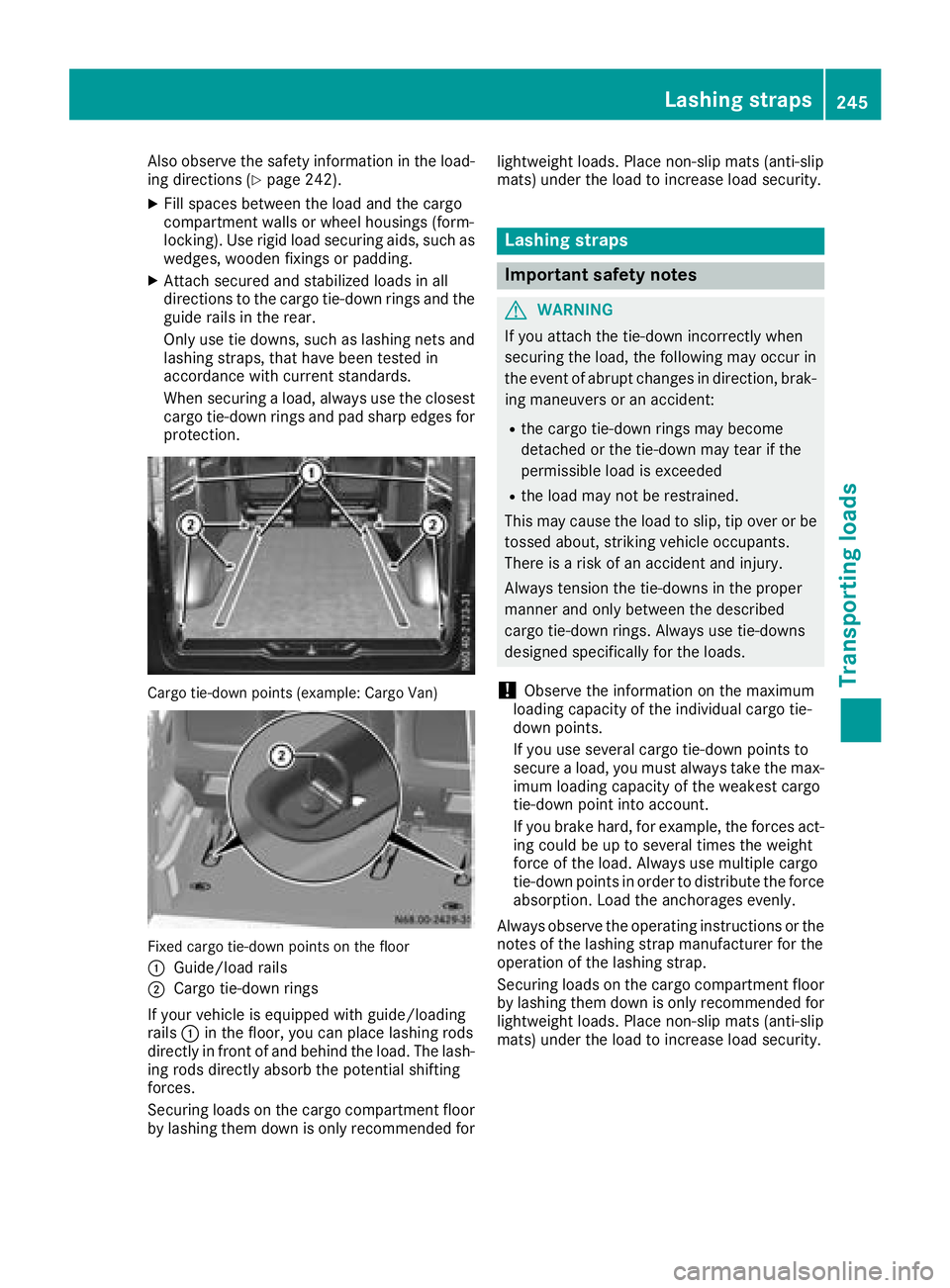
directions to the cargo tie-down rings and the
guide rails in the rear.
Only use tie downs, such as lashing nets and
lashing straps, that have been tested in
accordance with current standards.
When securing a load, always use the closest cargo tie-down rings and pad sharp edges for
protection.
Cargo tie-down points (example: Cargo Van)
Fixed cargo tie-down points on the floor
:
Guide/load rails
;Cargo tie-down rings
If your vehicle is equipped with guide/loading
rails :in the floor, you can place lashing rods
directly in front of and behind the load. The lash-
ing rods directly absorb the potential shifting
forces.
Securing loads on the cargo compartment floor
by lashing them down is only recommended for lightweight loads. Place non-slip mats (anti-slip
mats) under the load to increase load security.
Lashing straps
Important safety notes
GWARNING
If you attach the tie-down incorrectly when
securing the load, the following may occur in
the event of abrupt changes in direction, brak- ing maneuvers or an accident:
Rthe cargo tie-down rings may become
detached or the tie-down may tear if the
permissible load is exceeded
Rthe load may not be restrained.
This may cause the load to slip, tip over or be
tossed about, striking vehicle occupants.
There is a risk of an accident and injury.
Always tension the tie-downs in the proper
manner and only between the described
cargo tie-down rings. Always use tie-downs
designed specifically for the loads.
!Observe the information on the maximum
loading capacity of the individual cargo tie-
down points.
If you use several cargo tie-down points to
secure a load, you must always take the max-
imum loading capacity of the weakest cargo
tie-down point into account.
If you brake hard, for example, the forces act-
ing could be up to several times the weight
force of the load. Always use multiple cargo
tie-down points in order to distribute the force absorption. Load the anchorages evenly.
Always observe the operating instructions or the
notes of the la shing strap ma
nufacturer for the
operation of the lashing strap.
Securing loads on the cargo compartment floor
by lashing them down is only recommended for
lightweight loads. Place non-slip mats (anti-slip
mats) under the load to increase load security.
Lashing straps245
Transporting loads
Z
Page 251 of 318
You will find information about the maximum
roof load under "Cargo tie-down points and car-
rier systems" (
Ypage 312).
!Make sure that:
Rthe screws of the roof carrier are tightened
to a maximum torque of 7.4 lb-ft(10 Nm) in
the threaded holes provided and
Rthere is a minimum bolt penetration of
4 turns.
Only install roof carriers and rear racks that
have been approved or recommended for
Mercedes-Benz vehicles. This will help avoid
damage to the vehicle.
You can install a roof carrier on the roof and, for
example, a rear-mounted cycle rack on the tail-
gate.
Install the protective caps on the securing
threads after you have removed the roof carrier.
If you have installed a rear rack on the tailgate,
the additional weight reduces the assistance
provided by the gas pressure springs when the
tailgate is opened. You will then need more force
to open the tailgate. At low outside tempera-
tures below freezing you will need to provide
extra support for the tailgate to prevent it from
sinking unintentionally.
Carrier systems249
Transporting loads
Z
Page 267 of 318
and associated spray produced by the power
washer could cause extensive damage to thevehicle.
!When using high-pressure cleaning equip-
ment, maintain a minimum distance of
approx. 1 ft (30 cm)betwee nthe spra ynozzle
and th evehicl eparts. Do no tuse apowe r
washer wit h around-jet nozzle. You could
damage th evehicl eor engin eparts.
!Kee pth ewater je tmovin gconstantl ywhile
cleaning .This will avoid causin gdamage to
th evehicle.
Do no tpoin tth ewater je tat:
Rdoo rjoints
Rrear vie wcamera
Rair bellows
Rbrak ehoses
Rwhee lbalance weights
Relectrica lcomponent s
Relectricalconnection s
Rseals
Rdrive train ,especially no tat th eintermedi-
ate bearin gof th epropelle rshaf t
Cleaning the engine
!Water mus tno tente rintak eor ventilation
openings. Whe ncleaning wit hhigh pressur e
water or steam cleaners ,th espray mus tno t
be aime ddirectl yat electrica lcomponent sor
th eterminals of electrica llines.
Preserve th eengin eafter th eengin ehas been
cleaned. Protect th ebelt drive system from
exposure to th epreservative agent.
Also observ eth einformation under "Powe r
washers " (
Ypage 264).
Cleaning the paintwork
!Do notaffix:
Rstickers
Rfilm s
Rmagneti cplates or similar items
to painte dsurfaces. You could otherwise
damage th epaintwork .
Scratches, corrosiv edeposits, area saffecte dby
corrosio nand damage caused by inadequate
car ecanno talways be completely repaired. In
suc hcases, visit aqualified specialist workshop .
XRemove impurities immediately, wher epos -
sible, whils tavoidin grubbin gto ohard.
XSoak insec tremain swit hinsec tremove rand
rinse off th etreated area safterwards .
XSoak birddroppings wit hwater and rinse off
th etreated area safterwards .
XRemove coolant, brak efluid, tree resin ,oils ,
fuel sand greases by rubbin ggentl ywit h a
cloth soaked in petroleum ether or lighte r
fluid.
XUse tar remove rto remove tar stains.
XUse silicon eremove rto remove wax .
Cleaning the windows
GWARNING
You could become trapped by th ewindshield
wiper sif they start movin gwhile cleaning th e
windshield or wiper blades. There is aris kof
injury.
Always switch off th ewindshield wiper sand
th eignition before cleaning th ewindshield or
wiper blades.
!Do no tfol dth ewindshield wiper saway from
th ewindshield unless th ehoo dis closed .Oth-
erwise, you could damage th ehood.
!Hold th ewiper arm securel ywhen foldin g
back. The windshield could be damaged if th e
wiper arm smack sagainst it suddenly.
!Do no tuse dry cloths, abrasiv eproducts ,
solvents or cleaning agents containin gsol-
vents to clean th einside of th ewindows .Do
no ttouch th einside sof th ewindows wit h
har dobjects ,e.g. an ice scrape ror ring. There
is otherwise aris kof damagin gth ewindows .
!Clean thewater drainag echannels of th e
windshield and th erear window at regular
intervals. Deposit ssuc has leaves, petals and
pollen may under certain circumstances pre -
ven twater from draining away. This can lead
to corrosio ndamage and damage to elec -
tronic components.
XClean th einside and outside of th ewindows
wit h a damp cloth and acleaning agen tthat is
recommended and approve dby Mercedes -
Benz .
Care265
Maintenance and care
Z
Page 268 of 318
Exterior
Cleaning the wheels
!Do not use any acidic or alkaline cleaning
agents. They can cause corrosion on the
wheel bolts or the retainer springs for the
wheel-balancing weights.
!Do not park your vehicle for a long period of
time directly after cleaning, particularly after
cleaning the wheel rim with wheel cleaner.
Wheel cleaner can lead to the increased cor-
rosion of the brake discs and pads. Therefore,
drive for a few minutes after cleaning. By
heating up the brakes, the brake discs and
pads dry. The vehicle can then be parked for a
long period of time.
If you clean the wheels with a power washer,
observe the safety notes for the power washer
(
Ypage 264). You could otherwise damage the
tires.
Cleaning the wiper blades
GWARNING
You could become trapped by the windshield wipers if they start moving while cleaning the
windshield or wiper blades. There is a risk of
injury.
Always switch off the windshield wipers and
the ignition before cleaning the windshield or
wiper blades.
!Do not fold the windshield wipers away from
the windshield unless the hood is closed. Oth-
erwise, you could damage the hood.
!Do not pull the wiper blade. Otherwise, the
wiper blade could be damaged.
!Do not clean wiper blades too often and do
not rub them too hard. Otherwise, the graph-
ite coating could be damaged. This could
cause wiper noise.
!Hold the wiper arm securely when folding
back. The windshield could be damaged if the
wiper arm smacks against it suddenly.
XTurn the SmartKey to position 0in the ignition
lock or remove the SmartKey.
XFold the windshield wiper arms away from the
windshield until you feel them engage.
XCarefully clean the wiper blades with a damp
cloth.
XFold back the wiper arms before switching on
the ignition.
Cleaning the exterior lighting
!Only use cleaning agents or cleaning cloths
which are suitable for plastic light lenses.
Unsuitable cleaning agents or cleaning cloths
could scratch or damage the plastic light len- ses.
XClean the plastic covers of the exterior light-
ing with a damp sponge and a mild cleaning
agent, e.g. Mercedes-Benz car shampoo, or
with cleaning cloths.
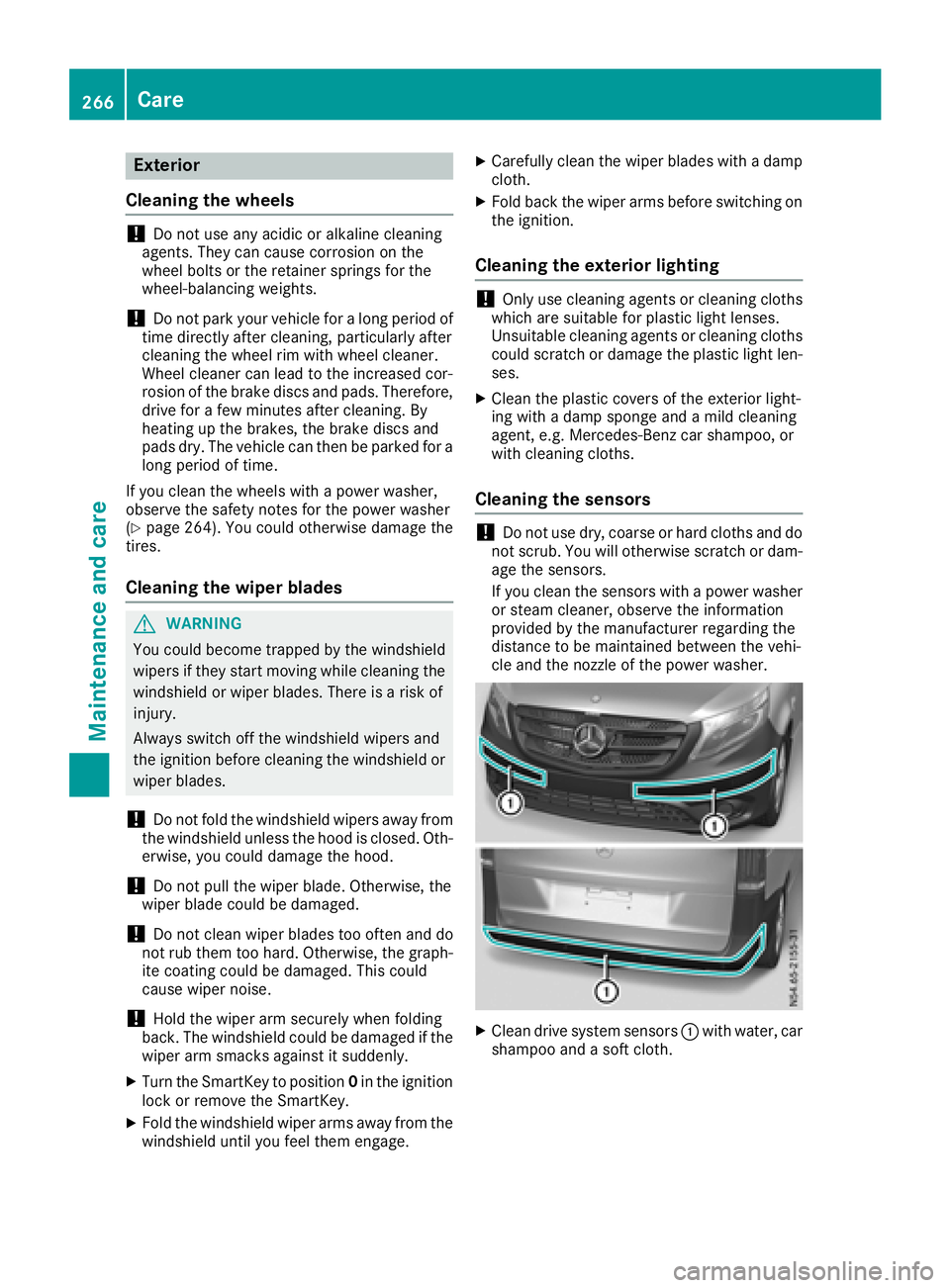
Cleaning the sensors
!Do not use dry, coarse or hard cloths and do
not scrub. You will otherwise scratch or dam-
age the sensors.
If you clean the sensors with a power washer
or steam cleaner, observe the information
provided by the manufacturer regarding the
distance to be maintained between the vehi-
cle and the nozzle of the power washer.
XClean drive system sensors :with water, car
shampoo and a soft cloth.
266Care
Maintenance and care
Page 272 of 318
Useful information
This Operator's Manual describes all models as
well as standard and optional equipment of your
vehicle that were available at the time of going
to print. Country-specific variations are possi-
ble. Note that your vehicle may not be equipped
with all of the described functions. This also
applies to systems and functions relevant to
safety.
Read the information on qualified specialist
workshops (
Ypage 31).
Where will I find...?
Vehicle tool kit
General notes
Depending on the equipment version of the vehi- cle, the vehicle tool kit is:
Rin the seat base of the left front seat
Rin the rear stowage compartment
Rin the tool holder in the cargo compartment
Apart from some country-specific variants, vehi-
cles without a spare wheel are not equipped
with tire-changing tools. If your vehicle is equip-
ped with tire-changing tools, these are in the
vehicle tool kit. If the vehicle tool kit is stowed in
the driver's seat base, the jack is in a separate
holder in the cargo compartment on the right-
hand side of the vehicle next to the tailgate/rear door (
Ypage 272).
Some tools for changing a wheel are specific to
the vehicle. For more information on which tools are required and approved to perform a wheel
change on your vehicle, consult a qualified spe-
cialist workshop.
Necessary tire-changing tools can include, for
example:
Rjack
Rlug wrench
Rratchet wrench
iThe jack has a maximum weight of 7.5 kg
depending on the vehicle's equipment.
The maximum payload of the jack can be
found on the sticker on the jack itself.
The jack is maintenance-free. In the event of a malfunction, please contact a qualified spe-
cialist workshop.
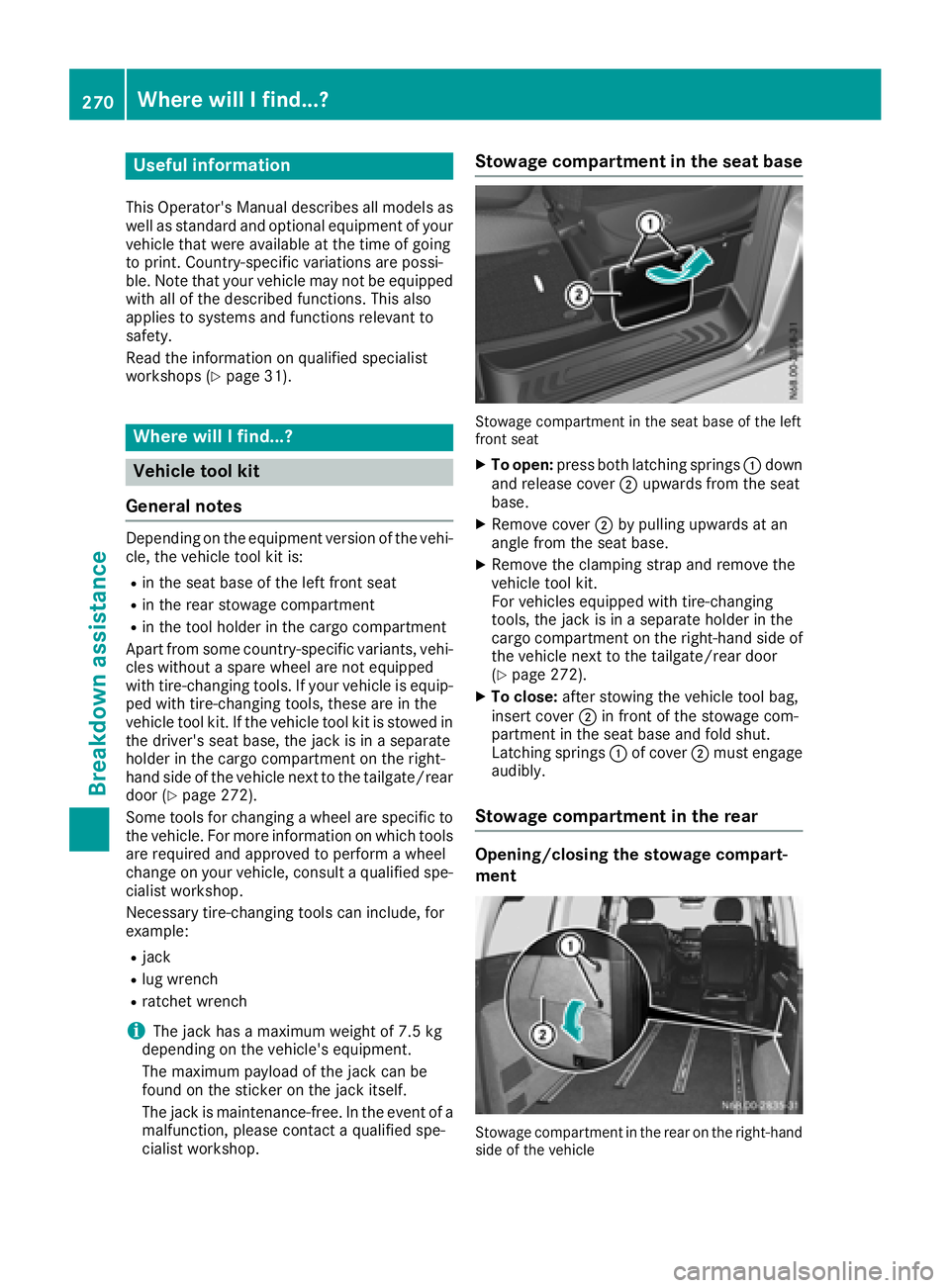
Stowage compartment in the seat base
Stowage compartment in the seat base of the left
front seat
XTo open: press both latching springs :down
and release cover ;upwards from the seat
base.
XRemove cover ;by pulling upwards at an
angle from the seat base.
XRemove the clamping strap and remove the
vehicle tool kit.
For vehicles equipped with tire-changing
tools, the jack is in a separate holder in the
cargo compartment on the right-hand side of
the vehicle next to the tailgate/rear door
(
Ypage 272).
XTo close: after stowing the vehicle tool bag,
insert cover ;in front of the stowage com-
partment in the seat base and fold shut.
Latching springs :of cover ;must engage
audibly.
Stowage compartment in the rear
Opening/closing the stowage compart-
ment
Stowage compartment in the rear on the right-hand
side of the vehicle
270Where will I find...?
Breakdown assistance
Page 276 of 318
XConnect the negative terminal clamp of the
jumper cable to negative terminal;of the
donor veh icle's battery, and then to earth
contact ?of your own veh icle.
XInsert the key into the ignition lock and start
the engine.
You can now switch electrical consumers
back on except the lighting system.
XBefore disconnecting the jumper cables, let
the engine run for several minutes.
XDisconnect the negative terminal of the
jumper cable from earth contact ?and then
from negative terminal ;of the donor veh i-
cle's battery.
XDisconnect the positive terminal clamp of the
jumper cable from positive terminal Aon the
jump-starting connection point, and then
from positive terminal =of the donor veh i-
cle's battery.
Contact protection cover :isautomatically
returned forwards to its original position by
the spring force and the jump-starting con-
nection pointis closed.
XPosition the cover on positive terminal =of
the donor veh icle's battery.
You can now switch on the lighting system.
XHave the battery checked at a qualified spe-
cialist workshop.
Tow-starting and towing away
Important safety notes
GWAR NING
Functions relevant to safety are restricted or
no longer availab leif:
Rthe engine isnot running.
Rthe brake system or the power steering is
malfunctioning.
Rthere isa malfunction inthe voltage supply
or the veh icle's electrical system.
If your veh icle is bein g towed, much more
force may benecessary to steer or brake.
There isa risk of an acc ident.
In such cases, use a tow bar. Before to wing,
make sure that the steering moves freely.
GWARNING
You can no longer steer the vehicle ifthe
steering wheel lock has been engaged. There
is a risk of an accident.
Alwa ysswit ch off the ignition when to wingthe
vehicle with a tow cable or a tow bar.
GWARNING
When to wingor tow-starting another vehicle
and its weight isgreater than the permissible
gross weight of your vehicle, the:
Rthe to wingeye could detach itself
Rthe vehicle /trailer combination could roll-
over.
There is a risk of an accident.
When towing or tow-starting another vehicle,
its weight should not be greater than the per- missible gross weight of your vehicle.
In formation on the gross vehicle weight can be
found on the vehicle identification plate
(
Ypage 303).
!Secure the tow rope or tow bar to the to wing
eye or trailer tow hitch only. Otherwise, the
vehicle could become damaged.
!Do not use the to wingeye for recovery, this
could damage the vehicle. If indoubt, recover
the vehicle with a crane.
!Drive slowly and smoothly when to wing.
Excessive tractive power could otherwise
damage the vehicles.
!Shift the automatic transmission to Nand
do not open the driver's or front passenger's
door during to wing. The automatic transmis-
sion may otherwise shift to position P,whic h
could damage the transmission.
!The vehicle can be towed a maximum of
30 miles (50km ).The to wingspeed of 30 mph
(50 km/h) must not be exceeded.
If the vehicle has to betowed more than
30 mile
s(50k
m) ,the entire vehicl emust be
raised and transported.
When towing away, you must observe the legal
requirements for the country in which you are
currently driving.
It is better to have the vehicle transported than
to have it towed.
274Tow-starting and towing away
Breakdown assistance
Page 286 of 318
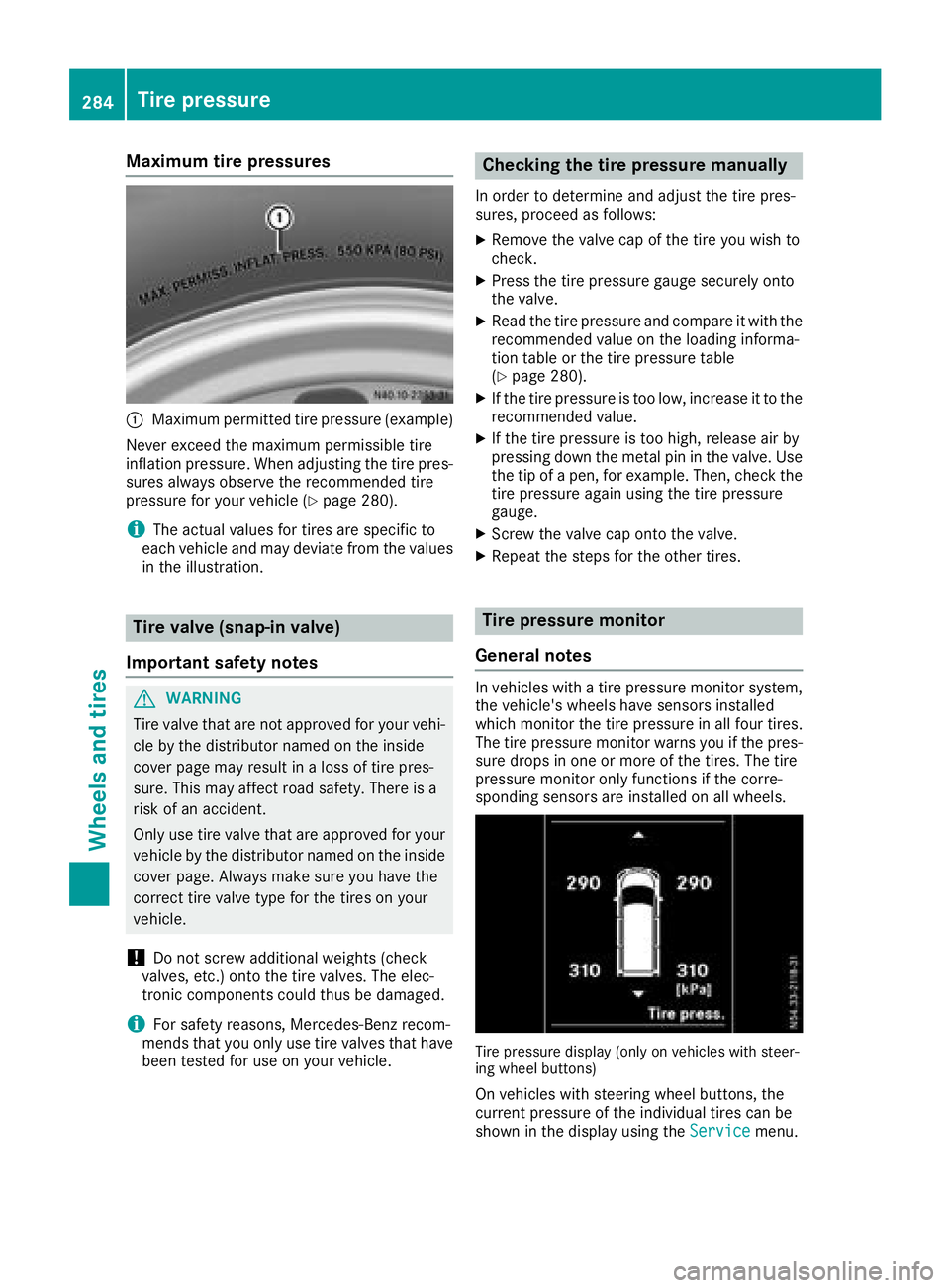
Maximum tire pressures
:Maximum permitted tire pressure (example)
Never exceed the maximum permissible tire
inflation pressure. When adjusting the tire pres-
sures always observe the recommended tire
pressure for your vehicle (
Ypage 280).
iThe actual values for tires are specific to
each vehicle and may deviate from the values
in the illustration.
Tire valve (snap-in valve)
Important safety notes
GWARNING
Tire valve that are not approved for your vehi-
cle by the distributor named on the inside
cover page may result in a loss of tire pres-
sure. This may affect road safety. There is a
risk of an accident.
Only use tire valve that are approved for your
vehicle by the distributor named on the inside
cover page. Always make sure you have the
correct tire valve type for the tires on your
vehicle.
!Do not screw additional weights (check
valves, etc.) onto the tire valves. The elec-
tronic components could thus be damaged.
iFor safety reasons, Mercedes-Benz recom-
mends that you only use tire valves that have been tested for use on your vehicle.
Checking the tire pressure manually
In order to determine and adjust the tire pres-
sures, proceed as follows:
XRemove the valve cap of the tire you wish to
check.
XPress the tire pressure gauge securely onto
the valve.
XRead the tire pressure and compare it with the
recommended value on the loading informa-
tion table or the tire pressure table
(
Ypage 280).
XIf the tire pressure is too low, increase it to the
recommended value.
XIf the tire pressure is too high, release air by
pressing down the metal pin in the valve. Use
the tip of a pen, for example. Then, check the
tire pressure again using the tire pressure
gauge.
XScrew the valve cap onto the valve.
XRepeat the steps for the other tires.
Tire pressure monitor
General notes
In vehicles with a tire pressure monitor system,
the vehicle's wheels have sensors installed
which monitor the tire pressure in all four tires.
The tire pressure monitor warns you if the pres- sure drops in one or more of the tires. The tire
pressure monitor only functions if the corre-
sponding sensors are installed on all wheels.
Tire pressure display (only on vehicles with steer-
ing wheel buttons)
On vehicles with steering wheel buttons, the
current pressure of the individual tires can be
shown in the display using the Service
menu.
284Tire pressure
Wheels and tires
Page 290 of 318
Tire pressure tables
Vehicles with a gross vehicle weight of 6,724 lbs (3.05 t)
!The pressure difference between tires on any one axle must be no greater than 10 kPa (0.1 ba r/
1.5 psi).
The following tire pressure values apply to vehicles with:
Ra gross vehicle weight of 6,724 lbs (3.05 t)
Ra gross axle weight rating of 3,418 lbs(1,550 kg)on the rear axle and
Rthe tires referred to under "Wheel and tire combinations" (Ypage 300)
Always observe the notes under "Information on tire pressures" (
Ypage 280).
The tire pressure for the spare wheelis 340 kPa (3.4 bar/49 psi).
Partially laden vehicleFully laden vehicle
Tire sizeFront axleRear axleFront axleRear axle
225/55 R 17 XL270 kPa
(2.7 bar/ 39 psi)270 kPa
(2.7 bar/ 39 psi)300 kPa
(3.0 bar/ 44 psi)310 kPa
(3.1 bar/45 psi)
Loading the vehicle
Instruction labels for tires and loads
GWARNING
Overloaded tires can overheat, causing a
blowout. Overloaded tires can also impair the steering and driving characteristics and lead
to brake failure. There is a risk of accident.
Observe the load rating of the tires. The load
rating must be at least half of the GAWR of
your vehicle. Never overload the tires by
exceeding the maximum load.
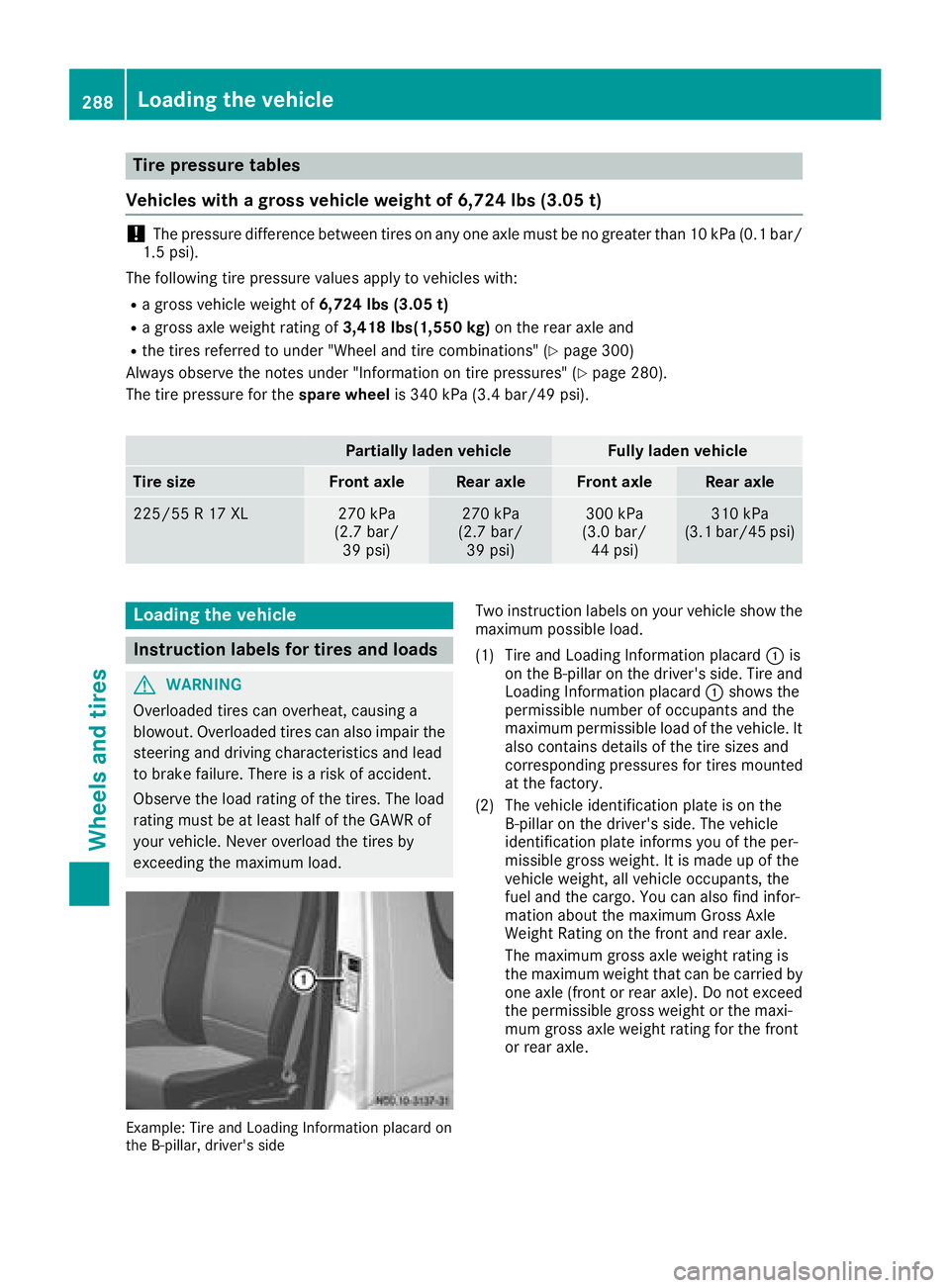
Example: Tire and Loading Information placard on
the B-pillar, driver's side
Two instruction labels on your vehicle show themaximum possible load.
(1) Tire and Loading Information placard :is
on the B-pillar on the driver's side. Tire and
Loading Information placard :shows the
permissible number of occupants and the
maximum permissible load of the vehicle. It also contains details of the tire sizes and
corresponding pressures for tires mounted
at the factory.
(2) The vehicle identification plate is on the B-pillar on the driver's side. The vehicle
identification plate informs you of the per-
missible gross weight. It is made up of the
vehicle weight, all vehicle occupants, the
fuel and the cargo. You can also find infor-
mation about the maximum Gross Axle
Weight Rating on the front and rear axle.
The maximum gross axle weight rating is
the maximum weight that can be carried by
one axle (front or rear axle). Do not exceed the permissible gross weight or the maxi-
mum gross axle weight rating for the front
or rear axle.
288Loading the vehicle
Wheels and tires
Page 291 of 318
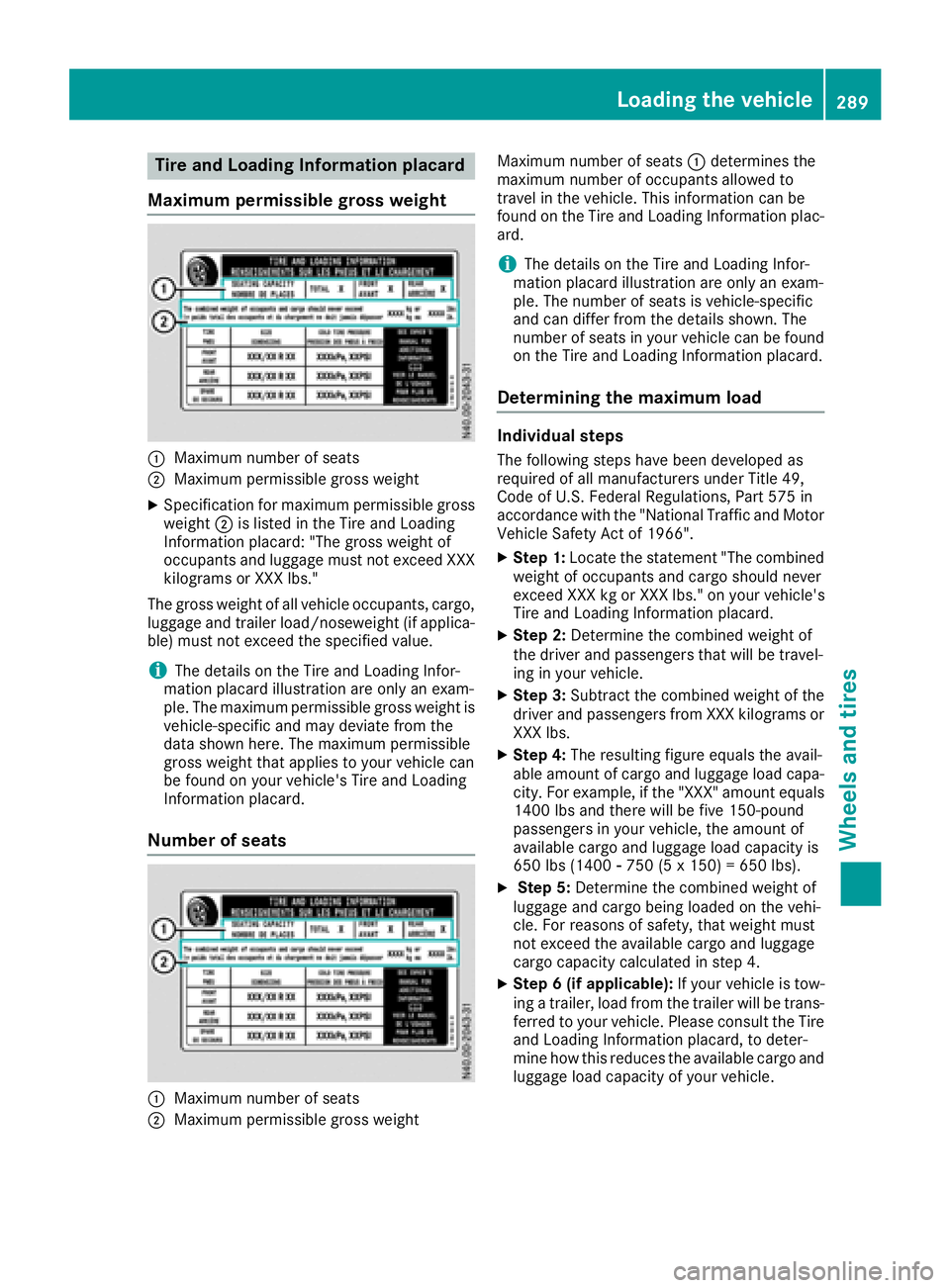
Tire and Loading Information placard
Maximum permissible gross weight
:Maximum number of seats
;Maximum permissible gross weight
XSpecification for maximum permissible gross
weight ;is listed in the Tire and Loading
Information placard: "The gross weight of
occupants and luggage must not exceed XXX
kilograms or XXX lbs."
The gross weight of all vehicle occupants, cargo,
luggage and trailer load/noseweight (if applica-
ble) must not exceed the specified value.
iThe details on the Tire and Loading Infor-
mation placard illustration are only an exam-
ple. The maximum permissible gross weight is
vehicle-specific and may deviate from the
data shown here. The maximum permissible
gross weight that applies to your vehicle can
be found on your vehicle's Tire and Loading
Information placard.
Number of seats
:Maximum number of seats
;Maximum permissible gross weight Maximum number of seats
:determines the
maximum number of occupants allowed to
travel in the vehicle. This information can be
found on the Tire and Loading Information plac- ard.
iThe details on the Tire and Loading Infor-
mation placard illustration are only an exam-
ple. The number of seats is vehicle-specific
and can differ from the details shown. The
number of seats in your vehicle can be found
on the Tire and Loading Information placard.
Determining the maximum load
Individual steps
The following steps have been developed as
required of all manufacturers under Title 49,
Code of U.S. Federal Regulations, Part 575 in
accordance with the "National Traffic and Motor
Vehicle Safety Act of 1966".
XStep 1: Locate the statement "The combined
weight of occupants and cargo should never
exceed XXX kg or XXX lbs." on your vehicle's
Tire and Loading Information placard.
XStep 2: Determine the combined weight of
the driver and passengers that will be travel-
ing in your vehicle.
XStep 3: Subtract the combined weight of the
driver and passengers from XXX kilograms or
XXX lbs.
XStep 4: The resulting figure equals the avail-
able amount of cargo and luggage load capa-
city. For example, if the "XXX" amount equals
1400 lbs and there will be five 150-pound
passengers in your vehicle, the amount of
available cargo and luggage load capacity is
650 lbs (1400 Ò750 (5 x 150) = 650 lbs).
XStep 5: Determine the combined weight of
luggage and cargo being loaded on the vehi-
cle. For reasons of safety, that weight must
not exceed the available cargo and luggage
cargo capacity calculated in step 4.
XStep 6 (if applicable): If your vehicle is tow-
ing a trailer, load from the trailer will be trans-
ferred to your vehicle. Please consult the Tire
and Loading Information placard, to deter-
mine how this reduces the available cargo and
luggage load capacity of your vehicle.
Loading the vehicle289
Wheels and tires
Z
Page 292 of 318
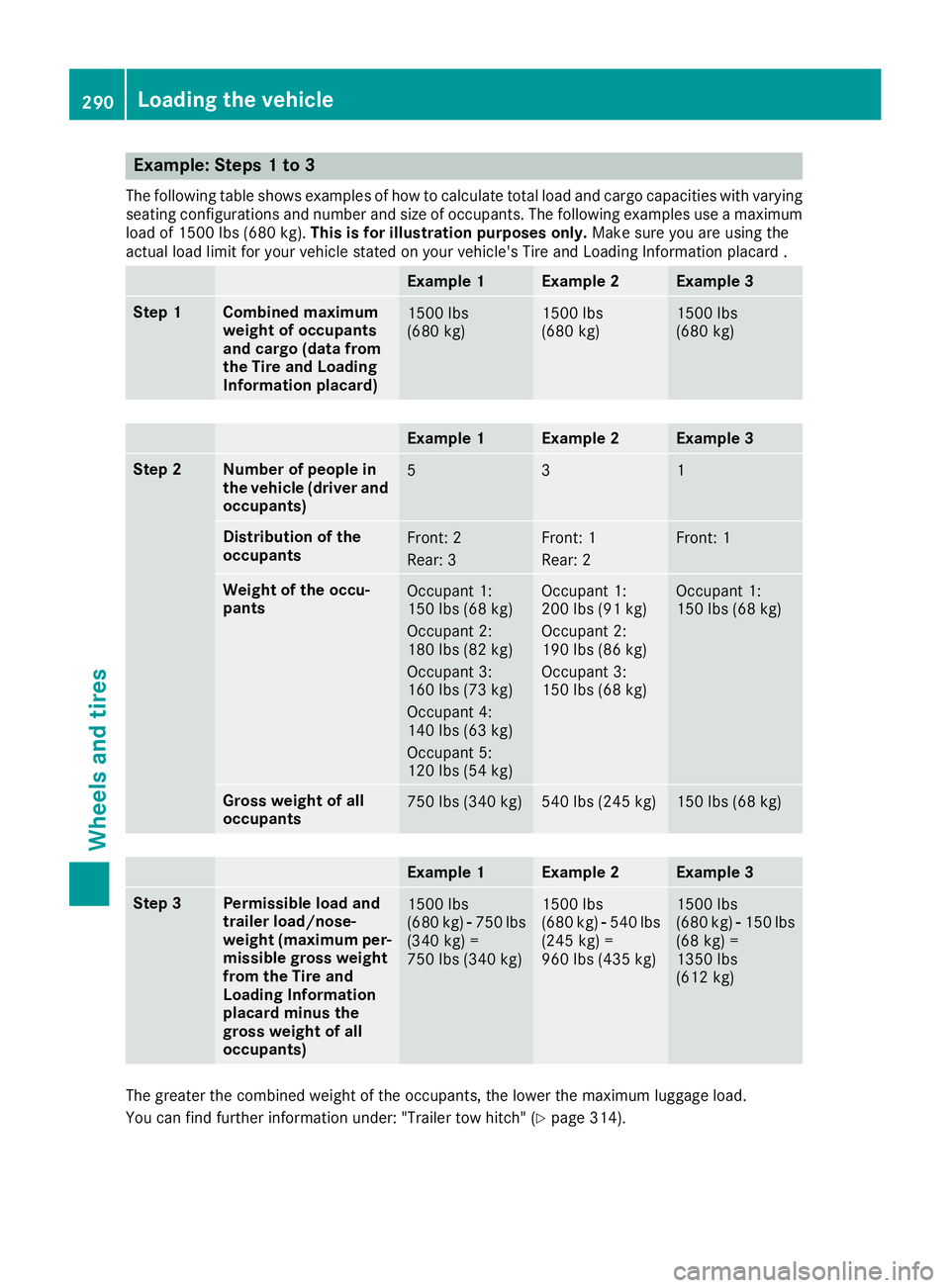
Example: Steps 1 to 3
The following table shows examples of how to calculate total load and cargo capacities with varyingseating configurations and number and size of occupants. The following examples use a maximum
load of 1500 lbs (680 kg). This is for illustration purposes only. Make sure you are using the
actual load limit for your vehicle stated on your vehicle's Tire and Loading Information placard .
Example 1Example 2Example 3
Step 1Combined maximum
weight of occupants
and cargo (data from
the Tire and Loading
Information placard)1500 lbs
(680 kg)1500 lbs
(680 kg)1500 lbs
(680 kg)
Example 1Example 2Example 3
Step 2Number of people in
the vehicle (driver and
occupants)531
Distribution of the
occupantsFront: 2
Rear: 3Front: 1
Rear: 2Front: 1
Weight of the occu-
pantsOccupant 1:
150 lbs (68 kg)
Occupant 2:
180 lbs (82 kg)
Occupant 3:
160 lbs (73 kg)
Occupant 4:
140 lbs (63 kg)
Occupant 5:
120 lbs (54 kg)Occupant 1:
200 lbs (91 kg)
Occupant 2:
190 lbs (86 kg)
Occupant 3:
150 lbs (68 kg)Occupant 1:
150 lbs (68 kg)
Gross weight of all
occupants750 lbs (340 kg)540 lbs (245 kg)150 lbs (68 kg)
Example 1Example 2Example 3
Step 3Permissible load and
trailer load/nose-
weight (maximum per-
missible gross weight
from the Tire and
Loading Information
placard minus the
gross weight of all
occupants)1500 lbs
(680 kg) Ò750 lbs
(340 kg) =
750 lbs (340 kg)1500 lbs
(680 kg) Ò540 lbs
(245 kg) =
960 lbs (435 kg)1500 lbs
(680 kg) Ò150 lbs
(68 kg) =
1350 lbs
(612 kg)
The greater the combined weight of the occupants, the lower the maximum luggage load.
You can find further information under: "Trailer tow hitch" (
Ypage 314).
290Loading the vehicle
Wheels and tires