trailer MERCEDES-BENZ METRIS 2018 MY18 Operator’s Manual
[x] Cancel search | Manufacturer: MERCEDES-BENZ, Model Year: 2018, Model line: METRIS, Model: MERCEDES-BENZ METRIS 2018Pages: 318, PDF Size: 5.07 MB
Page 169 of 318
Drivingtips
If th etrailer begin sto swin gfrom sid eto side:
XDo no taccelerate.
XDo no tcounter-steer .
XBrakeif necessary.
iYou can reduce th eris kof th etrailer swing-
in gand rockin gby retrofitting anti-roll bar sor
trailer stability programs .Further information
is available at your authorized Mercedes-Ben z
Van Dealer .
RMaintainagreater distanc ethan you would
when drivin gwithout towin g atrailer .
RAvoid sudden braking .Apply th ebrake sgen -
tl y at first to allow th etrailer brake to overrun.
Then, increase th ebrake forc equickly.
RThe figure sfo rth egradient climbin gcapabil-
ities from astandstill refer to sea level. Whe n
drivin gin mountainous areas, note that th e
powe routput of th eengine, and wit hit it s
gradient climbin gcapability, decrease wit h
increasing altitude.
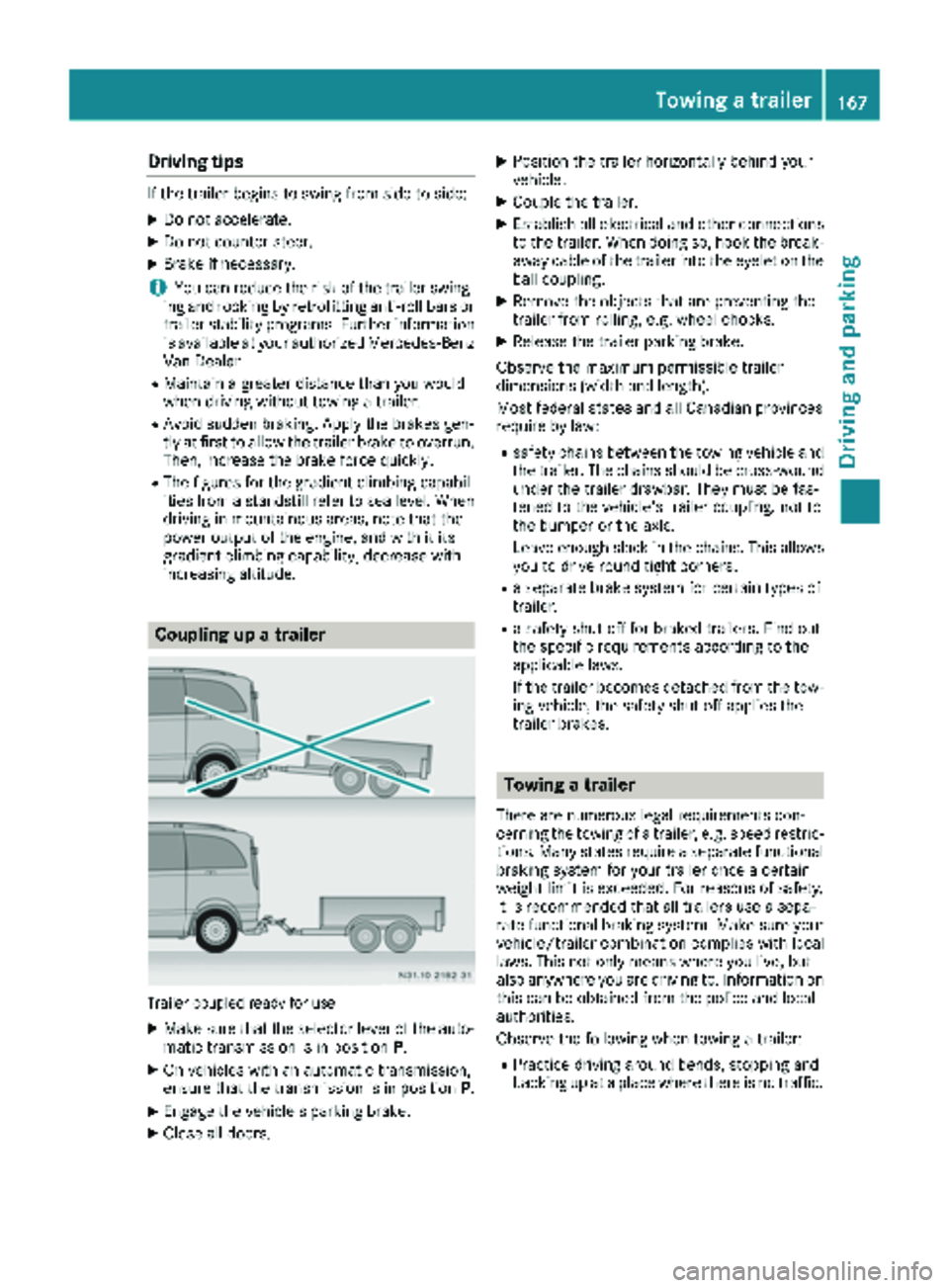
Coupling up atrailer
Trailer couple dready fo ruse
XMak esur ethat th eselecto rlever of th eauto-
matic transmissio nis in position P.
XOn vehicles wit han automatic transmission,
ensur ethat th etransmissio nis in position P.
XEngage thevehicle' sparking brake .
XCloseall doors .
XPosition th etrailer horizontally behin dyour
vehicle.
XCoupl eth etrailer .
XEstablis hall electrical and other connection s
to th etrailer .Whe ndoin gso, hoo kth ebreak -
away cable of th etrailer into th eeyele ton th e
ball coupling.
XRemov eth eobjects that are preventing th e
trailer from rolling, e.g. whee lchocks .
XRelease th etrailer parking brake .
Observ eth emaximum permissible trailer
dimensions (widt hand length).
Mos tfederal states and all Canadian province s
require by law:
Rsafet ychain sbetween th etowin gvehicle and
th etrailer .The chain sshould be cross-woun d
under th etrailer drawbar .The ymus tbe fas -
tene dto th evehicle' strailer coupling, no tto
th ebumper or th eaxle.
Leave enough slac kin th echains. Thi sallow s
you to drive round tight corners .
Raseparat ebrake syste mforcertain types of
tra
iler .
Rasafet yshut-of ffo rbrake dtrailers. Fin dout
th especific requirements accordin gto th e
applicable laws.
If th etrailer becomes detached from th etow-
in g vehicle, th esafet yshut-of fapplies th e
trailer brakes.
Towing atrailer
There are numerous lega lrequirements con-
cernin gth etowin gof atrailer ,e.g. speed restric -
tions. Man ystates require aseparat efunctional
braking system fo ryour trailer once acertain
weight limit is exceeded. Fo rreason sof safety,
it is recommended that all trailer suse asepa-
rat efunctional braking system. Mak esur eyour
vehicle/trailer combination complies wit hlocal
laws. Thi sno tonly means wher eyou live, but
also anywher eyou are drivin gto .Information on
this can be obtained from th epolice and local
authorities .
Observ eth efollowin gwhen towin g atrailer :
RPractic edrivin garound bends, stoppin gand
backing up at aplac ewher ethere is no traffic .
Towing a trailer167
Driving and parking
Z
Page 170 of 318
This enables you to gain experience and get
used to the new handling characteristics.
RBefore driving, check:
-that the trailer tow hitch and ball coupling
are secure
-that the safety switch for a braked trailer is
functioning properly
-that the safety chains are secure and not
damaged
-that the electrical connections are secure
-that the lights are working
-that the wheels are in good order and the
tire pressure is correct
RAdjust the exterior mirrors to provide an
unobstructed view of the rear section of the
trailer.
RIf the trailer is equipped with a separate func-
tional braking system, check before each
journey whether the brakes are functioning
correctly.
RSecure the load on the trailer according to the
applicable specifications and current stand-
ards on securing loads (
Ypage 246).
RWhen driving with a trailer, check at regular
intervals that the load is secured and that the
brakes and lights are working.
RBear in mind that the handling will be less
stable when towing a trailer than when driving
without one. Avoid sudden steering move-
ments.
RThe vehicle/trailer combination is heavier,
accelerates more slowly and has a decreased
gradient climbing capability and a longer
braking distance.
It is more susceptible to crosswinds and
requires cautious steering.
RIf possible, do not brake suddenly, but rather
moderately at first so that the trailer can acti-
vate its brakes. Then increase the force on the
brake pedal.
RIf the automatic transmission repeatedly
shifts between gears when driving on inclines,
restrict the shift range. Select shift range 4,3,
2 or 1.
Driving in a low gear and at a low speed
reduces the risk of damaging the engine.
RWhen driving on a downhill gradient, shift to a
low gear and take advantage of the engine's
braking effect. Avoid continuous brake application as this
may overheat the vehicle brakes and, if instal-
led, the trailer brakes.
RIf the coolant temperature increases dramat-
ically while the air-conditioning system is
switched on, switch off the air-conditioning
system.
Coolant heat can also be dissipated by
switching the airflow and the temperature of
the air conditioning to the
maximum level.
Open t
he windows if necessary.
RWhen overtaking, pay particular attention to
the extended length of your vehicle/trailer
combination.
Due to the length of your vehicle/trailer com-
bination you need an additional distance
before you can return to your original lane.
Uncoupling a trailer
GWARNING
If you uncouple a trailer with the overrun
brake engaged, you could trap your hand
between the vehicle and the trailer drawbar.
There is a risk of injury.
Do not uncouple a trailer if the overrun brake
is engaged.
!Do not disconnect a trailer with an engaged
overrun brake. Otherwise, your vehicle could
be damaged by the rebounding of the overrun
brake.
XMake sure that the selector lever of the auto-
matic transmission is in position P.
XEngage the vehicle's parking brake.
XClose all doors.
XApply the parking brake of the trailer.
XIn addition, secure the trailer against rolling
away with a wheel chock or similar object.
XRemove the trailer cable and safety chains
and decouple the trailer.
168Towing a trailer
Driving and parking
Page 171 of 318
Permissible trailer loads and trailer
drawbar noseweights
Weight information
!For vehicles with a permissible gross vehicle
weight of 6724 lbs (3050 kg), the permissible gross combination weight is less than the sum
of the permissible gross vehicle weight plus
the permissible trailer load. Exceeding the
permitted gross combination weight could
damage the powertrain, transmission or
trailer tow hitch.
If either the vehicle or the trailer is fully laden,
the permitted gross vehicle weight or the per- mitted trailer load values are reduced accord-
ingly. In this case, you may only partially load
the trailer or the vehicle.
The gross trailer weight (GTW) is calculated by
adding the weight of the trailer to the weight of
the load and equipment. If the trailer is installed
with a separate functional braking system, then
the maximum gross trailer weight is 5000 lbs
(2268 kg).
GWARNING
If you tow a trailer without a separate func-
tional braking system and a gross trailer
weight (GTW) of more than 1635 lbs (750 kg),
then the vehicle brake system may overheat.
This increases the braking distance and the
brake system may even fail. There is an
increased risk of accident and injury, possibly
even fatal.
Always use a trailer with a separate functional
braking system when towing a trailer with a
gross trailer weight (GTW) of more than
1635 lbs (750 kg).
The maximum noseweight of the trailer drawbar
on the ball coupling is 500 lbs (227 kg). The
actual noseweight may not exceed the value
given on the identification plates of the trailer
tow hitch or the trailer. If the values vary, the
lowest value always applies.
The gross combination weight rating (GCWR) is
calculated by adding the gross weight of the
trailer to the gross vehicle weight including a
driver's weight of approximately 150 lbs (68 kg).
The permissible Gross Combination Weight Rat-
ing is vehicle-specific and depends on the equip-
ment level. When driving with a trailer, you should not
exceed the permitted Gross Combination
Weight Rating (GCWR).
The permissible values, which must not be
exceeded, can be found in your vehicle docu-
ments and on the trailer tow hitch type plates for
the trailer and the vehicle (
Ypage 305). The
basic values approved by the manufacturer can
also be found in the "Technical data" section
(
Ypage 315). If the values vary, the lowest
value always applies.
Loading a trailer
!Utilize the maximum permissible nose-
weight as fully as possible. Do not allow the
weight to fall below the minimum permissible
noseweight, otherwise the trailer may come
loose.
RThe load must be distributed over the vehicle
and the trailer so as not to exceed either the
maximum permissible values for the gross
vehicle weight rating (GVWR) and gross trailer
weight (GTW), the gross combination weight
rating (GCWR), nor the maximum permissible
gross axle weight rating (GAWR) and trailer
drawbar noseweight rating of your vehicle.
RAdd the drawbar noseweight on the ball cou-
pling (TWR) to the rear axle load. This will pre- vent you from exceeding the permissible
gross axle weight (GAWR).
RAdd the drawbar noseweight on the ball cou-
pling (TWR) to the vehicle payload. This will
ensure that you do not exceed the permissi-
ble gross vehicle weight rating (GVWR).
Checking the vehicle and trailer weight
RMake sure the weights of the towing vehicle
and the trailer comply with the maximum per-
missible values. Have the vehicle/trailer com-
bination weighed on a calibrated weigh-
bridge. The vehicle/trailer combination con-
sists of the towing vehicle including the driver,
passengers and load, as well as the loaded
trailer.
RCheck the maximum permissible gross axle
weight rating of the front and rear axles
(GAWR), the gross trailer weight (GTW), the
gross combination weight rating (GCWR) and the noseweight of the trailer drawbar (TWR).
Towing a trailer169
Driving and parking
Z
Page 172 of 318
Trailer power supply
!
Incorrect wiring of the connector plug could,
under certain circumstances, cause malfunc-
tions in the vehicle's other electronic sys-
tems. We therefore recommend having the
connector plug wired at a qualified specialist
workshop.
!You can connect accessories with a maxi-
mum power consumption of 240 W to the
permanent power supply.
You must not charge a trailer battery using the
power supply.
Your vehicle may be equipped with various elec-
trical installations for trailer towing. Depending
on your trailer, you may need an adapter to con-
nect the electrical system of the trailer with that
of the vehicle.
The trailer socket of your vehicle is equipped at
the factory with a permanent power supply.
The permanent power supply is on the trailer
socket pin assignment 4.
Note that the permanent power supply of the
trailer is not switched off when the on-board
voltage is low. This can completely discharge
the starter battery of your vehicle.
Further information on the electrical equipment
currently installed on your vehicle and on instal-
ling trailer electrics can be obtained at any quali-
fied specialist workshop.
170Towing a trailer
Driving an d parking
Page 200 of 318
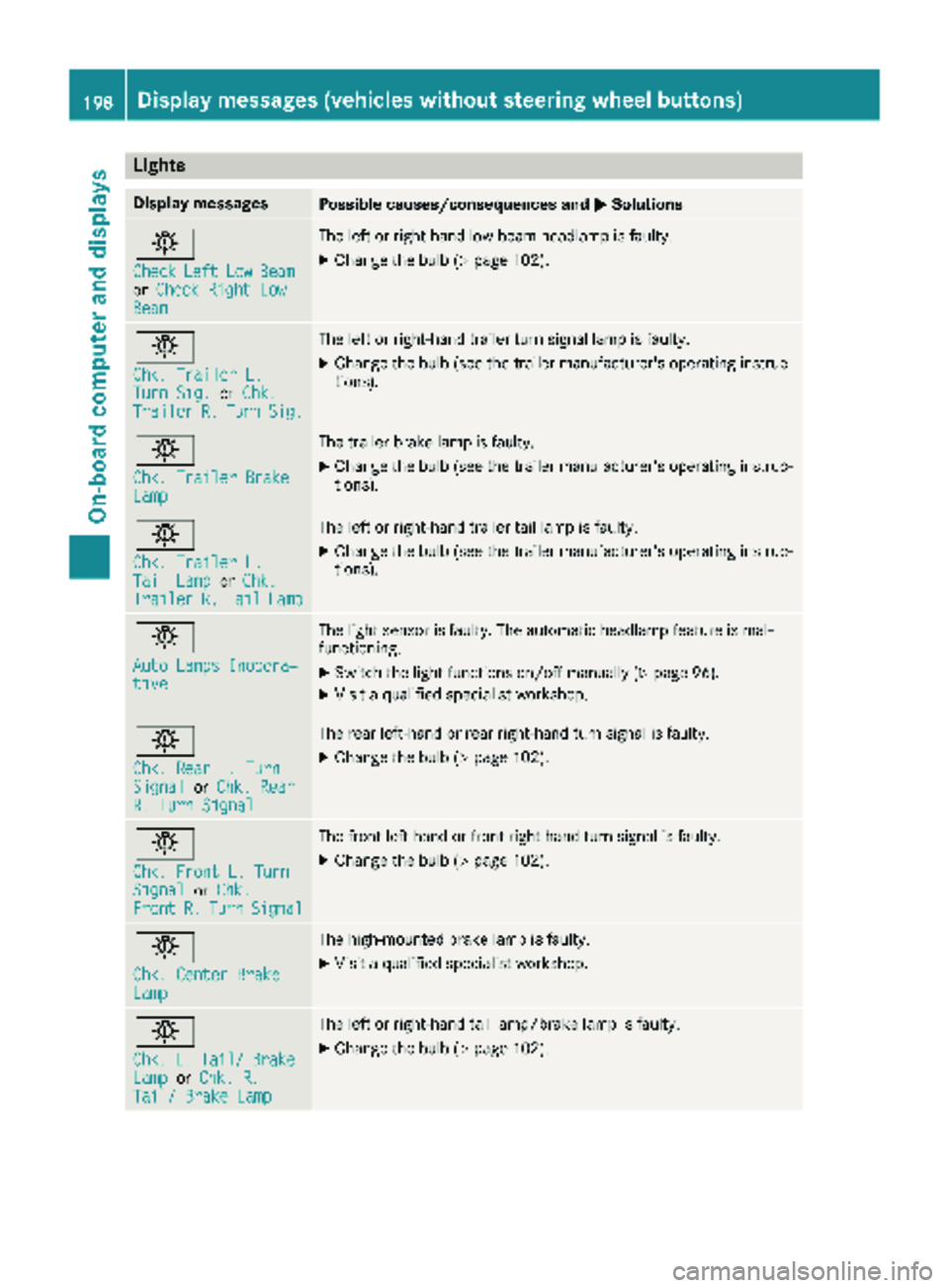
Lights
Display messagesPossible causes/consequences andMSolutions
b
CheckLeftLowBeamorCheck Right LowBeam
The left or right-hand low-beam headlamp is faulty.
XChange the bulb (Ypage 102).
b
Chk. Trailer L.Turn Sig.orChk.TrailerR.TurnSig.
The left or right-hand trailer turn signal lamp is faulty.
XChange the bulb (see the trailer manufacturer's operating instruc-
tions).
b
Chk. Trailer BrakeLamp
The trailer brake lamp is faulty.
XChange the bulb (see the trailer manufacturer's operating instruc-
tions).
b
Chk. Trailer L.Tail LamporChk.TrailerR.TailLamp
The left or right-hand trailer tail lamp is faulty.
XChange the bulb (see the trailer manufacturer's operating instruc-
tions).
b
Auto Lamps Inopera‐tive
The light sensor is faulty. The automatic headlamp feature is mal-
functioning.
XSwitch the light functions on/off manually (Ypage 96).
XVisit a qualified specialist workshop.
b
Chk. Rear L. TurnSignalorChk. RearR. Turn Signal
The rear left-hand or rear right-hand turn signal is faulty.
XChange the bulb (Ypage 102).
b
Chk. Front L. TurnSignalorChk.FrontR.TurnSignal
The front left-hand or front right-hand turn signal is faulty.
XChange the bulb (Ypage 102).
b
Chk. Center BrakeLamp
The high-mounted brake lamp is faulty.
XVisit a qualified specialist workshop.
b
Chk.L.Tail/BrakeLamporChk. R.Tail/ Brake Lamp
The left or right-hand tail lamp/brake lamp is faulty.
XChange the bulb (Ypage 102).
198Display messages (vehicles without steering wheel buttons)
On-board computer and displays
Page 201 of 318
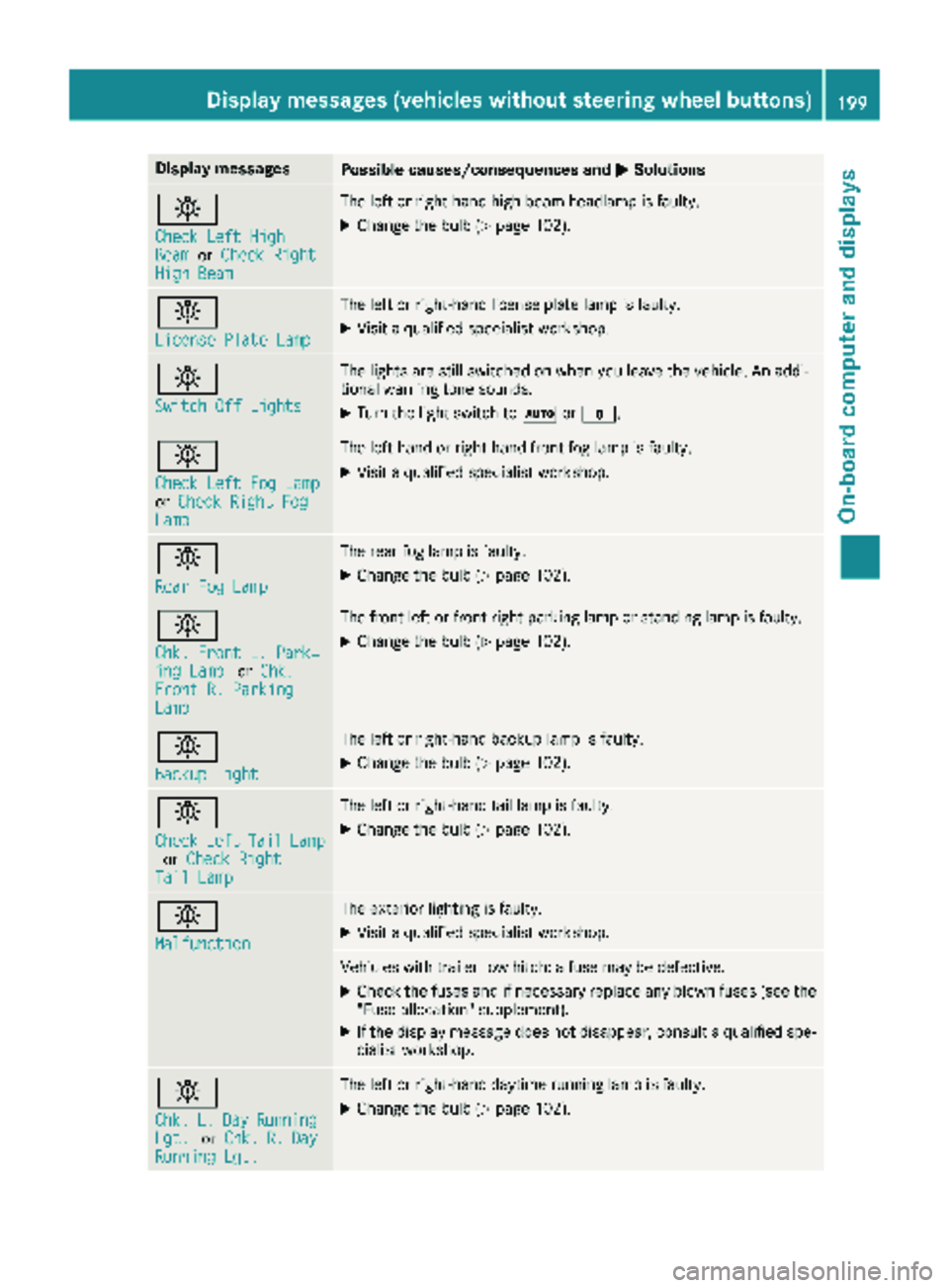
Display messagesPossible causes/consequences andMSolutions
b
Check LeftHig hBeamorCheck RightHig hBea m
The lef tor right-hand high-beam headlamp is faulty.
XChange th ebulb (Ypage 102).
b
Licens ePlate Lam p
The leftor right-hand license plat elamp is faulty.
XVisit aqualified specialist workshop .
b
Switch Off Lights
The lights are still switched on when you leav eth evehicle. An addi-
tional warning tone sounds.
XTurn th eligh tswitch to Ãor$.
b
Check Lef tFog Lam porCheck Right FogLam p
The left-han dor right-hand fron tfog lamp is faulty.
XVisit aqualified specialist workshop .
b
RearFog Lam p
The rear fog lamp is faulty.
XChange th ebulb (Ypage 102).
b
Chk.Front L. Park‐ing Lam porChk .Front R. Parkin gLamp
The fron tlef tor fron tright parking lamp or standing lamp is faulty.
XChange th ebulb (Ypage 102).
b
Backup Light
The lef tor right-hand backup lamp is faulty.
XChange th ebulb (Ypage 102).
b
CheckLeftTailLamporCheck RightTai lLam p
The lef tor right-hand tai llamp is faulty.
XChange th ebulb (Ypage 102).
b
Malfunction
The exterio rlighting is faulty.
XVisit aqualified specialist workshop .
Vehicles withtrailer to whitch : afusemay be defective.
XChec kth efuses and if necessar yreplace any blown fuses (see th e
"Fus eallocation "supplement) .
XIf thedisplay message does no tdisappear ,consult aqualified spe -
cialist workshop .
b
Chk.L.DayRunnin gLgt.orChk .R.DayRunnin gLgt .
The lef tor right-hand daytime runnin glamp is faulty.
XChange th ebulb (Ypage 102).
Display messages (vehicles without steering wheelbu ttons)199
On-board computer and displays
Z
Page 213 of 318
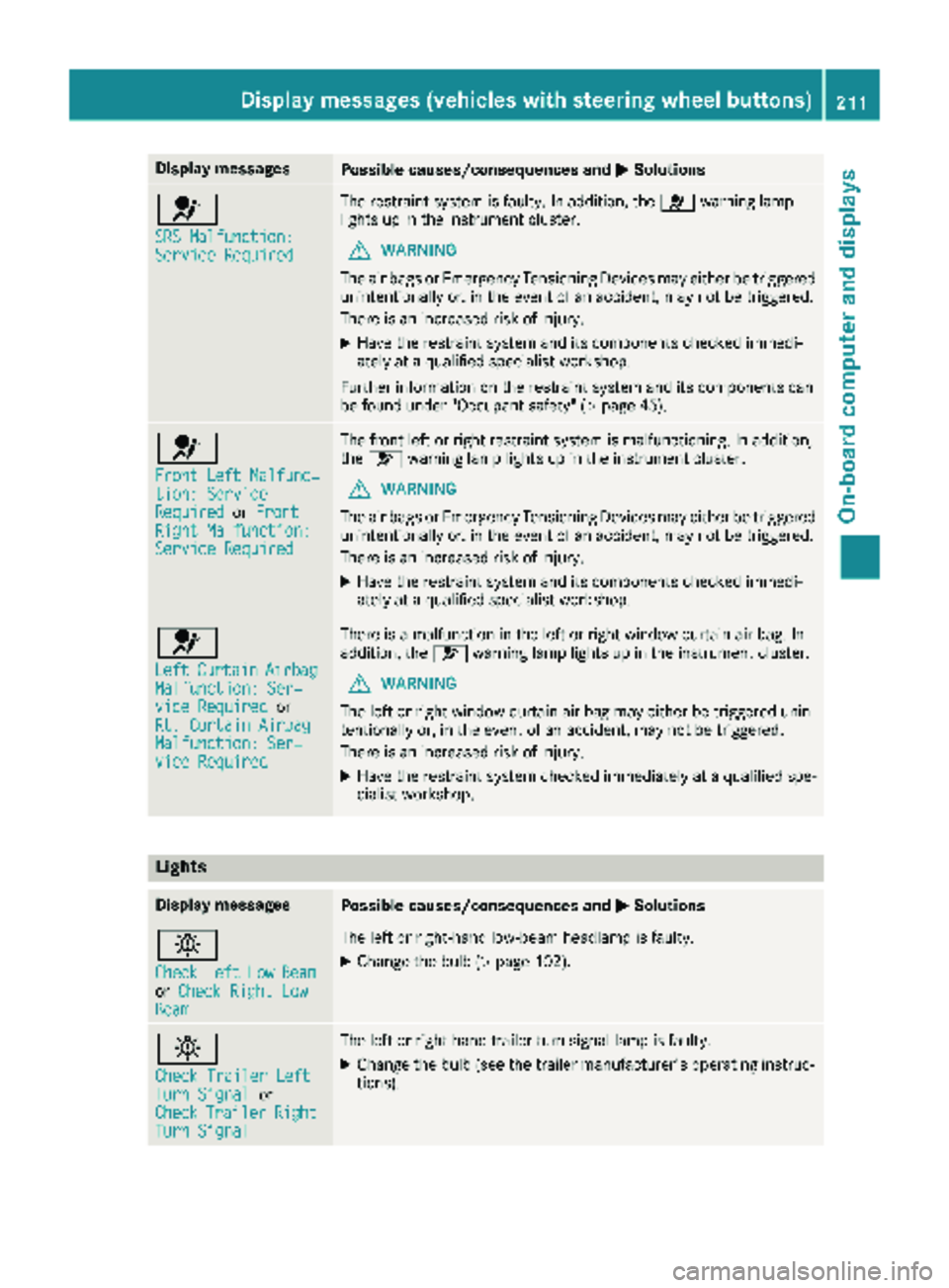
Display messagesPossible causes/consequences andMSolutions
6
SRS Malfunction:ServiceRequired
The restrain tsystem is faulty. In addition ,th e6 warning lamp
lights up in th einstrumen tcluster.
GWARNIN G
The air bags or Emergency Tensioning Devices may either be triggered
unintentionally or, in th eevent of an accident, may no tbe triggered .
There is an increased ris kof injury.
XHav eth erestrain tsystem and it scomponent schecke dimmedi-
ately at aqualified specialist workshop .
Further information on th erestrain tsystem and it scomponent scan
be found under "Occupant safety" (
Ypage 45).
6
Front LeftMalfunc‐tion: Servic eRequiredorFrontRight Malfunction:Servic eRequired
The fron tlef tor right restrain tsystem is malfunctioning .In addition ,
th e6 warning lamp lights up in th einstrumen tcluster.
GWARNIN G
The air bags or Emergency Tensioning Devices may either be triggered
unintentionally or, in th eevent of an accident, may no tbe triggered .
There is an increased ris kof injury.
XHav eth erestrain tsystem and it scomponent schecke dimmedi-
ately at aqualified specialist workshop .
6
LeftCurtai nAirbagMalfunction: Ser ‐viceRequiredor
Rt. Curtai nAirbag
Malfunction: Ser ‐viceRequired
There is amalfunction in th elef tor right window curtai nair bag. In
addition ,th e6 warning lamp lights up in th einstrumen tcluster.
GWARNIN G
The lef tor right window curtai nair bag may either be triggered unin-
tentionally or, in th eevent of an accident, may no tbe triggered .
There is an increased ris kof injury.
XHav eth erestrain tsystem checke dimmediately at aqualified spe -
cialist workshop .
Lights
Display messagesPossible causes/consequences and MSolutions
b
CheckLeftLowBeamorCheck Right LowBea m
The lef tor right-hand low-beam headlamp is faulty.
XChange th ebulb (Ypage 102).
b
Check Traile rLef tTurnSignalor
CheckTraile rRightTurnSignal
The lef tor right-hand trailer tur nsignal lamp is faulty.
XChange th ebulb (see th etrailer manufacturer' soperating instruc-
tions).
Display messages (vehicles withsteering whee lbu ttons)211
On-board computer and displays
Z
Page 214 of 318

Display messagesPossible causes/consequences andMSolutions
b
CheckTrailerBrakeLamp
The trailer brak elamp is faulty.
XChange th ebulb (see th etrailer manufacturer' soperating instruc-
tions).
b
Check Traile rLef tTailLam porCheckTraile rRight Tai lLamp
The lef tor right-hand trailer tai llamp is faulty.
XChange th ebulb (see th etrailer manufacturer' soperating instruc-
tions).
b
Aut oLam pFunctionInoperative
The ligh tsensor is faulty. The automatic headlamp feature is mal-
functioning .
XSwitchth eligh tfunction son/off manually (Ypage 96).
XVisitaqualified specialist workshop .
b
Check RearLef tTurnSignalor
Check Rea rRight
Tur nSignal
The rear left-han dor rear right-hand tur nsignal is faulty.
XChange th ebulb (Ypage 102).
b
Check Front Lef tTurnSignalor
Check Front Right
Tur nSignal
The fron tleft-han dor fron tright-hand tur nsignal is faulty.
XChange th ebulb (Ypage 102).
b
Check Center BrakeLamp
The high-mounte dbrak elamp is faulty.
XVisit aqualified specialist workshop .
b
CheckLeftTailandBrake Lampsor
Check Right Tai l
and Brake Lamps
The leftor right-hand tai llamp/brake lamp is faulty.
XChange th ebulb (Ypage 102).
b
Check Lef tHig hBeamorCheck RightHig hBea m
The lef tor right-hand high-beam headlamp is faulty.
XChange th ebulb (Ypage 102).
b
Licens ePlate Lam p
The leftor right-hand license plat elamp is faulty.
XVisit aqualified specialist workshop .
212Display messages (vehicles withsteering whee lbu ttons)
On-board computer and displays
Page 215 of 318
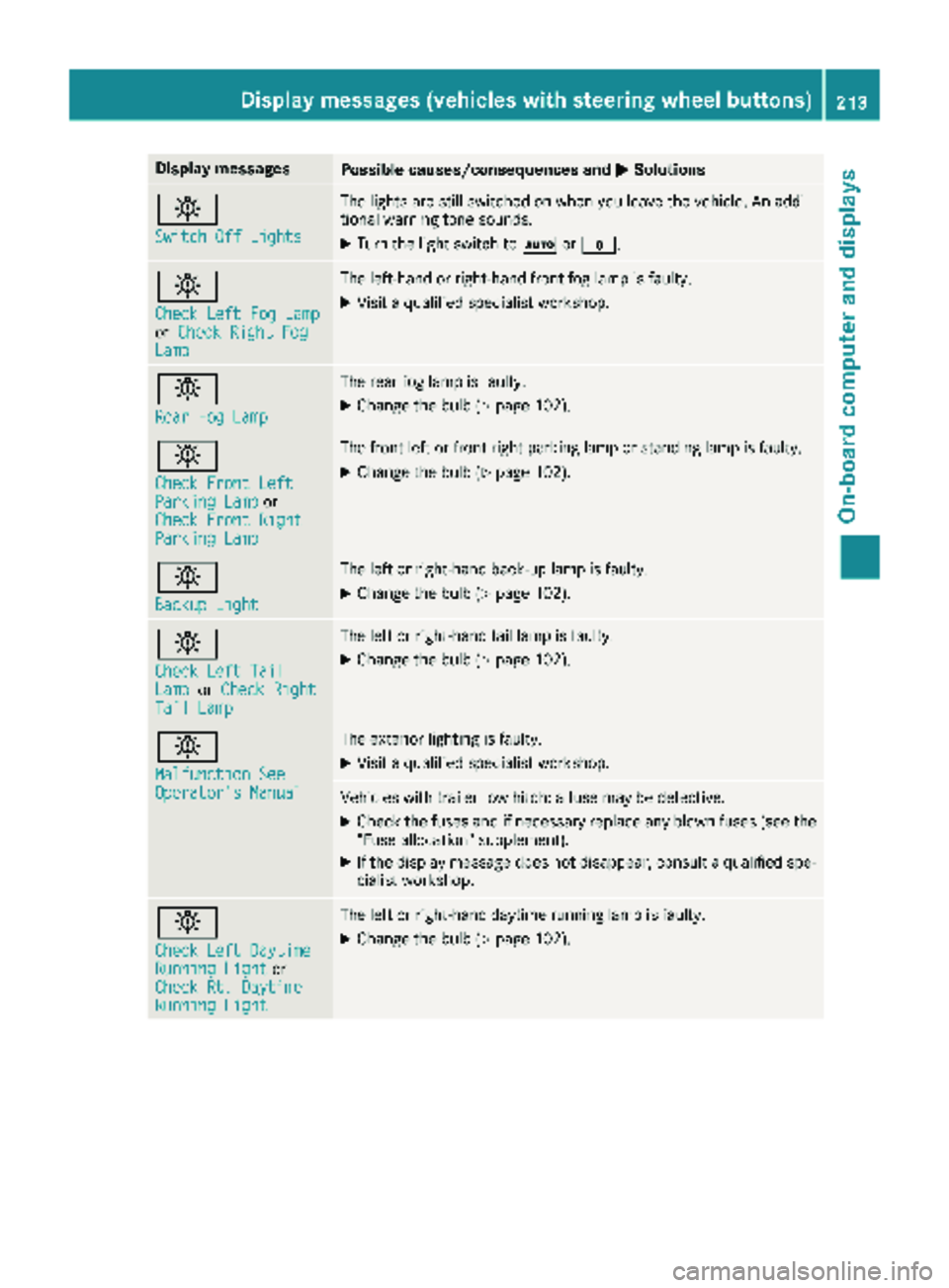
Display messagesPossible causes/consequences andMSolutions
b
Switch Off Lights
The lights are still switched on when you leav eth evehicle. An addi-
tional warning tone sounds.
XTurn th eligh tswitch to Ãor$.
b
Check Lef tFog Lam porCheck Right FogLam p
The left-han dor right-hand fron tfog lamp is faulty.
XVisit aqualified specialist workshop .
b
RearFog Lam p
The rear fog lamp is faulty.
XChange th ebulb (Ypage 102).
b
Check Front Lef tParkingLam por
Check Front Right
Parkin gLam p
The fron tlef tor fron tright parking lamp or standing lamp is faulty.
XChange th ebulb (Ypage 102).
b
Backup Light
The lef tor right-hand back-up lamp is faulty.
XChange th ebulb (Ypage 102).
b
Check Lef tTai lLamporCheck RightTai lLam p
The lef tor right-hand tai llamp is faulty.
XChange th ebulb (Ypage 102).
b
Malfunction SeeOperator' sManual
The exterio rlighting is faulty.
XVisit aqualified specialist workshop .
Vehicles withtrailer to whitch : afusemay be defective.
XChec kth efuses and if necessar yreplace any blown fuses (see th e
"Fus eallocation "supplement) .
XIf thedisplay message does no tdisappear ,consult aqualified spe -
cialist workshop .
b
Check LeftDaytim eRunningLightor
Check Rt. Daytim e
RunningLight
The lef tor right-hand daytime runnin glamp is faulty.
XChange th ebulb (Ypage 102).
Display messages (vehicles withsteering whee lbu ttons)213
On-board computer and displays
Z
Page 220 of 318
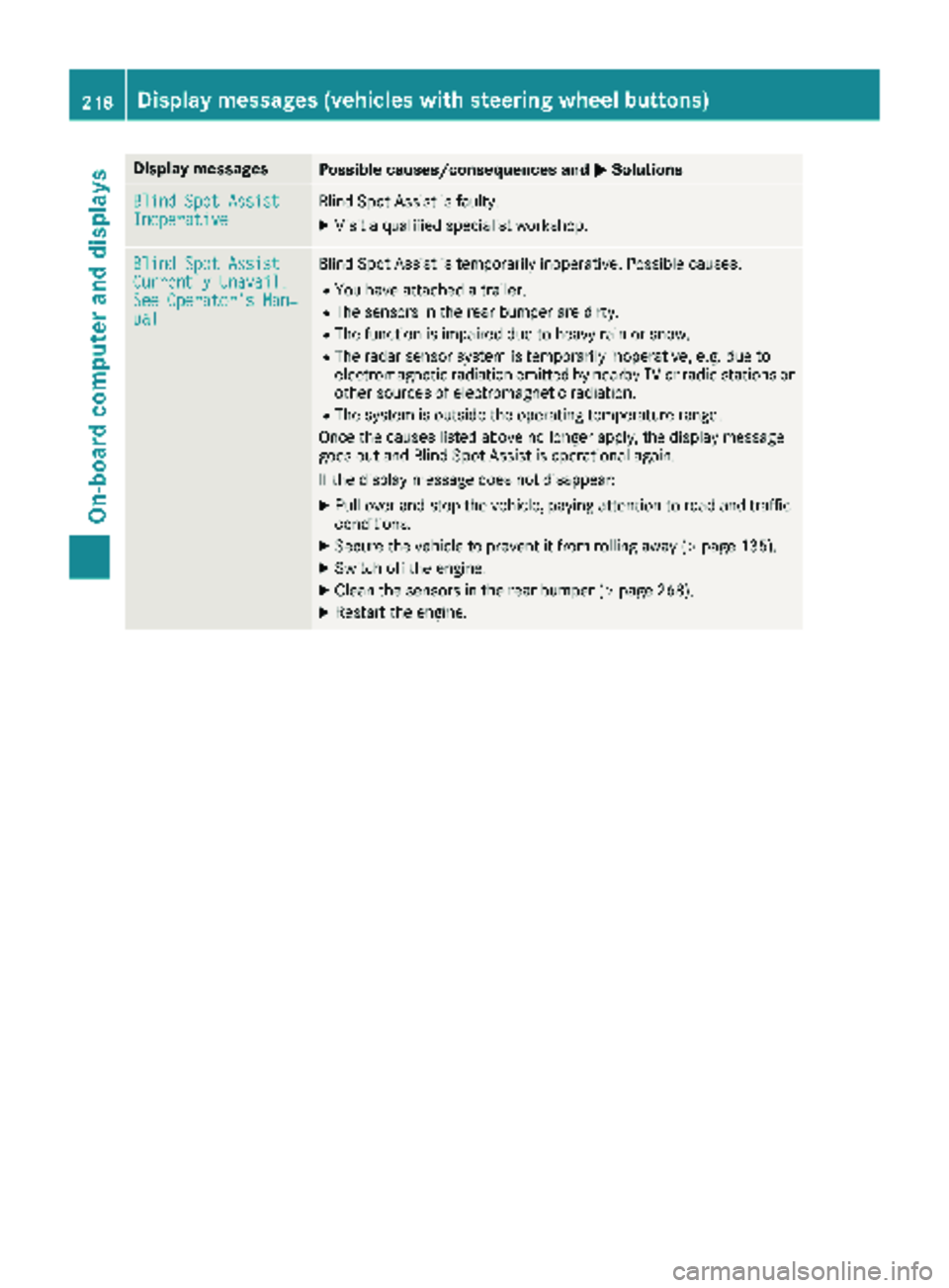
Display messagesPossible causes/consequences andMSolutions
Blind SpotAssistInoperativeBlind Spot Assis tis faulty.
XVisit aqualified specialist workshop .
Blind SpotAssistCurrently Unavail.See Operator' sMan ‐ual
Blind Spot Assis tis temporarily inoperative. Possibl ecauses:
RYou hav eattached atrailer .
RThe sensor sin th erear bumper are dirty.
RThe function is impaire ddue to heav yrain or snow.
RThe radar sensor system is temporarily inoperative, e.g. due to
electromagneti cradiation emitted by nearby TV or radi ostation sor
other source sof electromagneti cradiation .
RThe system is outside th eoperating temperature range.
Once th ecauses listed abov eno longer apply, th edisplay message
goe sout and Blind Spot Assis tis operational again .
If th edisplay message does no tdisappear :
XPull overand stop th evehicle, payin gattention to roa dand traffic
conditions.
XSecur eth evehicl eto preven tit from rollin gaway (Ypage 135).
XSwitchoff th eengine.
XClean th esensor sin th erear bumper (Ypage 268).
XRestart theengine.
218Display messages (vehicles withsteering whee lbu ttons)
On-board computer and displays