seats MERCEDES-BENZ METRIS 2019 MY19 Operator’s Manual
[x] Cancel search | Manufacturer: MERCEDES-BENZ, Model Year: 2019, Model line: METRIS, Model: MERCEDES-BENZ METRIS 2019Pages: 318, PDF Size: 5.07 MB
Page 63 of 318
LATCH-type (ISOFIX) child seat secur-
ing system
GWARNING
For LATCH-type (ISOFIX) child restraint sys-
tems in which the child is secured using the
safety belt integrated in the child restraint
system, the maximum permissible weight of
the child and child restraint system together
is 73 lbs (33 kg).
If the child and the child restraint system
together weigh more than 73 lbs (33 kg), the
LATCH-type (ISOFIX) child restraint system
with integrated safety belt no longer offers
sufficient protection. The LATCH-type (ISO-
FIX) child seat securing system may be over-
loaded, and the child may not be restrained in
an accident, for example. This poses an
increased risk of injury or even fatal injury.
If the child and the child restraint system
together weigh more than 73 lbs (33 kg),use
only a LATCH-type (ISOFIX) ch ildrestraint sys-
tem in whic h the ch ild isalso secured with the
veh icle seat belt. Also secure the ch ild
restraint system with the Top Tether belt,if
available.
Regularly check that the permis siblegross
weight of the ch ildtogether with the ch ild
restraint system isstill maintained.
Alwa ys co mply wit h the manufacturer's instal-
lation and operating instructions for the ch ild
restraint system used.
Before installing a ch ildseat, move the rear seat
backrest to an upright position. Do not adjust
the backrest of a seatw
it h a LATCH-type (ISO-
FIX) ch ildrestraint system installed.
Before every tr ip,make sure that the LATCH-
type (ISOFIX) ch ildrestraint system isengaged
correct ly inboth LATCH-type (ISOFIX) securing
rings
!When fitting the ch ildrestraint system in
veh icleswit h a rear bench seat, make sure
that the seat beltfor the center seat does not
get tr apped. Otherwise, the seat beltcould be
damaged.
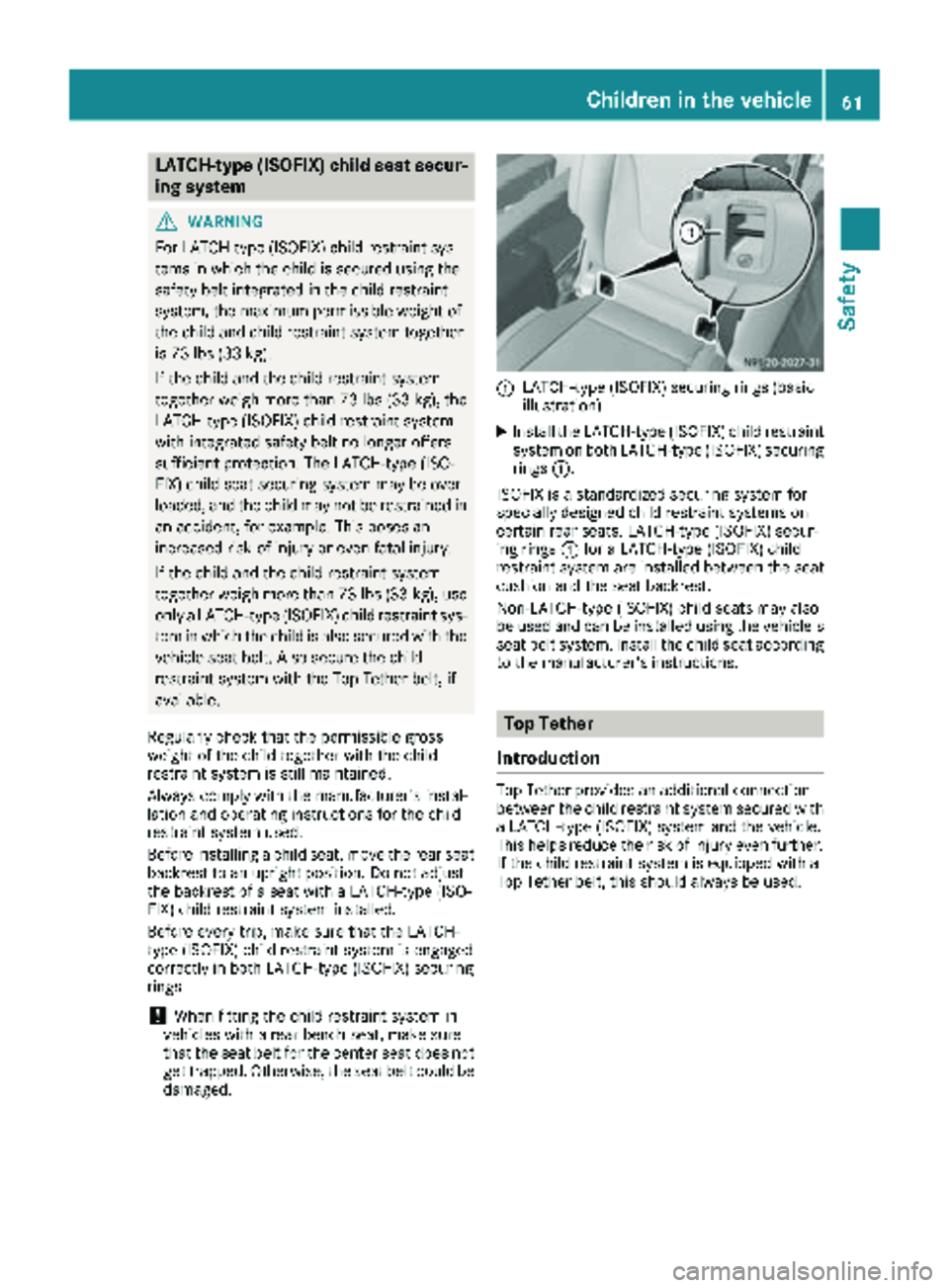
:LATCH-type (ISOFIX) securing rings (basic
illustration)
XIn stall the LATCH-type (ISOFIX) child restraint
system on both LATCH-type (ISOFIX) securing
rings :.
ISOFIX isa standardized securing system for
specially designed child restraint systems on
certain rear seats. LATCH-type (ISOFIX) secur-
ing rings :for a LATCH-type (ISOFIX) child
restraint system are installed between the seat
cushion and the seat backrest.
Non-LATCH-type (ISOFIX) child seats may also
be used and can beinstalled using the vehicle's
seat belt system. Install the child seat according to the manufacturer's instructions.
Top Tether
Introduction
Top Tether pro vides an additional connection
between the child restraint system secured with
a LATCH-type (ISOFIX) system and the vehicle.
This helps reduce the risk of injury even further.
If the child restraint system isequipped with a
Top Tether belt, this should always be used.
Children in the vehicle61
Safety
Z
Page 64 of 318
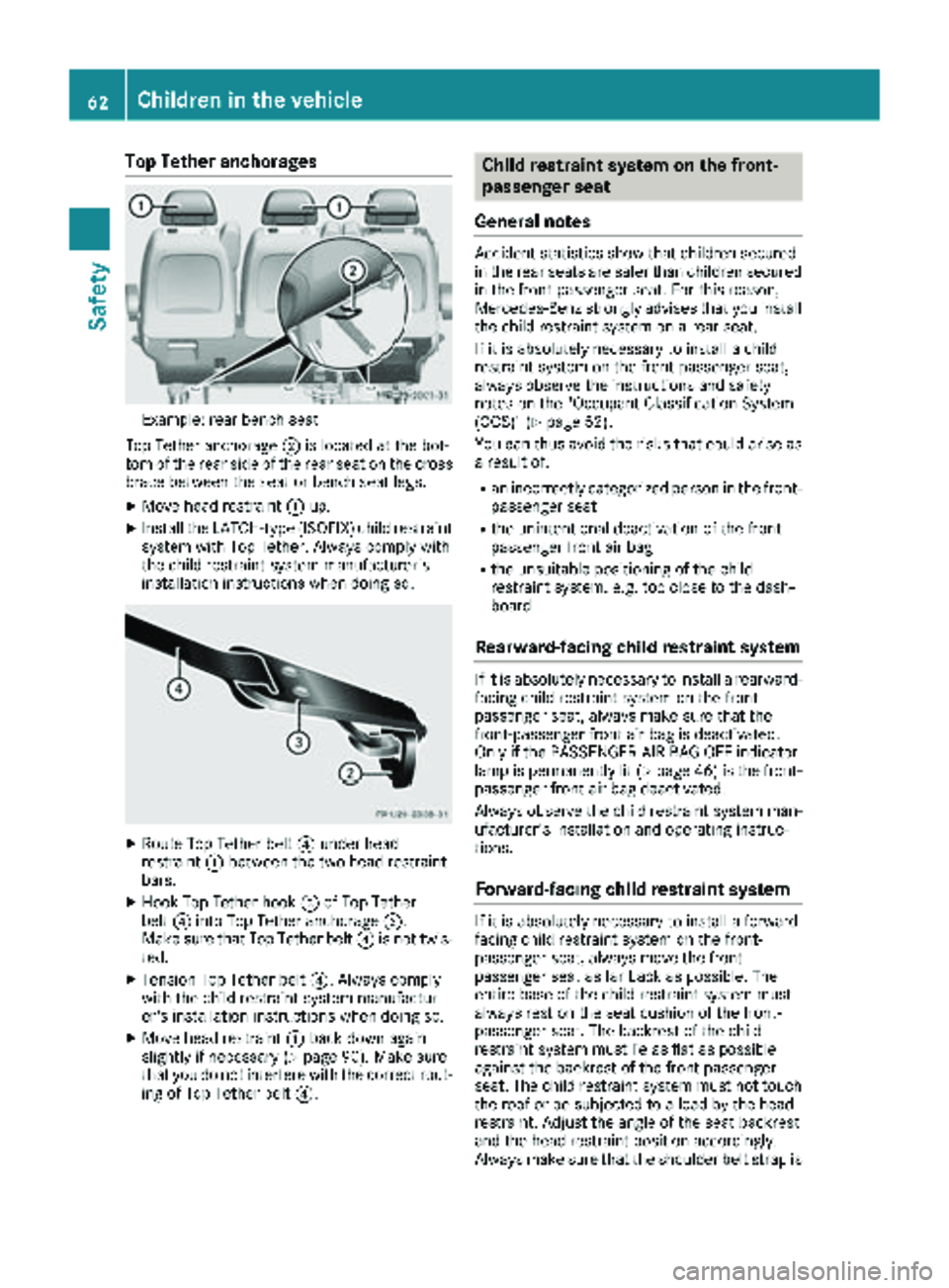
Top Tether anchorages
Example: rear bench seat
Top Tether anchorage ;is located at the bot-
tom of the rear side of the rear seat on the cross
brace between the seat or bench seat legs.
XMove head restraint :up.
XInstall the LATCH-type (ISOFIX) child restraint
system with Top Tether. Always comply with
the child restraint system manufacturer's
installation instructions when doing so.
XRoute Top Tether belt ?under head
restraint :between the two head restraint
bars.
XHook Top Tether hook =of Top Tether
belt ?into Top Tether anchorage ;.
Make sure that Top Tether belt ?is not twis-
ted.
XTension Top Tether belt ?. Always comply
with the child restraint system manufactur-
er's installation instructions when doing so.
XMove head restraint :back down again
slightly if necessary (Ypage 90). Make sure
that you do not interfere with the correct rout-
ing of Top Tether belt ?.
Child restraint system on the front-
passenger seat
General notes
Accident statistics show that children secured
in the rear seats are safer than children secured
in the front-passenger seat. For this reason,
Mercedes-Benz strongly advises that you install
the child restraint system on a rear seat.
If it is absolutely necessary to install a child
restraint system on the front-passenger seat,
always observe the instructions and safety
notes on the "Occupant Classification System
(OCS)" (
Ypage 52).
You can thus avoid the risks that could arise as a result of:
Ran incorrectly categorized person in the front-
passenger seat
Rthe unintentional deactivation of the front-
passenger front air bag
Rthe unsuitable positioning of the child
restraint system, e.g. too close to the dash-
board
Rearward-facing child restraint system
If it is absolutely necessary to install a rearward-
facing child restraint system on the front-
passenger seat, always make sure that the
front-passenger front air bag is deactivated.
Only if the PASSENGER AIR BAG OFF indicator
lamp is permanently lit (
Ypage 46 )is the front-
passenger front air bag deactivated.
Always observe the child restraint system man-
ufacturer's installation and operating instruc-
tions.
Forward-facing child restraint system
If it is absolutely necessary to install a forward-
facing child restraint system on the front-
passenger seat, always move the front-
passenger seat as far back as possible. The
entire base of the child restraint system must
always rest on the seat cushion of the front-
passenger seat. The backrest of the child
restraint system must lie as flat as possible
against the backrest of the front-passenger
seat. The child restraint system must not touch
the roof or be subjected to a load by the head
restraint. Adjust the angle of the seat backrest
and the head restraint position accordingly.
Always make sure that the shoulder belt strap is
62Children in the vehicle
Safety
Page 87 of 318
Useful information
This Operator's Manual describes all models as
well as standard and optional equipment of your
vehicle that were available at the time of going
to print. Country-specific variations are possi-
ble. Note that your vehicle may not be equipped
with all of the described functions. This also
applies to systems and functions relevant to
safety.
Read the information on qualified specialist
workshops (
Ypage 31).
Seats
Driver's and front-passenger seat
Important safety notes
GWARNING
Children could become trapped if they adjust
the seats, particularly when unattended.
There is a risk of injury.
When leaving the vehicle, always take the
SmartKey with you and lock the vehicle. Never
leave children unsupervised in the vehicle.
GWARNING
You could lose control of your vehicle if you do the following while driving:
Radjust the driver's seat, head restraint,
steering wheel or mirrors
Rfasten the seat belt
There is a risk of an accident.
Adjust the driver's seat, head restraint, steer-
ing wheel and mirror and fasten your seat belt before starting the engine.
GWARNING
When you adjust a seat, you or other vehicle
occupants could become trapped, e.g. on the seat guide rail. There is a risk of injury.
Make sure when adjusting a seat that no one
has any body parts in the sweep of the seat.
GWARNING
If the driver's seat is not engaged, it could
move unexpectedly while the vehicle is in
motion. This could cause you to lose control of the vehicle. There is a risk of an accident.
Always make sure that the driver's seat is
engaged before starting the vehicle.
GWARNING
The front-air bags for could also injure the
vehicle occupants in the front If the front
seats are positioned too close to the dash-
board or steering wheel. This poses an
increased risk of injury or even fatal injury.
Always adjust the front seats so that they are
as far from the front air bags as possible. Also
observe the notes on the correct adjustment
of the seats.
GWARNING
The seat belt does not offer the intended level of protection if you have not moved the back-
rest to an almost vertical position. When brak-
ing or in the event of an accident, you could
slide underneath the seat belt and sustain
abdomen or neck injuries, for example. This
poses an increased risk of injury or even fatal injury.
Adjust the seat properly before beginning
your journey. Always ensure that the backrest
is in an almost vertical position and that the
shoulder section of your seat belt is routed
across the center of your shoulder.
GWARNING
If the head restraints are not installed or not
adjusted correctly, they cannot provide pro-
tection as intended. There is an increased risk
of injury in the head and neck area, e.g. in the event of an accident or when braking.
Always drive with the head restraints instal-
led. Before driving off, make sure for every
vehicle occupant that the center of the head
restraint supports the back of the head at
about eye level.
Seats85
Seats, steering wheel and mirrors
Z
Page 88 of 318
!To avoid damage to the seats and the seat
heating, observe the following information:
Rkeep liquids from spilling on the seats. If
liquid is spilled on the seats, dry them as
soon as possible.
Rif the seat covers are damp or wet, do not
switch on the seat heating. The seat heat-
ing should also not be used to dry the seats.
Rclean the seat covers as recommended;
see the "Interior care" section.
Rdo not transport heavy loads on the seats.
Do not place sharp objects on the seat
cushions, e.g. knives, nails or tools. The
seats should only be occupied by passen-
gers, if possible.
Rwhen the seat heating is in operation, do
not cover the seats with insulating materi-
als, e.g. blankets, coats, bags, seat covers,
child seats or booster seats.
Your seat must be adjusted in such a way that
you can wear the seat belt correctly.
Observe the following points:
RPosition the backrest in an almost vertical
position so that you are sitting virtually
upright. Do not drive with the backrest
reclined too far back.
RYour arms should be slightly bent when you
are holding the steering wheel.
RAvoid seat positions that prevent the seat belt
from being correctly routed. The shoulder
section of the belt must be routed over the
middle of your shoulder and be pulled tight
against your upper body. The lap belt must
always pass across your lap as low down as
possible, i.e. over your hip joints.
RAdjust the head restraint so that it supports
the back of the head at eye level.
RThe distance from the pedals should be such
that you can depress them fully.
Please also observe the important safety notes
on "Air bags" (
Ypage 50), "Seat belts"
(Ypage 47) and "Child restraint systems"
(Ypage 59).
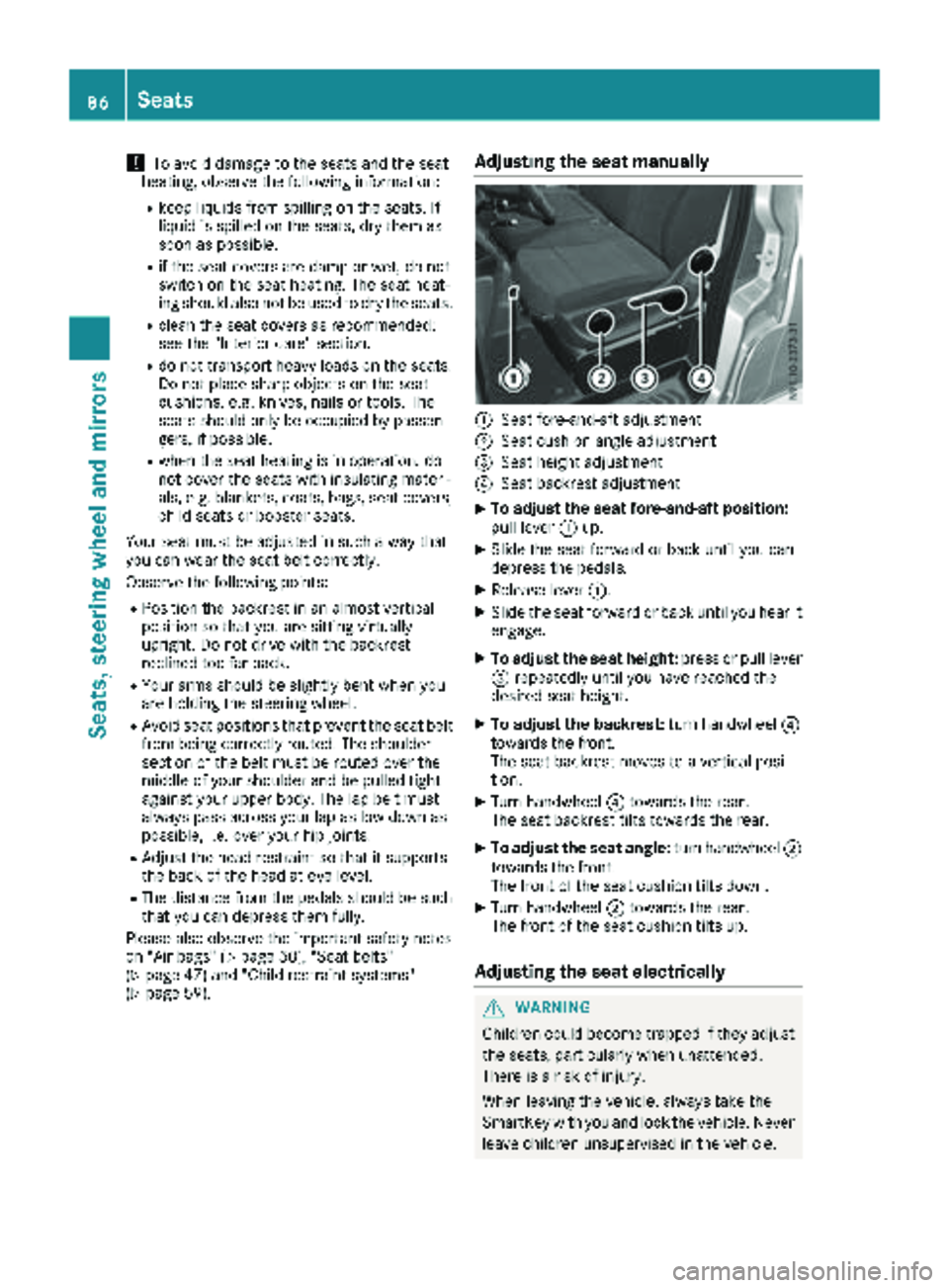
Adjusting the seat manually
:Seat fore-and-aft adjustment
;Seat cushion angle adjustment
=Seat height adjustment
?Seat backrest adjustment
XTo adjust the seat fore-and-aft position:
pull lever :up.
XSlide the seat forward or back until you can
depress the pedals.
XRelease lever :.
XSlide the seat forward or back until you hear it
engage.
XTo adjust the seat height: press or pull lever
= repeatedly until you have reached the
desired seat height.
XTo adjust the backrest: turn handwheel?
towards the front.
The seat backrest moves to a vertical posi-
tion.
XTurn handwheel ?towards the rear.
The seat backrest tilts towards the rear.
XTo adjust the seat angle: turn handwheel;
towards the front.
The front of the seat cushion tilts down.
XTurn handwheel ;towards the rear.
The front of the seat cushion tilts up.
Adjusting the seat electrically
GWARNING
Children could become trapped if they adjust
the seats, particularly when unattended.
There is a risk of injury.
When leaving the vehicle, always take the
SmartKey with you and lock the vehicle. Never
leave children unsupervised in the vehicle.
86Seats
Seats, steering wheel and mirrors
Page 89 of 318
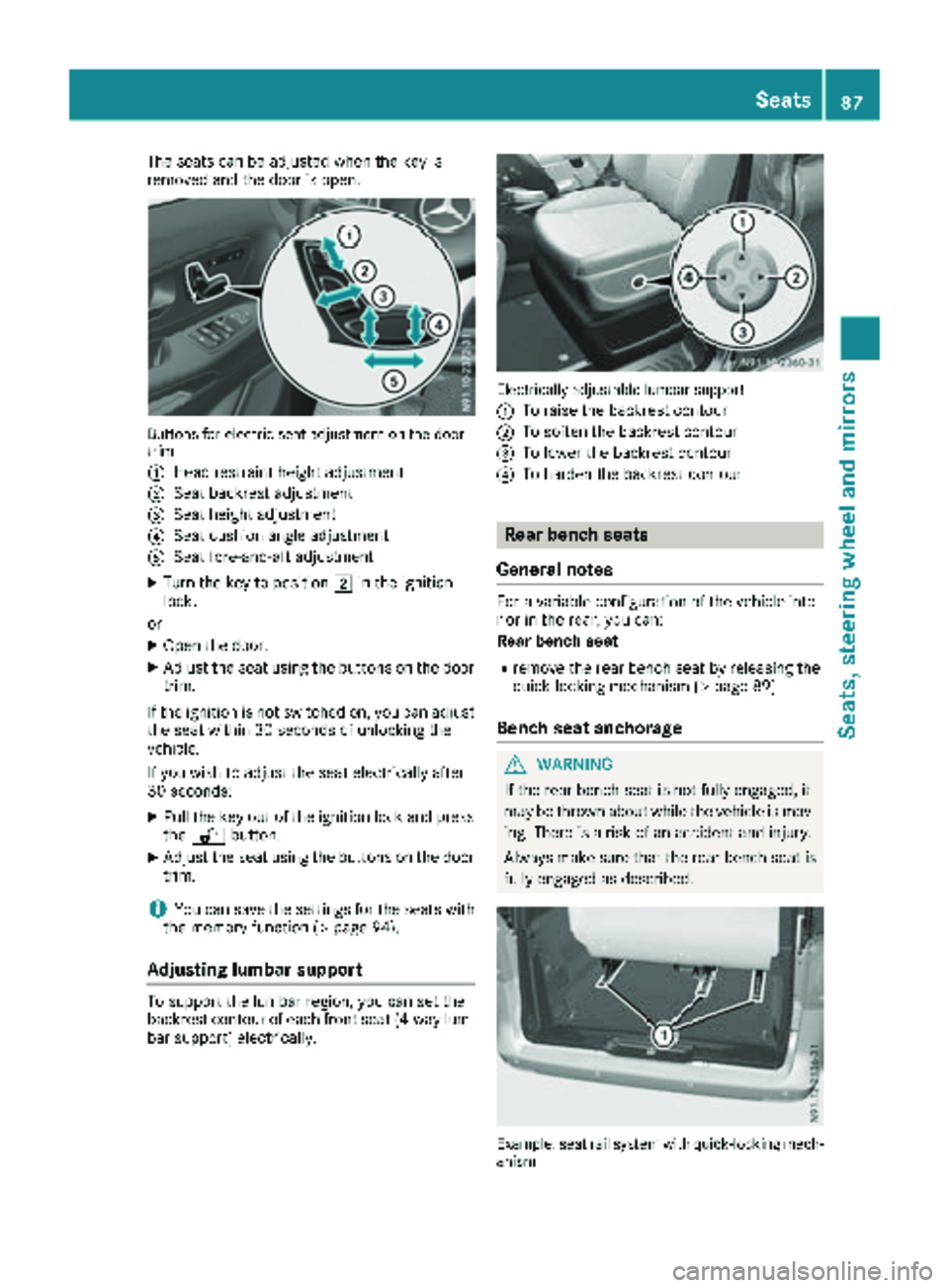
The seats can be adjusted when the key is
removed and the door is open.
Buttons for electric seat adjustment on the door
trim
:
Head restraint height adjustment
;Seat backrest adjustment
=Seat height adjustment
?Seat cushion angle adjustment
ASeat fore-and-aft adjustment
XTurn the key to position2in the ignition
lock.
or
XOpen the door.
XAdjust the seat using the buttons on the door
trim.
If the ignition is not switched on, you can adjust
the seat within 30 seconds of unlocking the
vehicle.
If you wish to adjust the seat electrically after
30 seconds:
XPull the key out of the ignition lock and press
the % button.
XAdjust the seat using the buttons on the door
trim.
iYou can save the settings for the seats with
the memory function (Ypage 94).
Adjusting lumbar support
To support the lumbar region, you can set the
backrest contour of each front seat (4-way lum- bar support) electrically.
Electrically adjustable lumbar support
:
To raise the backrest contour
;To soften the backrest contour
=To lower the backrest contour
?To harden the backrest contour
Rear bench seats
General notes
For a variable configuration of the vehicle inte-
rior in the rear, you can:
Rear bench seat
Rremove the rear bench seat by releasing the
quick-locking mechanism (Ypage 89)
Bench seat anchorage
GWARNING
If the rear bench seat is not fully engaged, it
may be thrown about while the vehicle is mov-
ing. There is a risk of an accident and injury.
Always make sure that the rear bench seat is
fully engaged as described.
Example: seat rail system with quick-locking mech-
anism
Seats87
Seats, steering wheel and mirrors
Z
Page 90 of 318
Guide rails:of the seat rail system allow you
to:
Rsecure rear bench seats in up to two rear seat rows
The only way to ensure that the rear bench seats
will engage securely is to always keep the seat
anchorages clean and free of foreign objects.
Seating variants
GWARNING
If the rear bench seats are not installed as
described, the safety precautions integrated
into the rear bench seats cannot protect as
intended. There is an increased risk of injury.
Only install the rear bench seats as described.
Only use rear bench seats approved for the
vehicle.
You can install rear bench seats with two or
three seats.
The seating variants shown are only permitted if the conditions named below for safe rear seat-
ing are met. Other seating variants are not per-
mitted and can endanger the occupants.
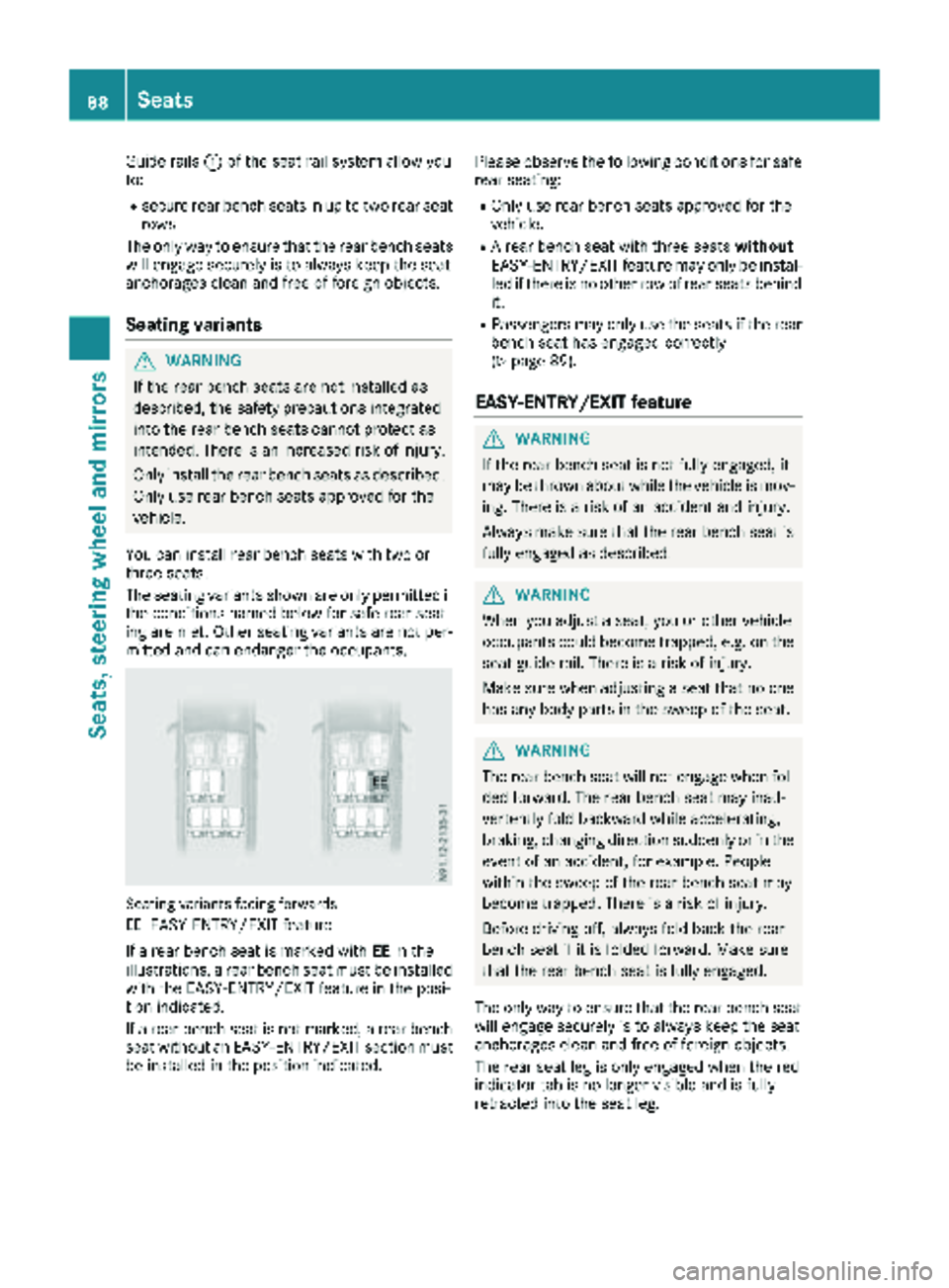
Seating variants facing forwards
EE
EASY-ENTRY/EXIT feature
If a rear bench seat is marked with EEin the
illustrations, a rear bench seat must be installed
with the EASY-ENTRY/EXIT feature in the posi-
tion indicated.
If a rear bench seat is not marked, a rear bench
seat without an EASY-ENTRY/EXIT section must
be installed in the position indicated. Please observe the following conditions for safe
rear seating:
ROnly use rear bench seats approved for the
vehicle.
RA rear bench seat with three seats
without
EASY-ENTRY/EXIT feature may only be instal- led if there is no other row of rear seats behind
it.
RPassengers may only use the seats if the rear
bench seat has engaged correctly
(
Ypage 89).
EASY-ENTRY/EXIT feature
GWARNING
If the rear bench seat is not fully engaged, it
may be thrown about while the vehicle is mov-
ing. There is a risk of an accident and injury.
Always make sure that the rear bench seat is
fully engaged as described.
GWARNING
When you adjust a seat, you or other vehicle
occupants could become trapped, e.g. on the seat guide rail. There is a risk of injury.
Make sure when adjusting a seat that no one
has any body parts in the sweep of the seat.
GWARNING
The rear bench seat will not engage when fol-
ded forward. The rear bench seat may inad-
vertently fold backward while accelerating,
braking, changing direction suddenly or in the
event of an accident, for example. People
within the sweep of the rear bench seat may
become trapped. There is a risk of injury.
Before driving off, always fold back the rear
bench seat if it is folded forward. Make sure
that the rear bench seat is fully engaged.
The only way to ensure that the rear bench seat
will engage securely is to always keep the seat
anchorages clean and free of foreign objects.
The rear seat leg is only engaged when the red
indicator tab is no longer visible and is fully
retracted into the seat leg.
88Seats
Seats, steering wheel and mirrors
Page 91 of 318
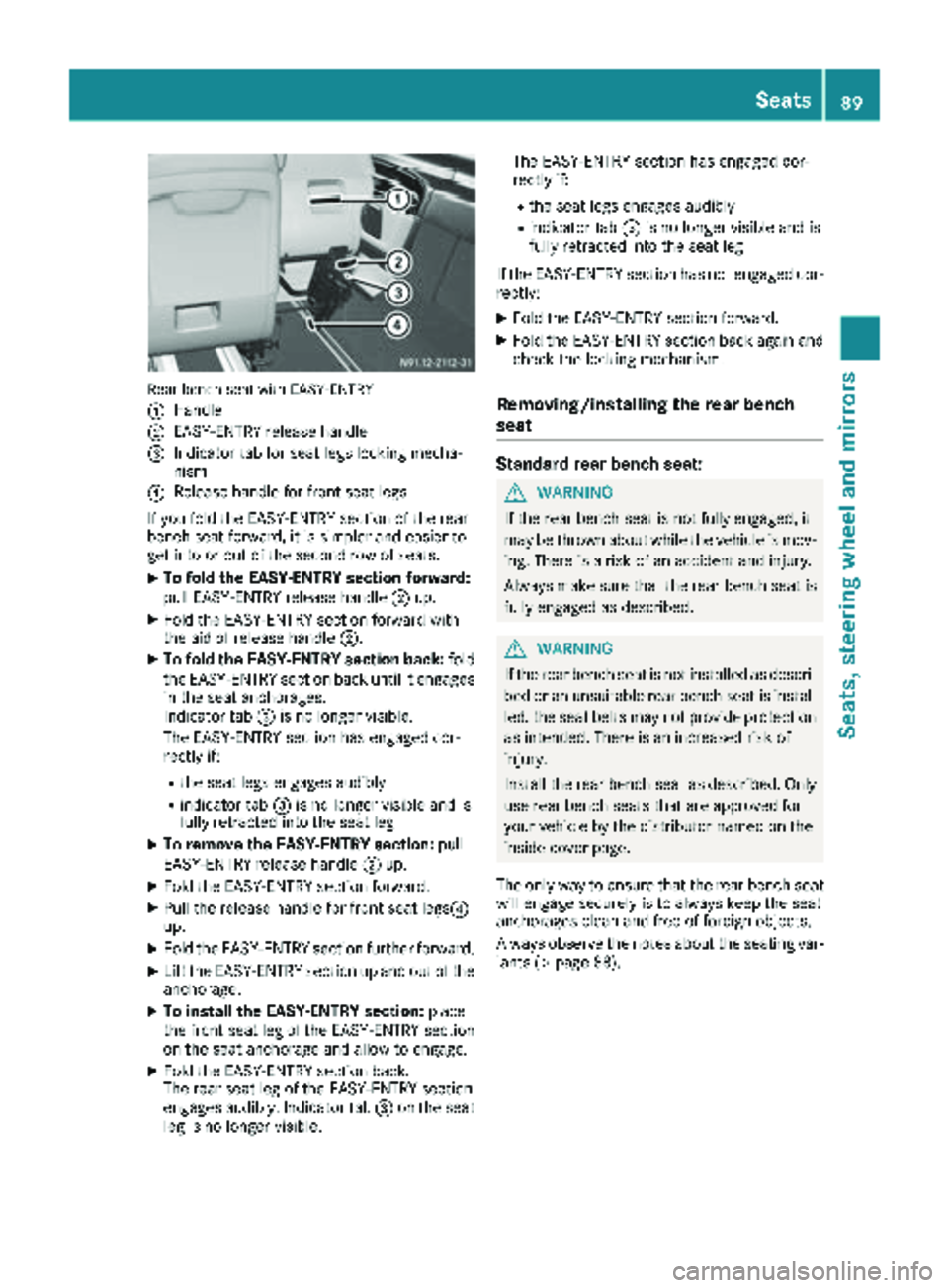
Rear bench seat withEASY-ENTRY
:
Han dle
;EASY-EN TRY release handle
=Indicator tab for seat legs locking mecha-
nis m
?Release handle for front seat legs
If you fold the EASY-ENTRY section ofthe rear
bench seat forward, it issimpler and easier to
get intoor out ofthe secon d rowofseats.
XTo fold the EASY-ENTRY section forward:
pull EASY-EN TRY release handle ;up.
XFold the EASY-EN TRY section forward with
the aid ofrelease handle ;.
XTofold the EASY-ENTRY sectionback:fold
the EASY-EN TRY section back unt il itengages
in the seat anc horages.
Indic ator tab =is no lon ger visible.
The EASY-EN TRY section has engaged cor-
rectly if:
Rthe seat legs engages audibly
Rindicat ortab =is no lon ger visibleand is
fully retracted into the seat leg
XTo rem ove the EASY-ENTRY section:pull
EASY-EN TRY release handle ;up.
XFold the EASY-EN TRY section forward.
XPullthe release handle for front seat legs ?
up.
XFold the EASY-EN TRY section further forward.
XLift theEASY-EN TRY section up and out ofthe
anc horage.
XToinstall the EASY-ENTRY section:place
the fr ont seat leg ofthe EASY-EN TRY section
on the seat anc horage and allowto engage.
XFold the EASY-EN TRY section back.
The rear seat leg ofthe EASY-EN TRY section
en
gages audibly. Indic ator tab=onthe seat
leg is no lon ger visible. The
EASY-EN TRY section has engaged cor-
rectly if:
Rthe seat legs engages audibly
Rindicat ortab =isno longer vis ibleand is
fully retracted into the seat leg
If the EASY-EN TRY section has not engaged cor-
rectly:
XFold the EASY-EN TRY section forward.
XFold theEASY-EN TRY section back again and
check the locking mechanism.
Removing/installing the rear bench
seat
Standard rear bench seat:
GWARNIN G
If the rear bench seat is not fully engaged, it
may bethrown about whilethe vehicle is mov-
ing. There isa risk ofan acc ident and injury.
Alw ays make sure that the rear bench seat is
fully engaged as described.
GWARNIN G
If the rear bench seat is not installed as descri-
bed oran unsuita blerear bench seat is instal-
led, the seat belts may not pro videprotection
as intended. Thereisan increased risk of
inj ury.
In stall the rear bench seat as described. Only
use rear bench seats that are approved for
your vehicle bythe distribut ornamed onthe
inside cover page.
The only way to ensure that the rear bench seat
will engage securely is to always keep the seat
anc horages clean and free offoreign objects.
Alw ays obse rve the notes about the seating var-
iant s (
Ypage 88).
Seats89
Seats, steering wheel and mirrors
Z
Page 92 of 318
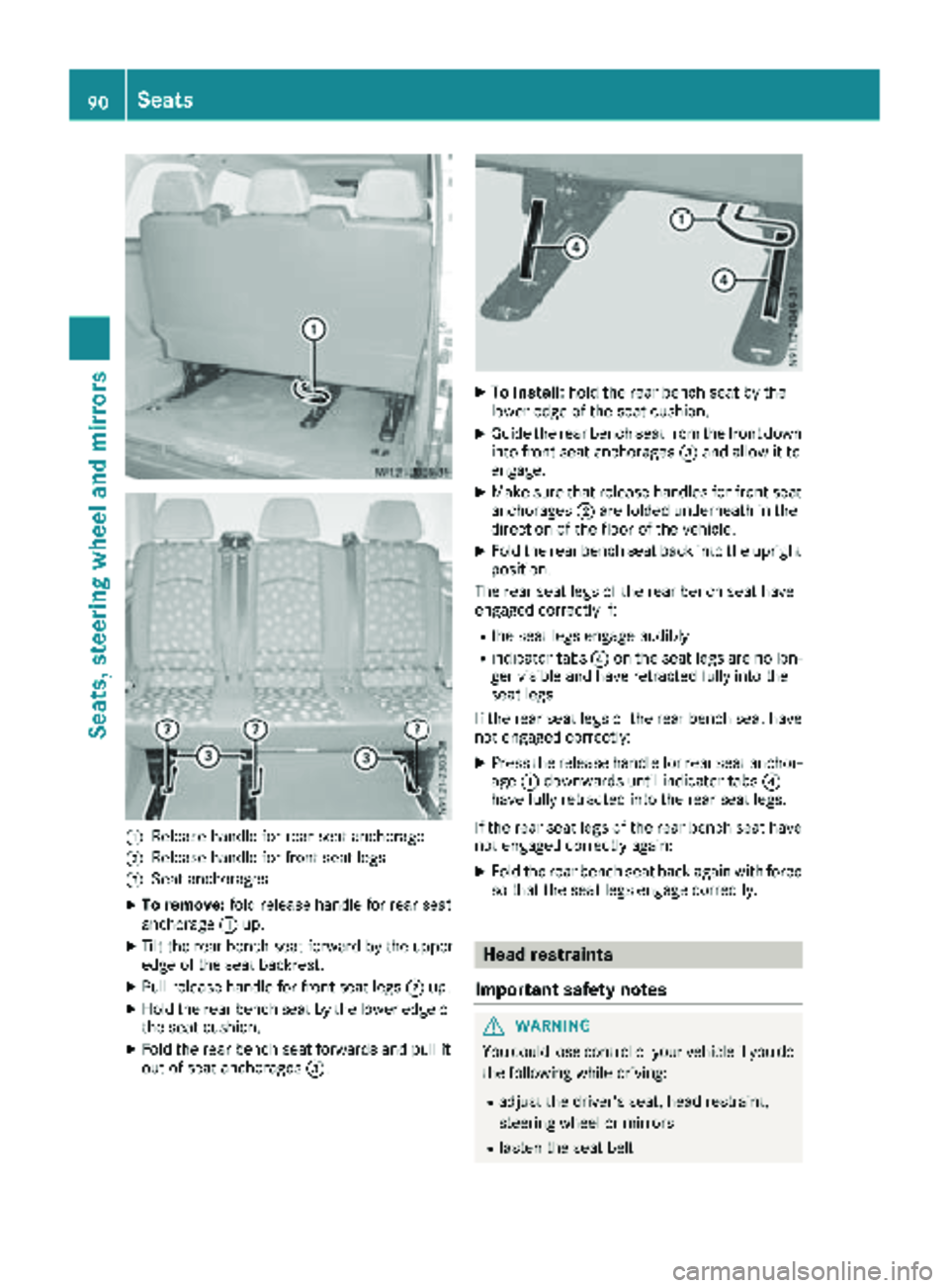
:Releasehandle for rear seat anchorage
;Releas ehandle for fron tseat legs
=Seat anchorages
XTo remove: foldrelease handle for rear seat
anchorage :up.
XTilt th erear bench seat forward by th eupper
edge of th eseat backrest .
XPull release handle for fron tseat legs ;up.
XHold th erear bench seat by th elower edge of
th eseat cushion .
XFold therear bench seat forwards and pull it
out of seat anchorages =.
XTo install:hold th erear bench seat by th e
lower edge of th eseat cushion .
XGuide therear bench seat from th efron tdown
int ofron tseat anchorages =and allow it to
engage .
XMakesur ethat release handles for fron tseat
anchorages ;are folded underneat hin th e
direction of th efloor of th evehicle.
XFold th erear bench seat bac kint oth eupright
position .
The rear seat legs of th erear bench seat hav e
engage dcorrectl yif:
Rth eseat legs engage audibly
Rindicator tab s? on th eseat legs are no lon -
ger visible and hav eretracte dfully int oth e
seat legs
If th erear seat legs of th erear bench seat hav e
no tengage dcorrectly:
XPress th erelease handle for rear seat anchor -
age :downwards until indicator tab s?
hav efully retracte dint oth erear seat legs .
If th erear seat legs of th erear bench seat hav e
no tengage dcorrectl yagain :
XFold th erear bench seat bac kagain wit hforce
so that th eseat legs engage correctly.
Head restraints
Important safety notes
GWARNIN G
You could lose control of your vehicl eif you do
th efollowin gwhile driving :
Radjust thedriver' sseat ,head restraint,
steering whee lor mirror s
Rfastenth eseat belt
90Seats
Seats, steering wheel and mirrors
Page 93 of 318
There is a risk of an accident.
Adjust the driver's seat, head restraint, steer-ing wheel and mirror and fasten your seat belt
before starting the engine.
GWARNING
If the head restraints are not installed or not
adjusted correctly, they cannot provide pro-
tection as intended. There is an increased risk
of injury in the head and neck area, e.g. in the event of an accident or when braking.
Always drive with the head restraints instal-
led. Before driving off, make sure for every
vehicle occupant that the center of the head
restraint supports the back of the head at
about eye level.
Adjust the head restraint so that:
Rthe center of the head restraint supports the
back of the head at eye level and the head
restraint is engaged
Rwhen your head is relaxed the back of your
head rests as close as possible to the head
restraint
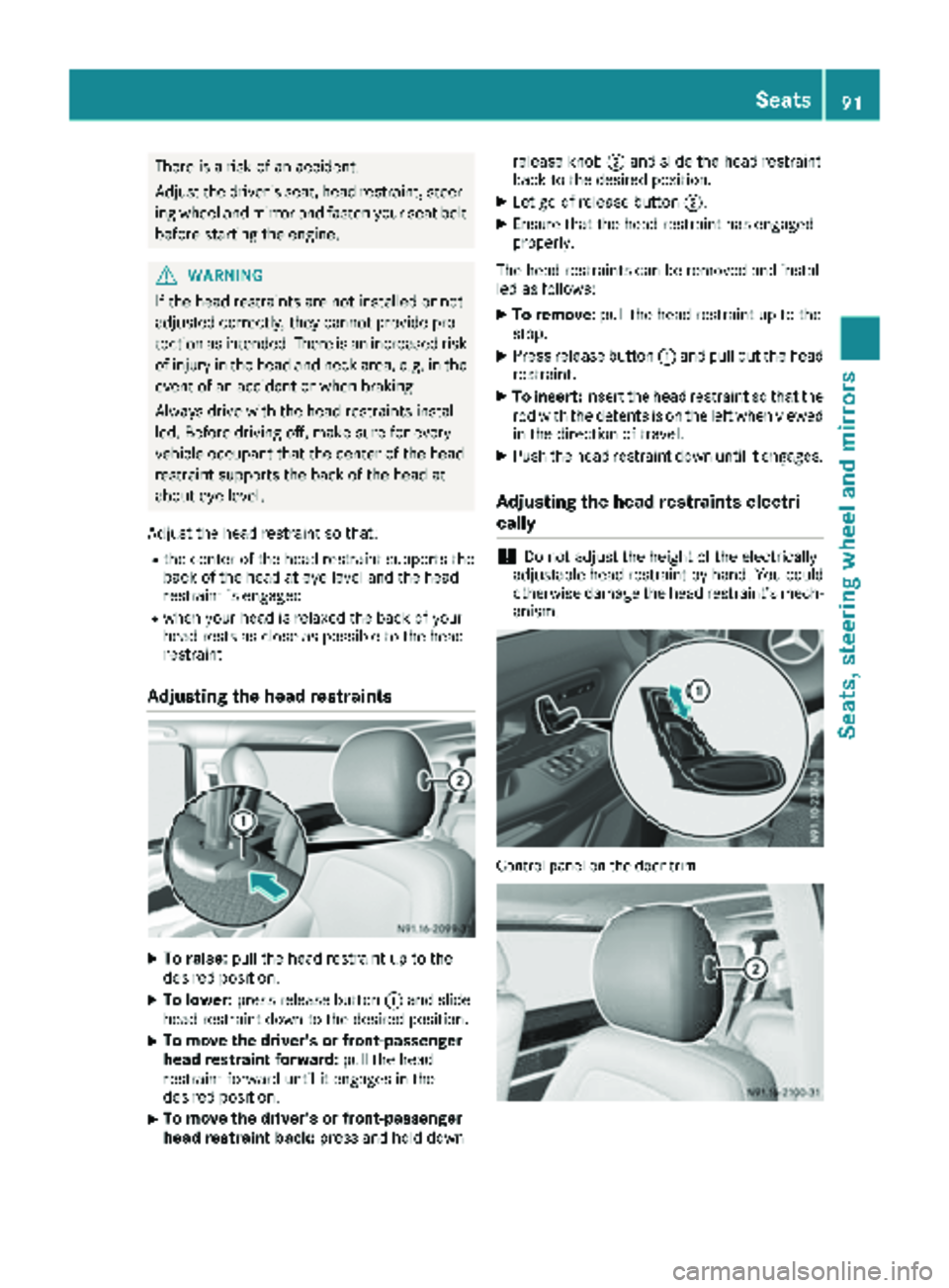
Adjusting the head restraints
XTo raise: pull the head restraint up to the
desired position.
XTo lower: press release button :and slide
head restraint down to the desired position.
XTo move the driver's or front-passenger
head restraint forward: pull the head
restraint forward until it engages in the
desired position.
XTo move the driver's or front-passenger
head restraint back: press and hold down release knob
;and slide the head restraint
back to the desired position.
XLet go of release button ;.
XEnsure that the head restraint has engaged
properly.
The head restraints can be removed and instal-
led as follows:
XTo remove: pull the head restraint up to the
stop.
XPress release button :and pull out the head
restraint.
XTo insert: insert the head restraint so that the
rod with the detents is on the left when viewed in the direction of travel.
XPush the head restraint down until it engages.
Adjusting the head restraints electri-
cally
!Do not adjust the height of the electrically
adjustable head restraint by hand. You could
otherwise damage the head restraint’s mech- anism.
Control panel on the door trim
Seats91
Seats, steering wheel and mirrors
Z
Page 94 of 318
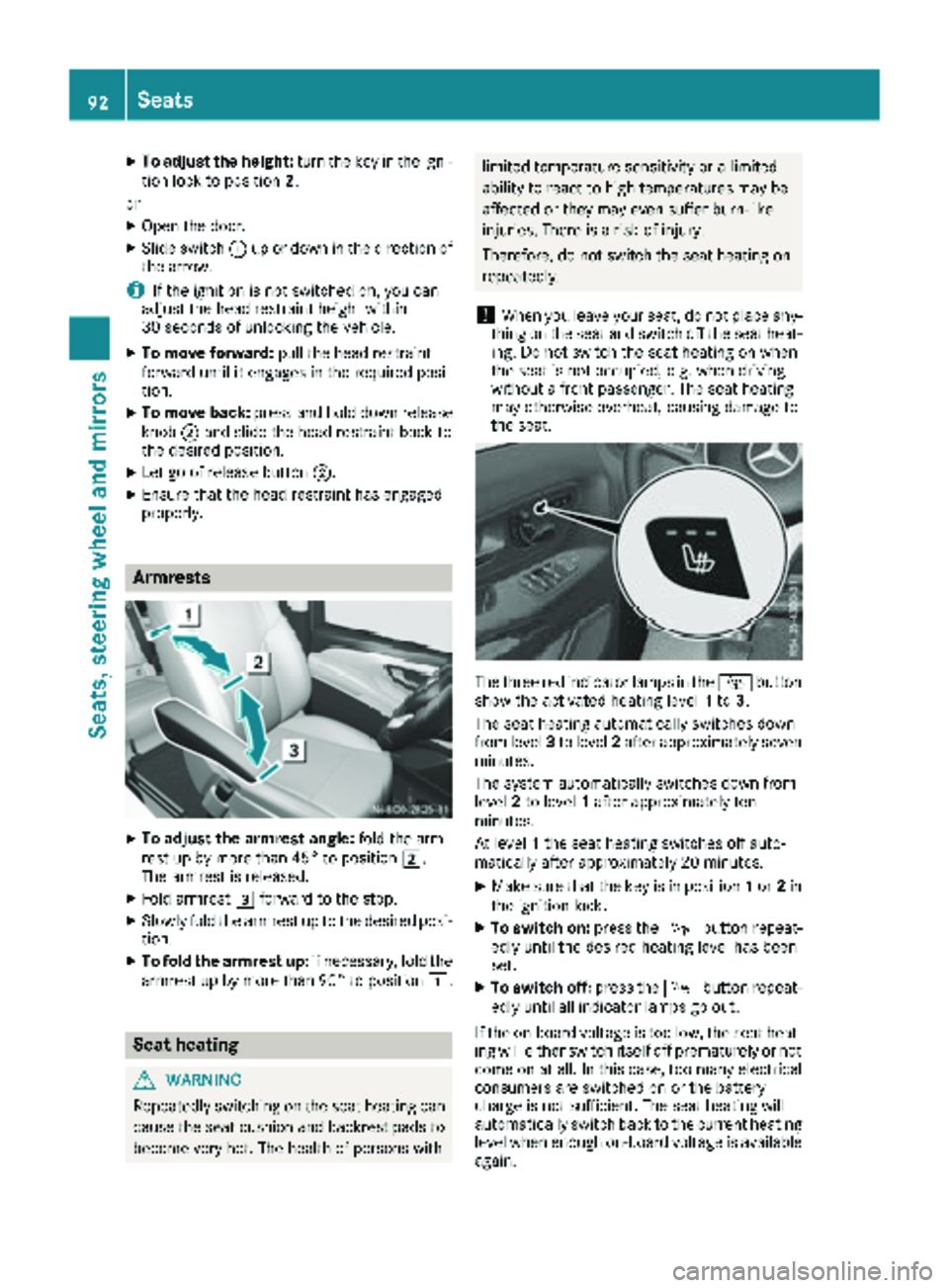
XTo adjust the height:turn the key in the igni-
tion lock to position 2.
or
XOpen the door.
XSlide switch :up or down in the direction of
the arrow.
iIf the ignition is not switched on, you can
adjust the head restraint height within
30 seconds of unlocking the vehicle.
XTo move forward: pull the head restraint
forward until it engages in the required posi-
tion.
XTo move back: press and hold down release
knob ;and slide the head restraint back to
the desired position.
XLet go of release button ;.
XEnsure that the head restraint has engaged
properly.
Armrests
XTo adjust the armrest angle: fold the arm-
rest up by more than 45° to position 2.
The armrest is released.
XFold armrest 3forward to the stop.
XSlowly fold the armrest up to the desired posi-
tion.
XTo fold the armrest up: if necessary, fold the
armrest up by more than 90° to position 1.
Seat heating
GWARNING
Repeatedly switching on the seat heating can
cause the seat cushion and backrest pads to
become very hot. The health of persons with
limited temperature sensitivity or a limited
ability to react to high temperatures may be
affected or they may even suffer burn-like
injuries. There is a risk of injury.
Therefore, do not switch the seat heating on
repeatedly.
!When you leave your seat, do not place any-
thing on the seat and switch off the seat heat-
ing. Do not switch the seat heating on when
the seat is not occupied, e.g. when driving
without a front passenger. The seat heating
may otherwise overheat, causing damage to
the seat.
The three red indicator lamps in the Íbutton
show the activated heating level 1to 3.
The seat heating automatically switches down
from level 3to level 2after approximately seven
minutes.
The system automatically switches down from
level 2to level 1after approximately ten
minutes.
At level 1the seat heating switches off auto-
matically after approximately 20 minutes.
XMake sure that the key is in position 1or 2in
the ignition lock.
XTo switch on: press theÍbutton repeat-
edly until the desired heating level has been
set.
XTo switch off: press theÍbutton repeat-
edly until all indicator lamps go out.
If the on-board voltage is too low, the seat heat-
ing will either switch itself off prematurely or not
come on at all. In this case, too many electrical
consumers are switched on or the battery
charge is not sufficient. The seat heating will
automatically switch back to the current heating level when enough on-board voltage is available
again.
92Seats
Seats, steering wheel and mirrors