engine oil MERCEDES-BENZ METRIS 2020 MY20 Operator’s Manual
[x] Cancel search | Manufacturer: MERCEDES-BENZ, Model Year: 2020, Model line: METRIS, Model: MERCEDES-BENZ METRIS 2020Pages: 320, PDF Size: 26.38 MB
Page 222 of 320
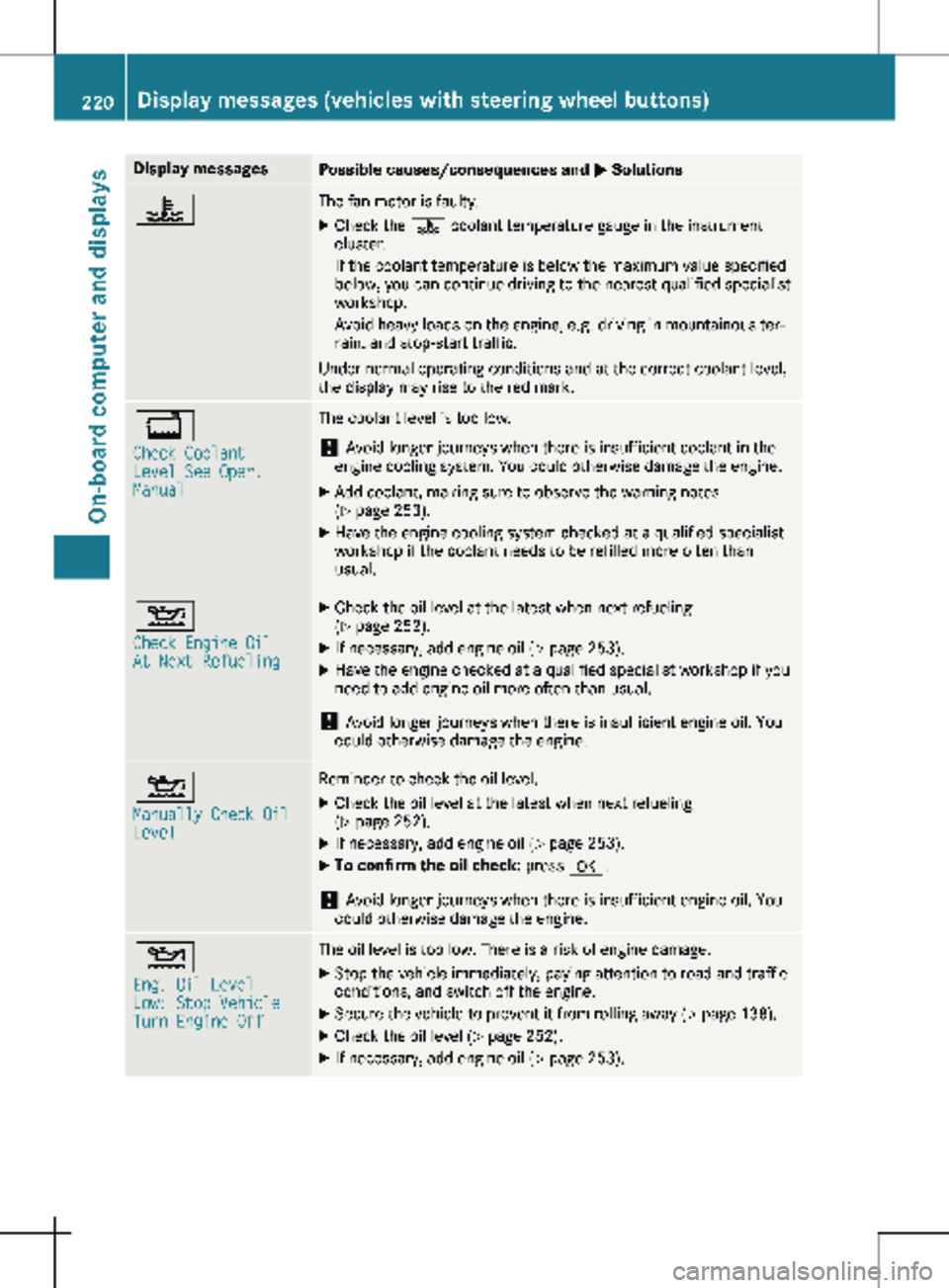
Display messages
Possible causes/consequences and
M Solutions? The fan motor is faulty.
X Check the ? coolant temperature gauge in the instrument
cluster.
If the coolant temperature is below the maximum value specified
below, you can continue driving to the nearest qualified specialist
workshop.
Avoid heavy loads on the engine, e.g. driving in mountainous ter-
rain, and stop-start traffic.
Under normal operating conditions and at the correct coolant level,
the display may rise to the red mark. +
Check Coolant
Level See Oper.
Manual The coolant level is too low.
! Avoid longer journeys when there is insufficient coolant in the
engine cooling system. You could otherwise damage the engine.
X Add coolant, making sure to observe the warning notes
(Y page 253).
X Have the engine cooling system checked at a qualified specialist
workshop if the coolant needs to be refilled more often than
usual. 4
Check Engine Oil
At Next Refueling X
Check the oil level at the latest when next refueling
(Y page
252).
X If necessary, add engine oil (Y page
253).
X Have the engine checked at a qualified specialist workshop if you
need to add engine oil more often than usual.
! Avoid longer journeys when there is insufficient engine oil. You
could otherwise damage the engine. 4
Manually Check Oil
Level Reminder to check the oil level.
X Check the oil level at the latest when next refueling
(Y page
252).
X If necessary, add engine oil (Y page
253).
X To confirm the oil check: press a.
! Avoid longer journeys when there is insufficient engine oil. You
could otherwise damage the engine. 4
Eng. Oil Level
Low: Stop Vehicle
Turn Engine Off The oil level is too low. There is a risk of engine damage.
X Stop the vehicle immediately, paying attention to road and traffic
conditions, and switch off the engine.
X Secure the vehicle to prevent it from rolling away ( Y page
138).
X Check the oil level ( Y page
252).
X If necessary, add engine oil (Y page
253).220
Display messages (vehicles with steering wheel buttons)
On-board computer and displays
Page 245 of 320
replaced. If you use load securing aids or tie
downs which are worn out, the load may not
be sufficiently secured and could cause dam-
age to property.
In the event of an accident, have a damaged
cargo compartment floor or loading area, the
cargo tie-down rings and the tie down checked
at a specialist workshop. Otherwise, the load
may not be correctly secured the next time
anything is stowed.
Even if you follow all loading guidelines, the
load increases the risk of injury in the event of
an accident. Observe the information in the
"Securing a load"
(Y page 244) and "Load dis-
tribution" (Y page 243) sections.
You will find information about the maximum
roof load under "Cargo tie-down points and
carrier systems" (Y page 313). You will find
information about roof carriers under "Carrier
systems" (Y page 249). Before loading
! The anti-slip mats cannot be used for
securing goods and must be replaced when
they show signs of:
R Permanent deformation and crushing
R Crack formation
R Cuts
X Tire pressure: check the tire pressure and
correct if necessary
(Y page 282).
X Cargo compartment floor: clean the cargo
compartment floor.
The cargo compartment floor must be free
from oil and dust, dry and swept clean to
prevent the load from slipping.
X Place non-slip mats (anti-slip mats) on the
cargo compartment floor if necessary. During loading
X Observe the gross axle weight rating and
permissible gross vehicle weight for your
vehicle.
Take into account that your vehicle's curb
weight is increased if accessories or optional equipment are installed. The maxi-
mum payload is thus reduced.
X Observe the notes on load distribution
(Y page
243).
The overall center of gravity of the load
should always be as low as possible, cen-
tered and between the axles near the rear
axle.
X Secure the load (Y page
244).
Observe the legal requirements of the coun-
try in which you are currently driving. Checks after loading
G
DANGER
Combustion engines emit poisonous
exhaust gases, such as carbon monoxide.
Exhaust gases can enter the vehicle interior
if the tailgate/rear-end door is open when
the engine is running, especially if the vehi-
cle is in motion. There is a risk of poisoning.
Always switch off the engine before opening
the tailgate/rear-end door. Never drive the
vehicle when the tailgate/rear-end door is
open.
X Securing luggage/loads: make sure that
the luggage and/or load is secure before
every journey and at regular intervals during
a long journey, and correct it if necessary.
X Doors/tailgate: close the sliding doors and
tailgate/door.
X Tire pressure: adjust the tire pressure
according to the vehicle load
(Y page 282).
X Driving style: adapt your driving style
according to the vehicle load. Load distribution
General notes
! Excessive loads on individual points of the
cargo floor or on the load surface impair
vehicle handling characteristics and could
cause damage to the floor covering.
The overall center of gravity of the load should
always be as low as possible, centered and
between the axles near the rear axle. Load distribution
243
Transporting loads Z
Page 252 of 320
Useful information
This Operator's Manual describes all models
as well as standard and optional equipment of
your vehicle that were available at the time of
going to print. Country-specific variations are
possible. Note that your vehicle may not be
equipped with all of the described functions.
This also applies to systems and functions rel-
evant to safety.
Read the information on qualified specialist
workshops (Y page
32).Engine compartment
Hood
Important safety notes G
WARNING
If the hood is unlatched, it may open up
when the vehicle is in motion and block your
view. There is a risk of an accident.
Never unlatch the hood while driving. Before
every trip, ensure that the hood is locked. G
WARNING
Opening the hood when the engine is over-
heated or when there is a fire in the engine
compartment could expose you to hot gases
or other service products. There is a risk of
injury.
Let an overheated engine cool down before
opening the hood. If there is a fire in the
engine compartment, keep the hood closed
and contact the fire department. G
WARNING
The engine compartment contains moving
components. Certain components, such as
the radiator fan, may continue to run or start
again suddenly when the ignition is off.
There is a risk of injury. If you need to do any work inside the engine
compartment:
R switch off the ignition
R never reach into the area where there is a
risk of danger from moving components,
such as the fan rotation area
R remove jewelry and watches
R keep items of clothing and hair, for exam-
ple, away from moving parts G
WARNING
The ignition system operates with a high
voltage. If you touch the live components,
you could receive an electric shock. There is
an increased risk of injury.
Never touch components of the ignition sys-
tem if:
R the engine is running or being started
R the key is in radio position or drive posi-
tion in the ignition lock
The live components of the ignition system
are, for example:
R ignition coils
R spark plug connectors
R diagnostic sockets G
WARNING
Certain components in the engine compart-
ment, such as the engine, radiator and parts
of the exhaust system, can become very
hot. Working in the engine compartment
poses a risk of injury.
Where possible, let the engine cool down
and touch only the components described in
the following.
If you have to carry out work in the engine
compartment, only touch the following compo-
nents:
R hood
R oil dipstick
R engine oil filler neck cap
R washer fluid reservoir cap
R coolant expansion tank cap250
Engine compartment
Maintenance and care
Page 254 of 320
X
Hold support strut ? and lift the hood
slightly.
X Guide support strut ? towards retainer =
and apply slight pressure to make it engage.
X Lower the hood and allow it to fall with
momentum from a height of approximately
1 ft (30 cm
).
The hood locks audibly.
X Check that the hood is correctly locked.
If the hood can be raised slightly, it is not
properly engaged. If the hood is not cor-
rectly engaged, open the hood again. Let
the hood fall with a little more momentum. Overview of the engine compart-
ment
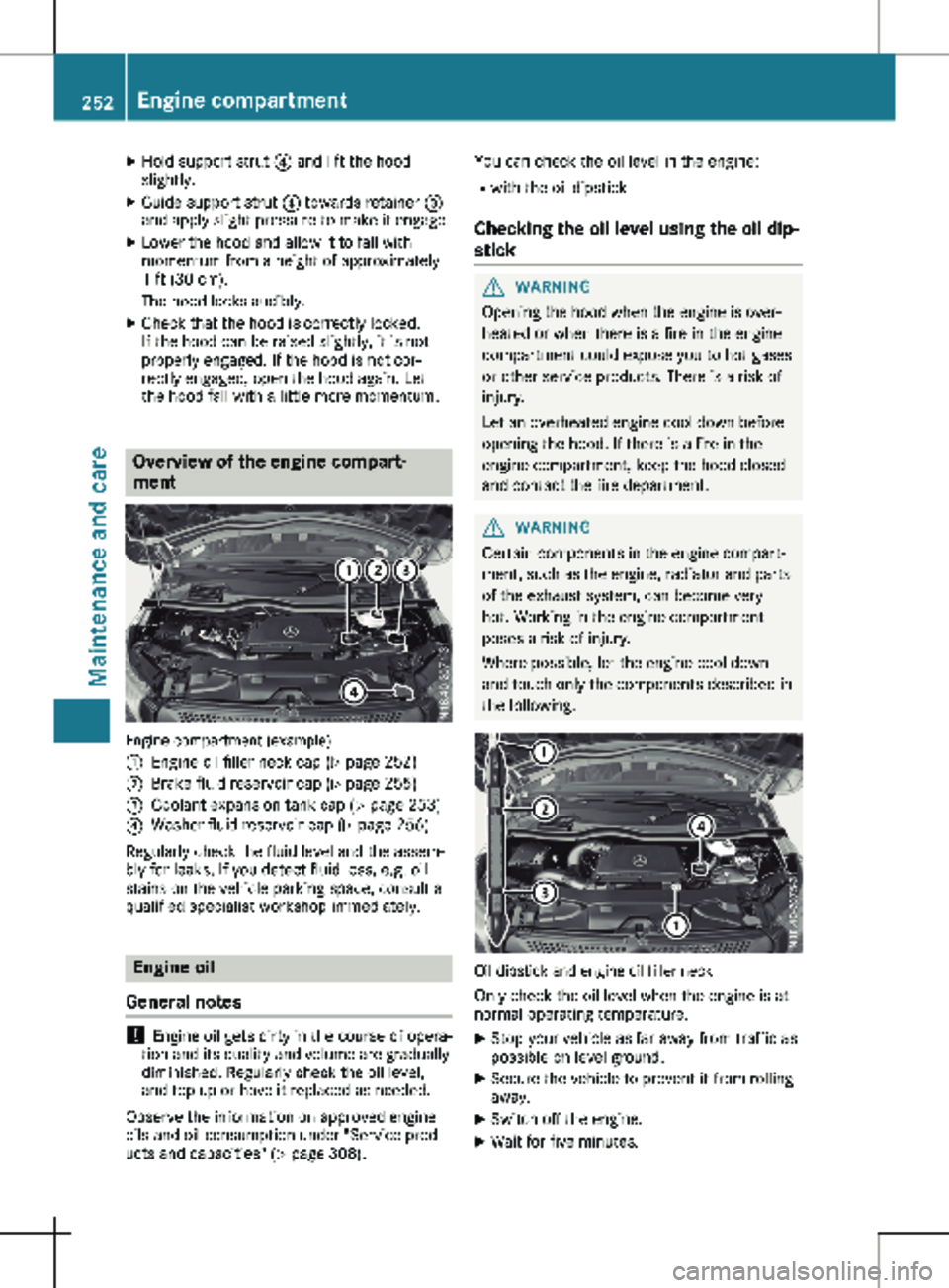
Engine compartment (example)
:
Engine oil filler neck cap (Y page
252)
; Brake fluid reservoir cap (Y page
255)
= Coolant expansion tank cap ( Y page
253)
? Washer fluid reservoir cap (Y page
256)
Regularly check the fluid level and the assem-
bly for leaks. If you detect fluid loss, e.g. oil
stains on the vehicle parking space, consult a
qualified specialist workshop immediately. Engine oil
General notes !
Engine oil gets dirty in the course of opera-
tion and its quality and volume are gradually
diminished. Regularly check the oil level,
and top up or have it replaced as needed.
Observe the information on approved engine
oils and oil consumption under "Service prod-
ucts and capacities" ( Y page
308).You can check the oil level in the engine:
R with the oil dipstick
Checking the oil level using the oil dip-
stick G
WARNING
Opening the hood when the engine is over-
heated or when there is a fire in the engine
compartment could expose you to hot gases
or other service products. There is a risk of
injury.
Let an overheated engine cool down before
opening the hood. If there is a fire in the
engine compartment, keep the hood closed
and contact the fire department. G
WARNING
Certain components in the engine compart-
ment, such as the engine, radiator and parts
of the exhaust system, can become very
hot. Working in the engine compartment
poses a risk of injury.
Where possible, let the engine cool down
and touch only the components described in
the following. Oil dipstick and engine oil filler neck
Only check the oil level when the engine is at
normal operating temperature. X Stop your vehicle as far away from traffic as
possible on level ground.
X Secure the vehicle to prevent it from rolling
away.
X Switch off the engine.
X Wait for five minutes.252
Engine compartment
Maintenance and care
Page 255 of 320
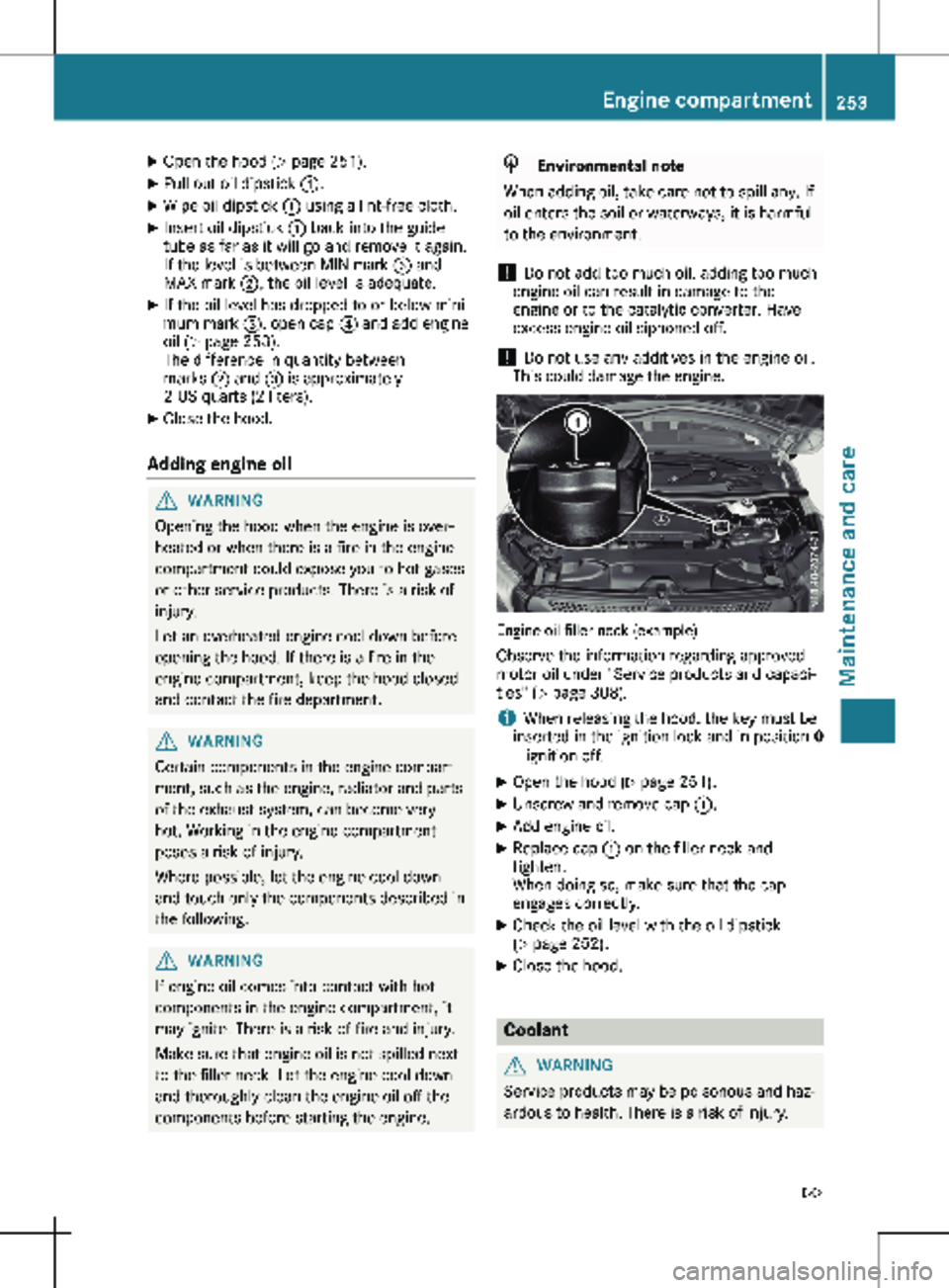
X
Open the hood (Y page 251).
X Pull out oil dipstick :.
X Wipe oil dipstick : using a lint-free cloth.
X Insert oil dipstick : back into the guide
tube as far as it will go and remove it again.
If the level is between MIN mark = and
MAX mark ;, the oil level is adequate.
X If the oil level has dropped to or below mini-
mum mark =, open cap ? and add engine
oil
(Y page 253).
The difference in quantity between
marks ; and = is approximately
2 US quarts (2 liters).
X Close the hood.
Adding engine oil G
WARNING
Opening the hood when the engine is over-
heated or when there is a fire in the engine
compartment could expose you to hot gases
or other service products. There is a risk of
injury.
Let an overheated engine cool down before
opening the hood. If there is a fire in the
engine compartment, keep the hood closed
and contact the fire department. G
WARNING
Certain components in the engine compart-
ment, such as the engine, radiator and parts
of the exhaust system, can become very
hot. Working in the engine compartment
poses a risk of injury.
Where possible, let the engine cool down
and touch only the components described in
the following. G
WARNING
If engine oil comes into contact with hot
components in the engine compartment, it
may ignite. There is a risk of fire and injury.
Make sure that engine oil is not spilled next
to the filler neck. Let the engine cool down
and thoroughly clean the engine oil off the
components before starting the engine. H
Environmental note
When adding oil, take care not to spill any. If
oil enters the soil or waterways, it is harmful
to the environment.
! Do not add too much oil. adding too much
engine oil can result in damage to the
engine or to the catalytic converter. Have
excess engine oil siphoned off.
! Do not use any additives in the engine oil.
This could damage the engine. Engine oil filler neck (example)
Observe the information regarding approved
motor oil under "Service products and capaci-
ties" (Y page
308).
i When releasing the hood, the key must be
inserted in the ignition lock and in position 0
– ignition off.
X Open the hood (Y page
251).
X Unscrew and remove cap :.
X Add engine oil.
X Replace cap : on the filler neck and
tighten.
When doing so, make sure that the cap
engages correctly.
X Check the oil level with the oil dipstick
(Y page
252).
X Close the hood. Coolant
G
WARNING
Service products may be poisonous and haz-
ardous to health. There is a risk of injury. Engine compartment
253
Maintenance and care
Z
Page 257 of 320
X
Turn cap : further and remove it from cool-
ant expansion tank ;.
X Check the coolant level.
If the coolant is up to marker bar =
in the
filler neck when cold, there is a sufficient
amount of coolant in coolant expansion
tank ;.
If the coolant is approximately 0.59 in
(1.5 cm) above marker bar = in the filler
neck when warm, there is a sufficient
amount of coolant in coolant expansion
tank ;.
Adding coolant X If the coolant drops under marker bar = in
the filler neck, add coolant.
Observe the information on the correct cool-
ant mixture ratio and the required water
quality under "Service products and capaci-
ties" ( Y page
310). To prevent damage to
the engine cooling system, use only
approved corrosion inhibitor/antifreeze that
complies with the Mercedes-Benz Specifica-
tions for Service Products.
X Replace cap : and tighten in a clockwise
direction.
X Start the engine.
X Set the temperature in the vehicle interior to
the maximum output on the air-conditioning
system control panel.
X After approximately five minutes, switch off
the engine again and allow it to cool down.
X Check the coolant level again and add cool-
ant if necessary.
X Close the hood. Brake fluid
G
WARNING
Service products may be poisonous and haz-
ardous to health. There is a risk of injury.
Comply with instructions on the use, storage
and disposal of service products on the
labels of the respective original containers.
Always store service products sealed in their
original containers. Always keep service
products out of the reach of children. G
WARNING
Opening the hood when the engine is over-
heated or when there is a fire in the engine
compartment could expose you to hot gases
or other service products. There is a risk of
injury.
Let an overheated engine cool down before
opening the hood. If there is a fire in the
engine compartment, keep the hood closed
and contact the fire department. G
WARNING
Certain components in the engine compart-
ment, such as the engine, radiator and parts
of the exhaust system, can become very
hot. Working in the engine compartment
poses a risk of injury.
Where possible, let the engine cool down
and touch only the components described in
the following.
Brake fluid is hazardous to health. Also
observe the safety notes under "Service prod-
ucts and capacities"
(Y page 305). G
WARNING
The brake fluid constantly absorbs moisture
from the air. This lowers the boiling point of
the brake fluid. If the boiling point of the
brake fluid is too low, vapor pockets may
form in the brake system when the brakes
are applied hard. This would impair braking
efficiency. There is a risk of an accident.
You should have the brake fluid renewed at
the specified intervals.
! If the brake fluid level in the brake fluid
reservoir has fallen to the MIN mark or
below, check the brake system immediately
for leaks. Also check the thickness of the
brake linings. Visit a qualified specialist
workshop immediately.
Do not add brake fluid. This does not cor-
rect the malfunction.
! Brake fluid corrodes paint, plastic and rub-
ber. If paint, plastic or rubber has come into
contact with brake fluid, rinse with water
immediately. Engine compartment
255
Maintenance and care Z
Page 259 of 320
Maintenance
General notes
H
Environmental note
Observe measures to protect the environ-
ment when working on the vehicle. You
must observe the legal requirements when
disposing of service products, e.g. engine
oil. This also includes all components, e.g.
filters, which have come into contact with
service products. Any qualified specialist
workshop can provide information about
this.
Dispose of empty containers, cleaning
cloths and care products in an environmen-
tally responsible manner. Comply with the
instructions for use of the care products.
Do not run the engine for longer than neces-
sary when the vehicle is stationary.
Before carrying out maintenance measures
and repairs, you must read the following docu-
ments relating to maintenance measures and
repairs:
R relevant sections of the technical documen-
tation such as the Operator's Manual and
workshop information
R legal stipulations such as work safety regu-
lations and accident prevention regulations
While working under the vehicle, you must
secure the vehicle on jack stands with suffi-
cient load capacity.
Never use a vehicle jack instead of stands. The
jack is designed only to raise the vehicle for a
short time when changing a wheel. It is not
suited for performing maintenance work under
the vehicle.
Please also refer to the notes about qualified
specialist workshops
(Y page 32).
The scope and regularity of the inspection and
maintenance work primarily depend on the
often diverse operating conditions. Specialist
knowledge beyond the scope of this Opera-
tor's Manual is required when carrying out
testing and maintenance work. This work
should only be carried out by trained staff.
The vehicle Maintenance Booklet describes
the scope and frequency of maintenance work
and contains additional notes on the Limited
Warranty. You will find information about ser- vice products approved by Mercedes-Benz and
capacities under "Service products and capaci-
ties"
(Y page 305)
Maintenance services must be carried out in
accordance with the provisions and recom-
mendations in the Maintenance Booklet. Not
doing so could void the warranty claim and
lead to refusal of goodwill gestures after the
manufacturer has submitted a damage report.
Observe the information under "Mercedes-
Benz genuine parts" (Y page 34). Service interval display
General notes The service interval display informs you of the
next service due date. Information on the type
of service and service intervals can be found in
the Maintenance Booklet.
i The service interval display does not pro-
vide information about the engine oil level.
The service interval display should therefore
not be confused with the engine oil level dis-
play.
For example, the display shows one of the fol-
lowing service messages for a few seconds: R Service A in .. days
R Service A Due or Service A Due
R Serv. A Exceed. by .. Days
Then either the remaining time or distance
until the next service due date is displayed. If
the service due date has been exceeded, the
elapsed time or distance traveled after the
overdue service date is shown. The letter in
the display message indicates which service is
due. A stands for a minor service and B for a
major service.
A qualified specialist workshop, e.g. an author-
ized Mercedes-Benz Commercial Van Center,
will reset the service interval display after the
service work has been carried out. You can
also obtain further information on mainte-
nance work, for example. Maintenance
257
Maintenance and care Z
Page 260 of 320
The prescribed service interval is based on
normal vehicle use. Service work will need to
be performed more frequently than prescribed
if the vehicle is operated under more arduous
conditions or with higher loads. Such arduous
conditions include:
R regular city driving with frequent intermedi-
ate stops
R driving predominantly short distances
R frequent operation in mountainous terrain or
on poor road surfaces
R leaving the engine idling for long periods on
a frequent basis
In these or similar operating conditions, have
the air filter, engine oil and oil filter, for exam-
ple, replaced more frequently. Under more
arduous operating conditions, the tires must
be checked more often. Further information
can be obtained at a qualified specialist work-
shop, e.g. an authorized Mercedes-Benz Com-
mercial Van Center.
Hiding service messages Vehicles without steering wheel buttons
X Press the 3 button on the instrument clus-
ter.
Vehicles with steering wheel buttons
X Press the a or % button on the steer-
ing wheel.
Calling up the service due date Vehicles without steering wheel buttons
The vehicle must be stationary. Use the but-
tons in the instrument cluster.
X Turn the key to position 2 in the ignition
lock.
X Press È to select the service display.
The display shows a possible service mes-
sage.
Vehicles with steering wheel buttons
Using the steering wheel buttons
X Turn the key to position 2 in the ignition
lock.
X Press = or ; to select the Service
menu.
X Press 9 or : to select the ASSYST
PLUS submenu and press a to confirm.
The display shows the service due date. Battery
Important safety notes
Work on the battery, e.g. removing or instal-
ling, requires specialist knowledge and the use
of special tools. Therefore, always have work
on the battery carried out at a qualified spe-
cialist workshop. G
WARNING
Work carried out incorrectly on the battery
can lead, for example, to a short circuit and
thus damage the vehicle electronics. This
can lead to function restrictions applying to
safety-relevant systems, e.g. the lighting
system, the ABS (anti-lock braking system)
or the ESP ®
(Electronic Stability Program).
The operating safety of your vehicle may be
restricted.
You could lose control of the vehicle, for
example:
R when braking
R in the event of abrupt steering maneuvers
and/or when the vehicle's speed is not
adapted to the road conditions
There is a risk of an accident.
In the event of a short circuit or a similar
incident, contact a qualified specialist work-
shop immediately. Do not drive any further.
You should have all work involving the bat-
tery carried out at a qualified specialist
workshop.
Further information can be found under "ABS"
(Y page
67) and under "ESP ®
" (Y page 68). G
WARNING
Electrostatic build-up can lead to the crea-
tion of sparks, which could ignite the highly
explosive gases of a battery. There is a risk
of an explosion.
Before handling the battery, touch the vehi-
cle body to remove any existing electrostatic
build-up.
The flammable gas mix is produced when the
battery is charged or when the vehicle is jump-
started. 258
Battery
Maintenance and care
Page 267 of 320
X
Thoroughly hose down the vehicle with a
gentle jet of water.
X Do not point the water jet directly towards
the air inlet grilles.
X Use plenty of water and rinse out the
sponge frequently.
X Rinse the vehicle with clean water and dry
thoroughly with a chamois.
X Do not let the cleaning agents dry on the
paintwork.
When using the vehicle in winter, remove all
traces of road salt deposits carefully and as
soon as possible.
Power washers G
WARNING
The water jet from a circular jet nozzle (dirt
blasters) can cause invisible exterior dam-
age to the tires or chassis components.
Components damaged in this way may fail
unexpectedly. There is a risk of an accident.
Do not use power washers with circular jet
nozzles to clean the vehicle. Have damaged
tires or chassis components replaced imme-
diately.
! Under no circumstances use power wash-
ers in the vehicle interior. The pressurized
water and associated spray produced by the
power washer could cause extensive dam-
age to the vehicle.
! When using high-pressure cleaning equip-
ment, maintain a minimum distance of
approx. 1 ft (30 cm
) between the spray noz-
zle and the vehicle parts. Do not use a
power washer with a round-jet nozzle. You
could damage the vehicle or engine parts.
! Keep the water jet moving constantly
while cleaning. This will avoid causing dam-
age to the vehicle.
Do not point the water jet at:
R door joints
R rear view camera
R air bellows
R brake hoses
R wheel balance weights
R electrical components
R electrical connections R
seals
R drive train, especially not at the inter-
mediate bearing of the propeller shaft
Cleaning the engine !
Water must not enter intake or ventilation
openings. When cleaning with high pressure
water or steam cleaners, the spray must not
be aimed directly at electrical components
or the terminals of electrical lines.
Preserve the engine after the engine has
been cleaned. Protect the belt drive system
from exposure to the preservative agent.
Also observe the information under "Power
washers"
(Y page 265).
Cleaning the paintwork !
Do not affix:
R stickers
R films
R magnetic plates or similar items
to painted surfaces. You could otherwise
damage the paintwork.
Scratches, corrosive deposits, areas affected
by corrosion and damage caused by inade-
quate care cannot always be completely
repaired. In such cases, visit a qualified spe-
cialist workshop.
X Remove impurities immediately, where pos-
sible, whilst avoiding rubbing too hard.
X Soak insect remains with insect remover
and rinse off the treated areas afterwards.
X Soak bird droppings with water and rinse off
the treated areas afterwards.
X Remove coolant, brake fluid, tree resin, oils,
fuels and greases by rubbing gently with a
cloth soaked in petroleum ether or lighter
fluid.
X Use tar remover to remove tar stains.
X Use silicone remover to remove wax.
Cleaning the windows G
WARNING
You could become trapped by the wind-
shield wipers if they start moving while
cleaning the windshield or wiper blades.
There is a risk of injury. Care
265
Maintenance and care
Z
Page 300 of 320
An arrow on the sidewall of the tire indicates
its correct direction of rotation.
You may mount a spare wheel against the
direction of rotation. Observe the time restric-
tion on use as well as the speed limitation
specified on the spare wheel. Storing wheels
Store wheels that are not being used in a cool,
dry and preferably dark place. Protect the tires
from contact with oil, grease and fuel. Mounting a wheel
Vehicle preparation X
Stop the vehicle as far away as possible
from traffic and on a level, firm and non-slip
surface.
X If your vehicle poses a risk to approaching
traffic, switch on the hazard warning lamps.
X Apply the parking brake.
X Turn the front wheels to the straight-ahead
position.
X Shift the transmission to position j.
X Switch off the engine.
X Passengers should leave the vehicle. Make
sure that the passengers are not endan-
gered as they do so.
X Make sure that no one is near the danger
area while the wheel is being changed. Any-
one who is not directly assisting in the
wheel change should, for example, stand
behind the barrier.
X Place the warning triangle or warning lamp
at a suitable distance.
Observe the legal requirements on the cor-
rect use of the warning triangle or warning
lamp for the country in which you are cur-
rently driving
X Secure the vehicle to prevent it from rolling
away.
Observe the safety notes on parking under
"Driving and parking"
(Y page 138)
X On level terrain: place chocks or other suit-
able objects under the front and rear of the
wheel that is diagonally opposite the wheel
to be changed. X
On slight inclines: place chocks or other
suitable objects under the wheels on the
front and rear axles opposite the wheel to
be changed.
X If included in the vehicle equipment, take
the tire-changing tool kit out of the vehicle
tool kit (Y page
270).
Apart from some country-specific variants,
vehicles are not equipped with tire-changing
tools. Some tools for changing a wheel are
specific to the vehicle. Consult a qualified
specialist workshop for more information on
which tools are required to perform a wheel
change on your vehicle.
X If included in the vehicle equipment, remove
the spare wheel from the spare wheel
bracket
(Y page 303). Observe the safety
notes listed under "Spare wheel"
(Y page 302).
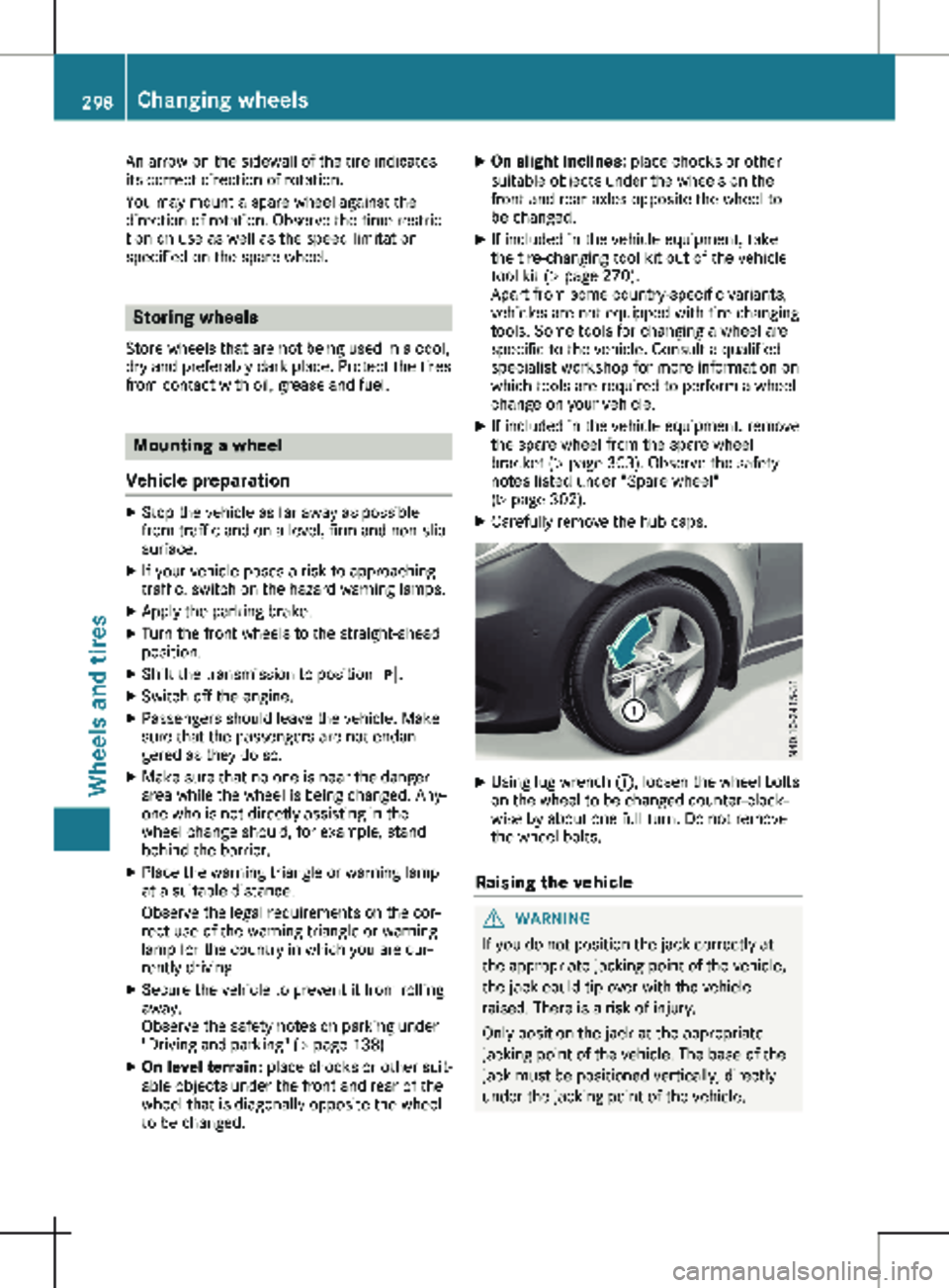
X Carefully remove the hub caps. X
Using lug wrench :, loosen the wheel bolts
on the wheel to be changed counter-clock-
wise by about one full turn. Do not remove
the wheel bolts.
Raising the vehicle G
WARNING
If you do not position the jack correctly at
the appropriate jacking point of the vehicle,
the jack could tip over with the vehicle
raised. There is a risk of injury.
Only position the jack at the appropriate
jacking point of the vehicle. The base of the
jack must be positioned vertically, directly
under the jacking point of the vehicle. 298
Changing wheels
Wheels and tires