load capacity MERCEDES-BENZ METRIS 2020 MY20 Operator’s Manual
[x] Cancel search | Manufacturer: MERCEDES-BENZ, Model Year: 2020, Model line: METRIS, Model: MERCEDES-BENZ METRIS 2020Pages: 320, PDF Size: 26.38 MB
Page 298 of 320
Wheel rim
The part of the wheel on which the tire is
mounted.
GAWR (Gross Axle Weight Rating) GAWR is the maximum gross axle weight rat-
ing. The actual load on an axle must never
exceed the gross axle weight rating. You can
find the maximum gross axle weight rating on
the
B-pillar on the driver's side ( Y page 304).
Speed index The speed index is part of the tire identifica-
tion. It specifies the speed range for which the
tire is approved.
GTW (Gross Trailer Weight) GTW is the total of weight of a trailer and the
weight of the load, accessories etc. on the
trailer.
GVW (Gross Vehicle Weight)
The gross vehicle weight includes the weight
of the vehicle including fuel, tools, spare
wheel, accessories installed, occupants, lug-
gage and the drawbar noseweight if applica-
ble. The gross vehicle weight must never
exceed the permissible gross weight (GVWR)
specified on the B-pillar on the driver's side
(Y page 304).
GVWR (Gross Vehicle Weight Rating) The GVWR is the maximum permitted gross
weight of the fully laden vehicle (weight of the
vehicle including all accessories, occupants,
fuel, luggage and the drawbar noseweight if
applicable). The permissible gross weight is
specified on the vehicle identification plate on
the B-pillar on the driver's side (Y page 304).
Maximum weight of the laden vehicle
The maximum weight is the sum of:
R the curb weight of the vehicle
R the weight of the accessories
R the load limit
R the weight of the factory installed optional
equipment
Kilopascal (kPa) Metric unit for tire pressure. 6.9 kPa are the
equivalent of 1 psi. Another tire pressure unit
is bar. 100 kilopascals (kPa) are the equivalent
of 1 bar. Load index
In addition to the load bearing index, a load
index can be stamped onto the sidewall of the
tire. It specifies the load-bearing capacity of
the tire more precisely.
Curb weight The weight of a vehicle with standard equip-
ment including the maximum filling capacity of
fuel, oil, and coolant. It also includes the air-
conditioning system and optional equipment if
these are installed on the vehicle, but does not
include passengers or luggage.
Maximum tire load
The maximum tire load in kilograms or pounds
is the maximum weight for which a tire is
approved.
Maximum permissible tire pressure
Maximum permissible tire pressure for one
tire.
Maximum load on one tire
Maximum load on one tire. This is calculated
by dividing the maximum axle load of one axle
by two.
PSI (Pounds per square inch)
Standard unit of measurement for tire pres-
sure.
Aspect ratioRelationship between tire height and width in
percent.
Tire pressure
Pressure inside the tire applying an outward
force to every square inch of the tire's surface.
Tire pressure is specified in pounds per square
inch (psi), in kilopascal (kPa) or in bar. Tire
pressure should only be corrected when the
tires are cold.
Cold tire pressure The tires are cold:
R if the vehicle has been parked for at least
three hours without direct sunlight on the
tires, and
R if the vehicle has not been driven further
than
1 mile (1.6 km)296
What you should know about wheels and tires
Wheels and tires
Page 299 of 320
Tire tread
The part of the tire that comes into contact
with the road.
Tire bead
The tire bead ensures that the tire sits
securely on the wheel. There are several steel
wires in the bead to prevent the tire from com-
ing loose from the wheel rim.
SidewallThe part of the tire between the tread and the
tire bead.
Weight of optional extras The combined weight of those optional extras
that weigh more than the replaced standard
parts and more than 2.3 kg
(5 lbs). These
optional extras, such as high-performance
brakes, a roof rack or a high-performance bat-
tery, are not included in the curb weight and
the weight of the accessories.
TIN (Tire Identification Number) A unique identification number which can be
used by a tire manufacturer to identify tires,
for example for a product recall, and thus iden-
tify the purchasers. The TIN is composed of
the manufacturer identification code, tire size,
tire model code and manufacturing date.
Load bearing index
The load bearing index (also load index) is a
code that contains the maximum load bearing
capacity of a tire.
Traction
Traction is the result of friction between the
tires and the road surface.
TWR (permissible trailer drawbar load)
The TWR is the maximum permissible weight
that may act on the ball coupling of the trailer
tow hitch.
Wear indicator Narrow bars (tread wear bars) that are distrib-
uted over the tire tread. If the tire tread is level
with the bars, the wear limit of á in (1.6 mm)
has been reached. Distribution of the vehicle occupants
The distribution of vehicle occupants over des-
ignated seat positions in a vehicle.
Maximum permissible payload weightNominal load and goods/luggage load plus
68 kg (150 lbs) multiplied by the number of
seats in the vehicle. Changing wheels
Rotating the wheels
! On vehicles equipped with a tire pressure
monitor, electronic components are located
in the wheel.
Tire-mounting tools should not be used near
the valve. This could damage the electronic
components.
Only have tires changed at a qualified spe-
cialist workshop.
Always observe the instructions and safety
notes under "Mounting a wheel"
(Y page
298).
The wear patterns on the front and rear tires
differ, depending on the operating conditions.
Rotate the wheels before a clear wear pattern
has formed on the tires. Front tires typically
wear more on the shoulders and the rear tires
in the center.
If your vehicle's tire configuration allows, you
can rotate the tires according to the intervals
in the tire manufacturer's warranty book in
your vehicle documents. If no warranty book is
available, the tires should be rotated every
3,000 to 6,000 miles (5,000 to 10,000 km) or
earlier if tire wear requires. Do not change the
direction of rotation.
Clean the contact surfaces of the wheel and
the brake disc thoroughly every time a wheel
is rotated. Avoid oily or greasy cleaning
agents.
Check the tire pressure and reactivate the tire
pressure monitor if necessary. Direction of rotation
Tires with a specified direction of rotation have
additional benefits, e.g. if there is a risk of
hydroplaning. You will only gain these benefits
if the correct direction of rotation is observed. Changing wheels
297
Wheels and tires Z
Page 315 of 320
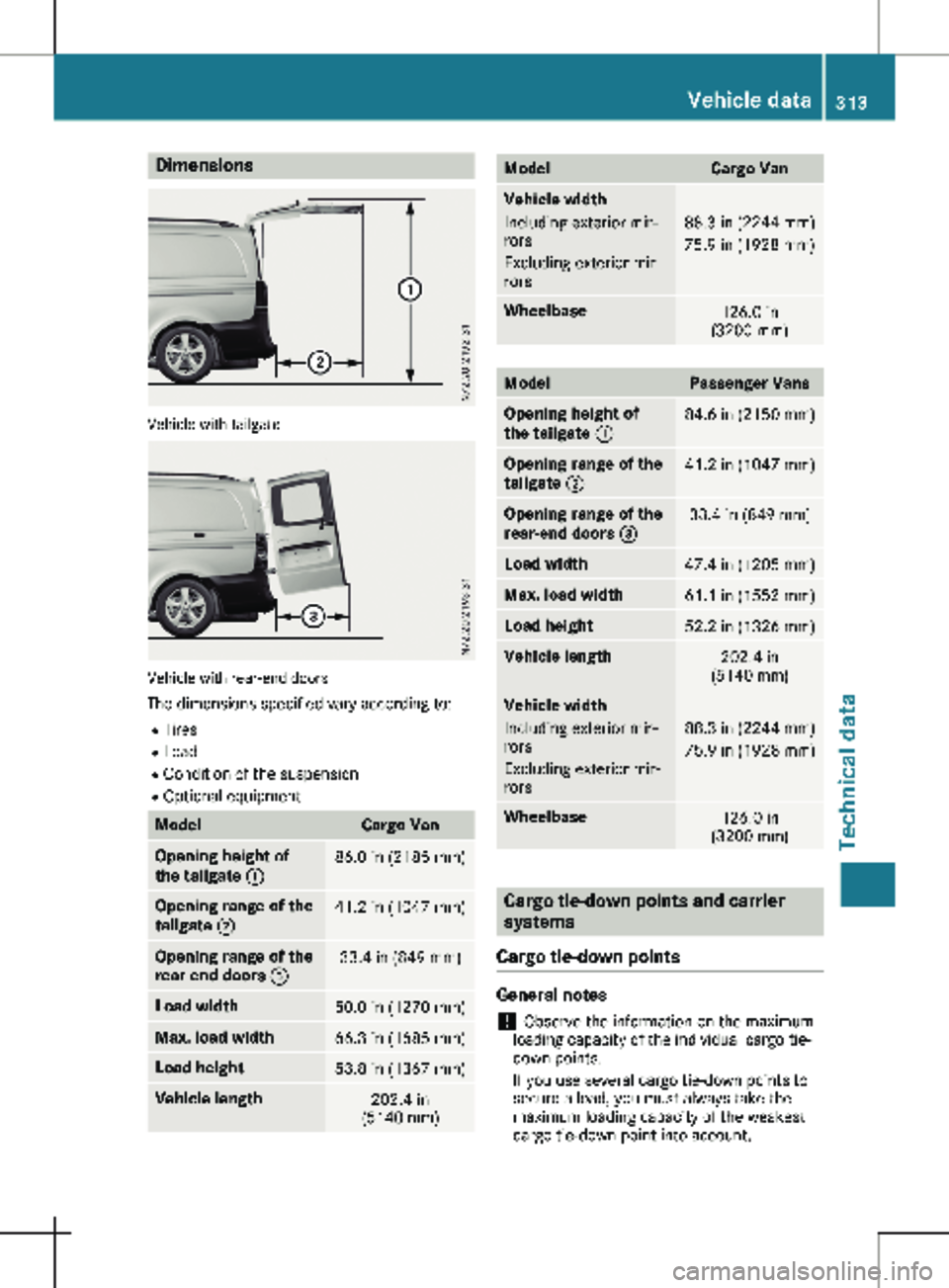
Dimensions
Vehicle with tailgate
Vehicle with rear-end doors
The dimensions specified vary according to:
R Tires
R Load
R Condition of the suspension
R Optional equipment Model Cargo Van
Opening height of
the tailgate :
86.0 in (2185 mm)
Opening range of the
tailgate ;
41.2 in (1047 mm)
Opening range of the
rear-end doors
= 33.4 in (849 mm)
Load width
50.0 in (1270 mm)
Max. load width
66.3 in (1685 mm)
Load height
53.8 in (1367 mm)
Vehicle length
202.4 in
(5140 mm ) Model Cargo Van
Vehicle width
Including exterior mir-
rors
Excluding exterior mir-
rors
88.3 in
(2244 mm)
75.9 in (1928 mm) Wheelbase
126.0 in
(3200 mm
) Model Passenger Vans
Opening height of
the tailgate :
84.6 in (2150 mm)
Opening range of the
tailgate ;
41.2 in (1047 mm)
Opening range of the
rear-end doors
= 33.4 in (849 mm)
Load width
47.4 in (1205 mm)
Max. load width
61.1 in (1552 mm)
Load height
52.2 in (1326 mm)
Vehicle length
202.4 in
(5140 mm
) Vehicle width
Including exterior mir-
rors
Excluding exterior mir-
rors
88.3 in
(2244 mm)
75.9 in (1928 mm) Wheelbase
126.0 in
(3200 mm
) Cargo tie-down points and carrier
systems
Cargo tie-down points General notes
! Observe the information on the maximum
loading capacity of the individual cargo tie-
down points.
If you use several cargo tie-down points to
secure a load, you must always take the
maximum loading capacity of the weakest
cargo tie-down point into account. Vehicle data
313
Technical data Z