service interval MERCEDES-BENZ METRIS 2020 MY20 Operator’s Manual
[x] Cancel search | Manufacturer: MERCEDES-BENZ, Model Year: 2020, Model line: METRIS, Model: MERCEDES-BENZ METRIS 2020Pages: 320, PDF Size: 26.38 MB
Page 260 of 320
The prescribed service interval is based on
normal vehicle use. Service work will need to
be performed more frequently than prescribed
if the vehicle is operated under more arduous
conditions or with higher loads. Such arduous
conditions include:
R regular city driving with frequent intermedi-
ate stops
R driving predominantly short distances
R frequent operation in mountainous terrain or
on poor road surfaces
R leaving the engine idling for long periods on
a frequent basis
In these or similar operating conditions, have
the air filter, engine oil and oil filter, for exam-
ple, replaced more frequently. Under more
arduous operating conditions, the tires must
be checked more often. Further information
can be obtained at a qualified specialist work-
shop, e.g. an authorized Mercedes-Benz Com-
mercial Van Center.
Hiding service messages Vehicles without steering wheel buttons
X Press the 3 button on the instrument clus-
ter.
Vehicles with steering wheel buttons
X Press the a or % button on the steer-
ing wheel.
Calling up the service due date Vehicles without steering wheel buttons
The vehicle must be stationary. Use the but-
tons in the instrument cluster.
X Turn the key to position 2 in the ignition
lock.
X Press È to select the service display.
The display shows a possible service mes-
sage.
Vehicles with steering wheel buttons
Using the steering wheel buttons
X Turn the key to position 2 in the ignition
lock.
X Press = or ; to select the Service
menu.
X Press 9 or : to select the ASSYST
PLUS submenu and press a to confirm.
The display shows the service due date. Battery
Important safety notes
Work on the battery, e.g. removing or instal-
ling, requires specialist knowledge and the use
of special tools. Therefore, always have work
on the battery carried out at a qualified spe-
cialist workshop. G
WARNING
Work carried out incorrectly on the battery
can lead, for example, to a short circuit and
thus damage the vehicle electronics. This
can lead to function restrictions applying to
safety-relevant systems, e.g. the lighting
system, the ABS (anti-lock braking system)
or the ESP ®
(Electronic Stability Program).
The operating safety of your vehicle may be
restricted.
You could lose control of the vehicle, for
example:
R when braking
R in the event of abrupt steering maneuvers
and/or when the vehicle's speed is not
adapted to the road conditions
There is a risk of an accident.
In the event of a short circuit or a similar
incident, contact a qualified specialist work-
shop immediately. Do not drive any further.
You should have all work involving the bat-
tery carried out at a qualified specialist
workshop.
Further information can be found under "ABS"
(Y page
67) and under "ESP ®
" (Y page 68). G
WARNING
Electrostatic build-up can lead to the crea-
tion of sparks, which could ignite the highly
explosive gases of a battery. There is a risk
of an explosion.
Before handling the battery, touch the vehi-
cle body to remove any existing electrostatic
build-up.
The flammable gas mix is produced when the
battery is charged or when the vehicle is jump-
started. 258
Battery
Maintenance and care
Page 311 of 320
Capacities
!
Do not add too much oil. adding too much
engine oil can result in damage to the
engine or to the catalytic converter. Have
excess engine oil siphoned off.
Oil change including oil filter Engine oil
Approx. 2 US gal
(7.75 l )Additives
!
Do not use any additives in the engine oil.
This could damage the engine.
Engine oil viscosity !
If the SAE class of the engine oil used does
not cover the outside temperature range in
which your vehicle is traveling, you must
change the engine oil in good time, in partic-
ular before the cold season commences.
Using an engine oil that does not have ade-
quate temperature characteristics can lead
to engine damage.
The temperature range information of the
SAE classification always refers to that of
fresh oil. The temperature characteristics of
the engine oil may deteriorate significantly
as a result of aging during vehicle operation,
especially at low outside temperatures.
Therefore, have the engine oil changed
before the cold season commences. Use an
approved engine oil of the specified SAE
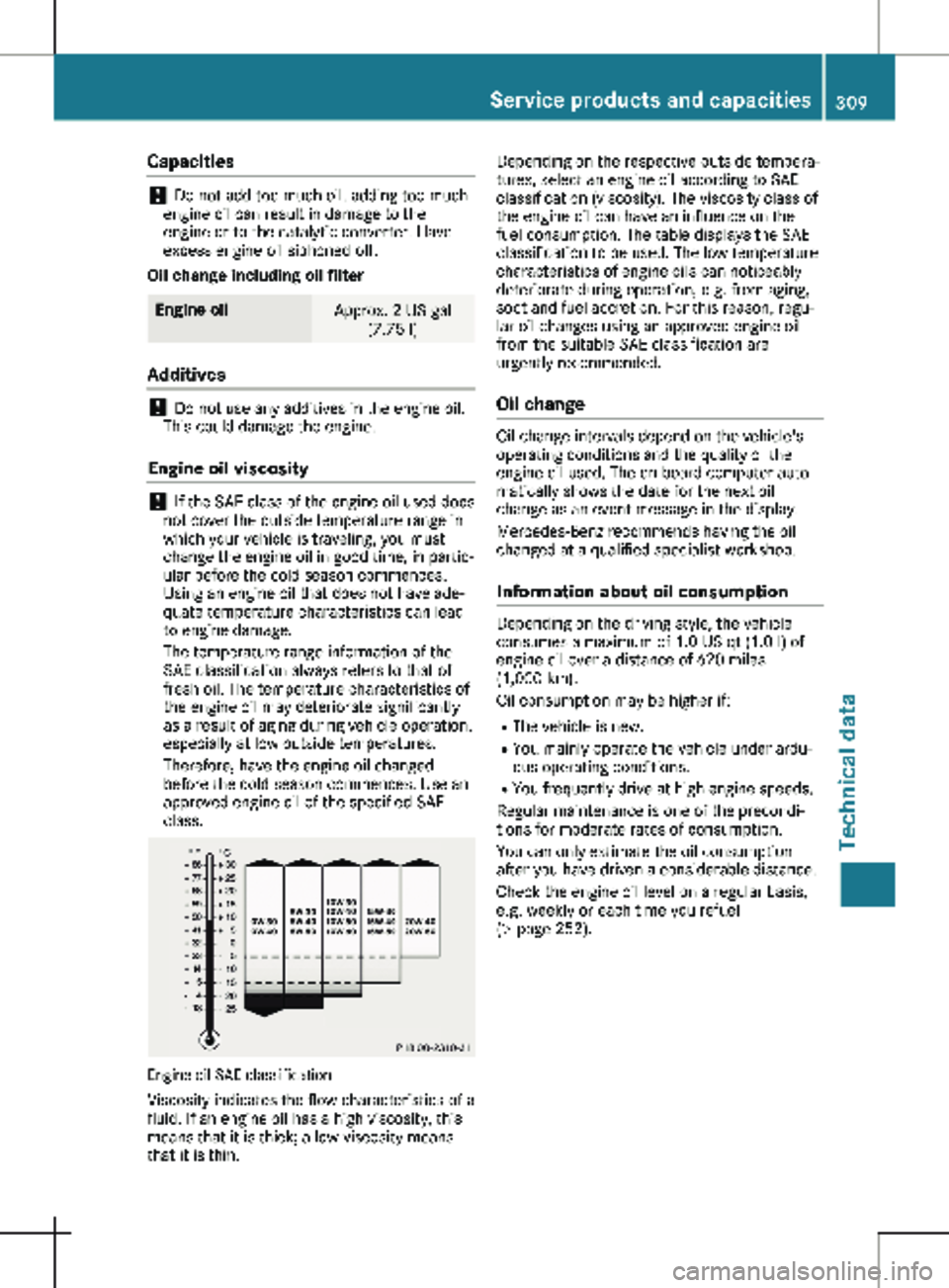
class. Engine oil SAE classification
Viscosity indicates the flow characteristics of a
fluid. If an engine oil has a high viscosity, this
means that it is thick; a low viscosity means
that it is thin. Depending on the respective outside tempera-
tures, select an engine oil according to SAE
classification (viscosity). The viscosity class of
the engine oil can have an influence on the
fuel consumption. The table displays the SAE
classification to be used. The low temperature
characteristics of engine oils can noticeably
deteriorate during operation, e.g. from aging,
soot and fuel accretion. For this reason, regu-
lar oil changes using an approved engine oil
from the suitable SAE classification are
urgently recommended.
Oil change Oil change intervals depend on the vehicle's
operating conditions and the quality of the
engine oil used. The on-board computer auto-
matically shows the date for the next oil
change as an event message in the display.
Mercedes-Benz recommends having the oil
changed at a qualified specialist workshop.
Information about oil consumption Depending on the driving style, the vehicle
consumes a maximum of 1.0 US qt
(1.0 l) of
engine oil over a distance of 620 miles
(1,000 km).
Oil consumption may be higher if:
R The vehicle is new.
R You mainly operate the vehicle under ardu-
ous operating conditions.
R You frequently drive at high engine speeds.
Regular maintenance is one of the precondi-
tions for moderate rates of consumption.
You can only estimate the oil consumption
after you have driven a considerable distance.
Check the engine oil level on a regular basis,
e.g. weekly or each time you refuel
( Y page 252). Service products and capacities
309
Technical data Z
Page 312 of 320
Transmission oil
Automatic transmission Operating fluid: automatic transmission
fluid Product name/number Maintenance
interval Mobil ATF 134 FE
Valvoline ATF Pro 236.15
MB Sheet No. 236.15 —
More information can be obtained at any quali-
fied specialist workshop.
Rear axle Operating fluid: transmission oil
Product name/number Maintenance
interval Mobilube FE 75W-85
Mobilube FE Plus NG
75W-85
MB Sheet No. 235.7 —
More information can be obtained at any quali-
fied specialist workshop.
Brake fluid
G
WARNING
The brake fluid constantly absorbs moisture
from the air. This lowers the boiling point of
the brake fluid. If the boiling point of the
brake fluid is too low, vapor pockets may
form in the brake system when the brakes
are applied hard. This would impair braking
efficiency. There is a risk of an accident.
You should have the brake fluid renewed at
the specified intervals.
! Brake fluid corrodes paint, plastic and rub-
ber. If paint, plastic or rubber has come into
contact with brake fluid, rinse with water
immediately.
When handling, storing and disposing of brake
fluid, please observe the relevant regulations and the important safety notes for service
products (Y page
305).
Over a period of time, the brake fluid absorbs
moisture from the air. This reduces its boiling
point.
Have the brake fluid replaced at specified
intervals by a qualified specialist workshop.
i There is usually a notice in the engine
compartment to remind you when the next
brake fluid change is due.
Use only approved brake fluids that comply
with the Mercedes-Benz Specifications for Ser-
vice Products. Always check for the identifica-
tion DOT 4 plus.
Information about approved brake fluids can
be obtained:
R on the Internet at
http://bevo.mercedes-benz.com. Coolant
Important safety notes G
WARNING
If antifreeze comes into contact with hot
components in the engine compartment, it
may ignite. There is a risk of fire and injury.
Let the engine cool down before you add
antifreeze. Make sure that antifreeze is not
spilled next to the filler neck. Thoroughly
clean the antifreeze from components
before starting the engine.
! Take care not to spill any coolant on pain-
ted surfaces. You could otherwise damage
the paintwork.
When handling, storing and disposing of cool-
ant and antifreeze, please observe the relevant
regulations and the important safety notes for
operating fluids
(Y page 305).
Coolant additive with corrosion and
antifreeze protection !
Use only approved antifreeze/corrosion
inhibitor that complies with MB Specifica-
tion for Service Products, Sheet Number
325. Using other, non-approved antifreeze/
corrosion inhibitors may cause damage to 310
Service products and capacities
Technical data
Page 313 of 320
the coolant system and reduce the engine's
service life.
The coolant is a mixture of water and anti-
freeze and corrosion inhibitor. It performs the
following tasks:
R Anti-corrosion protection
R Antifreeze protection
R Raises the boiling point
When the vehicle is first delivered, it is filled
with a coolant mixture that ensures adequate
antifreeze/corrosion protection. Coolant must
remain in the engine cooling system all year
round to ensure anti-corrosion protection and
a higher boiling point, even in countries with
high outside temperatures.
Check the antifreeze/corrosion inhibitor con-
centration in the coolant every six months.
The percentage of corrosion inhibitor/anti-
freeze additive in the engine cooling system
should:
R be at least
50%. This way, the engine cooling
system is protected against freezing down
to approximately -35 ‡ (-37 †).
R not exceed 55% (antifreeze protection down
to -49 ‡ [-45 †]). Otherwise, heat will not
be dissipated as effectively.
Mercedes-Benz recommends an antifreeze and
corrosion inhibitor that meets the require-
ments in the Mercedes-Benz Specifications for
Service Products Sheet Number 325.
More information can be obtained at any quali-
fied specialist workshop.
Operating fluid: coolant Product name/number
Zerex G40-91, The Valvoline Company
MB Sheet No. 325.5
Maintenance interval
Have the coolant replaced at specified inter-
vals by a qualified specialist workshop.
Capacities Engine cooling system
Coolant
Approx. 11 US qt
(10.4 l
) Climate control system refrigerants
Important safety notes The climate control system of your vehicle is
filled with the refrigerant R ‑134a.
The warning label for the refrigerant being
used can be found on the radiator cross mem-
ber.
! Only the refrigerant R‑134a and the PAG
oil approved by Mercedes-Benz may be
used. The approved PAG oil may not be
mixed with any other PAG oil that is not
approved for R-134a refrigerant. Otherwise,
the climate control system may be dam-
aged.
Maintenance work such as adding refrigerant
or replacing components may only be carried
out by a qualified specialist workshop. All
applicable regulations thereto and the SAE
standard J639 must be adhered to.
All work on the climate control system should
always be carried out at qualified specialist
workshop.
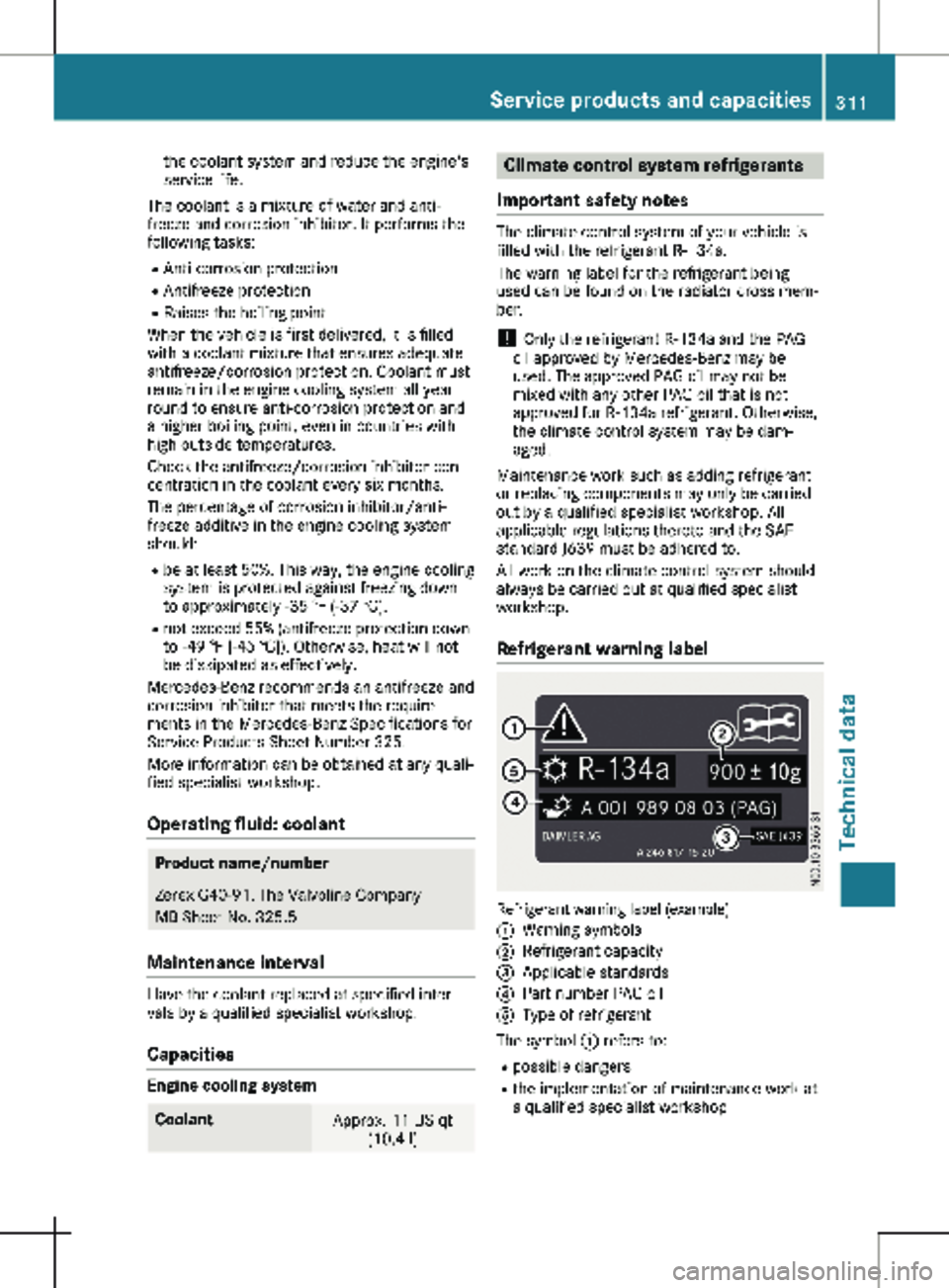
Refrigerant warning label Refrigerant warning label (example)
: Warning symbols
; Refrigerant capacity
= Applicable standards
? Part number PAG oil
A Type of refrigerant
The symbol : refers to:
R possible dangers
R the implementation of maintenance work at
a qualified specialist workshop Service products and capacities
311
Technical data Z