fuel type MERCEDES-BENZ METRIS 2020 MY20 Operator’s Manual
[x] Cancel search | Manufacturer: MERCEDES-BENZ, Model Year: 2020, Model line: METRIS, Model: MERCEDES-BENZ METRIS 2020Pages: 320, PDF Size: 26.38 MB
Page 10 of 320
Cooling with air dehumidification .. 118
Defrosting the windows .................
122
Defrosting the windshield .............. 121
Important safety notes .................. 114
Information on dual-zone auto-
matic climate control ..................... 116
Information on TEMPMATIC (air-
conditioning system) ..................... 115
Overview of systems ...................... 114
Problem with the rear window
defroster ........................................ 122
Rear-compartment air condition-
ing ................................................. 117
Refrigerant ..................................... 311
Refrigerant filling capacity ............. 312
Setting the air distribution ............. 120
Setting the air vents ...................... 124
Setting the airflow ......................... 120
Setting the temperature ................ 119
Switching air-recirculation mode
on/off ............................................ 123
Switching on/off ........................... 117
Switching residual heat on/off ...... 123
Switching the rear window
defroster on/off ............................ 122
Switching the synchronization
function on and off ........................ 121
TEMPMATIC control panel (air
conditioning) .................................. 115
Clock
Setting (vehicle without steering
wheel buttons) ............................... 181
Co-driver's seat
see Seats
Cockpit
Instrument cluster (vehicle with
steering wheel buttons) ................... 40
Overview .......................................... 37
see Instrument cluster
Coffee cup symbol
see ATTENTION ASSIST
COLLISION PREVENTION ASSIST
Activating/deactivating the dis-
tance warning function .................. 190
Adaptive Brake Assist .................... 150
Display message ............................ 222
Distance warning function ............. 149
Operation/notes ............................ 149 Collision warning
see COLLISION PREVENTION ASSIST
COMAND display
Cleaning
......................................... 268
Combination switch .......................... 101
Communications equipment
Operation ....................................... 241
Type approval/frequency .............. 304
Constant headlamp mode
see Daytime running lamps
Consumption statistics
Fuel (vehicle with steering wheel
buttons) ......................................... 184
Fuel (vehicle without steering
wheel buttons) ............................... 177
Control panel
Above the windshield ....................... 44
Center console ................................ 43
Climate control ................................ 43
Driver's door .................................... 44
Convenience closing feature .............. 85
Convenience opening
With the SmartKey ......................... 123
Convenience opening feature ............ 85
Conversions/equipment .................... 33
Coolant (engine)
Adding ........................................... 255
Checking the level ......................... 253
Display messages (vehicle with
steering wheel buttons) ................. 220
Display messages (vehicle with-
out steering wheel buttons) ........... 204
Displaying the temperature (on-
board computer) ............................ 178
Filling capacity ............................... 311
Notes ............................................. 310
Temperature display in the
instrument cluster ......................... 175
Warning lamp ................................. 233
Cooling
see Climate control
Crosswind Assist ................................. 70
Cruise control
Activating ....................................... 148
Activation conditions ..................... 147
Cruise control lever ....................... 147
Deactivating ................................... 1488
Index
Page 27 of 320
Vehicle data .......................................
312
Vehicle dimensions ........................... 313
Vehicle emergency locking ................ 73
Vehicle identification number
see VIN
Vehicle identification plate .............. 304
Vehicle key
see SmartKey
Vehicle tool kit
in the seat base ............................. 270
Scope ............................................ 270
Storage location ............................ 270
Stowage compartment in the
rear ................................................ 271
Stowage space in the cargo com-
partment ........................................ 272
Ventilation
see Climate control
Vents
see Air vents
VIN
Engine compartment ..................... 305
Type plate ...................................... 304 W
Warning Stickers
........................................... 29
Warning and indicator lamps
ABS ................................................ 230
Brakes ........................................... 229
Check Engine ................................. 233
COLLISION PREVENTION ASSIST .. 235
Coolant .......................................... 233
Distance warning ........................... 235
Door ............................................... 237
ESP ®
.............................................. 230
ESP ®
OFF ....................................... 232
Fuel tank ........................................ 233
General notes ................................ 227
Overview (vehicle with steering
wheel buttons) ................................. 41
Overview (vehicle without steer-
ing wheel buttons) ........................... 39
Parking brake ................................ 138
PASSENGER AIR BAG OFF ............... 47
Rear door ....................................... 237
Reserve fuel ................................... 233 Restraint system ............................ 232
Seat belt ........................................
228
Sliding door ................................... 237
Steering ......................................... 237
Tire pressure monitor .................... 236
Warranty .............................................. 27
Washer fluid
Adding ........................................... 256
Capacities ...................................... 312
Display messages (vehicle with
steering wheel buttons) ................. 227
Display messages (vehicle with-
out steering wheel buttons) ........... 209
Notes ............................................. 312
Wheel and tire combination
see Tires
Wheel bolt tightening torque ........... 300
Wheels
Changing a wheel .......................... 297
Checking ........................................ 279
Cleaning ......................................... 266
Important safety notes .................. 278
Interchanging/changing ................ 297
Mounting a new wheel ................... 300
Mounting a wheel .......................... 298
Removing a wheel .......................... 299
Removing and mounting the
spare wheel ................................... 303
Snow chains .................................. 281
Storing ........................................... 298
Tightening torque ........................... 300
Wheel/tire combinations ............... 301
Window curtain air bag
Display message (vehicle with
steering wheel buttons) ................. 215
Display message (vehicle without
steering wheel buttons) ................. 201
Operation ......................................... 53
Windows
see Side windows
Windows misted up
see Climate control
Windshield
Cleaning ......................................... 265
Defrosting ...................................... 121
Windshield
see Windshield Index
25
Page 62 of 320
ation is not high. Conversely, air bags may be
deployed even though the vehicle suffers only
minor deformation. This is the case if, for
example, very rigid vehicle parts such as longi-
tudinal body members are hit, and sufficient
deceleration occurs as a result.
If the restraint system control unit detects a
side impact or if the vehicle rolls over, the
applicable components of the restraint system
are deployed independently of each other
depending on the apparent type of accident.
R Side impact air bag and pelvis air bag on the
side on which an impact occurs, independ-
ent from the Emergency Tensioning Device
and seat belt usage
The side impact air bag on the front
passenger side deploys under the following
conditions:
- the OCS system detects that the front
passenger seat is occupied or
- the seat belt buckle tongue is engaged in
the belt buckle of the front passenger
seat
R Window curtain air bag on the side of
impact, independently of the use of the seat
belt and independently of whether the front-
passenger seat is occupied
R Emergency Tensioning Devices, if the sys-
tem determines that deployment can offer
additional protection in this situation
R Window curtain air bags on the driver's and
front-passenger side in certain situations
when the vehicle rolls over, if the system
determines that deployment can offer addi-
tional protection to that provided by the
seat belt
i Not all air bags are deployed in an acci-
dent. The various air bags work independ-
ently of each other.
How the air bag works is determined by the
severity of the accident detected, especially
the vehicle deceleration or acceleration and
the apparent type of accident:
R Head-on collision
R Side impact
R Rollover Automatic measures after an acci-
dent
Immediately after an accident, the following
measures are implemented, depending on the
type and severity of the impact:
R the hazard warning lamps are switched on
R the emergency lighting in the interior is acti-
vated
R the vehicle doors are unlocked
R the front side windows are lowered
R air-recirculation mode is activated
R climate control is switched off
R the engine is switched off and the fuel sup-
ply is cut off Children in the vehicle
Important safety notes
Accident statistics show that children secured
on the rear seats are safer than children
secured on the front seats. For this reason,
Mercedes-Benz strongly advises that you fit
the child restraint system to a rear seat. The
child is generally better protected there.
If a child younger than twelve years old and
under 5 ft
(1.50 m) in height is traveling in the
vehicle:
R always secure the child in a child restraint
system suitable for Mercedes-Benz vehicles.
The child restraint system must be appropri-
ate to the age, weight and size of the child.
R always observe the instructions and safety
notes in this section in addition to the child
restraint system manufacturer's instruc-
tions.
R always observe the instructions and safety
notes on the "Occupant Classification Sys-
tem (OCS)" ( Y page 54). G
WARNING
If children are left unsupervised in the vehi-
cle, they could, in particular:
R open doors, thereby endangering other
persons or road users.
R get out and be struck by oncoming traffic.
R operate vehicle equipment and become
trapped, for example.60
Children in the vehicle
Safety
Page 143 of 320
Do not drink or take drugs and drive or allow
anyone to drive who has been drinking or
taking drugs.
Emission control G
DANGER
Combustion engines emit poisonous
exhaust gases such as carbon monoxide.
Inhaling these exhaust gases is hazardous to
health and can result in poisoning. There is a
risk of fatal injury. Therefore, never leave the
engine running an enclosed space without
adequate ventilation.
Certain engine systems are designed to keep
the level of poisonous substances in exhaust
fumes within legal limits.
These systems only work optimally if they are
maintained exactly in accordance with the
manufacturer's specifications. Any work on
the engine should therefore be carried out by
qualified and authorized Mercedes-Benz tech-
nicians.
The engine settings must not be changed
under any circumstances. In addition, all spe-
cific maintenance work must be carried out at
regular intervals and in accordance with the
service requirements of the dealer listed here
on the inside title page. Details can be found
in the Maintenance Booklet. Speed limiter
G
WARNING
Exceeding the stated tire load-bearing capa-
city and the approved maximum speed
could lead to tire damage or the tire burst-
ing. There is a risk of accident.
Therefore, only use tire types and sizes
approved for your vehicle model. Observe
the tire load rating and speed rating
required for your vehicle.
As the driver, you must be aware of the maxi-
mum design speed of the vehicle and the max-
imum permissible speed based on the tires
(tire and tire pressure). In particular, also observe the tire approval regulations for each
country.
You must not exceed the speed limit for the
tires indicated by the speed rating. The speed
rating is stated in the tire tables (Y page
302).
You can permanently limit the permissible
maximum speed of your vehicle, e.g. for driv-
ing on winter tires.
Mercedes-Benz recommends that you have
the maximum permissible speed programed at
a Mercedes-Benz Commercial Van Center.
Before overtaking, take into consideration that
the engine speed limiter prevents the speed
increasing beyond the programmed permissi-
ble maximum speed. Driving abroad
Service An extensive network of authorized Mercedes-
Benz Centers is also at your disposal when you
are traveling abroad. Nevertheless, please
bear in mind that service facilities or replace-
ment parts may not always be immediately
available. The relevant workshop directories
are available from any Mercedes-Benz Com-
mercial Van Center.
Fuel In some countries, only fuels with a higher sul-
fur content are available.
Unsuitable fuel can cause engine damage. You
will find information about fuel under "Service
products and capacities"
(Y page 306).
Low-beam headlamps General notes
When driving in countries in which traffic
drives on the opposite side of the road to the
country where the vehicle is registered, you
must switch the headlamps to symmetrical
low beam. This prevents oncoming traffic from
being blinded. Symmetrical low beam does not
illuminate as large an area of the edge of the
road. Driving tips
141
Driving and parking Z
Page 171 of 320
Ensure that the following weights are not
exceeded:
R the permissible noseweight
R the permissible trailer load
R the permissible rear axle load of the towing
vehicle
R the maximum permissible gross vehicle
weight of both the towing vehicle and the
trailer
R the maximum permissible gross weight of
vehicle/trailer combination
The applicable permissible values that may not
be exceeded can be found:
R in your vehicle documents
R on the type plates for the trailer tow hitch
R on the type plates for the trailer
R on the vehicle identification plate
(Y page
304)
Where the values differ, the lowest is valid.
You will find the values approved by the manu-
facturer on the vehicle identification plates
and those for the towing vehicle in the "Tech-
nical data" section (Y page 315).
Your vehicle behaves differently with a trailer
than without one.
The vehicle/trailer combination:
R is heavier
R is restricted in its acceleration and gradient-
climbing capability
R has an increased braking distance
R is more susceptible to strong crosswinds
R requires more sensitive steering
R has a larger turning radius
This may impair the handling characteristics.
When towing a trailer, always adjust your
speed to suit the road and weather conditions.
Drive carefully. Maintain a safe distance.
If you require any further explanation regard-
ing the information contained in the Operating
Instructions, please contact a Mercedes-Benz
Commercial Van Center.
General notes R
Observe the legally permitted maximum
speed for vehicle/trailer combinations in
the relevant country, state or Canadian
province. Before beginning the journey,
check the trailer's documents for the maxi-
mum permitted speed of your trailer. This reduces the risk of accidents.
R Install only an approved trailer coupling on
your vehicle. Only use a ball coupling for
your Metris trailer tow hitch if it has been
approved for your vehicle. More information
on the availability, mounting and installation
of the trailer electrics is available at any
qualified specialist workshop.
R The trailer coupling is one of the most
important vehicle parts with regard to road
safety. Observe the notes on operation, care
and maintenance of the trailer tow hitch
(see the manufacturer's operating instruc-
tions).
R The bumpers of your vehicle are not suitable
for installing detachable trailer couplings.
R Do not attach rented trailer tow hitches or
other detachable trailer tow hitches to the
bumper.
R Minimize the risk of damage to the ball cou-
pling. If you do not require the ball coupling,
remove it from the ball coupling recess.
You will find weight information under "Techni-
cal data"
(Y page 315).
The height of the ball neck changes according
to the load on the vehicle. If this is case, use a
trailer with a height-adjustable trailer drawbar.
Driving tips The maximum permissible speed for vehicle/
trailer combination depends on the type of
trailer. Before beginning the journey, check
the trailer's documents for the maximum per-
mitted speed of your trailer. Observe the
legally permitted maximum speed in the rele-
vant country, state or Canadian province.
When towing a trailer, your vehicle's handling
characteristics will be different in comparison
to when driving without a trailer and it will con-
sume more fuel.
On long and steep downhill gradients, select a
lower gear.
i This also applies if cruise control is activa-
ted.
This enables you to utilize the engine's braking
effect and you do not need to brake so heavily
to keep the correct speed. This relieves the
load on the brake system and prevents the
brakes from overheating and wearing too
quickly. If you need to brake additionally, to Towing a trailer
169
Driving and parking Z
Page 235 of 320

Engine
Warning/
indicator
lamp
N Signal type
Possible causes/consequences and
M Solutions;
N The yellow Check Engine warning lamp lights up while the engine is running.
There may be a malfunction in the following vehicle systems:
R in the engine management
R in the transmission management
R in the fuel injection system
R in the exhaust system
R in the ignition system (for vehicles with a gasoline engine)
R in the fuel system
The emission limit values may be exceeded and the engine may be running in
emergency mode.
X Have the vehicle checked as soon as possible at a qualified specialist work-
shop. 6
N The yellow reserve fuel warning lamp is on while the engine is running.
The fuel level has dropped to the reserve range.
X Refuel at the nearest gas station. ?
N The red coolant warning lamp comes on while the engine is running.
On vehicles without steering wheel buttons, the coolant temperature gauge is at
the start of the bar display
(Y page 178).
On vehicles with steering wheel buttons, the coolant temperature gauge is at
the start of the scale in the instrument cluster ( Y page 40).
The temperature sensor for the coolant temperature gauge is faulty.
The coolant temperature is no longer being monitored. There is a risk of engine
damage if the coolant temperature is too high.
X Stop the vehicle immediately, paying attention to road and traffic conditions,
and switch off the engine. Do not continue driving under any circumstances.
X Secure the vehicle to prevent it from rolling away (Y page
138).
X Consult a qualified specialist workshop. Indicator and warning lamps in the instrument cluster
233
On-board computer and displays Z
Page 280 of 320
Useful information
This Operator's Manual describes all models
as well as standard and optional equipment of
your vehicle that were available at the time of
going to print. Country-specific variations are
possible. Note that your vehicle may not be
equipped with all of the described functions.
This also applies to systems and functions rel-
evant to safety.
Read the information on qualified specialist
workshops (Y page
32).Important safety notes
G
Warning
A flat tire severely impairs the driving, steer-
ing and braking characteristics of the vehi-
cle. There is a risk of an accident.
do not drive with a flat tire. Immediately
replace the flat tire with your spare wheel,
or consult a qualified specialist workshop. G
WARNING
If you install wheels and tires with incorrect
dimensions, the service brake or wheel sus-
pension components may be damaged.
There is a risk of an accident.
Always replace wheels and tires with ones
that comply with the specifications of the
original part.
When replacing wheels, pay attention to the:
R Designation
R Model
When replacing tires, pay attention to the:
R Designation
R Manufacturer
R Model
Accessories that are not approved for your
vehicle by Mercedes-Benz or are not being
used correctly can impair operating safety. Before purchasing and using non-approved
accessories, visit a qualified specialist work-
shop and inquire about the following points:
R
suitability
R legal stipulations
R factory recommendations
Information on the dimensions and types of
wheels and tires for your vehicle can be found
under "Wheel and tire combinations"
( Y page
301).
Information on your vehicle's tire pressures
can be found in the following locations:
R in the Tire and Loading Information placard
on the B-pillar, driver's side
R in the tire pressure table inside the fuel filler
flap ( Y page 282)
R under "Tire pressure tables" (Y page 289)
R under "Tire pressure" (Y page 282)
Modifications to the brake system or wheels
are not permitted. The use of spacers or brake
dust shields is not permitted. This invalidates
the general operating permit for the vehicle.
Further information on wheels and tires can be
obtained at any qualified specialist workshop. Operation
Information for a journey
If the vehicle is heavily laden, check the tire
pressures, and correct them, if necessary
( Y page
282).
While driving, pay attention to vibrations,
noises and unusual handling characteristics,
e.g. pulling to one side. This may indicate that
the wheels or tires are damaged. If you sus-
pect that a tire is defective, reduce your speed
immediately. Stop the vehicle as soon as pos-
sible to check the wheels and tires for dam-
age. Hidden tire damage could also be causing
the unusual handling characteristics. If you
find no signs of damage, have the tires and
wheels checked at a qualified specialist work-
shop.
When parking your vehicle, make sure that the
tires do not get deformed by the curb or other
obstacles. If it is necessary to drive over curbs,
speed humps or similar elevations, try to do so
slowly and not at a sharp angle. Otherwise, the
tires, particularly the sidewalls, can get dam-
aged. 278
Operation
Wheels and tires
Page 303 of 320

X
Turn the jack back to its out-of-use position.
X Stow the jack and the rest of the tire-
change tool kit in the vehicle again.
X Wheel with hub cap: position the opening
for the tire valve in the hub cap over the tire
valve.
X Push the edge of the hub cap with both
hands against the wheel until it clicks into
place. Make sure the hub cap retaining
catches engage on the steel wheel.
X If included in the vehicle equipment, secure
the faulty wheel in the spare wheel bracket
(Y page
303). Otherwise, transport the
faulty wheel in the cargo compartment.
X Check the tire pressure of the newly moun-
ted wheel and adjust it if necessary.
Observe the recommended tire pressure
( Y page
282).
Vehicles with the tire pressure monitor sys-
tem: all mounted wheels must be equipped
with functioning sensors.
X Retighten the wheel bolts or wheel nuts to
the specified tightening torque after the
vehicle has been driven for
30 miles
(50 km).
When using a wheel/spare wheel with a new
or newly painted wheel rim, have the wheel
bolts/nuts retightened again after approx-
imately
600 to 3,000 miles (1,000 to
5,000 km). Observe the specified tightening
torque. Wheel and tire combinations
General notes
! Retreaded tires are neither tested nor rec-
ommended by Mercedes-Benz, since previ-
ous damage cannot always be detected on
retreaded tires. As a result, Mercedes-Benz
cannot guarantee vehicle safety if retreaded
tires are mounted. Do not mount used tires
if you have no information about their previ-
ous usage.
! For safety reasons, Mercedes-Benz recom-
mends that you only use tires, wheels and accessories which have been approved by
Mercedes-Benz specifically for your vehicle.
These tires have been specially adapted for
use with the driving safety systems, such as
ABS or ESP
®
.
Only use tires, wheels or accessories tested
and approved by Mercedes-Benz. Certain
characteristics, e.g. handling, vehicle noise
emissions or fuel consumption, may other-
wise be adversely affected. In addition,
when driving with a load, tire dimension var-
iations could cause the tires to come into
contact with the bodywork and axle compo-
nents. This could result in damage to the
tires or the vehicle.
Mercedes-Benz accepts no liability for dam-
age resulting from the use of tires, wheels
or accessories other than those tested and
approved.
Further information on wheels, tires and
approved combinations can be obtained
from a qualified specialist workshop.
! Large wheels: the lower the section width
for a certain wheel size, the lower the ride
comfort is on poor road surfaces. Roll com-
fort and suspension comfort are reduced
and the risk of damage to the wheels and
tires as a result of driving over obstacles
increases.
You will find a table with the recommended
tire pressures for various vehicle loads on the
inside of your vehicle's fuel filler flap or under
"Tire pressure tables"
(Y page 289). You can
find further information under "Tire pressure"
( Y page 282).
Check tire pressures regularly and only when
the tires are cold.
Notes on the vehicle equipment – always
equip the vehicle:
R with tires of the same size across an axle
(left/right)
R with the same type of tires on all wheels at
a given time (summer tires, winter tires)
i Not all wheel/tire combinations can be
installed at the factory in all countries. Wheel and tire combinations
301
Wheels and tires Z
Page 306 of 320
Useful information
This Operator's Manual describes all models
as well as standard and optional equipment of
your vehicle that were available at the time of
going to print. Country-specific variations are
possible. Note that your vehicle may not be
equipped with all of the described functions.
This also applies to systems and functions rel-
evant to safety.
Read the information on qualified specialist
workshops (Y page
32).Vehicle electronics
Tampering with the engine electron-
ics
! Have work carried out on the engine elec-
tronics and its associated parts, such as
control units, sensors, actuating compo-
nents and fuel lines, only at a qualified spe-
cialist workshop. Vehicle components may
otherwise wear more quickly. This can lead
to the loss of the New Vehicle Limited War-
ranty. Installing electrical or electronic
equipment
You and others can suffer health-related dam-
age through electromagnetic radiation. By
using an exterior antenna, a possible health
risk caused by electromagnetic fields, as dis-
cussed in scientific circles, is taken into
account. Only have the exterior antenna instal-
led by a qualified specialist workshop.
Electrical and electronic devices may have a
detrimental effect on both the comfort and the
operating safety of the vehicle. If equipment of
this kind is installed, its electromagnetic com-
patibility must be checked and verified.
If these devices are linked to functions associ-
ated with resistance to interference, they must
have type approval. This applies to the device
or its interfaces to the vehicle electronics, e.g.
charging brackets.
A telephone or two-way radio to be installed in
the vehicle must be approved. You can obtain
further information from any Mercedes-Benz
Commercial Van Center. For operation of mobile phones and two-way
radios, Mercedes-Benz recommends connec-
tion to an approved exterior antenna. This is
the only way to ensure optimum reception
quality inside the vehicle and to minimize
mutual interference between the vehicle elec-
tronics, mobile phones and two-way radios.
The transmission output of the mobile phone
or two-way radio may not exceed the following
maximum transmission output (PEAK): Frequency range Maximum trans-
mission output
(PEAK)
Shortwave
(f < 50 MHz
) 100 W
4 m waveband 30 W
2 m waveband 50 W
Trunked radio/Tetra 35 W
70 cm waveband 35 W
GSM/UMTS/LTE 10 W
Identification plates
Vehicle identification plate with
vehicle identification number (VIN)
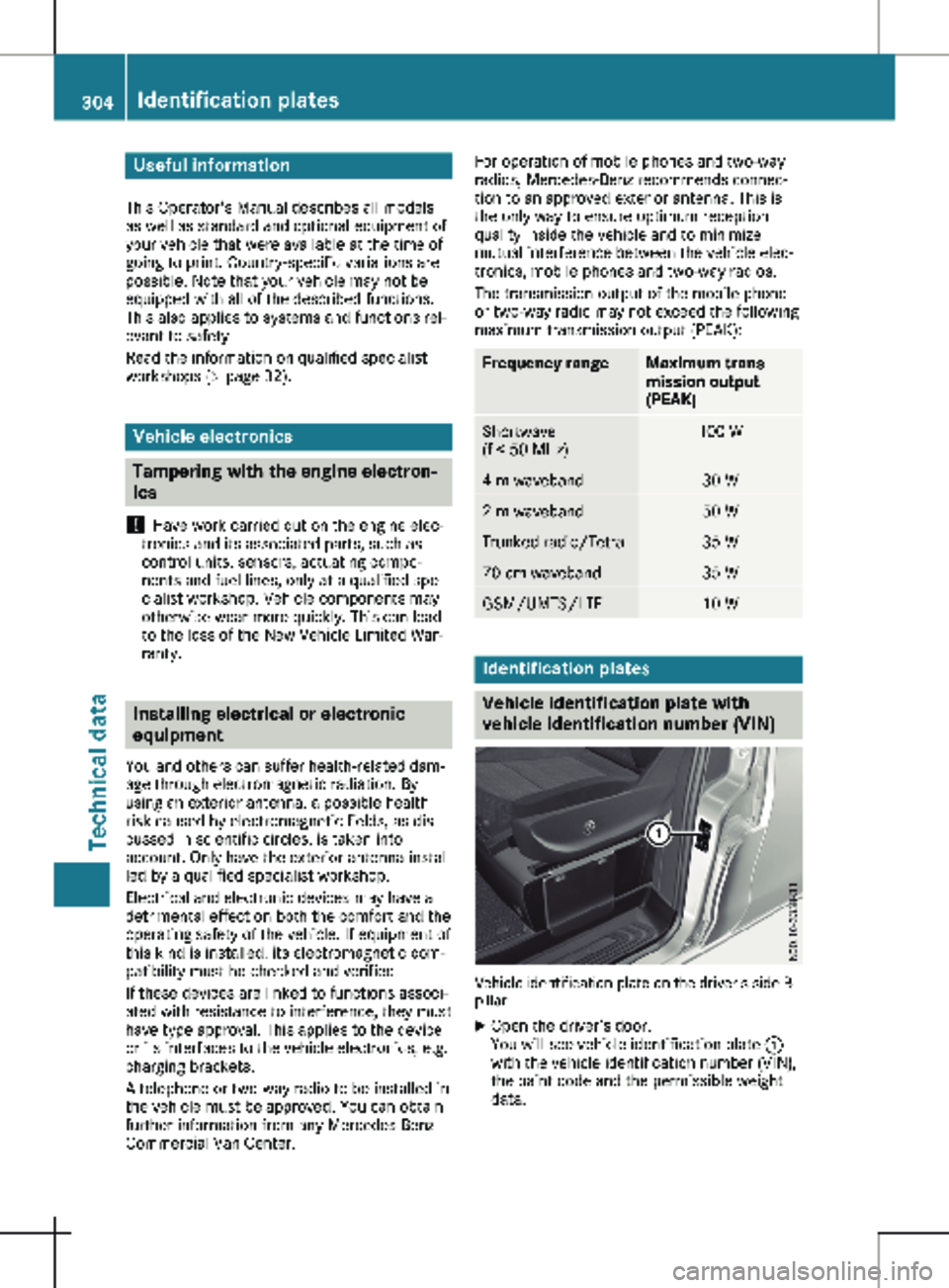
Vehicle identification plate on the driver's side B-
pillar
X Open the driver’s door.
You will see vehicle identification plate :
with the vehicle identification number (VIN),
the paint code and the permissible weight
data. 304
Identification plates
Technical data
Page 309 of 320
!
Filter the fuel before transferring it to the
vehicle if you are refueling the vehicle from
barrels or containers.
This will prevent malfunctions in the fuel
system due to contaminated fuel.
i E10 fuel contains an admixture of up to
10% bioethanol. Your vehicle is E10 compat-
ible. You can refuel your vehicle with E10
fuel.
i You can obtain information on fuel grades
at a qualified specialist workshop or at a gas
station. If there is no identification on the
filling pump, consult a gas station attendant.
For more information about refueling
(Y page
136).
Fuel additives
! Operating the engine with subsequently
added fuel additives can cause engine dam-
age. Do not mix fuel additives with fuel. This
does not include additives for the removal
and prevention of deposits. Gasoline can
only be mixed with additives recommended
by Mercedes-Benz. Follow the instructions
in the product description. You can find fur-
ther information on recommended additives
in any Mercedes-Benz Commercial Van Cen-
ter.
Mercedes-Benz recommends using brand-
name fuels with additives.
If you use fuels without these additives for a
long period of time, deposits can form. This
primarily forms on the inlet valve and in the
combustion chamber.
In some countries, the available fuel grade
may be inadequate. Residue could build up in
the fuel injection system as a result. In this
case, in consultation with a Mercedes-Benz
Commercial Van Center, the fuel should be
mixed with the cleaning additive recommen-
ded by Mercedes-Benz. You must observe the
notes and mixing ratios indicated on the con-
tainer.
Do not add other fuel additives to the fuel.
This results in unnecessary costs and can
damage the engine. Information on fuel consumption H
Environmental note
CO 2 (carbon dioxide) is the gas that accord-
ing to the current state of knowledge is
mainly responsible for the heating of the
earth's atmosphere (greenhouse effect). The
CO 2 emissions of your vehicle vary in direct
correspondence with the fuel consumption
and is therefore dependent on:
R the efficient utilization of the fuel by the
engine
R the respective style of driving
R other non-technical factors, such as envi-
ronmental influences, condition of the
road or traffic flow, for example
You can help to minimize CO 2 emissions
with a conservative driving style and regular
maintenance of your vehicle .
Only for certain countries: the respective cur-
rent consumption and emission values of your
vehicle can be found in the COC papers (EC
CERTIFICATE OF CONFORMITY). These docu-
ments are supplied when the vehicle is deliv-
ered.
Consumption figures were found in the cur-
rently valid respective version: R for vehicles with exhaust gas standard Euro
6 as per directive (EC) no. 715/2007
R for vehicles with exhaust gas standard
EURO VI as per directive (EC) no. 595/2009
Fuel consumption depends on:
R the vehicle version
R the style of driving
R the operating conditions
R the fuel type and fuel grade used
The vehicle will use more fuel than usual in the
following situations:
R at very low outside temperatures
R in city traffic
R during short journeys
R on mountainous terrain
R when towing a trailer
Observe the advice in the "Protection of the
environment" section to keep fuel consump-
tion low
(Y page 29). Service products and capacities
307
Technical data Z