spare tire MERCEDES-BENZ METRIS 2020 MY20 Operator’s Manual
[x] Cancel search | Manufacturer: MERCEDES-BENZ, Model Year: 2020, Model line: METRIS, Model: MERCEDES-BENZ METRIS 2020Pages: 320, PDF Size: 26.38 MB
Page 5 of 320
Display messages (vehicles with
steering wheel buttons) .......................
209
Indicator and warning lamps in the
instrument cluster ............................... 227 Stowing and features .......................
238
Useful information ...............................
238
Stowage spaces and stowage com-
partments ............................................ 238
Sun visors ............................................ 239
Cup holder ........................................... 239
Bottle holder ........................................ 240
Ashtray ................................................ 240
Cigarette lighter ................................... 240
12 V socket ......................................... 241
Mobile communications equipment ..... 241 Transporting loads
............................242
Useful information ...............................
242
Loading guidelines ............................... 242
Load distribution ................................. 243
Securing loads ..................................... 244
Lashing straps ..................................... 246
Securing loads ..................................... 248
Carrier systems ................................... 249 Maintenance and care
......................250
Useful information ...............................
250
Engine compartment ........................... 250
Maintenance ........................................ 257
Battery ................................................. 258
Care ..................................................... 263 Breakdown assistance
.....................270
Useful information ...............................
270
Where will I find...? .............................. 270
Flat tire ................................................ 272
Jump-starting ....................................... 272
Tow-starting and towing away ............. 274
Electrical fuses .................................... 277 Wheels and tires ...............................
278
Useful information ...............................
278
Important safety notes ........................ 278
Operation ............................................ 278 Operation in winter .............................. 280
Tire pressure
....................................... 282
Loading the vehicle .............................. 289
What you should know about wheels
and tires .............................................. 292
Changing wheels ................................. 297
Wheel and tire combinations ............... 301
Spare wheel ......................................... 302 Technical data ...................................
304
Useful information ...............................
304
Vehicle electronics .............................. 304
Identification plates ............................. 304
Service products and capacities .......... 305
Vehicle data ......................................... 312 Contents
3
Page 14 of 320
Activating/deactivating (vehicle
without steering wheel buttons)
.... 179
Crosswind Assist ............................. 70
Deactivating/activating ................... 69
Display message (vehicle with
steering wheel buttons) ................. 214
Display message (vehicle without
steering wheel buttons) ................. 200
Function/notes ................................ 68
Important safety information ........... 68
Trailer stabilization ........................... 69
Warning lamp ................................. 230
Exhaust check ................................... 141
Exterior lighting
see Lights
Exterior mirror
Heating ............................................ 97
Exterior mirrors
Adjusting ......................................... 97
Out of position (troubleshooting) ..... 97
Eyeglasses compartment ................. 238 F
First-aid kit .........................................
272
Flat tire
Changing a wheel/mounting the
spare wheel ................................... 298
Frequencies
Mobile phone ................................. 304
Two-way radio ................................ 304
Front fog lamps
Changing bulbs .............................. 105
Display messages (vehicle with
steering wheel buttons) ................. 217
Display messages (vehicle with-
out steering wheel buttons) ........... 203
Switching on/off ........................... 100
Front-passenger front air bag
Display message (vehicle without
steering-wheel buttons) ................. 197
Fuel
Additives (gasoline) ........................ 307
Consumption information .............. 307
Consumption statistics (vehicle
with steering wheel buttons) ......... 184
Consumption statistics (vehicle
without steering wheel buttons) .... 177 Displaying the current consump-
tion (vehicle with steering wheel
buttons) .........................................
184
Displaying the current consump-
tion (vehicle without steering
wheel buttons) ............................... 178
Displaying the range (vehicle
with steering wheel buttons) ......... 184
Displaying the range (vehicle
without steering wheel buttons) .... 178
Driving abroad ............................... 141
Driving tips .................................... 140
Fuel content display (vehicle
without steering wheel buttons) .... 176
Fuel gauge (vehicle with steering
wheel buttons) ................................. 40
Grade (gasoline) ............................ 306
Important safety notes .................. 306
Problem (malfunction) ................... 138
Refueling ........................................ 136
Tank content/reserve fuel ............. 306
Fuel content
Display (vehicle without steering
wheel buttons) ............................... 176
Fuel level
Gauge (vehicle with steering
wheel buttons) ................................. 40
Fuel tank
Problem (malfunction) ................... 138
Fuel tank reserve level
Display messages (vehicle with
steering wheel buttons) ................. 221
Display messages (vehicle with-
out steering wheel buttons) ........... 206
Fuses .................................................. 277 G
Gasoline .............................................
306
Gearshift recommendation
Display (vehicle with steering
wheel buttons) ............................... 183
Display (vehicle without steering
wheel buttons) ............................... 176
Genuine parts ...................................... 34
Glove box ........................................... 238
GTW (Gross Trailer Weight) (defi-
nition) ................................................. 29612
Index
Page 17 of 320
Load protection net ...........................
248
Loading guidelines ............................ 242
Loading rails
Maximum tensile strength ............. 314
Loads
Securing ........................................ 244
Transporting .................................. 242
Locking
see Central locking
Locking centrally
see Central locking
Low-beam headlamps
Display messages (vehicle with
steering wheel buttons) ................. 216
Display messages (vehicle with-
out steering wheel buttons) ........... 202
Driving abroad ............................... 141
Replacing bulbs ............................. 106
Switching on/off ........................... 100
Lumbar support ................................... 89M
M+S tires ............................................
280
Maintenance ...................................... 257
Maintenance points under the
hood .................................................... 252
Maximum permissible speed
Speed limitation (tires) .................. 141
Mechanical key
Function/notes ................................ 72
Inserting .......................................... 73
Locking vehicle ................................ 73
Removing ......................................... 72
Media Interface
Connections ..................................... 43
Memory card (audio) ......................... 187
Memory function
Seat ................................................. 97
Mercedes-Benz Commercial Van
Center
see Qualified specialist workshop
Mercedes-Benz Service24h .............. 272
Message memory
On-board computer (vehicle with
steering wheel buttons) ................. 209
On-board computer (vehicle with-
out steering wheel buttons) ........... 195 Messages
see Warning and indicator lamps
Mirrors
Exterior mirrors
................................ 97
Important safety notes .................... 96
Rear-view mirror .............................. 96
see Vanity mirror
Mobile phone
Type approval/frequency .............. 304
Mobile phone
see Telephone
Model series
see Vehicle identification plate
Modifying the programming
(SmartKey) ........................................... 72
Mounting wheels
Lowering the vehicle ...................... 300
Mounting a new wheel ................... 300
Preparing the vehicle ..................... 298
Raising the vehicle ......................... 298
Removing a wheel .......................... 299
Removing and mounting the
spare wheel ................................... 303
Securing the vehicle against roll-
ing away ........................................ 298
MP3
Operation ....................................... 187 N
Navigation Menu (on-board computer) ............
185
Notes on breaking-in a new vehi-
cle ....................................................... 126 O
Occupant Classification System
(OCS) Conditions .......................................
54
Faults ............................................... 57
Operation ......................................... 54
Self-test ........................................... 56
Occupant safety
Air bags ........................................... 51
Automatic measures after an
accident ........................................... 60
Belt warning ..................................... 50
Children in the vehicle ..................... 60 Index
15
Page 27 of 320
Vehicle data .......................................
312
Vehicle dimensions ........................... 313
Vehicle emergency locking ................ 73
Vehicle identification number
see VIN
Vehicle identification plate .............. 304
Vehicle key
see SmartKey
Vehicle tool kit
in the seat base ............................. 270
Scope ............................................ 270
Storage location ............................ 270
Stowage compartment in the
rear ................................................ 271
Stowage space in the cargo com-
partment ........................................ 272
Ventilation
see Climate control
Vents
see Air vents
VIN
Engine compartment ..................... 305
Type plate ...................................... 304 W
Warning Stickers
........................................... 29
Warning and indicator lamps
ABS ................................................ 230
Brakes ........................................... 229
Check Engine ................................. 233
COLLISION PREVENTION ASSIST .. 235
Coolant .......................................... 233
Distance warning ........................... 235
Door ............................................... 237
ESP ®
.............................................. 230
ESP ®
OFF ....................................... 232
Fuel tank ........................................ 233
General notes ................................ 227
Overview (vehicle with steering
wheel buttons) ................................. 41
Overview (vehicle without steer-
ing wheel buttons) ........................... 39
Parking brake ................................ 138
PASSENGER AIR BAG OFF ............... 47
Rear door ....................................... 237
Reserve fuel ................................... 233 Restraint system ............................ 232
Seat belt ........................................
228
Sliding door ................................... 237
Steering ......................................... 237
Tire pressure monitor .................... 236
Warranty .............................................. 27
Washer fluid
Adding ........................................... 256
Capacities ...................................... 312
Display messages (vehicle with
steering wheel buttons) ................. 227
Display messages (vehicle with-
out steering wheel buttons) ........... 209
Notes ............................................. 312
Wheel and tire combination
see Tires
Wheel bolt tightening torque ........... 300
Wheels
Changing a wheel .......................... 297
Checking ........................................ 279
Cleaning ......................................... 266
Important safety notes .................. 278
Interchanging/changing ................ 297
Mounting a new wheel ................... 300
Mounting a wheel .......................... 298
Removing a wheel .......................... 299
Removing and mounting the
spare wheel ................................... 303
Snow chains .................................. 281
Storing ........................................... 298
Tightening torque ........................... 300
Wheel/tire combinations ............... 301
Window curtain air bag
Display message (vehicle with
steering wheel buttons) ................. 215
Display message (vehicle without
steering wheel buttons) ................. 201
Operation ......................................... 53
Windows
see Side windows
Windows misted up
see Climate control
Windshield
Cleaning ......................................... 265
Defrosting ...................................... 121
Windshield
see Windshield Index
25
Page 272 of 320
Useful information
This Operator's Manual describes all models
as well as standard and optional equipment of
your vehicle that were available at the time of
going to print. Country-specific variations are
possible. Note that your vehicle may not be
equipped with all of the described functions.
This also applies to systems and functions rel-
evant to safety.
Read the information on qualified specialist
workshops (Y page
32).Where will I find...?
Vehicle tool kit
General notes Depending on the equipment version of the
vehicle, the vehicle tool kit is:
R in the seat base of the left front seat
R in the rear compartment stowage compart-
ment
R in the tool holder in the cargo compartment
Apart from some country-specific variants,
vehicles without a spare wheel are not equip-
ped with tire-changing tools. If your vehicle is
equipped with tire-changing tools, these are in
the vehicle tool kit. If the vehicle tool kit is
stowed in the driver's seat base, the jack is in
a separate holder in the cargo compartment
on the right-hand side of the vehicle next to
the tailgate/rear-end door
(Y page 272).
Some tools for changing a wheel are specific
to the vehicle. For more information on which
tools are required and approved to perform a
wheel change on your vehicle, consult a quali-
fied specialist workshop.
Necessary tire-changing tools can include, for
example:
R Jack
R Lug wrench
R Ratchet wrench
i The jack has a maximum weight of 7.5 kg
depending on the vehicle's equipment.
The maximum payload of the jack can be
found on the sticker on the jack itself. The jack is maintenance-free. In the event of
a malfunction, please contact a qualified
specialist workshop.
Stowage compartment in the seat
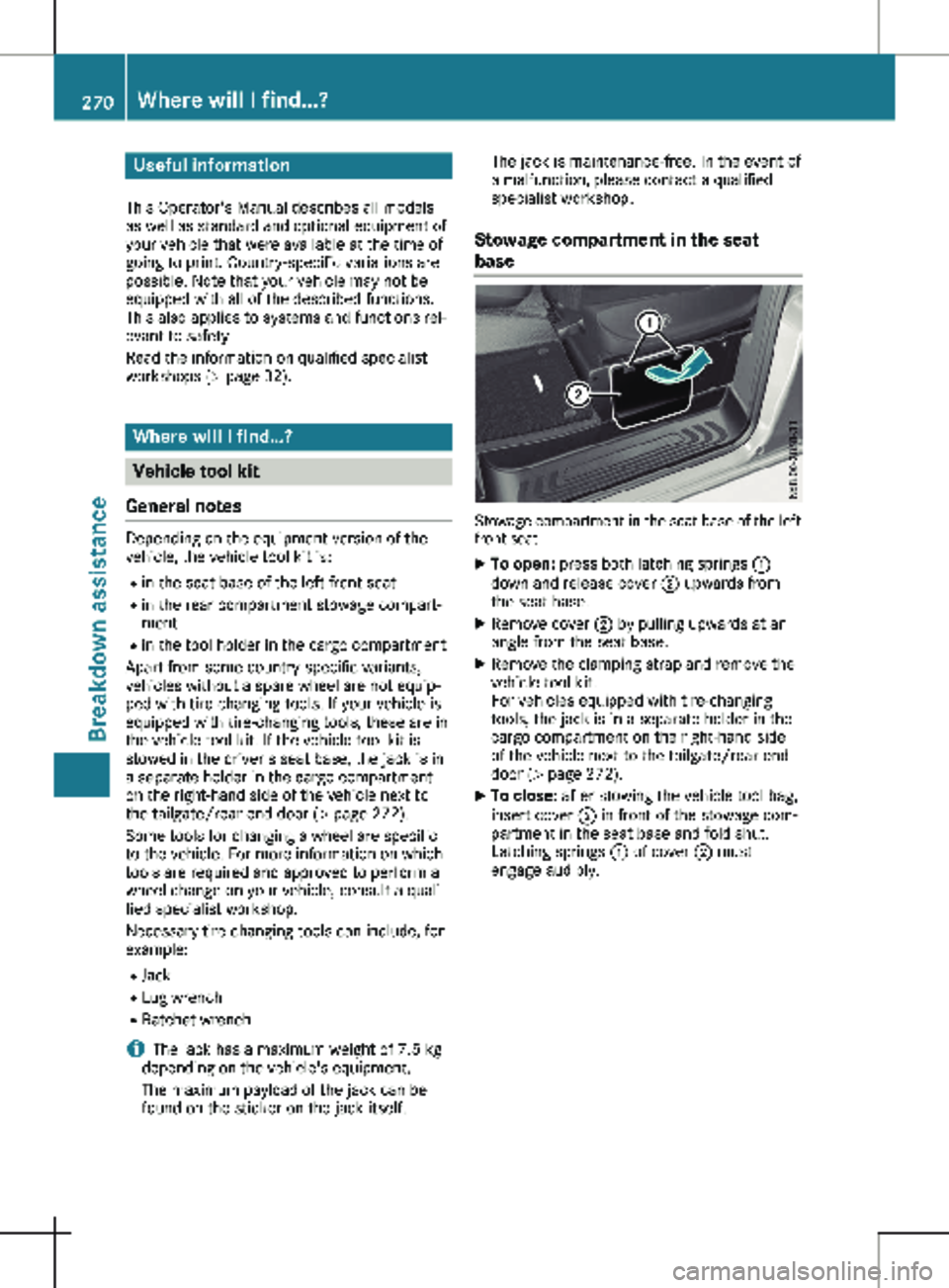
base Stowage compartment in the seat base of the left
front seat
X To open: press both latching springs :
down and release cover ; upwards from
the seat base.
X Remove cover ; by pulling upwards at an
angle from the seat base.
X Remove the clamping strap and remove the
vehicle tool kit.
For vehicles equipped with tire-changing
tools, the jack is in a separate holder in the
cargo compartment on the right-hand side
of the vehicle next to the tailgate/rear-end
door (Y page
272).
X To close: after stowing the vehicle tool bag,
insert cover ; in front of the stowage com-
partment in the seat base and fold shut.
Latching springs : of cover ; must
engage audibly. 270
Where will I find...?
Breakdown assistance
Page 274 of 320
Stowage space in the cargo compart-
ment
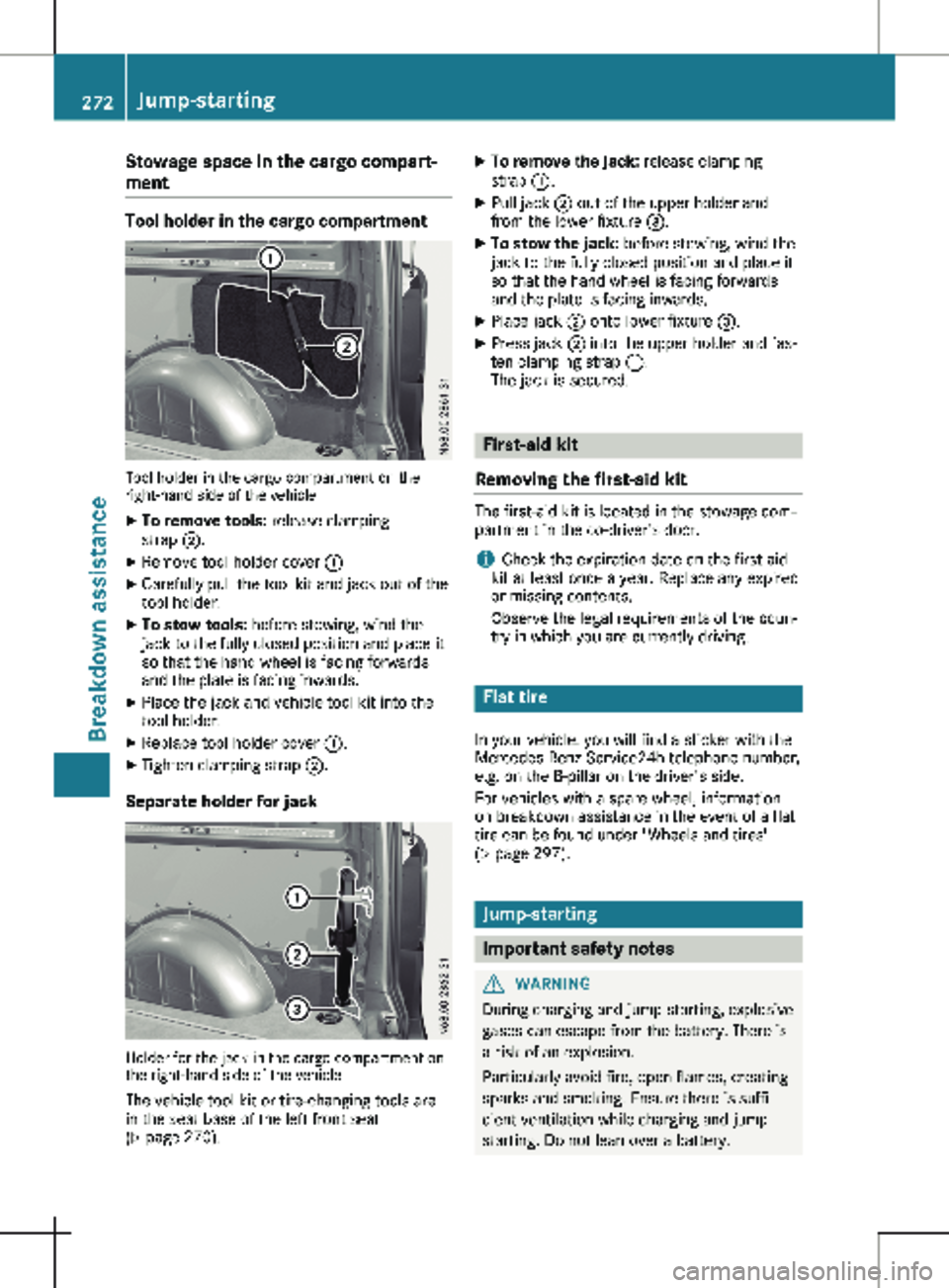
Tool holder in the cargo compartment
Tool holder in the cargo compartment on the
right-hand side of the vehicle
X To remove tools: release clamping
strap ;.
X Remove tool holder cover :
X Carefully pull the tool kit and jack out of the
tool holder.
X To stow tools: before stowing, wind the
jack to the fully closed position and place it
so that the hand wheel is facing forwards
and the plate is facing inwards.
X Place the jack and vehicle tool kit into the
tool holder.
X Replace tool holder cover :.
X Tighten clamping strap ;.
Separate holder for jack Holder for the jack in the cargo compartment on
the right-hand side of the vehicle
The vehicle tool kit or tire-changing tools are
in the seat base of the left front seat
(Y page
270). X
To remove the jack: release clamping
strap :.
X Pull jack ; out of the upper holder and
from the lower fixture =.
X To stow the jack: before stowing, wind the
jack to the fully closed position and place it
so that the hand wheel is facing forwards
and the plate is facing inwards.
X Place jack ; onto lower fixture =.
X Press jack ; into the upper holder and fas-
ten clamping strap :.
The jack is secured. First-aid kit
Removing the first-aid kit The first-aid kit is located in the stowage com-
partment in the co-driver's door.
i Check the expiration date on the first-aid
kit at least once a year. Replace any expired
or missing contents.
Observe the legal requirements of the coun-
try in which you are currently driving. Flat tire
In your vehicle, you will find a sticker with the
Mercedes-Benz Service24h telephone number,
e.g. on the B-pillar on the driver's side.
For vehicles with a spare wheel, information
on breakdown assistance in the event of a flat
tire can be found under "Wheels and tires"
( Y page
297). Jump-starting
Important safety notes
G
WARNING
During charging and jump-starting, explosive
gases can escape from the battery. There is
a risk of an explosion.
Particularly avoid fire, open flames, creating
sparks and smoking. Ensure there is suffi-
cient ventilation while charging and jump-
starting. Do not lean over a battery. 272
Jump-starting
Breakdown assistance
Page 280 of 320
Useful information
This Operator's Manual describes all models
as well as standard and optional equipment of
your vehicle that were available at the time of
going to print. Country-specific variations are
possible. Note that your vehicle may not be
equipped with all of the described functions.
This also applies to systems and functions rel-
evant to safety.
Read the information on qualified specialist
workshops (Y page
32).Important safety notes
G
Warning
A flat tire severely impairs the driving, steer-
ing and braking characteristics of the vehi-
cle. There is a risk of an accident.
do not drive with a flat tire. Immediately
replace the flat tire with your spare wheel,
or consult a qualified specialist workshop. G
WARNING
If you install wheels and tires with incorrect
dimensions, the service brake or wheel sus-
pension components may be damaged.
There is a risk of an accident.
Always replace wheels and tires with ones
that comply with the specifications of the
original part.
When replacing wheels, pay attention to the:
R Designation
R Model
When replacing tires, pay attention to the:
R Designation
R Manufacturer
R Model
Accessories that are not approved for your
vehicle by Mercedes-Benz or are not being
used correctly can impair operating safety. Before purchasing and using non-approved
accessories, visit a qualified specialist work-
shop and inquire about the following points:
R
suitability
R legal stipulations
R factory recommendations
Information on the dimensions and types of
wheels and tires for your vehicle can be found
under "Wheel and tire combinations"
( Y page
301).
Information on your vehicle's tire pressures
can be found in the following locations:
R in the Tire and Loading Information placard
on the B-pillar, driver's side
R in the tire pressure table inside the fuel filler
flap ( Y page 282)
R under "Tire pressure tables" (Y page 289)
R under "Tire pressure" (Y page 282)
Modifications to the brake system or wheels
are not permitted. The use of spacers or brake
dust shields is not permitted. This invalidates
the general operating permit for the vehicle.
Further information on wheels and tires can be
obtained at any qualified specialist workshop. Operation
Information for a journey
If the vehicle is heavily laden, check the tire
pressures, and correct them, if necessary
( Y page
282).
While driving, pay attention to vibrations,
noises and unusual handling characteristics,
e.g. pulling to one side. This may indicate that
the wheels or tires are damaged. If you sus-
pect that a tire is defective, reduce your speed
immediately. Stop the vehicle as soon as pos-
sible to check the wheels and tires for dam-
age. Hidden tire damage could also be causing
the unusual handling characteristics. If you
find no signs of damage, have the tires and
wheels checked at a qualified specialist work-
shop.
When parking your vehicle, make sure that the
tires do not get deformed by the curb or other
obstacles. If it is necessary to drive over curbs,
speed humps or similar elevations, try to do so
slowly and not at a sharp angle. Otherwise, the
tires, particularly the sidewalls, can get dam-
aged. 278
Operation
Wheels and tires
Page 282 of 320
R
Break in new tires at moderate speeds for
the first
65 miles (100 km).
R Do not drive with tires which have too little
tread depth, as this significantly reduces the
traction on wet roads (hydroplaning).
R Replace the tires after six years at the lat-
est, regardless of wear. This also applies to
the spare wheel. Operation in winter
General notes
Have your vehicle winterized at a qualified spe-
cialist workshop at the onset of winter.
Only use wheels with tire sizes approved for
Mercedes-Benz.
Prior to the onset of winter, ensure that snow
chains are stowed in the vehicle
(Y page
281). Snow chains cannot be moun-
ted on all wheel/tire combinations. Observe
the restrictions on the use of snow chains
under "Wheel/tire combinations"
(Y page 302).
Also observe the notes in the "Changing a
wheel" section ( Y page 297).Driving with summer tires
At temperatures below 45 ‡
(+7 †), summer
tires lose elasticity and therefore traction and
braking power. Change the tires on your vehi-
cle to M+S tires. Using summer tires at very
cold temperatures could cause tears to form,
thereby damaging the tires permanently.
Mercedes-Benz cannot accept responsibility
for this type of damage. M+S tires
G
WARNING
Wheel and tire dimensions as well as the
type of tire can vary between the spare
wheel and the wheel to be replaced. When
the spare wheel is mounted, driving charac-
teristics may be severely affected. There is a
risk of an accident. In order to reduce risks:
R you should therefore adapt your driving
style and drive carefully.
R never mount more than one spare wheel
that differs from the wheel to be replaced.
R only use a spare wheel that differs from
the wheel to be replaced for a short time.
R have a spare wheel that differs from the
wheel that has been changed replaced at
the nearest qualified specialist workshop.
You must observe the correct wheel and
tire dimensions as well as the wheel type. G
WARNING
M+S tires with a tire tread depth of less than
ã in
(4 mm) are not suitable for use in win-
ter and do not provide sufficient traction.
There is a risk of an accident.
M+S tires with a tread depth of less than ã
in (4 mm) must be replaced immediately.
Use winter tires or all-season tires at tempera-
tures below 45 ‡ (+7 †). Both types of tire
are identified by the M+S marking.
Only winter tires bearing the i snowflake
symbol in addition to the M+S marking provide
the best possible grip in wintry road condi-
tions.
Only these tires will allow driving safety sys-
tems such as ABS and ESP ®
to function opti-
mally in winter. These tires have been devel-
oped specifically for driving in snow.
For safe driving, use M+S tires of the same
make and tread pattern on all wheels.
Always observe the maximum permissible
speed specified for the M+S tires you have
mounted.
If you mount M+S tires that have a lower maxi-
mum permissible speed than the maximum
design speed of the vehicle, affix a corre-
sponding warning label in the driver's field of
vision. You can obtain this at a qualified spe-
cialist workshop.
Once you have mounted the winter tires:
X Check the tire pressure (Y page
282).
X Restart the tire pressure monitor
(Y page
288).280
Operation in winter
Wheels and tires
Page 284 of 320
Tire pressure
Tire pressure specifications
Important safety notes G
WARNING
Underinflated or overinflated tires pose the
following risks:
R the tires may burst, especially as the load
and vehicle speed increase.
R the tires may wear excessively and/or
unevenly, which may greatly impair tire
traction.
R the driving characteristics, as well as
steering and braking, may be greatly
impaired.
There is a risk of an accident.
Follow recommended tire inflation pressures
and check the pressure of all the tires
including the spare wheel:
R monthly, at least
R if the load changes
R before beginning a long journey
R under different operating conditions, e.g.
off-road driving
If necessary, correct the tire pressure.
The tire pressure monitor will not warn you of: R an incorrectly set tire pressure
R sudden loss of tire pressure, for example
caused through intrusion from a foreign
object G
WARNING
If you fit unsuitable accessories onto tire
valves, the tire valves may be overloaded
and malfunction, which can cause tire pres-
sure loss. Due to their design, retrofitted tire
pressure monitors keep the tire valve open.
This can also result in tire pressure loss.
There is a risk of an accident.
Only screw the standard valve cap or other
valve caps approved by Mercedes-Benz for
your vehicle onto the tire valve. !
The pressure difference between tires on
any one axle must be no greater than
10 kPa
(0.1 bar/1.5 psi).
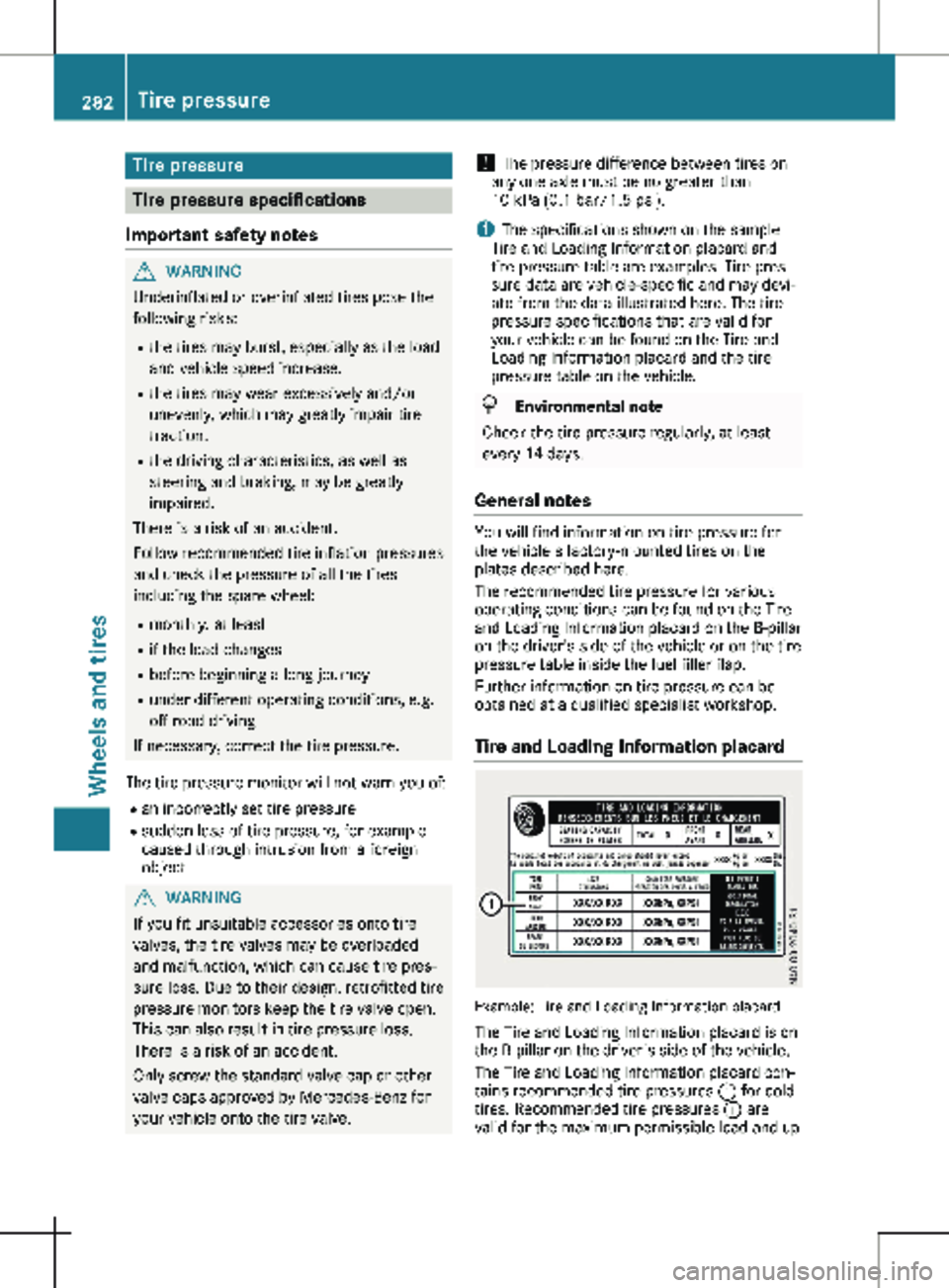
i The specifications shown on the sample
Tire and Loading Information placard and
tire pressure table are examples. Tire pres-
sure data are vehicle-specific and may devi-
ate from the data illustrated here. The tire
pressure specifications that are valid for
your vehicle can be found on the Tire and
Loading Information placard and the tire
pressure table on the vehicle. H
Environmental note
Check the tire pressure regularly, at least
every
14 days.
General notes You will find information on tire pressure for
the vehicle's factory-mounted tires on the
plates described here.
The recommended tire pressure for various
operating conditions can be found on the Tire
and Loading Information placard on the B-pillar
on the driver's side of the vehicle or on the tire
pressure table inside the fuel filler flap.
Further information on tire pressure can be
obtained at a qualified specialist workshop.
Tire and Loading Information placard Example: Tire and Loading Information placard
The Tire and Loading Information placard is on
the B-pillar on the driver's side of the vehicle.
The Tire and Loading Information placard con-
tains recommended tire pressures : for cold
tires. Recommended tire pressures : are
valid for the maximum permissible load and up 282
Tire pressure
Wheels and tires
Page 286 of 320
Important notes on tire pressure
G
WARNING
If the tire pressure drops repeatedly, the
wheel, valve or tire may be damaged. Tire
pressure that is too low may result in a tire
blow-out. There is a risk of an accident. R Check the tire for foreign objects.
R Check whether the wheel is losing air or
the valve is leaking.
If you are unable to rectify the damage, con-
tact a qualified specialist workshop.
Use a suitable pressure gauge to check the
tire pressure. The outer appearance of a tire
does not permit any reliable conclusion about
the tire pressure. On vehicles equipped with
the electronic tire pressure monitor, the tire
pressure can be checked using the on-board
computer.
The tire temperature and pressure increase
when the vehicle is in motion. This is depend-
ent on the driving speed and the load.
Therefore, you should only correct tire pres-
sure when the tires are cold.
The tires are cold: R if the vehicle has been parked for at least
three hours without direct sunlight on the
tires, and
R if the vehicle has not been driven further
than
1 mile (1.6 km)
Tire temperature changes depending on the
ambient temperature, driving speed and tire
load. If the tire temperature changes by 18 ‡
(10 †), the tire pressure changes by approx-
imately 10 kPa (0.1 bar/1.5 psi). Take this into
account when checking the pressure of warm
tires. Only correct the tire pressure if it is too
low for the current operating conditions. If you
check the tire pressure when the tires are
warm, it results in a higher value than when
the tires are cold. This is normal. Do not under
any circumstances release the air in order to
adjust the pressure to the prescribed value for
cold tires. The tire pressure would otherwise
be too low.
Observe the recommended tire pressure for
cold tires on the tire pressure table in the fuel
filler flap. Driving with tire pressure that is too high or
too low can:
R shorten the service life of the tires
R cause increased tire damage
R have a negative effect on handling charac-
teristics and thus the driving safety (e.g.
hydroplaning) Underinflated or overinflated tires
Underinflated tires: G
WARNING
Tires with pressure that is too low can over-
heat and burst as a consequence. In addi-
tion, they also suffer from excessive and/or
irregular wear, which can severely impair the
braking properties and the driving character-
istics. There is a risk of an accident.
Avoid tire pressures that are too low in all
the tires, including the spare wheel.
Underinflated tires can:
R fail from being overheated
R adversely affect handling
R wear excessively and/or unevenly
R have an adverse effect on fuel consumption
Overinflated tires G
WARNING
Tires with excessively high pressure can
burst because they are damaged more eas-
ily by road debris, potholes etc. In addition,
they also suffer from irregular wear, which
can severely impair the braking properties
and the driving characteristics. There is a
risk of an accident.
Avoid tire pressures that are too high in all
the tires, including the spare wheel.
Overinflated tires can:
R increase the braking distance
R adversely affect handling
R wear excessively and/or unevenly
R adversely affect ride comfort
R be more susceptible to damage284
Tire pressure
Wheels and tires