engine MERCEDES-BENZ ML320 1997 Complete Repair Manual
[x] Cancel search | Manufacturer: MERCEDES-BENZ, Model Year: 1997, Model line: ML320, Model: MERCEDES-BENZ ML320 1997Pages: 4133, PDF Size: 88.89 MB
Page 1210 of 4133
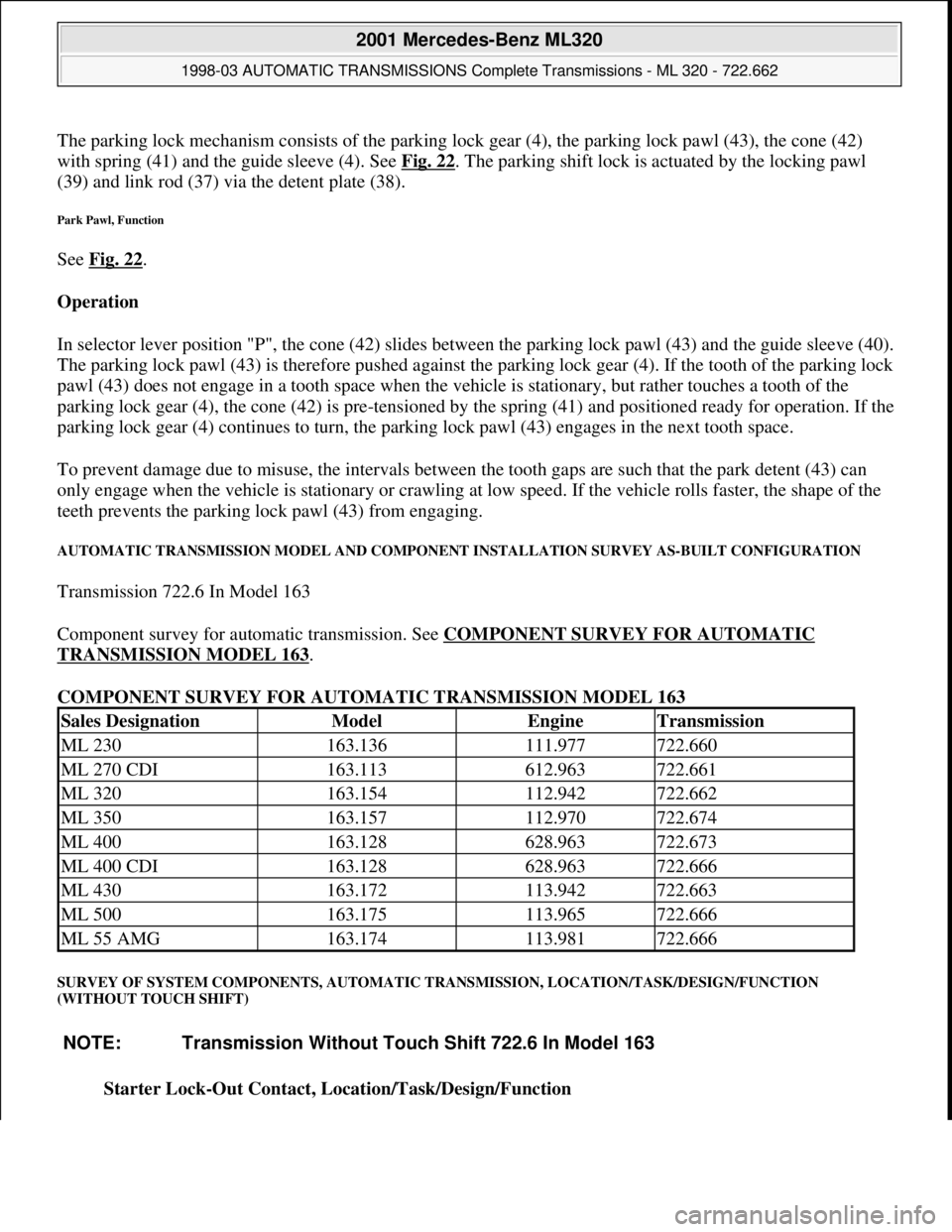
The parking lock mechanism consists of the parking lock gear (4), the parking lock pawl (43), the cone (42)
with spring (41) and the guide sleeve (4). See Fig. 22
. The parking shift lock is actuated by the locking pawl
(39) and link rod (37) via the detent plate (38).
Park Pawl, Function
See Fig. 22.
Operation
In selector lever position "P", the cone (42) slides between the parking lock pawl (43) and the guide sleeve (40).
The parking lock pawl (43) is therefore pushed against the parking lock gear (4). If the tooth of the parking lock
pawl (43) does not engage in a tooth space when the vehicle is stationary, but rather touches a tooth of the
parking lock gear (4), the cone (42) is pre-tensioned by the spring (41) and positioned ready for operation. If the
parking lock gear (4) continues to turn, the parking lock pawl (43) engages in the next tooth space.
To prevent damage due to misuse, the intervals between the tooth gaps are such that the park detent (43) can
only engage when the vehicle is stationary or crawling at low speed. If the vehicle rolls faster, the shape of the
teeth prevents the parking lock pawl (43) from engaging.
AUTOMATIC TRANSMISSION MODEL AND COMPONENT INSTALLATION SURVEY AS-BUILT CONFIGURATION
Transmission 722.6 In Model 163
Component survey for automatic transmission. See COMPONENT SURVEY FOR AUTOMATIC
TRANSMISSION MODEL 163.
COMPONENT SURVEY FOR AUTOMATIC TRANSMISSION MODEL 163
SURVEY OF SYSTEM COMPONENTS, AUTOMATIC TRANSMISSION, LOCATION/TASK/DESIGN/FUNCTION
(WITHOUT TOUCH SHIFT)
Starter Lock-Out Contact, Location/Task/Design/Function
Sales DesignationModelEngineTransmission
ML 230163.136111.977722.660
ML 270 CDI163.113612.963722.661
ML 320163.154112.942722.662
ML 350163.157112.970722.674
ML 400163.128628.963722.673
ML 400 CDI163.128628.963722.666
ML 430163.172113.942722.663
ML 500163.175113.965722.666
ML 55 AMG163.174113.981722.666
NOTE: Transmission Without Touch Shift 722.6 In Model 163
2001 Mercedes-Benz ML320
1998-03 AUTOMATIC TRANSMISSIONS Complete Transmissions - ML 320 - 722.662
me
Saturday, October 02, 2010 3:15:26 PMPage 41 © 2006 Mitchell Repair Information Company, LLC.
Page 1232 of 4133
vehicle is stationary and the engine is idling, boosts the engine torque and provides infinitely variable
engine speed and torque matching when moving off.
Torque Converter, Design
The impeller (P) is connected to the engine, the turbine wheel (T) is connected to the transmission input
shaft.
The stator (L) is connected to the transmission housing via a freewheel and the stator shaft (8).
Torque Converter, Function
See TORQUE CONVERTER, FUNCTION
.
Torque Converter, Function
Due to the effect of centrifugal force, the blades of the impeller (P) pump the oil outwards to the turbine wheel
(T), causing it to rotate. See Fig. 31
. The turbine wheel blades direct the oil onto the blades of the stator, which
in turn push the oil back to the impeller (P) (arrow). This diversion at the stator (L), which is supported against
the transmission housing via the freewheel, produces and increase in torque. At the maximum speed difference
between the impeller and the turbine wheel (T), the torque conversion achieves its maximum value at a factor of
1.8 to 2.0, dropping to a torque ratio of 1:1 as the speeds converge. From this operating state onwards, also
referred to as the coupling point, the stator (l) rotates with the impeller (P) and the turbine wheel (T).
Efficiencies of up to approximately 98% are achieved in the coupling range.
The oil in the torque converter is constantly being replaced so that the heat produced in the operating phase can
be dissipated via the transmission oil cooler.
2001 Mercedes-Benz ML320
1998-03 AUTOMATIC TRANSMISSIONS Complete Transmissions - ML 320 - 722.662
me
Saturday, October 02, 2010 3:15:26 PMPage 63 © 2006 Mitchell Repair Information Company, LLC.
Page 1236 of 4133
Wheel Speed Sensor, Location
RPM sensors 2 and 3 (Y3/6n2 and Y3/6n3) are permanently connected with the supporting body of the
electrical control unit (Y3/6) via contact tongues. See Fig. 32
.
Wheel Speed Sensor,
The signals from the RPM sensors 2 3 (Y3/6n2, Y3/6n3) are recorded in the ETC control module (N15/3)
together with the wheel and engine speeds and other information, and are the input signals for the
electronic control system.
Wheel Speed Sensor, Function
See SPEED SENSOR, FUNCTION
.
Speed Sensor, Function
2001 Mercedes-Benz ML320
1998-03 AUTOMATIC TRANSMISSIONS Complete Transmissions - ML 320 - 722.662
me
Saturday, October 02, 2010 3:15:26 PMPage 67 © 2006 Mitchell Repair Information Company, LLC.
Page 1264 of 4133
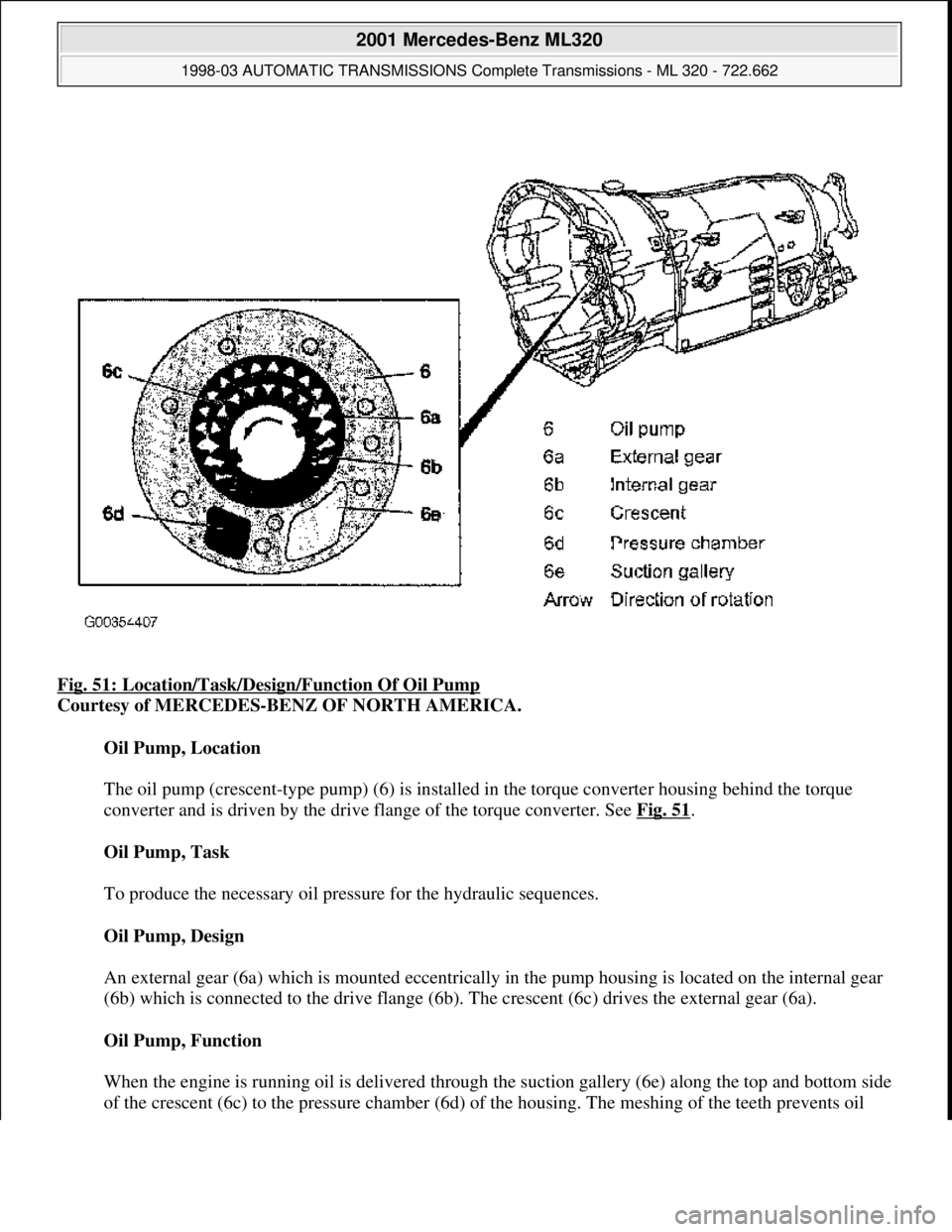
Fig. 51: Location/Task/Desi gn/Function Of Oil Pump
Courtesy of MERCEDES-BENZ OF NORTH AMERICA.
Oil Pump, Location
The oil pump (crescent-type pump) (6) is installed in the torque converter housing behind the torque
converter and is driven by the drive flange of the torque converter. See Fig. 51
.
Oil Pump, Task
To produce the necessary oil pressure for the hydraulic sequences.
Oil Pump, Design
An external gear (6a) which is m ounted eccentrically in the pump housi ng is located on the internal gear
(6b) which is connected to the drive flange (6b). The crescent (6c) drives the external gear (6a).
Oil Pump, Function
When the engine is running oil is delivered through th e suction gallery (6e) along the top and bottom side
of the crescent (6c) to the pr essure chamber (6d) of the housin
g. The meshing of the teeth prevents oil
2001 Mercedes-Benz ML320
1998-03 AUTOMATIC TRANSMI SSIONS Complete Transmissions - ML 320 - 722.662
me
Saturday, October 02, 2010 3:15:26 PMPage 95 © 2006 Mitchell Repair Information Company, LLC.
Page 1306 of 4133

Overlap Regulating Valve, Function
Operation - During the shift phase the pressure in the disengaging shift actuator is controlled depending on the
engine load (modulating pressure (p-Mod)) and the pressure in the engaging shift actuator. The regulated
pressure is inversely proportional to the transfer capacity of the activating shift actuator (regulated overlap). See
Fig. 78
.
2001 Mercedes-Benz ML320
1998-03 AUTOMATIC TRANSMISSIONS Complete Transmissions - ML 320 - 722.662
me
Saturday, October 02, 2010 3:15:27 PMPage 137 © 2006 Mitchell Repair Information Company, LLC.
Page 1333 of 4133
Task - The ETC control module (N15/3) determines the instantaneous operating condition of the vehicle and
controls all gearshift sequences taking into account the ease of shifting and the driving situation. This involves
receiving, converting and transmitting various digital and analog signals. See Fig. 96
.
It receives operating data in the form of input signals from:
Starter Lock-Out Contact (Y3/6S1)
RPM Sensor 2 (Y3/6N2)
RPM Sensor 3 (Y3/6n3)
Transmission Oil Temperature Sensor (Y3/6B1)
In addition there is a connection via the engine compartment bus to the:
Instrument Cluster (A1)
ME-SFI Control Module (N3/10) or CDI Control Module (N3/9)
The solenoid valves for the modulating and shift pressure and for the gear changes are actuated by the ETC
control module (N15/3).
The pressure required is calculated from all input signals, adjusted to the torque to be transferred. The following
information from other systems is then processed.
ME-SFI Control Module (N3/10) or CDI Control Module (N3/9):
Engine Torque
Engine Speed
Accelerator Pedal Position
Gear Shift
Engine Status
Electronic Selector Lever Module Control Module (N15/5):
Kickdown Switch (S16/6)
Selector Lever Position P/N
Traction System Control Module (N47):
Transmission Ratio
Speeds
Instrument Cluster (A1):
Selector Lever Position/Shift Range
2001 Mercedes-Benz ML320
1998-03 AUTOMATIC TRANSMISSIONS Complete Transmissions - ML 320 - 722.662
me
Saturday, October 02, 2010 3:15:27 PMPage 164 © 2006 Mitchell Repair Information Company, LLC.
Page 1335 of 4133
Courtesy of MERCEDES-BENZ OF NORTH AMERICA.
Task - The ETC control module (N15/3) determines the instantaneous operating condition for the vehicle and
controls all gearshift sequences taking into account the ease of shifting and the driving situation. See Fig. 97
.
This involves receiving , converting and transmitting various digital and analog signals.
Input signals:
Starter Lock-Out Contact (Y3/6S1)
RPM Sensor 2 (Y3/6N2)
RPM Sensor 3 (Y3/6N3)
Transmission Oil Temperature Sensor (Y3/6B1)
Kickdown Switch (S16/6)
Gear Recognition Switch (S16/10)
Output signals:
Reverse/parking lock valve
Input and output signals:
Datalink connector (X11/4)
In addition there is a connection via the engine compartment bus to the:
ME-SFI Control Module (N3/10) or CDI Control Module (N3/9)
Traction System Control Module (N47)
Transfer Case Control Module (N78)
The solenoid valves for the modulating and shift pressure and for the gear changes are actuated by the ETC
control module (N15/3). The pressure required is calculated from all input signals, adjusted to the torque to be
transferred.
The following information from other systems is then processed:
ME-SFI Control Module (N3/10) or CDI Control Module (N3/9)
(Y66/1)
Selector lever position P/N to the engine control module (ME-SFI) (N3/10) (only on detection of the
selector lever position "P" or "N" on the transmission range recognition switch (S16/10) and at the starter
interlock contact (Y3/6s1)).
Traction system control module (N47):
Wheel speeds
2001 Mercedes-Benz ML320
1998-03 AUTOMATIC TRANSMISSIONS Complete Transmissions - ML 320 - 722.662
me
Saturday, October 02, 2010 3:15:27 PMPage 166 © 2006 Mitchell Repair Information Company, LLC.
Page 1336 of 4133
Gear shift
Traction status
Transfer case control module (N78):
Position of transfer case (off-road or on-road ratio)
Engine torque
Engine speed
Accelerator pedal position
Gear soft
Engine status
The following information is output to other systems:
ME-SFI Control Module (N3/10) or CDI Control Module (N3/9):
Kickdown switch (S16/6)
Engage drive mode
Traction system control module (N47):
Transmission ratio
Speeds
Electronic Selector Lever Module Control Module, Location/Task/Design (With Touch Shift)
2001 Mercedes-Benz ML320
1998-03 AUTOMATIC TRANSMISSIONS Complete Transmissions - ML 320 - 722.662
me
Saturday, October 02, 2010 3:15:27 PMPage 167 © 2006 Mitchell Repair Information Company, LLC.
Page 1342 of 4133
Fig. 100: CAN Data Bus
Courtesy of MERCEDES-BENZ OF NORTH AMERICA.
Task
The electronic selector lever module control module (N15/5) receives digital and analog input signals, converts
these signals and controls various components or transfers information to various control modules via CAN.
In selector lever position "D" lateral touch movements in the "+" or "-" direction are detected by the electronic
selector lever module control module (N15/5) via two contacts and are conveyed to the ETC control module
(N15/3) via the engine compartment bus. See Fig. 99
and Fig. 100 .
The selector lever positions are determined by the slider position of the potentiometer and transferred to the
electronic selector lever module control module 90 (N15/5).
The selection diagram symbols (shift pattern display) are illuminated by means of LEDs when low beam is
switched on.
Input signals:
Selector Lever Position (From Potentiometer (90))
Touch Button +/-
Voltage Supply (Terminal 87)
Power Supply For Reverse Lamp (Terminal 15)
Signal For Shift Gate Illumination (Terminal 58D)
Kickdown Switch (S16/6)
Stop Light Switch (S9/1)
Input & Output Signals:
Datalink connector (X11/4)
Output Signals:
R/P locking solenoid (89)
Power supply and ground for potentiometer
Reverse lamp (via the light module (N7-1)).
Via The Engine Compartment Bus, There Are Connections To The:
ETC (EGS) Control Module (N15/3)
Traction System Control Module (N47)
The Following Information Is Received:
2001 Mercedes-Benz ML320
1998-03 AUTOMATIC TRANSMISSIONS Complete Transmissions - ML 320 - 722.662
me
Saturday, October 02, 2010 3:15:27 PMPage 173 © 2006 Mitchell Repair Information Company, LLC.
Page 1349 of 4133
selected by the driver.
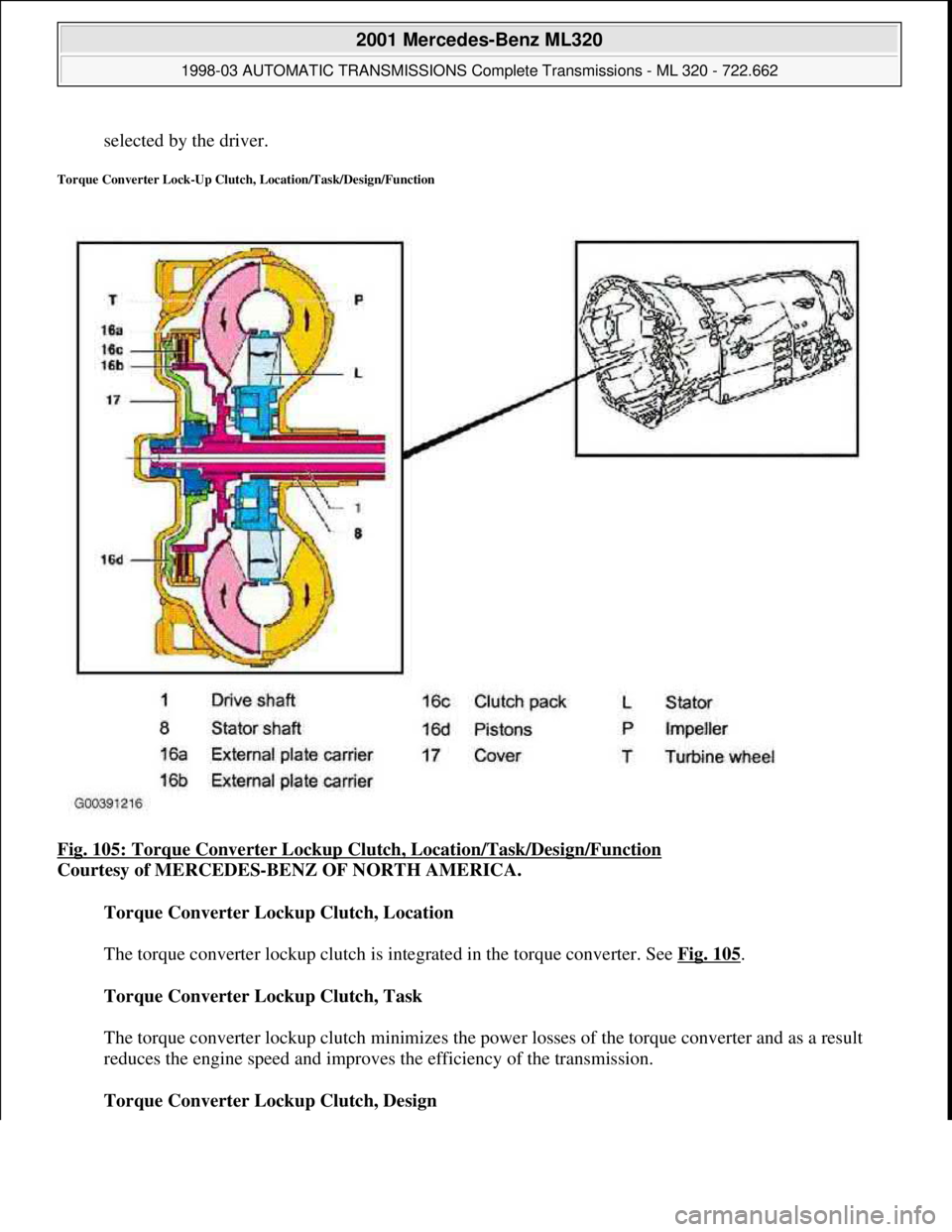
Torque Converter Lock-Up Clutch, Location/Task/Design/Function
Fig. 105: Torque Converter Lockup Clut ch, Location/Task/Design/Function
Courtesy of MERCEDES-BENZ OF NORTH AMERICA.
Torque Converter Lockup Clutch, Location
The torque converter lockup clutch is in tegrated in the torque converter. See Fig. 105
.
Torque Converter Lockup Clutch, Task
The torque converter lockup clutch minimizes the power losses of the torque converter and as a result
reduces the engine speed and improves the efficiency of the transmission.
Torque Converter Lockup Clutch, Design
2001 Mercedes-Benz ML320
1998-03 AUTOMATIC TRANSMI SSIONS Complete Transmissions - ML 320 - 722.662
me
Saturday, October 02, 2010 3:15:28 PMPage 180 © 2006 Mitchell Repair Information Company, LLC.