engine MERCEDES-BENZ ML320 1997 Complete Repair Manual
[x] Cancel search | Manufacturer: MERCEDES-BENZ, Model Year: 1997, Model line: ML320, Model: MERCEDES-BENZ ML320 1997Pages: 4133, PDF Size: 88.89 MB
Page 3165 of 4133
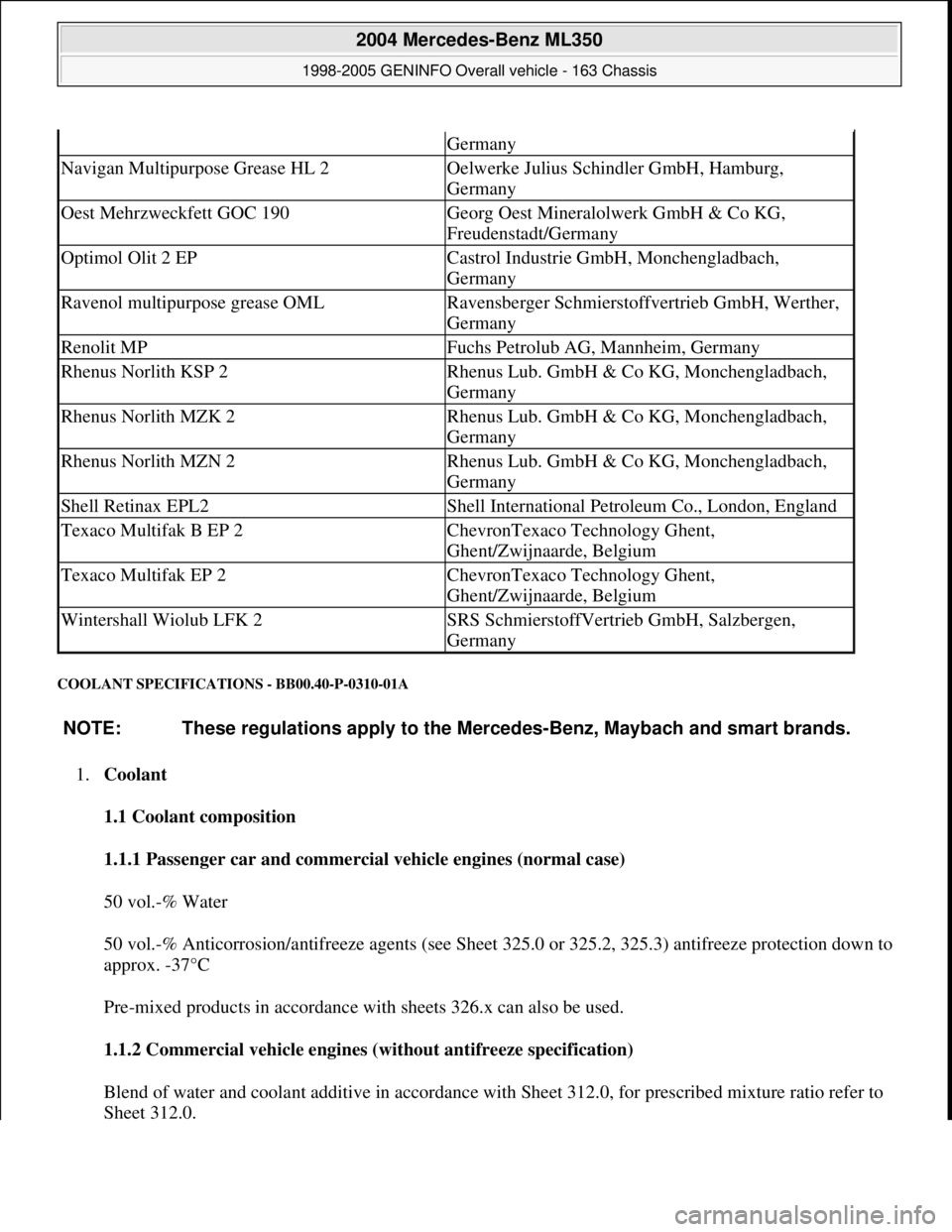
COOLANT SPECIFICATIONS - BB00.40-P-0310-01A
1.Coolant
1.1 Coolant composition
1.1.1 Passenger car and commercial vehicle engines (normal case)
50 vol.-% Water
50 vol.-% Anticorrosion/antifreeze agents (see Sheet 325.0 or 325.2, 325.3) antifreeze protection down to
approx. -37°C
Pre-mixed products in accordance with sheets 326.x can also be used.
1.1.2 Commercial vehicle engines (without antifreeze specification)
Blend of water and coolant additive in accordance with Sheet 312.0, for prescribed mixture ratio refer to
Sheet 312.0.
Germany
Navigan Multipurpose Grease HL 2Oelwerke Julius Schindler GmbH, Hamburg,
Germany
Oest Mehrzweckfett GOC 190Georg Oest Mineralolwerk GmbH & Co KG,
Freudenstadt/Germany
Optimol Olit 2 EPCastrol Industrie GmbH, Monchengladbach,
Germany
Ravenol multipurpose grease OMLRavensberger Schmierstoffvertrieb GmbH, Werther,
Germany
Renolit MPFuchs Petrolub AG, Mannheim, Germany
Rhenus Norlith KSP 2Rhenus Lub. GmbH & Co KG, Monchengladbach,
Germany
Rhenus Norlith MZK 2Rhenus Lub. GmbH & Co KG, Monchengladbach,
Germany
Rhenus Norlith MZN 2Rhenus Lub. GmbH & Co KG, Monchengladbach,
Germany
Shell Retinax EPL2Shell International Petroleum Co., London, England
Texaco Multifak B EP 2ChevronTexaco Technology Ghent,
Ghent/Zwijnaarde, Belgium
Texaco Multifak EP 2ChevronTexaco Technology Ghent,
Ghent/Zwijnaarde, Belgium
Wintershall Wiolub LFK 2SRS SchmierstoffVertrieb GmbH, Salzbergen,
Germany
NOTE: These regulations apply to the Mercedes-Benz, Maybach and smart brands.
2004 Mercedes-Benz ML350
1998-2005 GENINFO Overall vehicle - 163 Chassis
me
Saturday, October 02, 2010 3:47:57 PMPage 520 © 2006 Mitchell Repair Information Company, LLC.
Page 3166 of 4133
Scope: With constant ambient temperatures above freezing point.
1.1.3 Commercial vehicle engines (exception, not for engines OM 500, OM 900, OM 457 and OM
460)
99 vol % Water
1 vol % Refining agent (see Sheet 311.0)
Scope: For constant ambient temperatures above freezing point, e.g. in tropical regions, in which it can be
proven that no approved anticorrosion/antifreeze agents and coolant additives according to Sheet 312.0
are available.
Passenger-car engines, which are installed in a commercial vehicle, must always be filled up as for a
passenger-car engine, refer to points 2.1/2.2.
A quick-glance overview of the fields of application for the approved coolant additives and the
prescribed change intervals are available in Section 5. Please note the mixing prohibition for Sheets 325.3
and 326.3!
1.2 Water
1.2.1 Fresh-water regulations/water treatment
Clean, and where possible, not too hard water should be used for processing the coolant. Drinking water
frequently, although not always, complies with the given specifications.
Sea water, brackish water, brine and industrial waters are not suitable. The level of water containing
dissolved substances can vary greatly depending upon its origin (ground, spring, surface water) and it is
of major significance regarding the presence of corrosion.
Water that is too hard is disadvantageous because of the possibility of scaling or sludging occurring. Salt
content, predominantly chloride, greatly promotes corrosion. If in doubt, analyze the water.
Information concerning the water quality of drinking water is available from the local water-plant
authorities or the official water utilities on request.
If there is no available information regarding the quality of the drinking water then distilled or deionized
water should be used.
If the water fails to comply with the approved analysis values, then it is be processed in a suitable
manner, because even excellent anticorrosion/antifreeze agents are greatly impaired in their ability to
protect against corrosion if water quality is poor.
Should it not be possible to soften the water then the water should be brought up to an approved hardness
by an admixture of soft or distilled (deionized) water.
2004 Mercedes-Benz ML350
1998-2005 GENINFO Overall vehicle - 163 Chassis
me
Saturday, October 02, 2010 3:47:57 PMPage 521 © 2006 Mitchell Repair Information Company, LLC.
Page 3167 of 4133
If the chloride or total ionic content of the water is too high, then the level can be reduced through the
admixture of demineralized, in other words, ion-exchanged or distilled water.
Particular treatment processes will need to be used (desalination and demineralization or subprocesses)
depending upon the contaminants present in the water. Information on how to conduct water treatment is
available from water plants or water utilities as well as several companies and engineering consultants
who are experienced in this area.
Depending upon the coolant composition, the analysis values for the water should lie within the following
limits:
1.2.2 Fresh-water quality for coolant composition as under item 1.1.1 (passenger-cars and
commercial-vehicle engines)
Sum total of alkalis (water hardness): 0 to 3.6 mmol/l (0 up to 20° d)*
pH value at 20°C: 6.5 up 8.5
Chlorine ion content: max. 100 mg/l
Total chlorides and sulfates: max. 200 mg/l
1.2.3 Fresh-water quality for coolant composition as under item 1.1.2/1.1.3 (commercial-vehicle
engines)
Sum total of alkalis (water hardness): 0 to 2.7 mmol/l (0 up to 15° d)*
pH value at 20°C: 6.5 to 8.0
Chlorine ion content: max. 80 mg/l
Total chlorides and sulfates: max. 160 mg/l
If in doubt, contact DaimlerChrysler AG, department EP/MOR (operating fluids), C 405, D-70546
Stuttgart, Germany.
* Customary designations for water hardness in various countries: 1 mmol/l=5.6° d=10° f=7.02° e=100
mg/kg Ca CO.
3.
1° d (German degree =1° dGH)=1.78° (French degree)=1.25° e (English degree )=17.9 mg/kg Ca CO
3
(USA hardness).
1.3 Premixed coolant
Several providers have water with premixed coolant in their product range. Provided they are approved
(see below), the
y can also be used; the regulations relating to application, composition, change intervals,
2004 Mercedes-Benz ML350
1998-2005 GENINFO Overall vehicle - 163 Chassis
me
Saturday, October 02, 2010 3:47:57 PMPage 522 © 2006 Mitchell Repair Information Company, LLC.
Page 3168 of 4133
etc. of these coolant specifications also apply. It is imperative that the correct concentration (50/50) is
used in their application and, of course, further dilution is not permitted!
Approval status:
Coolants for all vehicle and engines (Basis 325.0) Sheet 326.0
Coolants for commercial vehicle and industrial engines (Basis 325.2) Sheet 326.2
Coolants for commercial vehicle and industrial engines (Basis 325.3) Sheet 326.3
The regulations for each respective Sheet 325.x are to be transferred correspondingly to Sheet
326.x.
At the time of compiling these regulations it is possible that not all the Sheets 326.x are represented with
approved products.
2.Coolant additives (General information)
Normally, coolant consists of water and anticorrosion/antifreeze agents. The anticorrosion/antifreeze
agents (ethylene glycol with corrosions inhibitors) in the cooling system have to fulfill, among other
things, the following functions:
to provide sufficient corrosion and cavitation protection for all cooling system components
freezing point depression (antifreeze)
increasing boiling point
For corrosion protection purposes the coolant
approx. 50 vol.-% Anticorrosion/antifreeze agents are added if the expected ambient temperatures do not
require an even higher concentration. This concentration (50 vol %) offers frost protection up to approx. -
37°C. A higher concentration is only necessary if the ambient temperatures are even lower.
Even with extremely low ambient temperatures, not more than 55 vol.-% anticorrosion/antifreeze agent
should be used, because at this level the maximum antifreeze protection is reached and a greater
concentration reduces the antifreeze protection again and decreases the heat dissipation (55 vol.-%
corresponds to antifreeze protection down to approx. -45°C).
Should these coolant regulations fail to be observed then corrosion and damage to the cooling
system are inevitable.
The admixture of anticorrosion/antifreeze agent serves to increase the boiling point. By raising the
pressure the boiling temperature can be increased yet further. Both physical relationships are put to use in
modern cooling systems - the maximum coolant temperature is raised, without increasing the danger of
boiling. In keeping with the higher temperature level the cooling performance is also greater. Only
approved products (Sheet 325.0/326.0 or 325.2 or 326.2, 325.3 or 326.3 as well as 312.0 or 311.0)
2004 Mercedes-Benz ML350
1998-2005 GENINFO Overall vehicle - 163 Chassis
me
Saturday, October 02, 2010 3:47:57 PMPage 523 © 2006 Mitchell Repair Information Company, LLC.
Page 3169 of 4133
provide reliable cooling system protection. In special cases (commercial-vehicle engines, no antifreeze
specification) coolant additives can be used that are primarily corrosion protection additives. In this case
item 2.3 is valid.
As an exception, if neither anticorrosion/antifreeze agent conforming to Sheet 325.0 nor coolant additives
without addition of antifreeze conforming to Sheet 312.0 are available, proceed according to point 2.4
(exception: OM 500 and OM 900). The systems described under items 2.2/2.3/2.4 are not compatible
with each other. It is recommended to mix the entire coolant quantity outside the engine.
2.1 Anticorrosion/antifreeze agent for passenger-car engines
Alongside the correct constitution of the cooling water (point 1.2.2), care must be taken to ensure that
only anticorrosion/antifreeze agents as approved for all engines in accordance with Sheet 325.0 are used.
These products serve to guarantee that, in particular, an effective protection against corrosion is provided
for all light-alloy parts in the cooling system and they are also specified for all passenger-car engines.
In order to ensure that the protection against corrosion is effective, the anticorrosion/antifreeze agent must
remain in the cooling system throughout the year - including when in tropical climates - and regardless of
the operating conditions. In countries with high outside temperatures this is also important in terms of
raising the boiling point.
In the event that these regulations are not observed the cooling system may suffer from damage by
corrosion. As a consequence of corrosion deposits there is a danger that ducts in the radiators (engine
overheating) and heat exchangers (poor heat output) get plugged up thus causing damage to the engine.
As a result of the optimizations we have carried out on the system of engine/coolant/cooling system, in
the majority of our newer passenger cars, a replacement of coolant is not necessary until reaching 15
operating years or 250,000 km (whichever comes first). This may not apply to some models; in these
cases the maintenance booklet will stipulate another regulation.
2.2 Anticorrosion/antifreeze agent for commercial-vehicle engines (normal case)
(not: BR 600, BR 100 and BR 200)
The coolant in commercial-vehicle engines is made up of both water and anticorrosion/antifreeze agent
(refer to item 1.1.1) and as such offers ideal protection against corrosion and cavitation.
All the approved products on the Sheets 325.2, 325.3 or 325.0 which are part of the Specifications for
Operating Fluids can be used to select an anticorrosion/antifreeze agent. However, it should be noted that
passenger vehicle engines built into commercial vehicles must be filled like passenger vehicles (e.g. OM
601 in T1), i.e. a product conforming to Sheet 325.0 and 326.0 must be used.
Products that are not listed in Sheets 325.0 and 326.0, or 325.2 and 326.2, or 325.3 and 326.3 are not
approved and are therefore not to be used under any circumstances.
Anticorrosion/antifreeze agents or coolants conforming to Sheet 325.3 or 326.3 may be used for
longer than other products due to their composition. The change interval is set at 5 years (refer to
2004 Mercedes-Benz ML350
1998-2005 GENINFO Overall vehicle - 163 Chassis
me
Saturday, October 02, 2010 3:47:57 PMPage 524 © 2006 Mitchell Repair Information Company, LLC.
Page 3170 of 4133
Overview Section 5). However, it should always be remembered that anticorrosion/antifreeze
a
gents or coolants conforming to Sheet 325.3 and 326.3 must not be mixed with those conforming to
Sheet 325.0 or 326.0 or 325.2 and 326.2.
2.3 Coolant additives for commercial-vehicle en
gines without antifreeze specifications (refer to item
1.1.2) (not: BR 600, BR 100 and BR 200)
In those application cases where no antifreeze is necessary, coolant for commercial-vehicle engines as
under item 1.1.2 can be mixed to suit. It is impossible to cite generalized mixing proportions because the
application concentrations of products included in Sheet 312.0 may be different. If the tolerances exceed
or fall below those given in Sheet 312.0, then appropriate adjustments must be made. The coolant's
boiling point is only insignificantly increased by these additives. The starting-off water underlies the
more stringent regulations as under point 1.2.3. The usage period for this coolant is shorter than usual (see
position 3). If it is necessary to refill, the same product must be used and at the same concentration level.
The blending of different products is not permitted as stated in Sheet 312.0.
2.4 Coolant regulations for commercial vehicle engines (exception, not for engines OM 500, OM
900, OM 457 and OM 460)
In the event that neither an approved anticorrosion/antifreeze agent is available, nor a coolant additive in
accordance with sheet 312.0 and if temperatures do not drop below freezing then it is possible in this
exceptional case to use a coolant refining agent to 1 vol % if it is approved in sheet 311.0 (soluble
corrosion protection oil). This will not raise the boiling point. The starting-off water itself underlies the
more stringent regulations as under point 1.2.3.
The period of usage for this coolant, which may only be used in exceptional circumstances, is shorter than
usual (refer to position 3).
Water that is too hard may impair the emulsion resistance, with the result that the emulsion
breaks down (oil separation) and the engine's water jackets are contaminated.
2.4.1 Applying water refining mixture
When carrying out a new filling (initial filling or filling after a cleansing operation) an emulsion of 1.0-
1.5 vol % should be used. When refilling, an emulsion of 0.5-1.0 vol % should be used. Concentrations
that are too high (>1.5 vol %) do not improve the corrosion protection capability and may exert a negative
influence on seals and hoses.
3.Monitoring coolant operation
It is very important to monitor the coolant constantly if the engine is to run trouble free.
The concentration level should be checked every six months.
The inspection should be conducted with suitable apparatus. If, when monitoring the concentration of the
coolant, it is determined that the concentration of anticorrosion/antifreeze agent has reached 40 vol.% or
less or an antifreeze protection of -28°C is no lon
ger guaranteed, the concentration must be increased to
2004 Mercedes-Benz ML350
1998-2005 GENINFO Overall vehicle - 163 Chassis
me
Saturday, October 02, 2010 3:47:57 PMPage 525 © 2006 Mitchell Repair Information Company, LLC.
Page 3171 of 4133
the regulation filling of 50 vol.% (-37°C). When topping up (after coolant loss), an anticorrosion/
antifreeze agent content in the coolant of at least 50 vol. % (antifreeze protection down to -37°C) must be
ensured, or the concentration regulations according to point 2.3/2.4.1 must be observed. In closing an
example is given in Overview Section 5.
Non observance a observance of these regulations or the use of non-approved products will
result in serious damage.
The corrosion inhibitors diminish during operation and lose their protective capability. Coolant that is too
old, and has lost its important inhibitors and anti-aging additives, becomes strongly corrosive. The
coolant additives as under Sheets 311.0 and 312.0 will also age. This causes a deterioration in the level of
protection capability, and with regard to coolant refining agents this will also cause the emulsion to break
down.
For this reason it is important to replace the coolant, in order to ensure that its corrosion protection
capability is retained. If necessary the cooling system should be thoroughly cleansed before refilling with
the new coolant. A sufficient level of heat dissipation will only be given if the cooler surfaces are clean.
The maximum permissible period of usage for coolant is cited in Overview Section 5.
The use of approved operatin
g fluids, which naturally include the anticorrosion/antifreeze agents, is
a well-known constituent of the warranty conditions.
4.Disposal of coolants
The coolants are biologically-degradable material.
All statutory regulations or waste water regulations in each individual country with regard to the disposal
of used coolant must be observed.
It is recommended to have the possibilities available for disposing of materials explained by the local
responsible water authorities.
Currently in Germany methods are being compiled for the purification of used coolant. The separate
collection of all used operating fluids is highly recommended.
However, as a consequence of the complex tasks asked of a modern coolant, it is on no account advisable
to use an improperly "recycled" coolant, which has only undergone a mechanical pre-purification process
5.Overview
Which coolant additive, what change interval for which engines?
Passenger cars engines
Sheet No.Engine seriesChange interval
years/km
M100/M200OM600
2004 Mercedes-Benz ML350
1998-2005 GENINFO Overall vehicle - 163 Chassis
me
Saturday, October 02, 2010 3:47:57 PMPage 526 © 2006 Mitchell Repair Information Company, LLC.
Page 3172 of 4133
Commercial vehicles engines
Calculation of the antifreeze quantity to be refilled with a concentration that is too low (specified: 50 vol.
%)
Fig. 645: Calculation Of Antifreeze Quantity
- (1 Of 2)
Example of calculation:
325.0 and 326.0••15/250.000
Whichever occurs first
must be observed;
Exception: in the vehicle's
maintenance booklet
shorter change intervals
are stipulated
Sheet No.Engine seriesChange
interval Years
OM 300OM 457/460OM 400OM 500OM 900
311.0• • 0.5
312.0•••••1
325.0 and
326.0•••••3
325.2 or 326.2•••••3
325.3 or 326.3•••••5
2004 Mercedes-Benz ML350
1998-2005 GENINFO Overall vehicle - 163 Chassis
me
Saturday, October 02, 2010 3:47:57 PMPage 527 © 2006 Mitchell Repair Information Company, LLC.
Page 3173 of 4133
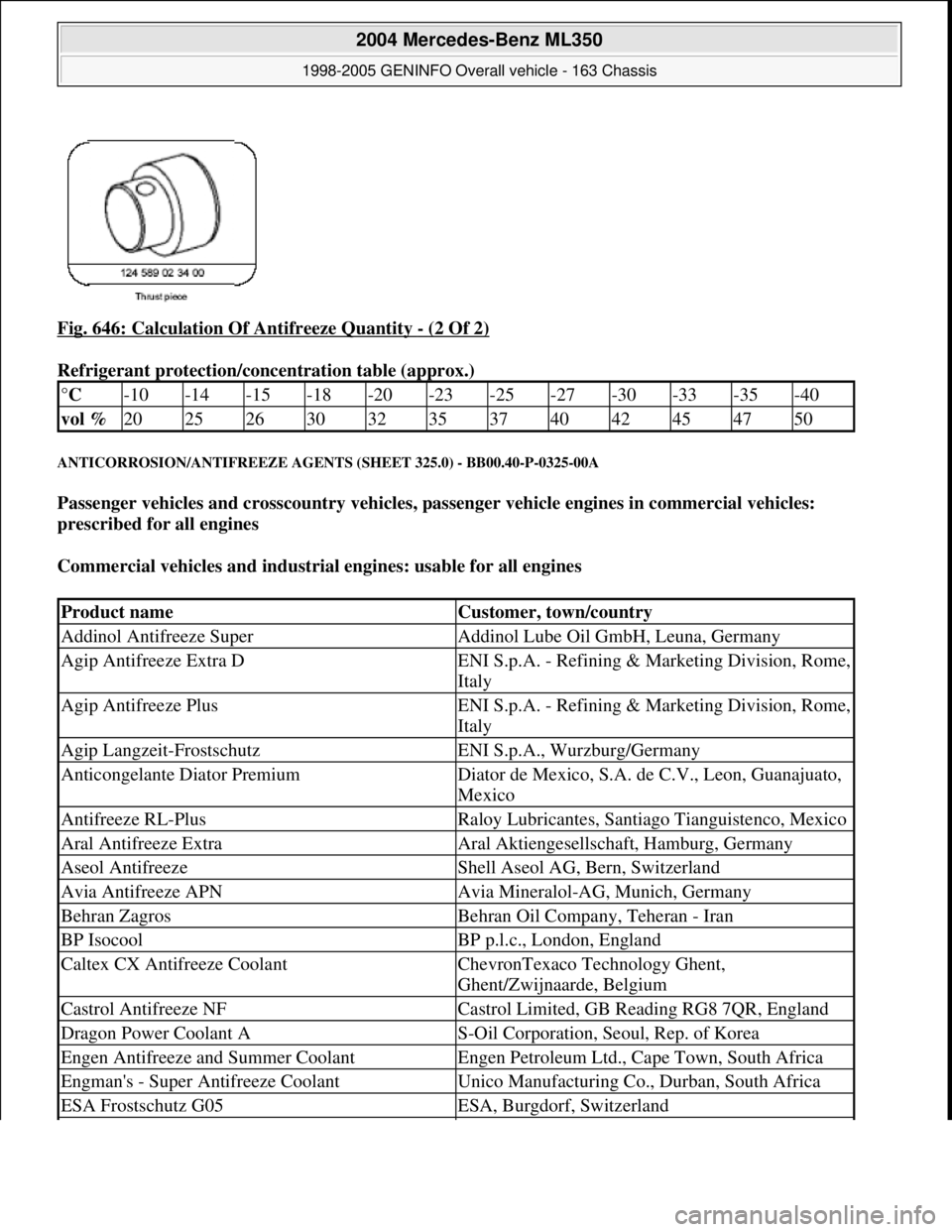
Fig. 646: Calculation Of Antifreeze Quantity - (2 Of 2)
Refrigerant protection/concentration table (approx.)
ANTICORROSION/ANTIFREEZE AGENTS (SHEET 325.0) - BB00.40-P-0325-00A
Passenger vehicles and crosscountry vehicles, passenger vehicle engines in commercial vehicles:
prescribed for all engines
Commercial vehicles and industrial engines: usable for all engines
°C -10-14-15-18-20-23-25-27-30-33-35-40
vol % 202526303235374042454750
Product nameCustomer, town/country
Addinol Antifreeze SuperAddinol Lube Oil GmbH, Leuna, Germany
Agip Antifreeze Extra DENI S.p.A. - Refining & Marketing Division, Rome,
Italy
Agip Antifreeze PlusENI S.p.A. - Refining & Marketing Division, Rome,
Italy
Agip Langzeit-FrostschutzENI S.p.A., Wurzburg/Germany
Anticongelante Diator PremiumDiator de Mexico, S.A. de C.V., Leon, Guanajuato,
Mexico
Antifreeze RL-PlusRaloy Lubricantes, Santiago Tianguistenco, Mexico
Aral Antifreeze ExtraAral Aktiengesellschaft, Hamburg, Germany
Aseol AntifreezeShell Aseol AG, Bern, Switzerland
Avia Antifreeze APNAvia Mineralol-AG, Munich, Germany
Behran ZagrosBehran Oil Company, Teheran - Iran
BP IsocoolBP p.l.c., London, England
Caltex CX Antifreeze CoolantChevronTexaco Technology Ghent,
Ghent/Zwijnaarde, Belgium
Castrol Antifreeze NFCastrol Limited, GB Reading RG8 7QR, England
Dragon Power Coolant AS-Oil Corporation, Seoul, Rep. of Korea
Engen Antifreeze and Summer CoolantEngen Petroleum Ltd., Cape Town, South Africa
Engman's - Super Antifreeze CoolantUnico Manufacturing Co., Durban, South Africa
ESA Frostschutz G05ESA, Burgdorf, Switzerland
2004 Mercedes-Benz ML350
1998-2005 GENINFO Overall vehicle - 163 Chassis
me
Saturday, October 02, 2010 3:47:57 PMPage 528 © 2006 Mitchell Repair Information Company, LLC.
Page 3185 of 4133

AD54.30-P-2000-02GC
Notes on HHT previous knowledge diagnosis
IC
HHT :
The instrument cluster and active service system (ASSYST) sub-
function are checked with HHT, there being the choice of the
following functions for this:
1. Control module version
2. Fault memory
3. Actual values
4. Actuations
5. Control module adaptation
Additional information on test items 2, 3 and 5 can be called up using
the INPUT key
Control module adaptation
The following alternatives are available in the HHT under control
module adaptation:
1.)
Read out coding and transfer to new instrument cluster. IC and
ASSYST.
2.)
Read out/change codings e.g.:
Engine and national variants,
version of fuel tank,
special equipment etc.
3.)
Settings:
1
Clock
2
Put forward kilometer reading
3
Put back kilometer reading
4
Oil change
5
Reset oil change initiated inadvertently
6
Active Service System
7
Enter times with battery disconnected
8
Set minimum oil warning
Before replacing a defective instrument cluster, readout the existing
variant codings (driving data and instrument cluster data) and store in
the HHT on an interim basis. Read in the values stored on an interim
basis again after installing the new instrument cluster.
If it is not possible to read out the stored variant coding, all variant
codings must be input manually (menu-assistance in HHT).
When installing an instrument cluster on an experimental basis, do
not put forward the kilometer reading as it cannot be put back later.
Copyright DaimlerChrysler AG 05.06.2006 CD-Ausgabe G/10/04 . This WIS print-out will not be recorde
d by Modification services.
Page 1