child restraint MERCEDES-BENZ ML430 1997 Complete Owner's Guide
[x] Cancel search | Manufacturer: MERCEDES-BENZ, Model Year: 1997, Model line: ML430, Model: MERCEDES-BENZ ML430 1997Pages: 4133, PDF Size: 88.89 MB
Page 532 of 4133
65
Restraint systems
Te ch n ica l
data
Instruments
and controls Operation
Driving Instrument
cluster display Practical hints Car care Index
Infant and child restraint systems
We recommend t ha t all infa nts and children be properly
restrained at all times while the vehicle is in motion. All
lap-shoulder belts except the driver’s seat belt have
special seat belt retractors for secure fastening of child
restraints.
To fasten a child restraint follow child restraint
instructions for routing. Then pull shoulder belt out
completely and let it retract. During the seat belt
retraction a ratcheting sound can be heard to indicate
that the special seat belt retractor is activated. The belt
is now locked. Push down on child restraint to take up
any slack.
To deactivate, release seat belt buckle and let seat belt
retract completely. The seat belt can again be used in
the usual manner.
Note:
For child seats with mounting fittings for tether
anchorages refer to page 67 (installation of infant and
child restra int systems). Important!
The use of infant or child restraints is required by law in
all 50 states and all Canadian provinces.
Infants and small children should be seated in an
appropriate infant or child restraint system properly
secured by a lap-shoulder belt, and that complies with
U.S. Federal Motor Vehicle Safety Standard 213 and
Canadian Motor Vehicle Safety Standard 213.
A statement by the child restraint manufacturer of
compliance with this standard can be found on the
instruction label on the restraint and in the instruction
manual provided with the restraint.
When using any infant or child restraint system, be sure
to carefully read and follow all manufacturer’s
instructions for installation and use.
Please read and observe warning labels affixed to inside
of vehicle and to infant or child restraints.
Wa r n i n g !
Never release the seat belt buckle while vehicle is
in motion, since the special seat belt retractor will
be deactivated.
Page 533 of 4133
66
Restraint systems
Te ch n ica l
data
Instruments
and controls Operation
Driving Instrument
cluster display Practical hints Car care Index
Wa r n i n g !
Children 12 years old and under must never ride in
the front seat, except in a Mercedes-Benz
authorized BabySmart
TM compatible child seat,
which operates with the BabySmart
TM System
installed in the vehicle to deactivate the passenger
front airbag when it is properly installed.
Otherwise they will be struck by the airbag when it
inflates in a crash. If this happens, serious or fatal
injury can result.
According to accident statistics, children are safer
when properly restrained in the rear seating
positions than in the front seating positions.
Infants and small children must ride in back seats
and be seated in an infant or child restraint system,
which is properly secured with the vehicle’s seat
belt, fully in accordance with the child seat
manufacturer’s instructions.
Infants and small children should never share a
seat belt with another occupant. During an
accident, they could be crushed between the
occupant and seat belt.Children too big for child restraint systems must
ride in back seats using regular seat belts. Position
shoulder belt across chest and shoulder, not face or
neck. A booster seat may be necessary to achieve
proper belt positioning for children from 41 lbs. to
the point where a lap / shoulder belt fits properly
without one.When the child restraint is not in use, remove it
from the vehicle or secure it with the seat belt to
prevent the child restraint from becoming a
projectile in the event of an accident.
Page 534 of 4133
67
Restraint systems
Te ch n ica l
data
Instruments
and controls Operation
Driving Instrument
cluster display Practical hints Car care Index
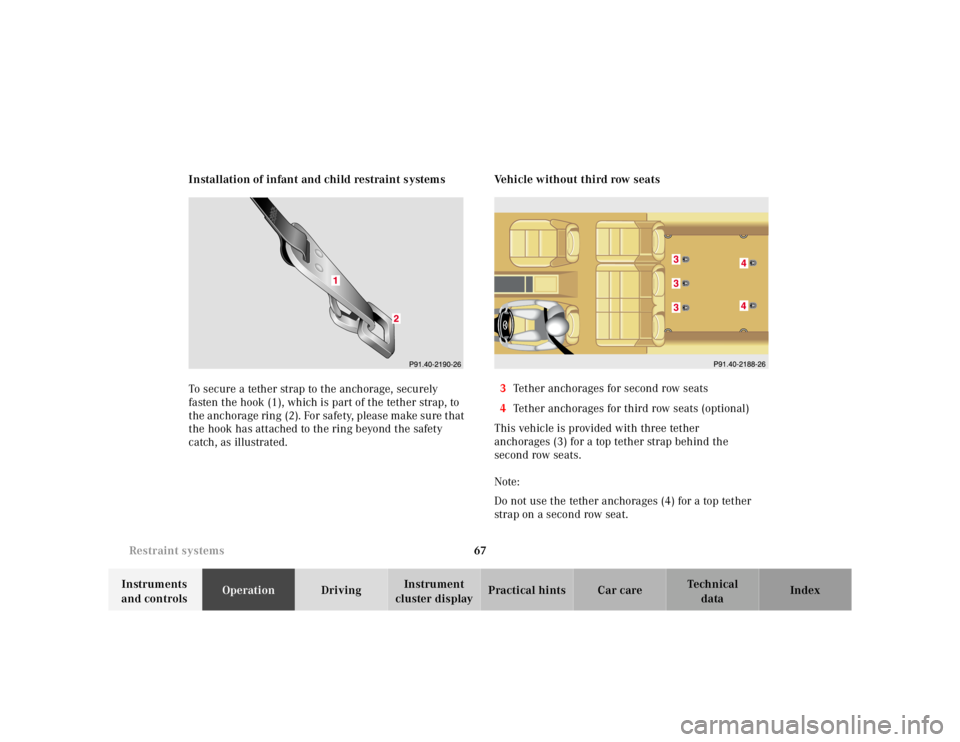
Installation of infant and child restraint systems
To secure a tether strap to the anchorage, securely
fasten the hook (1), which is part of the tether strap, to
the anchorage ring (2). For safety, please make sure that
the hook has attached to the ring beyond the safety
catch, as illustrated. Vehicle without third row seats
3 Tether anchorages for second row seats
4 Tether anchorages for third row seats (optional)
This vehicle is provided with three tether
anchorages (3) for a top tether strap behind the
second row seats.
Note:
Do not use the tether anchorages (4) for a top tether
strap on a second row seat.
Page 535 of 4133
68
Restraint systems
Te ch n ica l
data
Instruments
and controls Operation
Driving Instrument
cluster display Practical hints Car care Index
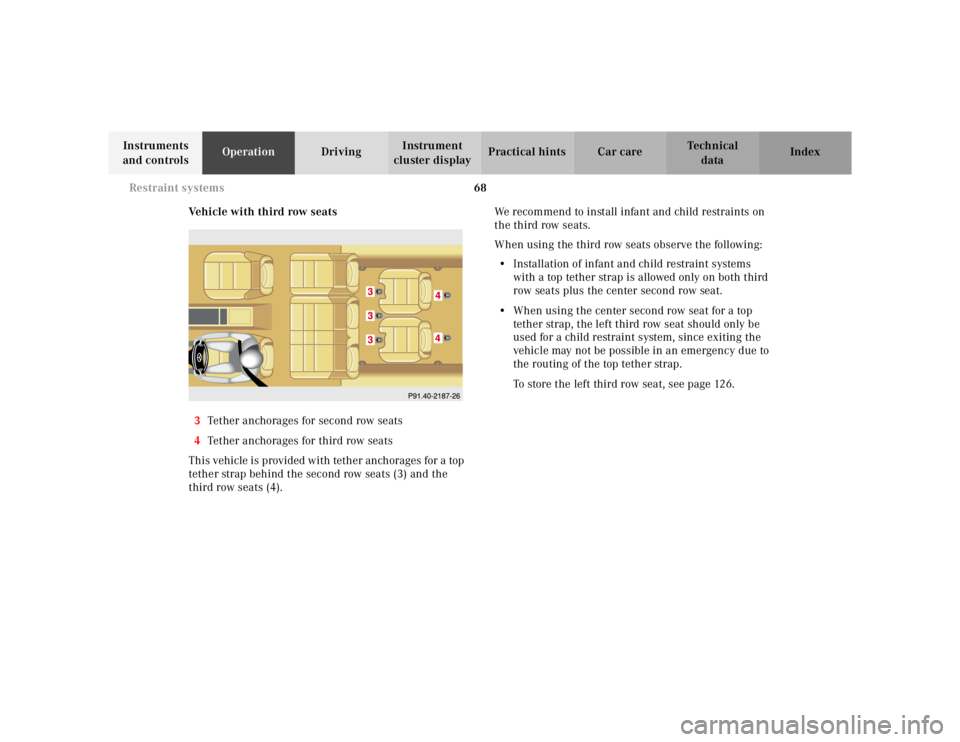
Vehicle with third row seats
3 Tether anchorages for second row seats
4 Tether anchorages for third row seats
This vehicle is provided with tether anchorages for a top
tether strap behind the second row seats (3) and the
third row seats (4). We recommend to install infant and child restraints on
the third row seats.
When using the third row seats observe the following:
• Installation of infant and child restraint systems
with a top tether strap is allowed only on both third
row seats plus the center second row seat.
• When using the center second row seat for a top
tether strap, the left third row seat should only be
used for a child restraint system, since exiting the
vehicle may not be possible in an emergency due to
the routing of the top tether strap.
To store the left third row seat, see page 126.
Page 536 of 4133
69
Restraint systems
Te ch n ica l
data
Instruments
and controls Operation
Driving Instrument
cluster display Practical hints Car care Index
Important!
An infant and child restraint system must not be
installed on the right second row seat while a passenger
rides in a third row seat. Use of the easy-entry / exit
feature is not possible. See page 123 for easy-entry / exit
feature. Note:
When installing an infant or child restraint system with
a top tether strap on the left second row seat, the left
third row seat should not be occupied. For storage of the
left third row seat, see page 126.
Page 686 of 4133
219
Malfunction and indicator lamps
Te ch n ica l
data
Instruments
and controls Operation Driving
Instrument
cluster display Practical hints Car care Index
Brake warning lamp
When the brake warning lamp appears
while the engine is running, this means:
• there is insufficient brake fluid in the reservoir
(engine running and parking brake released), or
• the parking brake is set (engine running)
• the electronic brake proportioning (EBP) system is
malfunctioning.
Note:
If you find that the minimum mark on the brake fluid
reservoir is reached, have the brake system checked for
brake pad thickness and leaks. Supplemental restraint system (SRS) indicator lamp
The operational readiness of the airbag
system is verified by the indicator lamp
“SRS” in the instrument cluster when
turning the key in steering lock to position 1 or 2. If no
fault is detected, the lamp will go out after
approximately 5 seconds; after the lamp goes out, the
system continues to monitor the components and
circuitry of the airbag system and will indicate a
malfunction by coming on again.
See page 56 for notes on airbags, page 55 for belt
tensioners, and page 65 for infant and child seat
restraints.
Wa r n i n g !
Driving with the brake warning lamp illuminated
can result in an accident. Have your brake system
checked immediately if the brake warning lamp
stays on. Don’t add brake fluid before checking the
brake system. Overfilling the brake fluid reservoir
can result in spilling brake fluid on hot engine
parts and the brake fluid catching fire. You can be
seriously burned.BRAKE
Wa r n i n g !
In the event a malfunction of the “SRS” is indicated
as outlined above, the “SRS” may not be
operational. For your safety, we strongly
recommend that you visit an authorized
Mercedes-Benz Light Truck Center immediately to
have the system checked; otherwise the “SRS” may
not be activated when needed in an accident, which
could result in serious or fatal injury, or it might
deploy unexpectedly and unnecessarily which
could also result in injury.SRS
Page 768 of 4133
301
Index
Te ch n ica l
data
Instruments
and controls Operation Driving
Instrument
cluster display Practical hints Car care
Index
Brake fluid ............................................................. 175, 294
Brake warning lamp ................................................. 219
Capacity ......................................................................293
Brake pad wear indicator .............................................225
Brake warning lamp ...................................................... 219 Brake fluid low .......................................................... 219
Brakes ....................................................173, 175, 293, 294
CCapacities Fuels, coolants, lubricants etc. ...............................292
Cargo area ....................................................................... 131 Hooks .......................................................................... 133
Loading instructions ................................................ 136
Cargo area cover blind .................................................. 137
Cargo compartment lamp .............................................. 111
Cargo floor plates
Removable .................................................................. 129
Storage ........................................................................ 130
Cargo tie-down rings ..................................................... 132
Catalytic converter ........................................................ 160
Cellular telephone ......................................................... 139
Center console .................................................................. 20
Central locking switch .................................................... 32 Central locking system .................................................... 26
Automatic central locking .........................................32
Locking and unlocking ............................................... 27
Mechanical keys ..........................................................29
Panic button .................................................................28
Remote control ............................................................26
Unlocking the liftgate ................................................. 28
Vehicle keys .................................................................24
Changing wheels ........................................................... 245 Inflating the space-saver tire ................................. 249
Charge indicator lamp .................................................. 223
CHECK ENGINE malfunction indicator lamp ............ 218
Check regularly and before a long trip ....................... 215
Checking engine oil level Via engine oil level indicator ....................................89
Via oil dipstick .......................................................... 233
Child restraint ..............................................38, 46, 53, 65
Cleaning and care of the vehicle ................................ 278
Climate control .................................................................98 Air recirculation ........................................................102
Basic setting ...............................................................100
Defogging windows ................................................... 101
Defrosting windshield .............................................. 101
Dust filter ...................................................................102
Rear window defroster ............................................. 103
Special settings ......................................................... 101
Page 772 of 4133
305
Index
Te ch n ica l
data
Instruments
and controls Operation Driving
Instrument
cluster display Practical hints Car care
Index
Headlamp cleaning system ............................................ 94
Headlights ......................................................................... 90
Heated seats ..................................................................... 44
Hood ................................................................................. 231
Hooks ............................................................................... 133
IIdentification labels .......................................................285
Illuminated vanity mirrors ............................................113
Indicator lamps in the instrument cluster ................... 78
Infant and child restraint system Installation ................................................................... 67
Infant and child restraint systems ................................ 65
Inflating the space-saver tire .......................................249
Information call See Tele Aid ............................................................... 148
Instrument cluster ........................................................... 76
Activating display ....................................................... 80
Display illumination ................................................... 80
Indicator lamps ........................................................... 78
Malfunction and indicator lamps ........................... 218
Instrument lamps ............................................................ 80 Instruments and controls ............................................... 18
Interior General notes ............................................................. 114
Interior lighting .............................................................. 110
JJump starting ................................................................. 253KKeys, vehicle .....................................................................24LLamps, exterior .............................................................. 260 Adjusting headlamp aim ......................................... 268
Auxiliary fog lamp ............................................. 92, 264
Fog lamps .....................................................................93
Headlamp assembly ......................................... 261, 262
Headlamps .................................90, 261, 262, 268, 280
High mounted stop lamp ......................................... 267
License plate lamps ................................................. 267
Low and high beam ............................................90, 263
Page 783 of 4133
SERVICING
SRS AIR BAG label on driver-side door latch post indicates SRS replacement date for air bag units. All SRS
components must be thoroughly inspected, including wiring harness. Before component replacement, check for
SRS fault codes by performing system operation check. See SYSTEM OPERATION CHECK
. SRS service
life is 10 years from manufactured date or 10 years from SRS replacement date after accident related repairs are
completed.
SYSTEM OPERATION CHECK
SRS warning light indicates SRS and Emergency Tensioning Retractor (ETR) system readiness. Turn ignition
on. SRS warning light will illuminate, then turn off after approximately 4-6 seconds indicating SRS system is
functioning properly. If SRS warning light does not illuminate, illuminates while driving or is continuously
illuminated, there is a system fault. Repair malfunctioning system.
AIR BAG SAFETY PRECAUTIONS
Observe these precautions when servicing the air bag system:
When working around SRS components and before any repairs are performed, disable air bag system. See
DISABLING & ACTIVATING AIR BAG SYSTEM
.
Before straightening any damage to body, or before performing electrical arc-welding, disable air bag
system. See DISABLING & ACTIVATING AIR BAG SYSTEM
.
Always wear safety glasses and gloves when handling a deployed air bag module. Air bag module may
contain sodium hydroxide deposits which are irritating to the skin.
Always use control module and impact sensors made by same manufacturer. Using components produced
by different manufacturers could cause accidental air bag or ETR deployment.
DO NOT repair any portion of SRS wiring harness.
If any SRS component is dropped from a height greater than 1.6 feet (0.5 m), it must be replaced.
If SRS components show signs of damage, they must be replaced.
Always handle air bag module with trim cover facing away from your body.
Always place air bag module on workbench with trim cover up, away from loose objects.
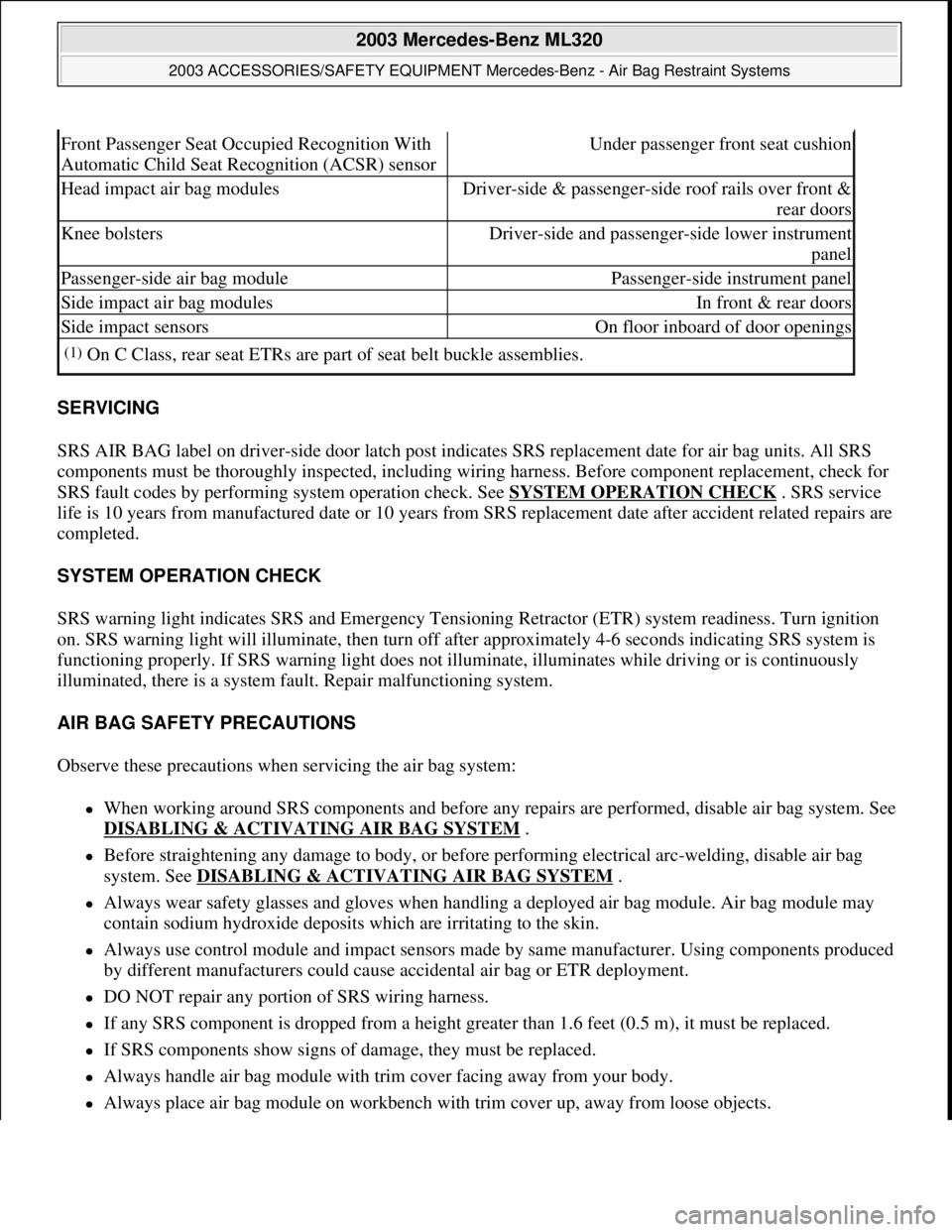
Front Passenger Seat Occupied Recognition With
Automatic Child Seat Recognition (ACSR) sensorUnder passenger front seat cushion
Head impact air bag modulesDriver-side & passenger-side roof rails over front &
rear doors
Knee bolstersDriver-side and passenger-side lower instrument
panel
Passenger-side air bag modulePassenger-side instrument panel
Side impact air bag modulesIn front & rear doors
Side impact sensorsOn floor inboard of door openings
(1)On C Class, rear seat ETRs are part of seat belt buckle assemblies.
2003 Mercedes-Benz ML320
2003 ACCESSORIES/SAFETY EQUIPMENT Mercedes-Benz - Air Bag Restraint Systems
me
Saturday, October 02, 2010 3:32:07 PMPage 2 © 2006 Mitchell Repair Information Company, LLC.
Page 808 of 4133

ContentsSafety and Security........................... 57
Occupant safety................................... 58
Airbags ........................................... 59
Seat belts ....................................... 64
Children in the vehicle .................... 67
Blocking of rear door
window operation ........................... 73
Panic alarm .......................................... 75
Activating ....................................... 75
Deactivating ................................... 75
Driving and safety systems .................. 76
ABS ................................................ 76
BAS ................................................ 78
4-ETS .............................................. 79
EBP................................................. 80
ESP ................................................. 80
Anti-theft systems................................ 83
Immobilizer..................................... 83
Anti-theft alarm .............................. 83
Tow-away alarm,
glass breakage sensor.................... 84
Controls in detail............................... 87
Locking and unlocking ......................... 88
Remote control with folding key..... 88
Opening the doors
from the inside ............................... 90
Opening the liftgate ....................... 91
Closing the liftgate ......................... 92
Automatic central locking .............. 93
Locking and unlocking
from the inside ............................... 94
Seats ................................................... 95
Removing and installing
front seat head restraints............... 95
Rear seat head restraints ............... 96
Heated seats* ................................ 98
Rear seats ...................................... 99
Third row seats* .......................... 102
Memory function* ............................. 105
Storing exterior rear view mirror
parking position ........................... 105
Storing positions in memory ........ 106
Recalling positions from memory . 106Lighting ............................................. 107
Combination switch ..................... 107
Fog lamps .................................... 111
Hazard warning flasher ................ 112
Interior lighting ............................ 112
Instrument cluster ............................. 116
Instrument cluster illumination .... 116
Coolant temperature gauge ......... 117
Display in the speedometer ......... 117
Resetting trip odometer ............... 118
Tachometer .................................. 118
Outside temperature indicator ..... 118
Setting the clock .......................... 118
Automatic transmission ..................... 119
One-touch gearshifting ................ 120
Gear ranges ................................. 121
Gear selector lever position ......... 122
Accelerator position ..................... 123
Towing a trailer ............................ 124
Emergency operation
(Limp Home Mode) ...................... 124