seats MERCEDES-BENZ R-Class 2012 W251 Repair Manual
[x] Cancel search | Manufacturer: MERCEDES-BENZ, Model Year: 2012, Model line: R-Class, Model: MERCEDES-BENZ R-Class 2012 W251Pages: 368, PDF Size: 15.19 MB
Page 310 of 368
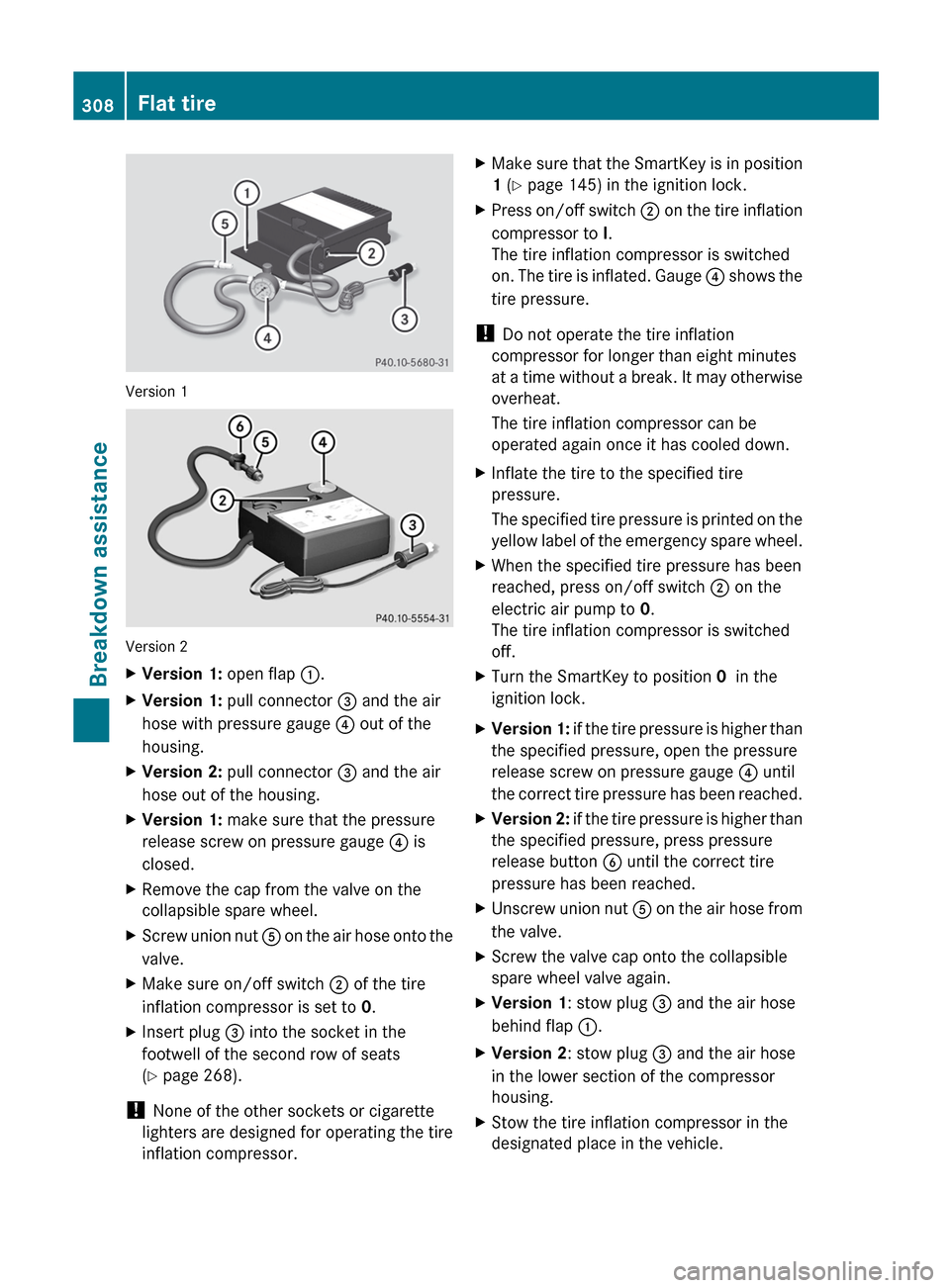
Version 1
Version 2
XVersion 1: open flap :.XVersion 1: pull connector = and the air
hose with pressure gauge ? out of the
housing.XVersion 2: pull connector = and the air
hose out of the housing.XVersion 1: make sure that the pressure
release screw on pressure gauge ? is
closed.XRemove the cap from the valve on the
collapsible spare wheel.XScrew union nut A on the air hose onto the
valve.XMake sure on/off switch ; of the tire
inflation compressor is set to 0.XInsert plug 3 into the socket in the
footwell of the second row of seats
( Y page 268).
!
None of the other sockets or cigarette
lighters are designed for operating the tire
inflation compressor.
XMake sure that the SmartKey is in position
1 (Y page 145) in the ignition lock.XPress on/off switch ; on the tire inflation
compressor to I.
The tire inflation compressor is switched
on. The tire is inflated. Gauge ? shows the
tire pressure.
! Do not operate the tire inflation
compressor for longer than eight minutes
at a time without a break. It may otherwise
overheat.
The tire inflation compressor can be
operated again once it has cooled down.
XInflate the tire to the specified tire
pressure.
The specified tire pressure is printed on the
yellow label of the emergency spare wheel.XWhen the specified tire pressure has been
reached, press on/off switch 2 on the
electric air pump to 0.
The tire inflation compressor is switched
off.XTurn the SmartKey to position 0 in the
ignition lock.XVersion 1: if the tire pressure is higher than
the specified pressure, open the pressure
release screw on pressure gauge 4 until
the correct tire pressure has been reached.XVersion 2: if the tire pressure is higher than
the specified pressure, press pressure
release button 6 until the correct tire
pressure has been reached.XUnscrew union nut A on the air hose from
the valve.XScrew the valve cap onto the collapsible
spare wheel valve again.XVersion 1 : stow plug = and the air hose
behind flap :.XVersion 2 : stow plug = and the air hose
in the lower section of the compressor
housing.XStow the tire inflation compressor in the
designated place in the vehicle.308Flat tireBreakdown assistance
Page 329 of 368
Important notes on tire pressureGWARNING
If the tire pressure drops repeatedly, check
the tires for punctures from foreign objects
and/or whether air is leaking from the valves
or from around the rim.
The tire temperature and pressure increase
when the vehicle is in motion. This is
dependent on the driving speed and the load.
If you wish to drive at high speeds of
100 mph (160 km/h) or higher when this is
allowed, use the tire pressure table on the
inside of the fuel filler flap to set the correct
tire pressures when the tires are cold. If the
tire pressure is not set correctly, this can lead
to an excessive build up of heat and a sudden
loss of pressure.
For further information, consult a qualified
specialist workshop, e.g. an authorized
Mercedes-Benz Center.
i Driving comfort can be impaired if the tire
pressure value recommended in the tire
pressure table for speeds over
100 mph(160 km/h) is adopted.
Make sure that the tire pressure for normal
speeds is adopted again.
Additional specifications of tire pressure
values for loads can also be found on the tire
pressure table on the inside of the fuel filler
flap.
The tire pressure for emergency spare wheels
can be found:
R printed in yellow on the rim of the
emergency spare wheel
R in the "Wheel and tire combinations"
section ( Y page 347) in this manual
R on the Tire and Loading Information placard
on the B-pillar on the driver's side.
i Specifications shown in the examples of
tire pressure tables are for illustration
purposes only. Tire pressure specifications
are vehicle-specific and may deviate from
the data shown here. Tire pressure
specifications applicable to your vehicle
are located in your vehicle's tire pressure
table.
Unless stated otherwise, the tire pressures
specified on the fuel filler flap apply for all
tires approved for this vehicle.
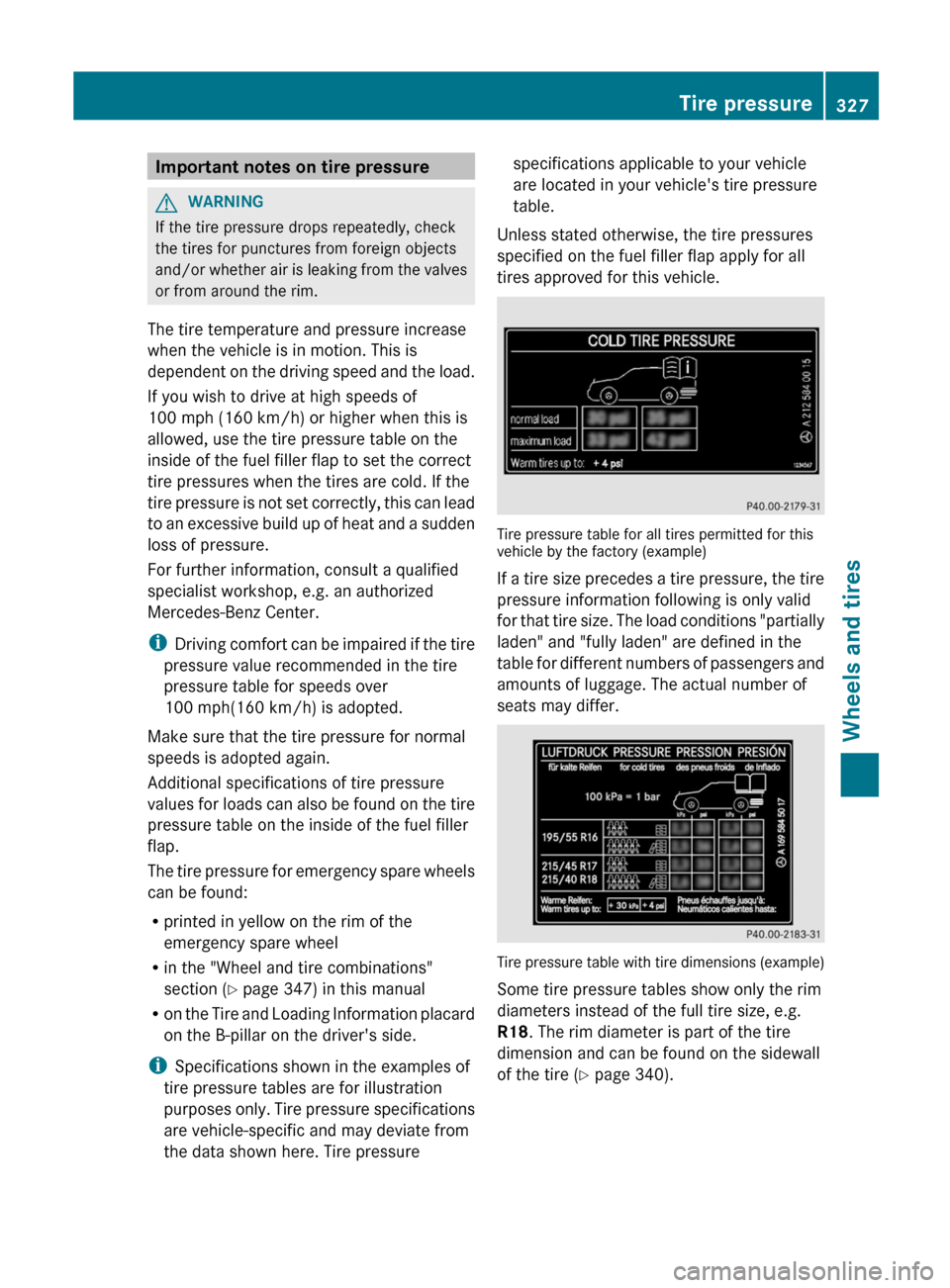
Tire pressure table for all tires permitted for this
vehicle by the factory (example)
If a tire size precedes a tire pressure, the tire
pressure information following is only valid
for that tire size. The load conditions "partially
laden" and "fully laden" are defined in the
table for different numbers of passengers and
amounts of luggage. The actual number of
seats may differ.
Tire pressure table with tire dimensions (example)
Some tire pressure tables show only the rim
diameters instead of the full tire size, e.g.
R18 . The rim diameter is part of the tire
dimension and can be found on the sidewall
of the tire ( Y page 340).
Tire pressure327Wheels and tiresZ
Page 336 of 368
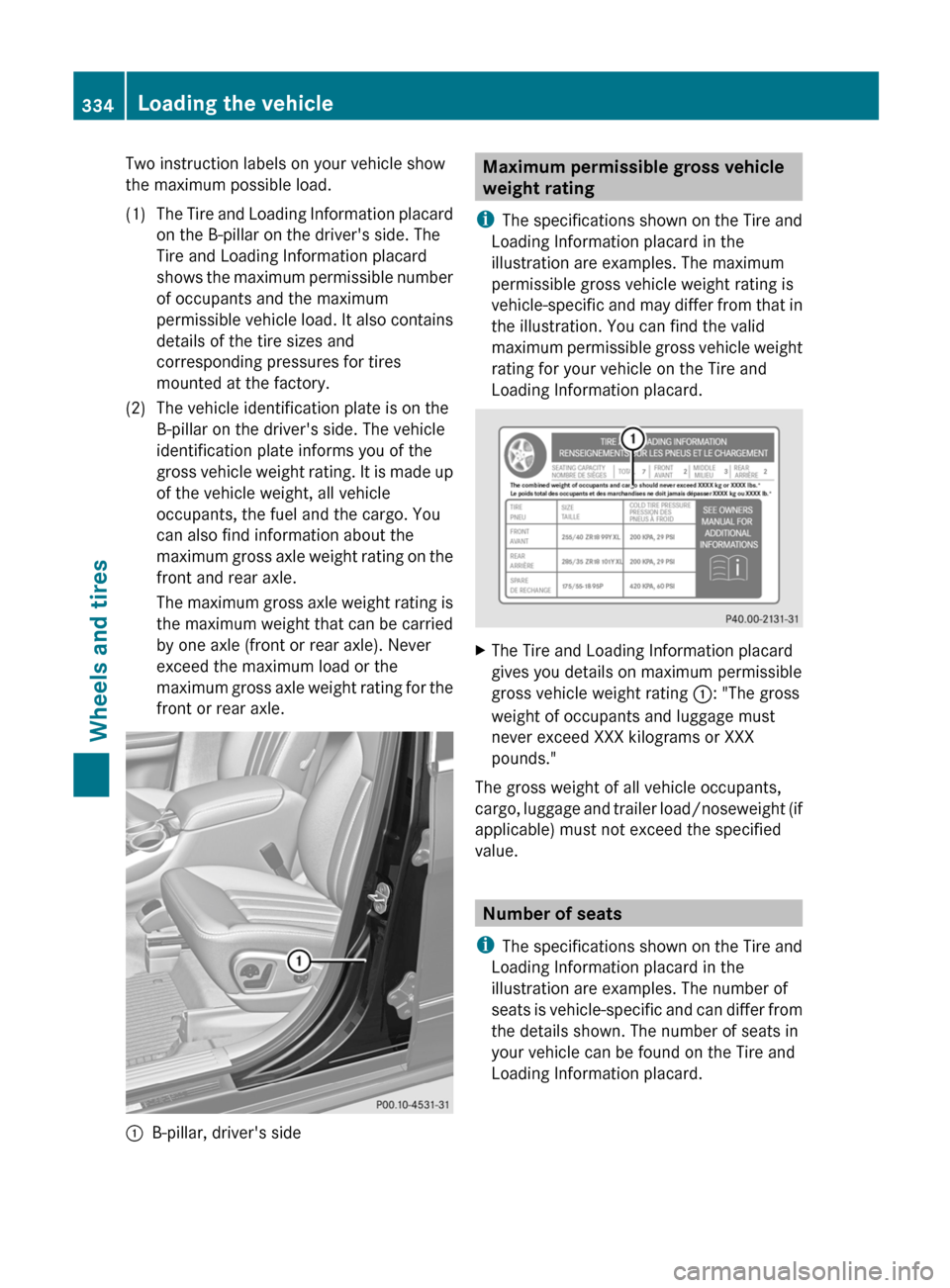
Two instruction labels on your vehicle show
the maximum possible load.(1)The Tire and Loading Information placard
on the B-pillar on the driver's side. The
Tire and Loading Information placard
shows the maximum permissible number
of occupants and the maximum
permissible vehicle load. It also contains
details of the tire sizes and
corresponding pressures for tires
mounted at the factory.(2)The vehicle identification plate is on the
B-pillar on the driver's side. The vehicle
identification plate informs you of the
gross vehicle weight rating. It is made up
of the vehicle weight, all vehicle
occupants, the fuel and the cargo. You
can also find information about the
maximum gross axle weight rating on the
front and rear axle.
The maximum gross axle weight rating is
the maximum weight that can be carried
by one axle (front or rear axle). Never
exceed the maximum load or the
maximum gross axle weight rating for the
front or rear axle.:B-pillar, driver's sideMaximum permissible gross vehicle
weight rating
i The specifications shown on the Tire and
Loading Information placard in the
illustration are examples. The maximum
permissible gross vehicle weight rating is
vehicle-specific and may differ from that in
the illustration. You can find the valid
maximum permissible gross vehicle weight
rating for your vehicle on the Tire and
Loading Information placard.XThe Tire and Loading Information placard
gives you details on maximum permissible
gross vehicle weight rating :: "The gross
weight of occupants and luggage must
never exceed XXX kilograms or XXX
pounds."
The gross weight of all vehicle occupants,
cargo, luggage and trailer load/noseweight (if
applicable) must not exceed the specified
value.
Number of seats
i The specifications shown on the Tire and
Loading Information placard in the
illustration are examples. The number of
seats is vehicle-specific and can differ from
the details shown. The number of seats in
your vehicle can be found on the Tire and
Loading Information placard.
334Loading the vehicleWheels and tires
Page 337 of 368
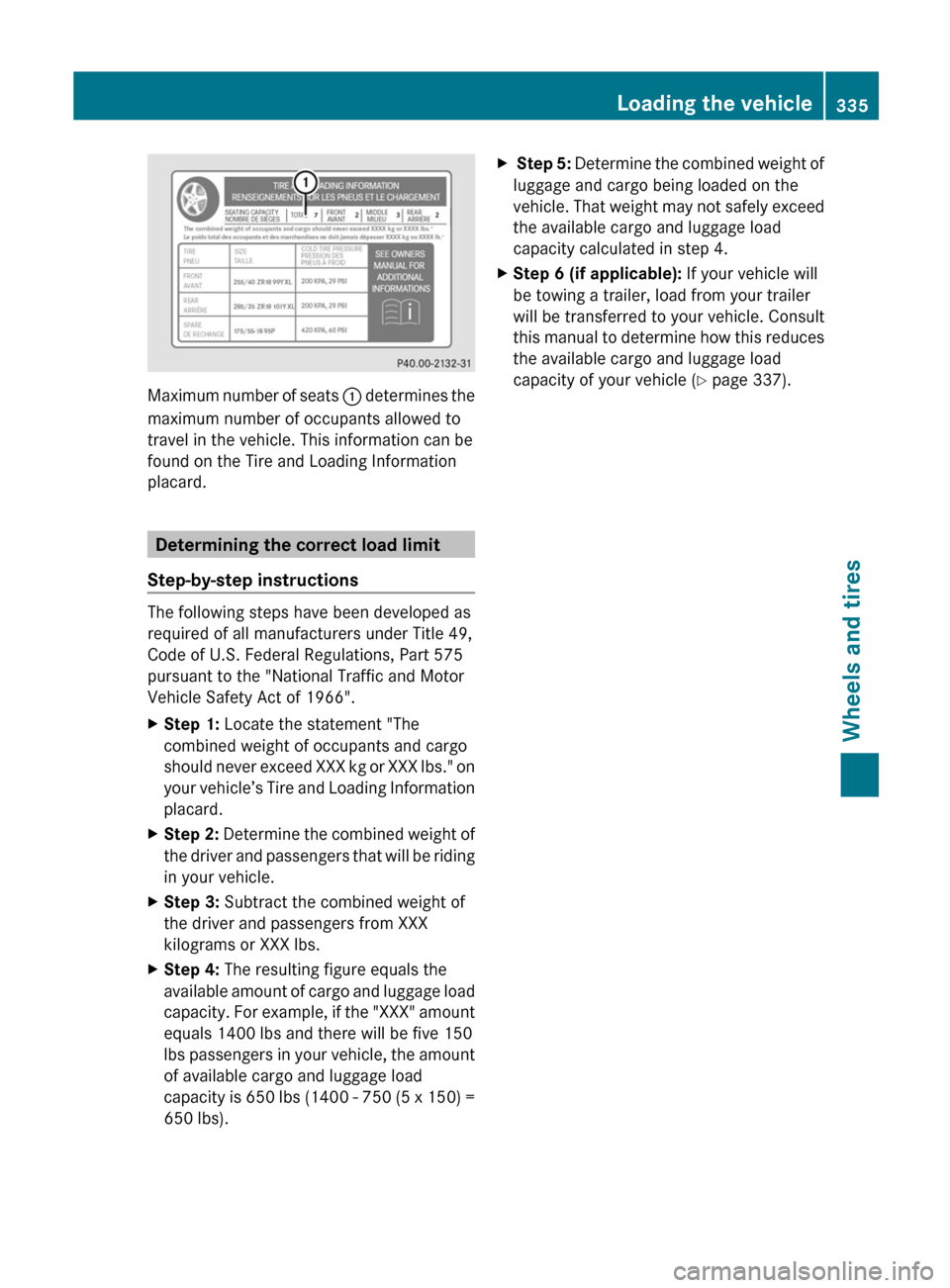
Maximum number of seats : determines the
maximum number of occupants allowed to
travel in the vehicle. This information can be
found on the Tire and Loading Information
placard.
Determining the correct load limit
Step-by-step instructions
The following steps have been developed as
required of all manufacturers under Title 49,
Code of U.S. Federal Regulations, Part 575
pursuant to the "National Traffic and Motor
Vehicle Safety Act of 1966".
XStep 1: Locate the statement "The
combined weight of occupants and cargo
should never exceed XXX kg or XXX lbs." on
your vehicle’s Tire and Loading Information
placard.XStep 2: Determine the combined weight of
the driver and passengers that will be riding
in your vehicle.XStep 3: Subtract the combined weight of
the driver and passengers from XXX
kilograms or XXX lbs.XStep 4: The resulting figure equals the
available amount of cargo and luggage load
capacity. For example, if the "XXX" amount
equals 1400 lbs and there will be five 150
lbs passengers in your vehicle, the amount
of available cargo and luggage load
capacity is 650 lbs (1400 - 750 (5 x 150) =
650 lbs).X Step 5: Determine the combined weight of
luggage and cargo being loaded on the
vehicle. That weight may not safely exceed
the available cargo and luggage load
capacity calculated in step 4.XStep 6 (if applicable): If your vehicle will
be towing a trailer, load from your trailer
will be transferred to your vehicle. Consult
this manual to determine how this reduces
the available cargo and luggage load
capacity of your vehicle ( Y page 337).Loading the vehicle335Wheels and tiresZ
Page 354 of 368

Useful information
i This Operator's Manual describes all
models and all standard and optional
equipment of your vehicle available at the
time of publication of the Operator's
Manual. Country-specific differences are
possible. Please note that your vehicle may
not be equipped with all features
described. This also applies to safety-
related systems and functions.
i Please read the information on qualified
specialist workshops ( Y page 24).
Genuine Mercedes-Benz parts
All Mercedes-Benz Centers maintain a supply
of genuine Mercedes-Benz parts for
necessary service and repair work. In
addition, strategically located parts delivery
centers provide for quick and reliable parts
service.
There are more than 300,000 different
genuine Mercedes-Benz parts available for
Mercedes-Benz models.
Genuine Mercedes-Benz parts are subject to
strict quality control. Each part has been
specially developed, manufactured or
selected for Mercedes-Benz vehicles and
fine-tuned for them.
Therefore, only genuine Mercedes-Benz parts
should be used.
GWARNING
Driving safety may be impaired if non-
approved parts, tires and wheels or safety-
relevant accessories are used.
This could lead to malfunctions in safety-
relevant systems, e.g. the brake system. This
could cause you to lose control of your vehicle
and cause an accident.
For this reason, Mercedes-Benz recommends
that you use genuine Mercedes-Benz parts or
parts of equal quality. Only use tires, wheels
and accessories that have been specifically
approved for your vehicle.
! Air bags and Emergency Tensioning
Devices, as well as control units and
sensors for these restraint systems may be
installed in the following areas of your
vehicle:
R doors
R door pillars
R door sills
R seats
R dashboard
R instrument cluster
R center console
Do not install accessories such as audio
systems in these areas. Do not carry out
repairs or welding. You could impair the
operating efficiency of the restraint
systems.
Have aftermarket accessories installed at
a qualified specialist workshop. Mercedes-
Benz recommends that you use an
authorized Mercedes-Benz Center for this
purpose.HEnvironmental note
Daimler AG also supplies reconditioned major
assemblies and parts which are of the same
quality as new parts. They are covered by the
same Limited Warranty entitlements as new
parts.
Always specify the vehicle identification
number (VIN) ( Y page 353) and the engine
number ( Y page 354) when ordering genuine
Mercedes-Benz parts.
Warranty
The Service and Warranty Information
booklet contains detailed information about
the warranties covering your vehicle.
352WarrantyTechnical data
Page 356 of 368
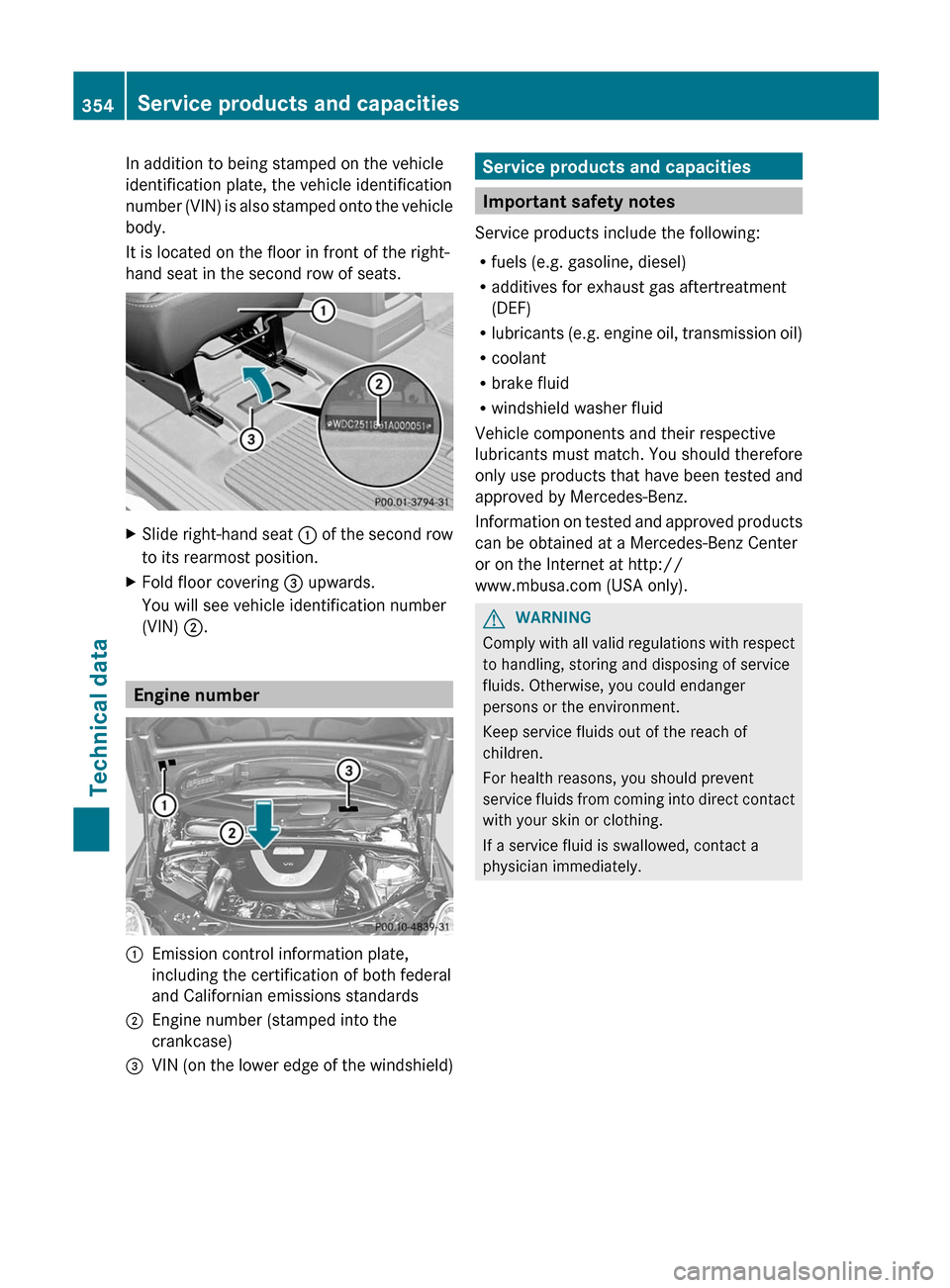
In addition to being stamped on the vehicle
identification plate, the vehicle identification
number (VIN) is also stamped onto the vehicle
body.
It is located on the floor in front of the right-
hand seat in the second row of seats.XSlide right-hand seat : of the second row
to its rearmost position.XFold floor covering = upwards.
You will see vehicle identification number
(VIN) ;.
Engine number
:Emission control information plate,
including the certification of both federal
and Californian emissions standards;Engine number (stamped into the
crankcase)=VIN (on the lower edge of the windshield)Service products and capacities
Important safety notes
Service products include the following:
R fuels (e.g. gasoline, diesel)
R additives for exhaust gas aftertreatment
(DEF)
R lubricants (e.g. engine oil, transmission oil)
R coolant
R brake fluid
R windshield washer fluid
Vehicle components and their respective
lubricants must match. You should therefore
only use products that have been tested and
approved by Mercedes-Benz.
Information on tested and approved products
can be obtained at a Mercedes-Benz Center
or on the Internet at http://
www.mbusa.com (USA only).
GWARNING
Comply with all valid regulations with respect
to handling, storing and disposing of service
fluids. Otherwise, you could endanger
persons or the environment.
Keep service fluids out of the reach of
children.
For health reasons, you should prevent
service fluids from coming into direct contact
with your skin or clothing.
If a service fluid is swallowed, contact a
physician immediately.
354Service products and capacitiesTechnical data