weight MERCEDES-BENZ R-Class 2012 W251 Owner's Manual
[x] Cancel search | Manufacturer: MERCEDES-BENZ, Model Year: 2012, Model line: R-Class, Model: MERCEDES-BENZ R-Class 2012 W251Pages: 368, PDF Size: 15.19 MB
Page 12 of 368
Fuel filler flapEmergency release ........................158
Opening/closing ............................ 158
Fuel filter (display message) ............ 228
Fuel level Calling up the range (on-board
computer) ...................................... 211
Fuel tank
Capacity ........................................ 355
Problem (malfunction) ...................160
Fuse allocation chart (vehicle tool
kit) ...................................................... 296
Fuses Allocation chart ............................. 317
Before changing ............................. 317
Dashboard fuse box .......................318
Engine emergency stop .................319
Fuse box in the cargo
compartment ................................. 318
Fuse box in the engine
compartment ................................. 318
Important safety notes ..................317
G
Garage door opener Clearing the memory .....................278
Notes ............................................. 275
Opening/closing the garage door ..278
Programming (button in the rear-
view mirror) ................................... 276
Gasoline ............................................. 157
Gear or selector lever (cleaning
guidelines) ......................................... 293
Genuine Mercedes-Benz parts ......... 352
Glove box ........................................... 249
GTW (Gross Trailer Weight)
(definition) ......................................... 344
H
Handbrake see Parking brake
Hazard warning lamps ...................... 117
Headlamp cleaning system Notes ............................................. 360
Headlamp delayed switch-off
see Exterior lighting delayed switch-off
Headlamps
Adding fluid to cleaning system .....285
Cleaning system (function) ............117
Misting up ...................................... 118
see Automatic headlamp mode
Head restraints
Adjusting ......................................... 99
Adjusting (electrically) .....................99
Adjusting (manually) ........................99
Adjusting (rear) .............................. 100
Installing/removing (rear) ..............100
Luxury .............................................. 99
see NECK-PRO head restraints/
NECK-PRO luxury head restraints
Heating
see Climate control
High-beam headlamps
Changing bulbs .............................. 122
Display message ............................ 223
Switching on/off ........................... 117
Hill start assist .................................. 147
Hood Closing ........................................... 283
Display message ............................ 235
Opening ......................................... 282
Hydroplaning ..................................... 168
I
Ignition lock see SmartKey positions
Immobilizer .......................................... 68
Indicator and warning lamps DISTRONIC .................................... 245
Indicator lamps
see Warning and indicator lamps
Insect protection on the radiator .... 283
Instrument cluster Overview .......................................... 29
Selecting the language (on-board
computer) ...................................... 206
Settings ......................................... 205
Warning and indicator lamps ...........30
Instrument cluster lighting ................ 29
Instrument lighting see Instrument cluster lighting
Interior lighting
Automatic control ..........................119
10Index
Page 19 of 368
Opening/closing (automatically
from outside) ................................... 83
Opening/closing (from outside) .......82
Tail lamps
Display message ............................ 224
see Lights
Tank
see Fuel tank
Tank content
Fuel gauge ....................................... 29
Technical data
R 350 ............................................. 361
R 350 BlueTEC ............................... 360
Tires/wheels ................................. 347
TELEAID
Call priority .................................... 273
Display message ............................ 218
Downloading destinations
(COMAND) ..................................... 273
Emergency call .............................. 270
Important safety notes ..................269
Locating a stolen vehicle ...............275
MB info call button ........................272
Roadside Assistance button ..........272
Search & Send ............................... 274
Self-test ......................................... 270
System .......................................... 270
Vehicle remote unlocking ..............274
Telephone
Accepting a call ............................. 211
Display message ............................ 235
Menu (on-board computer) ............211
Number from the phone book ........ 212
Redialing ........................................ 212
Rejecting/ending a call .................212
Temperature
Coolant (on-board computer) ......... 202
Displaying the outside
temperature ................................... 202
Outside temperature ...................... 198
Setting (climate control) ................137
Theft deterrent locking system
Immobilizer ...................................... 68
Tilt/sliding sunroof
see Sliding sunroof
Time (on-board computer) ................ 206
TIREFIT kit .......................................... 299Tire pressure
Calling up (on-board computer) .....331
Checking manually ........................329
Display message ............................ 231
Maximum ....................................... 328
Notes ............................................. 327
Not reached (TIREFIT) ....................302
Pressure loss warning ....................329
Reached (TIREFIT) ..........................302
Recommended ............................... 325
Tire pressure monitoring system
Function/notes ............................. 331
Restarting ...................................... 333
Warning lamp ................................. 245
Tires
Aspect ratio (definition) .................345
Average weight of the vehicle
occupants (definition) ....................343
Bar (definition) ............................... 343
Characteristics .............................. 343
Checking ........................................ 323
Definition of terms .........................343
Direction of rotation ......................346
Display message ............................ 231
Distribution of the vehicle
occupants (definition) ....................346
DOT, Tire Identification Number
(TIN) ............................................... 342
DOT (Department of
Transportation) (definition) ............343
GAWR (Gross Axle Weight Rating)
(definition) ..................................... 344
GTW (Gross Trailer Weight)
(definition) ..................................... 344
GVW (Gross Vehicle Weight)
(definition) ..................................... 344
GVWR (Gross Vehicle Weight
Rating) (definition) .........................344
Important safety notes ..................322
Increased vehicle weight due to
optional equipment (definition) ......343
Kilopascal (kPa) (definition) ...........344
Labeling (overview) ........................339
Load bearing index (definition) ......345
Load index ..................................... 342
Load index (definition) ...................344
Maximum loaded vehicle weight
(definition) ..................................... 344Index17
Page 20 of 368
Maximum load on a tire
(definition) ..................................... 345
Maximum permissible tire
pressure (definition) ....................... 344
Maximum tire load .........................337
Maximum tire load (definition) .......344
Optional equipment weight
(definition) ..................................... 345
PSI (pounds per square inch)
(definition) ..................................... 345
Replacing ....................................... 346
Service life ..................................... 323
Sidewall (definition) .......................345
Speed index (definition) .................344
Storing ........................................... 347
Structure and characteristics
(definition) ..................................... 343
Temperature .................................. 339
TIN (Tire Identification Number)
(definition) ..................................... 345
Tire bead (definition) ......................345
Tire pressure (definition) ................345
Tire pressures (recommended) ......343
Tire size (data) ............................... 347
Tire size designation, load-bearing
capacity, speed index ....................340
Tire tread ....................................... 323
Tire tread (definition) .....................345
Total load limit (definition) .............346
Traction ......................................... 338
Traction (definition) .......................345
Tread wear ..................................... 338
TWR (permissible trailer drawbar
noseweight) (definition) .................345
Uniform Tire Quality Grading
Standards ...................................... 338
Uniform Tire Quality Grading
Standards (definition) ....................343
Unladen weight (definition) ............344
Wear indicator (definition) .............346
Wheel rim (definition) ....................344
see Flat tire
Top Tether ............................................ 60
Towing Important safety guidelines ...........315
Installing the towing eye ................315
Removing the towing eye ...............316Towing a trailer
Coupling up a trailer ......................192
Decoupling a trailer .......................193
Driving tips .................................... 191
Important safety notes ..................191
Lights display message ..................222
Power supply ................................. 194
Shift range ..................................... 153
Towing away
With both axles on the ground .......316
Tow-starting
Emergency engine starting ............317
Important safety notes ..................315
Trailer
Towing ........................................... 192
Trailer loads and drawbar
noseweights ...................................... 194
Trailer towing Blind Spot Assist ............................ 191
ESP ®
................................................ 67
PARKTRONIC ................................. 186
Permissible trailer loads and
drawbar noseweights .....................194
Towing a trailer .............................. 192
Transmission
see Automatic transmission
Transporting the vehicle .................. 316
Trim pieces (cleaning instructions) . 293
Trip computer (on-board
computer) .......................................... 210
Trip meter see Trip odometer
Trip odometer
Calling up ....................................... 202
Resetting (on-board computer) ......211
Trunk
see Tailgate
Turn signals
Changing bulbs (front) ...................122
Display message ............................ 222
Switching on/off ........................... 117
see Turn signals
TWR (Tongue Weight Rating)
(definition) ......................................... 345
Type identification plate see Vehicle identification plate 18Index
Page 21 of 368
U
Unlocking Emergency unlocking .......................81
From inside the vehicle (central
unlocking button) ............................. 80
V
Vanity mirror (in sun visor) .............. 265
Vehicle Correct use ...................................... 24
Data acquisition ............................... 25
Display message ............................ 234
Equipment ....................................... 21
Individual settings ..........................205
Limited Warranty ............................. 25
Loading .......................................... 333
Locking (in an emergency) ...............81
Locking (SmartKey) .......................... 73
Lowering ........................................ 309
Maintenance .................................... 22
Parking for a long period ................ 164
Pulling away ................................... 147
Raising ........................................... 305
Reporting problems .........................24
Towing away .................................. 315
Transporting .................................. 316
Unlocking (in an emergency) ...........81
Unlocking (SmartKey) ......................73
Vehicle battery
see Battery (vehicle)
Vehicle dimensions
see Technical data
Vehicle emergency locking ................ 81
Vehicle identification number see VIN
Vehicle identification plate .............. 353
Vehicle level (display message) ....... 229
Vehicle tool kit .................................. 296
Vehicle weights see Technical data
Video (DVD) ........................................ 204
Video DVD (on-board computer) ...... 204
VIN ...................................................... 353
W
Warning and indicator lamps ABS ................................................ 240
Brakes ........................................... 239
Check Engine ................................. 244
Cruise control ................................ 171
Distance warning ........................... 245
ESP ®
.............................................. 241
ESP ®
OFF ....................................... 242
Fuel tank ........................................ 244
LIM (DISTRONIC) ........................... 175
Overview .......................................... 30
Reserve fuel ................................... 244
Seat belt ........................................ 238
SRS ................................................ 243
Tire pressure monitor ....................245
Warranty ............................................ 352
Washer fluid Display message ............................ 236
see Windshield washer system
Weight
see Technical data
Wheel bolt tightening torque ........... 309
Wheel chock ...................................... 304
Wheels Changing/replacing .......................346
Changing a wheel .......................... 303
Checking ........................................ 323
Cleaning ......................................... 289
Important safety notes ..................322
Mounting a wheel .......................... 307
Removing a wheel ..........................306
Storing ........................................... 347
Tightening torque ........................... 309
Wheel size/tire size .......................347
Window curtain air bag ....................... 43
Windows Cleaning ......................................... 291
see Side windows
Windshield
Defrosting ...................................... 138
Infrared reflective .......................... 279
Windshield washer system .............. 285
Notes ............................................. 360
Windshield wipers
Problem (malfunction) ...................126
Rear window wiper ........................125Index19
Page 43 of 368
Since the air bag inflates with considerable
speed and force, a proper seating position
and correct positioning of the hands on the
steering wheel will help to keep you at a safe
distance from the air bag. Occupants who are
not wearing their seat belt, are not seated
properly or are too close to the air bag can be
seriously injured or killed by an air bag as it
inflates with great force instantaneously:
R Sit with the seat belt properly fastened in a
position that is as upright as possible with
your back against the seat backrest.
R Move the driver's seat as far back as
possible, still permitting proper operation
of vehicle controls. The distance from the
center of the driver's chest to the center of
the air bag cover on the steering wheel
must be at least 10 inches (25 cm) or more.
You should be able to accomplish this by
adjusting the seat and steering wheel. If
you have any difficulties, please contact an
authorized Mercedes-Benz Center.
R Do not lean your head or chest close to the
steering wheel or dashboard.
R Only hold the steering wheel by the rim.
Placing hands and arms inside the rim can
increase the risk and potential severity of
hand/arm injury when the driver front air
bag inflates.
R Adjust the front-passenger seat as far back
as possible from the dashboard when the
seat is occupied.
R Occupants, especially children, should
never place their bodies or lean their heads
in the area of the door where the side
impact air bag inflates. This could result in
serious injuries or death should the side
impact air bag be deployed. Always sit as
upright as possible, wear the seat belt
properly and use an appropriately sized
child restraint, infant restraint or booster
seat recommended for the size and weight
of the child.
Failure to follow these instructions can result
in severe injuries to you or other occupants.If you sell your vehicle, it is important that you
make the buyer aware of this safety
information. Be sure to give the buyer this
Operator's Manual.GWARNING
Accident research shows that the safest place
for children in an automobile is in a rear seat.
A side impact air bag related injury may occur
if occupants, especially children, are not
properly seated or restrained when next to a
side impact air bag which needs to deploy
rapidly in a side impact in order to do its job.
To help avoid the possibility of injury, please
follow these guidelines:
(1)Always sit as upright as possible
and use the seat belts properly.
Make sure that children 12 years
old and under use an appropriately
sized child restraint, infant
restraint, or booster seat
recommended for the size and
weight of the child.(2)Always wear seat belts properly.
The air bags are only deployed if the air bag
control unit detects the need for deployment.
Only in the event of such a situation will they
provide their supplemental protection.
The driver and passenger should always wear
their seat belts. Otherwise, it is not possible
for the air bags to provide their supplemental
protection.
In the event of other types of impacts and
impacts below air bag deployment
thresholds, the air bags will not deploy. The
driver and passengers will then be protected
to the extent possible by a properly fastened
seat belt. A properly fastened seat belt is also
needed to provide the best possible
protection in a rollover.
Air bags provide additional protection; they
are not, however, a substitute for seat belts.
All vehicle occupants must fasten their seat
belts regardless of whether your vehicle is
equipped with air bags or not.
Occupant safety41SafetyZ
Page 44 of 368
It is important for your safety and that of your
passenger to have deployed air bags replaced
and to have any malfunctioning air bags
repaired. This will help to make sure the air
bags continue to perform their protective
function for the vehicle occupants in the
event of a crash.
Front air bags
The front air bags increase protection for the
driver's and front-passenger's head and
chest.
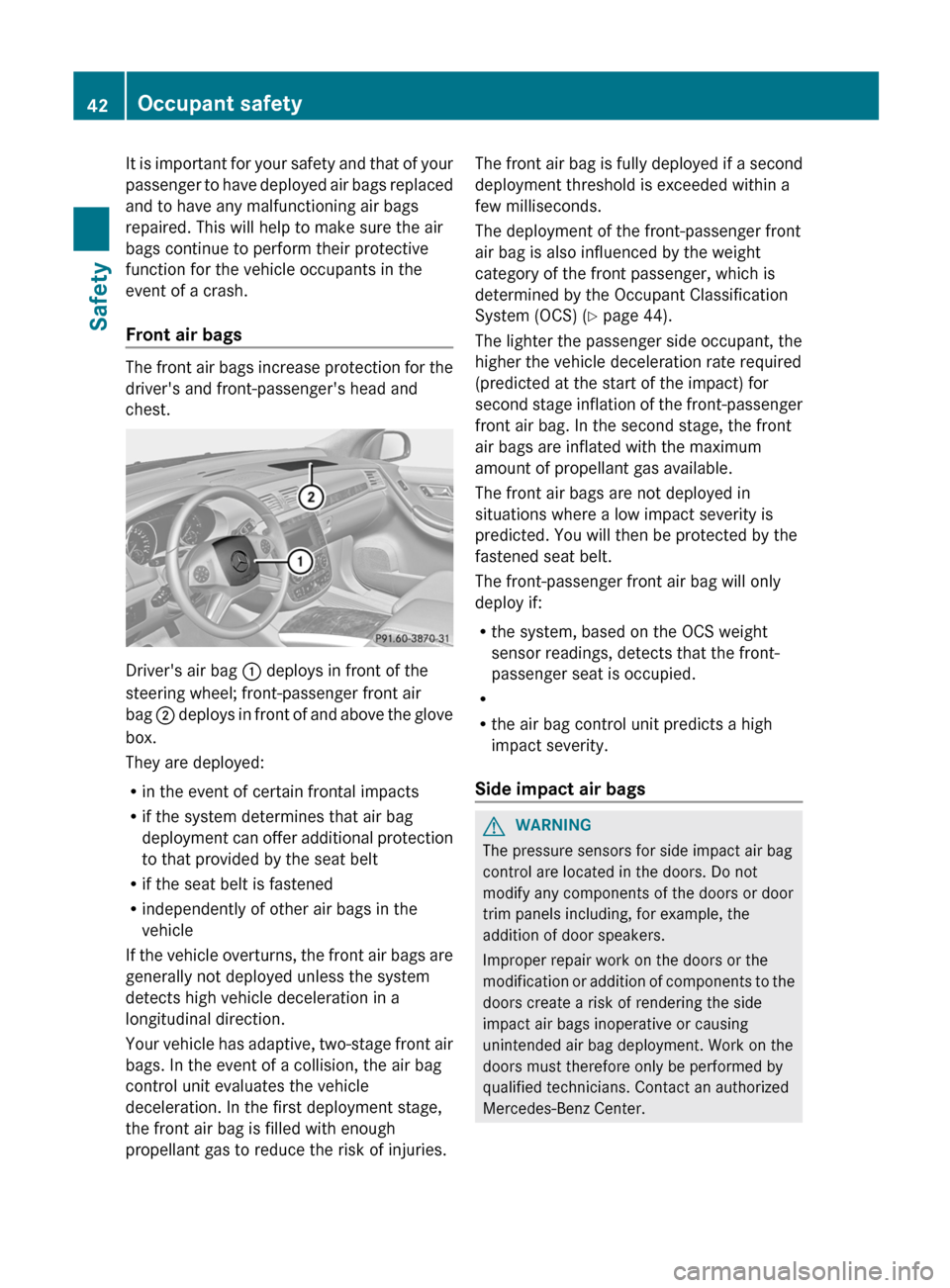
Driver's air bag : deploys in front of the
steering wheel; front-passenger front air
bag ; deploys in front of and above the glove
box.
They are deployed:
R in the event of certain frontal impacts
R if the system determines that air bag
deployment can offer additional protection
to that provided by the seat belt
R if the seat belt is fastened
R independently of other air bags in the
vehicle
If the vehicle overturns, the front air bags are
generally not deployed unless the system
detects high vehicle deceleration in a
longitudinal direction.
Your vehicle has adaptive, two-stage front air
bags. In the event of a collision, the air bag
control unit evaluates the vehicle
deceleration. In the first deployment stage,
the front air bag is filled with enough
propellant gas to reduce the risk of injuries.
The front air bag is fully deployed if a second
deployment threshold is exceeded within a
few milliseconds.
The deployment of the front-passenger front
air bag is also influenced by the weight
category of the front passenger, which is
determined by the Occupant Classification
System (OCS) ( Y page 44).
The lighter the passenger side occupant, the
higher the vehicle deceleration rate required
(predicted at the start of the impact) for
second stage inflation of the front-passenger
front air bag. In the second stage, the front
air bags are inflated with the maximum
amount of propellant gas available.
The front air bags are not deployed in
situations where a low impact severity is
predicted. You will then be protected by the
fastened seat belt.
The front-passenger front air bag will only
deploy if:
R the system, based on the OCS weight
sensor readings, detects that the front-
passenger seat is occupied.
R
R the air bag control unit predicts a high
impact severity.
Side impact air bagsGWARNING
The pressure sensors for side impact air bag
control are located in the doors. Do not
modify any components of the doors or door
trim panels including, for example, the
addition of door speakers.
Improper repair work on the doors or the
modification or addition of components to the
doors create a risk of rendering the side
impact air bags inoperative or causing
unintended air bag deployment. Work on the
doors must therefore only be performed by
qualified technicians. Contact an authorized
Mercedes-Benz Center.
42Occupant safetySafety
Page 46 of 368
Rindependently of seat belt use
R if the vehicle overturns and the system
determines that window curtain air bag
deployment can offer additional protection
to that provided by the seat belt
R independently of the front air bags
Window curtain air bags : will not deploy in
impacts with deceleration rates which do not
exceed the system's preset deployment
thresholds for vehicle deceleration or
acceleration. You will then be protected by
the fastened seat belt.
Occupant Classification System
(OCS)
How the occupant classification
system works
The OCS categorizes the occupant on the
front-passenger seat by means of a weight
sensor. The front-passenger front air bag is
deactivated automatically for certain weight
categories. The 42 indicator
lamp shows you the current status. If the
42 indicator lamp is illuminated,
the front-passenger front air bag is
deactivated.
The system does not disable:
R the side impact air bag
R the window curtain air bag
R the Emergency Tensioning Devices
To be classified correctly, the front passenger
must sit:
R with the seat belt fastened correctly
R in a position that is as upright as possible
with their back against the seat backrest
R with their feet on the floor
If the front-passenger's weight is transferred
to another object in the vehicle (e.g. by
leaning on armrests), OCS may not be able to
approximate the occupant's weight category.
In addition, the occupant weight may appear
to increase or decrease due to the following:
R objects hanging on the seat
R objects lodged underneath the seat
R objects lodged between the seat and the
center console
R objects lodged between the seat and the
door
R other passengers exerting weight on the
seat
R objects applying pressure to the back of
the seat
Make sure that the seat always has clearance
in all directions.
If the front-passenger seat, the seat cover or
the seat cushion are damaged, have the
necessary repair work carried out at an
authorized Mercedes-Benz Center.
For safety reasons, Mercedes-Benz
recommends that you only use seat
accessories which have been approved by
Mercedes-Benz.
Both the driver and the passenger should
always use the 42 indicator
lamp as an indication of whether or not the
passenger is properly positioned.GWARNING
If the 42 indicator lamp
illuminates when an adult or someone larger
than a small individual is in the front
passenger seat, have the front passenger
reposition himself or herself in the seat until
the 42 indicator lamp goes out,
or check whether objects are caught under or
around the seat.
In the event of a collision, the air bag control
unit will not allow front passenger front air bag
deployment when the OCS has classified the
front passenger seat occupant as weighing as
much as or less than a typical 12-month-old
child in a standard child restraint or if the front
passenger seat is classified as being empty.
When the OCS senses that the front
passenger seat occupant is classified as
44Occupant safetySafety
Page 47 of 368
being up to or less than the weight of a typical
12-month-old child in a standard child
restraint, the 42 indicator lamp
will illuminate when the engine is started and
remain illuminated. This indicates that the
front passenger front air bag is deactivated.
When the OCS senses that the front
passenger seat is classified as being empty,
the 42 indicator lamp will
illuminate when the engine is started and
remain illuminated. This indicates that the
front passenger front air bag is deactivated.
When the OCS senses that the front
passenger seat occupant is classified as
being heavier than the weight of a typical 12-
month-old child seated in a standard child
restraint or as being a small individual (such
as a young teenager or a small adult), the
42 indicator lamp will illuminate
for approximately 6 seconds when the engine
is started. Depending on occupant weight
sensor readings from the seat, it will then
remain illuminated or go out. With the
42 indicator lamp illuminated,
the front passenger front air bag is
deactivated. With the 42
indicator lamp out, the front passenger front
air bag is activated.
When the OCS senses that the front
passenger seat occupant is classified as an
adult or someone larger than a small
individual, the 42 indicator lamp
will illuminate for approximately six seconds
when the engine is started and then go out.
This indicates that the front passenger front
air bag is activated.
If the 42 indicator lamp is
illuminated, the front passenger front air bag
is deactivated and will not be deployed.If the 24 indicator lamp is not
illuminated, the front passenger front air bag
is activated and will be deployed
R in the event of certain frontal impacts
R if the impact exceeds a predetermined
triggering threshold
R independently of the side impact air bags
If the front passenger front air bag is
deployed, the rate of inflation will be
influenced by
R the rate of vehicle deceleration as assessed
by the air bag control unit
R the front passenger's weight category as
identified by the OCS
For further information, see "air bag display
messages" ( Y page 220).GWARNING
According to accident statistics, children are
safer when properly restrained on the rear
seats than on the front-passenger seat. Thus,
we strongly recommend that children be
placed in the rear seats whenever possible.
Regardless of seating position, children 12
years old and under must be seated and
properly secured in an appropriately sized
child restraint system or booster seat
recommended for the size and weight of the
child.
The infant or child restraint system must be
properly secured with the vehicle's seat belt,
the seat belt and Top Tether strap, or lower
anchors and Top Tether strap, fully in
accordance with the child seat
manufacturer's instructions.
Occupants, especially children, should always
sit as upright as possible, wear the seat belt
properly and use an appropriate sized infant
restraint, toddler restraint, or booster seat
recommended for the size and weight of the
child.
Occupant safety45SafetyZ
Page 48 of 368
Children can be killed or seriously injured by
an inflating air bag. Note the following
important information when circumstances
require you to place a child in the front-
passenger seat:
R Your vehicle is equipped with air bag
technology designed to deactivate the
front-passenger front air bag in your vehicle
when the system senses the weight of a
typical 12-month-old child or less along
with the weight of a standard appropriate
child restraint on the front-passenger seat.
R A child in a rear-facing child restraint on the
front-passenger seat will be seriously
injured or even killed if the front-passenger
front air bag inflates in a collision which
could occur under some circumstances,
even with the air bag technology installed
in your vehicle. The only means to eliminate
this risk completely is never to place a child
in a rear-facing child restraint in the front-
passenger seat. We therefore strongly
recommend that you always place a child
in a rear-facing child restraint on the rear
seat.
R If you install a rear-facing child restraint on
the front-passenger seat, make sure the
42 indicator lamp is
illuminated, indicating that the front-
passenger front air bag is deactivated.
Should the 42 indicator lamp
not illuminate or go out while the restraint
is installed, please check installation.
Periodically check the 42
indicator lamp while driving to make sure
the 42 indicator lamp is
illuminated. If the 42 indicator
lamp goes out or remains out, do not
transport a child on the front-passenger
seat until the system has been repaired.
A child in a rear-facing child restraint on the
front-passenger seat will be seriously
injured or even killed if the front-passenger
front air bag inflates.R If you place a child in a forward-facing child
restraint on the front-passenger seat:
- move the seat as far back as possible
- use the proper child restraint
recommended for the age, size and
weight of the child
- secure child restraint with the vehicle's
seat belt according to the child seat
manufacturer's instructions
R For children larger than a typical 12-month-
old child, the front-passenger front air bag
can be activated or deactivated.
If the driver's air bag deploys, this does not
mean that the front-passenger front air bag
also has to deploy.
The OCS may have detected that the seat:
R was empty or occupied by a person with a
weight of up to or less than that of a typical
12-month-old child seated in a standard
child restraint
R was occupied by a small individual, such as
a young teenager or a small adult
R was occupied by a child in a child restraint
system, whose weight is greater than that
of a typical 12-month-old child.
These are examples of when the OCS
deactivates the front-passenger front air bag.
Deactivation takes place although the
collision fulfills the criteria for deploying the
driver's air bag.
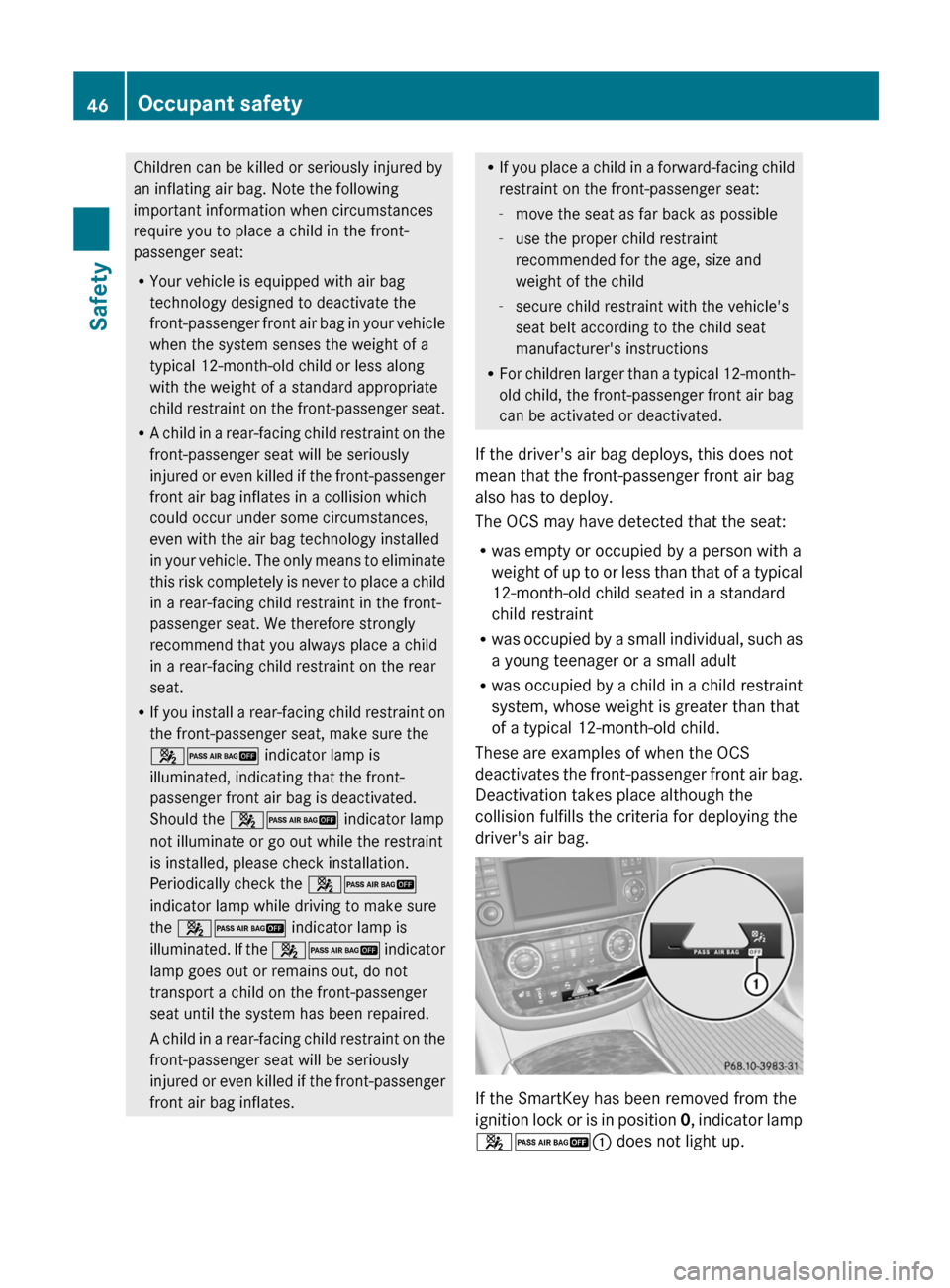
If the SmartKey has been removed from the
ignition lock or is in position 0, indicator lamp
42 : does not light up.
46Occupant safetySafety
Page 49 of 368
GWARNING
If the red + SRS warning lamp in the
instrument cluster and the 42
indicator lamp light up simultaneously, the
OCS is malfunctioning. The front passenger
front air bag will be deactivated in this case.
Have the system checked by qualified
technicians as soon as possible. Contact an
authorized Mercedes-Benz Center.
Only have the seat repaired or replaced at an
authorized Mercedes-Benz Center.
In order to ensure proper operation of the air
bag system and OCS:
R Do not place more than 4.4 lb (2 kg) into the
parcel net on the rear of the front
passenger seat. Otherwise, the OCS may
not be able to properly approximate the
occupant weight category.
R Do not place objects under and/or around
the front passenger seat.
R Do not hang anything from or attach any
items to the seats.
R do not store any objects, such as books,
between the front passenger seat and the
center console or the front-passenger door.
R Do not move the front passenger seat
backwards against rigid objects.
R Sit with the seat belt properly fastened in a
position that is as upright as possible with
your back against the seat backrest.
R When seated, a passenger should not
position him/herself in such a way as to
cause the passenger's weight to be lifted
from the seat cushion as this may result in
the OCS being unable to correctly
approximate the passenger's weight
category.
R Read and observe all warnings in this
chapter.
System self-test
The 42 indicator lamp
illuminates when you:
R turn the SmartKey to position 1 or 2 in the
ignition lock
R press the KEYLESS-GO Start/Stop button
once or twice
If an adult occupant is properly sitting on the
passenger seat and the OCS classifies the
occupant as an adult, the 42
indicator lamp illuminates and goes out again
after approximately 6 seconds.
If the seat is not occupied and the OCS
classifies the front passenger seat as being
unoccupied, the 42 indicator
lamp will illuminate and not go out.
GWARNING
If the 4 2 indicator lamp does
not illuminate, the system is not functioning.
You must contact an authorized Mercedes-
Benz Center before seating any child on the
front passenger seat.
For more information, see "Problems with the
Occupant Classification System"
( Y page 48).
GWARNING
Never place anything between seat cushion
and child seat (e.g. a pillow), since it reduces
the effectiveness of the OCS. The underside
and rear side child restraint system must be
placed entirely on the seat cushion and the
backrest of the front-passenger seat
backrest.
If necessary, adjust the tilt of the passenger
seat backrest.
An incorrectly mounted child seat could cause
injuries to the child in case of an accident,
instead of increasing protection for the child.
Follow the manufacturer's instructions for
installation of child restraint systems.
Occupant safety47SafetyZ