weight MERCEDES-BENZ R-CLASS MPV 2008 User Guide
[x] Cancel search | Manufacturer: MERCEDES-BENZ, Model Year: 2008, Model line: R-CLASS MPV, Model: MERCEDES-BENZ R-CLASS MPV 2008Pages: 373, PDF Size: 6.75 MB
Page 192 of 373
Loading and stowing
189
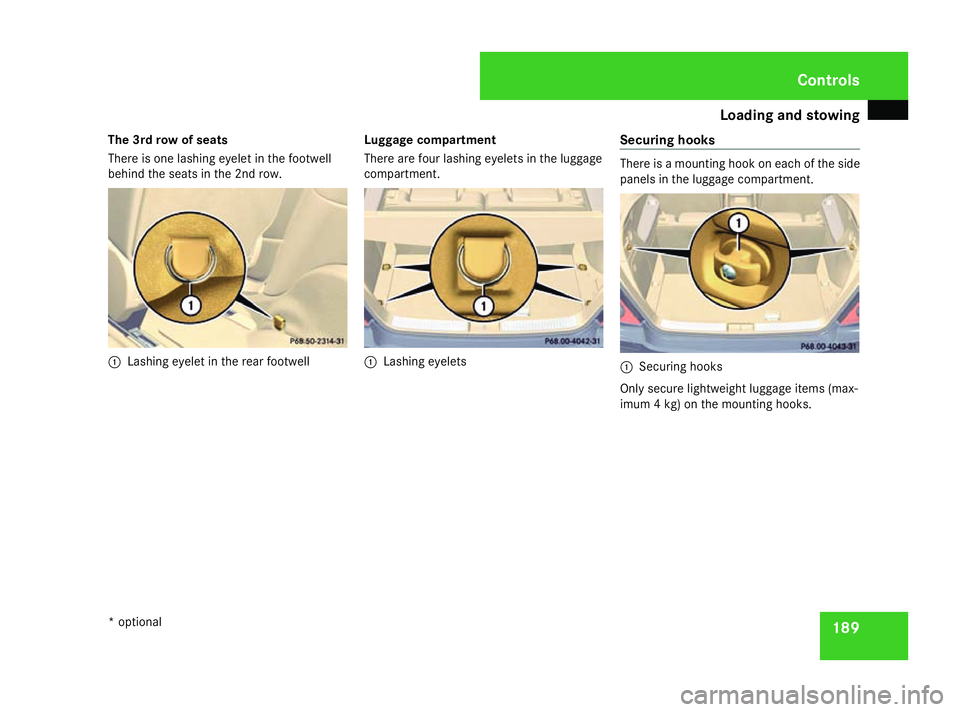
The 3rd row of seats
There is one lashing eyelet in the footwell
behind the seats in the 2nd row. 1
Lashing eyelet in the rear footwell Luggage compartment
There are four lashing eyelets in the luggage
compartment. 1
Lashing eyelets Securing hooks There is a mounting hook on each of the side
panels in the luggage compartment.
1
Securing hooks
Only secure lightweight luggage items (max-
imum 4 kg) on the mounting hooks. Controls
* optional
251_AKB; 5; 7, en-GB
wobuchh,
Version: 2.10.6 2008-05-11T14:51:51+02:00 - Seite 189 ZDateiname: 6515_1825_02_buchblock.pdf; preflight
Page 198 of 373

Loading and stowing
195Seat locked
1
Lock verification indicator
2 Indicator area
When the seat is locked, locking display 1is
folded in and indicator area 2is barely visi-
ble. Resetting the middle seat in the 2nd row
of seats Armrest position
1
Release loop
2 Seat
X Pull release loop 1of seat 2in the direc-
tion of the arrow and hold it securely.
The seat is released and folds up.
X Press seat 2further down until the back
of the seat engages in the armrest position.
X Pull release loop 1of the backrest in the
direction of the arrow and hold it securely.
X Fold the backrest back until it is heard to
engage in the driving position. Centre console for the 2nd row of
seats*
The centre console contains a stowage com-
partment (Y page 203) and a cup holder
(Y page 183).
If you are using the fully extended luggage
compartment and want an even loading area
(Y page 190), you must remove the centre
console.
Removing the centre console G
Risk of injury
Before removing the centre console, take
out all containers from the centre console
cup holder. Liquids could otherwise spill
onto the passengers and /or the vehicle
interior. Hot liquids could scald passen-
gers. Liquids spilt on the vehicle interior
could damage it.
! To avoid damage to the centre console or
to its components, make sure that the
stowage compartment is closed before
removing the centre console.
i Remove all objects from the stowage
compartment (Y page 203) to reduce the
weight of the centre console. Controls
* optional
251_AKB; 5; 7, en-GB
wobuchh
, Version: 2.10.6 2008-05-11T14:51:51+02:00 - Seite 195 ZDateiname: 6515_1825_02_buchblock.pdf; preflight
Page 222 of 373

Refuelling
219
X
Remove the key from the ignition lock.
X To open: press the fuel filler flap in the
direction of arrow 1.
The fuel filler flap opens slightly.
X Open the fuel filler flap.
X Turn the fuel filler cap to the left and
remove it.
X Insert the fuel filler cap into the holder
bracket on the inside of filler flap 2.
X Only fill the tank until the pump nozzle
switches off.
! Overfilling the tank could damage the fuel
system.
X To close: replace the fuel filler cap and turn
it clockwise. The fuel filler cap audibly
engages.
X Close the fuel filler flap.
i Vehicles with a diesel engine:
If the tank has been run completely dry, it
will be necessary to bleed the fuel system
(Y page 289). Petrol (EN 228)
! Refuel using only unleaded premium
grade petrol with a minimum octane num-
ber of 95 RON/85 MON conforming to
European standard EN 228.
You could otherwise impair engine output
or damage the engine.
You will find further information about pet-
rol under "Fuel" in the index.
i As a temporary measure, but only when
the recommended fuel is not available, you
may also use regular unleaded petrol,
91 RON/82.5 MON. This may reduce per-
formance and increase petrol consump-
tion. Avoid driving at full throttle.
In some countries, the available petrol qual-
ity may not be sufficient and could cause
coking around the inlet valve. In such
cases, and in consultation with a
Mercedes-Benz Service Centre, the petrol
may be mixed with the additive recommen-
ded by Mercedes-Benz (part no.
A000989254510). You must observe the
notes and mixing ratios given on the con-
tainer. Diesel (EN 590)
! Only use diesel that complies with the
EN 590 European standard.
You could otherwise impair engine output
or damage the engine.
You will find further information about die-
sel under "Fuel" in the index.
! When refuelling vehicles with a diesel par-
ticle filter in countries outside the EU, only
low-sulphur Euro diesel with less than
0.005 percent sulphur content by weight
should be used. In countries in which diesel
with a higher sulphur content is available
(e.g. 0.035 percent by weight), the engine
oil should be renewed at more frequent
intervals. More information about intervals
for changing the engine oil can be obtained
from any Mercedes-Benz Service Centre.
! Using fuel that does not comply with EN
590 can increase wear and damage the
engine and the exhaust system.
Do not use the following:
R marine diesel
R heating oil Operation
251_AKB; 5; 7, en-GB
wobuchh,
Version: 2.10.6 2008-05-11T14:51:51+02:00 - Seite 219 ZDateiname: 6515_1825_02_buchblock.pdf; preflight
Page 242 of 373

Trailer towing*
239G
Risk of injury
As soon as you raise the trailer drawbar, the
unladen vehicle rises slightly. The vehicle
then lowers to driving level.
Make sure that nobody is in the vicinity of
the wheel arch or the underbody. You could
otherwise trap yourself or others.
X Lift up the trailer drawbar and decouple the
trailer.
X Switch off the engine.
Vehicles with the AIRMATIC package*
X Make sure the selector lever is set to P.
X Depress the parking brake.
X Start the engine.
X Close the doors and tailgate.
X Secure the trailer against rolling away. G
Risk of injury
The vehicle is lowered as soon as you dis-
connect the trailer cable. Make sure that
nobody is in the vicinity of the wheel arch
or the underbody. You could otherwise trap
yourself or others.
As soon as you decouple the trailer, the
unladen vehicle rises slightly. Make sure that you or others are not injured in the
process.
X Remove the trailer cable and decouple the
trailer.
X Switch off the engine. Notes on towing a trailer
G
Risk of accident
When reversing the vehicle towards the
trailer, make sure there is nobody between
the trailer and the vehicle.
Couple and uncouple the trailer carefully. If
you do not couple the trailer to the towing
vehicle correctly, the trailer could become
detached.
Make sure that the following values are not
exceeded:
R The permitted trailer drawbar nose-
weight
R The permitted trailer load R
The permitted rear axle load of the towing
vehicle
R The maximum permissible gross vehicle
weight of both the towing vehicle and the
trailer
You will find the applicable permissible val-
ues which must not be exceeded in the
vehicle documents.
You will find the values approved by the
manufacturer on the vehicle identification
plates and those for the towing vehicle in
the "Technical data" section.
You will find installation dimensions and loads
in the "Technical data" section
(Y page 354).
The maximum permissible trailer drawbar
noseweight on the ball coupling is 85 kg.
However, the actual noseweight must not
exceed the value given on the trailer coupling
and trailer identification plates. The lowest
weight applies.
! Use a noseweight as close as possible to
the maximum permissible noseweight. Do
not use a noseweight of less than 50 kg,
otherwise the trailer may come loose. Operation
* optional
251_AKB; 5; 7, en-GB
wobuchh
,V ersion: 2.10.6
2008-05-11T14:51:51+02:00 - Seite 239 ZDateiname: 6515_1825_02_buchblock.pdf; preflight
Page 243 of 373

Trailer towing*
240Bear in mind that the payload and the rear
axle load are reduced by the actual nose-
weight.
i On vehicles without level control, the
height of the ball coupling will alter accord-
ing to the load placed on the vehicle. In this
case, you should use a trailer with a height-
adjustable drawbar.
Driving tips i
Observe the notes on ESP ®
trailer stabi-
lisation (Y page 60).
In Germany, the maximum permitted speed
for vehicle/trailer combinations is 80 km/h.
! A maximum speed of 80 km/h should not
be exceeded, even in countries where
higher speeds are permitted for vehicle/
trailer combinations.
When towing a trailer, your vehicle's handling
characteristics will be different in comparison
to when driving without a trailer.
The vehicle/trailer combination:
R is heavier
R is restricted in its acceleration and gradi-
ent-climbing capability
R has an increased braking distance R
is affected more by strong crosswinds
R demands more sensitive steering
R consumes more fuel
On long and steep downhill gradients you
must select the shift range 1,2or 3in good
time.
i This also applies if you have activated
cruise control, Distronic* or Speedtronic.
This uses the braking effect of the engine and
you will not have to brake to such an extent
to maintain the same speed. This relieves the
load on the brake system and prevents the
brakes from overheating and wearing too
quickly. If you need additional braking,
depress the brake pedal repeatedly rather
than continuously. G
Risk of accident
Never depress the brake pedal continu-
ously while the vehicle is in motion, e.g.
never cause the brakes to rub by applying
constant slight pedal pressure. This causes
the brake system to overheat, increases
the braking distance and can lead to the
brakes failing completely. Driving tips
R
Maintain a greater distance from the vehi-
cle in front than when driving without a
trailer.
R Avoid braking abruptly. If possible, brake
gently at first to allow the trailer to run on.
Then increase the braking force rapidly.
R The values given for gradient-climbing
capabilities from a standstill refer to sea
level. When driving in mountainous areas,
note that the power output of the engine,
and consequently the vehicle's gradient-
climbing capability, decrease with increas-
ing altitude.
If the trailer swings from side to side:
X Do not accelerate.
X Do not counter-steer.
X Brake if necessary. G
Risk of accident
On no account should you attempt to draw
the vehicle/trailer combination out by
increasing speed. Operation
* optional
251_AKB; 5; 7, en-GB
wobuchh
,V ersion: 2.10.6
2008-05-11T14:51:51+02:00 - Seite 240 Dateiname: 6515_1825_02_buchblock.pdf; preflight
Page 333 of 373

Towing and tow-starting
330
X
Electrical consumers can be switched on
again. Do not switch the lights on, however,
as this will overload the battery.
X Remove the jump lead from earth
point 1and negative terminal 3first,
then from positive terminal 2and positive
terminal 4, each time disconnecting from
the battery on your own vehicle first.
i The message Battery protection:
some convenience functions cur-
rently not available may appear in the
multi-function display. It disappears as
soon as the battery is sufficiently charged.
X Have the battery checked at a qualified
specialist workshop, e.g. a Mercedes-Benz
Service Centre. Towing and tow-starting
Points to remember
G
Risk of accident
If you tow the vehicle, you must use a rigid
towing bar if:
R the engine is not running
R there is a brake system malfunction
R the voltage supply or the vehicle's elec-
trical system is damaged
The electric power steering and the brake
force booster do not work when the engine
is not running. Greater braking force will
then be required and the brake pedal travel
will be longer. If necessary, depress the
brake pedal with maximum force.
Do not tow the vehicle if the key cannot be
turned in the ignition lock. If this is the case,
the steering is locked and the vehicle can-
not be steered.
If you tow or tow-start another vehicle, its
weight must not exceed the maximum per-
missible gross vehicle weight of your vehi-
cle.
It is better to have the vehicle transported
than to have it towed. When towing, observe the legal requirements
in all countries concerned.
!
When towing, pull away slowly and with-
out jerking. If the tractive power is too high,
the vehicles could be damaged.
! Do not use the towing eye for recovery,
as this will damage the vehicle. If in doubt
recover the vehicle with a crane.
! You may tow the vehicle for a maximum
of 50 km. A towing speed of 50 km/h must
not be exceeded.
With towing distances over 50 km, the
entire vehicle needs to be lifted up and
transported.
! On vehicles with KEYLESS GO*: use the
key instead of the KEYLESS GO * button.
Turn the key to position 2in the ignition
lock and set the automatic transmission to
N. Then turn the key back to 0and leave it
in the ignition lock.
! Only secure the tow cable or towing bar
to the towing eyes. You may otherwise
damage the vehicle. Practical advice
* optional
251_AKB; 5; 7, en-GB
wobuchh
,V ersion: 2.10.6
2008-05-11T14:51:51+02:00 - Seite 330 Dateiname: 6515_1825_02_buchblock.pdf; preflight
Page 340 of 373

337
Notes on the technical data
.............338
Genuine Mercedes-Benz parts .........338
Vehicle electronics ...........................339
Vehicle identification plates ............340
Engine ................................................ 342
Performance ...................................... 344
Tyres and wheels .............................. 345
Vehicle dimensions ..........................350
Vehicle weights ................................. 351
Trailer coupling* ............................... 354
Service products and capacities .....355
Frequencies for garage door open-
ers* .................................................... 363 Technical data
251_AKB; 5; 7, en-GB
wobuchh,
Version: 2.10.6
2008-05-11T14:51:51+02:00 - Seite 337 Dateiname: 6515_1825_02_buchblock.pdf; preflight
Page 343 of 373

Vehicle identification plates
340phones/wireless devices in the vehicle.
This also ensures that interference
between these devices and the vehicle's
electronics is kept to a minimum. If instal-
led, the exterior aerial conducts the elec-
tromagnetic fields transmitted by a mobile
phone to the exterior of the vehicle. Frequency range Maximum trans-
mission output
(watts)
Short wave
(< 50 MHz) 100
4 m waveband 20
2 m waveband 50
70 cm waveband 35
25 cm waveband 10
!
If electrical or electronic equipment
which does not comply with the above
installation conditions is operated inside
the vehicle, the vehicle's operating permit
may be invalidated (EU Directive
95/54/EC) - Automotive EMC directive) Vehicle identification plates
Vehicle identification plate with vehi-
cle identification number (VIN) and
paint code number
The vehicle identification plate is located at
the bottom of the door frame on the front-
passenger side. 1
Vehicle identification plate
X Open the driver's door.
You will see vehicle identification plate
1. Vehicle identification plate (example)
1
Vehicle identification plate
2 Vehicle manufacturer
3 EU type approval number
4 Vehicle identification number (VIN)
5 Maximum permissible gross vehicle
weight
6 Maximum permissible towing weight
7 Maximum permissible front axle load
8 Maximum permissible rear axle load
9 Paint code number Technical data
251_AKB; 5; 7, en-GB
wobuchh
,V ersion: 2.10.6
2008-05-11T14:51:51+02:00 - Seite 340 Dateiname: 6515_1825_02_buchblock.pdf; preflight
Page 353 of 373

Vehicle weights
350 Vehicle dimensions
Short wheelbase Long wheelbase
Vehicle length (ECE) 4,938 mm 5,173 mm
Vehicle width with mirrors folded
out 2,168 mm 2,168 mm
Vehicle height
1,661 mm/1,664 mm
51 1,663 mm / 1,666 mm
51Wheelbase 2,980 mm 3,215 mm
51
For R 500 4MATIC. Technical data
* optional
251_AKB; 5; 7, en-GB
wobuchh
,V ersion: 2.10.6
2008-05-11T14:51:51+02:00 - Seite 350 Dateiname: 6515_1825_02_buchblock.pdf; preflight
Page 354 of 373

Vehicle weights
351Tailgate opening dimensions
1
Max. headroom
2 Tailgate opening height Vehicle level
52 1
1 2
2 191 cm 204 cm
!
In vehicles with the AIRMATIC package*,
the tailgate opening dimensions may vary
depending on the selected basic setting
and current vehicle level.
Therefore, make sure that there is suffi-
cient clearance above the tailgate. Vehicle weights
The unladen weight includes the driver (68 kg), luggage (7 kg) and all fluids (fuel tank 90% full). Items of optional equipment increase the
unladen weight and reduce the maximum payload. Specific weight specifications can be found on the vehicle identification plate
(Y page 340). Short wheelbase R 280 R 350 R 350 4MATIC R 500 4MATIC
Unladen weight (in accordance with EC
directive) 2,130 kg 2,130 kg 2,180 kg 2,220 kg
Maximum permissible gross vehicle
weight 2,790 kg 2,790 kg 2,840 kg 2,880 kg
Maximum permissible front axle load 1,370 kg 1,370 kg 1,370 kg 1,370 kg
52
Values are rounded off and valid for unladen vehicles with basic equipment. Technical data
251_AKB; 5; 7, en-GB
wobuchh
,V ersion: 2.10.6
2008-05-11T14:51:51+02:00 - Seite 351 ZDateiname: 6515_1825_02_buchblock.pdf; preflight