brake MERCEDES-BENZ S CLASS 2018 User Guide
[x] Cancel search | Manufacturer: MERCEDES-BENZ, Model Year: 2018, Model line: S CLASS, Model: MERCEDES-BENZ S CLASS 2018Pages: 562, PDF Size: 7.25 MB
Page 188 of 562
R
The seat belt to ngue is not inser te d in th e
seat belt buckle of th e driver's seat and th e
driver's door is opened. R
There is a sy st em malfunction.R
The po we r supp ly is insuf fi cient.R
The ve hicle is st ationary fo r a lengt hy period.
When th e electric parking brake is applied, th e
I (USA) or $ (Canada) indicator lamp
lights up in th e instrument clus te r.
The electric parking brake is not automatically
applied if th e engine is switched off by th e ECO
st art/ st op function.
Fu nction of th e electric pa rk ing brake
(releasing automatically)
The elect ri c pa rk ing brake is re leased when th e
fo llowing conditions are fulfilled: R
The engine is ru nning.R
The seat belt to ngue is inser te d into th e seat
belt buckle of th e driver's seat.R
The transmission is in position [ or ^ and
yo u depr ess th e accelera to r pedal or yo u shift from transmission position ] to [ or
^ . R
If th e transmission is in position ^ , th e
trunk lid mu st be closed.
If th e seat belt to ngue is not inser te d into th e
seat belt buckle of th e driver's seat, th e fo llow‐
ing conditions must be fulfilled: R
The driver's door is closed. R
Yo u mo ve th e transmission out of transmis‐
sion position ] or yo u ha ve pr ev iously
driven fast er th an 2 mp h (3 km/h).R
If th e transmission is in position ^ , th e
trunk lid mu st be closed.
If th e elect r ic parking brake is re leased, th e
I (USA) or $ (CANADA) indicator lamp in
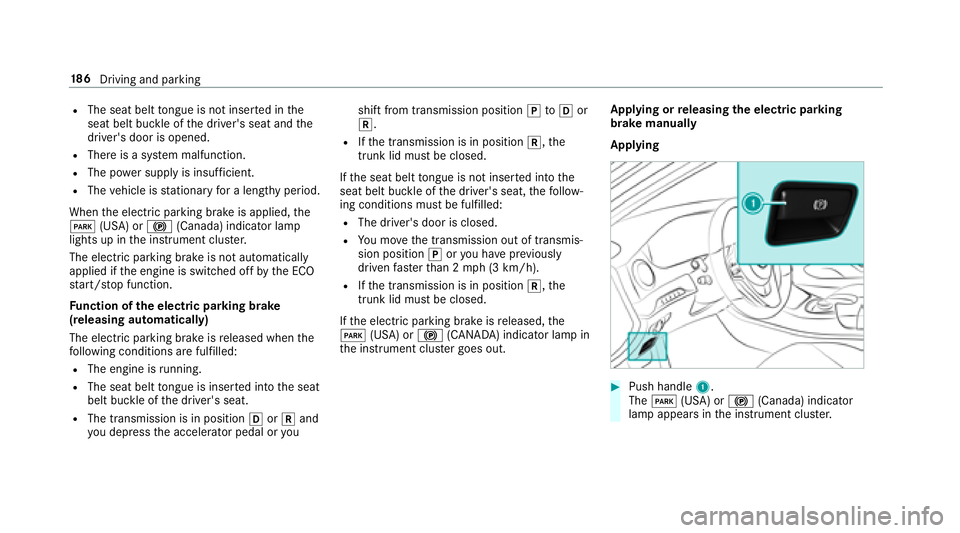
th e instrument clus te r goes out. Applying or re leasing th e electric pa rk ing
brake manually
Applying
Page 191 of 562
Fu nctions of ABS (anti-lock braking sy st em)
ABS re gulates th e brake pressure in critical driv‐
ing situations: R
During braking, e.g. at maximum full-s to p
braking or insuf fi cient traction of th e tires,
th e wheels are pr ev ented from blocking.R
Ve hicle st eerability while braking is ensured.
If ABS inter ve nes when braking, yo u will fe el a
pulsing in th e brake pedal. The pulsating brake
pedal can be an indication of hazardous ro ad
conditions and can ser ve as a re minder to ta ke
ex tra care while driving.
Sy st em limitations R
ABS is active from speeds of appr ox . 5 mp h
(8 km/h). R
ABS may be impaired or may not function if a
malfunction has occur re d and th e ye l‐
low % ABS wa rn ing lamp lights up contin‐
uously in th e instrument clus te r af te r th e
engine is st ar te d. Fu nction of BA S (Brake Assist Sy st em)
q
WA RNING Risk of an accident caused by
a malfunction in BA S (Brake Assi st Sys‐
te m)
If BA S is malfunctioning, th e braking dis ta nce
in an emergency braking situation is
increased.
Page 192 of 562
ESP ®
can moni to r and impr ove driving st ability
and traction in th e fo llowing situations, within
ph ys ical limits:R
When pulling aw ay on a we t or slippe ry ro ad.R
When braking. R
In stro ng sidewinds when yo u are drivin g
fast er th an 50 mp h (80 km/h).
If th e ve hicle deviates from th e direction desired
by th e driver, ESP ®
can st abilize th e ve hicle by
inter ve ning in th e fo llowing wa ys :R
One or more wheels are braked. R
The engine output is adap te d according to
th e situation.
ESP ®
is deactivated if th e ESP ®
OFF
Page 194 of 562
12 5 mp h (2 00 km/h) when driving st ra ight
ahead or cornering slightly. R
The ve hicle is st abilized by means of individ‐
ual brake application on one side.
Fu nction of EBD (electronic brake fo rc e dis‐
tribution)
EBD is ch aracterized by th e fo llowing:R
Monitoring and re gulating th e brake pressure
on th e re ar wheels.R
Impr ov ed driving st ability when braking,
especially on bends.
Fu nction of ST EER CONT RO L
ST EER CONTROL helps yo u by transmitting a
noticeable st eering fo rc e to th e st eering wheel in
th e direction requ ired fo r ve hicle st abilization.
This st eering re commendation is given pa rt icu‐
lar ly in th e fo llowing situations:R
Bo th ri ght wheels or bo th left wheels are on
a we t or slippe ry ro ad sur fa ce when yo u
brake. R
The ve hicle st arts to skid.
Sy st em limitations
ST EER CONTROL may be impaired or may not
function in th e fo llowing situations: R
ESP ®
is deactivated. R
ESP ®
is malfunctioning. R
The st eering is malfunctioning.
If ESP ®
is malfunctioning, yo u will be assis te d
fur th er by th e electric po we r st eering.
Fu nction of Ac tive Brake Assi st
Ac tive Brake Assi st consi st s of:R
Dis ta nce wa rn ing function R
Au to nomous braking function R
Situation-dependent braking assi st anceR
Ve hicles with Driving Assistance Pa ck ‐
age: Evasi ve St eering Assist
Ac tive Brake Assi st can help yo u to minimize th e
ri sk of a collision with ve hicles or pedestrians or
to re duce th e ef fe cts of su ch a collision. If Ac tive Brake Assi st has de te cted a ri sk of colli‐
sion, yo u will be wa rn ed visually and acousti‐
cally.
If yo u do not re act to th e visual or acoustic wa rn ‐
ing, autonomous braking can be initiated in criti‐
cal situations.
In especially critical situations, Ac tive Brake
Assi st can initia te autonomous braking direct ly .
In th is case, th e visual and acoustic wa rn ing
occurs simultaneously with th e braking applica‐
tion.
If yo u appl y th e brake yo urself in a critical situa‐
tion or appl y th e brake during autonomous brak‐
ing, situation-dependent braking assis ta nce
occu rs . This increases th e brake pressure up to
maximum full-s to p braking if necessar y.
If th e autonomous braking function or th e situa‐
tion-dependent braking assis ta nce is trig ge re d,
additional pr ev entive measures fo r occupant
pr ot ection (PRE-SAFE ®
) may also be initiated, if
th e ve hicle is equipped with th ese.19 2
Driving and pa rk ing
Page 195 of 562
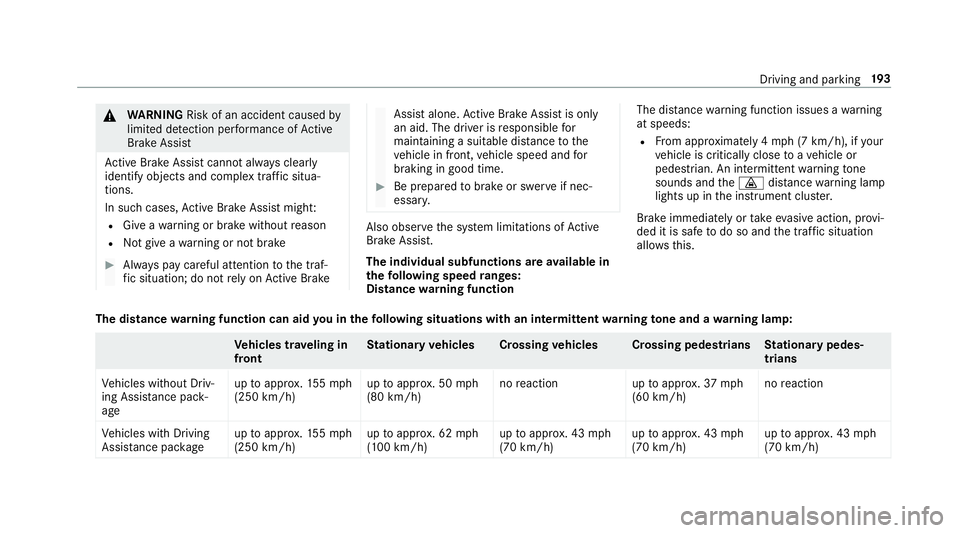
q
WA RNING Risk of an accident caused by
limited de te ction per fo rm ance of Ac tive
Brake Assi st
Ac tive Brake Assi st cannot al wa ys clear ly
identify objects and complex traf fi c situa‐
tions.
In su ch cases, Ac tive Brake Assi st might:R
Give a wa rn ing or brake without re asonR
No t give a wa rn ing or not brake
Page 197 of 562
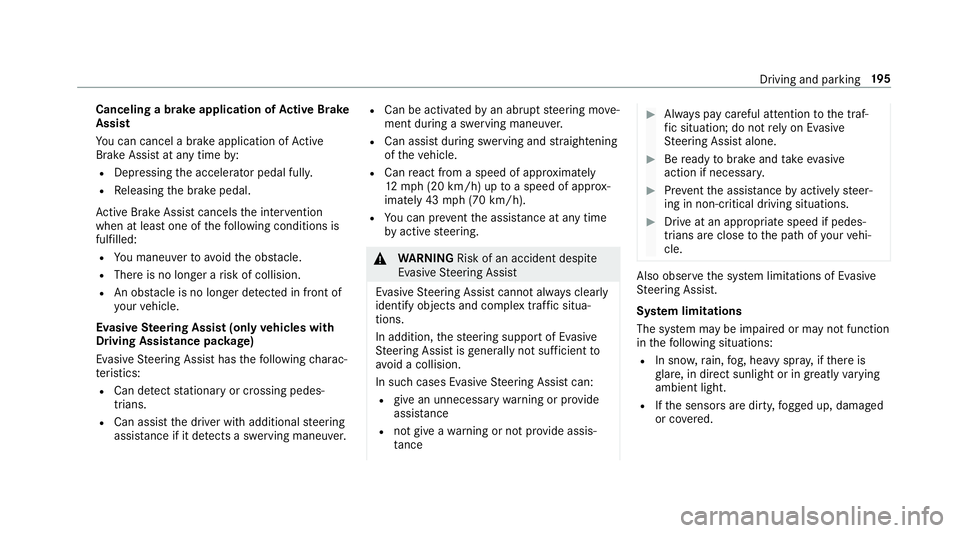
Canceling a brake application of Ac tive Brake
Assi st
Yo u can cancel a br ake applic ation of Ac tive
Brake Assi st at any time by :R
Dep re ssing th e accelera to r pedal fully.R
Re leasing th e brake pedal.
Ac tive Brake Assi st cancels th e inter ve ntion
when at least one of th e fo llowing conditions is
fulfilled: R
Yo u maneuver to av oid th e obs ta cle.R
The re is no longer a ri sk of collision.R
An obs ta cle is no longer de te cted in front of
yo ur ve hicle.
Evasive Ste ering Assist (only ve hicles with
Driving Assistance pac kage )
Evasive St eering Assist has th e fo llowing ch arac‐
te ri st ics: R
Can de te ct st ationary or crossing pedes‐
trians. R
Can assist th e driver with additional st eering
assis ta nce if it de te cts a swerving maneuver. R
Can be acti va te d by an abrupt st eering mo ve ‐
ment during a swerving maneu ve r.R
Can assist during swerving and st ra ightening
of th e ve hicle. R
Can re act from a speed of appr ox imately
12 mp h (2 0 km/h) up to a speed of appr ox ‐
imately 43 mp h (7 0 km/h).R
Yo u can pr eve nt th e assis ta nce at any time
by active st eering.
q
WA RNING Risk of an accident despi te
Evasive St eering Assist
Evasive St eering Assist cann ot alw ay s clearly
identify objects and complex traf fi c situa‐
tions.
In addition, th e st eering support of Evasive
St eering Assist is ge nerally not su ff icient to
av oid a collision.
In such cases Evasive St eering Assist can:R
give an unnecessary wa rn ing or pr ov ide
assis ta nce R
not gi ve a wa rn ing or not pr ov ide assis‐
ta nce
Page 198 of 562
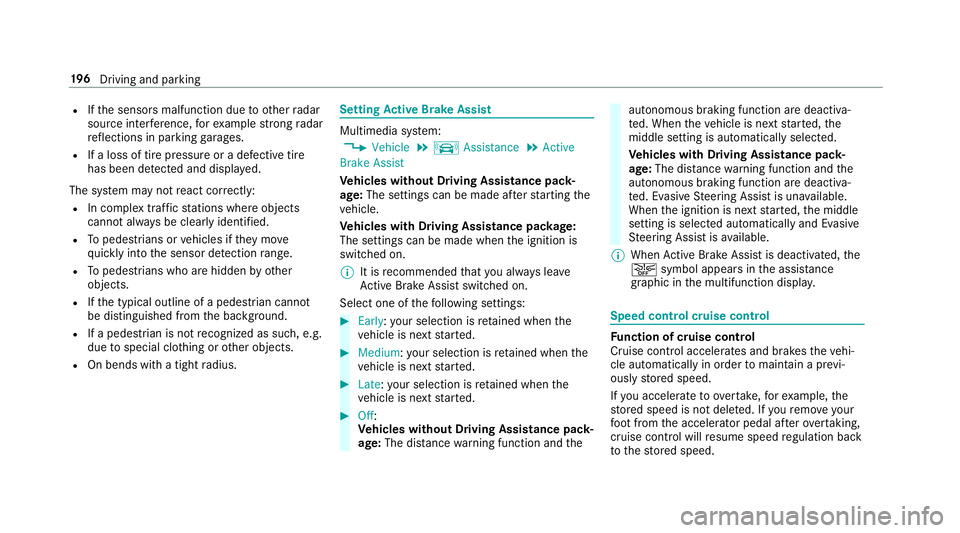
R
If th e sensors malfunction due to ot her ra dar
source inter fe re nce, fo r ex ample stro ng ra dar
re fl ections in parking ga ra ge s.R
If a loss of tire pressure or a defective tire
has been de te cted and displ ay ed.
The sy st em may not re act cor re ctly:R
In compl ex traf fi c st ations where objects
cannot alw ay s be clearly identified.R
To pedestrians or ve hicles if th ey mo ve
qu ickly into th e sensor de te ction ra nge.R
To pedestrians who are hidden by ot her
objects. R
If th e typical outline of a pedestrian cann ot
be distinguished from th e bac kg ro und.R
If a pedestrian is not re cognized as su ch , e.g.
due to special clo th ing or ot her objects.R
On bends with a tight ra dius. Setting Ac tive Brake Assi st
Multimedia sy st em:
Page 201 of 562
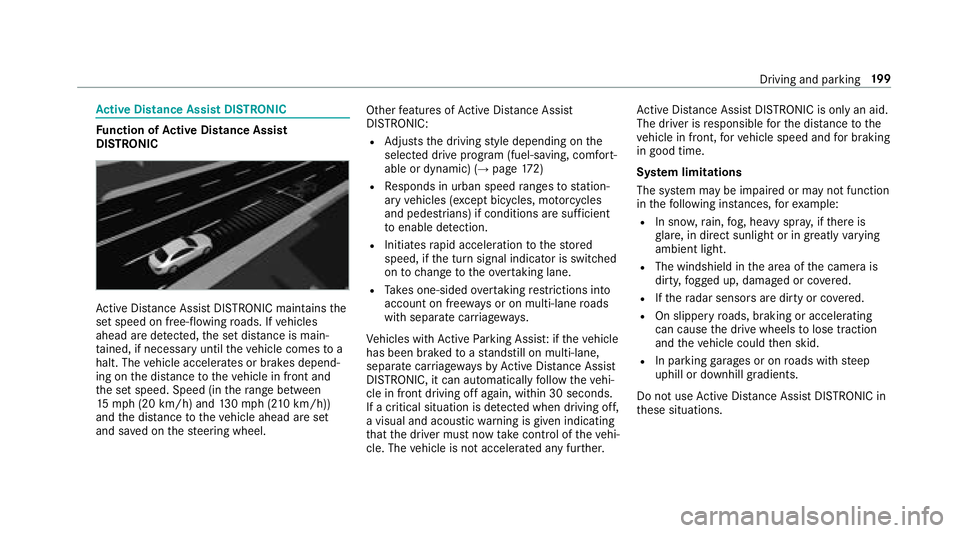
Ac tive Di st ance Assist DI STRO NIC
Fu nction of Ac tive Di st ance Assist
DI STRO NIC
Ac tive Dis ta nce Assi st DISTRONIC maintains th e
set speed on free-flowing ro ads. If ve hicles
ahead are de te cted, th e set dis ta nce is main‐
ta ined, if necessary until th e ve hicle comes to a
halt. The ve hicle accelerates or brakes depend‐
ing on th e dis ta nce to th e ve hicle in front and
th e set speed. Speed (in th e ra nge between
15 mp h (2 0 km/h) and 13 0 mp h (2 10 km/h))
and th e dis ta nce to th e ve hicle ahead are set
and sa ve d on th e st eering wheel. Other fe atures of Ac tive Dis ta nce Assi st
DISTRONIC: R
Ad justs th e driving st yl e depending on th e
selected drive program (fuel-saving, comfort‐
able or dynamic) ( →
page 17 2)R
Re sponds in urban speed ra nges to st ation‐
ary ve hicles (e xc ept bicycles, mo to rc yc les
and pedestrians) if conditions are suf fi cient
to enable de te ction. R
Initiates ra pid acceleration to th e st ored
speed, if th e turn signal indicator is switched
on to ch ange to th e ov er tak ing lane.R
Ta ke s one-sided ove rt aking re st ri ctions into
account on free wa ys or on multi-lane ro ads
with separate car ri ag ewa ys .
Ve hicles with Ac tive Pa rk ing Assis t: if th e ve hicle
has been braked to a st andstill on multi-lane,
separate car ri ag ewa ys by Ac tive Dis ta nce Assi st
DISTRONIC, it can au to matically fo llow th e ve hi‐
cle in front driving off again, within 30 seconds.
If a crit ical situation is de te cted when driving off,
a visual and acoustic wa rn ing is given indicating
th at th e driver must now ta ke control of th e ve hi‐
cle. The ve hicle is not accelerated any fur th er. Ac tive Dis ta nce Assi st DISTRONIC is only an aid.
The driver is re sponsible fo r th e dis ta nce to th e
ve hicle in front, fo r ve hicle speed and fo r braking
in good time.
Sy st em limitations
The sy st em may be impaired or may not function
in th e fo llowing ins ta nces, fo r ex ample: R
In sn ow , ra in, fo g, heavy spr ay , if th ere is
gl are, in direct sunlight or in great ly va ry ing
ambient light. R
The windshield in th e area of th e camera is
dirty, fo gged up, damaged or co ve re d.R
If th e ra dar sensors are dirty or co ve re d.R
On slippery ro ads, braking or accelerating
can cause th e drive wheels to lose traction
and th e ve hicle could th en skid. R
In parking ga ra ge s or on ro ads with st eep
uphill or downhill gradients.
Do not use Ac tive Dis ta nce Assi st DISTRONIC in
th ese situations. Driving and parking 19 9
Page 202 of 562
q
WA RNING Risk of accident from acceler‐
ation or braking by Ac tive Dis ta nce
Assi st DISTRONIC
Ac tive Dis ta nce Assi st DISTRONIC may accel‐
erate or brake in th e fo llowing cases, fo r
ex ample: R
If th e ve hicle pulls aw ay using Ac tive Dis‐
ta nce Assi st DISTRONIC.R
If th e st ored speed is called up and is
considerably fast er or slo we r th an th e
cur re ntly driven speed.R
If Ac tive Dis ta nce Assi st DISTRONIC no
longer de te cts a ve hicle in front or does
not re act to re le va nt objects.
Page 210 of 562
ve hicle is decelerated in st ages to a st andstill. At
speeds below 40 mp h (6 0 km/h) th e hazard
wa rn ing lights switch on automaticall y.
When st ationary:R
The ve hicle is secured with th e electric park‐
ing brake. R
Ac tive Dis ta nce Assi st DISTRONIC is ended.R
The ve hicle is unloc ke d.R
If possible, an emer ge ncy call is placed to
th e Mercedes-Benz emer ge ncy call center.
The driver can cancel th e deceleration at any
time by per fo rm ing one of th e fo llowing actions:R
St eeringR
Depressing th e brake or accelera to r pedalR
Pressing a st eering wheel button or operat‐
ing To uch ControlR
Ac tivating or deacti va ting Ac tive Dis ta nce
Assi st DISTRONIC Ac tive Di st ance Assist DI STRO NIC displa ys in
th e instrument clus te r
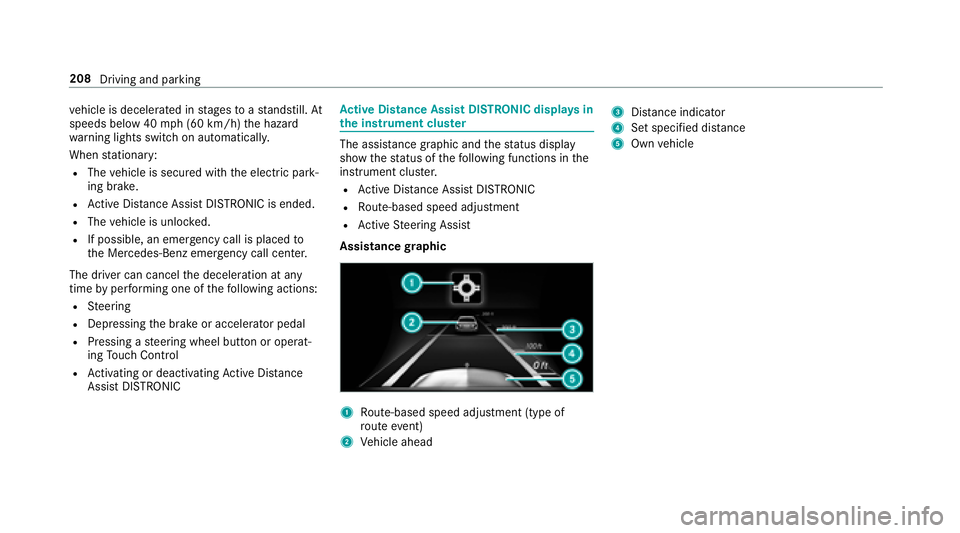
The assis ta nce graphic and th e st atus display
show th e st atus of th e fo llowing functions in th e
instrument clus te r. R
Ac tive Dis ta nce Assi st DISTRONICR
Ro ute-based speed adjustment R
Ac tive St eering Assist
Assistance gr aphic
1
Ro ute-based speed adjustment (type of
ro ute eve nt)
2
Ve hicle ahead 3
Dis ta nce indica to r4
Set specified di st ance5
Own ve hicle208
Driving and parking