belt MERCEDES-BENZ S CLASS 2019 User Guide
[x] Cancel search | Manufacturer: MERCEDES-BENZ, Model Year: 2019, Model line: S CLASS, Model: MERCEDES-BENZ S CLASS 2019Pages: 578, PDF Size: 23.31 MB
Page 41 of 578
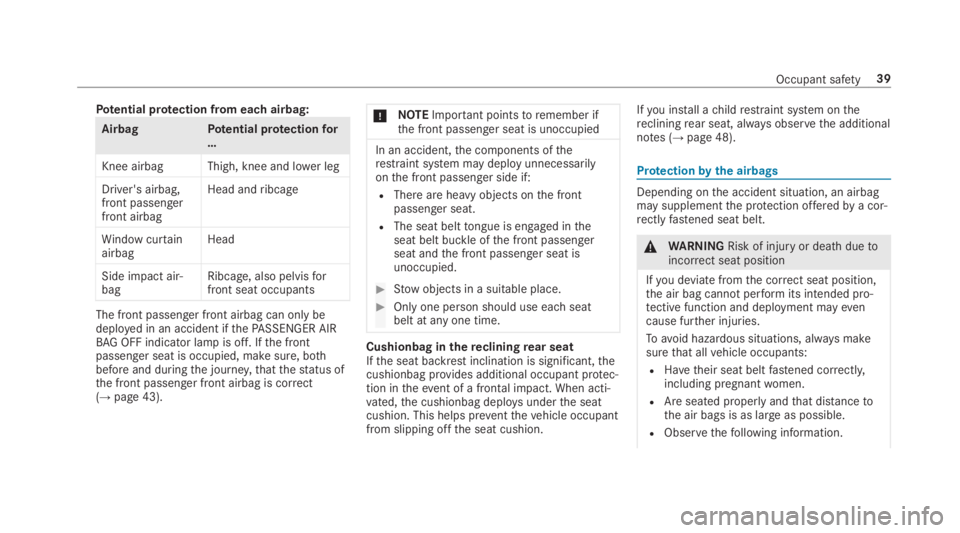
Potential protection from each airbag:
AirbagPotential protectionfor…
Knee airbag Thigh, knee and lower leg
Driver's airbag,front passengerfront airbag
Head andribcage
Window curtainairbagHead
Side impact air‐bagRibcage, also pelvisforfront seat occupants
The front passenger front airbag can only bedeployed in an accident ifthePASSENGER AIRBAG OFF indicator lamp is off. Ifthe frontpassenger seat is occupied, make sure, bothbefore and duringthe journey,thatthestatus ofthe front passenger front airbag is correct(→page43).
*NOTEImportant pointstoremember ifthe front passenger seat is unoccupied
In an accident,the components oftherestraint system may deploy unnecessarilyonthe front passenger side if:
RThere are heavy objects onthe frontpassenger seat.
RThe seat belttongue is engaged intheseat belt buckle ofthe front passengerseat andthe front passenger seat isunoccupied.
#Stowobjects in a suitable place.
#Only one person should use each seatbelt at any one time.
Cushionbag intherecliningrear seatIfthe seat backrest inclination is significant,thecushionbag provides additional occupant protec‐tion intheevent of a frontal impact. When acti‐vated,the cushionbag deploysunderthe seatcushion. This helps preventthevehicle occupantfrom slipping offthe seat cushion.
Ifyou install achildrestraint system ontherecliningrear seat, always observethe additionalnotes (→page 48).
Protectionbythe airbags
Depending onthe accident situation, an airbagmay supplementthe protection offeredbya cor‐rectlyfastened seat belt.
&WARNINGRisk of injuryor death duetoincorrect seat position
Ifyou deviate fromthe correct seat position,the air bag cannotperformits intended pro‐tective function and deployment mayevencause further injuries.
Toavoid hazardous situations, always makesurethat allvehicle occupants:
RHavetheir seat beltfastened correctly,including pregnantwomen.
RAre seated properlyandthat distancetothe air bags is as largeas possible.
RObservethefollowing information.
Occupant safety39
Page 44 of 578
RThe backrest oftheforward-facingchildrestraint system must lie asflat as possibleagainstthe backrest ofthe front passengerseat.
RThechildrestraint system must nottouchtheroof or be put understrainbythe headrestraints.Adjustthe seat backrest inclina‐tion andthe headrestraint setting accord‐ingly.
&WARNINGRisk of injuryor death duetoobjects betweenthe sitting surface andthechildrestraint system
Objects betweenthe sitting surface andthechildrestraint system could affectthe func‐tion ofthe automatic front passenger airbagshutoff.
This couldresult inthe front passenger air‐bag not functioning as intended during anaccident.
#Do not place any objects betweenthesitting surface andthechildrestraintsystem.
#The entire base ofthechildrestraintsystem must alwaysrestonthe sittingsurface ofthe front passenger seat.
#The backrest oftheforward-facingchildrestraint system must, asfar as possi‐ble, beresting onthe seat backrest ofthe front passenger seat.
#Always comply withthechildrestraintsystem manufacturer's installationinstructions.
A person onthe front passenger seat mustobservethefollowing information:
RFasten seat belts correctly (→page34).
RSit in an almost upright seat position withtheir back againstthe seat backrest.
RSit withtheirfeetresting onthefloor, if pos‐sible.
The front passenger front airbag mayotherwisebe disabledbymistake,forexample inthefol‐lowing situations:
RThe front passenger transferstheirweightbysupportingthemselves on avehicle armrest.
RThe front passenger sits in such awaythattheirweight israised fromthe sitting sur‐face.
&WARNINGRisk of injuryor death duetodeactivated front passenger airbag
IfthePASSENGER AIRBAG OFF indicatorlamp is lit,the front passenger airbag is disa‐bled. It will not be deployed intheevent ofan accident and cannotperformits intendedprotective function.
A person inthe front passenger seat couldthen,forexample, come into contact withthevehicle interior, especially ifthe person issittingtoo closetothe cockpit.
Ifthe front passenger seat is occupied,always ensurethat:
RThe classification ofthe person inthefront passenger seat is correct andthefront passenger airbag is enabled or disa‐bled in accordance withthe person inthefront passenger seat.
42Occupant safety
Page 46 of 578
Status displayIfthe front passenger seat is occupied, ensure,bothbefore and duringthe journey,thatthesta‐tus ofthe front passenger front airbag is correctforthe current situation.
After installing arearward-facingchildrestraint system onthe front passengerseat:PASSENGER AIRBAG OFF must be lit con‐tinuously.
&WARNINGRisk of injuryor death fromusing arearward-facingchildrestraintsystem whenthe front passenger frontairbag is enabled
Ifyou secure achild in arearward-facingchildrestraint system onthe front passengerseat andthePASSENGER AIRBAG OFF indi‐cator lamp is off,the front passenger airbagcan deploy intheevent of an accident.
Thechild could bestruckbythe airbag.
Always ensurethatthe front passenger air‐bag is deactivated. ThePASSENGER AIRBAGOFF indicator lamp must be lit.
NEVER use arearward-facingchildrestraintsystem on a seat protectedbyan ENABLEDFRONT AIRBAGin front of it, DEATH or SERI‐OUS INJURYtotheCHILD can occur.
When installing achildrestraint system onthefront passenger seat, observethevehicle-spe‐cific information (→page57).
Depending onthechildrestraint system andthestature ofthechild,thePASSENGER AIRBAGOFF indicator lamp may be off. Inthis case, donot installtherearward-facingchildrestraintsystem onthe front passenger seat.
Instead, installtherearward-facingchildrestraint system on a suitablerear seat.
After installing aforward-facingchildrestraint system onthe front passengerseat:depending onthechildrestraint systemandthestature ofthechild,PASSENGER AIRBAG OFF may be lit continuously or be off.Always observethefollowing information.
&WARNINGRisk of injuryor death duetoincorrect positioning oftheforward-facingchildrestraint system
Ifyou secure achild in aforward-facingchildrestraint system onthe front passenger seatandyou positionthe front passenger seattooclosetothe cockpit, intheevent of an acci‐dent,thechild could:
RCome into contact with thevehicle inte‐rior ifthePASSENGER AIRBAG OFF indi‐cator lamp is lit,forexample.
RBestruckbythe air bag ifthePASSENGER AIRBAG OFF indicator lampis off.
#Always movethe front passenger seatasfar back as possible and fullyretractthe seat cushion length adjustment.Always make surethatthe shoulder beltstrap is correctlyrouted fromthe seatbelt outlet onthevehicletothe shoul‐der belt guide onthechildrestraint sys‐tem. The shoulder beltstrap must beroutedforwards and downwards from
44Occupant safety
Page 47 of 578
thevehicle belt outlet. If necessary,adjustthe seat belt outlet andthe frontpassenger seat accordingly.
#Always observethechildrestraint sys‐tem manufacturer's installation instruc‐tions.
When installing achildrestraint system onthefront passenger seat, observethevehicle-spe‐cific information (→page57).
If a person is sitting onthe front passengerseat:PASSENGER AIRBAG OFF may be lit con‐tinuously or be off, depending onthe person'sstature.
A person onthe front passenger seat mustalways observethefollowing information:
RIfthe front passenger seat is occupiedbyanadult or a person with astature correspond‐ingtothat of an adult,thePASSENGER AIRBAG OFF indicator lamp must be off. Thisindicatesthatthe front passenger front air‐bag is enabled.
IfthePASSENGER AIRBAG OFF indicatorlamp is lit continuously,an adult or person
with a build correspondingtothat of an adultshould not usethe front passenger seat.Instead,theyshould use arear seat.
RIfthe front passenger seat is occupiedby aperson of smallerstature (e.g. ateenager orsmall adult),thePASSENGER AIRBAG OFFindicator lamp either lights up continuouslyorremains off, depending ontheresult oftheclassification.
-IfthePASSENGER AIRBAGOFF indicatorlamp is off: movethe front passengerseat asfar back as possible orthe personof smallerstature should use arear seat.
-IfthePASSENGER AIRBAGOFF indicatorlamp is lit continuously:the person ofsmallerstature should not usethe frontpassenger seat.
&WARNINGRisk of injuryor death whenthePASSENGER AIRBAG OFF indicatorlamp is lit
IfthePASSENGER AIRBAG OFF indicatorlampremains lit afterthe system self-test,the front passenger air bag is deactivated. It
will not be deployed intheevent of an acci‐dent. Inthis case,the front passenger air bagcannotperformits intended protective func‐tion, e.g. when a person is seated inthe frontpassenger seat.
That person could,forexample, come intocontact withthevehicle interior, especially ifthe person is sittingtoo closetothe cockpit.
Ifthe front passenger seat is occupied,always ensurethat:
RThe classification ofthe person inthefront passenger seat is correct andthefront passenger air bag is enabled ordeactivated in accordance withthe per‐son inthe front passenger seat.
RThe person is seated properly with a cor‐rectlyfastened seat belt.
RThe front passenger seat has been movedasfar back as possible.
Be suretoalso observethefollowing furtherrelated subjects:RChildrestraint system onthe front passengerseat (→page57).
Occupant safety45
Page 48 of 578
PRE-SAFE®system
PRE-SAFE®(anticipatoryoccupant protec‐tion)
PRE-SAFE®is abletodetect certain critical driv‐ing situations and implement pre-emptive meas‐urestoprotectthevehicle occupants.
PRE-SAFE®can implementthefollowing meas‐ures independently of eachother:
RTighteningthe seat belts onthe driver's seatand front passenger seat.
RClosingthe side windows.
RVehicles with sliding sunroof:Closingthesliding sunroof.
RVehicles with memory function:Movingthe front passenger seattoa morefavorableseat position.
RVehicles with memory function intherear passenger compartment:Movingtheouterrear seatstoa morefavorable seatposition.
RVehicles with multicontour seat:Increas‐ingthe air pressure inthe seat side bolstersofthe seat backrest.
RVehicles withrear seat belt buckleextenders:Tightening seat belts ontheouterrear seats.
RPRE-SAFE®Sound: providedthatthe multi‐media system is switched on,generates abrief noise signaltostimulatethe innate pro‐tective mechanism of a person's hearing.
*NOTEDamagecausedbyobjects inthefootwell or behindthe seat
The automatic adjustment ofthe seat posi‐tion mayresult in damagetothe seat and/orthe object.
#Stowobjects in a suitable place.
Reversingthe PRE-SAFE®system measures
If an accident did not occur,the pre-emptivemeasuresthatweretaken arereversed.
You will needtoperformcertain settingsyour‐self.
#Ifthe seat belt pre-tensioning is notreduced,movethe seat backrest back slightly.The locking mechanismreleases.
Function of PRE-SAFE®PLUS (anticipatoryoccupant protection plus)
PRE-SAFE®PLUS can detect certain impacts,particularlyan imminentrear impact, andtakepre-emptive measurestoprotectthevehicleoccupants. These measures cannot necessarilyprevent an imminent impact.
PRE-SAFE®PLUS can implementthefollowingmeasures independently of eachother:
RTighteningthe seat belts onthe driver's seatand front passenger seat.
RVehicles with electricrear seats:tighten‐ing seat belts onthe outerrear seats.
RIncreasing brake pressure whenthevehicleisstationary.This brake application is can‐celed automatically whenthevehicle pullsaway.
46Occupant safety
Page 49 of 578
If an accident did not occur,the pre-emptivemeasuresthatweretaken arereversed.
System limitations
The system will not initiate any action inthefol‐lowing situations:
Rwhen backing up
The system will not initiate any braking applica‐tion inthefollowing situations:
Rwhilst driving
or
Rwhen entering orexiting a parking spacewhile usingActiveParking Assist
Safely transportingchildren inthevehicle
Always observewhenchildren are travelinginthevehicle
%Alsostrictly observethe safety notesforthespecific situation. Inthiswayyou canrecog‐nize potentialrisks andavoid dangers ifchil‐dren are traveling inthevehicle(→page 48).
Be diligentBear in mindthat neglectingtosecure achild inthechildrestraint system may haveserious con‐sequences. Always be diligent in securing achildcarefully beforeeveryjourney.
Toimproveprotectionforchildrenyoungerthan12years old or under 5ft(1.50 m) in height,Mercedes-Benzrecommendsyou observethefollowing information:
RAlways securethechild in achildrestraintsystem suitableforthis Mercedes-Benzvehi‐cle.
RThechildrestraint system must be appropri‐atetothe age,weight and size ofthechild.
RThevehicle seat must be suitablefor instal‐ling achildrestraint system.
Accidentstatistics showthatchildren secured intherear seats aregenerally saferthanchildrensecured inthe front seats.Forthisreason,Mercedes-Benzstrongly advisesthatyou installachildrestraint system on arear seat.
Genericterm"childrestraint system"
Thegenerictermchildrestraint system is usedinthis Operator's Manual. Achildrestraint sys‐tem is,forexample:
Ra baby car seat
Rarearward-facingchild seat
Raforward-facingchild seat
Rachild booster seat with a backrest and seatbelt guide
Mercedes-Benzrecommends using achildbooster seat with a backrest.
Thechildrestraint system must be appropriatetothe age,weight and size ofthechild.
Observing lawsand legalrequirementsAlways observethe legalrequirements whenusing achildrestraint system inthevehicle.
Occupant safety47
Page 50 of 578
Observingstandardsforchildrestraint sys‐tems
Allchildrestraint systems must meetthefollow‐ingstandards:
RU.S.Federal MotorVehicle SafetyStandards213 and 225
RCanadian MotorVehicle SafetyStandards213 and210.2
Confirmationthatthechildrestraint systemcomplies withthestandards can befound on aninstruction label onthechildrestraint system.This confirmation can also befound inthe instal‐lation instructionsthat are included withthechildrestraint system.
Detectingrisks,avoiding danger
Securing systemsforchildrestraint systemsinthevehicle
Only usethefollowing securing systemsforchildrestraint systems:
RtheLATCH-type (ISOFIX) mounting brackets
Rthevehicle's seat belt system
RtheTopTether anchorages
Installing aLATCH-type (ISOFIX)childrestraintsystem is preferred.
Simply attachingtothe securingrings onthevehicle canreducetherisk of installingthechildrestraint system incorrectly.
When securing achild withthe integrated seatbelt oftheLATCH-type (ISOFIX)childrestraintsystem, always comply withthe permissiblegrossweightforthechild andchildrestraint sys‐tem (→page 53).
A booster seat may be necessarytoachieveproper seat belt positioningforchildrenover40 lbs (18kg) inweight or untiltheyreach aheight where athree-point seat belt can beinstalled properlywithout a booster seat.
Mercedes-Benzrecommends a suitablechildbooster seat with a backrest and seat belt guide.
Advantage of arearward-facingchildrestraint systemIt is preferabletotransporta baby or a smallchild in a suitablerearward-facingchildrestraintsystem. Inthis case,thechild sits inthe oppo‐
site directiontothe direction of travel andfacesbackwards.
Babies and smallchildren havecomparativelyweak neck muscles inrelationtothe size andweight oftheir head. Therisk of injurytothe cer‐vical spine during an accident can bereduced inarearward-facingchildrestraint system.
Always secure achildrestraint system cor‐rectly
&WARNINGRisk of injuryor death causedbyincorrect installation ofthechildrestraint system
Ifthechildrestraint system is incorrectlyinstalled on a suitable seating position, itcannot performits intended protective func‐tion.
Thechild cannot berestrained intheevent ofan accident, heavy braking or a suddenchange of direction.
#Always comply withthe manufacturer'sinstallation instructionsforthechildrestraint system and its correct use.
48Occupant safety
Page 51 of 578
#Make surethatthe entire base ofthechildrestraint system alwaysrests onthe sitting surface ofthe seat.
#Never place objects under or behindthechildrestraint system, e.g. cush‐ions.
#Always usechildrestraint systems withthe original cover designedforthem.
#Alwaysreplace damaged coverswithgenuine covers.
&WARNINGRisk of injuryor death fromunsecuredchildrestraint systems inthevehicle
Ifthechildrestraint system is not correctlyinstalled or secured, it couldrelease intheevent of an accident, sudden braking or asuddenchange in direction.
Thechildrestraint system could beflungaround and hitvehicle occupants.
#Always installchildrestraint systemscorrectly,even when not in use.
#Always comply withthechildrestraintsystem manufacturer's installationinstructions.
RAlways observethechildrestraint systemmanufacturer's installation and operatinginstructions aswell asthevehicle-specificinformation:
-InstalltheLATCH-type (ISOFIX)childrestraint system ontherear seat(→page 53).
-Securethechildrestraint system withtheseat belt ontherear seat (→page 56).
-Securethechildrestraint system withtheseat belt onthe front passenger seat(→page 58). Observethe specificinstructionsfortherearward-facing andforward-facingchildrestraint systems(→page57).
Ifthe front passenger seat is occupied,ensure, bothbefore and duringthe jour‐ney,thatthestatus ofthe frontpassenger front airbag is correctforthecurrent situation (→page43).
RObservethewarning labels inthevehicleinterior and onthechildrestraint system.
RAlso secureTopTether if present.
Notesforvehicles with arecliningrear seat
&WARNINGRisk of injuryduetothe seatbackrest beingreclinedtoofar back‐wards
If achildrestraint system is installed andtheseat backrest isreclinedtoofar backwards,the cushionbag may deploybymistakeintheevent of an accident.
#When using achildrestraint system,always ensurethatthe seat is correctlyadjusted andthatthe seat backrest isalmostvertical.
When installing achildrestraint system, movetherecliningrear seat backresttoan almostupright position. Therecliningrear seat backrestmustrestagainstthechildrestraint system.Observethe notes onthe cushion airbag(→page 38).
Occupant safety49
Page 54 of 578
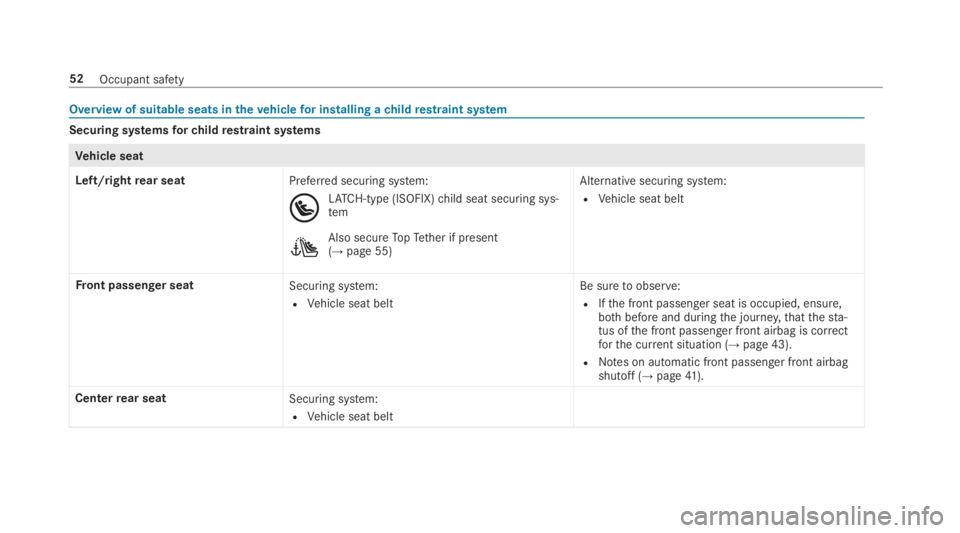
Overview of suitable seats inthevehiclefor installing achildrestraint system
Securing systemsforchildrestraint systems
Vehicle seat
Left/rightrear seatPreferred securing system:
LATCH-type (ISOFIX)child seat securing sys‐tem
Also secureTopTether if present(→page 55)
Alternative securing system:
RVehicle seat belt
Front passenger seatSecuring system:
RVehicle seat belt
Be suretoobserve:
RIfthe front passenger seat is occupied, ensure,bothbefore and duringthe journey,thatthesta‐tus ofthe front passenger front airbag is correctforthe current situation (→page43).
RNotes on automatic front passenger front airbagshutoff (→page41).
Centerrear seatSecuring system:
RVehicle seat belt
52Occupant safety
Page 55 of 578
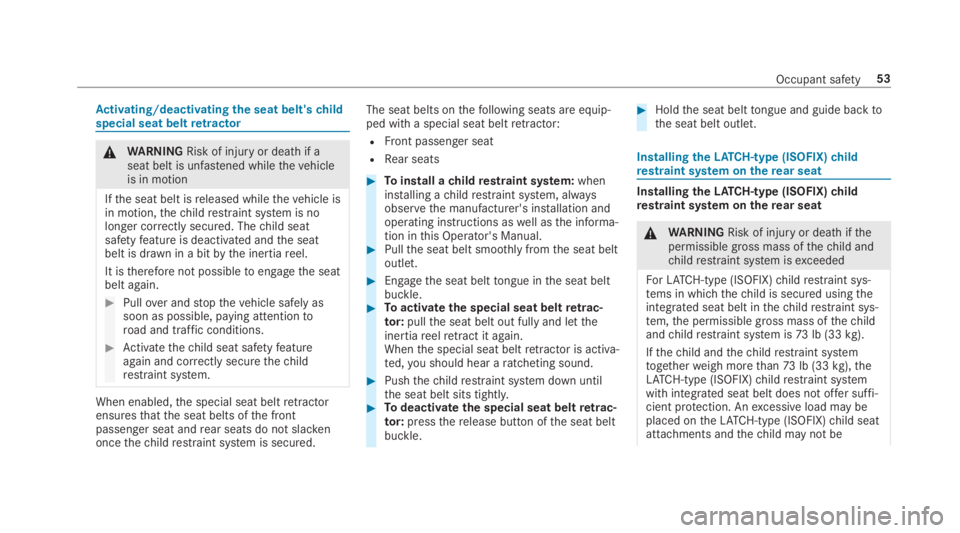
Activating/deactivating the seat belt'schildspecial seat beltretractor
&WARNINGRisk of injuryor death if aseat belt is unfastened whilethevehicleis in motion
Ifthe seat belt isreleased whilethevehicle isin motion,thechildrestraint system is nolonger correctly secured. Thechild seatsafetyfeature is deactivated andthe seatbelt is drawn in a bitbythe inertiareel.
It istherefore not possibletoengagethe seatbelt again.
#Pullover andstopthevehicle safely assoon as possible, paying attentiontoroad and traffic conditions.
#Activatethechild seat safetyfeatureagain and correctly securethechildrestraint system.
When enabled,the special seat beltretractorensuresthatthe seat belts ofthe frontpassenger seat andrear seats do not slackenoncethechildrestraint system is secured.
The seat belts onthefollowing seats are equip‐ped with a special seat beltretractor:
RFront passenger seat
RRear seats
#Toinstall achildrestraint system:wheninstalling achildrestraint system, alwaysobservethe manufacturer's installation andoperating instructions aswell asthe informa‐tion inthis Operator's Manual.#Pullthe seat belt smoothly fromthe seat beltoutlet.
#Engagethe seat belttongue inthe seat beltbuckle.#Toactivatethe special seat beltretrac‐tor:pullthe seat belt out fully and lettheinertiareelretract it again.Whenthe special seat beltretractor is activa‐ted,you should hear aratcheting sound.
#Pushthechildrestraint system down untilthe seat belt sits tightly.#Todeactivate the special seat beltretrac‐tor:presstherelease button ofthe seat beltbuckle.
#Holdthe seat belttongue and guide backtothe seat belt outlet.
InstallingtheLATCH-type (ISOFIX)childrestraint system ontherear seat
InstallingtheLATCH-type (ISOFIX)childrestraint system ontherear seat
&WARNINGRisk of injuryor death ifthepermissible gross mass ofthechild andchildrestraint system isexceeded
ForLATCH-type (ISOFIX)childrestraint sys‐tems in whichthechild is secured usingtheintegrated seat belt inthechildrestraint sys‐tem,the permissible gross mass ofthechildandchildrestraint system is73lb (33kg).
Ifthechild andthechildrestraint systemtogetherweigh morethan73lb (33kg),theLATCH-type (ISOFIX)childrestraint systemwith integrated seat belt does not offer suffi‐cient protection. Anexcessive load may beplaced ontheLATCH-type (ISOFIX)child seatattachments andthechild may not be
Occupant safety53