change wheel MERCEDES-BENZ S CLASS 2019 Owner's Manual
[x] Cancel search | Manufacturer: MERCEDES-BENZ, Model Year: 2019, Model line: S CLASS, Model: MERCEDES-BENZ S CLASS 2019Pages: 578, PDF Size: 23.31 MB
Page 415 of 578
Emergency
Removing the safetyvest
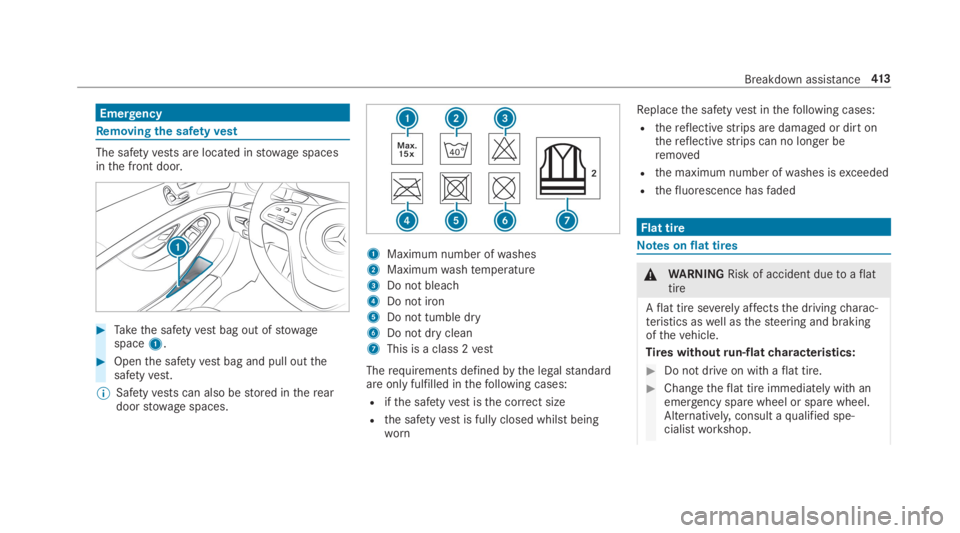
The safetyvests are located instowage spacesinthe front door.
#Takethe safetyvestbag out ofstowagespace1.
#Openthe safetyvestbag and pull outthesafetyvest.
%Safetyvests can also bestored inthereardoorstowage spaces.
1Maximum number ofwashes
2Maximumwashtemperature
3Do not bleach
4Do not iron
5Do not tumble dry
6Do not dry clean
7This is a class 2vest
Therequirements definedbythe legalstandardare only fulfilled inthefollowing cases:
Rifthe safetyvestisthe correct size
Rthe safetyvestis fully closed whilst beingworn
Replacethe safetyvestinthefollowing cases:
Rthereflectivestrips are damaged or dirt onthereflectivestrips can no longer beremoved
Rthe maximum number ofwashes isexceeded
Rthefluorescence hasfaded
Flat tire
Notes on flat tires
&WARNINGRisk of accident duetoaflattire
Aflat tire severelyaffectsthe drivingcharac‐teristics aswell asthesteering and brakingofthevehicle.
Tires withoutrun-flatcharacteristics:
#Do not drive on with aflat tire.
#Changetheflat tire immediately with anemergency sparewheel or spare wheel.Alternatively,consult aqualified spe‐cialistworkshop.
Breakdown assistance413
Page 416 of 578
Tires withrun-flatcharacteristics:
#Observethe information andwarningnotes on MOExtended tires (run-flattires).
Intheevent of aflat tire,thefollowing optionsareavailable depending onyourvehicle's equip‐ment:
RVehicles with MOExtended tires:it is pos‐sibletocontinuethe journeyfor a shortperiod of time. Make sureyou observethenotes on MOExtended tires (run-flat tire)(→page414).
RVehicles with a TIREFIT kit:you canrepairthe tires sothat it is possibletocontinuethejourneyfor a short period of time.Todothis,usethe TIREFIT kit (→page415).
RVehicles with Mercedes me connect:youcan make a callforRoadside Assistance viatheoverhead control panel inthe case of abreakdown (→page 344).
RAllvehicles:changethe wheel(→page 458).
Notes on MOExtended tires (run-flat tire)
&WARNINGRisk of accident when drivingin emergency mode
When driving in emergency mode,the han‐dlingcharacteristics are impaired. e.g. whencornering, when acceleratingstronglyandwhen braking.
#Do notexceedthe permissible maxi‐mum speedfor MOExtended tires.
#Avoid any abruptsteering and drivingmaneuvers aswell as drivingoverobstacles (curbs, pot holes, off-road).This applies, in particular,toa loadedvehicle.
#Stop driving inthe emergency mode ifyou notice:
Rbanging noise
Rvehicle vibration
Rsmoke which smells likerubber
Rcontinuous ESP®intervention
Rcracksin tire sidewalls
#After driving in emergency mode havetherimscheckedbyaqualified special‐istworkshop withregardtotheir furtheruse.
#The defective tire must bereplaced ineverycase.
WithMOExtended tires (run-flat tire),you cancontinuetodriveyourvehicleeven ifthere is atotal loss of pressure in one or more tires. How‐ever,the tire affected must not show any clearlyvisible damage.
You canrecognize MOExtended tiresbytheMOExtended marking which appearsonthe sidewall ofthe tire.
Vehicles with tire pressure monitoring sys‐tem:MOExtended tires may only be used in con‐junction withan activated tire pressure monitor‐ing system.
If a pressure losswarning message appears inthe multifunction display,proceed asfollows:
RCheckthe tirefor damage.
RIf driving on, observethefollowing notes.
414Breakdown assistance
Page 418 of 578
&WARNINGRisk of injuryand poisoningfrom tire sealant
The tire sealant is harmful and causes irrita‐tion. Do not allow ittocome into contactwith the skin,eyes or clothing, and do notswallow it. Do not inhale tire sealant fumes.Keepthe tire sealantawayfromchildren.
Ifyou come into contact withthe tire sealant,observethefollowing:
#Rinse offthe tire sealant fromyour skinimmediately usingwater.
#If tire sealantgets intoyoureyes,thor‐oughlyrinse outtheeyes using cleanwater.
#If tire sealant has been swallowed,immediatelyrinse outthe mouththor‐oughly and drink plenty ofwater.Do notinducevomiting and seek medicalattention immediately.
#Change out of any clothes contamina‐ted with tire sealant immediately.
#If allergicreactions occur, seek medicalattention immediately.
*NOTEOverheating duetothe tire infla‐tion compressorrunningtoo long
#Do notrunthe tire inflation compressorfor longerthan eight minutes withoutinterruption.
Comply withthe manufacturer's safety notes onthesticker onthe tire inflation compressor.
Havethe tire sealant bottlereplacedeveryfouryears at aqualified specialistworkshop.
#Do notremoveanyforeign objects whichhaveenteredthe tire.
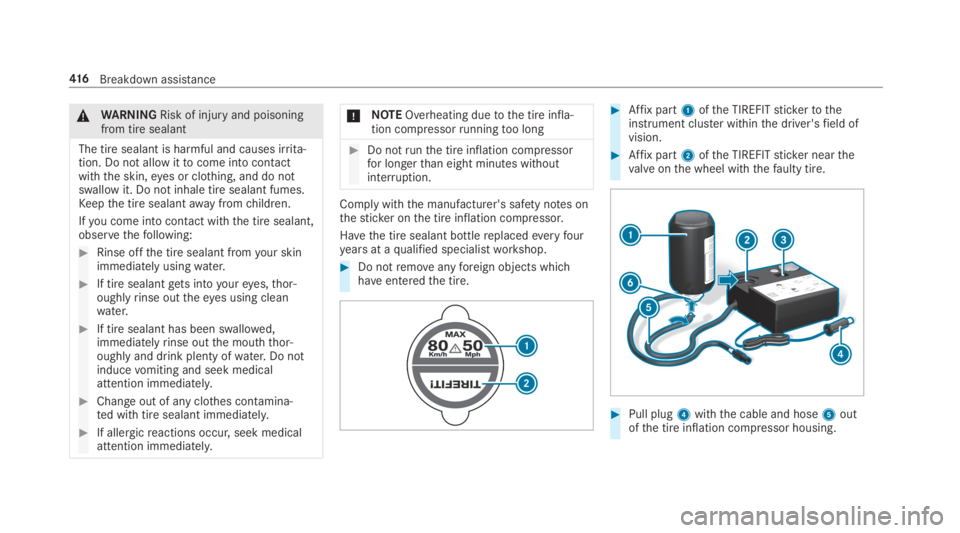
#Affix part1ofthe TIREFITstickertotheinstrument cluster withinthe driver'sfield ofvision.
#Affix part2ofthe TIREFITsticker nearthevalve onthe wheel withthefaulty tire.
#Pull plug4withthe cable and hose5outofthe tire inflation compressor housing.
416Breakdown assistance
Page 438 of 578
RThe tires maywearexcessively and/orunevenly,which maygreatlyimpair tiretraction.
RThe drivingcharacteristics, aswell assteering and braking, may be greatlyimpaired.
#Comply withtherecommended tirepressure andcheckthe tire pressure ofall tires includingthe spare wheelregu‐larly:
Rat least once a month
Rwhenthe loadchanges
Rbefore embarking on a longer journey
Rif operating conditionschange, e.g. off-road driving
#Adjustthe tire pressure as necessary.
Driving withtire pressurethat istoo high ortoolow can:
RShortenthe service life ofthe tires.
RCause increased tire damage.
RAdversely affect drivingcharacteristics andthus driving safety,e.g. dueto hydroplaning.
&WARNINGRisk of an accident duetoinsufficient tire pressure
Tires with pressurethat istoo low canover‐heat and burstas aresult.
In addition,theyalso suffer fromexcessiveand/or irregularwear, which can significantlyimpairthe braking properties andthe han‐dlingcharacteristics.
#Avoidexcessively low tire pressures inallthe tires, includingthe spare wheel.
Tirepressure which istoo low can cause:
RTiredefects as aresult ofoverheating
RImpaired handlingcharacteristics
RIrregularwear
RIncreased fuel consumption
&WARNINGRisk of accident fromexces‐sive tire pressure
Tires withexcessively high pressure canburst becausetheyare damaged more easilybyhighwayfill, pot holesetc.
In addition,theyalso suffer from irregularwear, which can significantly impairthe brak‐ing properties andthe handlingcharacteris‐tics.
#Avoidexcessively high tire pressures inallthe tires, includingthe spare wheel.
Excessively high tire pressure canresult in:
RIncreased braking distance
RImpaired handlingcharacteristics
RIrregularwear
RImpaired driving comfort
RSusceptibilitytodamage
436Wheels and tires
Page 442 of 578
The systemchecksthe tire pressure andthe tiretemperature ofthe tires installed onthevehiclebymeans of a tire pressuresensor.
New tire pressure sensors, e.g. in winter tires,are automaticallytaught-in duringthefirst jour‐neytheyare used.
The tire pressure appears inthe multifunctiondisplay (→page 255).
Ifthere is a substantial pressure loss or ifthetiretemperature isexcessive,you will bewarnedinthefollowingways:
Rvia display messages (→page511)
Rviathewwarning lamp inthe instrumentcluster (→page 533)
The tire pressuremonitoring system is only anaid. It isthe driver'sresponsibilitytosetthe tirepressuretotherecommended cold tire pressuresuitableforthe operating situation. Setthe tirepressurefor cold tires using a tire pressuregauge. Notethatthe correct tire pressureforthecurrent operating situation mustfirst betaught-intothe tire pressure monitoring system.
In most cases,the tire pressure monitoring sys‐tem will automatically updatethe newreferencevalues afteryou havechangedthe tire pressure.You can, however,also updatethereferenceval‐uesbyrestartingthe tire pressure monitoringsystem manually (→page441).
System limitations
The system may be impaired or may not functioninthefollowing situations:
RIfthe tire pressure is set incorrectly
RIfthere is a sudden pressure loss caused,forexample,byaforeign object penetratingthetire
RIfthere is a malfunction causedbyanotherradio signal source
Make suretoobservethefollowing furtherrela‐ted subject:
RNotes on tire pressure (→page 435)
Checkingthe tire pressure withthe tire pres‐sure monitoring system
Requirements:RThe ignition is switched on.
On-board computer:
,Service.Tires
One ofthefollowing displaysappears:
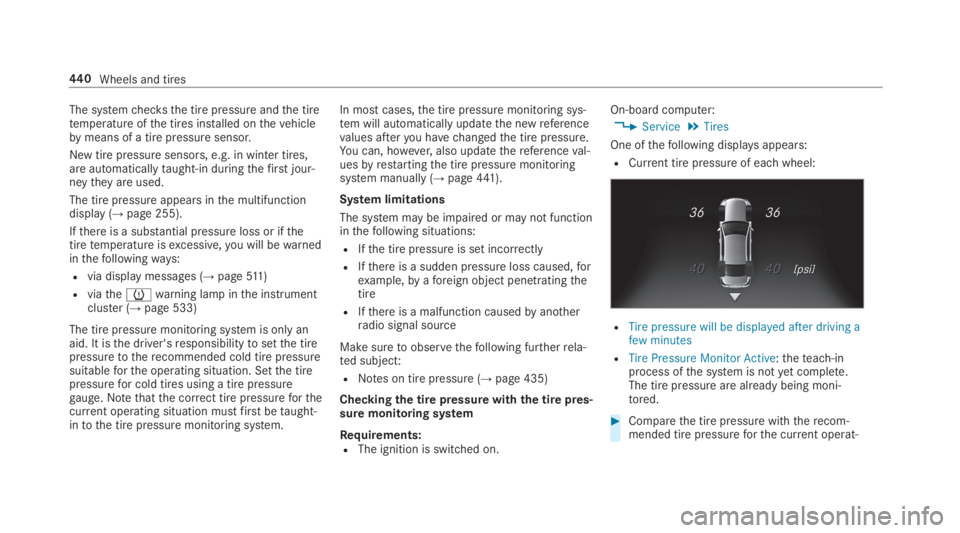
RCurrent tire pressure of eachwheel:
RTire pressure will be displayed after driving afew minutes
RTire Pressure Monitor Active:theteach-inprocess ofthe system is notyet complete.The tire pressure are already being moni‐tored.
#Comparethe tire pressure withtherecom‐mended tire pressureforthe current operat‐
440Wheels and tires
Page 443 of 578
ing condition (→page 437). Observethenotes on tiretemperature (→page 435).
%Thevalues displayed inthe multifunction dis‐play may deviate fromthose ofthe tire pres‐suregauge astheyrefertosea level.Athighaltitudes,the tire pressurevalue indicatedbya pressuregauge are higherthanthoseshownbythe on-board computer. Inthiscase, do notreducethe tire pressure.
Make suretoobservethefollowing furtherrela‐ted subject:
RNotes on tire pressure (→page 435)
Restartingthe tire pressure monitoring sys‐tem
Requirements:RTherecommended tire pressure is correctlysetfortherespective operating condition oneach ofthefour wheels (→page 435).
Restartthe tire pressure monitoring system inthefollowing situations:
RThe tire pressure haschanged.
RThe wheels or tires havebeenchanged ornewly installed.
On-board computer:
,Service.Tires
#Swipe downwards onTouch Control ontheleft-hand side ofthesteering wheel.TheUse Current Pressures as New Refer-ence Values?message is shown inthe multi‐function display.
#Pressvtoconfirmtherestart.TheRun Flat Indicator Restartedmessage isshown inthe multifunction display.
Currentwarning messages are deleted andthewyellowwarning lamp goes out.
Afteryou havedrivenfor afew minutes,thesystemcheckswhetherthe current tire pres‐sures are withinthe specifiedrange. The cur‐rent tire pressures arethen accepted asref‐erencevalues and monitored.
Make suretoobservethefollowing furtherrela‐ted subject:
RNotes on tire pressure (→page 435)
Radio equipment approval ofthe tire pres‐sure monitoring system
Radio equipment approval numbers
CountryRadio type approval number
Canada IC: 2546A-GG4T
IC: 2546A-DG6W2D4
IC: 2546A-MC34MA4
Le présent appareil est conformeaux CNR d'Industrie Canadaapplicables aux appareilsradioexempts de licence. L'exploita‐tion est autorisée aux deux con‐ditions suivantes:
(1) l'appareil ne doit pas produirede brouillage,et
(2) l'utilisateur de l'appareil doitacceptertout brouillageradioé‐lectrique subi, même si le
brouillage est susceptible d'encompromettrelefonctionnement.
Wheels and tires441
Page 457 of 578
Only use tires, wheels and accessoriesthathavebeenchecked andrecommendedbyMercedes-Benz.
*NOTERisktodriving safety fromretrea‐ded tires
Retreaded tires are neithertested norrecom‐mendedbyMercedes-Benz, since previousdamage cannot always be detected onretreaded tires.
Forthisreason driving safety cannot be guar‐anteed.
#Do not use used tires ifyou havenoinformation abouttheir previous usage.
*NOTEPossible damagetowheels or tireswhen drivingover obstacles
Large wheels havea lower tire section width.The lowerthe tire section width,the greateristherisk of damagetowheels or tires whendrivingover obstacles.
#Avoid obstacles or drive particularlycarefully.
*NOTEDamagetoelectronic componentparts fromthe use of tire-mountingtools
Vehicles with a tire pressure monitoringsystem:Electronic component parts arelocated inthe wheel.Tire-mountingtoolsshould not be used inthe area ofthevalve.
This couldotherwise damagethe electroniccomponent parts.
#Havethe tireschanged at aqualifiedspecialistworkshop only.
*NOTEDamagetosummer tires at lowambienttemperatures
Atlow ambienttemperatures,tears couldformwhen driving with summer tires, caus‐ing permanent damagetothe tires.
#Attemperatures below 45 °F (7 °C),use M+S tires .
Accessory partsthat are not approvedforyourvehiclebyMercedes-Benz or are not being usedcorrectly can impairthe operating safety.
Before purchasing and using non-approvedaccessories, visit aqualified specialistworkshopand inquire about:
RSuitability
RLegalstipulations
RFactoryrecommendations
&WARNINGRisk of accident withhighperformance tires
The special tire tread in combination withtheoptimized tire compound meansthattheriskof skidding orhydroplaning onwetroads isincreased.
In addition,the tire grip is greatlyreduced ata low outsidetemperature and tirerunningtemperature.
#Switch onthe ESP®and adaptyourdrivingstyle accordingly.
#Use M+S tire at outsidetemperaturesof lessthan10°C (50 °F).
Wheels and tires455
Page 459 of 578
Thewear patterns onthe front andrear wheelsdiffer:
RFront wheelswear more onthe shoulder ofthe tire
RRear wheelswear more inthe center ofthetire
Onvehiclesthat havethe same size front andrear wheels,rotatethe wheels accordingtotheintervals inthe tire manufacturer'swarrantybook inyourvehicle documents. Ifthis is notavailable,rotatethe tiresevery3,000to6,000 miles (5,000to10,000 km),depending onthewear. Ensurethatthe directionofrotation is maintained.
It is imperativetoobservethe instructions andsafety notes on "Changing a wheel" when doingso Preparingthevehiclefor a wheelchange(→page 458).
Notes onstoring wheels
Whenstoring wheels, observethefollowingnotes:
RAfterremoving wheels,storethem in a cool,dry and preferably dark place.
RProtectthe tires from contact withoil, greaseor fuel.
Overview ofthe tire-changetool kit
Apart from some country-specificvariants,vehi‐cles are not equipped with a tire-changetool kit.For more information on whichtire-changetoolsarerequired and approvedfor performing awheelchange onyourvehicle, consult aqualifiedspecialistworkshop.
Required tire-changetools may include,forexample:
RJack
RChock
RLug wrench
RAlignment bolt
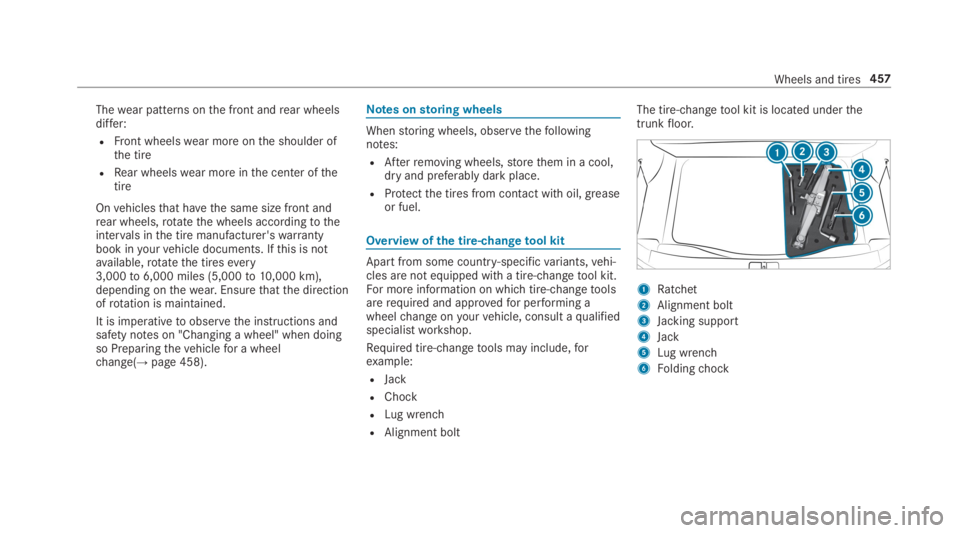
The tire-changetool kit is located underthetrunkfloor.
1Ratchet
2Alignment bolt
3Jacking support
4Jack
5Lug wrench
6Foldingchock
Wheels and tires457
Page 460 of 578
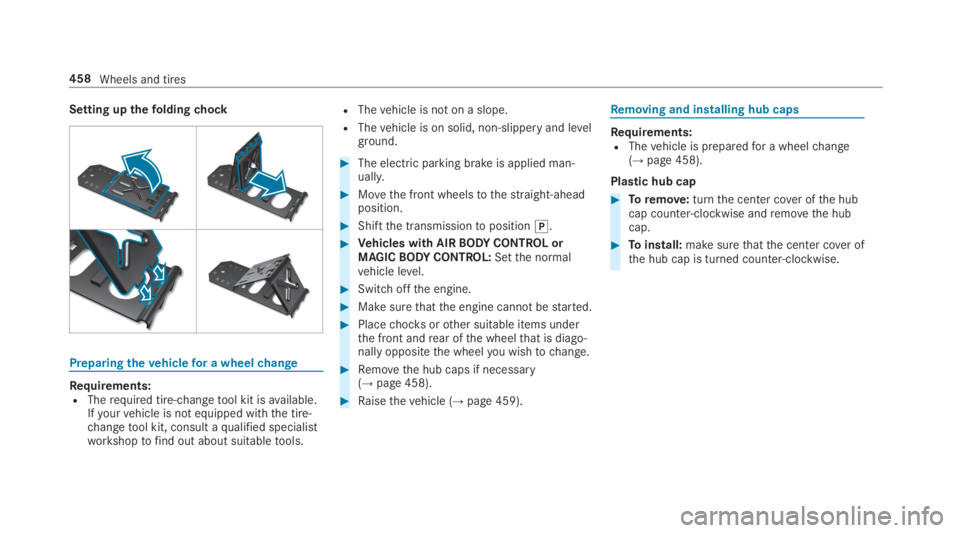
Setting upthefoldingchock
Preparingthevehiclefor a wheelchange
Requirements:RTherequired tire-changetool kit isavailable.Ifyourvehicle is not equipped withthe tire-changetool kit, consult aqualified specialistworkshoptofind out about suitabletools.
RThevehicle is not on a slope.
RThevehicle is on solid, non-slippery and levelground.
#The electric parking brake is applied man‐ually.
#Movethe front wheelstothestraight-aheadposition.
#Shiftthe transmissiontoposition].
#Vehicles with AIRBODYCONTROL orMAGICBODYCONTROL:Setthe normalvehicle level.
#Switchoffthe engine.
#Make surethatthe engine cannotbestarted.
#Placechocksorother suitable items underthe front andrear ofthe wheelthat is diago‐nally oppositethe wheelyou wishtochange.
#Removethe hub caps if necessary(→page 458).
#Raisethevehicle (→page 459).
Removing and installing hub caps
Requirements:RThevehicle is preparedfor a wheelchange(→page 458).
Plastic hub cap
#Toremove:turnthe center cover ofthe hubcap counter-clockwise andremovethe hubcap.
#Toinstall:make surethatthe center cover ofthe hub cap is turned counter-clockwise.
458Wheels and tires
Page 461 of 578
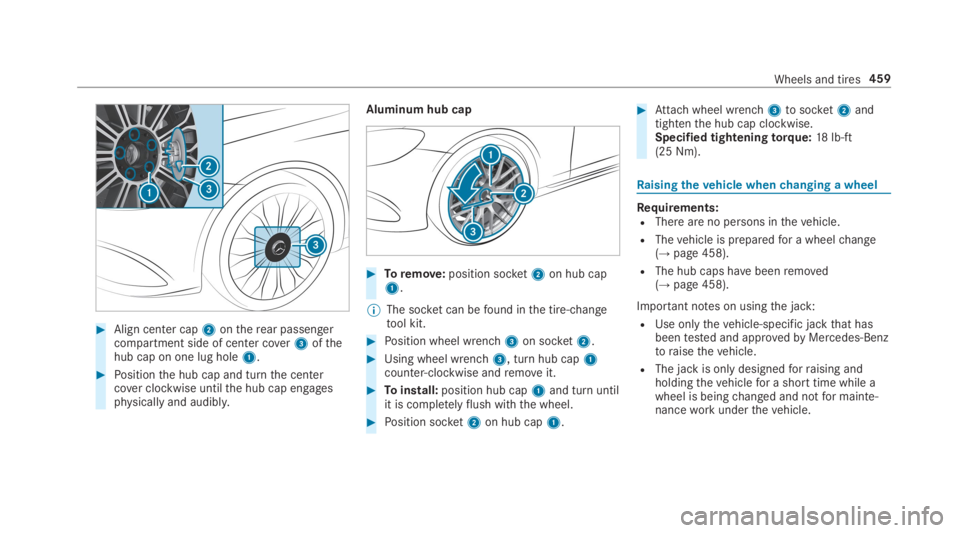
#Align center cap2ontherear passengercompartment side of center cover3ofthehub cap on one lug hole1.
#Positionthe hub cap and turnthe centercover clockwise untilthe hub cap engagesphysically and audibly.
Aluminum hub cap
#Toremove:position socket2on hub cap1.
%The socket can befound inthe tire-changetool kit.
#Position wheel wrench3on socket2.
#Using wheel wrench3, turn hub cap1counter-clockwise andremoveit.
#Toinstall:position hub cap1and turn untilit is completelyflush withthe wheel.
#Position socket2on hub cap1.
#Attachwheel wrench3tosocket2andtightenthe hub cap clockwise.Specified tighteningtorque:18lb-ft(25 Nm).
Raisingthevehicle whenchanging a wheel
Requirements:RThere are no persons inthevehicle.
RThevehicle is preparedfor a wheelchange(→page 458).
RThe hub caps havebeenremoved(→page 458).
Important notes on usingthe jack:
RUse onlythevehicle-specific jackthat hasbeentested and approvedbyMercedes-Benztoraisethevehicle.
RThe jack is only designedforraising andholdingthevehiclefor a short time while awheel is beingchanged and notfor mainte‐nanceworkunderthevehicle.
Wheels and tires459