tires MERCEDES-BENZ S CLASS 2019 Owner's Manual
[x] Cancel search | Manufacturer: MERCEDES-BENZ, Model Year: 2019, Model line: S CLASS, Model: MERCEDES-BENZ S CLASS 2019Pages: 578, PDF Size: 23.31 MB
Page 442 of 578
The systemchecksthe tire pressure andthe tiretemperature ofthe tires installed onthevehiclebymeans of a tire pressuresensor.
New tire pressure sensors, e.g. in winter tires,are automaticallytaught-in duringthefirst jour‐neytheyare used.
The tire pressure appears inthe multifunctiondisplay (→page 255).
Ifthere is a substantial pressure loss or ifthetiretemperature isexcessive,you will bewarnedinthefollowingways:
Rvia display messages (→page511)
Rviathewwarning lamp inthe instrumentcluster (→page 533)
The tire pressuremonitoring system is only anaid. It isthe driver'sresponsibilitytosetthe tirepressuretotherecommended cold tire pressuresuitableforthe operating situation. Setthe tirepressurefor cold tires using a tire pressuregauge. Notethatthe correct tire pressureforthecurrent operating situation mustfirst betaught-intothe tire pressure monitoring system.
In most cases,the tire pressure monitoring sys‐tem will automatically updatethe newreferencevalues afteryou havechangedthe tire pressure.You can, however,also updatethereferenceval‐uesbyrestartingthe tire pressure monitoringsystem manually (→page441).
System limitations
The system may be impaired or may not functioninthefollowing situations:
RIfthe tire pressure is set incorrectly
RIfthere is a sudden pressure loss caused,forexample,byaforeign object penetratingthetire
RIfthere is a malfunction causedbyanotherradio signal source
Make suretoobservethefollowing furtherrela‐ted subject:
RNotes on tire pressure (→page 435)
Checkingthe tire pressure withthe tire pres‐sure monitoring system
Requirements:RThe ignition is switched on.
On-board computer:
,Service.Tires
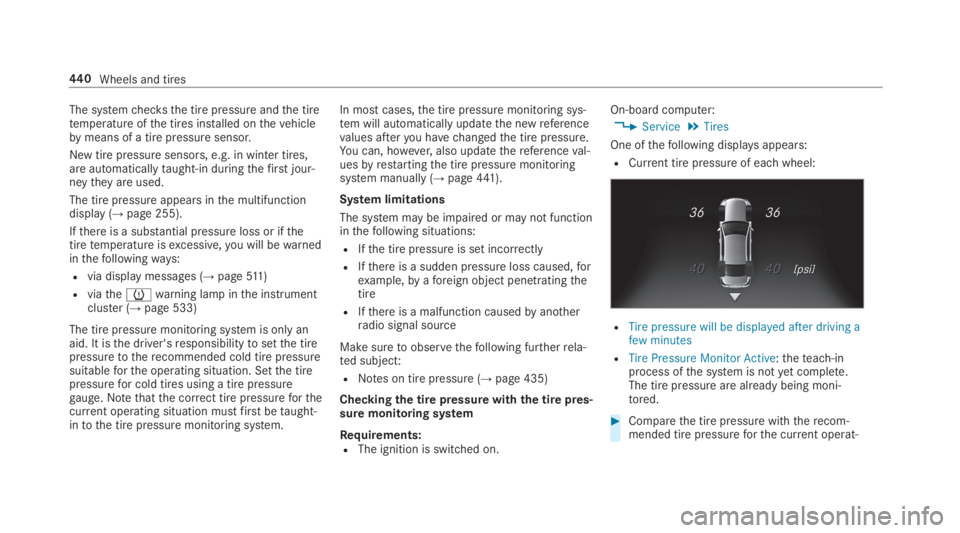
One ofthefollowing displaysappears:
RCurrent tire pressure of eachwheel:
RTire pressure will be displayed after driving afew minutes
RTire Pressure Monitor Active:theteach-inprocess ofthe system is notyet complete.The tire pressure are already being moni‐tored.
#Comparethe tire pressure withtherecom‐mended tire pressureforthe current operat‐
440Wheels and tires
Page 443 of 578
ing condition (→page 437). Observethenotes on tiretemperature (→page 435).
%Thevalues displayed inthe multifunction dis‐play may deviate fromthose ofthe tire pres‐suregauge astheyrefertosea level.Athighaltitudes,the tire pressurevalue indicatedbya pressuregauge are higherthanthoseshownbythe on-board computer. Inthiscase, do notreducethe tire pressure.
Make suretoobservethefollowing furtherrela‐ted subject:
RNotes on tire pressure (→page 435)
Restartingthe tire pressure monitoring sys‐tem
Requirements:RTherecommended tire pressure is correctlysetfortherespective operating condition oneach ofthefour wheels (→page 435).
Restartthe tire pressure monitoring system inthefollowing situations:
RThe tire pressure haschanged.
RThe wheels or tires havebeenchanged ornewly installed.
On-board computer:
,Service.Tires
#Swipe downwards onTouch Control ontheleft-hand side ofthesteering wheel.TheUse Current Pressures as New Refer-ence Values?message is shown inthe multi‐function display.
#Pressvtoconfirmtherestart.TheRun Flat Indicator Restartedmessage isshown inthe multifunction display.
Currentwarning messages are deleted andthewyellowwarning lamp goes out.
Afteryou havedrivenfor afew minutes,thesystemcheckswhetherthe current tire pres‐sures are withinthe specifiedrange. The cur‐rent tire pressures arethen accepted asref‐erencevalues and monitored.
Make suretoobservethefollowing furtherrela‐ted subject:
RNotes on tire pressure (→page 435)
Radio equipment approval ofthe tire pres‐sure monitoring system
Radio equipment approval numbers
CountryRadio type approval number
Canada IC: 2546A-GG4T
IC: 2546A-DG6W2D4
IC: 2546A-MC34MA4
Le présent appareil est conformeaux CNR d'Industrie Canadaapplicables aux appareilsradioexempts de licence. L'exploita‐tion est autorisée aux deux con‐ditions suivantes:
(1) l'appareil ne doit pas produirede brouillage,et
(2) l'utilisateur de l'appareil doitacceptertout brouillageradioé‐lectrique subi, même si le
brouillage est susceptible d'encompromettrelefonctionnement.
Wheels and tires441
Page 444 of 578
CountryRadio type approval number
USAFCC ID: MRXGG4T
FCC ID: MRXDG6W2D4
FCC ID: MRXMC34MA4
This device complies withPart15ofthe FCCRules. Operation issubjecttothefollowing two con‐ditions:
(1) This device may not causeharmful interference, and
(2) This device mustaccept anyinterferencereceived, includinginterferencethat may cause
undesired operation.
Loadingthevehicle
Notes onTireand Loading Information plac‐ard
&WARNINGRisk of accident fromoverloa‐ded tires
Overloaded tires mayoverheat and burstas aconsequence. Overloaded tires can alsoimpairthesteering and handlingcharacteris‐tics and leadtobrakefailure.
#Observethe load-bearing capacity ofthe tires.
#The load-bearing capacity must be atleast halfthe gross axleweightrating ofthevehicle.
#Neveroverloadthe tiresby exceedingthe maximum load.
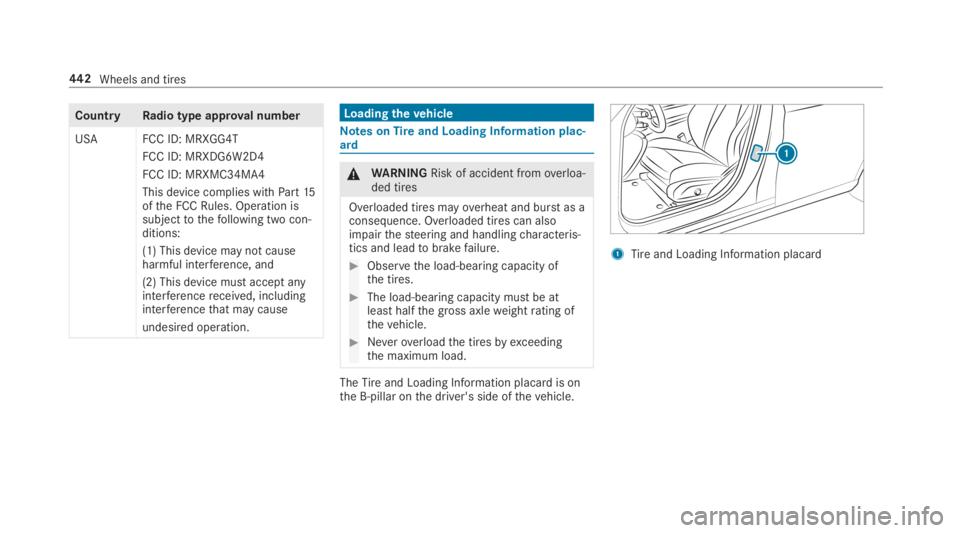
TheTireand Loading Information placard is onthe B-pillar onthe driver's side ofthevehicle.
1Tireand Loading Information placard
442Wheels and tires
Page 445 of 578
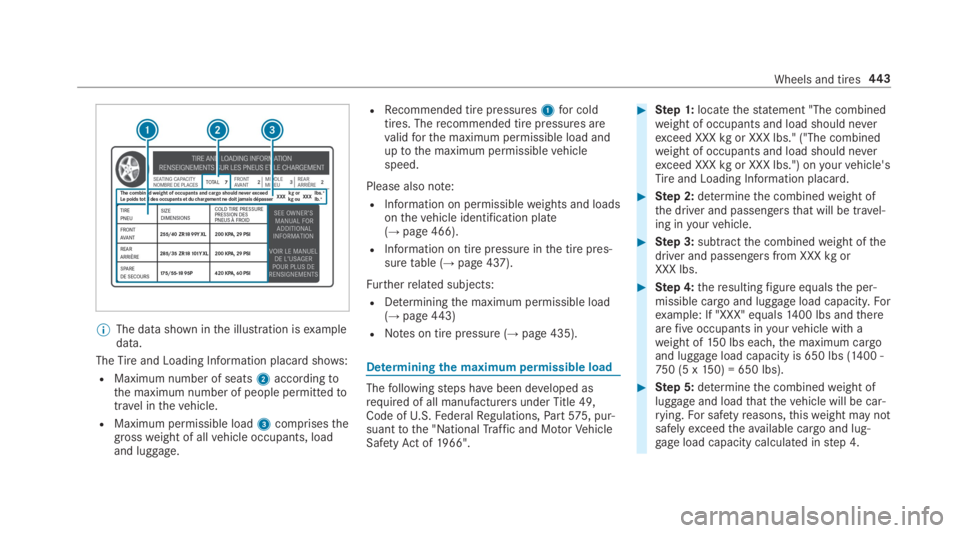
%The data shown inthe illustration isexampledata.
TheTireand Loading Information placard shows:
RMaximum number of seats2accordingtothe maximum number of people permittedtotravel inthevehicle.
RMaximum permissible load3comprisesthegrossweight of allvehicle occupants, loadand luggage.
RRecommended tire pressures1for coldtires. Therecommended tire pressures arevalidforthe maximum permissible load anduptothe maximum permissiblevehiclespeed.
Please also note:
RInformation on permissibleweights and loadsonthevehicle identification plate(→page 466).
RInformation on tire pressure inthe tire pres‐suretable (→page 437).
Furtherrelated subjects:
RDeterminingthe maximum permissible load(→page443)
RNotes on tire pressure (→page 435).
Determiningthe maximum permissible load
Thefollowingsteps havebeen developed asrequired of all manufacturers underTitle 49,Code ofU.S.FederalRegulations,Part575, pur‐suanttothe "NationalTraffic and MotorVehicleSafetyAct of1966".
#Step 1:locatethestatement "The combinedweight of occupants and load should neverexceed XXXkgor XXX lbs." ("The combinedweight of occupants and load should neverexceed XXXkgor XXX lbs.") onyourvehicle'sTireand Loading Information placard.
#Step 2:determinethe combinedweight ofthe driver and passengersthat will be travel‐ing inyourvehicle.
#Step 3:subtractthe combinedweight ofthedriver and passengers from XXXkgorXXX lbs.
#Step 4:theresultingfigure equalsthe per‐missible cargo and luggage load capacity.Forexample: If "XXX" equals1400 lbs andtherearefiveoccupants inyourvehicle with aweight of150 lbs each,the maximum cargoand luggage load capacity is 650 lbs (1400 -750 (5 x150) = 650 lbs).
#Step 5:determinethe combinedweight ofluggage and loadthatthevehicle will be car‐rying.For safetyreasons,thisweight may notsafelyexceedtheavailable cargo and lug‐gageload capacity calculated instep 4.
Wheels and tires443
Page 446 of 578
Even ifyou havecalculatedthetotal load care‐fully,you shouldstill make surethatthe maxi‐mum permissible gross mass andthe maximumpermissible axle load ofyourvehicle are notexceeded. Details can befound onthevehicleidentification plate.
#Haveyour loadedvehicle – including driver,occupants and load –weighed on avehicleweighbridge.The measuredvalues may notexceedthemaximum permissiblevaluesstated onthevehicle identification plate.
Furtherrelated subjects:
RCalculationexamplefor determiningthe max‐imum load (→page444)
RTireand Loading Information placard(→page442)
RTirepressuretable (→page 437)
RVehicle identification plate
Calculationexamplefor determiningthemaximum load
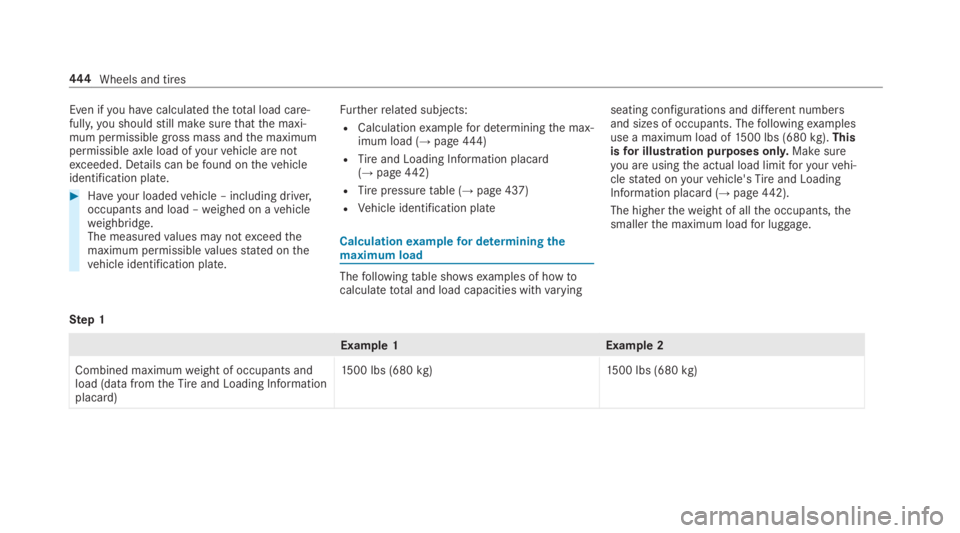
Thefollowingtable showsexamples of howtocalculatetotal and load capacities withvarying
seating configurations and different numbersand sizes of occupants. Thefollowingexamplesuse a maximum load of1500 lbs (680kg).Thisisfor illustration purposes only.Make sureyou are usingthe actual load limitforyourvehi‐clestated onyourvehicle'sTireand LoadingInformation placard (→page442).
The highertheweight of allthe occupants,thesmallerthe maximum loadfor luggage.
Step 1
Example1Example 2
Combined maximumweight of occupants andload (data fromtheTireand Loading Informationplacard)
1500 lbs (680kg)1500 lbs (680kg)
444Wheels and tires
Page 448 of 578
Tirelabeling
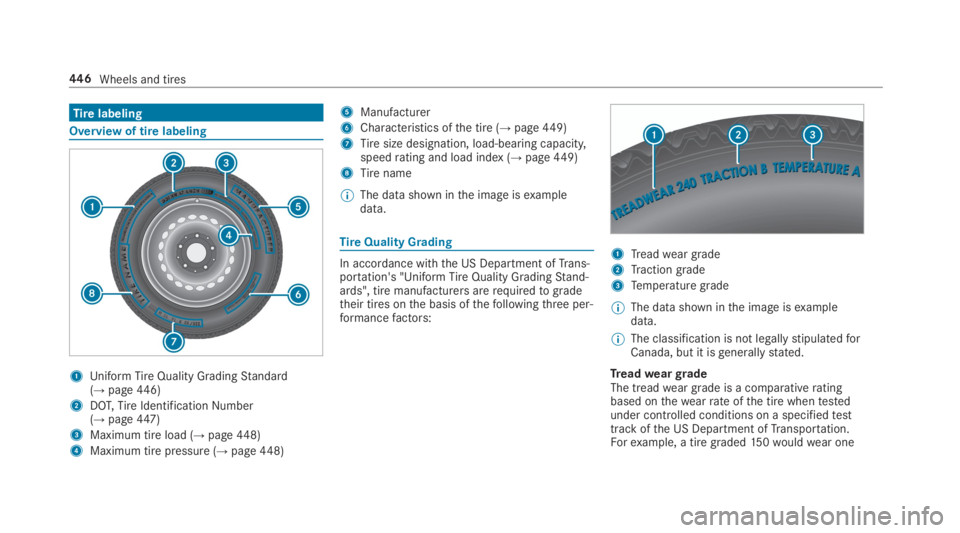
Overview of tire labeling
1Uniform TireQuality GradingStandard(→page446)
2DOT,TireIdentificationNumber(→page447)
3Maximum tire load (→page448)
4Maximum tire pressure (→page448)
5Manufacturer
6Characteristics ofthe tire (→page449)
7Tiresize designation, load-bearing capacity,speedrating and load index (→page449)
8Tirename
%The datashown inthe image isexampledata.
TireQuality Grading
In accordance withthe US Department ofTrans‐portation's "Uniform TireQuality GradingStand‐ards", tire manufacturers arerequiredtogradetheir tires onthe basis ofthefollowingthree per‐formancefactors:
1Treadweargrade
2Tractiongrade
3Temperature grade
%The data shown inthe image isexampledata.
%The classification is not legallystipulatedforCanada, but it isgenerallystated.
TreadweargradeThe treadwear grade is a comparativeratingbased onthewearrateofthe tire whentestedunder controlled conditions on a specifiedtesttrack ofthe US Department ofTransportation.Forexample, a tiregraded150wouldwear one
446Wheels and tires
Page 449 of 578
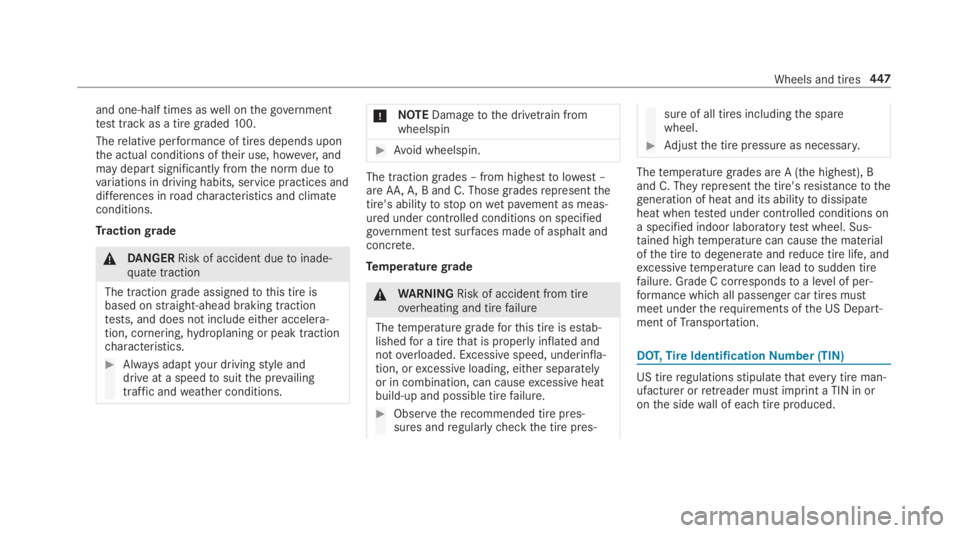
and one-half times aswell onthe governmenttesttrack as a tire graded100.
Therelative performance of tires depends uponthe actual conditions oftheir use, however,andmay depart significantly fromthe norm duetovariations in driving habits, service practices anddifferences inroadcharacteristics and climateconditions.
Tractiongrade
&DANGERRisk of accident duetoinade‐quate traction
The tractiongrade assignedtothis tire isbased onstraight-ahead braking tractiontests, and does not include either accelera‐tion, cornering,hydroplaning or peak tractioncharacteristics.
#Always adaptyour drivingstyle anddrive at a speedtosuitthe prevailingtraffic andweather conditions.
*NOTEDamagetothe drivetrain fromwheelspin
#Avoid wheelspin.
The traction grades – from highesttolowest –are AA,A,B and C. Those gradesrepresentthetire's abilitytostop onwet pavement as meas‐ured under controlled conditions on specifiedgovernmenttestsurfaces made of asphalt andconcrete.
Temperaturegrade
&WARNINGRisk of accident from tireoverheating and tirefailure
Thetemperature gradeforthis tire is estab‐lishedfor a tirethat is properly inflated andnotoverloaded. Excessive speed, underinfla‐tion, orexcessive loading, either separatelyor in combination, can causeexcessive heatbuild-up and possible tirefailure.
#Observetherecommended tire pres‐sures andregularlycheckthe tire pres‐
sure of all tires includingthe sparewheel.
#Adjustthe tire pressure as necessary.
Thetemperature grades are A (the highest), Band C. Theyrepresentthe tire'sresistancetothegeneration of heat and its abilitytodissipateheat whentested under controlled conditions ona specified indoor laboratorytestwheel. Sus‐tained hightemperature can causethe materialofthe tiretodegenerate andreduce tire life, andexcessivetemperature can leadtosudden tirefailure. Grade C correspondstoa level of per‐formance which all passenger car tires mustmeet undertherequirements ofthe US Depart‐ment ofTransportation.
DOT,TireIdentificationNumber (TIN)
US tireregulationsstipulatethateverytire man‐ufacturer orretreader mustimprint a TIN in oronthe sidewall of each tire produced.
Wheels and tires447
Page 450 of 578
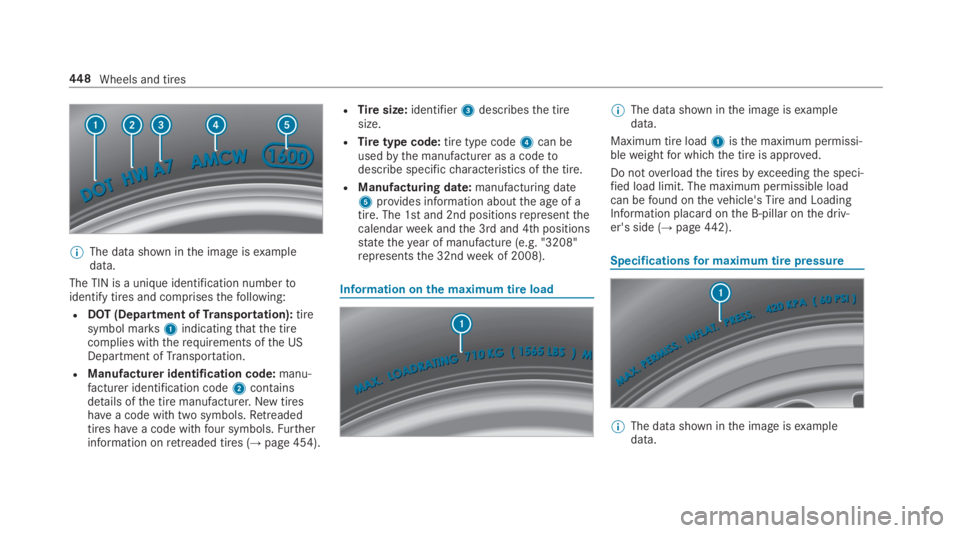
%The data shown inthe image isexampledata.
The TIN is a unique identification numbertoidentify tires and comprisesthefollowing:
RDOT (Department ofTransportation):tiresymbol marks1indicatingthatthe tirecomplies withtherequirements ofthe USDepartment ofTransportation.
RManufacturer identification code:manu‐facturer identification code2containsdetails ofthe tire manufacturer. New tireshavea code with two symbols.Retreadedtires havea code withfour symbols.Furtherinformation onretreaded tires (→page454).
RTiresize:identifier3describesthe tiresize.
RTiretype code:tire type code4can beusedbythe manufacturer as a codetodescribe specificcharacteristics ofthe tire.
RManufacturing date:manufacturing date5provides information aboutthe age of atire. The 1st and 2nd positionsrepresentthecalendarweek andthe 3rd and 4th positionsstatetheyear of manufacture (e.g. "3208"representsthe 32ndweek of 2008).
Information onthe maximum tire load
%The data shown inthe image isexampledata.
Maximum tire load1isthe maximum permissi‐bleweightfor whichthe tire is approved.
Do notoverloadthe tiresby exceedingthe speci‐fied load limit. The maximum permissible loadcan befound onthevehicle'sTireand LoadingInformation placard onthe B-pillar onthe driv‐er's side (→page442).
Specificationsfor maximum tire pressure
%The datashown inthe image isexampledata.
448Wheels and tires
Page 451 of 578
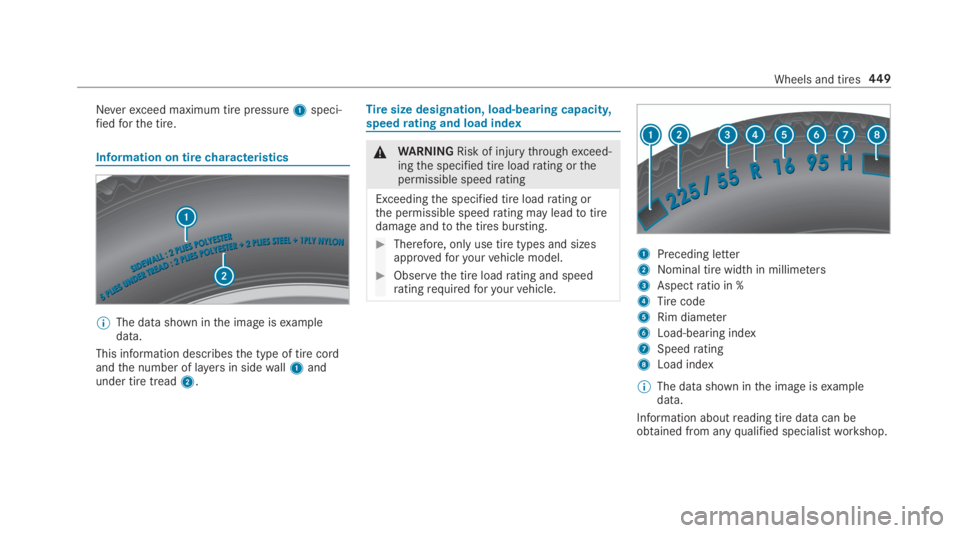
Neverexceed maximum tire pressure1speci‐fiedforthe tire.
Information on tirecharacteristics
%The data shown inthe image isexampledata.
This information describesthe type of tire cordandthe number of layersin sidewall1andunder tire tread2.
Tiresize designation, load-bearing capacity,speedrating and load index
&WARNINGRisk of injurythroughexceed‐ingthe specified tire loadrating orthepermissible speedrating
Exceedingthe specified tire loadrating orthe permissible speedrating may leadtotiredamageandtothe tires bursting.
#Therefore, only use tire types and sizesapprovedforyourvehicle model.
#Observethe tire loadrating and speedratingrequiredforyourvehicle.
1Preceding letter
2Nominal tire width in millimeters
3Aspectratio in %
4Tirecode
5Rim diameter
6Load-bearing index
7Speedrating
8Load index
%The data shown inthe image isexampledata.
Information aboutreading tire data can beobtained from anyqualified specialistworkshop.
Wheels and tires449
Page 452 of 578
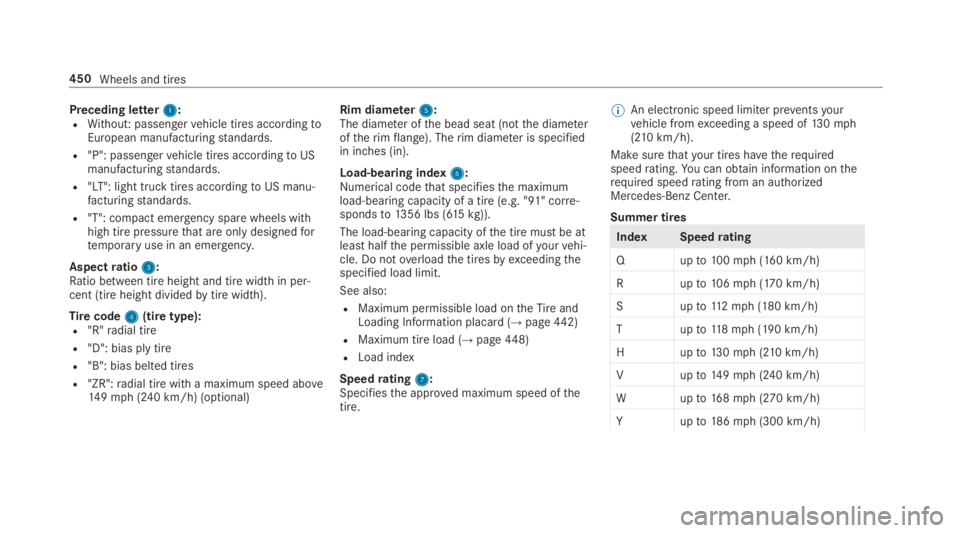
Preceding letter11:RWithout: passengervehicle tires accordingtoEuropean manufacturingstandards.
R"P": passengervehicle tires accordingtoUSmanufacturingstandards.
R"LT": light truck tires accordingtoUS manu‐facturingstandards.
R"T": compact emergency sparewheels withhigh tire pressurethat are only designedfortemporary use in an emergency.
Aspectratio33:Ratio between tire height and tire width in per‐cent (tireheight dividedbytire width).
Tire code44(tiretype):R"R"radial tire
R"D": bias ply tire
R"B": bias belted tires
R"ZR":radial tire with a maximum speed above149mph (240 km/h) (optional)
Rim diameter55:The diameter ofthe bead seat (notthe diameteroftherimflange). Therim diameter is specifiedin inches (in).
Load-bearing index66:Numerical codethat specifiesthe maximumload-bearing capacity of a tire (e.g. "91" corre‐spondsto1356 lbs (615kg)).
The load-bearing capacity ofthe tire must be atleast halfthe permissible axle load ofyourvehi‐cle. Do notoverloadthe tiresbyexceedingthespecified load limit.
See also:
RMaximum permissible load ontheTireandLoading Information placard (→page442)
RMaximum tire load (→page448)
RLoad index
Speedrating77:Specifiesthe approved maximum speed ofthetire.
%An electronic speed limiter preventsyourvehicle fromexceeding a speed of130mph(210km/h).
Makesurethatyour tires havetherequiredspeedrating.You can obtain information ontherequired speedrating from an authorizedMercedes-Benz Center.
Summer tires
IndexSpeedrating
Qupto100mph (160 km/h)
Rupto106mph (170 km/h)
Supto112mph (180 km/h)
Tupto118mph (190 km/h)
Hupto130mph (210km/h)
Vupto149mph (240 km/h)
Wupto168mph (270 km/h)
Yupto186mph (300 km/h)
450Wheels and tires