Esc MERCEDES-BENZ S CLASS 2019 Owner's Guide
[x] Cancel search | Manufacturer: MERCEDES-BENZ, Model Year: 2019, Model line: S CLASS, Model: MERCEDES-BENZ S CLASS 2019Pages: 578, PDF Size: 23.31 MB
Page 403 of 578
#Followthe instructions inthe serviceinterval displayregardingthe oilchange.
*NOTEDamagecausedbyaddingtoomuch engine oil
Too much engine oil can damagethe engineorthe catalytic converter.
#Haveexcess engine oilremoved at aqualified specialistworkshop.
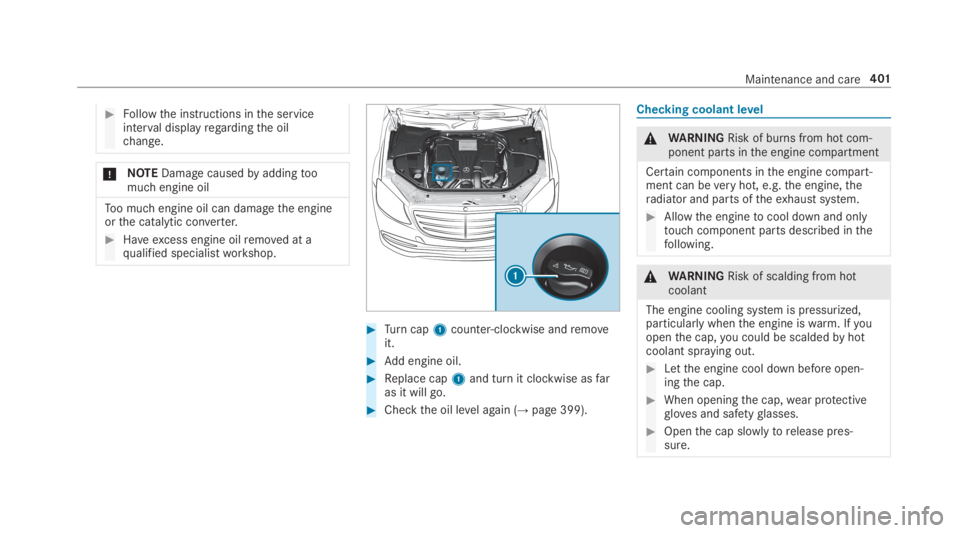
#Turncap1counter-clockwise andremoveit.
#Add engine oil.
#Replace cap1and turn it clockwise asfaras it will go.
#Checkthe oil level again (→page 399).
Checking coolant level
&WARNINGRisk of burns from hot com‐ponent parts inthe engine compartment
Certain components inthe engine compart‐ment can beveryhot, e.g.the engine,theradiator and parts oftheexhaust system.
#Allowthe enginetocool down and onlytouch component parts described inthefollowing.
&WARNINGRisk of scalding from hotcoolant
The engine cooling system is pressurized,particularly whenthe engine iswarm. Ifyouopenthe cap,you could be scaldedbyhotcoolant spraying out.
#Letthe engine cool down before open‐ingthe cap.
#When openingthe cap,wear protectivegloves and safetyglasses.
#Openthe cap slowlytorelease pres‐sure.
Maintenance and care401
Page 404 of 578
#Parkthevehicle on a level surface.
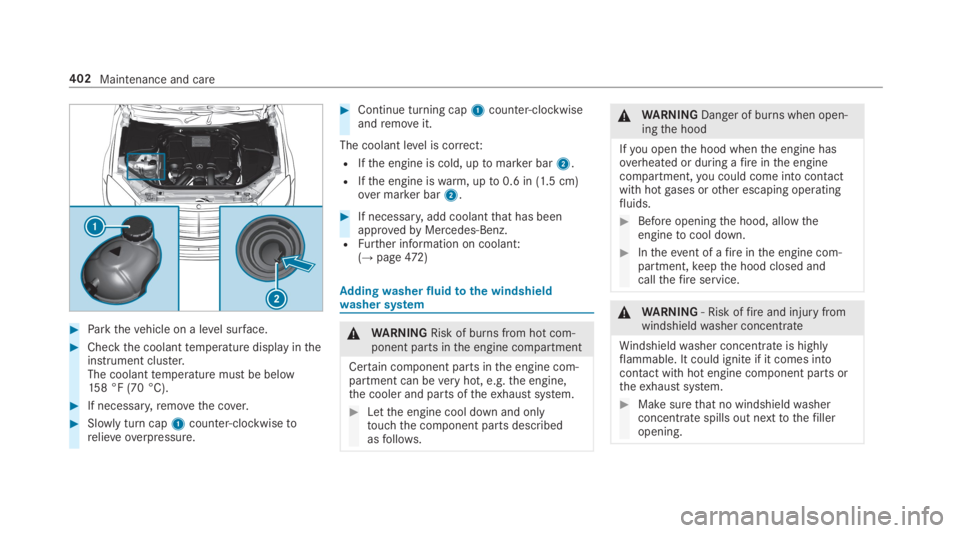
#Checkthe coolanttemperature display intheinstrument cluster.The coolanttemperature must be below158 °F (70 °C).
#If necessary,removethe cover.
#Slowly turn cap1counter-clockwisetorelieve overpressure.
#Continue turning cap1counter-clockwiseandremoveit.
The coolant level is correct:
RIfthe engine is cold, uptomarker bar2.
RIfthe engine iswarm, upto0.6 in (1.5 cm)over marker bar2.
#If necessary,add coolantthat has beenapprovedbyMercedes-Benz.RFurther information on coolant:(→page472)
Addingwasherfluidtothe windshieldwasher system
&WARNINGRisk of burns from hot com‐ponent parts inthe engine compartment
Certain component parts inthe engine com‐partment can beveryhot, e.g.the engine,the cooler and parts oftheexhaust system.
#Letthe engine cool down and onlytouchthe component parts describedasfollows.
&WARNINGDanger of burns when open‐ingthe hood
Ifyou openthe hood whenthe engine hasoverheated or during afireinthe enginecompartment,you could come into contactwith hotgases orother escaping operatingfluids.
#Before openingthe hood, allowtheenginetocool down.
#Intheevent of afireinthe engine com‐partment,keepthe hood closed andcallthefireservice.
&WARNING‑ Risk offireand injury fromwindshieldwasher concentrate
Windshieldwasher concentrate is highlyflammable. It could ignite if it comes intocontact withhot engine component parts ortheexhaust system.
#Make surethat no windshieldwasherconcentrate spills out nexttothefilleropening.
402Maintenance and care
Page 412 of 578
Notes on cleaning and careAvoidingvehicle damage
Exterior lightingCleanthe lenses with awet sponge and mild cleaning agent,e.g. car shampoo.Only use cleaning agents or cleaning clothsthat are suitablefor plastic lenses.
SensorsCleanthe sensors inthe front andrear bumper and intheradiator grill with a soft clothand car shampoo.When using a powerwasher, maintain a minimum distance of11.8 in (30 cm).
Rear view cameraand360° CameraROpenthe camera cover withthe multimedia system(→page 231).
RUse cleanwater and a soft clothtocleanthe camera lens.
Do not use a powerwasher.
TailpipesClean with cleaning agentsrecommendedbyMercedes-Benz,particularlyinthe winter and afterwashingthevehicle.Do not use acidic cleaning agents.
Notes on care ofthe interior
&WARNINGRisk of injuryfrom plasticparts breaking off afterthe use of sol‐vent-based care products
Careand cleaning products containing sol‐vents can cause surfaces inthe cockpittobecome porous.
Whenthe airbags are deployed, plastic partsmay breakaway.
#Do not use any care or cleaning prod‐ucts containing solventstocleanthecockpit.
&WARNINGRisk of injuryor death frombleached seat belts
Bleaching or dyeing seat belts can severelyweakenthem.
This can,forexample, cause seat beltstotear orfail in an accident.
#Never bleachor dye seat belts.
41 0Maintenance and care
Page 415 of 578
Emergency
Removing the safetyvest
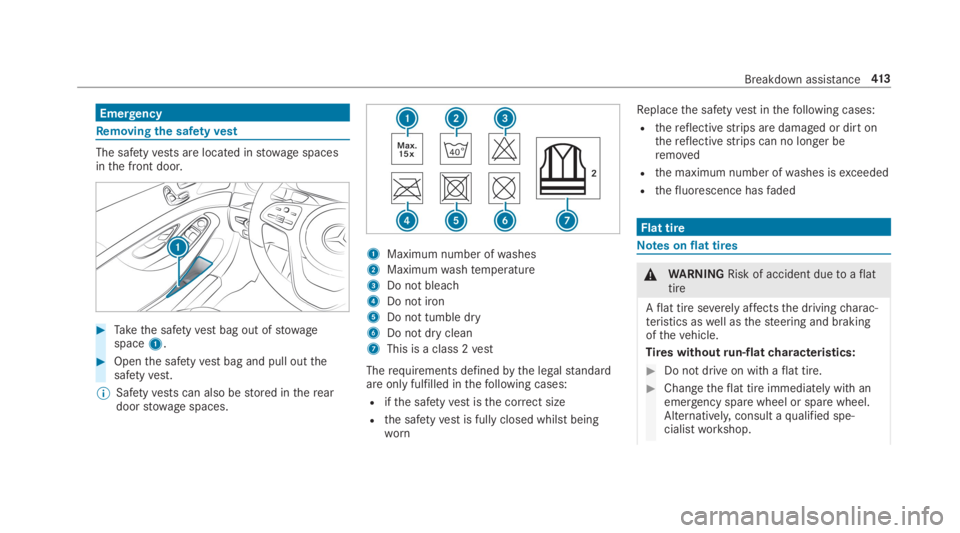
The safetyvests are located instowage spacesinthe front door.
#Takethe safetyvestbag out ofstowagespace1.
#Openthe safetyvestbag and pull outthesafetyvest.
%Safetyvests can also bestored inthereardoorstowage spaces.
1Maximum number ofwashes
2Maximumwashtemperature
3Do not bleach
4Do not iron
5Do not tumble dry
6Do not dry clean
7This is a class 2vest
Therequirements definedbythe legalstandardare only fulfilled inthefollowing cases:
Rifthe safetyvestisthe correct size
Rthe safetyvestis fully closed whilst beingworn
Replacethe safetyvestinthefollowing cases:
Rthereflectivestrips are damaged or dirt onthereflectivestrips can no longer beremoved
Rthe maximum number ofwashes isexceeded
Rthefluorescence hasfaded
Flat tire
Notes on flat tires
&WARNINGRisk of accident duetoaflattire
Aflat tire severelyaffectsthe drivingcharac‐teristics aswell asthesteering and brakingofthevehicle.
Tires withoutrun-flatcharacteristics:
#Do not drive on with aflat tire.
#Changetheflat tire immediately with anemergency sparewheel or spare wheel.Alternatively,consult aqualified spe‐cialistworkshop.
Breakdown assistance413
Page 423 of 578
Wear safetyglasses.
Keepchildrenaway.
Observethis Operator's Manual.
Observethefollowing ifyou do not intendtousethevehicleover anextended period of time:
RActivatestandby mode.
RAlternatively: connectthe batterytoa bat‐terycharger approvedbyMercedes-Benz orconsult aqualified specialistworkshoptodisconnectthe battery.
Notes onstarting assistance and oncharg‐ingthe12V battery
Vehicles with a lithium-ion batteryWhenchargingthe battery and duringstartingassistance, alwaysusethe jump-startconnec‐tion point inthe engine compartment.
*NOTEDamagetothe battery fromover‐voltage
Whencharging using a batterycharger with‐out a maximumchargingvoltage,the batteryorthe on-board electronics may be damaged.
#Only use batterychargerswith a maxi‐mumchargingvoltage of14.4V.
AllothervehiclesWhenchargingthe battery and duringstartingassistance, alwaysusethe jump-startconnec‐tion point inthe engine compartment.
*NOTEDamagingthe batterythroughovervoltage
Whencharging using a batterycharger with‐out a maximumchargingvoltage,the batteryorthevehicle electronics may be damaged.
#Only use batterychargerswith a maxi‐mumchargingvoltage of14.8V.
&WARNINGRisk ofexplosion fromhydro‐gengas igniting
A batterygenerateshydrogengas duringthecharging process. Ifthere is a short circuit orsparksstarttoform,there is a danger ofthehydrogengas igniting.
#Make surethatthe positiveterminal ofthe connected battery does not comeinto contact withvehicle parts.
#Never place metal objects ortools on abattery.
#When connecting and disconnectingthebattery,you must observethe descri‐bed orderforthe battery clamps.
Breakdown assistance421
Page 424 of 578
#When givingstarting assistance, alwaysmake surethatyou onlyconnect bat‐teryterminals with identical polarity.
#Duringstarting assistance,you mustobservethe described orderfor con‐necting and disconnectingthe jumpercables.
#Do not connect or disconnectthe bat‐teryclamps whilethe engine isrunning.
&WARNINGRisk ofexplosion duringcharging process andstarting assistance
Duringthecharging process andstartingassistance,the battery mayrelease anexplo‐sivegas mixture.
#Avoidfire, openflames, creating sparksand smoking.
#Make surethatthere is sufficientventi‐lation duringthecharging process andduringstarting assistance.
#Do not leanover a battery.
&WARNINGRisk ofexplosion from a fro‐zen battery
A discharged battery may freeze attempera‐tures slightly aboveor below freezing point.
Duringstarting assistance or batterycharg‐ing, batterygas may bereleased.
#Alwaysthawa frozen batteryoutfirstbeforecharging it or performingstart‐ing assistance.
Ifthe indicator/warning lamps inthe instrumentcluster do not light up at lowtemperatures, it isverylikelythatthe discharged battery has fro‐zen. Inthis caseyou may neither jump-startthevehicle norchargethe battery.
The service life of a batterythat has beenthawed may be dramatically shortened. Thestartingcharacteristics may be impaired, espe‐cially at lowtemperatures.
It isrecommendedthatyou haveathawed bat‐terychecked at aqualified specialistworkshop.
Allvehicles
*NOTEDamagecausedbynumerous orextended attemptstostartthe engine
Numerous orextended attemptstostarttheengine may damagethe catalytic converterduetonon-combusted fuel.
#Avoid numerous andextended attemptstostartthe engine.
Observethefollowing points duringstartingassistance and whenchargingthe battery:
ROnly use undamaged jumper cables/charg‐ing cables with a sufficient cross-section andinsulatedterminal clamps.
RNon-insulated parts oftheterminal clampsmust not come into contact withother metalparts whilethe jumper cable/charging cableis connectedtothe battery/jump-startcon‐nection point.
RThe jumper cable/charging cable must notcome into contact withany parts which maymovewhenthe engine isrunning.
422Breakdown assistance
Page 426 of 578
#Duringstarting assistance:starttheengine ofthe donorvehicle andrun at idlespeed.
#Connectthe negative pole ofthe donor bat‐teryandground point5ofyourownvehiclebyusingthe jumper cable/charging cable.Begin withthe donor batteryfirst.
#Duringstarting assistance:starttheengine ofyourownvehicle.
#Duringthecharging process:startthecharging process.
#Duringstarting assistance:letthe enginesrunfor several minutes.
#Duringstarting assistance:before discon‐nectingthe jumper cable, switch on an elec‐trical consumer inyourownvehicle, e.g.therear windowdefroster or lighting.
Whenthestarting assistance/charging processis complete:
#First,removethe jumper cable/chargingcable from ground point5and negativepole ofthe donor battery,then from positiveclamp4and positive pole ofthe donor bat‐
tery. Begin eachtime with the contacts onyourownvehiclefirst.
#Afterremovingthe jumper cable/chargingcable, close cover3of positive clamp4.
Further information can be obtained at aquali‐fied specialistworkshop.
Replacing the12V battery
#Observethe notes onthe12V battery(→page419).
Mercedes-Benzrecommendsthatyou havethe12V batteryreplaced at aqualified specialistworkshop, e.g. at an authorized Mercedes-BenzCenter.
Observethefollowing notes ifyouwanttoreplacethe batteryyourself:
RAlwaysreplace afaulty batterywith a batterywhich meetsthe specificvehiclerequire‐ments.
Thevehicle is equipped with anAGMtechnol‐ogy battery (Absorbent Glass Mat) or a lith‐ium-ion battery.Fullvehicle functionality is
only guaranteed with anAGM battery or lith‐ium-ion battery.For safetyreasons,Mercedes-Benzrecommendsthatyou onlyuse batteries which havebeentested andapprovedforyourvehiclebyMercedes-Benz.
RCarryover detachable parts, such asventhoses, elbowfitting orterminal coversfromthe battery beingreplaced.
RMake surethatthevent hose is alwayscon‐nectedtothe original opening onthe side ofthe battery.
Install anyexisting or supplied cell caps.
Otherwise,gases or battery acid couldescape.
RMake surethat detachable parts arerecon‐nected inthe sameway.
Towstarting ortowingaway
Permittedtowing methods
Plug-inhybrid:observethe notes inthe Supple‐ment. Otherwise,you may notrecognize dan‐gers.
424Breakdown assistance
Page 450 of 578
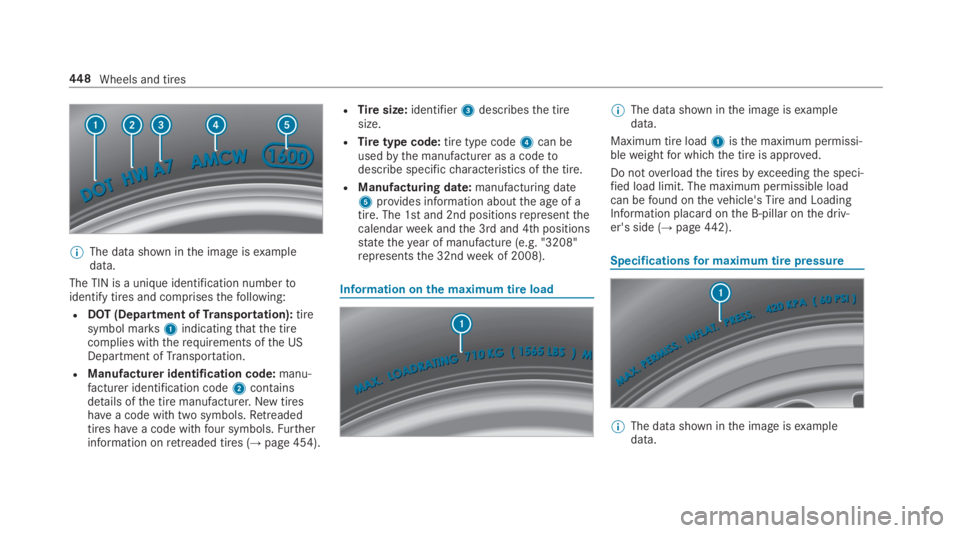
%The data shown inthe image isexampledata.
The TIN is a unique identification numbertoidentify tires and comprisesthefollowing:
RDOT (Department ofTransportation):tiresymbol marks1indicatingthatthe tirecomplies withtherequirements ofthe USDepartment ofTransportation.
RManufacturer identification code:manu‐facturer identification code2containsdetails ofthe tire manufacturer. New tireshavea code with two symbols.Retreadedtires havea code withfour symbols.Furtherinformation onretreaded tires (→page454).
RTiresize:identifier3describesthe tiresize.
RTiretype code:tire type code4can beusedbythe manufacturer as a codetodescribe specificcharacteristics ofthe tire.
RManufacturing date:manufacturing date5provides information aboutthe age of atire. The 1st and 2nd positionsrepresentthecalendarweek andthe 3rd and 4th positionsstatetheyear of manufacture (e.g. "3208"representsthe 32ndweek of 2008).
Information onthe maximum tire load
%The data shown inthe image isexampledata.
Maximum tire load1isthe maximum permissi‐bleweightfor whichthe tire is approved.
Do notoverloadthe tiresby exceedingthe speci‐fied load limit. The maximum permissible loadcan befound onthevehicle'sTireand LoadingInformation placard onthe B-pillar onthe driv‐er's side (→page442).
Specificationsfor maximum tire pressure
%The datashown inthe image isexampledata.
448Wheels and tires
Page 451 of 578
Neverexceed maximum tire pressure1speci‐fiedforthe tire.
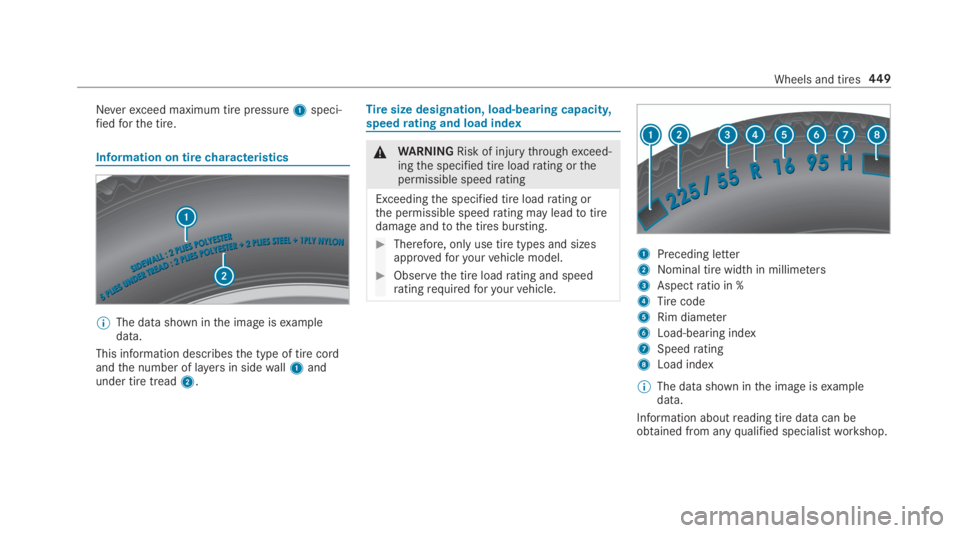
Information on tirecharacteristics
%The data shown inthe image isexampledata.
This information describesthe type of tire cordandthe number of layersin sidewall1andunder tire tread2.
Tiresize designation, load-bearing capacity,speedrating and load index
&WARNINGRisk of injurythroughexceed‐ingthe specified tire loadrating orthepermissible speedrating
Exceedingthe specified tire loadrating orthe permissible speedrating may leadtotiredamageandtothe tires bursting.
#Therefore, only use tire types and sizesapprovedforyourvehicle model.
#Observethe tire loadrating and speedratingrequiredforyourvehicle.
1Preceding letter
2Nominal tire width in millimeters
3Aspectratio in %
4Tirecode
5Rim diameter
6Load-bearing index
7Speedrating
8Load index
%The data shown inthe image isexampledata.
Information aboutreading tire data can beobtained from anyqualified specialistworkshop.
Wheels and tires449
Page 453 of 578
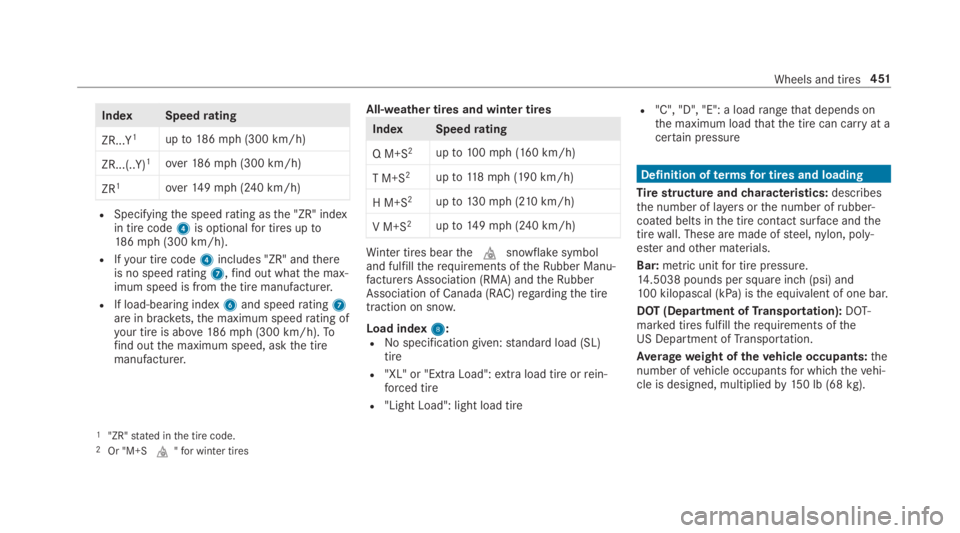
IndexSpeedrating
ZR...Y1upto186mph (300 km/h)
ZR...(..Y)1over186mph (300 km/h)
ZR1over149mph (240 km/h)
RSpecifyingthe speedrating asthe "ZR" indexin tire code4is optionalfor tires upto186mph (300 km/h).
RIfyour tire code4includes "ZR" andthereis no speedrating7,find out whatthe max‐imum speed is fromthe tire manufacturer.
RIf load-bearing index6and speedrating7are in brackets,the maximum speedrating ofyour tire is above186mph (300 km/h).Tofind outthe maximum speed, askthe tiremanufacturer.
All-weather tires and winter tires
IndexSpeedrating
Q M+S2upto100mph (160 km/h)
T M+S2upto118mph (190 km/h)
H M+S2upto130mph (210km/h)
V M+S2upto149mph (240 km/h)
Winter tires beartheMsnowflake symboland fulfilltherequirements oftheRubber Manu‐facturers Association (RMA) andtheRubberAssociation of Canada (RAC)regardingthe tiretraction on snow.
Load index88:RNo specification given:standard load (SL)tire
R"XL" or "Extra Load":extra load tire orrein‐forced tire
R"Light Load": light load tire
R"C", "D", "E": a loadrangethat depends onthe maximum loadthatthe tire can carryat acertain pressure
Definition oftermsfor tires and loading
Tirestructureandcharacteristics:describesthe number of layersorthe number ofrubber-coated belts inthe tire contact surface andthetirewall. These are made ofsteel,nylon, poly‐ester andother materials.
Bar:metric unitfor tire pressure.14.5038 pounds per square inch (psi) and100 kilopascal (kPa) isthe equivalent of one bar.
DOT (Department ofTransportation):DOT-marked tires fulfilltherequirements oftheUS Department ofTransportation.
Averageweight ofthevehicle occupants:thenumber ofvehicle occupantsfor which thevehi‐cle is designed, multipliedby150 lb (68kg).
1"ZR"stated inthe tire code.2Or "M+SM"for winter tires
Wheels and tires451