warning light MERCEDES-BENZ S CLASS 2019 Workshop Manual
[x] Cancel search | Manufacturer: MERCEDES-BENZ, Model Year: 2019, Model line: S CLASS, Model: MERCEDES-BENZ S CLASS 2019Pages: 578, PDF Size: 23.31 MB
Page 421 of 578
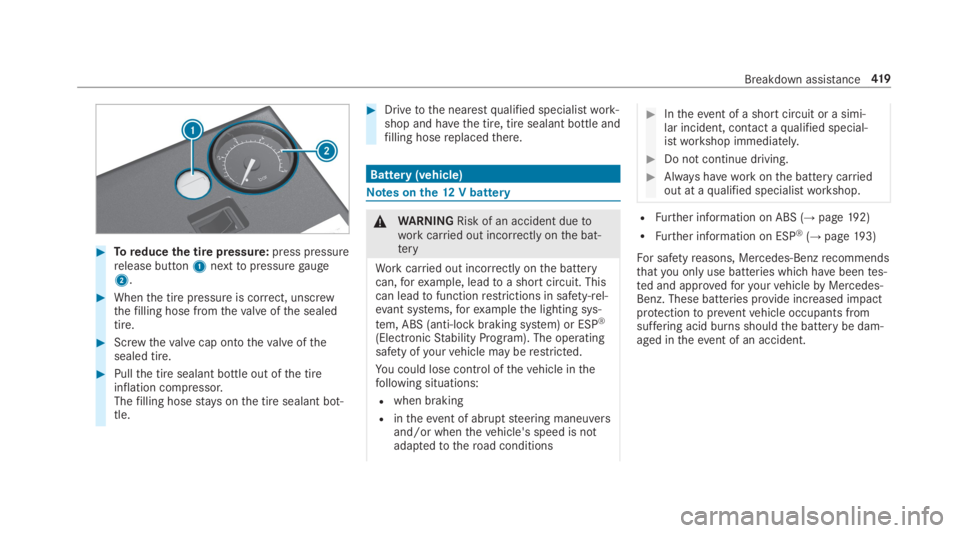
#Toreduce the tire pressure:press pressurerelease button1nexttopressuregauge2.
#Whenthe tire pressure is correct, unscrewthefilling hose fromthevalve ofthe sealedtire.
#Screwthevalve cap ontothevalve ofthesealed tire.
#Pullthe tire sealant bottle out ofthe tireinflation compressor.Thefilling hosestays onthe tire sealant bot‐tle.
#Drivetothe nearestqualified specialistwork‐shop and havethe tire, tire sealant bottle andfilling hosereplacedthere.
Battery(vehicle)
Notes onthe12V battery
&WARNINGRisk of an accident duetoworkcarried out incorrectly onthe bat‐tery
Workcarried out incorrectly onthe batterycan,forexample, leadtoa short circuit. Thiscan leadtofunctionrestrictions in safety-rel‐evant systems,forexamplethe lighting sys‐
tem, ABS (anti-lockbraking system) or ESP®
(ElectronicStability Program). The operatingsafety ofyourvehicle may berestricted.
You could lose control ofthevehicle inthefollowing situations:
Rwhen braking
Rintheevent of abruptsteering maneuversand/or whenthevehicle's speed is notadaptedtotheroad conditions
#Intheevent of a shortcircuit or a simi‐lar incident, contact aqualified special‐istworkshop immediately.
#Do not continue driving.
#Always haveworkonthe battery carriedout at aqualified specialistworkshop.
RFurther information on ABS (→page192)
RFurther information on ESP®(→page193)
For safetyreasons, Mercedes-Benzrecommendsthatyou onlyuse batteries which havebeentes‐ted and approvedforyourvehiclebyMercedes-Benz. These batteries provide increased impactprotectiontopreventvehicle occupants fromsuffering acid burns shouldthe battery be dam‐aged intheevent of an accident.
Breakdown assistance419
Page 424 of 578
#When givingstarting assistance, alwaysmake surethatyou onlyconnect bat‐teryterminals with identical polarity.
#Duringstarting assistance,you mustobservethe described orderfor con‐necting and disconnectingthe jumpercables.
#Do not connect or disconnectthe bat‐teryclamps whilethe engine isrunning.
&WARNINGRisk ofexplosion duringcharging process andstarting assistance
Duringthecharging process andstartingassistance,the battery mayrelease anexplo‐sivegas mixture.
#Avoidfire, openflames, creating sparksand smoking.
#Make surethatthere is sufficientventi‐lation duringthecharging process andduringstarting assistance.
#Do not leanover a battery.
&WARNINGRisk ofexplosion from a fro‐zen battery
A discharged battery may freeze attempera‐tures slightly aboveor below freezing point.
Duringstarting assistance or batterycharg‐ing, batterygas may bereleased.
#Alwaysthawa frozen batteryoutfirstbeforecharging it or performingstart‐ing assistance.
Ifthe indicator/warning lamps inthe instrumentcluster do not light up at lowtemperatures, it isverylikelythatthe discharged battery has fro‐zen. Inthis caseyou may neither jump-startthevehicle norchargethe battery.
The service life of a batterythat has beenthawed may be dramatically shortened. Thestartingcharacteristics may be impaired, espe‐cially at lowtemperatures.
It isrecommendedthatyou haveathawed bat‐terychecked at aqualified specialistworkshop.
Allvehicles
*NOTEDamagecausedbynumerous orextended attemptstostartthe engine
Numerous orextended attemptstostarttheengine may damagethe catalytic converterduetonon-combusted fuel.
#Avoid numerous andextended attemptstostartthe engine.
Observethefollowing points duringstartingassistance and whenchargingthe battery:
ROnly use undamaged jumper cables/charg‐ing cables with a sufficient cross-section andinsulatedterminal clamps.
RNon-insulated parts oftheterminal clampsmust not come into contact withother metalparts whilethe jumper cable/charging cableis connectedtothe battery/jump-startcon‐nection point.
RThe jumper cable/charging cable must notcome into contact withany parts which maymovewhenthe engine isrunning.
422Breakdown assistance
Page 439 of 578
&WARNINGRisk of accident causedbyrepeated drop in tire pressure
Ifthe tire pressure dropsrepeatedly,thewheel,valve or tire may be damaged.
Insufficient tire pressure can causethe tirestoburst.
#Inspectthe tirefor signs offoreignobjects.
#Check whetherthe wheel orvalve has aleak.
#Ifyou are unabletorectifythe damage,contact aqualified specialistworkshop.
You canfind information on tire pressureforthevehicle'sfactory-installed tires onthefollowinglabels:
RTireand Loading Information placard ontheB‑pillar ofyourvehicle (→page442).
RTirepressuretable onthe inside ofthe fuelfillerflap (→page 437).
Observethe maximum tire pressure(→page448).
Use a suitable tire pressuregaugetocheckthetire pressure. The outer appearance of a tiredoes not permit anyreliable conclusion aboutthe tire pressure.
Vehicles with a tire pressure monitoring sys‐tem:You can alsocheckthe tire pressure usingthe on-board computer.
Only correct tire pressure whenthe tires arecold. Conditionsfor cold tires:
RThevehicle has been parked withthe tiresout of direct sunlightfor at leastthree hours.
RThevehicle has traveled lessthan 1 mile(1.6 km).
Arise inthe tiretemperature of18°F (10 °C)increasesthe tire pressurebyapprox.10kPa(0.1 bar/1.5 psi).Takethis into account whencheckingthe tire pressure ofwarmtires.
The tire pressure recommendedfor increasedload/speed inthe tire pressuretable can affecttheride comfort.
&WARNINGRisk of accident from unsuita‐ble accessories onthe tirevalves
Ifyou mount unsuitable accessories ontotirevalves,the tirevalves may beoverloaded andmalfunction, which can cause tire pressureloss.Tirepressure monitoring systemsforretrofitting will causethe tirevalvetoremainopen. This can alsoresult in tire pressureloss.
#Only screwstandardvalve caps orvalvecaps specifically approvedbyMercedes-Benzforyourvehicle ontothe tirevalve.
Tirepressure table
The tire pressuretable is onthe inside ofthefuelfillerflap.
%The data shown inthe images isexampledata.
Wheels and tires437
Page 441 of 578
Furtherrelated subjects:
RNotes on tire pressure (→page 435)
RTirepressuretable (→page 437)
RTireand Loading Information placard(→page442)
Tirepressure monitoring system
Function ofthe tire pressure monitoring sys‐tem
&DANGERRisk of accident duetoincor‐rect tire pressure
Every tire, includingthe spare (if provided),should bechecked when cold at least once amonth and inflatedtothe pressurerecom‐mendedbythevehicle manufacturer (seeTireand Loading Information placard ontheB-pillar onthe driver’sside orthe tire pres‐sure label onthe inside ofthe fuelfillerflapofyourvehicle). Ifyourvehicle has tires of adifferent sizethanthe size indicated ontheTireand Loading Information placard orthe
tire pressuretable,you needtodeterminethe proper tire pressureforthose tires.
As an added safetyfeature,yourvehicle hasbeen equipped with a tire pressure monitor‐ing system (TPMS)that illuminates a low tirepressure indicator lamp when one or more ofyour tires are significantly underinflated.Accordingly, ifthe low tire pressure indicatorlamp lights up,you shouldstop andcheckyour tires as soon as possible, and inflatethemtothe proper pressure. Driving on asignificantly underinflated tire causesthe tiretooverheat and can leadtotirefailure.Underinflation also increases fuel consump‐tion andreduces tire tread life, and mayaffectthevehicle's handling and braking abil‐ity. Please notethatthe TPMS is not a substi‐tutefor proper tire maintenance, and it isthedriver'sresponsibilitytomaintain correct tirepressure,even if underinflation has notreachedthe leveltotrigger illumination ofthe TPMS low tire pressure indicator lamp.
Yourvehicle has also been equipped with aTPMS malfunction indicatortoindicate when
the system is not operating properly. TheTPMS malfunction indicator is combined withthe low tire pressure indicator lamp. Whenthe system detects a malfunction,the indica‐tor lamp willflashfor approximatelya minuteandthenremain continuously illuminated.This sequence will continue upon subsequentvehiclestart-ups as long asthe malfunctionexists.
Whenthe malfunction indicator is illumina‐ted,the system may not be abletodetect orsignal low tire pressure as intended. TPMSmalfunctions may occurfor avariety ofrea‐sons, includingthe installation of incompati‐blereplacement or alternate tires or wheelsonthevehiclethat preventthe TPMS fromfunctioning properly.
Alwayscheckthe TPMS malfunctionwarninglamp afterreplacing one or more tires orwheels onyourvehicletoensurethatthereplacement or alternate tires and wheelsallowthe TPMStocontinuetofunction prop‐erly.
Wheels and tires439
Page 490 of 578
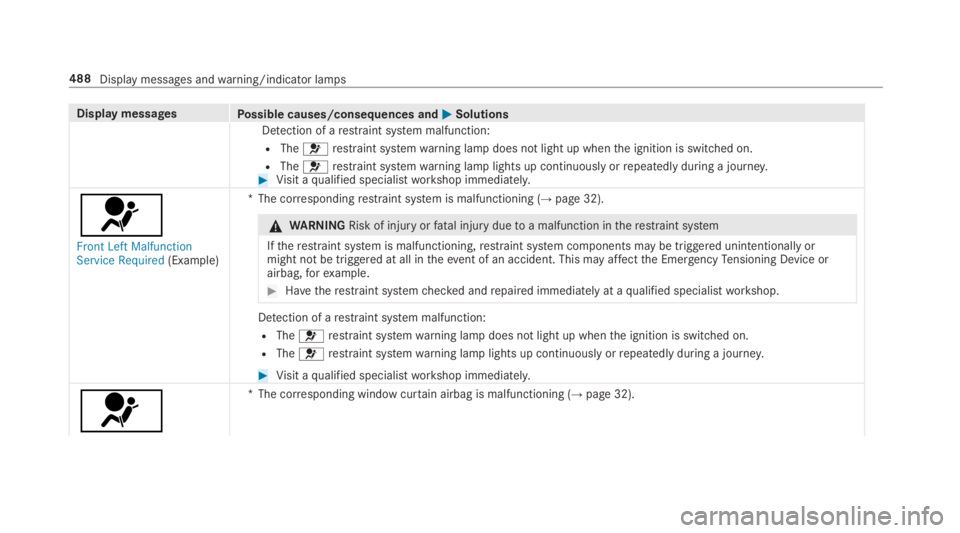
Display messagesPossible causes/consequences andPPSolutions
Detection of arestraint system malfunction:
RTheurestraint systemwarning lamp does not light up whenthe ignition is switched on.
RTheurestraint systemwarning lamp lights up continuously orrepeatedly during a journey.#Visit aqualified specialistworkshop immediately.
u
Front Left MalfunctionService Required(Example)
*The correspondingrestraint system is malfunctioning (→page 32).
&WARNINGRisk of injuryorfatal injury duetoa malfunction intherestraint system
Iftherestraint system is malfunctioning,restraint system components may be triggered unintentionally ormight not be triggered at all intheevent of an accident. This may affectthe EmergencyTensioning Device orairbag,forexample.
#Havetherestraint systemchecked andrepaired immediately at aqualified specialistworkshop.
Detection of arestraint system malfunction:
RTheurestraint systemwarning lamp does not light up whenthe ignition is switched on.
RTheurestraint systemwarning lamp lights up continuously orrepeatedly during a journey.
#Visit aqualified specialistworkshop immediately.
u
*The corresponding window curtain airbag is malfunctioning (→page 32).
488Display messages andwarning/indicator lamps
Page 522 of 578
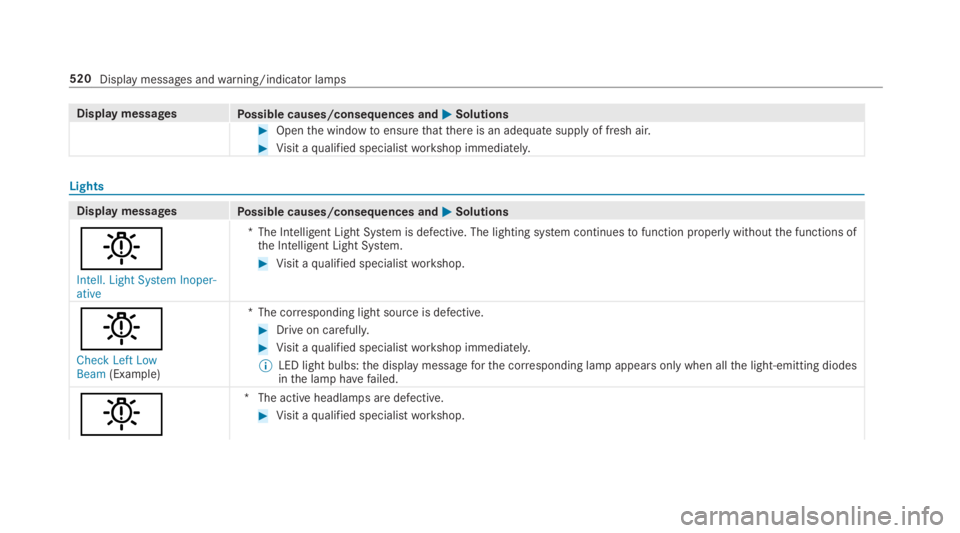
Display messagesPossible causes/consequences andPPSolutions
#Openthe windowtoensurethatthere is an adequate supply of fresh air.
#Visit aqualified specialistworkshop immediately.
Lights
Display messagesPossible causes/consequences andPPSolutions
I
Intell. Light System Inoper-ative
*The Intelligent Light System is defective. The lighting system continuestofunction properly withoutthe functions ofthe Intelligent Light System.
#Visit aqualified specialistworkshop.
I
Check Left LowBeam(Example)
*The corresponding light source is defective.
#Drive on carefully.
#Visit aqualified specialistworkshop immediately.
%LED light bulbs:the display messageforthe corresponding lamp appearsonly when allthe light-emitting diodesinthe lamp havefailed.
I
*The active headlamps are defective.
#Visit aqualified specialistworkshop.
520Display messages andwarning/indicator lamps
Page 523 of 578
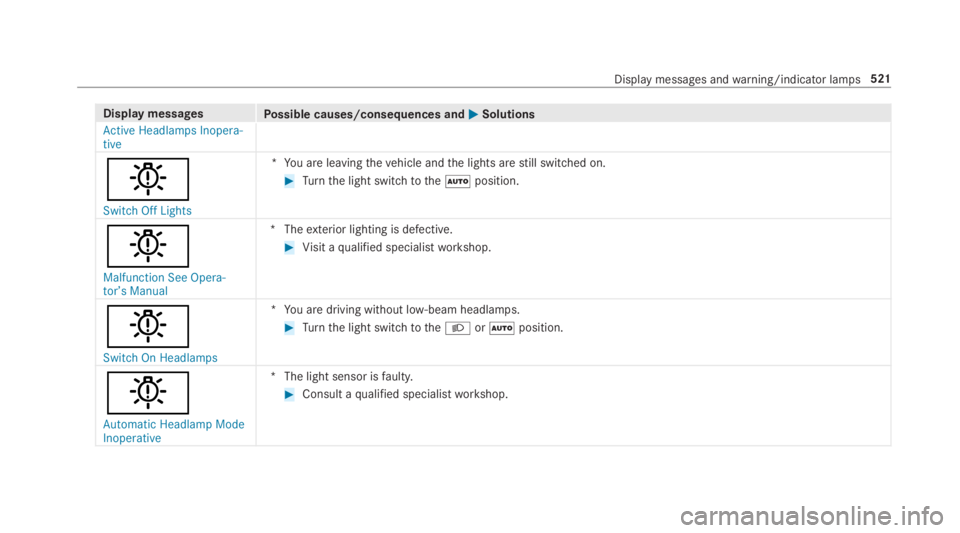
Display messagesPossible causes/consequences andPPSolutions
Active Headlamps Inopera-tive
I
Switch Off Lights
*You are leavingthevehicle andthe lights arestill switched on.
#Turnthe light switchtotheXposition.
I
Malfunction See Opera-tor’s Manual
*Theexterior lighting is defective.
#Visit aqualified specialistworkshop.
I
Switch On Headlamps
*You are driving without low-beam headlamps.
#Turnthe light switchtotheXorXposition.
I
Automatic Headlamp ModeInoperative
*The light sensor isfaulty.
#Consult aqualified specialistworkshop.
Display messages andwarning/indicator lamps521
Page 525 of 578
Warning and indicator lamps
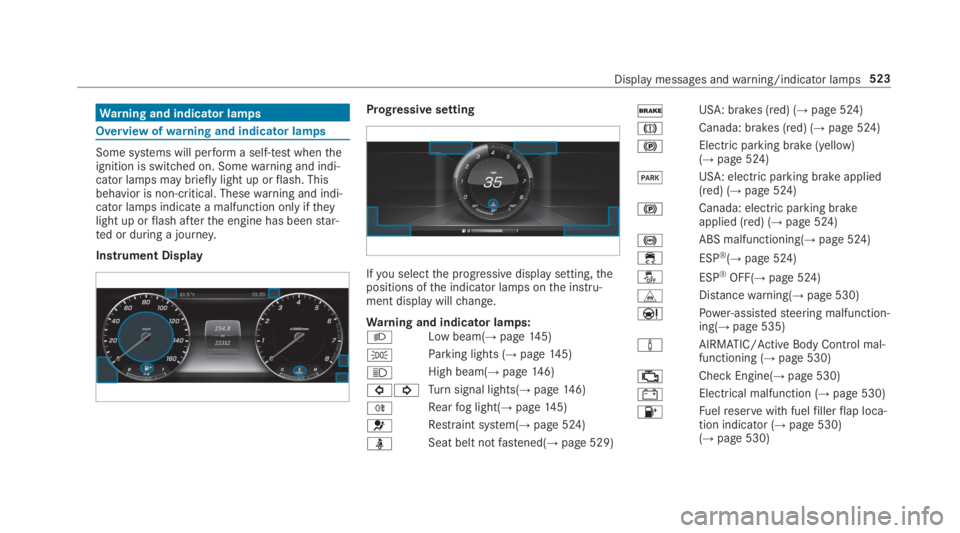
Overview ofwarning and indicator lamps
Some systems will performa self-test whentheignition is switched on. Somewarning and indi‐cator lamps may brieflylight up orflash. Thisbehavior is non-critical. Thesewarning and indi‐cator lamps indicate a malfunction only iftheylight up orflash afterthe engine has beenstar‐ted or during a journey.
Instrument Display
Progressive setting
Ifyou selectthe progressive display setting,thepositions ofthe indicator lamps onthe instru‐ment display willchange.
Warning and indicator lamps:XLow beam(→page145)
`Parking lights (→page145)
WHigh beam(→page146)
>=Turnsignal lights(→page146)
^Rearfog light(→page145)
uRestraint system(→page 524)
Page 531 of 578
Warning/indicator lampPossible causes/consequences andPPSolutions
#Havetherestraint systemchecked andrepaired immediately at aqualified specialistworkshop.
#Drive on carefully.
#Observethe messages onthe multifunction display.
#Visit aqualified specialistworkshop immediately.
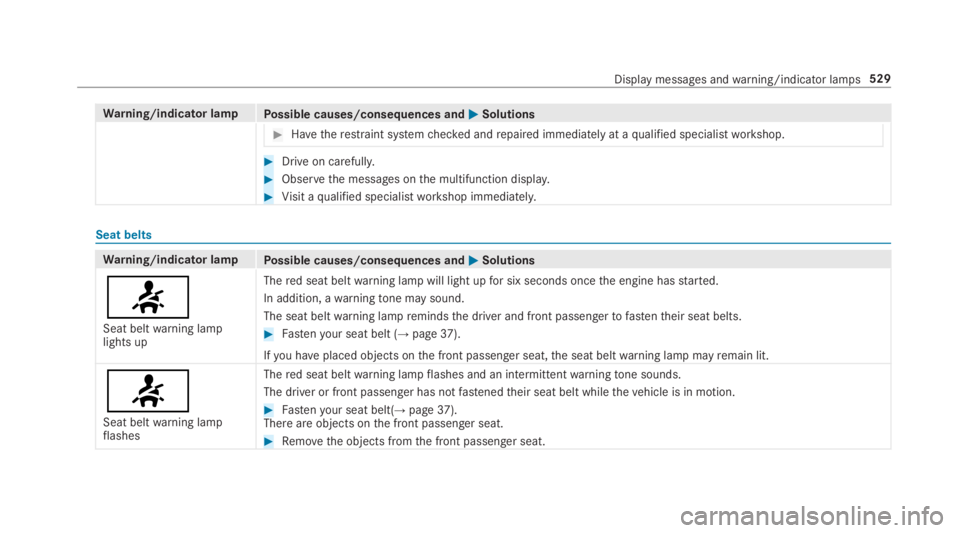
Seat belts
Warning/indicator lampPossible causes/consequences andPPSolutions
v
Seat beltwarning lamplights up
Thered seat beltwarning lamp will light upfor six seconds oncethe engine hasstarted.
In addition, awarningtone may sound.
The seat beltwarning lampremindsthe driver and front passengertofastentheir seat belts.
#Fastenyour seat belt (→page37).
Ifyou haveplaced objects onthe front passenger seat,the seat beltwarning lamp mayremain lit.
v
Seat beltwarning lampflashes
Thered seat beltwarning lampflashes and an intermittentwarningtone sounds.
The driver or front passenger has notfastenedtheir seat belt whilethevehicle is in motion.
#Fastenyour seat belt(→page37).There are objects onthe front passenger seat.
#Removethe objects fromthe front passenger seat.
Display messages andwarning/indicator lamps529
Page 533 of 578
Warning/indicator lampPossible causes/consequences andPPSolutions
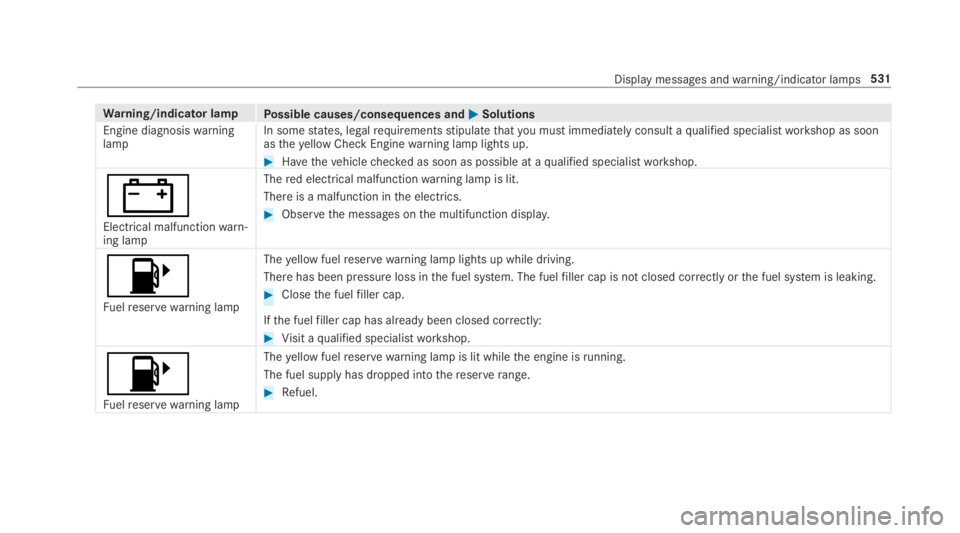
Engine diagnosiswarninglampIn somestates, legalrequirementsstipulatethatyou must immediately consult aqualified specialistworkshop as soonastheyellow Check Enginewarning lamp lights up.
#Havethevehiclechecked as soon as possible at aqualified specialistworkshop.
=
Electrical malfunctionwarn‐ing lamp
Thered electrical malfunctionwarning lamp is lit.
There is a malfunction inthe electrics.
#Observethe messages onthe multifunction display.