airbag MERCEDES-BENZ S-CLASS CABRIOLET 2018 Owner's Manual
[x] Cancel search | Manufacturer: MERCEDES-BENZ, Model Year: 2018, Model line: S-CLASS CABRIOLET, Model: MERCEDES-BENZ S-CLASS CABRIOLET 2018Pages: 502, PDF Size: 6.27 MB
Page 4 of 502
Atagl ance .................................................... 6
Cockpit ........................................................... 6
Wa rning and indicator lamps ........................ 10
Overhead contro l panel ................................ 12
Door control panel and seat adjustment ....... 14
Control settings inthere ar compartment .... .16
Emergencies and breakdowns ...................... 18
DigitalOperator' sManua l........................ .20
Callin gup the Digital Operator's Manual ...... 20
General no tes............................................. 21
Pr otecting the environment .......................... 21
Mercedes-Benz GenuineParts ....................... 21
Operator's Manual ........................................2 2
Service and vehicle operation ......................2 3
Operating saf ety.......................................... .24
Declaration of conformity for wireless
ve hicle components .....................................2 5
Diagnost ics connection ................................ 26
Qualified specialist workshop ....................... 27
Cor rect use of theve hicle ............................. 27
Problems with your vehicle ........................... 27
Re porting saf etydefects .............................. .27 Limited
Warranty .......................................... 28
QR codes forth ere scue card ....................... 28
Data storage .................................................2 8
Copyright .. .................................................... 32
Occupant safety......................................... 33
Re stra int sy stem .......................................... .33
Seat belts ..................................................... 35
Airbags ......................................................... 40
PRE-SAFE
®sy stem ....................................... 47
Childr en intheve hicle ..................................4 9
No tes on pets in theve hicle .........................5 6
Opening and closing.................................. 57
SmartK ey...................................................... 57
Doors ............................................................ 61
Tr unk ............................................................ 65
Ro ller sun blinds .......................................... .71
Side windo ws................................................ 72
Pa noramic roof ............................................. 76
Anti-theft pr otection .................................... .79
Seats and stowing ...................................... 81
No tes on the cor rect driver's seat posi‐
tion ............................................................... 81
Seats ............................................................ 82
St eering wheel ..............................................9 0
Using the memory function .......................... 93
St ow age areas .............................................. 94
Cup holder .................................................. 100
Ashtr ayand cigar ette lighter ...................... .101
Soc kets ....................................................... 102
Re frigerator box .......................................... 103
Wi reless charging of the mobile phone
and connection with theex terior antenna .. 105
Ins talling or removing thefloor mats ..........1 07
Light and visibility ................................... 108
Exterior lighting .......................................... 108
Interior lighting ............................................ 113
Wi ndshield wiper and windshield washer
sy stem ........................................................ 114
Mir rors ........................................................ 116
Operating the sun visors ............................. 119
Infrared reflective windshield function ........ 119
2
Conte nts
Page 24 of 502
*NO
TEImpairment of the operating ef fi‐
ciency of there stra int sy stems from
ins talling accessories or from repairs or
we lding
Airbags, Emer gency Tensioning Devices, as
we ll as control units and sensors forth e
re stra int sy stems, may be ins talled in thefo l‐
lowing areas of your vehicle:
RDoors
RDoor pillars
RDoor sills
RSeats
RCo ckpit
RInstrument clus ter
RCente r console
#Do not ins tall accessories such as audio
sy stems in these areas.
#Do not car ryout repairs or welding.
#Have accessori esretrofitted at a quali‐
fi ed specialist workshop.
Yo u could jeopardize the operating saf etyof your
ve hicle if you use parts, tires and wheels as well
as accessories releva nt tosaf etywhic hha ve not
been appr ovedby Mercedes-Benz. Saf ety-re le‐
va nt sy stems, e.g. the brake sy stem, may mal‐
function. Only use Mercedes-Benz GenuineParts
or parts of equal quality. Only use tires, wheels
and accessory parts that ha vebeen specifically
appr ovedfo ryo ur vehicle model.
Mercedes-Benz GenuineParts are subject to
st rict quality control. Each part has been spe‐
cially de veloped, manufactured or selecte dfo r
Mercedes-Benz vehicles and fine-tuned forth em.
Therefore, only Mercedes-Benz GenuineParts
should be used.
More than 300,000 dif fere nt Mercedes-Benz
GenuineParts are available for Mercedes-Benz
models.
All au thorized Mercedes-Benz Centers maintain
a supply of Mercedes-Benz GenuineParts for
necessary service and repair work. In addition,
st ra tegically located parts-delivery centers pro‐
vide forqu ick and reliable parts service. Alw
ays specify theve hicle identification number
(VIN) (→page 394) when ordering Mercedes-
Benz GenuineParts.
Operator's Manual
This Operator's Manual describes all models and
all standard and optional equipment available for
yo ur vehicle at the time of this Opera tor's Man‐
ual going topress. Countr y-specific dif fere nces
are possible. No tethat your vehicle may not be
equipped with all features descri bed. This also
applies tosaf ety-re leva nt sy stems and functions.
Therefore, the equipment on your vehicle may
dif fer from that in the descriptions and illustra‐
tions.
The original pur chase contract documentation
fo ryo ur vehicle contains a list of all of the sys‐
te ms in your vehicle.
Should you ha veany questions concerning
equipment and operation, please consult an
authorized Mercedes-Benz Center.
The Operator's Manual and Maintenance Booklet
are impor tant documents and should be kept in
th eve hicle.
22
General no tes
Page 31 of 502
Ingeneral, this information documents thest ate
of a component part, a module, a sy stem or the
sur roundings such as:
Roperating statuses of sy stem components
(e.g. fluid leve ls, battery status, tire pressure)
Rstatus messages concerning theve hicle and
its individual components (e.g. number of
wheel revo lutions/speed, decele ration, lat‐
eral acceleration, display of thefast ened seat
belts)
Rmalfunctions or defects in impor tant sy stem
components (e.g. lights, brakes)
Rinformation on vehicle damage events
Rsystem reactions in special driving situations
(e.g. airbag deployment, inter vention of sta‐
bility control sy stems)
Rambient conditions (e.g. temp erature, rain
sensor)
In addition toprov iding the actual control unit
function, this data assists the manufacturer in
de tecting and rectifying malfunctions and opti‐
mizing vehicle functions. The majority of this
data is temp orary and is only processed in the ve
hicle itself. Only a small portion of the data is
st ored in theev ent or malfunction memor y.
When service workis done on your vehicle, the
te ch nical da tafrom theve hicle can be read out
by service network staff (e.g. workshops, manu‐
fa cturer) or third parties (e.g. breakdown serv‐
ices). Services include repair services, mainte‐
nance processes, warranty events a
nd
quality
assurance measures, forex ample. The read out
is per form ed via the legally prescribed port for
th e diagnostics connection in theve hicle. The
re spective service network locations or third
parties collect, process and use the data. They
document tech nical statuses of theve hicle,
assist in finding malfunctions and impr oving
qu ality and are transmitted tothe manufacturer,
if necessar y.Fu rthermore, the manufacturer is
subject toproduct liability. Forth is, the manu‐
fa cturer requirestech nical da tafrom vehicles.
Malfunction memories in theve hicle can be
re set bya service outlet as part of repair or
maintenance work.
They can enter data into theve hicle's comfort
and inf otainment functions themselves as part
of the selected equipment. These include:
Rmultimedia data such as music,
films or pho‐
to sfo r playba ckin an integrated multimedia
sy stem
Raddress book data for use in connection with
an integrated hands-free sy stem or an inte‐
grated navigation sy stem
Rentered navigation destinations
Rdata about the use of Internet services
This data can be sa ved locally in theve hicle or it
is located on a device which you ha veconnected
to theve hicle (e.g. smartphone, USB flash drive
or MP3 pla yer). If this data is stored in theve hi‐
cle, you c
an dele
teit at any time. This data can
only be transmitte dto third parties upon your
re qu est with particular rega rd tothe scope of
use of online services according toyour selected
settings.
Yo u can store or change con venience settings/
individualization in theve hicle at any time.
Depending on the equipment, this includes, for
ex ample:
Rseat and steering wheel position settings
General no tes 29
Page 35 of 502
Restra int sy stem
Pr otection bythere stra int sy stem
The restra int sy stem includes thefo llowing:
RSeat belt sy stem
RAirbags
RChild restra int sy stem
RChild seat securing sy stem
The restra int sy stem can reduce therisk of vehi‐
cle occupants coming into contact with parts of
th eve hicle interior in theeve nt of an accident. In
th eev ent of an accident, there stra int sy stem
can also reduce thefo rc es towhich theve hicle
occupants are subjected.
A seat belt can only pr ovide the best le vel of pro‐
te ction if it is worncor rectl y.Depending on the
de tected accident situation, Emergency Tension‐
ing Devices and/or airbags supplement the pro‐
te ction of fere dby a cor rectly wornseat belt.
Emer gency Tensioning Devices and/or airbags
are not depl oyed in everyaccident. In order
forth ere stra int sy stem toprov ide the
intended le vel of pr otection, each vehicle occu‐
pant must obser vethefo llowing information:
RFa sten seat belts cor rectl y.
RSit in an almost up right seat position with
th eir back against the seat backrest.
RSit with their feet resting on thefloor, if pos‐
sible.
RAlw ays secure persons under 5 ft(1.50 m)
ta ll in an additional restra int sy stem suitable
fo r Mercedes-Benz vehicles.
Ho wever,no sy stem available today can com‐
ple tely eliminate injuries and
fata lit
ies in every
accident situation. In particular, the seat belt
and airbag generally do not pr otect against
objects penetrating theve hicle from the outside.
It is also not possible tocomplet elyrule out the
ri sk of injury caused bythe airbag deploying.
Re duced restra int sy stem pr otection
&
WARNING Risk of injury or death from
modifications tothere stra int sy stem
The restra int sy stem can no longer function
cor rectly af ter alterations ha vebeen made.
The restra int sy stem may then not pr otect
th eve hicle occupants as intended byfailing
in an accident or triggering unexpec tedly, for
ex ample
#Ne ver alter the parts of there stra int
sy stem.
#Ne verta mp er with the wiring or any
electronic component parts or their
software.
RIf it is necessary tomodify theve hicle to
accommodate a person with disabilities, con‐
ta ct a Mercedes-Benz service center for
de tails.
RUSA only: for de tails, con tact our Cu stomer
Assis tance Center on 1-800-FOR-MERCedes
(1‑800‑367‑63 72).
Occupant saf ety 33
Page 36 of 502
Restra int sy stem functionality
When the ignition is switched on, a self-test is
per form ed, during which the6 restra int sys‐
te m wa rning lamp lights up. It goes out no later
th an a few seconds af terth eve hicle is star ted.
The components of there stra int sy stem are then
functional.
Malfunctioning restra int sy stem
A malfunction has occur red in there stra int sys‐
te m if:
RThe 6 restra int sy stem warning lamp
does not light up when the ignition is
switched on.
RThe 6 restra int sy stem warning lamp
lights up continuously or repeatedly during a
journe y.
&
WARNING Risk of injury orfata l injury
due toa malfunction in there stra int sys‐
te m
If th ere stra int sy stem is malfunctioning,
re stra int sy stem components may be trig‐
ge red unintentionally or might not be trig‐
ge red at all in theeve nt of an accident. This
may af fect the Emer gency Tensioning Device
or airbag, forex ample.
#Ha ve there stra int sy stem checked and
re paired immediately at a qualified spe‐
cialist workshop.
Fu nction of there stra int sy stem in an acci‐
dent
How there stra int sy stem works is de term ined by
th e se verity of the impact de tected and the type
of accident anticipated:
RFr ontal impact
RRe ar impact
RSide impact
RRo llover The activation
thre sholds forth e components of
th ere stra int sy stem are de term ined based on
th eev aluation of the sensor values measured at
va rious points in theve hicle. This process is pre-
em ptive in nature. The triggering/deployment of
th e components of there stra int sy stem must
ta ke place in good time at thest art of the colli‐
sion.
Fa ctors whi chcan only be seen and measure d
af te r a collision has occur red cann otplay a deci‐
sive role in airbag deployment, nor do they pro‐
vide an indication of airbag deployment.
The vehicle may be deformed significantly with‐
out an airbag being deplo yed. This is the case if
only parts which are relatively easily deformed
are af fected and thera te ofvehicle deceleration
is not high. Con versely, an airbag may be
deplo yedev en though theve hicle suf fers only
minor deformation. If very rigid vehicle parts
such as longitudinal members are hit, forex am‐
ple, this may result in suf ficiently high le vels of
ve hicle deceleration.
34
Occupant saf ety
Page 37 of 502
The components of there stra int sy stem can
be activated or deplo yed independently of
each other:
Component De tected deploy‐
ment situation
Emer gency Tension‐
ing Devices Fr
ontal impact, rear
impact, side impact,
ro llo ver
Driver's airbag, front
passenger airbag Fr
ontal impact
Knee airbag Frontal impact
Side impact airbag Side impact
Wi ndow airba gS ide impact,rollo ver,
frontal impact
The front passenger airbag can only be deploy ed
in an accident if thePA SSENGER AIR BAG OFF
indicator lamp is off. If the front passenger seat
is occupied, make sure, bo thbefore and during
th e journe y,that thest atus of the front
passenger airbag is cor rect (
→page 45)
(→page 45).
& WARNING Risk of burn s from hot air bag
components
The air bag parts are hot af ter an air bag has
been deploy ed.
#Do nottouch the air bag parts.
#Ha ve a deplo yed air bag replaced at a
qu alified specialist workshop as soon
as possible.
Mercedes-Benz recommends that you ha vethe
ve hicle towe dto aqu alified specialist workshop
af te r an accident. Take this into account, partic‐
ularly if an Emer gency Tensioning Device is trig‐
ge red or an airbag deplo yed.
If th e Emer gency Tensioning Devices are trig‐
ge red or an airbag is deplo yed, youwill hear a
bang, and a small amount of powder may also be
re leased:
RThe bang will not generally af fect your hear‐
ing.
RIn general, the powder released is not haz‐
ardous tohealth but may cause short-term breathing dif
ficulties topersons suf fering
from as thma or other pulmonary conditions.
Pr ov ided it is safe todo so, lea vetheve hicle
immediately or open the window in order to
pr eve nt brea thing dif ficulties.
Airbags and pyrotech nic Emergency Tensioning
Devices contain pe rchlorate material, which may
re qu ire special handling or environmental pro‐
te ction measure s.Na tional guidelines rega rding
wa ste disposal must be obser ved. In California,
see http://www.dtsc.ca.gov/HazardousWas te/
Pe rchlorate/index.cfm.
Seat belts
Pr otection pr ovided bythe seat belt
Alw aysfast enyour seat belt co rrectly before
st arting a journe y.A seat belt can only pr ovide
th e best le vel of pr otection if it is worncor rectl y.
Occupant saf ety 35
Page 41 of 502
RThe seat belttongue is not engaged in the
seat belt buckle within 60 seconds
If yo upr ess seat beltextender button 1
again in this case, the seat belt extender will
ex tend again.
ROpen there spective door.
RFo ldthe seat backrest forw ards.
RThe front passenger side remains unoccu‐
pied.
If yo upr ess seat beltextender button 1
again in this case, the seat belt extender will
no longer extend.
The seat belt extender must always be retracted
while theve hicle is in motion.
Fa stening seat belts
Ifth e seat belt is pulled quickly or sharply, the
seat belt retractor lo cks. The seat belt stra p can‐
not be pulled out any fur ther.
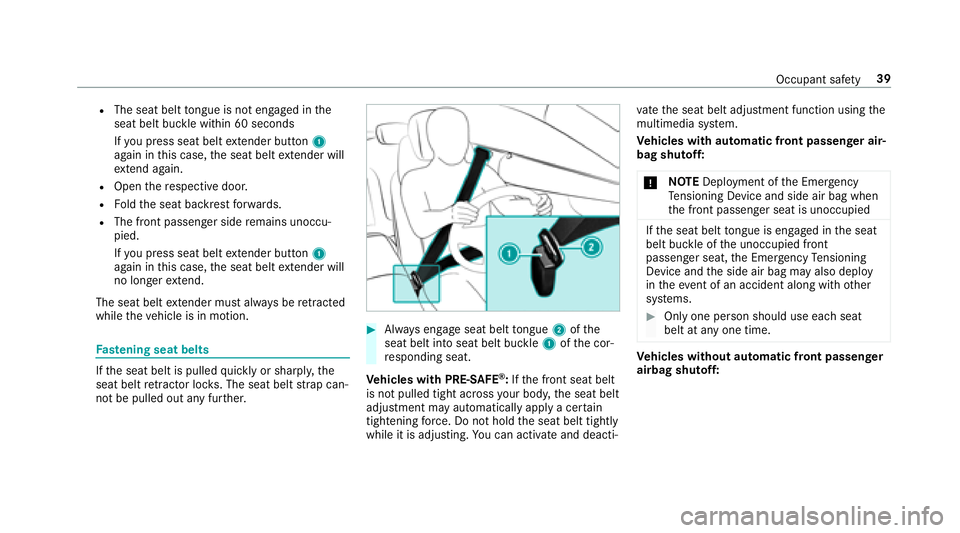
#Alw ays engage seat belt tongue 2ofthe
seat belt into seat belt buckle 1ofthe cor‐
re sponding seat.
Ve hicles with PRE-SAFE
®:If th e front seat belt
is not pulled tight across your body, the seat belt
adjustment may automatically apply a cer tain
tigh tening forc e. Do not hold the seat belt tightly
while it is adjusting. You can activate and deacti‐ va
te the seat belt adjustment function using the
multimedia sy stem.
Ve hicles with automatic front passenge r air‐
bag shu toff:
* NO
TEDeployment of the Emer gency
Te nsioning Device and side air bag when
th e front passenger seat is unoccupied
Ifth e seat belt tongue is engaged in the seat
belt buckle of the unoccupied front
passenger seat, the Emer gency Tensioning
Device and the side air bag may also deploy
in theev ent of an accident along with other
sy stems.
#Only one person should use each seat
belt at any one time.
Ve hicles without automatic front passenge r
airbag shu toff:
Occupant safe ty39
Page 42 of 502
*NO
TEDeployment of the Emer gency
Te nsioning Device when the front
passenger seat is unoccupied
If th e seat belt tongue is engaged in the seat
belt buckle of the unoccupied front
passenger seat, the Emer gency Tensioning
Device may also depl oyintheev ent of an
accident along with other sy stems.
#Only one person should use each seat
belt at any one time.
Re leasing seat belts
#Press there lease button in the seat belt
buckle and guide the seat belt back with the
seat belt tongue.
Ac tivating or deactivating seat belt adjust‐
ment via the multimedia sy stem
Multimedia sy stem:
,Vehicle.î Vehicle Settings.Belt
Adjustment
#Ac tivate Oor deacti vate ª the function.
Seat belt warning function for the driver and
front passen ger
The ü seat belt warning lamp in the Instru‐
ment Display is a reminder that all vehicle occu‐
pants must weartheir seat belts cor rectly.
The ü seat belt warning lamp lights up for six
seconds af tereve ryengine start.
In addition, an acoustic warning tone may sound.
When the driver's and front passenger doors are
closed and the driver and front passenger ha ve
fast ened their seat belts, the seat belt warning
goes out. During a journe
y,the seat belt warning lights up
if:
RThe vehicle speed exceeds 15mp h
(25 km/h) and the driver's or front
passenger seat belt is not fastened.
RThe driver or front passenger unfas tens their
seat belt while theve hicle is in motion.
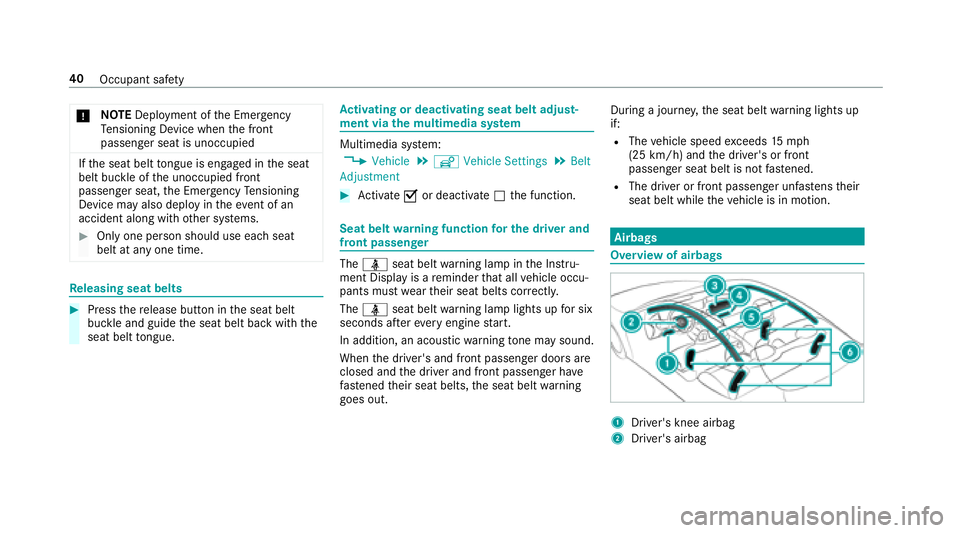
Airbags
Overview of airbags
1Driver's knee airbag
2Driver's airbag
40
Occupant saf ety
Page 43 of 502
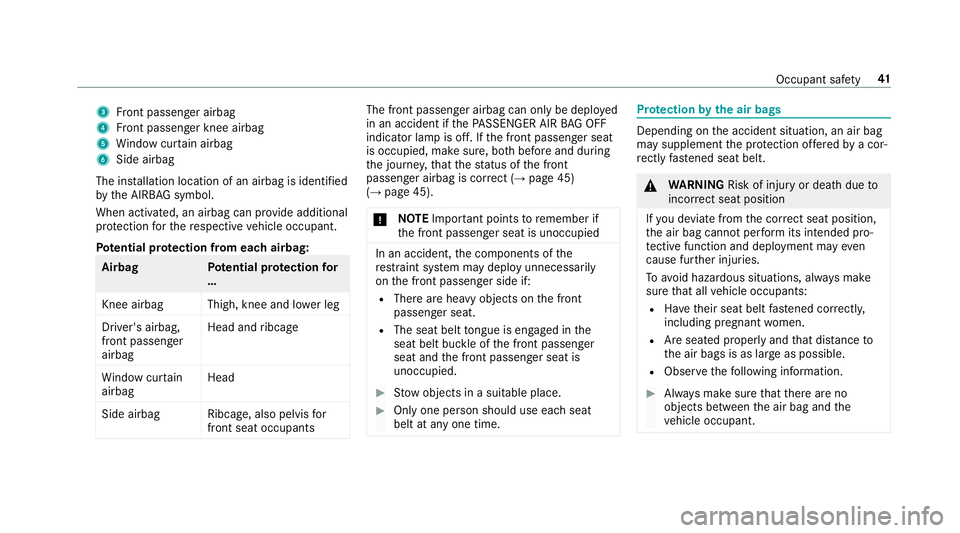
3Front passenger airbag
4Front passenger knee airbag
5Wi ndow cur tain airbag
6Side airbag
The ins tallation location of an airbag is identified
by the AIRB AGsymbol.
When activated, an airbag can pr ovide additional
pr otection forth ere spective vehicle occupant.
Pot ential pr otection from each airbag:
Airba gP otential pr otection for
…
Knee airbag Thigh, knee and lo wer leg
Driver's airbag,
front passenger
airbag Head and
ribcage
Wi ndow cur tain
airbag Head
Side airbag Ribcage, also pelvis for
front seat occupants
The front passenger airbag can only be deploy ed
in an accident if thePA SSENGER AIR BAG OFF
indicator lamp is off. If the front passenger seat
is occupied, make sure, bo thbefore and during
th e journe y,that thest atus of the front
passenger airbag is cor rect (
→page 45)
(→page 45).
* NO
TEImpo rtant points toremember if
th e front passenger seat is unoccupied
In an accident, the components of the
re stra int sy stem may deploy unnecessarily
on the front passenger side if:
RThere are heavy objects on the front
passenger seat.
RThe seat belt tongue is engaged in the
seat belt buckle of the front passenger
seat and the front passenger seat is
unoccupied.
#St ow objects in a suitable place.
#Only one person should use each seat
belt at any one time.
Protection bythe air bags
Depending on the accident situation, an air bag
may supplement the pr otection of fere dby a cor‐
re ctly fastened seat belt.
&
WARNING Risk of injury or death dueto
incor rect seat position
If yo ude viate from the cor rect seat position,
th e air bag cannot perform its intended pro‐
te ctive function and deployment may even
cause fur ther injuries.
To avo id hazardous situations, alw ays make
sure that all vehicle occupants:
RHa ve their seat belt fastened cor rectly,
including pregnant women.
RAre seated properly and that dis tance to
th e air bags is as large as possible.
RObser vethefo llowing information.
#Alw ays make sure that there are no
objects between the air bag and the
ve hicle occupant.
Occupant saf ety 41
Page 44 of 502
Toavo idtherisks resulting from the deployment
of an air bag, each vehicle occupant must
obser vethefo llowing information:
RBefore starting your journe y,adjust your seat
co rrectly ;th e driver's seat and front
passenger seat should be mo ved as far back
as possible.
When doing so, alw ays obser vethe informa‐
tion on the cor rect driver's seat position
(
→page 81).
ROnly hold thesteering wheel bythesteering
wheel rim. This all owsthe air bag tobe fully
deplo yed.
RAlw ays lean against the seat backrest when
th eve hicle is in motion. Do not lean forw ards
or against the door or side windo w.You may
ot herwise be in the deployment area of the
air bags.
RAlw ayske ep your feet on thefloor. Do not
put your feet on the cockpit, forex ample.
Yo ur feet may otherwise be in the deploy‐
ment area of the air bag.
RIfch ildren are tra veling in theve hicle,
obser vethe additional no tes (→page 49).
RAlw aysstow and secure objects cor rectly.
Objects in theve hicle interior may pr event an air
bag from functioning cor rectly. Each vehicle
occupant must alw ays make sure of thefo llow‐
ing:
RThere are no people, animals or objects
between theve hicle occupants and an air
bag.
RThere are no objects between the seat , door
and door pillar (B-pillar).
RThere are no hard objects, e.g. coat hangers,
hanging on the grab handles or coat hooks.
RThere are no accessory parts, such as cup
holders, attached totheve hicle within the
deployment area of an air bag, e.g. on doors,
side windo wsor side trim.
RThere are no heavy, sharp-edged or fragile
objects in the poc kets of your clo thing. Store
such objects in a suitable place.
Re duced airbag pr otection
&
WARNING Risk of injury from modifica‐
tions tothe airbag co ver
If yo u modify an airbag co ver or af fix objects
such assticke rs to it,the airbag can no lon‐
ge r function cor rectl y.
#Ne ver modify an airbag co ver and do
not af fix objects toit.
The ins tallation location of an airbag is identified
by the AIRB AGsymbol (→page 40).
&
WARNING Risk of injury or death dueto
th e use of unsuitable seat co vers
Uns uitable seat co vers can obstruct or pre‐
ve nt the deployment of air bags integrated
into the seats.
Consequentl y,the air bags cannot protect
ve hicle occupants as they are designed to
do. In addition, operation of the automatic
front passenger air bag shutoff may be
re stricted.
42
Occupant saf ety