stop start MERCEDES-BENZ S-CLASS CABRIOLET 2018 Owner's Manual
[x] Cancel search | Manufacturer: MERCEDES-BENZ, Model Year: 2018, Model line: S-CLASS CABRIOLET, Model: MERCEDES-BENZ S-CLASS CABRIOLET 2018Pages: 502, PDF Size: 6.27 MB
Page 9 of 502
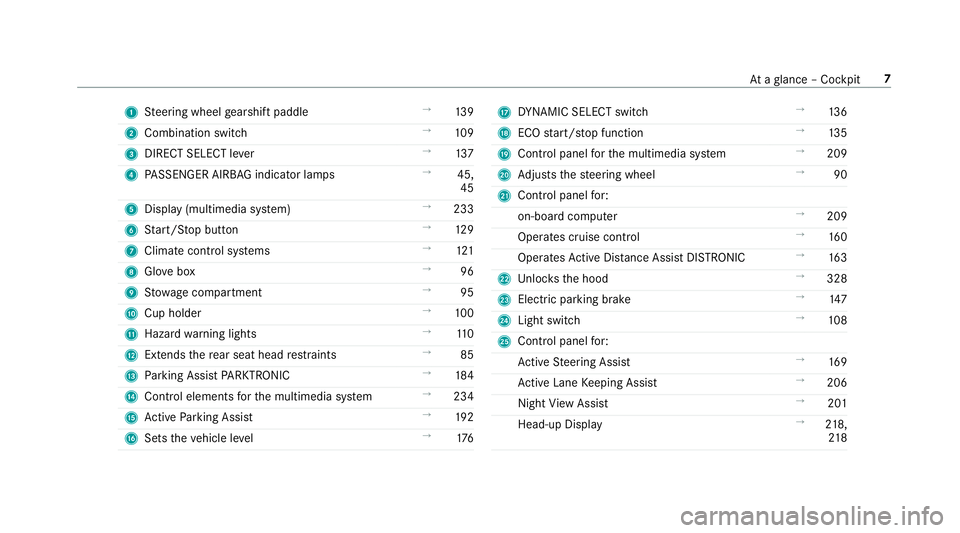
1Steering wheel gearshift paddle →
139
2 Combination switch →
109
3 DIRECT SELECT le ver →
137
4 PASSENGER AIRB AGindicator lamps →
45,
45
5 Display (multimedia sy stem) →
233
6 Start/ Stop button →
129
7 Climat e control sy stems →
121
8 Glovebox →
96
9 Stow age compartment →
95
A Cup holder →
100
B Hazard warning lights →
110
C Extends there ar seat head restra ints →
85
D Parking Assist PARKTRONI C →
184
E Control elements forth e multimedia sy stem →
234
F Active Parking Assist →
192
G Sets theve hicle le vel →
176H
DYNA MIC SELECT switch →
136
I ECO start/ stop function →
135
J Control panel forth e multimedia sy stem →
209
K Adjusts thesteering wheel →
90
L Control panel for:
on-board computer →
209
Operates cruise contro l →
160
Operates Active Dis tance Assist DISTRONIC →
163
M Unloc ksthe hood →
328
N Elect ric park ing brake →
147
O Light switch →
108
P Control panel for:
Ac tive Steering Assist →
169
Ac tive Lane Keeping Assist →
206
Night View Assist →
201
Head-up Display →
218,
21 8
At aglance – Cockpit 7
Page 23 of 502
Protecting the environment
+ENVIRONMENTAL NOTEEnvironmental
damage duetooperating conditions and
personal driving style
The pollutant emission of your vehicle is
directly related tothewa yyo u operate your
ve hicle.
Yo u can help toprotect the environment by
operating your vehicle in an environmentally-
re sponsible manner. Please obser vethefo l‐
lowing recommendations on ope rating condi‐
tions and pe rsonal driving style.
Operating conditions:
#Make sure that the tire pressure is cor‐
re ct.
#Do not car ryany unnecessary weight
(e.g. roof luggage rack s once you no
longe r need them).
#Ad here tothe service inter vals.
A regularly serviced vehicle will contri b‐
ute toenvironmen tal pr otection.
#Alw ays ha vemaintenance workcar ried
out at a qualified specialist workshop.
Pe rsonal driving style:
#Do not depress the accelera tor pedal
when starting the engine.
#Do not warm upthe engine while the
ve hicle is stationar y.
#Drive carefully and maintain a suitable
dist ance from theve hicle in front.
#Av oid frequent, sudden acceleration
and braking.
#Change gear in good time and use each
ge ar only uptoÔ of its maximum
engine speed.
#Switch off the engine in stationary traf‐
fi c, e.g. byusing the ECO start/ stop
function.
#Drive fuel-ef ficiently.
Environmental issues and recommendations:
it is recommended that youre -use or recycle
materials ins tead of just disposing of them. The
releva nt environmental guidelines and regu‐
lations ser vetoprotect the environment and
must be strictly obser ved.
Mercedes-Benz GenuineParts
+ENVIRONMEN TALNO TEEnvironmental
damage causedbynot using recycled
re conditioned components
Daimler AGoffers recycled reconditioned
components and part s withthe same quality
as new parts. The same entitlement from the
Limited Warranty is valid as for new parts.
#Use recycled reconditioned compo‐
nents and part s from Daimler AG.
Gene ral no tes 21
Page 73 of 502
#With th e handle pointing upwards, insert the
mechanical keyin to the trunk lock as far as it
will go.
#Tu rn the mechanical keyclo ckwise from posi‐
tion 1toposition 2.
#Turn the mechanical keybac kto position 1
and remo veit.
% Ifyo u use the mechanical keyto unlo ckand
open the trunk lid, the anti- theft alarm sys‐
te m will be triggered.
Ac tivating/deactivating the trunk lid opening
hight restriction
Multimedia sy stem:
,Vehicle.î Vehicle Set-
tings.Trunk Lid Restriction
This function allo wsyouto av oid bumping the
trunk lid on a low garage ceiling, forex ample.
#Ac tivate Oor deacti vate ª the function.
Ro ller sun blinds
Extending/r etra cting there ar window roller
sunblind
& WARNING Risk of entrapment when
ex tending or retracting thero ller sun
blind
Body parts could become ent rapped in the
sweep of thero ller sun blind when it is being
ex tended or retracted.
#Make surethat no body parts are in the
sweep of thero ller sun blind when it is
being extended or retracted.
#If someone becomes trapped, brie fly
press the button again.
The opening or closing process is
brief lystopped. The roller sun blind
th en returns toits starting position.
* NO
TEDama gecaused byobjects
#Make sure that thero ller sun blind can
mo vefreely.
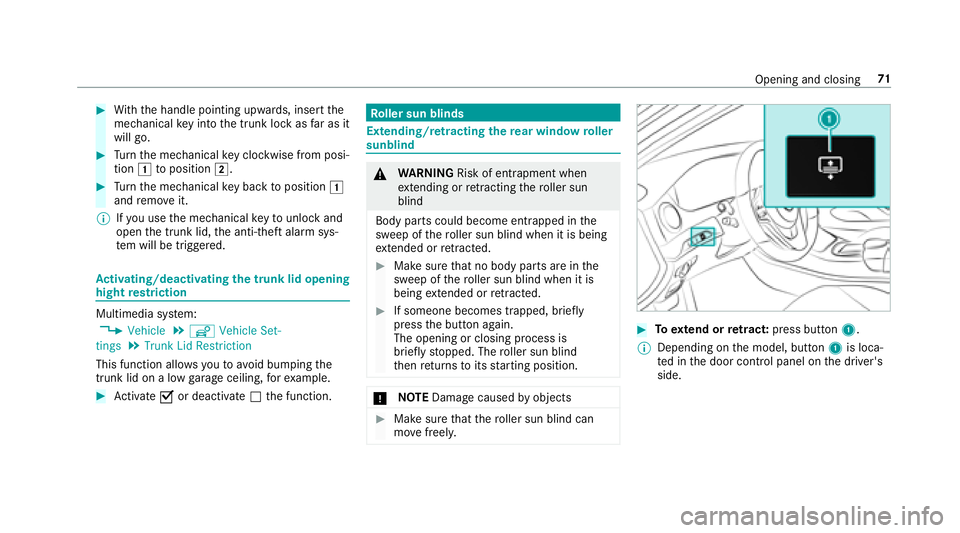
#To extend or retract: press button 1.
% Depending on the model, button 1is loca‐
te d in the door control panel on the driver's
side.
Opening and closing 71
Page 78 of 502
Panoramic roof
Operating the panoramic roof's roller sun‐
blind
& WARNING Risk of becoming trapped
when opening and closing thero ller sun‐
blinds
Body parts can become trapped between the
ro ller sunblind and frame when opening or
closing.
#When opening or closing, make sure
th at no body parts are in thera nge of
mo vement of thero ller sunblind.
#Re lease the button immediately if
somebody becomes trapped.
or
#Brief lypress the button in any direction
during automatic operation.
The opening/closing process is stop‐
ped.
Re quirementsRThe po wer supply is switched on. Opening or closing
thero ller sunblind
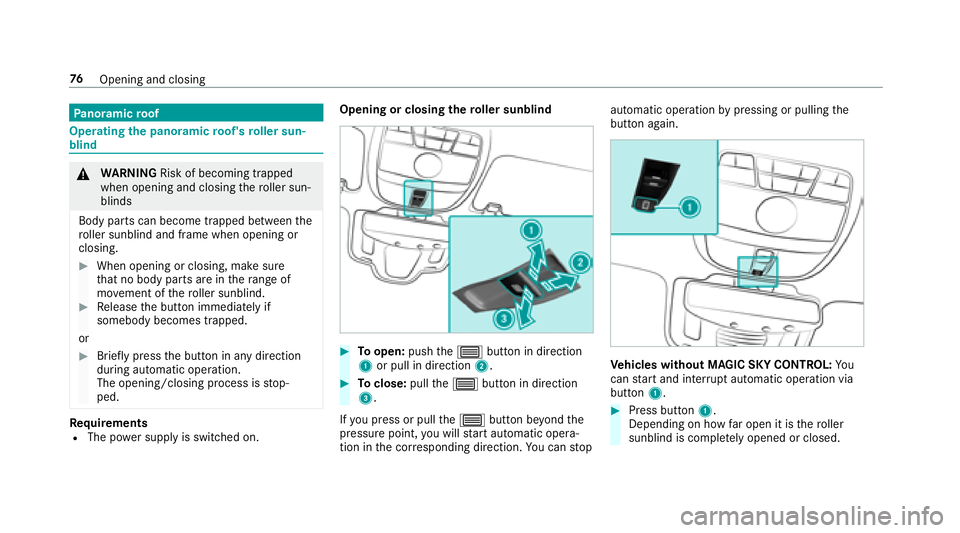
#To open: pushthe3 button in direction
1 or pull in direction 2.
#Toclose: pullthe3 button in direction
3.
If yo u press or pull the3 button be yond the
pressure point, you will start automatic opera‐
tion in the cor responding direction. You can stop automatic operation
bypressing or pulling the
button again.
Ve hicles without MAGIC SKY CONTROL: You
can start and inter rupt automatic operation via
button 1.
#Press button 1.
Depending on how far open it is thero ller
sunblind is comple tely opened or closed.
76
Opening and closing
Page 132 of 502
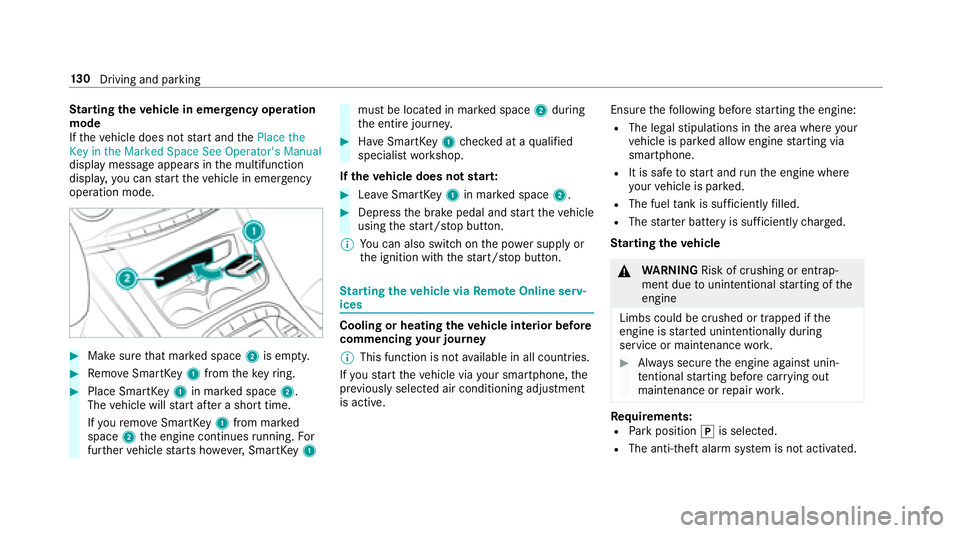
Starting theve hicle in emer gency operation
mode
If th eve hicle does not start and thePlace the
Key in the Marked Space See Operator's Manual
display message appears in the multifunction
displa y,yo u can start theve hicle in emer gency
operation mode.
#Make surethat mar ked space 2is em pty.
#Re mo veSmartK ey1 from theke yring.
#Place Smart Key1 in mar ked space 2.
The vehicle will start af ter a short time.
If yo ure mo veSmartK ey1 from mar ked
space 2the engine continues running. For
fur ther vehicle starts ho wever,SmartK ey1
must be located in mar ked space 2during
th e entire journe y.
#Have SmartK ey1 checked at a qualified
specialist workshop.
If th eve hicle does not star t:
#Lea veSmartK ey1 in mar ked space 2.
#Depress the brake pedal and start theve hicle
using thest art/ stop button.
% You can also switchon the po wer supp lyor
th e ignition with thest art/ stop button.
St arting theve hicle via Remo teOnline serv‐
ices
Cooling or heating theve hicle interior before
commencing your journey
% This function is not available in all countries.
If yo ustart theve hicle via your smartphone, the
pr ev iously selecte d air conditioning adjustment
is active. Ensure
thefo llowing before starting the engine:
RThe legal stipulations in the area where your
ve hicle is par ked allow engine starting via
smartphone.
RIt is safe tostart and runth e engine where
yo ur vehicle is par ked.
RThe fuel tank is suff icientlyfilled.
RThe star ter battery is suf ficiently charge d.
St arting the vehicle
&
WARNING Risk of crushing or entrap‐
ment due tounin tentional starting of the
engine
Limbs could be crushed or trapped if the
engine is star ted unintentionally during
service or maintenance work.
#Alw ays secure the engine against unin‐
te ntional starting before car rying out
maintenance or repair work.
Re quirements:RPark position jis selected.
RThe anti- theft alarm sy stem is not activated.
13 0
Driving and pa rking
Page 133 of 502
RThe panic alarm is not activated.
RThe hazardwarning lights are switched off.
RThe hood is closed.
RThe doors are closed and loc ked.
RThe windo wsand sliding sunro of are closed.
#Start theve hicle using the smartphone:RAf tereve ryvehicle start, the engine runs for
te n minu tes.
RYo u can car ryout a maximum of two consec‐
utive starting attem pts. The vehicle must be
st ar ted once with the SmartK eybefore trying
to start theve hicle again with the smart‐
phone.
RYo u can stop theve hicle again at any time.
RFu rther information can be found inthe
smartphone app.
Securing the engine against starting before
car rying out maintenance or repair work:
#Switch on the hazard warning lights.
or
#Un lock the doors. or
#Open a side window or
the sliding sunroof.
Breaking-in no tes
Mercedes-AMG vehicles: observeth e no tes in
th e Supplement. Otherwise, you may failto rec‐
ognize dangers.
To preser vethe engine during thefirs t
1, 000 miles (1,500 km):
Rdrive at varying road speeds and engine
speeds.
Rdrive theve hicle in drive program A
or ;.
Rchange gear before theta ch ome ter needle is
Ô ofthewa yto there d area of theta ch ome‐
te r.
Rdo not shift down a gear manually in order to
brake.
Ravo idoverstra ining theve hicle, e.g. driving at
full thro ttle.
Rdo not depress the accelera tor pedal past
th e pressure point (kickdown).
Ronly increase the engine speed gradually and
accelerate theve hicle tofull speed af ter
1, 000 miles (1,500 km).
This also applies when the engine or parts of the
driv etra in ha vebeen replaced.
Please also obser vethefo llowing breaking-in
no tes:
Rin cer tain driving and driving saf etysy stems,
th e sensor sy stem adjusts automatically
while a cer tain dis tance is driven af terth e
ve hicle has been delivered or af terre pairs.
Fu ll sy stem ef fectiveness is not achie ved
unt ilth e end of this teach-in process.
Rbrakepads, brake discs and tires that are
either new or ha vebeen replaced only ach‐
ie ve opt
imum braking ef fect and grip af ter
se veral hundred kilom eters of driving. Com‐
pensate forth ere duced braking ef fect by
applying greater forc eto the brake pedal.
Driving and parking 13
1
Page 136 of 502
Non-combusted fuel may get into the cata‐
lytic con verter.
#Only depress the accelera tor pedal
slightl y.
#Have the cause rectified immediately at
a qu alified specialist workshop.
Limited braking ef fect on salt-treate dro ads:
Rdue tosalt build-up on the brake discs and
brakepads, the braking dis tance can increase
conside rably or result in braking only on one
side.
Rmaintain a much greater safe dis tance tothe
ve hicle in front.
To preve nt salt build-up:
Rbrake occasionally while paying attention to
th e tra ffic conditions.
Rcarefully depress the brake pedal at the end
of the journey and when starting the next
journe y.
ECOstart/s top function
Opera tion of the ECO start/s top function
Mercedes -AMG vehicles: observeth e no tes in
th e Supplement. Otherwise, you may not recog‐
nize dangers.
The engine is au tomatical lyswitched off if the
fo llowing conditions are me t:
Rifyo ubr ake theve hicle toast andstill in
transmission position hori.
Rif all vehicle conditions for an au tomatic
engine stop are met.
The è symbol appears in the multifunction
display when theve hicle is stationar y.
The engine is restar ted automatically if:
Ryo ure lease the brake pedal in transmission
position hwhen the HOLD function is not
active.
Ryo u shift from transmission position j.
Ryou enga getransmission position hork.
Ryou depress the accelerator pedal.
Ryo uch ange theve hicle le vel.
Ran automatic engine start is necessar y.
If th e engine was switched off bythe ECO start/
st op function and you lea vetheve hicle, a warn‐
ing tone sounds. The Vehicle Operational Switch
the Ignition Off Before Exiting displaymessage
also appears in the multifunction displa y.Ifyo u
do not switch off the ignition, the ignition is
automatically switched off af ter one minute.
13 4
Driving and pa rking
Page 150 of 502
RStarting the engine.
In addition, they may operate vehicle equip‐
ment and become trapped.
#Ne ver lea vechildren unatte nded inthe
ve hicle.
#When leaving theve hicle, alw aysta ke
th e SmartK eywith you and lock the
ve hicle.
The electric parking brake is applied if the trans‐
mission is in position jand one of thefo llow‐
ing conditions is fulfilled:
RThe engine is switched off.
RThe seat belt tongue is not inser ted in the
seat belt buckle of the driver's seat and the
driver's door is opened.
% Toprev ent application: pull the handle of the
electric parking brake.
In thefo llowing situations, the electric parking
brake is also engaged:
RAc tive Dis tance Assist DISTRONIC is bringing
th eve hicle toast andstill.
RThe HOLD function is keeping theve hicle sta‐
tionar y.
RActive Parking Assist is keeping theve hicle
st ationar y.
This is only the case if one of thefo llowing con‐
ditions is also fulfilled:
RThe engine is switched off.
RThe seat belt tongue is not inser ted in the
seat belt buckle of the driver's seat and the
driver's door is opened.
RThere is a sy stem malfunction.
RThe po wer supply is insuf ficient.
RThe vehicle is stationary for a lengt hyperiod.
When the electric parking brake is applied, the
re dF (USA) or !(Canada) indicator lamp
appears in the instrument clus ter.
The electric parking brake is not automatically
applied if the engine is switched off bythe ECO
st art/ stop function. Electric parking brake function (releasing
automatically)
The electric parking brake is
released when the
fo llowin
g conditions are fulfilled:
RThe engine is running.
RThe seat belt tongue is inser ted into the seat
belt buckle of the driver's seat.
RThe transmission is in position hork and
yo u depress the accelera tor pedal or you
shift from transmission position jtoh or
k.
RIf th e transmission is in position k,the
trunk lid must be closed.
If th e seat belt tongue is not inser ted into the
seat belt buckle of the driver's seat, thefo llow‐
ing conditions must be fulfilled:
RThe driver's door is closed.
RYo u mo vethe transmission out of transmis‐
sion position joryou ha veprev iously
driven faster than 2 mph (3 km/h).
RIfth e transmission is in position k,the
trunk lid must be closed.
148
Driving and pa rking
Page 172 of 502
Assistance when changing lanes is pr ovided if all
th efo llowing conditions are me t:
RYou are driving on a highwa yor road with
multiple lanes in the direction of tr avel.
RThe neighboring lane is separated bya bro‐
ke n lane mark ing.
RNovehicle is de tected in the adjacent lane.
RThe driven speed is between 50 mph
(80 km/h) and 110mp h(1 80 km/h).
RAc tive Lane Change Assi stis activated bythe
driver with the turn signal indicator.
RAc tive Lane Change Assi stis switched on in
th e multimedia sy stem.
RAc tive Steering Assist is switched on and
active.
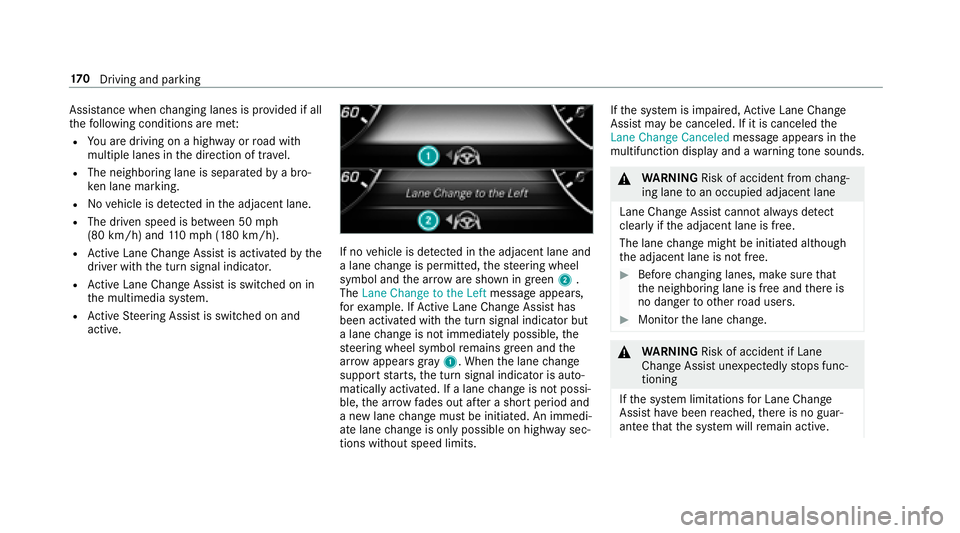
If no vehicle is de tected in the adjacent lane and
a lane change is permitte d,thesteering wheel
symbol and the ar row are shown in green 2.
The Lane Change to the Left message appears,
fo rex ample. If Active Lane Change Assi sthas
been activated with the turn signal indicator but
a lane change is not immediately possible, the
st eering wheel symbol remains green and the
ar row appears gray 1. When the lane change
support starts, the turn signal indicator is auto‐
matically activated. If a lane change is not possi‐
ble, the ar row fa des out af ter a short period and
a new lane change must be initiated. An immedi‐
ate lane change is only possible on highw aysec‐
tions without speed limits. If
th e sy stem is impaired, Active Lane Change
Assi stmay be canceled. If it is canceled the
Lane Change Canceled message appears inthe
multifunction display and a warning tone sounds.
&
WARNING Risk of accident from chang‐
ing lane toan occupied adjacent lane
Lane Change Assistcannot al ways detect
clear lyifth e adjacent lane is free.
The lane change might be initiated although
th e adjacent lane is not free.
#Before changing lanes, make sure that
th e neighboring lane is free and there is
no danger to otherroad users.
#Monitor the lane change.
&
WARNING Risk of accident if Lane
Change Assist unexpectedlystops func‐
tioning
If th e sy stem limitations for Lane Change
Assist ha vebeen reached, there is no guar‐
antee that the sy stem will remain active.
17 0
Driving and pa rking
Page 176 of 502
RIfth e HOLD function is deactivated by
depressing the accelera tor pedal or the
brake pedal, e.g. byave hicle occupant.
RIfth e electrics in the engine compart‐
ment, the battery or the fuses are tam‐
pered with or if the battery is disconnec‐
te d.
#Alw ays deactivate the HOLD function
and secure theve hicle against rolling
aw ay before leaving theve hicle.
* NO
TEDama gefrom au tomatic braking
When Active Brake Assi st,Ac tive Dis tance
Assist DISTRONIC or the HOLD function are
activated, theve hicle brakes autonomously
in cer tain situations.
To avo id damage totheve hicle, deactivate
th ese sy stems in thefo llowing or similar sit‐
uations:
#During towing
#In a car wash
Requirements:RThe vehicle is stationar y.
RThe driver's door is closed or the seat belt on
th e driver's side is fastened.
RThe engine is running or has been au tomati‐
cally switched off bythe ECO start/ stop
function.
RThe electric parking brake is released.
RAc tive Dis tance Assist DISTRONIC is deacti‐
va ted.
RThe transmission is in position h,kori.
Ac tivating the HOLD function
#Dep ress the brake pedal and af ter a short
time quickly depress fur ther until theë
display appears in the multifunction displa y.
#Release the brake pedal.
Deactivating the HOLD function
#Depress the accelerator pedal topull away.
or
#Depress the brake pedal until theë dis‐
play disappears from the multifunction dis‐
pla y. The HOLD function is deactivated in
thefo llow‐
ing situations:
RAc tive Dis tance Assist DISTRONIC is acti va‐
te d.
RThe transmission is switched toposition j.
RThevehicle is secured with the electric park‐
ing brake.
In thefo llowing situations, theve hicle is held by
th e transmission position jorby the electric
parking brake:
RThe seat belt is unfas tened and the driver's
door is opened.
RThe engine is switched off.
RThere is a malfunction in the sy stem or the
po we r supply is insuf ficient.
AIR BODY CONT ROL
AIR BODY CONT ROL function
AIR BODY CONTROL is an air suspension sy stem
with variable damping for impr oved driving com‐
fo rt. The all-round le vel control sy stem ensures
th e best possible suspension and const ant
174
Driving and pa rking