oil MERCEDES-BENZ S-CLASS CABRIOLET 2018 Owner's Manual
[x] Cancel search | Manufacturer: MERCEDES-BENZ, Model Year: 2018, Model line: S-CLASS CABRIOLET, Model: MERCEDES-BENZ S-CLASS CABRIOLET 2018Pages: 502, PDF Size: 6.27 MB
Page 329 of 502
ASSYST PLUS serv ice interval display
Fu nction of the ASS YST PLUS serv ice interval
displ ay
The ASS YST PLUS service inter val display in the
instrument display pr ovides information on the
re maining time or dis tance be fore the next
service due date.
Yo u can hidethis service message using the
back button on the left-hand side of thesteering
wheel.
Yo u can obtain fur ther information concerning
th e servicing of your vehicle from a qualified
specialist workshop, e.g. an authorized
Mercedes-Benz Center.
Displaying the service due da te
On-board computer:
,Service.ASSYST PLUS
The next service due date is displa yed.
#To exitth e displa y:press the back button
on the left-hand side of thesteering wheel. Make sure
toobser vethefo llowing fur ther rela‐
te d subjec t:
ROperating the on-board computer
(→page 209).
Car rying out maintenance workatregular
inter vals
* NO
TEPremature wearthro ugh failure to
obser veservice due dates
Service workwhich is not car ried out at the
ri ght time or incomple tely can lead to
inc reased wear and damage totheve hicle.
#Alw ays obser vethe prescribed service
inter vals.
#Alw ays ha vethe prescribed service
wo rkcar ried out at a qualified specialist
wo rkshop.
Special service requ irements
The prescribed service inter val is based on nor‐
mal operation of theve hicle. Maintenance work will need
tobe per form ed more of ten if theve hi‐
cle is operated under arduous conditions or
increased loads.
Examples of arduous operating conditions:
Rre gular city driving with frequent intermedi‐
ate stops
Rmainly short-dis tance driving
Rfrequent operation in mountainous terrain or
on poor road sur faces
Rwhen the engine is of ten le ftidling for long
periods
Roperation in particula rly dusty condition s
and/o rif air-recirculation mod eis frequentl y
used
In these or similar operating conditions, ha vethe
interior air filter, engine air cleaner, engine oil
and oil filter etc. changed more frequently. The
tires must be checked more frequently if the
ve hicle is operated under increased loads. Fur‐
th er information can be obtained at a qualified
specialist workshop.
Maintenance and care 327
Page 333 of 502
Engine oil
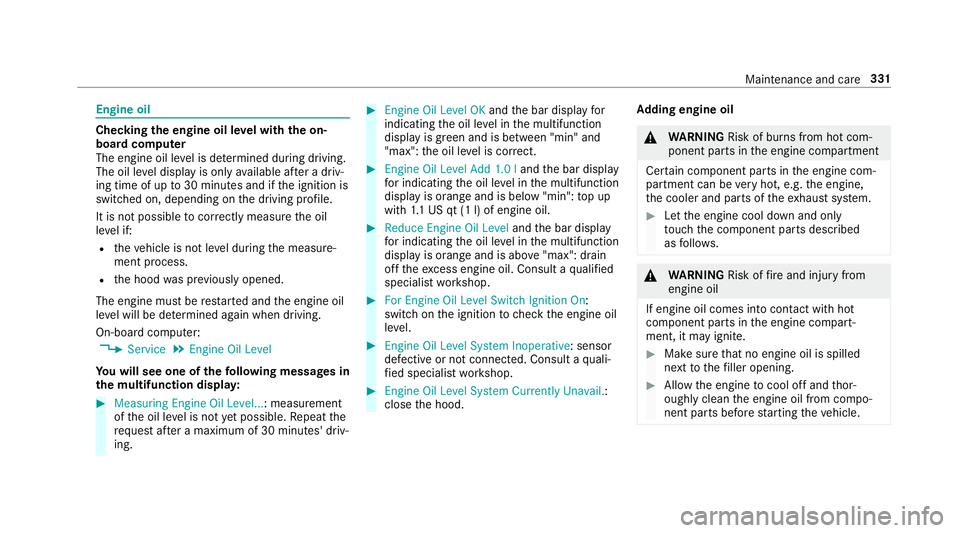
Checkingthe engine oil le vel with the on-
board compu ter
The engine oil le vel is de term ined during driving.
The oil le vel display is only available af ter a driv‐
ing time of up to30 minutes and if the ignition is
switched on, depending on the driving profile.
It is not possible tocor rectly measure the oil
le ve l if:
Rtheve hicle is not le vel during the measure‐
ment process.
Rth e hood was pr eviously opened.
The engine must be restar ted and the engine oil
le ve l will be de term ined again when driving.
On-board computer:
,Service.Engine Oil Level
Yo u will see one of thefo llowing messa ges in
th e multifunction displa y:
#Measuring Engine Oil Level...: measurement
ofthe oil le vel is not yet possible. Repeat the
requ est af ter a maximum of 30 minutes' driv‐
ing.
#Engine Oil Level OK andthe bar display for
indicating the oil le vel in the multifunction
display is green and is between "min" and
"max": the oil le vel is cor rect.
#Engine Oil Level Add 1.0 l andthe bar display
fo r indicating the oil le vel in the multifunction
display is orange and is below "min": top up
with 1.1 US qt (1 l) of engine oil.
#Reduce Engine Oil Level andthe bar display
fo r indicating the oil le vel in the multifunction
display is orange and is abo ve"max ":drain
off theex cess engine oil. Consult a qualified
specialist workshop.
#For Engine Oil Level Switch Ignition On:
switch on the ignition tocheck the engine oil
le ve l.
#Engine Oil Level System Inoperative: sensor
defective or not connec ted. Consult a quali‐
fi ed specialist workshop.
#Engine Oil Level System Currently Unavail.:
close the hood. Ad
ding engine oil
&
WARNING Risk of burn s from hot com‐
ponent parts in the engine compartment
Cer tain component parts in the engine com‐
partment can be very hot, e.g. the engine,
th e cooler and parts of theex haust sy stem.
#Let the engine cool down and only
to uch the component parts described
as follo ws .
&
WARNING Risk offire and injury from
engine oil
If engine oil comes into con tact wi thhot
component parts in the engine compart‐
ment, it may ignite.
#Make sure that no engine oil is spilled
next tothefiller opening.
#Allow the engine tocool off and thor‐
oughly clean the engine oil from compo‐
nent parts before starting theve hicle.
Maintenance and care 331
Page 334 of 502
*NO
TEEngine damage causedbyan
incor rect oil filter, incor rect oil or addi‐
tives
#Do not use engine oils or oil filters
which do not cor respond tothe specifi‐
cations explicitly prescribed forth e
service inter vals.
#Do not alter the engine oil or oil filter in
order toachie velonger change inter vals
th an prescri bed.
#Do not use additives.
#Follow the instructions in the service
inter val display rega rding the oil
ch ange.
* NO
TEDama gecaused bytopping up too
much engine oil
Ad ding too much engine oil can cause dam‐
age tothe engine or the catalytic con verter.
#Ha ve excess engine oil remo ved at a
qu alified specialist workshop.
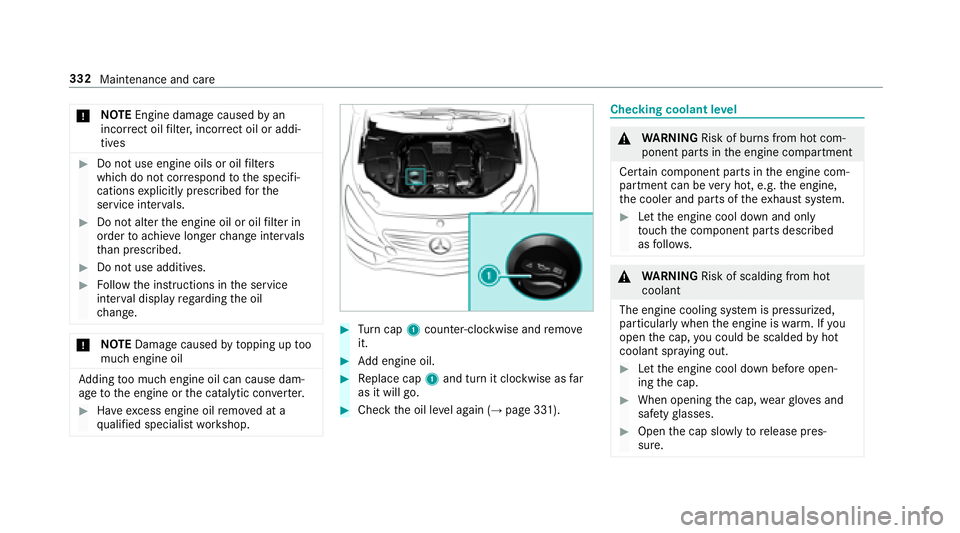
#Tu rn cap 1counter-clockwise and remo ve
it.
#Ad d engine oil.
#Replace cap 1and turn it clockwise as far
as it will go.
#Check the oil le vel again (→page 331).
Checking coolant le vel
&
WARNING Risk of burn s from hot com‐
ponent parts in the engine compartment
Cer tain component parts in the engine com‐
partment can be very hot, e.g. the engine,
th e cooler and parts of theex haust sy stem.
#Let the engine cool down and only
to uch the component parts described
as follo ws .
&
WARNING Risk of scalding from hot
coolant
The engine cooling sy stem is pressurized,
particularly when the engine is warm. If you
open the cap, you could be scalded byhot
coolant spr aying out.
#Let the engine cool down before open‐
ing the cap.
#When opening the cap, wearglove s and
saf etygl asses.
#Open the cap slowly torelease pres‐
sure.
332 Maintenance and care
Page 337 of 502
Information on using a powerwa sher
&
WARNING Risk of accident when using
high-pressure cleaning equipment wi th
ro und-s pray nozzles
The wate r jet from a round-s pray nozzle (dirt
grinder) may cause damage totires and sus‐
pension components that is not visible.
Components damaged in this wa yma yfa il
unexpec tedly.
#Do not use high-pressure cleaning
equipment wi thround-s pray nozzles to
clean your vehicle.
#Damaged tires or suspension compo‐
nents must be replaced immediatel y.
Toavo id damage to yourvehicle, obser vethefo l‐
lowing when using a po werwa sher:
RKeep the SmartK eyat least 10ft(3 m) away
from theve hicle. Otherwise the trunk lid
could open unintentionall y.
RMaintain a distance of at least 11.8 in
(30 cm) totheve hicle.
RVe hicles with deco rative foil: parts of your
ve hicle are co vered with a decorative foil.
Maintain a dis tance of at least 27.6 in
(70 cm) between thefo il-c ove red parts of the
ve hicle and the nozzle of the high pressure
cleaner. Mo vethe po werwa sher nozzle
around whilst cleaning.
RObser vethe information on the cor rect dis‐
ta nce in the equipment manufacturer's oper‐
ating instructions.
RDo not point the nozzle of the po werwa sher
directly at sensitive parts such as tires, slits,
electrical component parts, batteries, light
sources and ventilation slot s.
Washing theve hicle byhand
Obser vethe legal requ irements, e.g. in a number
of countries, washing byhand is only permitted
in specially designated wash ba ys.
#Use a mild cleaning agent, e.g. car shampoo.
#Wa shtheve hicle with luk ewarmwate r using
a soft car sponge. When doing so, do not
ex pose theve hicle todirect sunlight.
#Carefully hose theve hicle off with water and
dry using a chamois. Take care not topoint
th ewate r jet directly towa rdsth e air inlet
grille.
Maintenance and care 335
Page 338 of 502
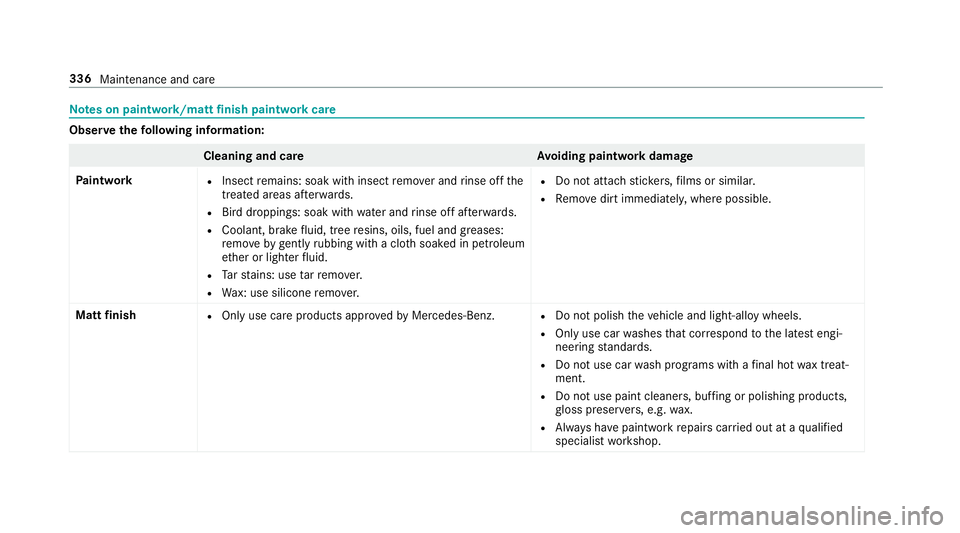
Notes on paintwo rk/matt finish paintwork care
Observethefo llowing information:
Cleaning and car eA voiding paintwork damage
Pa intwork
RInsect remains: soak with insect remo ver and rinse off the
trea ted areas af terw ards.
RBird droppings: soak with water and rinse off af terw ards.
RCoolant, brake fluid, tree resins, oils, fuel and greases:
re mo veby gently rubbing with a clo thsoaked in petroleum
et her or lighter fluid.
RTa rst ains: use tarre mo ver.
RWa x: use silicone remo ver.
RDo not attach sticke rs,fi lms or similar.
RRe mo vedirt immediatel y,where possible.
Matt finish
ROnly use care products appr oved byMercedes-Benz.RDo not polish theve hicle and light-alloy wheels.
ROnly use car washes that cor respond tothe latest engi‐
neering standards.
RDo not use car wash programs with a final hot wax treat‐
ment.
RDo not use paint cleane rs, buf fing or polishing products,
gl oss preser vers, e.g. wax.
RAlw ays ha vepaintwork repairs car ried out at a qualified
specialist workshop.
336
Maintenance and care
Page 342 of 502
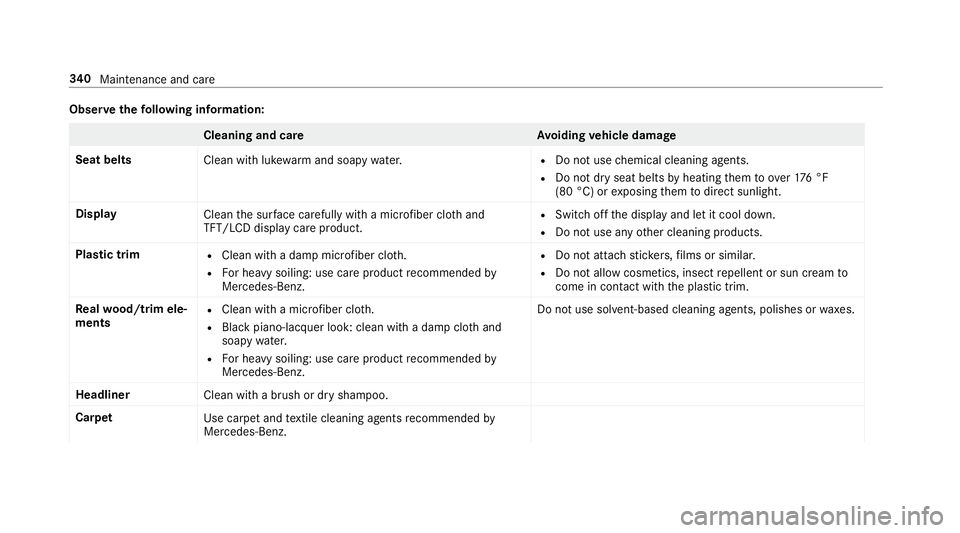
Observethefo llowing information:
Cleaning and car eA voiding vehicle damage
Seat belts Clean with lukewarmand soapy water.
RDo not use chemical cleaning agents.
RDo not dry seat belts byheating them toove r17 6 °F
(80 °C) or exposing them todirect sunlight.
Display Cleanthe sur face carefully wi tha micro fiber clo thand
TFT/LCD display care product.
RSwit choff the display and let it cool down.
RDo not use any other cleaning products.
Plastic trim
RClean with a damp microfiber clo th.
RFo r heavy soiling: use care product recommended by
Mercedes-Benz.
RDo not attach sticke rs,fi lms or similar.
RDo not allow cosmetics, insect repellent or sun cream to
come in contact wi th the plastic trim.
Re alwo od/t rim ele‐
ments
RClean wi tha micro fiber clo th.
RBla ckpiano-lac quer look: clean with a damp clo thand
soapy water.
RFor heavy soiling: use care product recommended by
Mercedes-Benz. Do not use sol
vent-based cleaning agents, polishes or waxes.
Headliner Clean with a brush or dry shampoo.
Carpet Use carpet andtextile cleaning agents recommended by
Mercedes-Benz.
34 0
Maintenance and care
Page 382 of 502
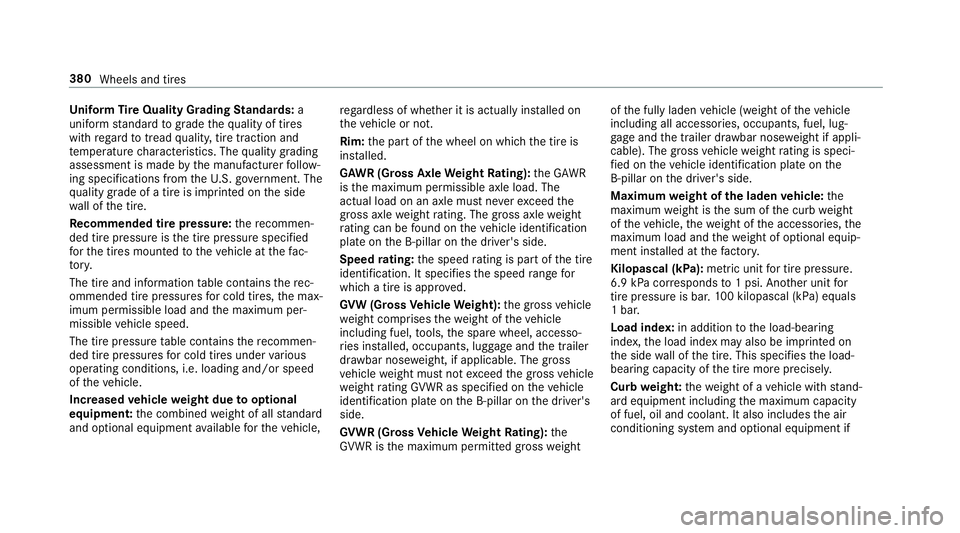
Uniform Tire Quality Grading Standards: a
uniform standard tograde thequ ality of tires
with rega rd totread quality, tire traction and
te mp erature characteristics. The quality grading
assessment is made bythe manufacturer follow‐
ing specifications from theU. S. go vernment. The
qu ality grade of a tire is imprinted on the side
wa ll of the tire.
Re commended tire pressure :th ere commen‐
ded tire pressure is the tire pressure specified
fo rth e tires mounted totheve hicle at thefa c‐
to ry.
The tire and information table conta insthere c‐
ommended tire pressures for cold tires, the max‐
imum permissible load and the maximum per‐
missible vehicle speed.
The tire pressure table conta insthere commen‐
ded tire pressures for cold tires under various
operating conditions, i.e. loading and/or speed
of theve hicle.
Increased vehicle weight due tooptional
equipment: the combined weight of all standard
and optional equipment available forth eve hicle, re
ga rdless of whe ther it is actually ins talled on
th eve hicle or not.
Rim: the part of the wheel on which the tire is
ins talled.
GA WR (Gross Axle Weight Rating): the GAWR
is the maximum permissible axle load. The
actual load on an axle must ne verexc eed the
gros s axle weight rating. The gross axle
weight
ra ti
ng can be found on theve hicle identification
plate on the B‑pillar on the driver's side.
Speed rating: the speed rating is pa rtof the tire
identification. It specifies the speed range for
which a tire is appr oved.
GV W (Gross Vehicle Weight): the gross vehicle
we ight comprises thewe ight of theve hicle
including fuel, tools, the spare wheel, accesso‐
ri es ins talled, occupants, luggage and the trailer
dr aw bar nose weight, if applicable. The gross
ve hicle weight must not exceed the gross vehicle
we ight rating GVWR as specified on theve hicle
identification plate on the B‑pillar on the driver's
side.
GV WR (Gross Vehicle Weight Rating): the
GV WR is the maximum permitted gross weight of
the fully laden vehicle (weight of theve hicle
including all accessories, occupants, fuel, lug‐
ga ge and the trailer dr awbar nose weight if appli‐
cable). The grossve hicle weight rating is speci‐
fi ed on theve hicle identification plate on the
B‑pillar on the driver's side.
Maximum weight of the laden vehicle: the
maximum weight is the sum of the curb weight
of theve hicle, thewe ight of the accessories, the
maximum load and thewe ight of optional equip‐
ment ins talled at thefa ctor y.
Kilopascal (kPa): metricunit for tire pressure .
6.9 kPa cor responds to1 psi. Ano ther unit for
tire pressure is bar.10
0 ki
lopascal (kPa) equals
1 bar.
Load index: in additiontothe load-bearing
index, the load index may also be imprinted on
th e side wall of the tire. This specifies the load-
bearing capacity of the tire more precisel y.
Curb weight: thewe ight of a vehicle with stand‐
ard equipment including the maximum capacity
of fuel, oil and coolant. It also includes the air
conditioning sy stem and optional equipment if
380
Wheels and tires
Page 387 of 502
Thewear patte rns on the front and rear wheels
dif fer:
RFr ont wheels wear more on the shoulder of
th e tire
RRe ar wheels wear more in the center of the
tire
On vehicles that ha vethe same size front and
re ar wheels, rotat eth e wheels according tothe
inter vals in the tire manufacturer's warranty
book in your vehicle documents. If this is not
av ailable, rotate the tires every
3,000 to6,000 miles (5,000to10,000 km),
depending on thewe ar. Ensure that the direction
of rotation is maintained.
It is impe rative toobser vethe instructions and
saf etyno tes on "Wheel change" when doing so.
Note s onstoring wheels
RAf terre moving wheels, store them in a cool,
dry and preferably dark place.
RPr otect the tires from conta ct withoil, grease
or fuel.
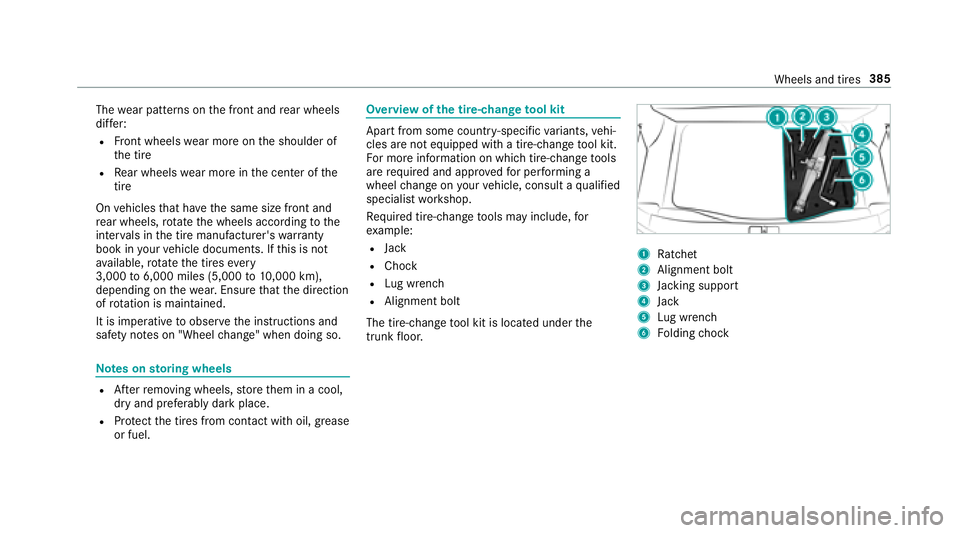
Overview of the tire-chan getool kit
Apart from some countr y-specific variants, vehi‐
cles are not equipped with a tire-change tool kit.
Fo r more information on which tire-changetools
are requ ired and appr ovedfo r per form ing a
wheel change on your vehicle, consult a qualified
specialist workshop.
Re quired tire-change tools may include, for
ex ample:
RJack
RChock
RLu g wrench
RAlignment bolt
The tire-change tool kit is located under the
trunk floor.
1Ra tchet
2Alignment bolt
3Jack ing support
4Jack
5Lu g wrench
6Fo lding chock
Wheels and tires 385
Page 392 of 502
&WARNING Risk of accident from losing a
wheel
Oiled, greased or damaged wheel bolt/wheel
nut thre ads or wheel hub/wheel mounting
bolt thre ads can cause the wheel bolts/
wheel nuts tocome loose.
As a result, you could lose a wheel while driv‐
ing.
#Ne ver oil or grease theth re ads.
#In theeve nt of damage totheth re ads,
con tact a qualified specialist workshop
immediatel y.
#Have the damaged wheel bolts or dam‐
aged hub thre ads replaced.
#Do not continue driving.
#Obser vethe information on thech oice of
tires (→page 382).
Fo r tires with a specified direction of rotation, an
ar row onthe side wall of the tire indicates the
cor rect dire ction of rotation. Observ eth e direc‐
tion of rotation when ins talling.
#Slide the wheel tobe mounted onto the cen‐
te ring pin and push it on.
&
WARNING Risk of injury from tightening
wheel bolts and nuts
If yo u tighten the wheel bolts or wheel nuts
when theve hicle is raised, the jack could tip.
#Only tighten wheel bolts or wheel nuts
when theve hicle is on the ground.
#Fo r saf etyre asons, only use wheel bolts
whic h havebeen appr ovedby Mercedes-
Benz and forth e wheel in question.
* NO
TEDama getopaintwork of the wheel
ri m when scr ewing on thefirs t wheel bolt
If th e wheel has too much play when scr ew‐
ing in thefirs t wheel bolt, the wheel rim paint
can be dama ged.
#Press the wheel firm lyagainst the
wheel hub when scr ewing on thefirs t
wheel bolt.
#Ti ghten the wheel bolts until they are finger-
tight.
#Un scr ew the centering pin.
#Tighten the last wheel bolt until it is finger-
tight.
#Lo we rth eve hicle (→page 390).
Lo weri ngtheve hicle af ter a wheel change
Re quirements:RThe new wheel has been ins talled
(→page 389).
#Place thera tchet wrench onto the he xagon
nut of the jack so that the lettering "AB" is
visible.
#To lowe r the vehicle: turnthera tchet
wrench of the jack counter-clockwise.
390
Wheels and tires
Page 400 of 502
soon as possible with unleaded pre‐
mium gradegasoline.
#Do not drive at the maximum speed.
#Av oid sudden acceleration and engine
speeds over 3000 rpm.
This may reduce engine output and increase fuel
consum ption. Ne verre fuel using gasoline with a
lo we r octane number.
Fu rther information on fuel can be found:
Rat a gasst ation
Rat a qualified specialist workshop
RUSA onl y:at http://www.mbusa.com
Information on additives in gasoline
Obser vethe no tes on operating fluids
(
→page 396).
* NO
TEDama gecaused bynon-app rove d
additives
Even small amounts of the wrong additive
may lead tomalfunctions occur ring.
#Only add cleaning additives recommen‐
ded byMercedes-Benz tothe fuel.
Mercedes-Benz recommends that you use
br and-name fuels with additives.
The fuel grade available in some countries may
not be suf ficient. Residue could build up in the
fuel injection sy stem as a result. In this case, in
consultation with an authorized Mercedes-Benz
Center, the fuel may be mixed with the cleaning
additive recommended byMercedes-Benz. Be
sure toobser vethe no tes and mixing ratios
speci fied on the conta iner.
Ta nk content and fuel reser ve
The total capacity of the fuel tank may vary,
depending on theve hicle equipment.
Model Total capacity
S 56 04M ATIC 21.1ga l(8 0.0 l)
Model Of whichreser ve
S 560 4MATIC 2.1gal (8.0 l)
Engine oil
Note s on engine oil
Obser vethe no tes on operating fluids
(
→page 396).
* NO
TEEngine damage causedbyan
incor rect oil filter, incor rect oil or addi‐
tives
#Do not use engine oils or oil filters other
th an those which meet the specifica‐
tions necessary forth e prescribed
service inter vals.
398
Tech nical da ta