seats MERCEDES-BENZ S-CLASS CABRIOLET 2018 Owner's Manual
[x] Cancel search | Manufacturer: MERCEDES-BENZ, Model Year: 2018, Model line: S-CLASS CABRIOLET, Model: MERCEDES-BENZ S-CLASS CABRIOLET 2018Pages: 502, PDF Size: 6.27 MB
Page 4 of 502
Atagl ance .................................................... 6
Cockpit ........................................................... 6
Wa rning and indicator lamps ........................ 10
Overhead contro l panel ................................ 12
Door control panel and seat adjustment ....... 14
Control settings inthere ar compartment .... .16
Emergencies and breakdowns ...................... 18
DigitalOperator' sManua l........................ .20
Callin gup the Digital Operator's Manual ...... 20
General no tes............................................. 21
Pr otecting the environment .......................... 21
Mercedes-Benz GenuineParts ....................... 21
Operator's Manual ........................................2 2
Service and vehicle operation ......................2 3
Operating saf ety.......................................... .24
Declaration of conformity for wireless
ve hicle components .....................................2 5
Diagnost ics connection ................................ 26
Qualified specialist workshop ....................... 27
Cor rect use of theve hicle ............................. 27
Problems with your vehicle ........................... 27
Re porting saf etydefects .............................. .27 Limited
Warranty .......................................... 28
QR codes forth ere scue card ....................... 28
Data storage .................................................2 8
Copyright .. .................................................... 32
Occupant safety......................................... 33
Re stra int sy stem .......................................... .33
Seat belts ..................................................... 35
Airbags ......................................................... 40
PRE-SAFE
®sy stem ....................................... 47
Childr en intheve hicle ..................................4 9
No tes on pets in theve hicle .........................5 6
Opening and closing.................................. 57
SmartK ey...................................................... 57
Doors ............................................................ 61
Tr unk ............................................................ 65
Ro ller sun blinds .......................................... .71
Side windo ws................................................ 72
Pa noramic roof ............................................. 76
Anti-theft pr otection .................................... .79
Seats and stowing ...................................... 81
No tes on the cor rect driver's seat posi‐
tion ............................................................... 81
Seats ............................................................ 82
St eering wheel ..............................................9 0
Using the memory function .......................... 93
St ow age areas .............................................. 94
Cup holder .................................................. 100
Ashtr ayand cigar ette lighter ...................... .101
Soc kets ....................................................... 102
Re frigerator box .......................................... 103
Wi reless charging of the mobile phone
and connection with theex terior antenna .. 105
Ins talling or removing thefloor mats ..........1 07
Light and visibility ................................... 108
Exterior lighting .......................................... 108
Interior lighting ............................................ 113
Wi ndshield wiper and windshield washer
sy stem ........................................................ 114
Mir rors ........................................................ 116
Operating the sun visors ............................. 119
Infrared reflective windshield function ........ 119
2
Conte nts
Page 17 of 502
1Adjusts the seats electrically →
82
2 Switches the seat heater on/off →
88
3 Switches the seat ventilation on/off →
89
4 Adjusts the front passenger seat from the driv‐
er ’s seat →
84
5 Sets the memory function →
93
6 W Opens/closes there ar left side wind ow→
72
7 W Opens/closes the left side window →
72
8 Adjusts and folds the outside mir rors out/in
electrically →
1169
Opens/closes the trunk lid →
65
A W Opens/closes theright side window →
72
B W Opens/closes there ar right side window →
72
C Opens the door →
61
D & Lockstheve hicle →
62
E % Unlockstheve hicle →
62
F Seat adjustment using the multimedia sy stem →
86
G Adjusts the head restra ints →
84
Ataglance – Door control panel and seat adjustment 15
Page 24 of 502
*NO
TEImpairment of the operating ef fi‐
ciency of there stra int sy stems from
ins talling accessories or from repairs or
we lding
Airbags, Emer gency Tensioning Devices, as
we ll as control units and sensors forth e
re stra int sy stems, may be ins talled in thefo l‐
lowing areas of your vehicle:
RDoors
RDoor pillars
RDoor sills
RSeats
RCo ckpit
RInstrument clus ter
RCente r console
#Do not ins tall accessories such as audio
sy stems in these areas.
#Do not car ryout repairs or welding.
#Have accessori esretrofitted at a quali‐
fi ed specialist workshop.
Yo u could jeopardize the operating saf etyof your
ve hicle if you use parts, tires and wheels as well
as accessories releva nt tosaf etywhic hha ve not
been appr ovedby Mercedes-Benz. Saf ety-re le‐
va nt sy stems, e.g. the brake sy stem, may mal‐
function. Only use Mercedes-Benz GenuineParts
or parts of equal quality. Only use tires, wheels
and accessory parts that ha vebeen specifically
appr ovedfo ryo ur vehicle model.
Mercedes-Benz GenuineParts are subject to
st rict quality control. Each part has been spe‐
cially de veloped, manufactured or selecte dfo r
Mercedes-Benz vehicles and fine-tuned forth em.
Therefore, only Mercedes-Benz GenuineParts
should be used.
More than 300,000 dif fere nt Mercedes-Benz
GenuineParts are available for Mercedes-Benz
models.
All au thorized Mercedes-Benz Centers maintain
a supply of Mercedes-Benz GenuineParts for
necessary service and repair work. In addition,
st ra tegically located parts-delivery centers pro‐
vide forqu ick and reliable parts service. Alw
ays specify theve hicle identification number
(VIN) (→page 394) when ordering Mercedes-
Benz GenuineParts.
Operator's Manual
This Operator's Manual describes all models and
all standard and optional equipment available for
yo ur vehicle at the time of this Opera tor's Man‐
ual going topress. Countr y-specific dif fere nces
are possible. No tethat your vehicle may not be
equipped with all features descri bed. This also
applies tosaf ety-re leva nt sy stems and functions.
Therefore, the equipment on your vehicle may
dif fer from that in the descriptions and illustra‐
tions.
The original pur chase contract documentation
fo ryo ur vehicle contains a list of all of the sys‐
te ms in your vehicle.
Should you ha veany questions concerning
equipment and operation, please consult an
authorized Mercedes-Benz Center.
The Operator's Manual and Maintenance Booklet
are impor tant documents and should be kept in
th eve hicle.
22
General no tes
Page 38 of 502
&WARNING Risk of injury or death dueto
incor rectly fastened seat belt
If th e seat belt is not worncor rectly, it can‐
not per form its intended pr otective function.
In addition, an incor rectly fastened seat belt
can also cause injuries, forex ample, in the
ev ent of an accident or when braking or
ch anging direction suddenly .
#Always ensure that all vehicle occu‐
pants ha vetheir seat belts fastened
cor rectly and are sitting prope rly.
Alw ays obser vethe instructions about the cor‐
re ct driver's seat position and adjusting the seat
(
→page 81).
In order forth e cor rectly wornseat belt topro‐
vide the intended le vel of pr otection, each vehi‐
cle occupant must obser vethefo llowing infor‐
mation:
RThe seat belt must not be twis ted and must
fi t tightly and snugl yacross the body.
RThe seat belt must be routed across the cen‐
te r of the shoulder and as low down across
th e hips as possible.
RThe shoulder section of the seat belt should
not touch your ne cknor be routed under
yo ur arm or behind your bac k.
RAvoid wearing bulky clo thing, e.g. a winter
coat.
RPush the lap belt down as far as possible
across your hips and pull tight with the shoul‐
der section of the belt. Ne verro ute the lap
belt across your abdomen.
RNe verro ute the seat belt across sharp, poin‐
te d, abrasive or fragile objects.
ROnly one person should use each seat belt at
any one time. Ne ver all owbabies and chil‐
dren totrave l sitting on the lap of ano ther
ve hicle occupant.
RNe ver secure objects with a seat belt if the
seat belt is also being used byone of the
ve hicle's occupants. Alw ays obser vethe
instructions for loading theve hicle when
securing objects, luggage or loads
(
→page 94). Also ensure
that no obj ects, e.
g. a cushion,
are ever placed between a person and the
seat.
The seat belts on thefo llowing seats are equip‐
ped with a child seat saf etyfe ature:
RFr ont passenger seat
RRe ar seats
Ac tivating or deacti vating thech ild seat saf ety
fe ature on the seat belt (
→page 51).
If ch ildren are tra veling in theve hicle, be sure to
obser vethe instructions and saf etyno tes on
"Children in theve hicle" (
→page 49).
Re duced seat belt pr otection
&
WARNING Risk of injury or death dueto
incor rect seat position
The seat belt does not of ferth e intended
le ve l of pr otection if you ha venot mo vedth e
seat backrest toan almost vertical position.
36
Occupant saf ety
Page 44 of 502
Toavo idtherisks resulting from the deployment
of an air bag, each vehicle occupant must
obser vethefo llowing information:
RBefore starting your journe y,adjust your seat
co rrectly ;th e driver's seat and front
passenger seat should be mo ved as far back
as possible.
When doing so, alw ays obser vethe informa‐
tion on the cor rect driver's seat position
(
→page 81).
ROnly hold thesteering wheel bythesteering
wheel rim. This all owsthe air bag tobe fully
deplo yed.
RAlw ays lean against the seat backrest when
th eve hicle is in motion. Do not lean forw ards
or against the door or side windo w.You may
ot herwise be in the deployment area of the
air bags.
RAlw ayske ep your feet on thefloor. Do not
put your feet on the cockpit, forex ample.
Yo ur feet may otherwise be in the deploy‐
ment area of the air bag.
RIfch ildren are tra veling in theve hicle,
obser vethe additional no tes (→page 49).
RAlw aysstow and secure objects cor rectly.
Objects in theve hicle interior may pr event an air
bag from functioning cor rectly. Each vehicle
occupant must alw ays make sure of thefo llow‐
ing:
RThere are no people, animals or objects
between theve hicle occupants and an air
bag.
RThere are no objects between the seat , door
and door pillar (B-pillar).
RThere are no hard objects, e.g. coat hangers,
hanging on the grab handles or coat hooks.
RThere are no accessory parts, such as cup
holders, attached totheve hicle within the
deployment area of an air bag, e.g. on doors,
side windo wsor side trim.
RThere are no heavy, sharp-edged or fragile
objects in the poc kets of your clo thing. Store
such objects in a suitable place.
Re duced airbag pr otection
&
WARNING Risk of injury from modifica‐
tions tothe airbag co ver
If yo u modify an airbag co ver or af fix objects
such assticke rs to it,the airbag can no lon‐
ge r function cor rectl y.
#Ne ver modify an airbag co ver and do
not af fix objects toit.
The ins tallation location of an airbag is identified
by the AIRB AGsymbol (→page 40).
&
WARNING Risk of injury or death dueto
th e use of unsuitable seat co vers
Uns uitable seat co vers can obstruct or pre‐
ve nt the deployment of air bags integrated
into the seats.
Consequentl y,the air bags cannot protect
ve hicle occupants as they are designed to
do. In addition, operation of the automatic
front passenger air bag shutoff may be
re stricted.
42
Occupant saf ety
Page 45 of 502
#You should only use seat covers that
ha ve been appr oved forth e cor respond‐
ing seats byMercedes-Benz.
&
WARNING Risk of injury duetomalfunc‐
tions of the sensors in the door paneling
Sensors tocontrol the airbags are located in
th e doors. Modifications or worknot per‐
fo rm ed cor rectly tothe doors or door panel‐
ing, as well as damaged doors, can lead to
th e function of the sensors being impaired.
The airbags might therefore not function
proper lyany more.
Consequent ly,th e airbags cannot protect
ve hicle occupants as they are designed to
do.
#Ne ver modify the doors or parts of the
doors.
#Alw ays ha vewo rkon the doors or door
paneling car ried out at a qualified spe‐
cialist workshop.
&
WARNING Risk of injury duetodeplo yed
airbag
A deplo yed airbag no longer has a pr otective
function and cann otprotect as intended in
th eev ent of an accident.
#Ha ve theve hicle towe dto aqu alified
specialist workshop in order tohave the
deplo yed airbag replaced.
Ha ve deplo yed airbags replaced immediately.
St atus of the front passenger airbag
Fu nction of the automatic front passenger
airbag shuto ff
The automatic front passenger airbag shutoff is
able todetect whe ther the front passenger seat
is occupied bya person or a child restra int sys‐
te m. The front passenger airbag and front
passenger knee airbag are then cor responding ly
either enabled or deactivated. When ins
talling a child restra int sy stem tothe
front passenger seat, alw ays make sure of the
fo llowing:
REnsure that thech ild restra int sy stem is posi‐
tioned cor rectly (→page 49).
RAlways obser vethech ild restra int sy stem
manufacturer's ins tallation instructions.
RNe ver place objects, e.g. cushions, under or
behind thech ild restra int sy stem.
RFu lly retract the seat cushion length adjust‐
ment.
RThe entire base of thech ild restra int sy stem
must alw aysre st on the sitting sur face of the
front passenger seat.
RThe backrest of thefo rw ard-facing child
re stra int sy stem must, as far as possible, be
re sting on the seat backrest of the front
passenger seat.
RThe child restra int sy stem must not touch the
ro of or be put under stra in by the head
re stra ints. Adjust the seat backrest inclina‐
tion and the head restra int setting accord‐
ing ly.
Occupant saf ety 43
Page 53 of 502
Thechild cannot be restra ined in theeve nt of
an accident, heavy braking or a sudden
ch ange of direction.
#Alw aysre place child restra int sy stems
immediately that ha vebeen damaged or
in vo lved in an accident.
#Ha ve the securing sy stems forth ech ild
re stra int sy stems checked at a qualified
specialist workshop before ins talling a
ch ild restra int sy stem again.
A boos ter seat may be necessary toachie ve
proper seat belt positioning forch ildren over
40 lbs (18 kg) in weight or until they reach a
height where a thre e-point seat belt can be
ins talled proper lywithout a boos ter seat.
The following no tes must be obser ved:
RWhen ins talling a child restra int sy stem on
th e front passenger seat, the information on
ins talling a child restra int sy stem on the front
passenger seat (
→page 55).
RInstructions and saf etyno tes on the auto‐
matic front passenger front airbag shutoff
(
→page 43).
RSaf etyno tes on the seat belt (→page 35).
RInformation on the cor rect use of the seat
belt (→page 39).
Ac tivating/deactivating the child seat saf ety
fe ature of the seat belt
&
WARNING Risk of injury or death if a
seat belt is unfas tened while theve hicle
is in motion
If th e seat belt is released while theve hicle is
in motion, thech ild restra int sy stem is no
longer cor rectly secure d. Thechild seat
saf etyfe ature is deactivated and the seat
belt is dr awn in a bit bythe inertia reel.
It is therefore not possible toengage the seat
belt again.
#Pull over and stop theve hicle safely as
soon as possible, paying attention to
ro ad and traf fic conditions.
#Ac tivate thech ild seat saf etyfe ature
again and cor rectly secure thech ild
re stra int sy stem.
When enabled, thech ild seat saf etyfe ature
ensures that the seat belts of the front
passenger seat and rear seats do not slac ken
once thech ild restra int sy stem is secured.
Installing a child restra int sy stem:
#Alw ays comply with the manufacturer's
ins tallation instructions when ins talling and
re moving thech ild restra int sy stem.
#Pull the seat belt smoo thly from the seat belt
outlet.
#En gage the seat belt tongue in the seat belt
buckle.
Ac tivating the child seat saf etyfe ature:
#Pull the seat belt out fully and let the inertia
re el retract it again.
When thech ild seat saf etyfe ature is activa‐
te d,you should hear a ratcheting sound.
#Push thech ild restra int sy stem down until
th e seat belt sits tightly.
Deactivating the child seat saf etyfe ature:
#Press there lease button of the seat belt
buckle.
Occupant saf ety 51
Page 54 of 502
#Holdthe seat belt tongue and guide it ba ck
to the seat belt outlet.
LA TC H-type (ISOFIX) child seat attachment
Note s onLATC H-type (ISOFIX) child seat
securing sy stems
&
WARNING Risk of injury or death ifthe
permissible gross mass of thech ild and
ch ild restra int sy stem toget her is excee‐
ded
Fo rLA TC H-type (ISOFIX) child restra int sys‐
te ms in which thech ild is secured using the
integrated seat belt integrated in thech ild
re stra int sy stem, the permissible gross mass
of thech ild and child restra int sy stem is
73 lb (33 kg).
If th ech ild and thech ild restra int sy stem
to ge ther we igh more than 73 lb (33 kg),th e
LA TC H-type (ISOFIX) child restra int sy stem
with integrated seat belt does not of fer suf fi‐
cient pr otection. An excessive load may be
placed on theLA TC H-type (ISOFIX) child seat
attachments and thech ild may not be
re stra ined in theeve nt of an accident, for
ex ample.
#Ifth ech ild and thech ild restra int sys‐
te m toget her weigh more than 73 lb
(33 kg),only use an LATC H-type (ISO‐
FIX) child restra int sy stem which
secures thech ild with theve hicle seat
belt.
#Also secure thech ild restra int sy stem
with theTo pTe ther belt, if available.
Alw ays comply with the information about the
mass of thech ild restra int sy stem:
Rin the manufacturer's ins tallation and operat‐
ing instructions forth ech ild restra int sy stem
used
Ron a label on thech ild restra int sy stem, if
present
Re gular lych eck that the permissible gross mass
of thech ild and child restra int sy stem is still
complied with. When using a
child restra int sy stem, be sure to
obser vethe manufacturer's ins tallation and
operating instructions as well as its cor rect use
and the suitability of the seats for attaching a
ch ild restra int sy stem.
ISOFIX is a standardized securing sy stem for
specially designed restra int sy stems. LATC H-
type (ISOFIX) child restra int sy stems are
appr oved in accordance with ECE R44.
Only child restra int sy stems that ha vebeen
appr oved in accordance with ECE R44 may be
attached toLATC H-type (ISOFIX) mounting
brac kets.
52
Occupant safe ty
Page 55 of 502
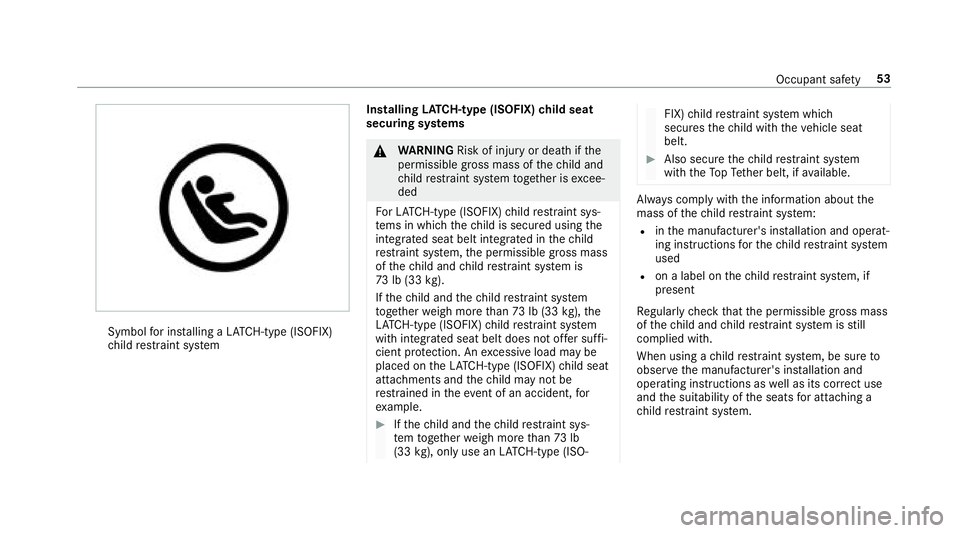
Symbolfor ins talling a LATC H-type (ISOFIX)
ch ild restra int sy stem Installing
LATC H-type (ISOFIX) child seat
securing sy stems
&
WARNING Risk of injury or death ifthe
permissible gross mass of thech ild and
ch ild restra int sy stem toget her is excee‐
ded
Fo rLA TC H-type (ISOFIX) child restra int sys‐
te ms in which thech ild is secured using the
integrated seat belt integrated in thech ild
re stra int sy stem, the permissible gross mass
of thech ild and child restra int sy stem is
73 lb (33 kg).
If th ech ild and thech ild restra int sy stem
to ge ther we igh more than 73 lb (33 kg),th e
LA TC H-type (ISOFIX) child restra int sy stem
with integrated seat belt does not of fer suf fi‐
cient pr otection. An excessive load may be
placed on theLA TC H-type (ISOFIX) child seat
attachments and thech ild may not be
re stra ined in theeve nt of an accident, for
ex ample.
#Ifth ech ild and thech ild restra int sys‐
te m toget her weigh more than 73 lb
(33 kg),only use an LATC H-type (ISO‐
FIX) child restra int sy stem which
secures thech ild with theve hicle seat
belt.
#Also secure thech ild restra int sy stem
with theTo pTe ther belt, if available.
Alw ays comply with the information about the
mass of thech ild restra int sy stem:
Rin the manufacturer's ins tallation and operat‐
ing instructions forth ech ild restra int sy stem
used
Ron a label on thech ild restra int sy stem, if
present
Re gular lych eck that the permissible gross mass
of thech ild and child restra int sy stem is still
complied with.
When using a child restra int sy stem, be sure to
obser vethe manufacturer's ins tallation and
operating instructions as well as its cor rect use
and the suitability of the seats for attaching a
ch ild restra int sy stem.
Occupant saf ety 53
Page 57 of 502
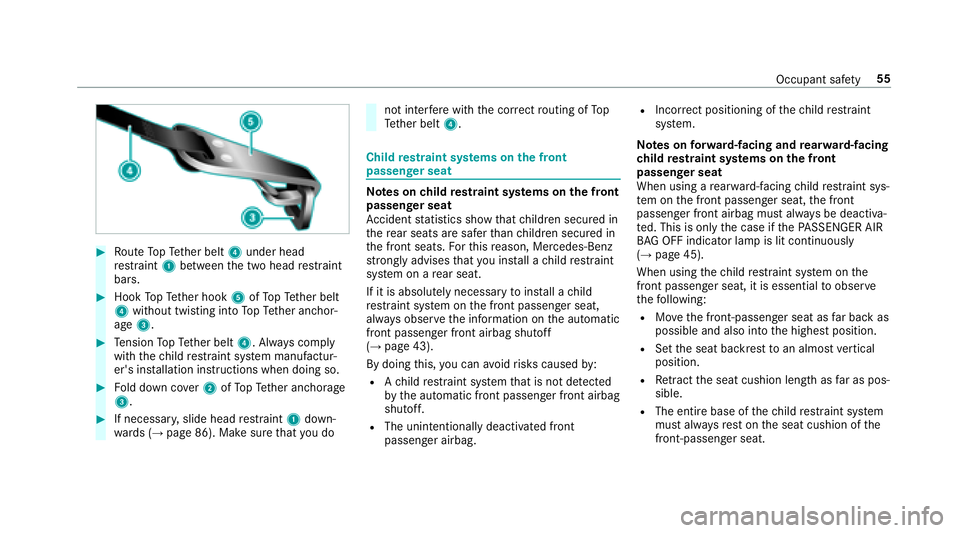
#Route TopTe ther belt 4under head
re stra int 1 between the two head restra int
bars.
#Hook TopTe ther hook 5ofTopTe ther belt
4 without twisting into TopTe ther anchor‐
age 3.
#Tension TopTe ther belt 4. Alw ays comply
with thech ild restra int sy stem manufactur‐
er's ins tallation instructions when doing so.
#Fo ld down co ver2 ofTopTe ther anchorage
3.
#If necessar y,slide head restra int 1 down‐
wa rds (→page 86). Make sure that youdo
not inter fere with the cor rect routing of Top
Te ther belt 4.
Childrestra int sy stems on the front
passenger seat
Note s onchild restra int sy stems on the front
passenger seat
Ac cident statistics show that children secured in
th ere ar seats are safer than children secured in
th e front seats. Forth is reason, Mercedes-Benz
stro ngly advises that you ins tall a child restra int
sy stem on a rear seat.
If it is absolutely necessary toins tall a child
re stra int sy stem on the front passenger seat,
alw ays obser vethe information on the automatic
front passenger front airbag shutoff
(
→page 43).
By doing this, you can avoidrisks caused by:
RAch ild restra int sy stem that is not de tected
by the automatic front passenger front airbag
shutoff.
RThe unintentionally deactivated front
passenger airbag.
RIncor rect positioning of thech ild restra int
sy stem.
Note s onforw ard-facing and rear wa rd-facing
ch ild restra int sy stems on the front
passenger seat
When using a rear wa rd-facing child restra int sys‐
te m on the front passenger seat, the front
passenger front airbag must alw ays be deactiva‐
te d. This is only the case if thePA SSENGER AIR
BA G OFF indicator lamp is lit continuously
(
→page 45).
When using thech ild restra int sy stem on the
front passenger seat, it is essential toobser ve
th efo llo wing:
RMo
vethe front-passen ger seat as far back as
possible and also into the highest position.
RSet the seat backrest toan almost vertical
position.
RRe tract the seat cushion length as far as pos‐
sible.
RThe entire base of thech ild restra int sy stem
must alw aysre st on the seat cushion of the
front-passenger seat.
Occupant saf ety 55