belt bag MERCEDES-BENZ S-Class COUPE 2015 C217 Owner's Manual
[x] Cancel search | Manufacturer: MERCEDES-BENZ, Model Year: 2015, Model line: S-Class COUPE, Model: MERCEDES-BENZ S-Class COUPE 2015 C217Pages: 402, PDF Size: 7.3 MB
Page 18 of 402
Roof load (maximum)
........................ 397S
Safety Occupant Classification System
(OCS) ............................................... 51
see Operating safety
Safety system
see Driving safety systems
Seat belts
Adjusting the driver's and front-
passenger seat bel t......................... 47
Cleaning ......................................... 333
Correct usage .................................. 45
Fastening ......................................... 46
Important safety guidelines ............. 44
Introduction ..................................... 44
Releasing ......................................... 47
Warning lamp ................................. 279
Warning lamp (function) ................... 48
Seating
Seating comfort packag e............... 107
Seating comfort package ................. 107
Seats
Active multicontour seat ................ 107
Adjusting (electrically) ................... 104
Adjusting the 4-way lumbar sup-
port ................................................ 107
Adjusting the head restraint .......... 105
Cleaning the cover ......................... 332
Correct driver's seat position ........ 102
EASY-ENTRY/EXIT system ............. 112
Folding the backrests forward/
back ............................................... 106
Important safety notes .................. 103
Seat backrest display message ..... 276
Seat heating .................................. 107
Seat heating problem .................... 109
Seat ventilation .............................. 109
Seat ventilation problem ................ 110
Storing settings (memory func-
tion) ............................................... 117
Switching seat heating on/of f....... 107
Switching seat ventilation on/of f.. 109
Section
Wheels and tires ............................ 356 Selector lever
Cleaning ......................................... 332
see Automatic transmission
Sensors (cleaning instructions) ....... 329
Service menu (on-board com-
puter) .................................................. 239
Service products
Brake fluid ..................................... 394
Coolant (engine) ............................ 395
Engine oil ....................................... 393
Fuel ................................................ 392
Important safety notes .................. 391
Refrigerant (air-conditioning sys-
tem) ............................................... 396
Washer fluid ................................... 396
Settings
Factory (on-board computer) ......... 244
On-board compute r....................... 239
SETUP (on-board computer) ............. 245
Side impact air bag ............................. 50
Side marker lamp (display mes-
sage) ................................................... 262
Side windows
Cleaning ......................................... 329
Convenience closing feature ............ 95
Convenience opening feature .......... 95
Important safety information ........... 93
Opening/closing .............................. 94
Problem (malfunction) ..................... 97
Resetting ......................................... 96
SmartKey
Changing the battery ....................... 82
Changing the programming ............. 80
Checking the battery ....................... 82
Convenience closing feature ............ 95
Convenience opening feature .......... 95
Display message ............................ 277
Door central locking/unlocking ....... 79
Important safety notes .................... 78
KEYLESS-GO start function .............. 80
Loss ................................................. 83
Mechanical key ................................ 81
Overview .......................................... 78
Positions (ignition lock) ................. 147
Problem (malfunction) ..................... 83
Starting the engine ........................ 150
Snow chains ...................................... 35916
Index
Page 22 of 402
Unlocking (in an emergency) ........... 86
Unlocking (SmartKey) ......................79
Vehicle data ................................... 397
Vehicle dimensions ........................... 397
Vehicle emergency locking ................ 87
Vehicle identification number
see VIN
Vehicle identification plate .............. 390
Vehicle level
Active Body Control ABC ............... 190
Display message ............................ 267
Vehicle maintenance
see ASSYST PLUS
Vehicle tool kit .................................. 336
Video
Operating the DVD .........................2 37
VIN ...................................................... 390 W
Warning and indicator lamps ABS ................................................ 281
Brakes .......................................... .280
Check Engine ................................. 286
Coolant .......................................... 287
Distance warning ........................... 289
ESP ®
.............................................. 283
ESP ®
OFF ....................................... 284
Fuel tank ........................................ 286
Overview .......................................... 32
Parking brake ................................ 285
PASSENGER AIR BAG ..................... .43
Reserve fuel .................................. .286
Restraint system ............................ 285
Seat belt ........................................ 279
Steering ......................................... 291
Tire pressure monitor .................... 290
Warranty .............................................. 22
Washer fluid
Display message ............................ 277
Wheel and tire combination
see Tires
Wheel bolt tightening torque ........... 382
Wheel chock ...................................... 378
Wheels
Changing a wheel .......................... 377
Checking ........................................ 357
Cleaning ......................................... 328 Important safety notes .................. 356
Interchanging/changing ................ 377
Mounting a new wheel ................... 381
Mounting a wheel .......................... 378
Removing a wheel .......................... 381
Storing .......................................... .378
Tightening torque ........................... 382
Wheel size/tire size ....................... 382
Window curtain air bag
Operation ......................................... 51
Windows
see Side windows
Windshield
Defrosting ...................................... 137
Infrared reflective .......................... 315
Windshield washer fluid
see Windshield washer system
Windshield washer system
Adding washer fluid ....................... 323
Notes ............................................. 396
Windshield wipers
Problem (malfunction) ................... 129
Replacing the wiper blades ............ 127
Switching on/off ........................... 126
Winter driving
Important safety notes .................. 358
Slippery road surfaces ................... 174
Snow chains .................................. 359
Winter operation
Summer tires ................................. 358
Winter tires
M+S tires ....................................... 358
Wiper blades
Cleaning ......................................... 329
Important safety notes .................. 127
Replacing ....................................... 127
Wooden trim (cleaning instruc-
tions) ................................................. .332
Workshop
see Qualified specialist workshop 20
Index
Page 29 of 402
QR codes for the rescue card
The QR code is secured in the fuel filler flap
and on the opposite side on the B-pillar. In the
event of an accident, rescue services can use the QR code to quickly find the appropriate
rescue card for your vehicle. The current res-
cue card contains the most important infor-
mation about your vehicle in a compact form, e.g. the routing of the electric cables.
You can find more information at https://
portal.aftersales.i.daimler.com. Data stored in the vehicle
Data recording
This vehicle is capable of recording diagnostic information relating to vehicle operation, mal-
functions, and user settings. This may include information about the performance or status
of various systems, including but not limited
to, engine, throttle, steering or brake sys-
tems, that is stored and can be read out with
suitable devices, particularly when the vehi-
cle is serviced. The data obtained is used to
properly diagnose and service your vehicle or to further optimize and develop vehicle func-
tions. COMAND/mbrace
If the vehicle is equipped with COMAND or
mbrace, additional data about the vehicle’s
operation, the use of the vehicle in certain
situations, and the location of the vehicle may be compiled through COMAND or the mbrace
system.
For additional information please refer to the
COMAND User Manual and/or the mbrace
Terms and Conditions. Event data recorders
This vehicle is equipped with an event data
recorder (EDR). The main purpose of an EDR is to record data that will assist in under-
standing how a vehicle’s systems performed
in certain crash or near crash-like situations,
such as during air bag deployment or when
hitting a road obstacle. The EDR is designed
to record data related to vehicle dynamics
and safety systems for a short period of time,
typically 30 seconds or less.
The EDR in this vehicle is designed to record
such data as:
R how various systems in your vehicle are
operating
R whether or not the driver and passenger
seat belts are fastened
R how far (if at all) the driver is depressing the
accelerator and/or brake pedal and
R how fast the vehicle is traveling
This data can help provide a better under-
standing of the circumstances in which
crashes and injuries occur. NOTE: EDR data is recorded by your vehicle only if a non-trivial
crash situation occurs; no data is recorded by
the EDR under normal driving conditions and no personal data (e.g., name, gender, age,
and crash location) are recorded. However,
other parties, such as law enforcement, can
combine the EDR data with the type of per-
sonal identification data routinely acquired
during a crash investigation.
To read data recorded by an EDR, special
equipment is required, and access to the vehi- cle or the EDR is needed. In addition to the
vehicle manufacturer, other parties that have
the special equipment, such as law enforce-
ment, can read the information by accessing
the vehicle or the EDR.
EDR data may be used in civil and criminal
matters as a tool in accident reconstruction,
accident claims, and vehicle safety. Since the Crash Data Retrieval CDR tool that is used to
extract data from the EDR is commercially
available, Mercedes-Benz USA, LLC
("MBUSA") expressly disclaims any and all lia- bility arising from the extraction of this infor-
mation by unauthorized Mercedes-Benz per-
sonnel. Introduction
27 Z
Page 32 of 402
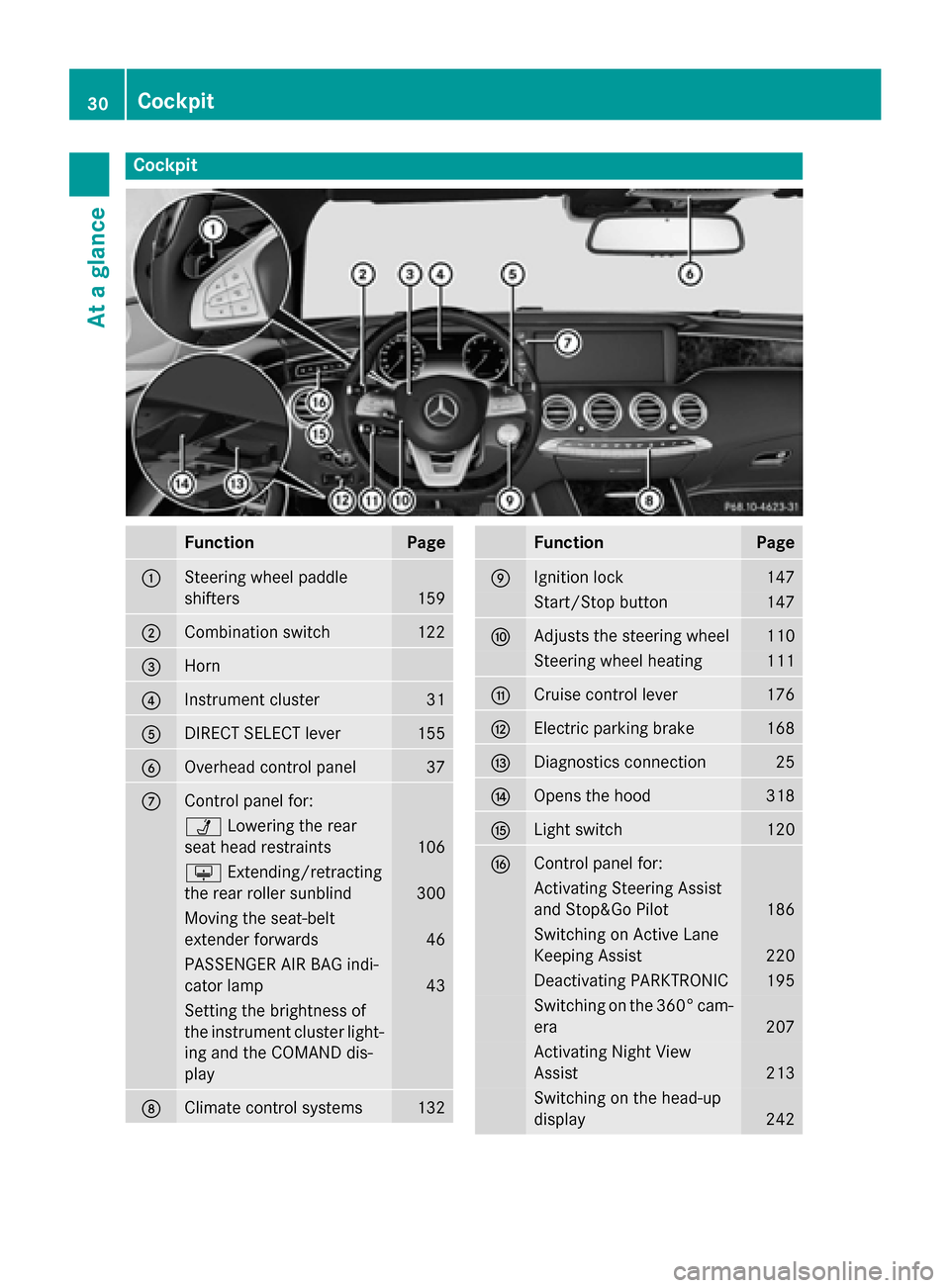
Cockpit
Function Page
0043
Steering wheel paddle
shifters
159
0044
Combination switch 122
0087
Horn
0085
Instrument cluster 31
0083
DIRECT SELECT lever 155
0084
Overhead control panel 37
006B
Control panel for:
00CA
Lowering the rear
seat head restraints 106
0094
Extending/retracting
the rear roller sunblind 300
Moving the seat-belt
extender forwards 46
PASSENGER AIR BAG indi-
cator lamp
43
Setting the brightness of
the instrument cluster light-
ing and the COMAND dis-
play 006C
Climate control systems 132 Function Page
006D
Ignition lock 147
Start/Stop button 147
006E
Adjusts the steering wheel 110
Steering wheel heating 111
006F
Cruise control lever 176
0070
Electric parking brake 168
0071
Diagnostics connection 25
0072
Opens the hood 318
0073
Light switch 120
0074
Control panel for:
Activating Steering Assist
and Stop&Go Pilot
186
Switching on Active Lane
Keeping Assist 220
Deactivating PARKTRONIC 195
Switching on the 360° cam-
era 207
Activating Night View
Assist 213
Switching on the head-up
display
24230
CockpitAt a glance
Page 44 of 402
Useful information
i This Operator's Manual describes all
models and all standard and optional equip- ment of your vehicle available at the time of
publication of the Operator's Manual.
Country-specific differences are possible.
Please note that your vehicle may not be
equipped with all features described. This
also applies to safety-related systems and
functions.
i Read the information on qualified special-
ist workshops (Y page 25). Panic alarm
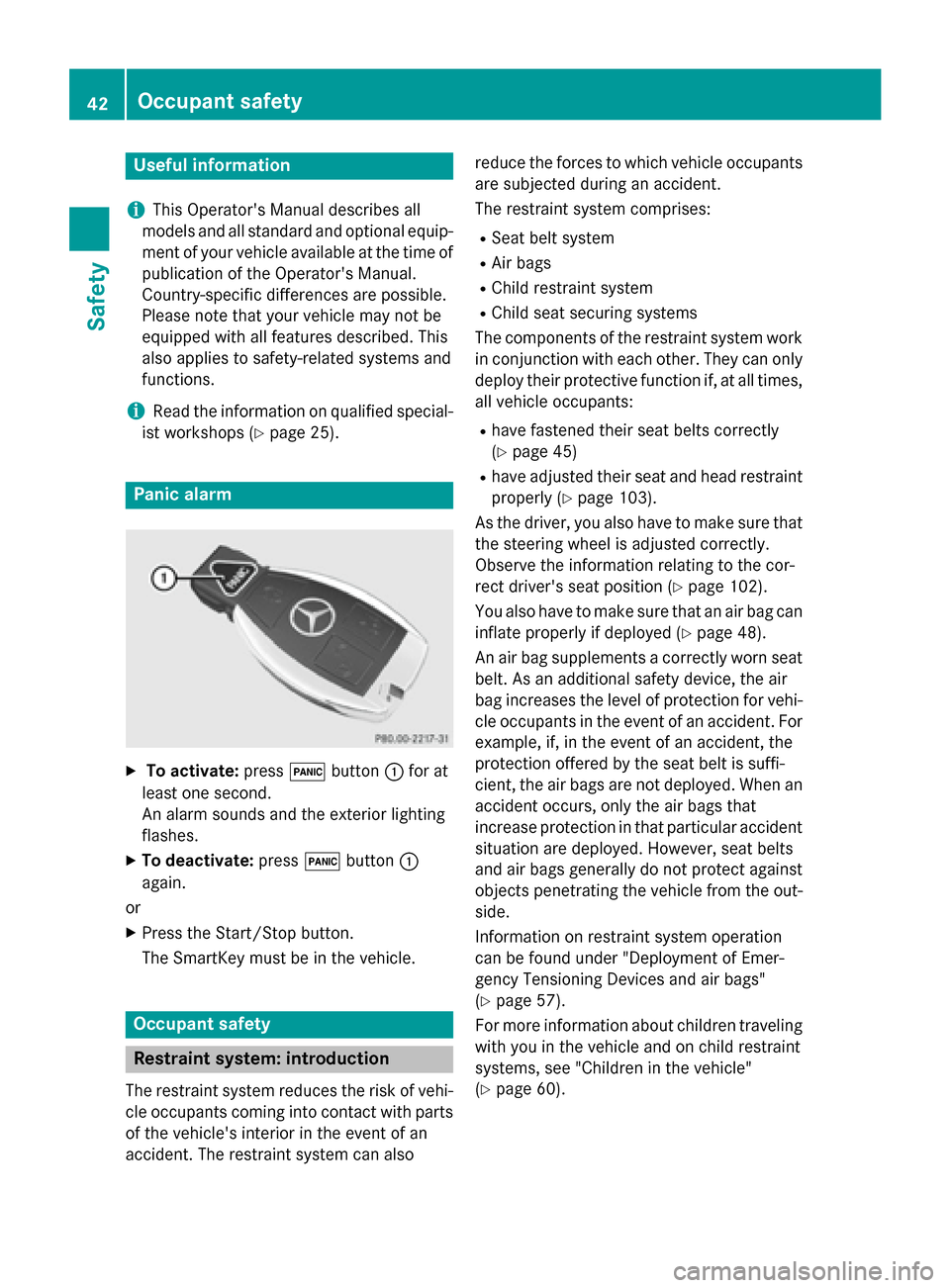
X
To activate: press0033button 0043for at
least one second.
An alarm sounds and the exterior lighting
flashes.
X To deactivate: press0033button 0043
again.
or
X Press the Start/Stop button.
The SmartKey must be in the vehicle. Occupant safety
Restraint system: introduction
The restraint system reduces the risk of vehi-
cle occupants coming into contact with parts of the vehicle's interior in the event of an
accident. The restraint system can also reduce the forces to which vehicle occupants
are subjected during an accident.
The restraint system comprises:
R Seat belt system
R Air bags
R Child restraint system
R Child seat securing systems
The components of the restraint system work
in conjunction with each other. They can only deploy their protective function if, at all times,
all vehicle occupants:
R have fastened their seat belts correctly
(Y page 45)
R have adjusted their seat and head restraint
properly (Y page 103).
As the driver, you also have to make sure that
the steering wheel is adjusted correctly.
Observe the information relating to the cor-
rect driver's seat position (Y page 102).
You also have to make sure that an air bag can inflate properly if deployed (Y page 48).
An air bag supplements a correctly worn seat
belt. As an additional safety device, the air
bag increases the level of protection for vehi-
cle occupants in the event of an accident. For example, if, in the event of an accident, the
protection offered by the seat belt is suffi-
cient, the air bags are not deployed. When an
accident occurs, only the air bags that
increase protection in that particular accident
situation are deployed. However, seat belts
and air bags generally do not protect against objects penetrating the vehicle from the out-
side.
Information on restraint system operation
can be found under "Deployment of Emer-
gency Tensioning Devices and air bags"
(Y page 57).
For more information about children traveling
with you in the vehicle and on child restraint
systems, see "Children in the vehicle"
(Y page 60). 42
Occupant safetySafety
Page 46 of 402
and size of the child. Therefore, be sure to
observe the notes on the "Occupant Clas-
sification System (OCS)" (Y page 51) and
on "Children in the vehicle" (Y page 60).
There you will also find instructions on rear-
ward and forward-facing child restraint sys- tems on the front-passenger seat.
R All other persons: depending on the clas-
sification of the person in the front-
passenger seat, the front-passenger front
air bag is enabled or deactivated
(Y page 51). Be sure to observe the notes
on "Seat belts“ (Y page 44) and "Air bags"
(Y page 48). There you can also find infor-
mation on the correct seat position. Seat belts
Introduction Seat belts are the most effective means of
restricting the movement of vehicle occu-
pants in the event of an accident or the vehi-
cle rolling over. This reduces the risk of vehi- cle occupants coming into contact with parts
of the vehicle interior or being ejected from
the vehicle. Furthermore, the seat belt helps
to keep the vehicle occupant in the best posi- tion in relation to the air bag.
The seat belt system comprises:
R Seat belts
R Emergency Tensioning Devices and seat
belt force limiters
If the seat belt is pulled by the seat belt
extender quickly or with a jerky movement,
the belt retractor locks. The belt strap cannot
be extracted any further.
The Emergency Tensioning Device tightens
the seat belt in an accident, pulling the belt
close against the body. However it does not
pull the vehicle occupant back in the direction of the backrest.
The Emergency Tensioning Device does not
correct an incorrect seat position or the rout-
ing of an incorrectly fastened seat belt. When triggered, seat belt force limiters help
to reduce the force exerted by the seat belt on
the vehicle occupant.
The seat belt force limiters for the front seats
are synchronized with the front air bags,
which absorb part of the deceleration force.
This can reduce the force exerted on the vehi-
cle occupants during an accident.
! If the front-passenger seat is unoccupied,
do not insert the belt tongue into the buckle of the front-passenger seat. This may oth-
erwise lead to the triggering of the Emer-
gency Tensioning Device in the event of anaccident, which will then need to be
replaced.
Important safety notes The use of seat belts and child restraint sys-
tems is required by law in:
R all 50 states
R the U.S. territories
R the District of Columbia
R all Canadian provinces
Even where this is not required by law, all
vehicle occupants should correctly fasten
their seat belts before starting the journey. G
WARNING
If the seat belt is incorrectly fastened, it can-
not protect as intended. Furthermore, an
incorrectly fastened seat belt can cause addi- tional injury, for example, in an accident, dur-
ing braking or when abruptly changing direc-
tion. This poses an increased risk of injury or
even fatal injury.
Make sure that all vehicle occupants are
seated properly with a correctly fastened seat belt. G
WARNING
The seat belt does not offer the intended level of protection if you have not moved the back-
rest to an almost vertical position. When brak-
ing or in the event of an accident, you could
slide underneath the seat belt and sustain 44
Occupant safetySafety
Page 50 of 402
You can switch the seat-belt adjustment on
and off using COMAND. Information on
switching the belt adjustment function on and
off can be found in the Digital Operator's
Manual or in the separate COMAND operating instructions.
Belt warning for the driver and front
passenger The
0076 seat belt warning lamp in the instru-
ment cluster is a reminder that all occupants
must fasten their seat belts. It may light up
continuously or flash. In addition, there may
be a warning tone.
Regardless of whether the driver's seat belt
has already been fastened, the 0076seat belt
warning lamp lights up for six seconds each
time the engine is started. If, after
six seconds, the driver or front-passenger
seat belt has not been fastened and the doors are closed, the 0076seat belt warning lamp
lights up. As soon as the driver's and front-
passenger seat belts are fastened or a front
door is opened again, the 0076seat belt
warning lamp goes out.
If the driver's seat belt is not fastened after
the engine is started, an additional warning
tone will sound. This warning tone stops after six seconds or when the driver's seat belt is
fastened.
If the vehicle's speed exceeds 15 mph
(25 km/h) once and the driver's and front-
passenger seat belts are not fastened, a
warning tone sounds. A warning tone also
sounds with increasing intensity for
60 seconds or until the driver or front
passenger have fastened their seat belts.
If the driver or front passenger unfasten their seat belts during the journey, the seat belt
warning is activated again.
i For more information on the
0076seat
belt warning lamp, see "Warning and indi-
cator lamps in the instrument cluster, seat
belts" (Y page 279). Air bags
Introduction The installation point of an air bag can be rec-
ognized by the AIR BAG symbol.
An air bag complements the correctly fas-
tened seat belt. It is no substitute for the seat
belt. The air bag provides additional protec-
tion in applicable accident situations.
Not all air bags are deployed in an accident.
The different air bag systems function inde-
pendently from one another (Y page 57).
However, no system available today can com- pletely eliminate injuries and fatalities.
It is also not possible to rule out a risk of injury
caused by an air bag due to the high speed at which the air bag must be deployed.
Important safety notes G
WARNING
If you do not sit in the correct seat position,
the air bag cannot protect as intended and
could even cause additional injury when
deployed. This poses an increased risk of
injury or even fatal injury.
To avoid hazardous situations, always make
sure that all of the vehicle's occupants:
R have fastened their seat belts correctly,
including pregnant women
R are sitting correctly and maintain the great-
est possible distance to the air bags
R follow the following instructions
Always make sure that there are no objects
between the air bag and the vehicle's occu-
pants.
R Adjust the seats properly before beginning
your journey. Always make sure that the
seat is in an almost upright position. The
center of the head restraint must support
the head at about eye level.
R Move the driver's and front-passenger
seats as far back as possible. The driver's
seat position must allow the vehicle to be
driven safely. 48
Occupant safetySafety
Page 51 of 402
R
Only hold the steering wheel on the out-
side. This allows the air bag to be fully
deployed.
R Always lean against the backrest while driv-
ing. Do not lean forwards or lean against
the door or side window. You may other-
wise be in the deployment area of the air
bags.
R Always keep your feet in the footwell in
front of the seat. Do not put your feet on the
dashboard, for example. Your feet may oth-
erwise be in the deployment area of the air bag.
R For this reason, always secure persons less
than 5 ft (1.50 m) tall in suitable restraint
systems. Up to this height, the seat belt
cannot be worn correctly.
If a child is traveling in your vehicle, also
observe the following notes:
R Always secure children under 12 years of
age and less than 5 ft (1.50 m)in height in
suitable child restraint systems.
R Child restraint systems should be installed
on the rear seats.
R Only secure a child in a rearward-facing
child restraint system on the front-
passenger seat when the front-passenger
front air bag is deactivated. If the
PASSENGER AIR BAG OFF indicator lamp is
permanently lit, the front-passenger front
air bag is deactivated (Y page 43).
R Always observe the instructions and safety
notes on the "Occupant Classification Sys- tem (OCS)" (Y page 51) and on "Children
in the vehicle" (Y page 60) in addition to
the child restraint system manufacturer's
installation instructions.
Objects in the vehicle interior may pre-
vent an air bag from functioning correctly.
Before starting your journey and to avoid risks
resulting from the speed of the air bag as it
deploys, make sure that:
R there are no people, animals or objects
between the vehicle occupants and an air
bag. Do not place any objects on the dashboard
e.g. above the front-passenger front air
bag.
R there are no objects between the seat, door
and B-pillar.
R no hard objects, e.g. coat hangers, hang on
the grab handles or coat hooks.
R no accessories, such as cup holders, are
attached to the vehicle within the deploy-
ment area of an air bag, e.g. to doors, side
windows, rear side trim or side walls.
R no heavy, sharp-edged or fragile objects
are in the pockets of your clothing. Store
such objects in a suitable place. G
WARNING
If you modify the air bag cover or affix objects
such as stickers to it, the air bag can no longer function correctly. There is an increased risk
of injury.
Never modify an air bag cover or affix objectsto it. G
WARNING
Sensors to control the air bags are located in the doors. Modifications or work not per-
formed correctly to the doors or door panel-
ing, as well as damaged doors, can lead to the
function of the sensors being impaired. The air bags might therefore not function properly
any more. Consequently, the air bags cannot
protect vehicle occupants as they are
designed to do. There is an increased risk of
injury.
Never modify the doors or parts of the doors.
Always have work on the doors or door pan-
eling carried out at a qualified specialist work- shop. Occupant safety
49Safety Z
Page 53 of 402
In the event of a side impact, the side impact
air bag is deployed on the side on which the
impact occurs.
The side impact air bag on the front-
passenger side (front) deploys in the follow-
ing situations:
R the OCS system detects that the front-
passenger seat is occupied or
R the belt tongue is engaged in the belt
buckle of the front-passenger seat
If the belt tongue is engaged in the belt
buckle, the side impact air bag on the front-
passenger side deploys if an appropriate acci-
dent situation occurs. In this case, deploy-
ment is independent of whether the front-
passenger seat is occupied or not.
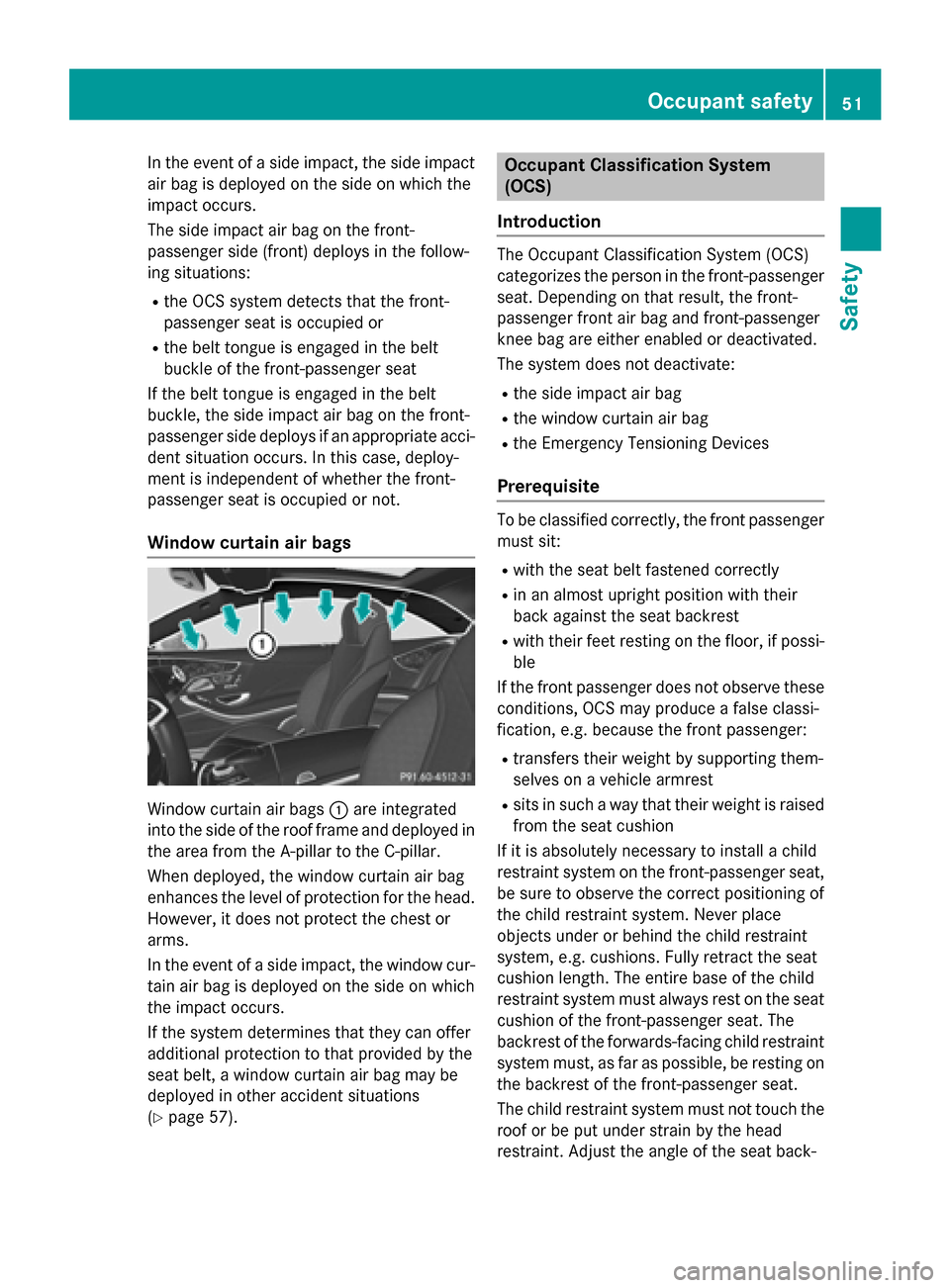
Window curtain air bags Window curtain air bags
0043are integrated
into the side of the roof frame and deployed in the area from the A-pillar to the C-pillar.
When deployed, the window curtain air bag
enhances the level of protection for the head.
However, it does not protect the chest or
arms.
In the event of a side impact, the window cur-
tain air bag is deployed on the side on which
the impact occurs.
If the system determines that they can offer
additional protection to that provided by the
seat belt, a window curtain air bag may be
deployed in other accident situations
(Y page 57). Occupant Classification System
(OCS)
Introduction The Occupant Classification System (OCS)
categorizes the person in the front-passenger
seat. Depending on that result, the front-
passenger front air bag and front-passenger
knee bag are either enabled or deactivated.
The system does not deactivate:
R the side impact air bag
R the window curtain air bag
R the Emergency Tensioning Devices
Prerequisite To be classified correctly, the front passenger
must sit:
R with the seat belt fastened correctly
R in an almost upright position with their
back against the seat backrest
R with their feet resting on the floor, if possi-
ble
If the front passenger does not observe these
conditions, OCS may produce a false classi-
fication, e.g. because the front passenger:
R transfers their weight by supporting them-
selves on a vehicle armrest
R sits in such a way that their weight is raised
from the seat cushion
If it is absolutely necessary to install a child
restraint system on the front-passenger seat,
be sure to observe the correct positioning of
the child restraint system. Never place
objects under or behind the child restraint
system, e.g. cushions. Fully retract the seat
cushion length. The entire base of the child
restraint system must always rest on the seat cushion of the front-passenger seat. The
backrest of the forwards-facing child restraint
system must, as far as possible, be resting on the backrest of the front-passenger seat.
The child restraint system must not touch the
roof or be put under strain by the head
restraint. Adjust the angle of the seat back- Occupant safety
51Safety Z
Page 55 of 402
Make sure that the front-passenger front air
bag has been disabled. The PASSENGER AIR
BAG OFF indicator lamp must be lit.
If the PASSENGER AIR BAG OFF indicator
lamp remains off and/or the PASSENGER AIR BAG ON indicator lamp lights up, do not install a rearward-facing child restraint system on
the front-passenger seat. You can find more
information on OCS under "Problems with the Occupant Classification System"
(Y page 56). G
WARNING
If you secure a child in a forward-facing child
restraint system on the front-passenger seat
and you position the front-passenger seat too close to the dashboard, in the event of an
accident, the child could:
R come into contact with the vehicle's inte-
rior if the PASSENGER AIR BAG OFF indi-
cator lamp is lit, for example
R be struck by the air bag if the PASSENGER
AIR BAG ON is lit up
This poses an increased risk of injury or even fatal injury.
Always move the front-passenger seat as far
back as possible and fully retract the seat
cushion length. Always make sure that the
shoulder belt strap is correctly routed from
the vehicle seat-belt extender to the shoulder
belt guide on the child restraint system. The
shoulder belt strap must be routed forwards
and downwards from the retracted seat-belt
extender. If necessary, adjust the front-
passenger seat accordingly. Always observe
the child restraint system manufacturer's
installation instructions.
If OCS determines that: R the front-passenger seat is unoccupied, the
PASSENGER AIR BAG OFF indicator lamp
lights up after the system self-test and
remains lit. This indicates that the front-
passenger front air bag is deactivated.
R the front-passenger seat is occupied by a
child of up to 12 months old in a standard child restraint system, the PASSENGER AIR
BAG OFF indicator lamp lights up after the
system self-test and remains lit. This indi-
cates that the front-passenger front air bag
is deactivated.
But in the case of a 12-month-old child in a
standard child restraint system, the
PASSENGER AIR BAG ON can light up per-
manently after the system self-test. This
indicates that the front-passenger front air
bag is activated. The result of the classifi-
cation is dependent on, among other fac-
tors, the child restraint system and the
child's stature. It is recommended that you
install the child restraint system on a suit-
able rear seat.
R the front-passenger seat is occupied by a
person of smaller stature (e.g. a teenager
or small adult), either the PASSENGER AIR
BAG ON or PASSENGER AIR BAG OFF indi- cator lamp lights up and remains lit after
the system self-test depending on the
result of the classification.
- If the PASSENGER AIR BAG ON indicator
lamp lights up, move the front-passenger
seat as far back as possible. Alterna-
tively, a person of smaller stature can sit on a rear seat.
- If the PASSENGER AIR BAG OFF indicator
lamp is lit, a person of smaller stature
should not use the front-passenger seat.
R the front-passenger seat is occupied by an
adult or a person of a stature correspond-
ing to that of an adult, the PASSENGER AIR
BAG ON indicator lamp lights up after the
system self-test and remains lit. This indi-
cates that the front-passenger front air bag
is activated.
If children are traveling in the vehicle, be sure to observe the notes on "Children in the vehi-
cle" (Y page 60).
When OCS is malfunctioning, the red 0075
restraint system warning lamp in the instru-
ment cluster and the PASSENGER AIR BAG
OFF indicator lamp light up simultaneously.
The front-passenger front air bag is deactiva- Occupant safety
53Safety Z