light MERCEDES-BENZ S-CLASS COUPE 2015 User Guide
[x] Cancel search | Manufacturer: MERCEDES-BENZ, Model Year: 2015, Model line: S-CLASS COUPE, Model: MERCEDES-BENZ S-CLASS COUPE 2015Pages: 417, PDF Size: 13.42 MB
Page 18 of 417
Night View Assist Plus
Activating/deactivating ................. 234
Cleaning ......................................... 351
Display message ............................ 290
Function/note s............................. 232
Pedestrian and animal recogni-
tion ................................................ 233
Problem (fault) ............................... 236
Switching automatic activation
on/of f............................................ 259
Notes on running in a new vehicle .. 160O
Occupant safety Automatic front-passenger front
airbag deactivation .......................... 51
Automatic measures after an acci-
dent ................................................. 60
Children in the vehicle ..................... 60
Important safety notes .................... 43
PASSENGER AIRBAG indicator
lamp ................................................. 43
Pets in the vehicle ........................... 69
PRE-SAFE ®
(anticipatory occu-
pant protection) ............................... 58
PRE-SAFE ®
PLUS (anticipatory
occupant protection PLUS) .............. 59
Restraint system introduction .......... 42
Restraint system warning lamp ........ 43
Odometer
see Total distance recorder
see Trip meter
Oil
see Engine oil
On-board computer
AMG menu ..................................... 265
Assistance graphic menu ............... 257
Assistance menu ........................... 258
Display messages .......................... 266
Displaying a service message ........ 344
DISTRONIC PLUS ........................... 201
Factory settings ............................. 264
Head-up display ............................. 247
Important safety notes .................. 244
Instrument cluster menu ............... 263
Light menu ..................................... 262
Media menu ................................... 254 Menu overview .............................. 249
Message memory .......................... 266
Navigation menu ............................ 251
Operating the TV ............................ 255
Operating video DVD ..................... 255
Operation ....................................... 245
Radio menu ................................... 253
Service menu ................................. 258
Settings menu ............................... 258
Standard display ............................ 249
Telephone menu ............................ 256
Trip menu ...................................... 249
Vehicle menu ................................. 264
Operating instructions
Vehicle equipment ........................... 24
Operating safety
Declaration of conformity ................ 25
Important safety note ...................... 24
Operating system
see On-board computer
Outside temperature display ........... 245
Overhead control panel ...................... 38
Owner's Manual
Overview .......................................... 24 P
Paint code .......................................... 404
Paintwork (cleaning instructions) ... 347
Panic alarm .......................................... 42
Panorama roof ................................... 103
Parking
Important safety notes .................. 181
Parking brake ................................ 183
Position of exterior mirror, front-
passenger side ............................... 121
Reversing camera .......................... 220
Switching off the engine ................ 182
see PARKTRONIC
Parking aid
see 360° camera
see Active Parking Assist
see Exterior mirrors
see PARKTRONIC
see Reversing camera
Parking assistance
see PARKTRONIC Index
15
Page 19 of 417
Parking brake
Display message ............................2 70
Electric parking brake .................... 183
Warning lamp ................................. 309
Parking lamps
Display message ............................ 281
Switching on/off ........................... 128
PARKTRONIC
Deactivating/activating ................. 214
Driving system ............................... 212
Function/notes ............................ .212
Important safety notes .................. 212
Problem (fault) ............................... 215
Sensor range ................................. 213
Warning displa y............................. 214
PASSENGER AIR BAG
Display message ............................ 279
Indicator lamps ................................ 43
Problems (malfunctions) ................ 279
Pedestrian protection
Active bonnet (pedestrian protec-tion) ............................................... 338
Perfume atomizer
Operating ....................................... 147
Perfume via l................................... 147
Problem (malfunction) ................... 149
Petrol .................................................. 405
Pets in the vehicle ............................... 69
Plastic trim (cleaning instruc-
tions) .................................................. 352
Power closing ...................................... 92
Power socket
Boot ............................................... 326
Power windows
see Side windows
PRE-SAFE ®
(anticipatory occupant
protection)
Operation ......................................... 58
PRE-SAFE ®
(preventive occupant
safety system)
Display message ............................ 274
PRE-SAFE ®
Brake
Activating/deactivating ................. 260
Display message ............................ 274
Function/note s................................ 77
Important safety notes .................... 78
Warning lamp ................................. 312 PRE-SAFE
®
PLUS (anticipatory
occupant protection PLUS)
Display message ............................ 274
Operation ......................................... 59
Program selector button .................. 173
Protection against theft
ATA (Anti-Theft Alarm system )......... 80
Immobiliser ...................................... 80
Interior motion sensor ..................... 81
Tow-away protection ........................ 81
Protection of the environment
General notes .................................. 23
Pulling away
Automatic transmission ................. 164
General notes ................................ 164
Hill start assist ............................... 164 Q
QR code Mercedes-Benz Guide App ................. 1
Rescue card ..................................... 27
Qualified specialist workshop ........... 26 R
Radiator cover ................................... 340
Radio
Selecting a station ......................... 253
Radio-based vehicle components
Declaration of conformity ................ 25
Reading lamp ..................................... 132
Rear compartment
Setting the air vents ...................... 157
Stowage compartment .................. 318
Rear foglamp
Display message ............................ 281
Switching on/of f........................... 127
Rear lamps
see Lights
Rear seats
Overview .......................................... 40
Rear window blind ............................ 324
Rear window heating
Problem (fault) ............................... 146
Switching on/of f........................... 145
Rear-compartment seat belt sta-
tus indicator ........................................ 4816
Index
Page 22 of 417
Start/stop function
see ECO start/stop function
Starting (engine) ................................ 163
STEER CONTROL ..................................80
Steering
Display message ............................3 00
Warning lamps ............................... 314
Steering Assist
see DISTRONIC PLUS
Steering Assist and Stop&Go Pilot
(DISTRONIC PLUS)
Display message ............................ 293
Steering assistant STEER CON-
TROL
see STEER CONTROL
Steering wheel
Adjusting (electrically) ................... 116
Button overview ............................... 34
Buttons (on-board computer) ......... 245
Cleaning ......................................... 352
EASY ENTRY/EXIT feature ............. 118
Gearshift paddle s........................... 174
Important safety notes .................. 116
Steering wheel heating .................. 117
Storing settings (memory func-
tion) ............................................... 123
Steering wheel gearshift paddles .... 174
Steering wheel heating
Problem (malfunction) ................... 118
Switching on/of f........................... 117
Stop&Go Pilot
see DISTRONIC PLUS
Stowage areas ................................... 316
Stowage compartments
Armrest (under) ............................. 318
Centre console .............................. 317
Centre console in rear compart-
ment .............................................. 319
Cup holde r..................................... 322
Door ............................................... 318
Glove compartment ....................... 317
Important safety information ......... 316
Rear ............................................... 318
Spectacles compartment ............... 317
see Stowage areas
Stowage net ....................................... 319 Stowage space
Luggage net retainers .................... 321
Rear seat backrest ......................... 319
Securing a load .............................. 321
Stowage net ................................... 319
Stowage well beneath the boot
floor .................................................... 321
Summer tyres
In winter ........................................ 378
Sun visor ............................................ 323
Suspension tuning
Active Body Control ABC ............... 208
AIRMATIC ...................................... 211
SETUP (on-board computer) .......... 265
Switching the auxiliary heating/
ventilation
On/off ........................................... 150 T
Tail lamps Display message ............................ 281
see Lights
Technical data
Capacities ...................................... 404
Information .................................... 402
Tyres/wheels ................................. 391
Vehicle data ................................... 410
Telephone
Accepting a call (multifunction
steering wheel) .............................. 256
Display message ............................ 300
Introduction ................................... 256
Menu (on-board computer) ............ 256
Number from the phone book ........ 257
Redialling ....................................... 257
Rejecting/ending a call ................. 257
Telephone compartment ................ 318
Temperature
Coolant .......................................... 245
Engine oil (on-board computer,
Mercedes-AMG vehicles) ............... 265
Outside temperature ...................... 245
Setting (climate control )................ 143
Transmission oil (on-board com-
puter, Mercedes-AMG vehicles) ..... 265
TEMPOMAT
Function/note s............................. 189 Index
19
Page 30 of 417
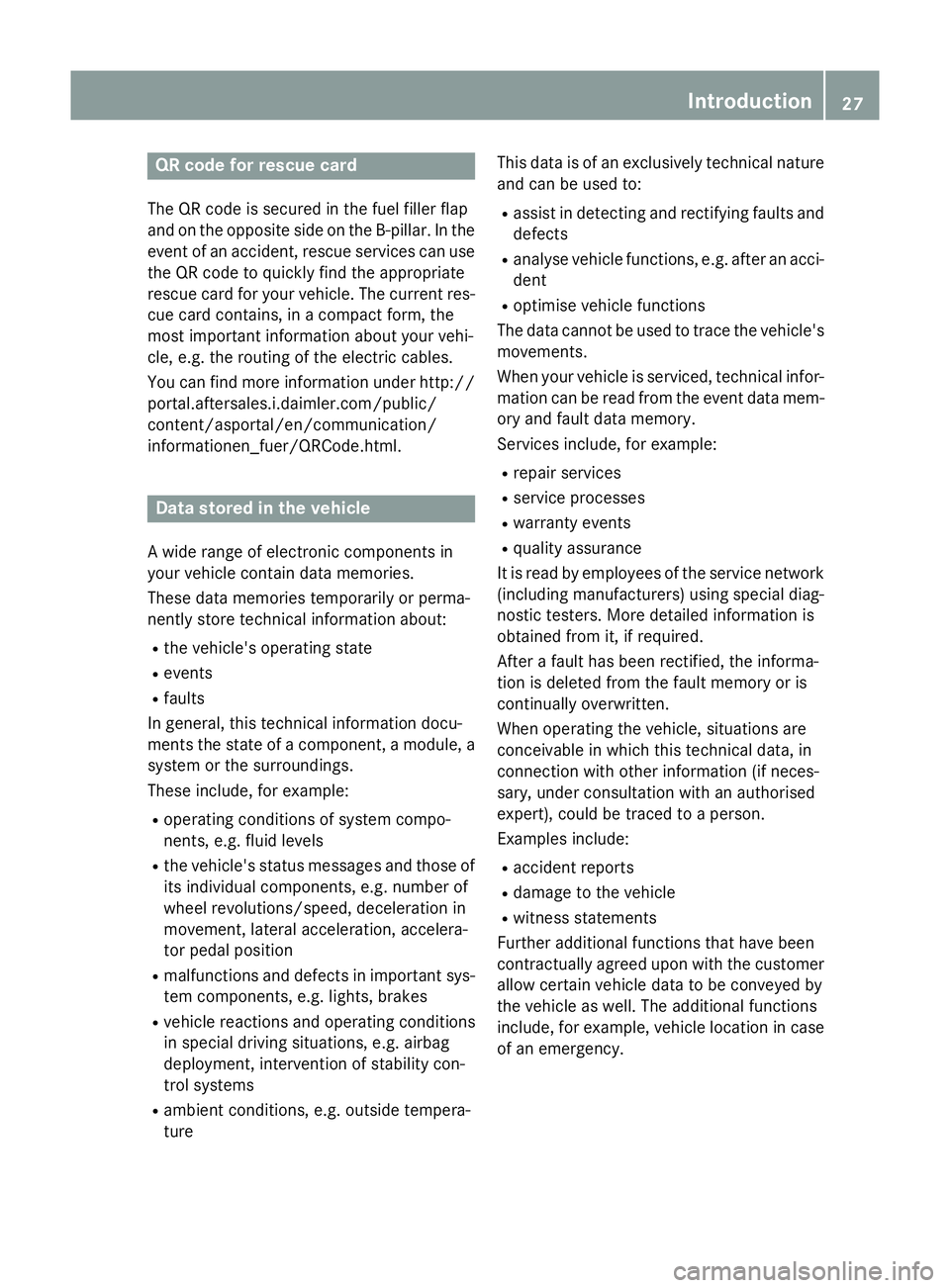
QR code for rescue card
The QR code is secured in the fuel filler flap
and on the opposite side on the B-pillar. In the
event of an accident, rescue services can use
the QR code to quickly find the appropriate
rescue card for your vehicle. The current res- cue card contains, in a compact form, the
most important information about your vehi-
cle, e.g. the routing of the electric cables.
You can find more information under http:// portal.aftersales.i.daimler.com/public/
content/asportal/en/communication/
informationen_fuer/QRCode.html. Data stored in the vehicle
A wide range of electronic components in
your vehicle contain data memories.
These data memories temporarily or perma-
nently store technical information about:
R the vehicle's operating state
R events
R faults
In general, this technical information docu-
ments the state of a component, a module, a
system or the surroundings.
These include, for example:
R operating conditions of system compo-
nents, e.g. fluid levels
R the vehicle's status messages and those of
its individual components, e.g. number of
wheel revolutions/speed, deceleration in
movement, lateral acceleration, accelera-
tor pedal position
R malfunctions and defects in important sys-
tem components, e.g. lights, brakes
R vehicle reactions and operating conditions
in special driving situations, e.g. airbag
deployment, intervention of stability con-
trol systems
R ambient conditions, e.g. outside tempera-
ture This data is of an exclusively technical nature
and can be used to:
R assist in detecting and rectifying faults and
defects
R analyse vehicle functions, e.g. after an acci-
dent
R optimise vehicle functions
The data cannot be used to trace the vehicle's movements.
When your vehicle is serviced, technical infor-
mation can be read from the event data mem- ory and fault data memory.
Services include, for example:
R repair services
R service processes
R warranty events
R quality assurance
It is read by employees of the service network (including manufacturers) using special diag-
nostic testers. More detailed information is
obtained from it, if required.
After a fault has been rectified, the informa-
tion is deleted from the fault memory or is
continually overwritten.
When operating the vehicle, situations are
conceivable in which this technical data, in
connection with other information (if neces-
sary, under consultation with an authorised
expert), could be traced to a person.
Examples include:
R accident reports
R damage to the vehicle
R witness statements
Further additional functions that have been
contractually agreed upon with the customer
allow certain vehicle data to be conveyed by
the vehicle as well. The additional functions
include, for example, vehicle location in case of an emergency. Introduction
27 Z
Page 33 of 417
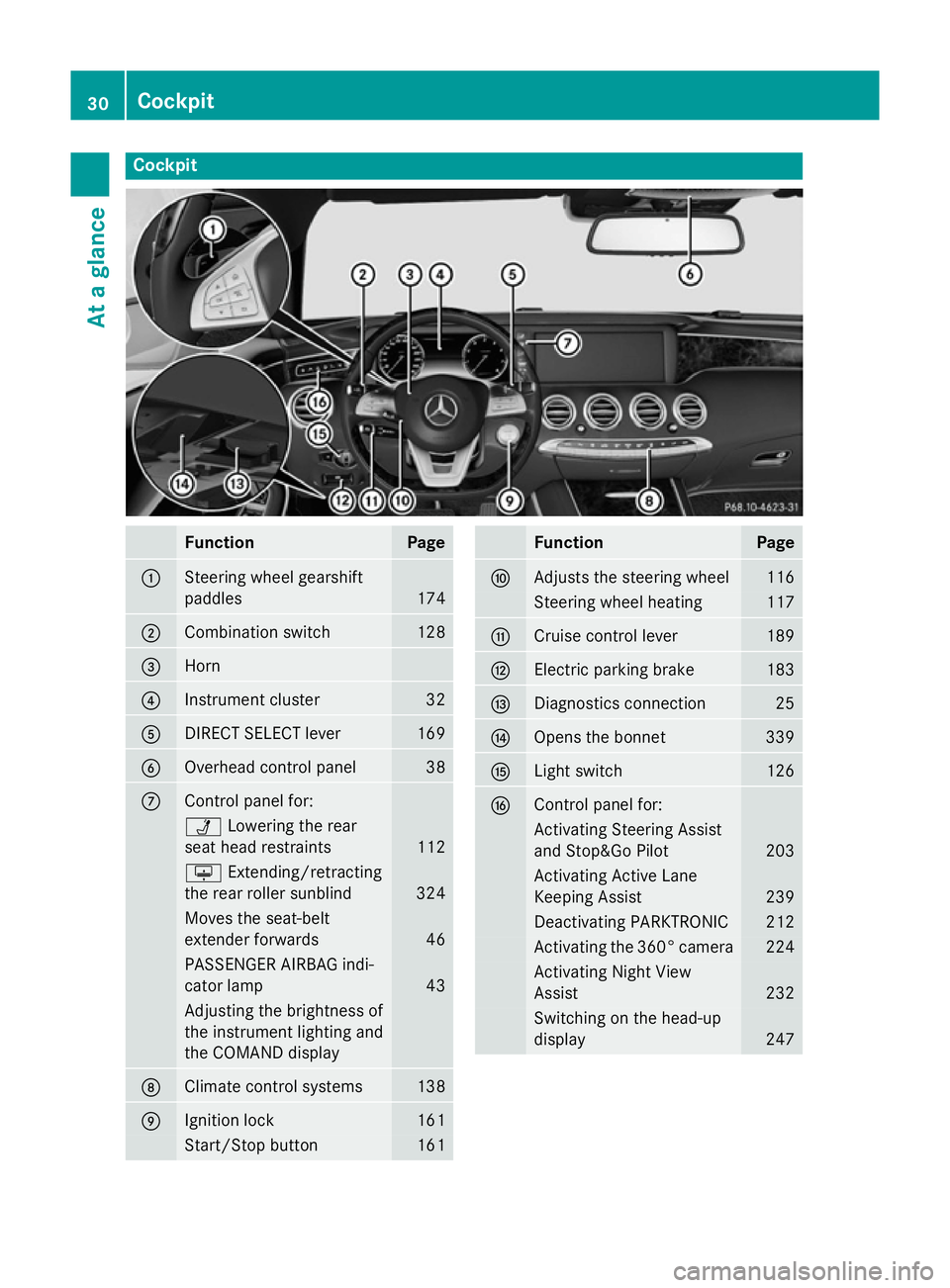
Cockpit
Function Page
:
Steering wheel gearshift
paddles
174
;
Combination switch 128
=
Horn
?
Instrument cluster 32
A
DIRECT SELECT lever 169
B
Overhead control panel 38
C
Control panel for:
Ü
Lowering the rear
seat head restraints 112
u
Extending/retracting
the rear roller sunblind 324
Moves the seat-belt
extender forwards 46
PASSENGER AIRBAG indi-
cator lamp
43
Adjusting the brightness of
the instrument lighting and
the COMAND display D
Climate control systems 138
E
Ignition lock 161
Start/Stop button 161 Function Page
F
Adjusts the steering wheel 116
Steering wheel heating 117
G
Cruise control lever 189
H
Electric parking brake 183
I
Diagnostics connection 25
J
Opens the bonnet 339
K
Light switch 126
L
Control panel for:
Activating Steering Assist
and Stop&Go Pilot
203
Activating Active Lane
Keeping Assist 239
Deactivating PARKTRONIC 212
Activating the 360° camera 224
Activating Night View
Assist 232
Switching on the head-up
display
24730
CockpitAt a glance
Page 34 of 417
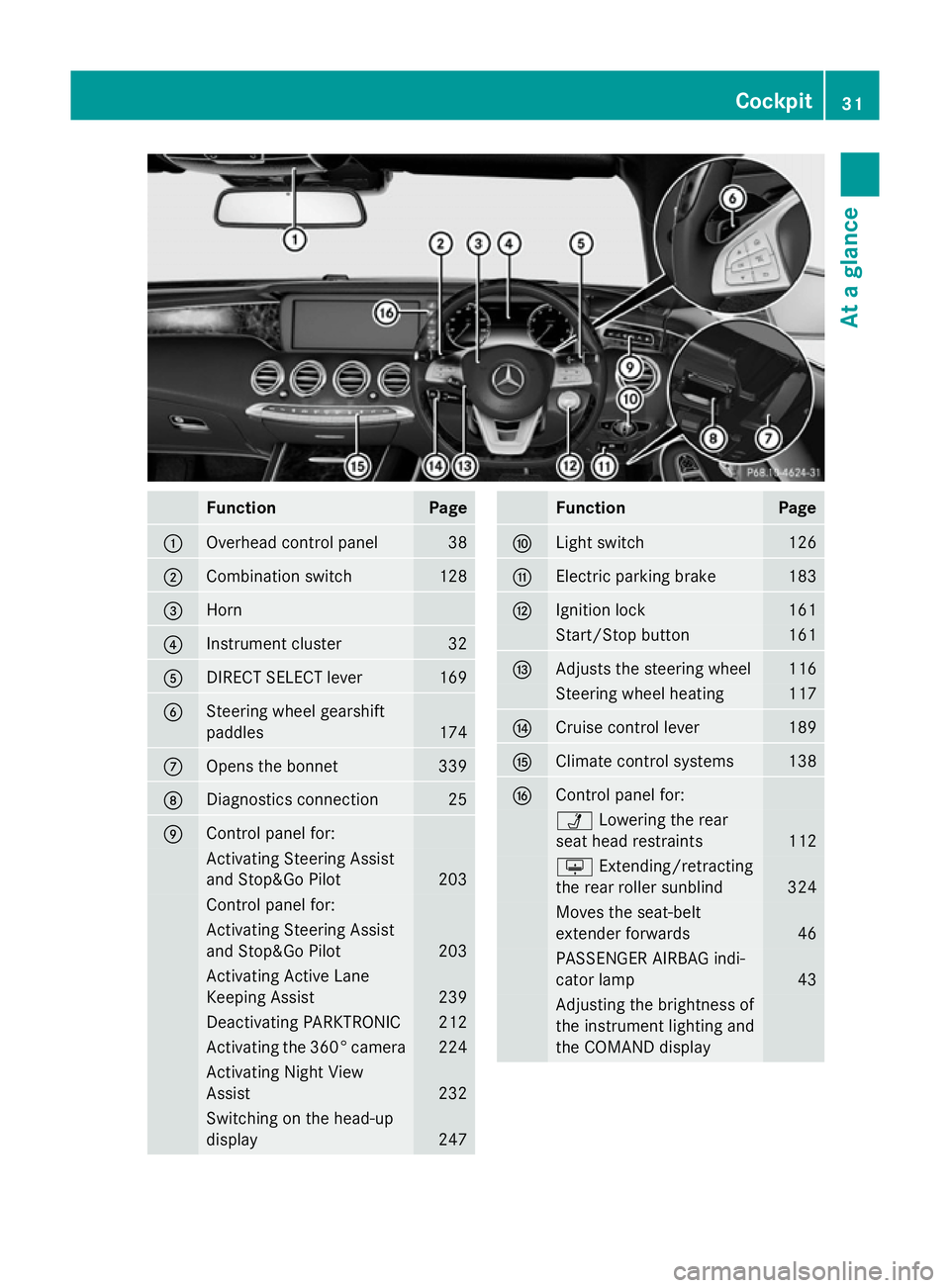
Function Page
:
Overhead control panel 38
;
Combination switch 128
=
Horn
?
Instrument cluster 32
A
DIRECT SELECT lever 169
B
Steering wheel gearshift
paddles
174
C
Opens the bonnet 339
D
Diagnostics connection 25
E
Control panel for:
Activating Steering Assist
and Stop&Go Pilot 203
Control panel for:
Activating Steering Assist
and Stop&Go Pilot
203
Activating Active Lane
Keeping Assist
239
Deactivating PARKTRONIC 212
Activating the 360° camera 224
Activating Night View
Assist
232
Switching on the head-up
display
247 Function Page
F
Light switch 126
G
Electric parking brake 183
H
Ignition lock 161
Start/Stop button 161
I
Adjusts the steering wheel 116
Steering wheel heating 117
J
Cruise control lever 189
K
Climate control systems 138
L
Control panel for:
Ü
Lowering the rear
seat head restraints 112
u
Extending/retracting
the rear roller sunblind 324
Moves the seat-belt
extender forwards
46
PASSENGER AIRBAG indi-
cator lamp
43
Adjusting the brightness of
the instrument lighting and
the COMAND display Cockpit
31At a glance
Page 36 of 417
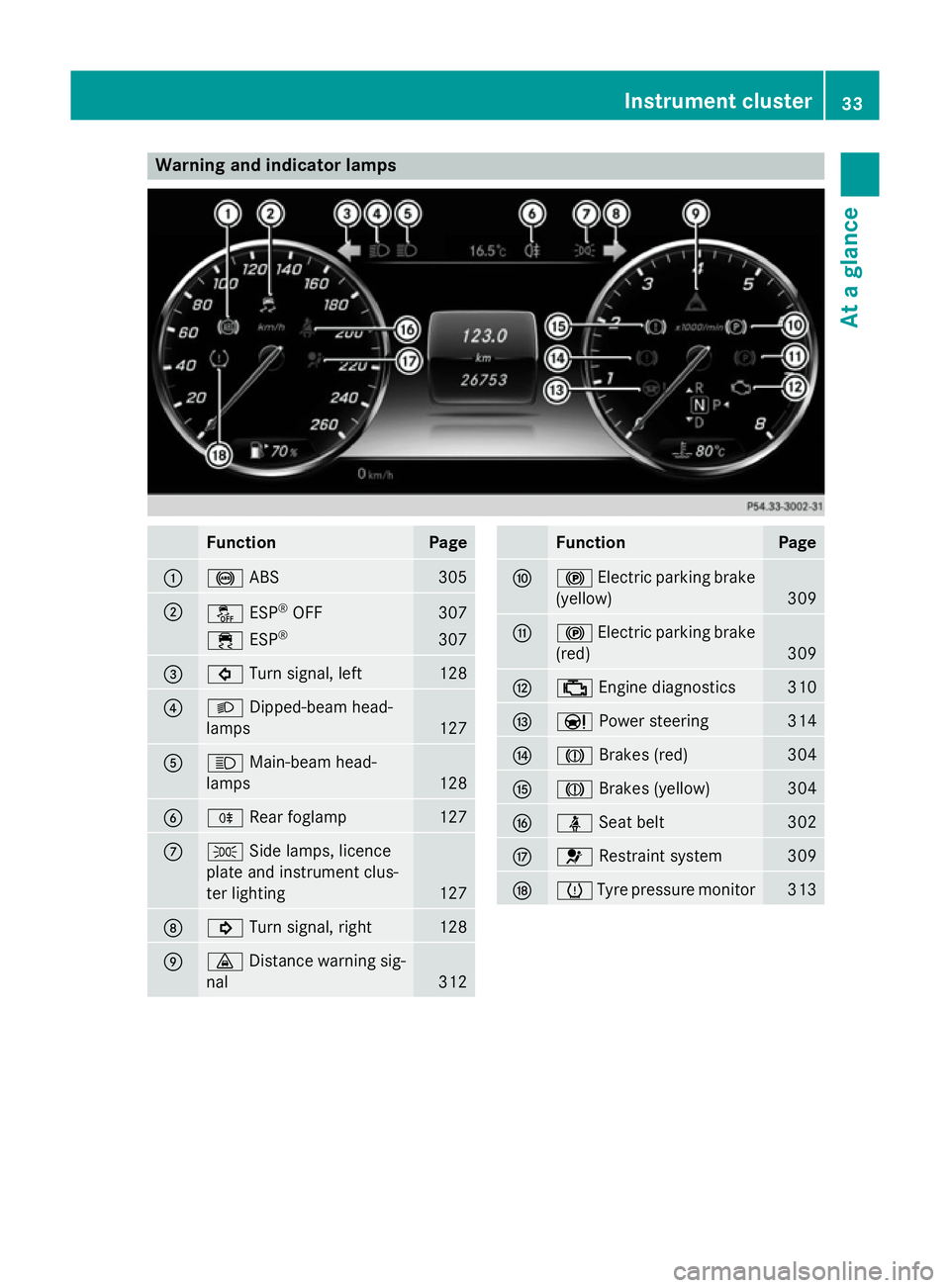
Warning and indicator lamps
Function Page
:
!
ABS 305
;
å
ESP®
OFF 307
÷
ESP® 307
=
#
Turn signal, left 128
?
L
Dipped-beam head-
lamps 127
A
K
Main-beam head-
lamps 128
B
R
Rear foglamp 127
C
T
Side lamps, licence
plate and instrument clus-
ter lighting 127
D
!
Turn signal, right 128
E
·
Distance warning sig-
nal 312 Function Page
F
!
Electric parking brake
(yellow) 309
G
!
Electric parking brake
(red) 309
H
;
Engine diagnostics 310
I
Ð
Power steering 314
J
J
Brakes (red) 304
K
J
Brakes (yellow) 304
L
ü
Seat belt 302
M
6
Restraint system 309
N
h
Tyre pressure monitor 313Instrument cluster
33At a glance
Page 41 of 417
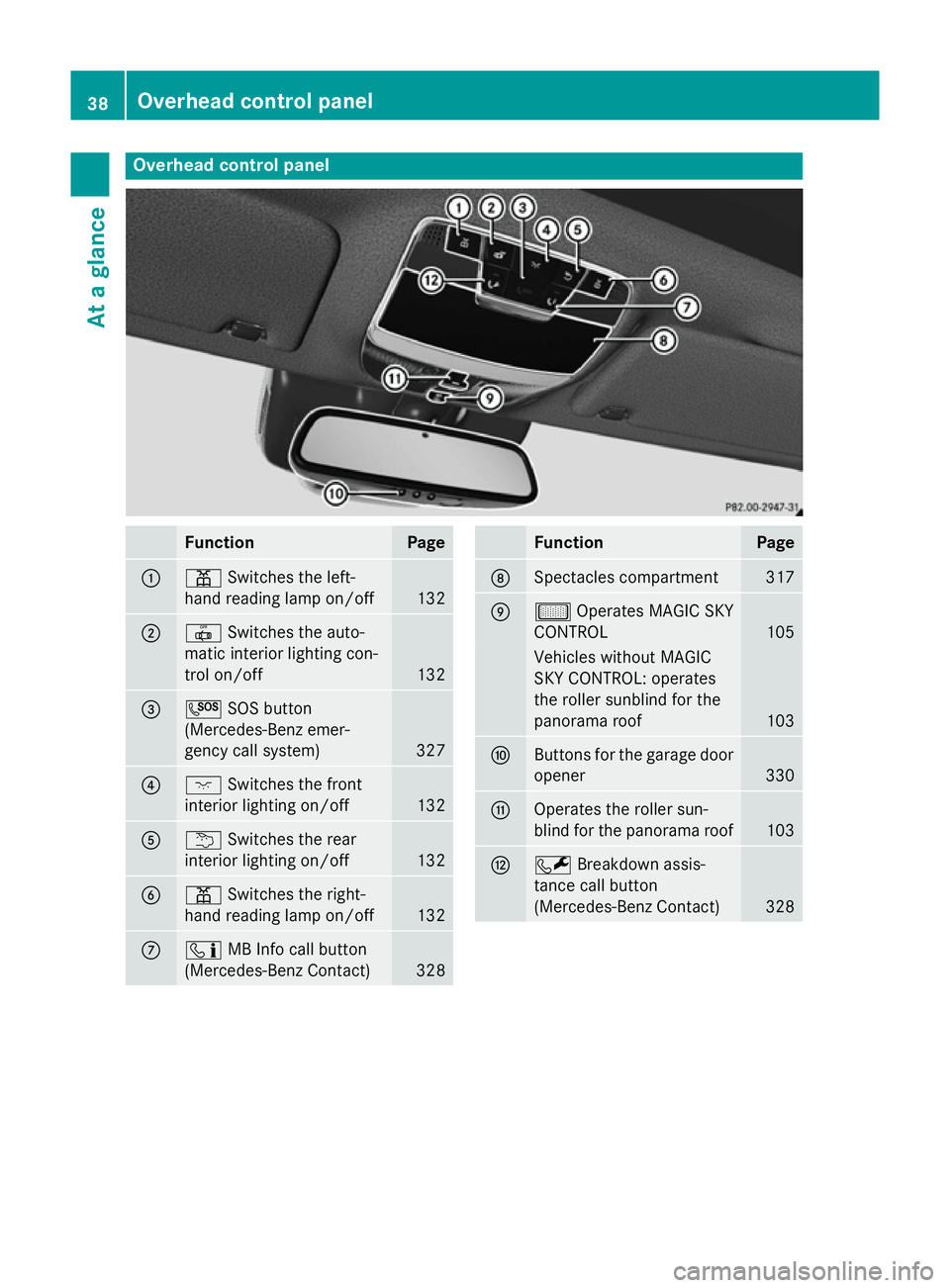
Overhead control panel
Function Page
:
p
Switches the left-
hand reading lamp on/off 132
;
|
Switches the auto-
matic interior lighting con-
trol on/off 132
=
G
SOS button
(Mercedes-Benz emer-
gency call system) 327
?
c
Switches the front
interior lighting on/off 132
A
u
Switches the rear
interior lighting on/off 132
B
p
Switches the right-
hand reading lamp on/off 132
C
ï
MB Info call button
(Mercedes-Benz Contact) 328 Function Page
D
Spectacles compartment 317
E
µ
Operates MAGIC SKY
CONTROL 105
Vehicles without MAGIC
SKY CONTROL: operates
the roller sunblind for the
panorama roof
103
F
Buttons for the garage door
opener 330
G
Operates the roller sun-
blind for the panorama roof
103
H
F
Breakdown assis-
tance call button
(Mercedes-Benz Contact) 32838
Overhead control panelAt a glance
Page 46 of 417
Important safety notes
G
WARNING
If the restraint system is modified, it may no
longer work as intended. The restraint system
may then not perform its intended protective function by failing in an accident or triggering
unexpectedly, for example. There is an
increased risk of injury, possibly even fatal.
Never modify parts of the restraint system. Do not attempt to modify the wiring as well as
electronic components or their software.
If it is necessary to modify an airbag system to
accommodate a person with disabilities, con- tact a Mercedes-Benz Service Centre for
details. Restraint system warning lamp
The functions of the restraint system are
checked after the ignition is switched on and
at regular intervals while the engine is run-
ning. Therefore, malfunctions can be detec-
ted in good time.
The 6 restraint system warning lamp in
the instrument cluster lights up when the igni- tion is switched on. It goes out no later than afew seconds after the vehicle is started. The
components of the restraint system are in
operational readiness.
A malfunction has occurred if the 6
restraint system warning lamp:
R does not light up after the ignition is
switched on
R does not go out after a few seconds with
the engine running
R lights up again while the engine is running G
WARNING
If the restraint system is malfunctioning,
restraint system components may be trig-
gered unintentionally or might not be trig-
gered at all in the event of an accident with a high rate of vehicle deceleration. This can
effect belt tensioners or airbags, for example. There is an increased risk of serious or even
fatal injuries.
Have the restraint system checked and
repaired immediately at a qualified specialist
workshop.
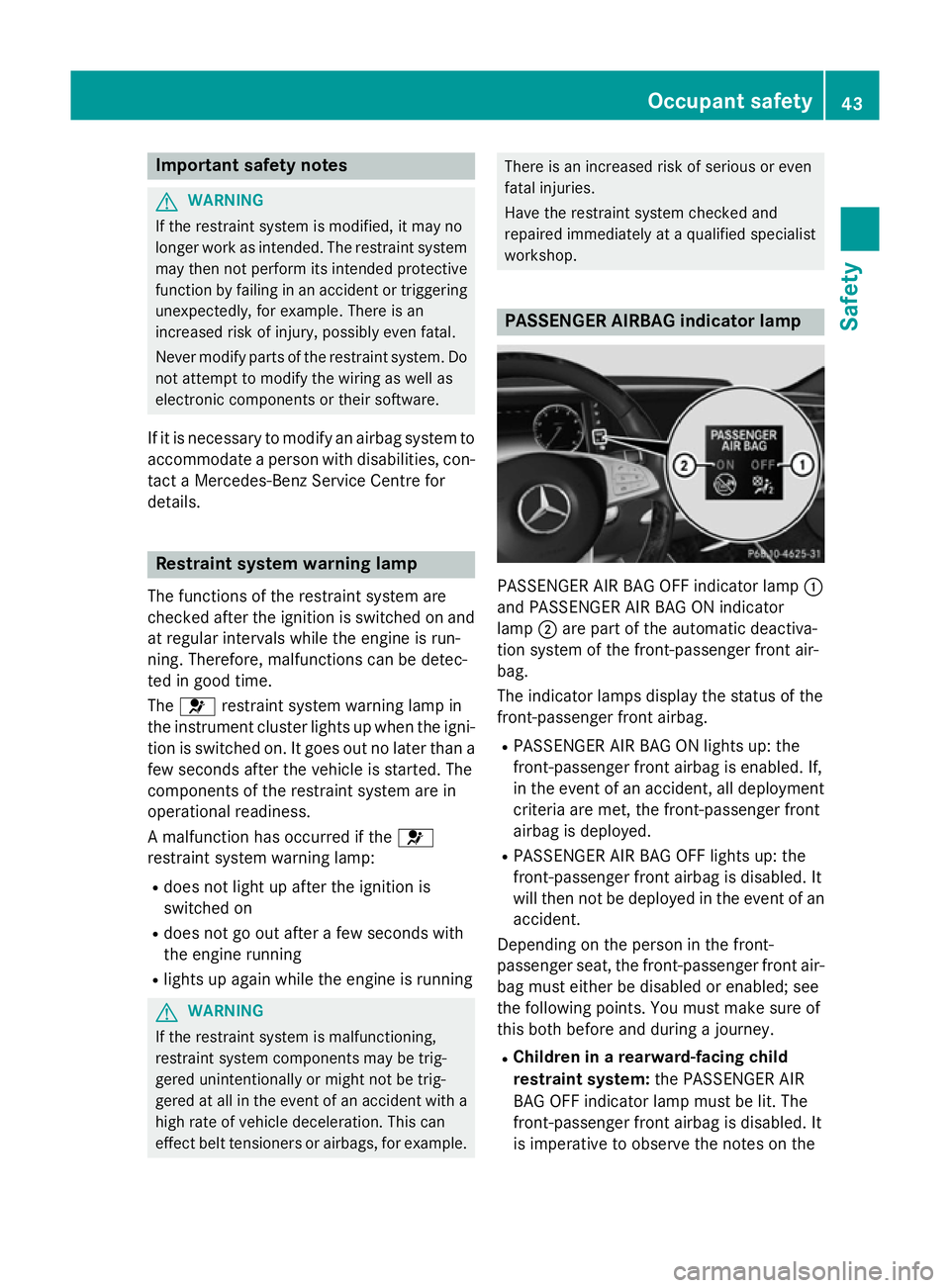
PASSENGER AIRBAG indicator lamp
PASSENGER AIR BAG OFF indicator lamp
:
and PASSENGER AIR BAG ON indicator
lamp ;are part of the automatic deactiva-
tion system of the front-passenger front air-
bag.
The indicator lamps display the status of the
front-passenger front airbag.
R PASSENGER AIR BAG ON lights up: the
front-passenger front airbag is enabled. If,
in the event of an accident, all deployment
criteria are met, the front-passenger front
airbag is deployed.
R PASSENGER AIR BAG OFF lights up: the
front-passenger front airbag is disabled. It
will then not be deployed in the event of an
accident.
Depending on the person in the front-
passenger seat, the front-passenger front air-
bag must either be disabled or enabled; see
the following points. You must make sure of
this both before and during a journey.
R Children in a rearward-facing child
restraint system: the PASSENGER AIR
BAG OFF indicator lamp must be lit. The
front-passenger front airbag is disabled. It
is imperative to observe the notes on the Occupant safety
43Safety Z
Page 47 of 417
"Automatic front-passenger front airbag
deactivation system" (Y page 51) and on
"Children in the vehicle" (Y page 60).
R Children in a forward-facing child
restraint system: depending on the instal-
led child restraint system and the age and
size of the child, the front-passenger front
airbag is either disabled or enabled. There-
fore, it is imperative to observe the notes
on the "Automatic front-passenger front
airbag deactivation system" (Y page 51)
and on "Children in the vehicle"
(Y page 60).
R All other persons: the PASSENGER AIR
BAG ON indicator lamp must be lit. The
front-passenger front airbag is enabled.
Depending on the build of the person on the
front-passenger seat, the PASSENGER AIR
BAG OFF indicator lamp may light up. The
front-passenger front airbag is disabled. It
will then not be deployed in the event of an accident. In this case, the front-passenger
seat should not be used.
It is imperative to observe the notes on the
"Automatic front-passenger front airbag
deactivation system" (Y page 51) as well
as on "Seat belts" (Y page 44) and "Air-
bags" (Y page 48). There you can also find
information on the correct seat position. Seat belts
Introduction A correctly worn seat belt is the most effec-
tive means of restraining the movement of
vehicle occupants in the event of a collision or
if the vehicle overturns. This reduces the risk of vehicle occupants coming into contact with
parts of the vehicle interior or being ejected
from it. The seat belt also helps to keep the
vehicle occupants in the best position in rela-
tion to the airbag being deployed.
The seat belt system consists of:
R seat belts
R belt tensioners and belt force limiters If the seat belt is pulled quickly or sharply by
the seat-belt extender, the inertia reel locks.
The belt strap cannot be pulled out any fur-
ther.
The belt tensioner tightens the seat belt in the
event of a collision so that it fits tightly across
your body. However, it does not pull the vehi- cle occupants back in the direction of the seat
backrest.
The belt tensioner does not, however, correct an incorrect seat position or correct the rout-
ing of a seat belt that is worn incorrectly.
When triggered, seat belt force limiters help
to reduce the peak force exerted by the seat
belt on the vehicle occupant.
The belt force limiters on the front seats are
synchronised with the front airbags, which
take on a part of the deceleration force. This
can reduce the forces to which the vehicle
occupants are subjected during an accident.
! If the co-driver's seat is not occupied, do
not engage the seat belt tongue in the
buckle on the co-driver's seat. Otherwise,
the belt tensioner could be triggered in the
event of an accident and would have to be
replaced.
Important safety notes G
WARNING
The seat belt cannot perform its intended pro- tective function if it is not fastened correctly. Also, an improperly fastened seat belt can
cause additional injuries in the event of an
accident, sudden braking or abrupt changes
of direction. There is an increased risk of
injury, possibly even fatal.
Always make sure that all vehicle occupants
are wearing their seat belt properly and are
seated correctly. G
WARNING
The seat belt does not offer the intended level of protection if you have not moved the back-
rest to an almost vertical position. When brak-
ing or in the event of an accident, you could 44
Occupant safetySafety