sensor MERCEDES-BENZ S-Class COUPE 2017 C217 User Guide
[x] Cancel search | Manufacturer: MERCEDES-BENZ, Model Year: 2017, Model line: S-Class COUPE, Model: MERCEDES-BENZ S-Class COUPE 2017 C217Pages: 338, PDF Size: 8.16 MB
Page 66 of 338
Function
To avoid acollision ,BA SPLU Scalculates th e
brak eforce necessar yif:
Ryou approac han obstacle ,and
RBA SPLU Shas detected aris kof collision
When drivin gat aspeed
under20 mph(30 km/h) :if you depress th e
brak epedal, BA SPLU Sis activated. The
increas ein brak epressur ewill be carried out at
th elast possible moment.
When drivin gat aspeed
abov e20 mph(30 km/h) :if you depress th e
brak epedal sharply, BA SPLU Sautomatically
raises th ebrak epressur eto avalue adapted to
th etraffic situation .
BA SPLU Sprovides brakin gassistanc ein haz -
ardous situation swit hvehicles in fron twithin a
speed range between 4mph (7 km/h) and
15 5mph (25 0km/h).
At speeds of up to approximately 44 mph
(70 km/h), BA SPLU Scan reac tto :
Rstationary objects in th epat hof your vehicle,
e.g. stoppe dor parked vehicles
Rpedestrian sin th epat hof your vehicl e
Robstacles crossin gyour path, whic hmov ein
th edetection range of th esensor sand are
recognized by them
iIf BA SPLU Sdemand sparticularly high brak -
in g force ,preventative passenger protection
measures (PRE-SAF E
®)are activated simulta-
neousl y (Ypage 55) .
XKeepth ebrak epedal depressed until th e
eme rgenc ybrakin gsituation is over.
AB Sprevents th ewheels from locking .
BA SPLU Sis deactivated and th ebrakes func-
tion as usual, if:
Ryou release th ebrak epedal .
Rthere is no longer aris kof collision .
Rno obstacle is detecte din fron tof your vehi-
cle .
Ryou depress th eaccelerato rpedal .
Ryou activat ekickdown .
COLLISION PREVENTION ASSIST
PLUS
Gene ral informa tion
COLLISION PREVENTION ASSIST PLU Sconsist s
of adistanc ewarnin gfunction wit han autono-
mous brakin gfunction and Adaptive Brake
Assist.
COLLISION PREVENTION ASSIST PLU Scan help
you to minimiz eth eris kof afront-en dcollision
wit h a vehicl eahead or reduce th eeffects of
suc h a collision .
If COLLISION PREVENTION ASSIST PLU S
detects that there is aris kof acollision ,you will
be warned visually and acoustically. If you do no t
reac tto th evisual and audibl ecollision warning,
autonomous brakin gcan be initiated in critica l
situations. If you apply th ebrak eyourself in a
critica lsituation ,th eCOLLISION PREVENTION
ASSIST PLU Sadaptive Brake Assis tassist syou.
Impor tant safety notes
In particular, th edetection of obstacles can be
impaire dif:
Rthere is dir ton th esensor sor anythin gelse
coverin gth esensor s
Rthere is snow or heav yrain
Rthere is interferenc eby other rada rsource s
Rthere are stron grada rreflections, for exam-
ple in parkin ggarages
Ranarrow vehicl eis travelin gin front, e.g. a
motorbik e
Ravehicl eis travelin gin fron ton adifferen tlin e
Rthevehicl eis ne wor after aservic eon th e
COLLISION PREVENTION ASSIST PLU Ssys-
te m
Observ eth enote sin th esection on breaking -
in (
Ypage 120).
Following damage to th efron ten dof th evehicle,
hav eth econfiguration and operation of th e
rada rsensor checke dat aqualified specialist
workshop .This also applie sto collision sat slow
speeds wher ethere is no visible damage to th e
fron tof th evehicle.
Activating/deactivating
The COLLISION PREVENTION ASSIST PLU Sis
automatically active after switchin gon th eigni-
tion .
64Driving safety systems
Safety
Page 67 of 338
You can activate or deactivate COLLISION PRE-
VENTION ASSIST PLUS in the on-board com-
puter (
Ypage 198). When deactivated, the dis-
tance warning function and the autonomous
braking function are also deactivated.
If COLLISION PREVENTION ASSIST PLUS is
deactivated, the 00D4symbol appears in the
assistance graphics display.
Distance warning function
General information
iObserve the "Important safety notes" sec-
tion for driving safety systems (Ypage 61).
The distance warning function can help you to
minimize the risk of a front-end collision with a
vehicle ahead or reduce the effects of such a
collision.
With the help of the radar sensor system, the
distance warning function can detect obstacles
that are in the path of your vehicle for an exten-
ded period of time.
If the distance warning function detects that
there is a risk of a collision, you will be warned
visually and acoustically.
Starting at a speed of approximately 4 mph
(7 km/h), the distance warning function warns
you if you rapidly approach a vehicle in front. An
intermittent warning tone will then sound, and
the 00BA distance warning lamp will light up in
the instrument cluster.
Up to a speed of approximately 44 mph
(70 km/h), the distance warning function can
also react to stationary obstacles, such as stop-
ped or parked vehicles.
Important safety notes
GWARNING
The distance warning function does not react:
Rto people or animals
Rto oncoming vehicles
Rto crossing traffic
Rwhen cornering
Thus, the distance warning function cannot
provide a warning in all critical situations.
There is a risk of an accident.
Always pay careful attention to the traffic sit-
uation and be ready to brake.
GWARNING
The distance warning function cannot always
clearly identify objects and complex traffic
situations.
In such cases, the distance warning function
may:
Rgive an unnecessary warning
Rnot give a warning
There is a risk of an accident.
Always pay careful attention to the traffic sit-
uation and do not rely solely on the distance
warning function.
XBrake immediately in order to increase the
distance from the vehicle in front.
or
XTake evasive action, provided it is safe to do
so.
Due to the nature of the system, particularly
complicated but non-critical driving conditions
may also cause the system to display a warning.
Autonomous braking function
If the driver does not react to the distance warn-
ing signal in a critical situation, COLLISION PRE-
VENTION ASSIST PLUS can assist with the
autonomous braking function.
The autonomous braking function is available in
the following speed ranges:
Rfrom 4 mph (7 km/h) to approx. 65 mph
(105 km/h) for moving objects
Rfrom 4 mph (7 km/h) to approx. 31 mph
(50 km/h) for stationary objects
Due to the nature of the system, particularly
complicated but non-critical driving conditions
may also cause the Autonomous Braking Func-
tion to intervene.
If the autonomous braking function requires a
particularly high braking force, preventative
passenger protection measures (PRE-SAFE
®)
are activated simultaneously (Ypage 55).
Driving safety systems65
Safety
Z
Page 68 of 338
Adaptive Brake Assist
Generalinformation
iObserv eth e"Importan tsafet ynotes" sec -
tion (Ypage 61) .
Wit hth ehelp of adaptive Brake Assist, th edis-
tance warning signal can detec tobstacles that
are in th epat hof your vehicl efor an extended
period of time.
If adaptive Brake Assis tdetects aris kof colli-
sion wit hth evehicl ein front, it calculates th e
braking force necessar yto avoi d acollision .If
you apply th ebrakes forcefully, adaptive Brake
Assis twill automatically increas eth ebraking
force to alevel suitable for th etraffic conditions.
Adaptive Brake Assis tprovides braking assis-
tance in hazardous situation sat speeds abov e
4 mph (7 km/h). It uses radar sensor technology
to assess th etraffic situation .
Up to aspee dof approximately 15 5mph
(25 0km/h), Adaptive Brake Assis tis capable of
reacting to moving objects that hav ealready
been detecte das suc hat least once ove rth e
period of observation .
Up to aspee dof approximately 44 mph
(70 km/h), Adaptive Brake Assis treacts to sta-
tionary obstacles.
If adaptive Brake Assis tdemand sparticularly
high braking force ,preventative passenger pro -
tection measures (PRE-SAF E
®)are activated
simultaneously (Ypage 55).
XKeepth ebrak epedal depressed until th e
emergenc ybraking situation is over.
AB Sprevents th ewheels from locking .
The brakes will wor knormally again if:
Ryou release th ebrak epedal .
Rthere is no longer any danger of acollision .
Rno obstacle is detecte din fron tof your vehi-
cle .
Adaptive Brake Assis tis then deactivated.
Important safety notes
GWARNIN G
Adaptive Brake Assis tcanno talways clearly
identify objects and complex traffic situa-
tions.
In suc hcases, Adaptive Brake Assis tcan :
Rinterven eunnecessarily
Rno tinterven e
There is aris kof an accident.
Always pay careful attention to th etraffic sit -
uation and be read yto brake. Terminate th e
intervention in anon-critical drivin gsituation .
GWARNIN G
Adaptive Brake Assis tdoes no treact:
Rto people or animals
Rto oncomin gvehicles
Rto crossing traffic
Rwhen cornering
As aresult ,th eAdaptive Brake Assis tmay no t
interven ein all critical conditions. There is a
ris kof an accident.
Always pay careful attention to th etraffic sit -
uation and be read yto brake.
Due to th enature of th esystem, particularly
complicated but non-critical drivin gcondition s
may also caus eBrake Assis tto intervene.
If adaptive Brake Assis tis no tavailable due to a
malfunction in th eradar sensor system, th e
brak esystem remain savailable wit hfull brak e
boosting effec tand BAS.
ESP®(Electron ic Stability Program)
Gene ral notes
iObserv eth e"Importan tsafet ynotes" sec -
tion (Ypage 61).
ES P
®monitors drivin gstabilit yand traction ,i.e .
powe rtransmission between th etires and th e
road surface.
If ES P
®detects that th evehicl eis deviating from
th edirection desired by th edriver ,on eor mor e
wheels are braked to stabiliz eth evehicle. The
engin eoutput is also modifie dto keep th evehi-
cle on th edesired cours ewithin physical limits .
ES P
®assist sth edriver when pullin gaway on
wet or slipper yroads. ES P®can also stabiliz e
th evehicl eduring braking .
ETS/4ETS (Electron ic Traction System)
iObserveth e"Importan tsafet ynotes" sec -
tion (Ypage 61).
66Driving safety systems
Safety
Page 71 of 338
For PRE-SAFE®Brake to assist you when driving,
the radar sensor system and the camera system
must be switched on and be operational.
With the help of the radar sensor system and the
camera system, PRE-SAFE
®Brake can detect
obstacles that are in front of your vehicle for an
extended period of time.
In addition, pedestrians in the path of your vehi-
cle can be detected.
PRE-SAFE
®Brake detects pedestrians using
typical characteristics such as the body con-
tours and posture of a person standing upright.
iObserve the restrictions described in the
"Important safety notes" section
(
Ypage 69).
Important safety notes
GWARNING
PRE-SAFE
®Brake will initially brake your vehi-
cle by a partial application of the brakes if a
danger of collision is detected. There may be
a collision unless you brake yourself. Even
after subsequent full application of the brakes
a collision cannot always be avoided, partic-
ularly when approaching at too high a speed.
There is a risk of an accident.
Always apply the brakes yourself and try to
take evasive action, provided it is safe to do
so.
In the event of a partial application of the brakes,
the vehicle is braked with up to 50% of the full
braking pressure.
GWARNING
PRE-SAFE
®Brake cannot always clearly iden-
tify objects and complex traffic conditions.
In these cases, PRE-SAFE
®Brake may:
Rgive an unnecessary warning and then
brake the vehicle
Rnot give a warning or intervene
There is a risk of an accident.
Always pay particular attention to the traffic
situation and be ready to brake, especially if
PRE-SAFE
®Brake warns you. Terminate the
intervention in a non-critical driving situation.
GWARNING
PRE-SAFE
®Brake cannot always clearly iden-
tify people, especially if they are moving. In
these cases, PRE-SAFE
®Brake cannot inter-
vene. There is a risk of an accident.
Always pay particular attention to the traffic
situation and be ready to brake, especially if
PRE-SAFE
®Brake warns you.
In order to maintain the appropriate distance to
the vehicle in front and thus prevent a collision,
you must apply the brakes yourself.
GWARNING
PRE-SAFE
®Brake does not react:
Rto small people, e.g. children
Rto animals
Rto oncoming vehicles
Rto crossing traffic
Rwhen cornering
As a result, PRE-SAFE
®Brake may neither
give warnings nor intervene in all critical sit-
uations. There is a risk of an accident.
Always pay careful attention to the traffic sit- uation and be ready to brake.
In the event of snowfall or heavy rain, the rec-
ognition can be impaired.
Recognition by the radar sensor system is also
impaired if:
Rthere is dirt on the sensors or anything else
covering the sensors
Rthere is interference by other radar sources
Rthere are strong radar reflections, for exam-
ple in parking garages
Ra narrow vehicle is traveling in front, e.g. a
motorbike
Ra vehicle is traveling in front on a different line
relative to the center of your vehicle
Recognition by the camera system is also
impaired in the event of:
Rdirt on the camera or if the camera is covered
Rglare on the camera system, e.g. from the sun
being low in the sky
Driving safety systems69
Safety
Z
Page 72 of 338
Rdarkness
Ror if:
-pedestrians move quickly, e.g. into the path
of the vehicle
-the camera system no longer recognizes a
pedestrian as a person due to special cloth-
ing or other objects
-a pedestrian is concealed by other objects
-the typical outline of a person is not distin-
guishable from the background
Following damage to the front end of the vehicle,
have the configuration and operation of the
radar sensors checked at a qualified specialist
workshop. This also applies to collisions at slow
speeds where there is no visible damage to the
front of the vehicle.
Following damage to the windshield, have the
configuration and operation of the camera sys-
tem checked at a qualified specialist workshop.
Function
XTo activate/deactivate: activate or deacti-
vate PRE-SAFE®Brake in the on-board com-
puter (Ypage 199).
If the PRE-SAFE®Brake is not activated, the
00D4 symbol appears in the multifunction dis-
play.
Starting at a speed of around 4 mph (7 km/h),
this function warns you if you rapidly approach a
vehicle in front. An intermittent warning tone
will then sound and the 00BAdistance warning
lamp will light up in the instrument cluster.
XBrake immediately to defuse the situation.
or
XTake evasive action provided it is safe to do
so.
PRE-SAFE
®Brake can also brake the vehicle
automatically under the following conditions:
Rthe driver and front passenger have their seat belts fastened
Rthe vehicle speed is between approximately
4 mph (7 km/h) and 124 mph (200 km/ h)
At speeds of up to approximately 44 mph
(70 km/h) PRE-SAFE
®Brake can also detect:
Rstationary objects in the path of your vehicle,
e.g. stopped or parked vehicles
Rpedestrians in the path of your vehicle
iIf there is an increased risk of a collision,
preventive passenger protection measures
(PRE-SAFE
®) are triggered (Ypage 55).
If the risk of collision with the vehicle in front
remains and you do not brake, take evasive
action or accelerate significantly, the vehicle
may perform automatic emergency braking, up
to the point of full brake application. Automatic emergency braking is not performed until imme-
diately prior to an imminent accident.
You can prevent the i
ntervention of the PRE-
SAFE®Brake at any time by:
Rdepressing the accelerator pedal further.
Ractivating kickdown.
Rreleasing the brake pedal.
The braking action of PRE-SAFE®Brake is ended
automatically if:
Ryou maneuver to avoid the obstacle.
Rthere is no longer a risk of collision.
Rthere is no longer an obstacle detected in
front of your vehicle.
STEER CONTROL
General information
STEER CONTROL helps you by transmitting a
noticeable steering force to the steering wheel
in the direction required for vehicle stabilization.
This steering assistance is provided in particular if:
Rboth right wheels or both left wheels are on a
wet or slippery road surface when you brake
Rthe vehicle starts to skid
Important safety notes
iObserve the "Important safety notes" sec-
tion (Ypage 61).
No steering support is provided from STEER
CONTROL, if:
RESP®is deactivated
RESP®is malfunctioning
Rthe steering is faulty
Power steering will, however, continue to func-
tion.
70Driving safety systems
Safety
Page 75 of 338
multimedia system; see the Digital Operator's
Manual.
You will receive visual and acoustic locking con-
firmation if all components were able to be
locked.
When the locator lighting is activated via the
multimedia system, it lights up when it is dark
after the vehicle is unlocked with the SmartKey;
see the Digital Operator's Manual.
XTo open the trunk lid automatically from
outside the vehicle:press and hold the0054
button until the trunk lid opens.
XTo open the trunk lid automatically from
outside the vehicle: if the SmartKey is loca-
ted in the immediate vicinity of the vehicle,
press the 0054button on the SmartKey.
When the trunk lid closes you can then
release the button.
KEYLESS-GO
General notes
Bear in mind that the engine can be started by
any of the vehicle occupants if there is a Smart-
Key in the vehicle (
Ypage 123).
Locking/unlocking centrally
You can start, lock or unlock the vehicle using
KEYLESS-GO. To do this, you only need carry the
SmartKey with you. You can combine the func-
tions of KEYLESS-GO with those of a conven-
tional SmartKey. Unlock the vehicle by using
KEYLESS-GO, for instance, and lock it using the
0037 button on the SmartKey.
The driver's door and the door at which the han-
dle is used, must both be closed. The SmartKey
must be outside the vehicle. When locking or
unlocking with KEYLESS-GO, the distance
between the SmartKey and the corresponding
door handle must not be greater than 3 ft (1 m).
A brief radio connection between the vehicle
and the SmartKey determines whether a valid
SmartKey is in, or in the direct vicinity of, the
vehicle. This occurs, for example:
Rwhen starting the engine
Rwhile driving
Rwhen using HANDS-FREE ACCESS
Rwhen the external door handles are touched
Rduring convenience closing
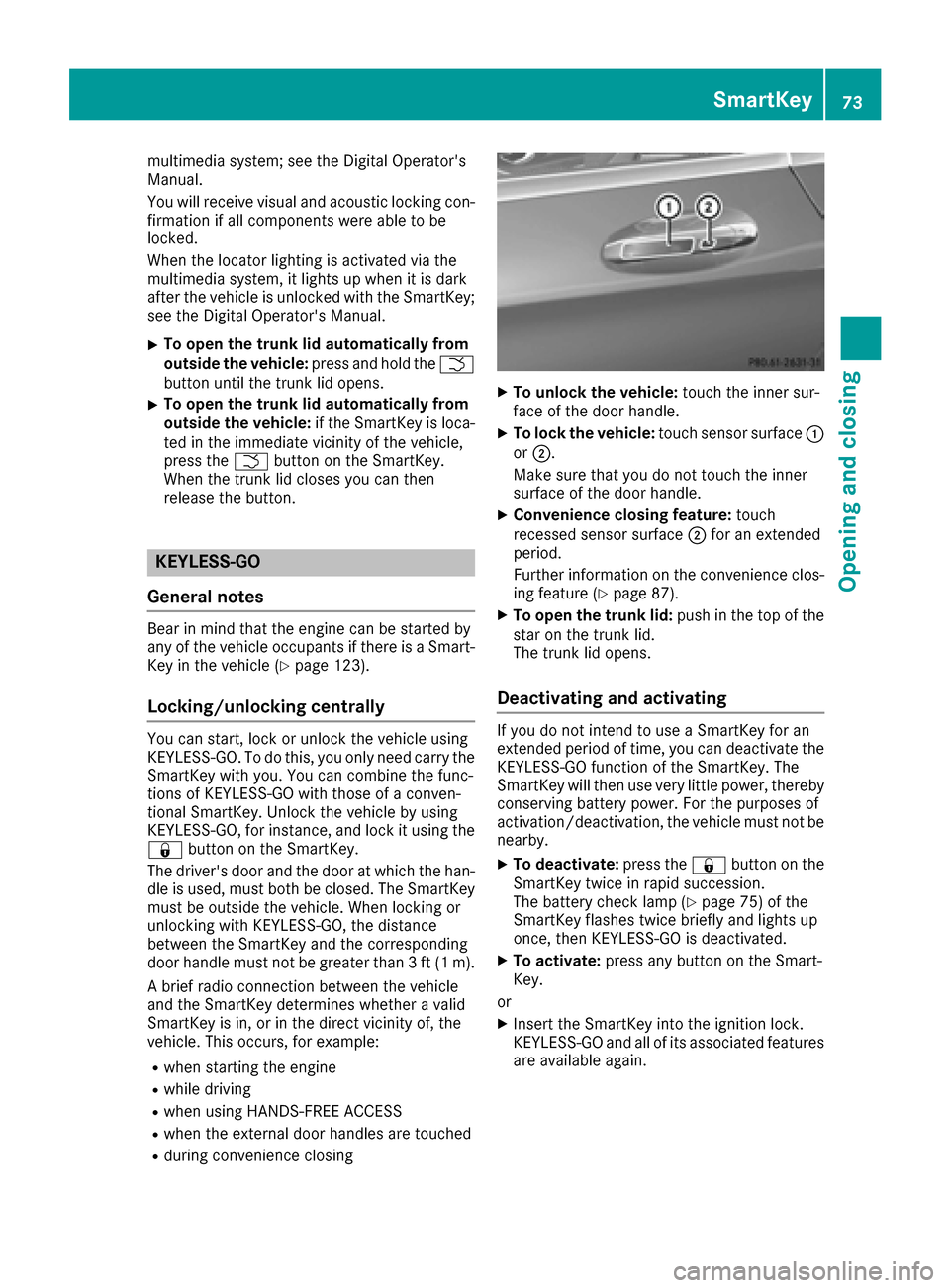
XTo unlock the vehicle: touch the inner sur-
face of the door handle.
XTo lock the vehicle: touch sensor surface 0043
or 0044.
Make sure that you do not touch the inner
surface of the door handle.
XConvenience closing feature: touch
recessed sensor surface 0044for an extended
period.
Further information on the convenience clos-
ing feature (
Ypage 87).
XTo open the trunk lid: push in the top of the
star on the trunk lid.
The trunk lid opens.
Deactivating and activating
If you do not intend to use a SmartKey for an
extended period of time, you can deactivate the
KEYLESS-GO function of the SmartKey. The
SmartKey will then use very little power, thereby
conserving battery power. For the purposes of
activation/deactivation, the vehicle must not be
nearby.
XTo deactivate: press the0037button on the
SmartKey twice in rapid succession.
The battery check lamp (
Ypage 75) of the
SmartKey flashes twice briefly and lights up
once, then KEYLESS-GO is deactivated.
XTo activate: press any button on the Smart-
Key.
or
XInsert the SmartKey into the ignition lock.
KEYLESS-GO and all of its associated features
are available again.
SmartKey73
Opening and closing
Z
Page 76 of 338
KEYLESS-GOstart function
Gene ral notes
Bear in min dthat th eengin ecan be started by
any of th evehicl eoccupant sif there is aSmart -
Key in th evehicl e (
Ypage 123).
Changing the settings ofthe locking
system
You can chang eth esetting sof th elocking sys-
tem. This mean sthat only th edriver's door and
th efuel filler flap are unlocke dwhen th evehicl e
is unlocked. This is useful if you frequentl ytravel
on your own .
XTo change th esetting: press and hold down
th e0036 and0037 buttons simultaneousl y
for approximately six seconds until th ebat -
tery chec klamp (
Ypage 75 )flashes twice .
If th esetting of th elocking system is changed
within th esignal range of th evehicle, pressing
th e0037 or0036 button:
Rlocks or
Runlocks th evehicl e
The SmartKey no wfunction sas follows :
XTo unlock: press the0036 buttononce .
XTo unlock centrally: press the0036 button
twice .
XTo lock: press the0037 button.
The KEYLESS-GO function scan be changed as
follows :
XTo unlock th edriver's door :touch th einner
surfac eof th edoor handle on th edriver's
door .
XTo unlock centrally: touch theinner surfac e
of th efront-passenger door handle.
XTo lock centrally: touch theouter sensor
surfac eon on eof th edoor handles .
XTo restoreth efactory settings: press and
hold th e0036 and0037 buttons simultane -
ousl yfor approximat
ely s
ix seconds until th e
battery chec klamp (Ypage 75) flashes
twice .
Mechanical key
Gene ral notes
If th evehicl ecan no longer be locke dor
unlocke dwit hth eSmartKey or KEYLESS-GO ,
use th emechanical key.
If you use th emechanical ke yto unloc kand
open th edriver's door ,th eanti-thef talarm sys-
te m will be triggered .Switc hoff th ealarm
(
Ypage 71) .
If you unloc kth evehicl eusin gth emechanical
key, th efuel filler flap will no tbe unlocke dauto -
matically.
XTo unlock th efuel filler flap: insert the
SmartKey int oth eignition lock.
Removing the mechanical key
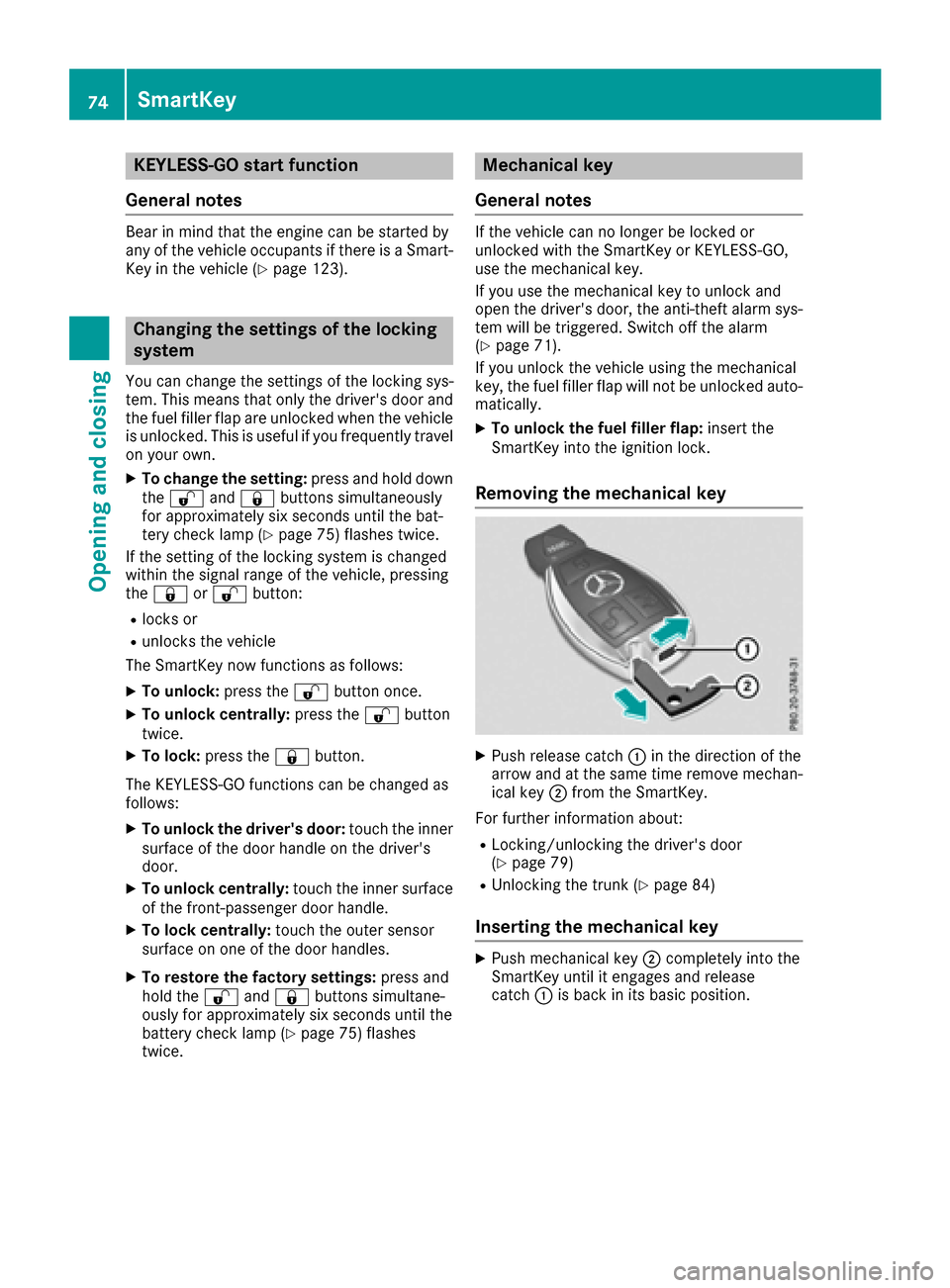
XPush release catch 0043in th edirection of th e
arrow and at th esam etime remove mechan -
ical ke y0044 from th eSmartKey.
Fo rfurther information about :
RLocking/unlocking thedriver's door
(Ypage 79 )
RUnlocking th etrunk (Ypage 84 )
Inserting the mechanical key
XPush mechanical ke y0044 completely int oth e
SmartKey until it engage sand release
catch 0043is bac kin it sbasic position .
74SmartKey
Opening and closing
Page 84 of 338
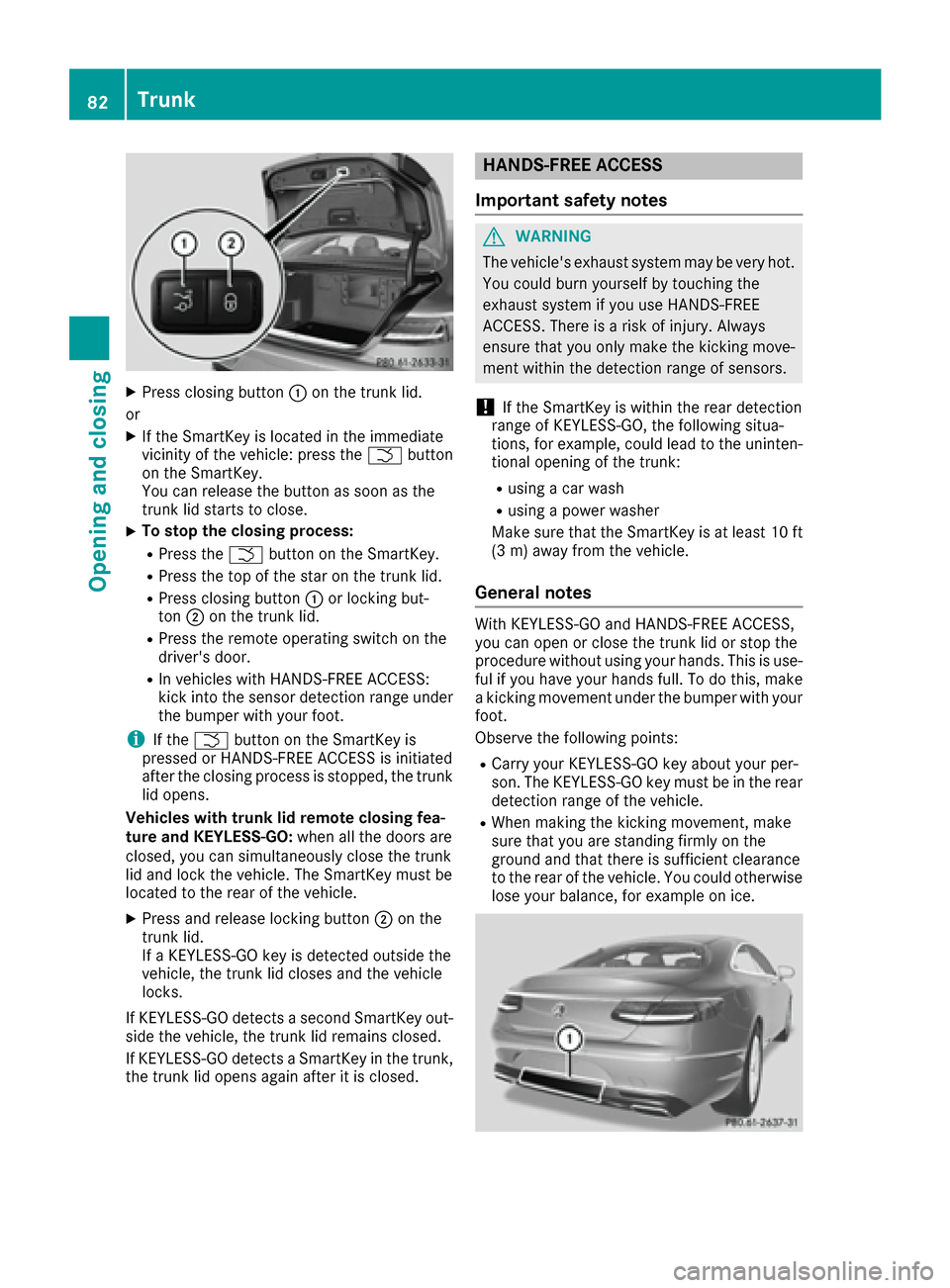
XPress closing button0043on the trunk lid.
or
XIf the SmartKey is located in the immediate
vicinity of the vehicle: press the 0054button
on the SmartKey.
You can release the button as soon as the
trunk lid starts to close.
XTo stop the closing process:
RPress the 0054button on the SmartKey.
RPress the top of the star on the trunk lid.
RPress closing button 0043or locking but-
ton 0044on the trunk lid.
RPress the remote operating switch on the
driver's door.
RIn vehicles with HANDS-FREE ACCESS:
kick into the sensor detection range under
the bumper with your foot.
iIf the 0054 button on the SmartKey is
pressed or HANDS-FREE ACCESS is initiated
after the closing process is stopped, the trunk
lid opens.
Vehicles with trunk lid remote closing fea-
ture and KEYLESS-GO: when all the doors are
closed, you can simultaneously close the trunk
lid and lock the vehicle. The SmartKey must be
located to the rear of the vehicle.
XPress and release locking button 0044on the
trunk lid.
If a KEYLESS-GO key is detected outside the
vehicle, the trunk lid closes and the vehicle
locks.
If KEYLESS-GO detects a second SmartKey out- side the vehicle, the trunk lid remains closed.
If KEYLESS-GO detects a SmartKey in the trunk,
the trunk lid opens again after it is closed.
HANDS-FREE ACCESS
Important safety notes
GWARNING
The vehicle's exhaust system may be very hot. You could burn yourself by touching the
exhaust system if you use HANDS-FREE
ACCESS. There is a risk of injury. Always
ensure that you only make the kicking move-
ment within the detection range of sensors.
!If the SmartKey is within the rear detection
range of KEYLESS-GO, the following situa-
tions, for example, could lead to the uninten-
tional opening of the trunk:
Rusing a car wash
Rusing a power washer
Make sure that the SmartKey is at least 10 ft
(3 m) away from the vehicle.
General notes
With KEYLESS-GO and HANDS-FREE ACCESS,
you can open or close the trunk lid or stop the
procedure without using your hands. This is use- ful if you have your hands full. To do this, make
a kicking movement under the bumper with your
foot.
Observe the following points:
RCarry your KEYLESS-GO key about your per-
son. The KEYLESS-GO key must be in the rear
detection range of the vehicle.
RWhen making the kicking movement, make
sure that you are standing firmly on the
ground and that there is sufficient clearance
to the rear of the vehicle. You could otherwise
lose your balance, for example on ice.
82Trunk
Opening and closing
Page 85 of 338
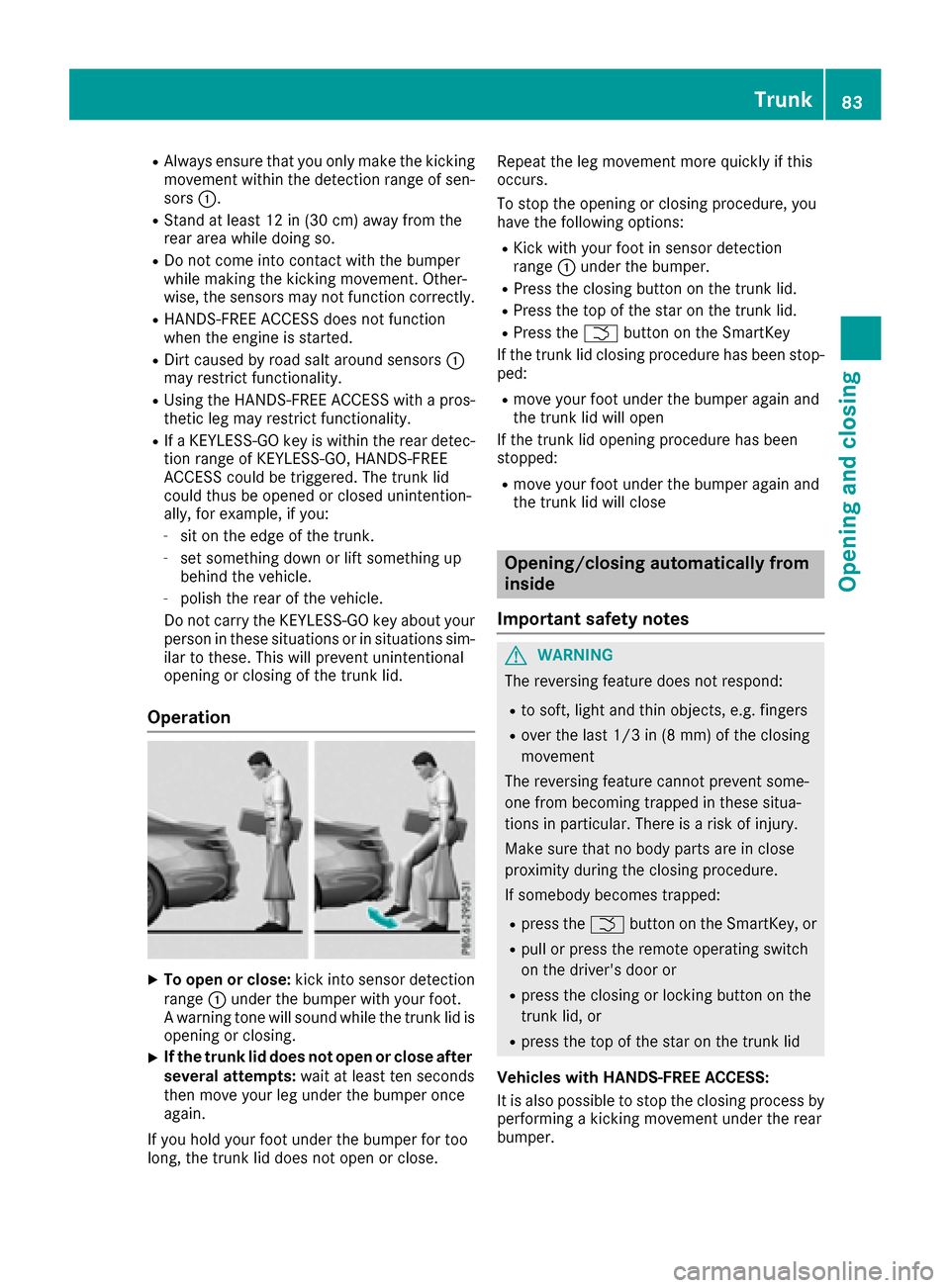
RAlways ensure that you only make the kicking
movement within the detection range of sen-
sors0043.
RStand at least 12 in (30 cm) away from the
rear area while doing so.
RDo not come into contact with the bumper
while making the kicking movement. Other-
wise, the sensors may not function correctly.
RHANDS-FREE ACCESS does not function
when the engine is started.
RDirt caused by road salt around sensors 0043
may restrict functionality.
RUsing the HANDS-FREE ACCESS with a pros-
thetic leg may restrict functionality.
RIf a KEYLESS-GO key is within the rear detec-
tion range of KEYLESS-GO, HANDS-FREE
ACCESS could be triggered. The trunk lid
could thus be opened or closed unintention-
ally, for example, if you:
-sit on the edge of the trunk.
-set something down or lift something up
behind the vehicle.
-polish the rear of the vehicle.
Do not carry the KEYLESS-GO key about your
person in these situations or in situations sim-
ilar to these. This will prevent unintentional
opening or closing of the trunk lid.
Operation
XTo open or close: kick into sensor detection
range 0043under the bumper with your foot.
A warning tone will sound while the trunk lid is
opening or closing.
XIf the trunk lid does not open or close after
several attempts: wait at least ten seconds
then move your leg under the bumper once
again.
If you hold your foot under the bumper for too
long, the trunk lid does not open or close. Repeat the leg movement more quickly if this
occurs.
To stop the opening or closing procedure, you
have the following options:
RKick with your foot in sensor detection
range
0043under the bumper.
RPress the closing button on the trunk lid.
RPress the top of the star on the trunk lid.
RPress the 0054button on the SmartKey
If the trunk lid closing procedure has been stop-
ped:
Rmove your foot under the bumper again and
the trunk lid will open
If the trunk lid opening procedure has been
stopped:
Rmove your foot under the bumper again and
the trunk lid will close
Opening/closing automatically from
inside
Important safety notes
GWARNING
The reversing feature does not respond:
Rto soft, light and thin objects, e.g. fingers
Rover the last 1/3 in (8 mm) of the closing
movement
The reversing feature cannot prevent some-
one from becoming trapped in these situa-
tions in particular. There is a risk of injury.
Make sure that no body parts are in close
proximity during the closing procedure.
If somebody becomes trapped:
Rpress the 0054button on the SmartKey, or
Rpull or press the remote operating switch
on the driver's door or
Rpress the closing or locking button on the
trunk lid, or
Rpress the top of the star on the trunk lid
Vehicles with HANDS-FREE ACCESS:
It is also possible to stop the closing process by
performing a kicking movement under the rear
bumper.
Trunk83
Opening and closing
Z
Page 89 of 338
Convenience closing feature
Important safety notes
GWARNING
When using the convenience closing feature,
parts of the body could be trapped in the clos-
ing area when a side window is being closed.
There is a risk of injury.
Observe the complete closing procedure
when the convenience closing feature is oper-
ating. Make sure that no body parts are in
close proximity during the closing procedure.
When you lock the vehicle, you can close the
windows at the same time.
You can then close the roller sunblinds.
iNotes on the automatic reversing feature
for:
Rthe side window (Ypage 85)
Rthe roller sunblind (Ypage 88)
Using the SmartKey
XPress and hold the 0037button until the side
windows are fully closed.
XMake sure that all the side windows are
closed.
XPress and hold the 0037button again until the
roller sunblinds of the panorama roof close.
XTo interrupt convenience closing: release
the 0037 button.
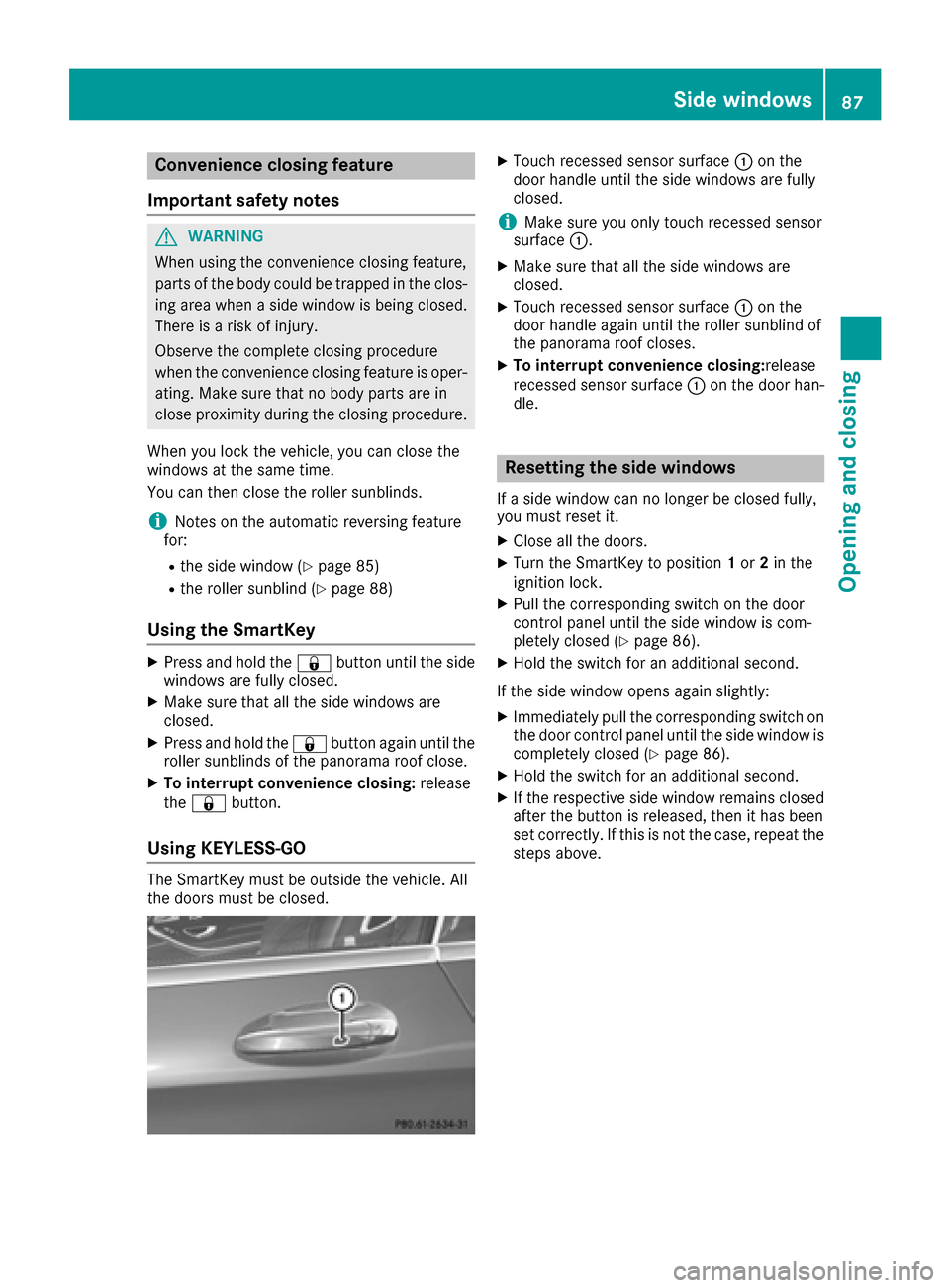
Using KEYLESS-GO
The SmartKey must be outside the vehicle. All
the doors must be closed.
XTouch recessed sensor surface 0043on the
door handle until the side windows are fully
closed.
iMake sure you only touch recessed sensor
surface 0043.
XMake sure that all the side windows are
closed.
XTouch recessed sensor surface 0043on the
door handle again until the roller sunblind of
the panorama roof closes.
XTo interrupt convenience closing: release
recessed sensor surface 0043on the door han-
dle.
Resetting the side windows
If a side window can no longer be closed fully,
you must reset it.
XClose all the doors.
XTurn the SmartKey to position 1or 2in the
ignition lock.
XPull the corresponding switch on the door
control panel until the side window is com-
pletely closed (
Ypage 86).
XHold the switch for an additional second.
If the side window opens again slightly:
XImmediately pull the corresponding switch on
the door control panel until the side window is
completely closed (
Ypage 86).
XHold the switch for an additional second.
XIf the respective side window remains closed
after the button is released, then it has been
set correctly. If this is not the case, repeat the
steps above.
Side windows87
Opening and closing
Z