ECU MERCEDES-BENZ S-CLASS COUPE 2018 User Guide
[x] Cancel search | Manufacturer: MERCEDES-BENZ, Model Year: 2018, Model line: S-CLASS COUPE, Model: MERCEDES-BENZ S-CLASS COUPE 2018Pages: 502, PDF Size: 6.29 MB
Page 53 of 502
Toimpr oveprotection forch ildren younger than
12 years old or under 5 ft(1.50 m) in height,
Mercedes-Benz recommends you observ eth e
fo llowing information:
ROnly secure children using a child restra int
sy stem which is appropriate tothe height,
age and weight of thech ild and suitable for
Mercedes-Benz vehicles. Be sure toobser ve
th e instructions for cor rect use of thech ild
re stra int sy stem.
RAlw ays ins tall a child restra int sy stem on a
re ar seat if possible.
ROnly usethefo llowing securing sy stems for
ch ild restra int sy stems:
-The seat belt sy stem
-The LATC H-type (ISOFIX) mounting brack‐
et s
RThe manufacturer's ins tallation instructions
fo rth ech ild restra int sy stem.
RThe warning labels in theve hicle interior and
on thech ild restra int sy stem.
&
WARNING Risk of injury or death caused
by incor rect ins tallation of thech ild
re stra int sy stem
If th ech ild restra int sy stem is incor rectly
ins talled on a suitable seating position, it
cannot per form its intended pr otective func‐
tion.
The child cannot be restra ined in theeve nt of
an accident, heavy braking or a sudden
ch ange of direction.
#Alw ays comply with the manufacturer's
ins tallation instructions forth ech ild
re stra int sy stem and its cor rect use.
#Make surethat the entire base of the
ch ild restra int sy stem alw aysre sts on
th e sitting sur face of the seat.
#Ne ver place objects under or behind
th ech ild restra int sy stem, e.g. cush‐
ions.
#Alw ays use child restra int sy stems with
th e original co ver designed forth em.
#Alw aysre place damaged co vers with
ge nuine co vers.
&
WARNING Risk of injury or death from
unsecured child restra int sy stems in the
ve hicle
If th ech ild restra int sy stem is not cor rectly
ins talled or secured, it could release in the
ev ent of an accident, sudden braking or a
sudden change in direction.
The child restra int sy stem could be flung
around and hit vehicle occupants.
#Alw ays ins tallch ild restra int sy stems
cor rectl y,eve n when not in use.
#Alw ays comply with thech ild restra int
sy stem manufacturer's ins tallation
instructions.
& WARNING Risk of injury or death caused
by the use of damaged child restra int
sy stems
Child restra int sy stems or their retaining sys‐
te ms that ha vebeen subjec tedto a load in
an accident may then not be able toper form
th eir intended pr otective function.
Occupant saf ety 51
Page 54 of 502
Thechild cannot be restra ined in theeve nt of
an accident, heavy braking or a sudden
ch ange of direction.
#Alw aysre place child restra int sy stems
immediately that ha vebeen damaged or
in vo lved in an accident.
#Ha ve the securing sy stems forth ech ild
re stra int sy stems checked at a qualified
specialist workshop before ins talling a
ch ild restra int sy stem again.
A boos ter seat may be necessary toachie ve
proper seat belt positioning forch ildren over
40 lbs (18 kg) in weight or until they reach a
height where a thre e-point seat belt can be
ins talled proper lywithout a boos ter seat.
The following no tes must be obser ved:
RWhen ins talling a child restra int sy stem on
th e front passenger seat, the information on
ins talling a child restra int sy stem on the front
passenger seat (
→page 55).
RInstructions and saf etyno tes on the auto‐
matic front passenger front airbag shutoff
(
→page 43).
RSaf etyno tes on the seat belt (→page 35).
RInformation on the cor rect use of the seat
belt (→page 39).
Ac tivating/deactivating the child seat saf ety
fe ature of the seat belt
&
WARNING Risk of injury or death if a
seat belt is unfas tened while theve hicle
is in motion
If th e seat belt is released while theve hicle is
in motion, thech ild restra int sy stem is no
longer cor rectly secure d. Thechild seat
saf etyfe ature is deactivated and the seat
belt is dr awn in a bit bythe inertia reel.
It is therefore not possible toengage the seat
belt again.
#Pull over and stop theve hicle safely as
soon as possible, paying attention to
ro ad and traf fic conditions.
#Ac tivate thech ild seat saf etyfe ature
again and cor rectly secure thech ild
re stra int sy stem.
When enabled, thech ild seat saf etyfe ature
ensures that the seat belts of the front
passenger seat and rear seats do not slac ken
once thech ild restra int sy stem is secured.
Installing a child restra int sy stem:
#Alw ays comply with the manufacturer's
ins tallation instructions when ins talling and
re moving thech ild restra int sy stem.
#Pull the seat belt smoo thly from the seat belt
outlet.
#En gage the seat belt tongue in the seat belt
buckle.
Ac tivating the child seat saf etyfe ature:
#Pull the seat belt out fully and let the inertia
re el retract it again.
When thech ild seat saf etyfe ature is activa‐
te d,you should hear a ratcheting sound.
#Push thech ild restra int sy stem down until
th e seat belt sits tightly.
Deactivating the child seat saf etyfe ature:
#Press there lease button of the seat belt
buckle.
52 Occupant saf ety
Page 55 of 502
#Holdthe seat belt tongue and guide it ba ck
to the seat belt outlet.
LA TC H-type (ISOFIX) child seat attachment
Note s onLATC H-type (ISOFIX) child seat
securing sy stems
&
WARNING Risk of injury or death ifthe
permissible gross mass of thech ild and
ch ild restra int sy stem toget her is excee‐
ded
Fo rLA TC H-type (ISOFIX) child restra int sys‐
te ms in which thech ild is secured using the
integrated seat belt integrated in thech ild
re stra int sy stem, the permissible gross mass
of thech ild and child restra int sy stem is
73 lb (33 kg).
If th ech ild and thech ild restra int sy stem
to ge ther we igh more than 73 lb (33 kg),th e
LA TC H-type (ISOFIX) child restra int sy stem
with integrated seat belt does not of fer suf fi‐
cient pr otection. An excessive load may be
placed on theLA TC H-type (ISOFIX) child seat
attachments and thech ild may not be
re stra ined in theeve nt of an accident, for
ex ample.
#Ifth ech ild and thech ild restra int sys‐
te m toget her weigh more than 73 lb
(33 kg),only use an LATC H-type (ISO‐
FIX) child restra int sy stem which
secures thech ild with theve hicle seat
belt.
#Also secure thech ild restra int sy stem
with theTo pTe ther belt, if available.
Alw ays comply with the information about the
mass of thech ild restra int sy stem:
Rin the manufacturer's ins tallation and operat‐
ing instructions forth ech ild restra int sy stem
used
Ron a label on thech ild restra int sy stem, if
present
Re gular lych eck that the permissible gross mass
of thech ild and child restra int sy stem is still
complied with. When using a
child restra int sy stem, be sure to
obser vethe manufacturer's ins tallation and
operating instructions as well as its cor rect use
and the suitability of the seats for attaching a
ch ild restra int sy stem.
ISOFIX is a standardized securing sy stem for
specially designed restra int sy stems. LATC H-
type (ISOFIX) child restra int sy stems are
appr oved in accordance with ECE R44.
Only child restra int sy stems that ha vebeen
appr oved in accordance with ECE R44 may be
attached toLATC H-type (ISOFIX) mounting
brac kets.
Occupant safe ty53
Page 56 of 502
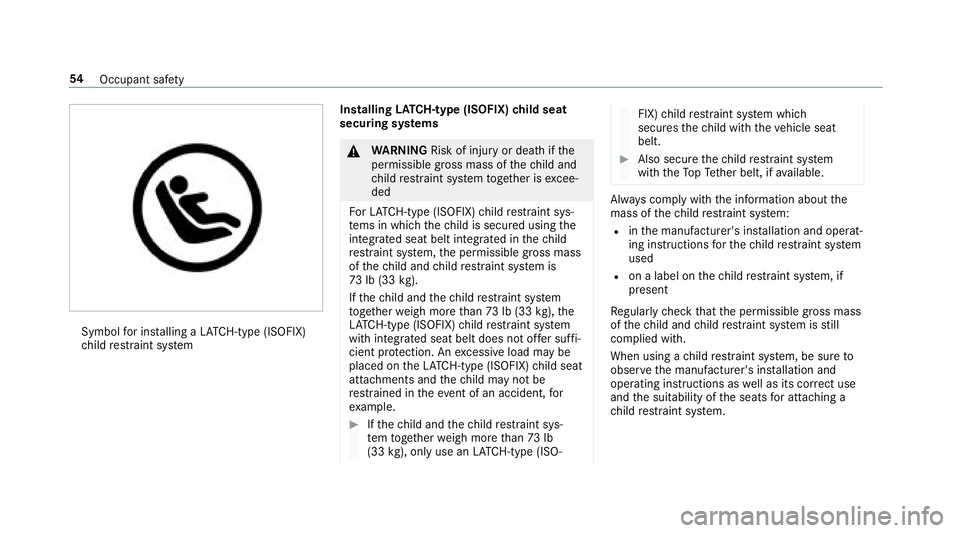
Symbolfor ins talling a LATC H-type (ISOFIX)
ch ild restra int sy stem Installing
LATC H-type (ISOFIX) child seat
securing sy stems
&
WARNING Risk of injury or death ifthe
permissible gross mass of thech ild and
ch ild restra int sy stem toget her is excee‐
ded
Fo rLA TC H-type (ISOFIX) child restra int sys‐
te ms in which thech ild is secured using the
integrated seat belt integrated in thech ild
re stra int sy stem, the permissible gross mass
of thech ild and child restra int sy stem is
73 lb (33 kg).
If th ech ild and thech ild restra int sy stem
to ge ther we igh more than 73 lb (33 kg),th e
LA TC H-type (ISOFIX) child restra int sy stem
with integrated seat belt does not of fer suf fi‐
cient pr otection. An excessive load may be
placed on theLA TC H-type (ISOFIX) child seat
attachments and thech ild may not be
re stra ined in theeve nt of an accident, for
ex ample.
#Ifth ech ild and thech ild restra int sys‐
te m toget her weigh more than 73 lb
(33 kg),only use an LATC H-type (ISO‐
FIX) child restra int sy stem which
secures thech ild with theve hicle seat
belt.
#Also secure thech ild restra int sy stem
with theTo pTe ther belt, if available.
Alw ays comply with the information about the
mass of thech ild restra int sy stem:
Rin the manufacturer's ins tallation and operat‐
ing instructions forth ech ild restra int sy stem
used
Ron a label on thech ild restra int sy stem, if
present
Re gular lych eck that the permissible gross mass
of thech ild and child restra int sy stem is still
complied with.
When using a child restra int sy stem, be sure to
obser vethe manufacturer's ins tallation and
operating instructions as well as its cor rect use
and the suitability of the seats for attaching a
ch ild restra int sy stem.
54
Occupant saf ety
Page 57 of 502
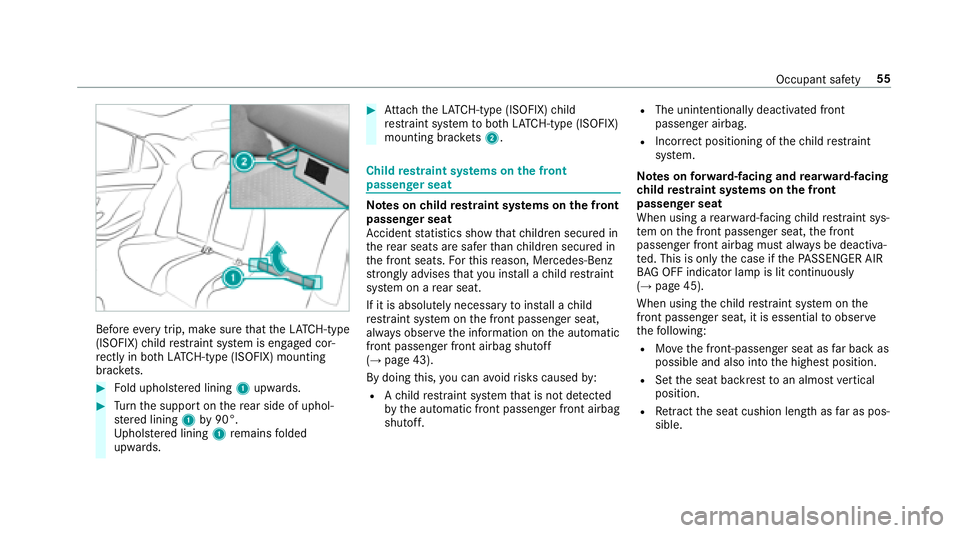
Beforeevery trip, make sure that theLA TC H-type
(ISOFIX) child restra int sy stem is engaged cor‐
re ctly in bo thLATC H-type (ISOFIX) mounting
brac kets.
#Fo ld uphols tere d lining 1upwards.
#Turn the support on there ar side of uphol‐
st ered lining 1by90°.
Up hols tere d lining 1remains folded
upwards.
#At tach theLA TC H-type (ISOFIX) child
re stra int sy stem toboth LATC H-type (ISOFIX)
mounting brac kets 2.
Child restra int sy stems on the front
passenger seat
Note s onchild restra int sy stems on the front
passenger seat
Ac cident statistics show that children secured in
th ere ar seats are safer than children secured in
th e front seats. Forth is reason, Mercedes-Benz
stro ngly advises that you ins tall a child restra int
sy stem on a rear seat.
If it is absolutely necessary toins tall a child
re stra int sy stem on the front passenger seat,
alw ays obser vethe information on the automatic
front passenger front airbag shutoff
(
→page 43).
By doing this, you can avoidrisks caused by:
RAch ild restra int sy stem that is not de tected
by the automatic front passenger front airbag
shutoff.
RThe unintentionally deactivated front
passenger airbag.
RIncor rect positioning of thech ild restra int
sy stem.
Note s onforw ard-facing and rear wa rd-facing
ch ild restra int sy stems on the front
passenger seat
When using a rear wa rd-facing child restra int sys‐
te m on the front passenger seat, the front
passenger front airbag must alw ays be deactiva‐
te d. This is only the case if thePA SSENGER AIR
BA G OFF indicator lamp is lit continuously
(
→page 45).
When using thech ild restra int sy stem on the
front passenger seat, it is essential toobser ve
th efo llo wing:
RMo
vethe front-passen ger seat as far back as
possible and also into the highest position.
RSet the seat backrest toan almost vertical
position.
RRe tract the seat cushion length as far as pos‐
sible.
Occupant saf ety 55
Page 58 of 502
RThe entire base ofthech ild restra int sy stem
must alw aysre st on the seat cushion of the
front-passenger seat.
RThe backrest of thefo rw ard-facing child
re stra int sy stem must, as far as possible, be
re sting on the seat backrest of the front
passenger seat. The child restra int sy stem
must not touch thero of or be put under
st ra in by the head restra ints.
RIf necessar y,adjust the angle of the seat
backrest and the head restra int position
according ly.
RAd just the seat cushion inclination so that
th e front edge of the seat cushion is in the
highest position and there ar edge of the
seat cushion is in the lo west position.
RAlways make sure that the shoulder belt
st ra p is cor rectly routed from the seat belt
outlet of theve hicle tothe shoulder belt
guide on thech ild restra int sy stem. The
shoulder belt stra p must be routed forw ards
and down wards from the seat belt outlet.
RIf necessar y,adjust the seat belt outlet and
th e front passenger seat accordingly.
RNe ver place objects under or behind the
ch ild restra int sy stem, e.g. cushions.
Alw ays comply with the manufacturer's ins talla‐
tion and operating instructions forth ech ild
re stra int sy stem used.
Note s on pets in theve hicle
&
WARNING Risk of accident and injury
due toanimals left unsecured or unat‐
te nded in theve hicle
If yo u lea veanimals in theve hicle unatten‐
ded or unsecured, they could possibly press
down buttons or switches.
There byan animal may:
Ractivate vehicle equipment and become
trapped, forex ample
Rswitch systems on or off and endanger
ot her road users
Uns ecured animals may be throw n around in
th eve hicle in theeve nt of an accident or
sudden steering and braking maneuver and
injure vehicle occupants in the process.
#Ne ver lea veanimals in theve hicle unat‐
te nded.
#Alw ays cor rectly secure animals while
driving, forex ample using a suitable
animal car rier.
56
Occupant saf ety
Page 68 of 502
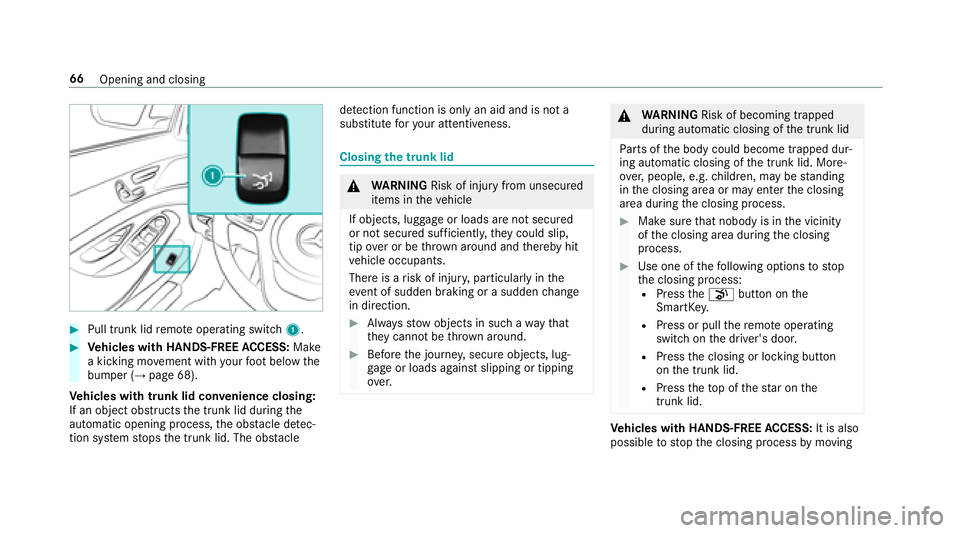
#Pull trunk lidremo teoperating switch 1.
#Vehicles with HANDS-FREE ACCESS: Make
a kicking mo vement with your foot below the
bumper (
→page 68).
Ve hicles with trunk lid co nvenience closing:
If an object obstructs the trunk lid during the
automatic opening process, the obs tacle de tec‐
tion sy stem stops the trunk lid. The obs tacle de
tection function is only an aid and is not a
substitute foryo ur attentiveness.
Closing the trunk lid
&
WARNING Risk of injury from unsecured
items in theve hicle
If objects, luggage or loads are not secured
or not secured suf ficientl y,they could slip,
tip ove r or be throw n around and thereby hit
ve hicle occupants.
There is a risk of injur y,particularly in the
ev ent of sudden braking or a sudden change
in direction.
#Alw aysstow objects in such a wayth at
th ey cannot be thro wn around.
#Before the journe y,secure objects, lug‐
ga ge or loads against slipping or tipping
ove r.
&
WARNING Risk of becoming trapped
duri ng au tomatic closing of the trunk lid
Pa rts of the body could become trapped dur‐
ing automatic closing of the trunk lid. More‐
ove r,people, e.g. children, may be standing
in the closing area or may enter the closing
area during the closing process.
#Make sure that nobody is in the vicinity
of the closing area during the closing
process.
#Use one of thefo llowing options tostop
th e closing process:
RPress thep button on the
SmartK ey.
RPress or pull there mo teoperating
switch on the driver's door.
RPress the closing or locking button
on the trunk lid.
RPress theto p of thest ar on the
trunk lid.
Ve hicles with HANDS-FREE ACCESS: It is also
possible tostop the closing process bymoving
66
Opening and closing
Page 71 of 502
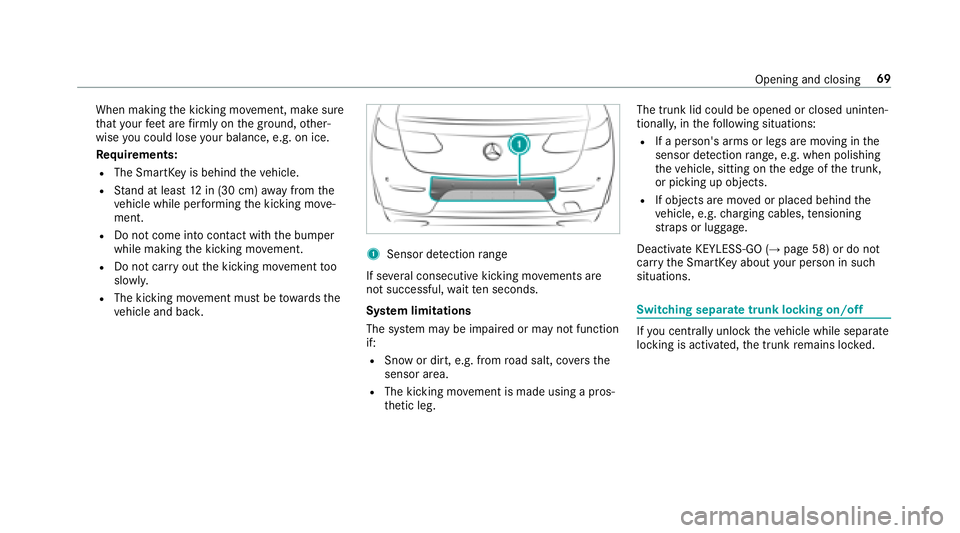
When makingthe kicking mo vement, make sure
th at your feet are firm ly on the ground, other‐
wise you could lose your balance, e.g. on ice.
Re quirements:
RThe SmartK eyis behind theve hicle.
RStand at least 12in (30 cm) away from the
ve hicle while per form ing the kicking mo ve‐
ment.
RDo not come into contact with the bumper
while making the kicking mo vement.
RDo not car ryout the kicking mo vement too
slowl y.
RThe kicking mo vement must be towa rdsth e
ve hicle and bac k.
1Sensor detection range
If se veral consecutive kicking mo vements are
not successful, waitte n seconds.
Sy stem limitations
The sy stem may be impaired or may not function
if:
RSnow or dirt, e.g. from road salt, co vers the
sensor area.
RThe kicking mo vement is made using a pros‐
th etic leg. The trunk lid could be opened or closed unin
ten‐
tional ly, in thefo llowing situations:
RIf a person's arms or legs are moving in the
sensor de tection range, e.g. when polishing
th eve hicle, sitting on the edge of the trunk,
or picking up objects.
RIf objects are mo ved or placed behind the
ve hicle, e.g. charging cables, tensioning
st ra ps or luggage.
Deactivate KEYLESS-GO (
→page 58) or do not
car rythe SmartK eyabout your person in such
situations.
Switch ing separate trunk locking on/off
Ifyo u centrally unlo cktheve hicle while separate
locking is activated, the trunk remains loc ked.
Opening and closing 69
Page 100 of 502
#Tocall up: press and hold there leva nt pre‐
set position button 1,2 or 3 until the front
seat, thesteering wheel, head-up display and
outside mir ror are in thestored position.
% Ifyo ure lease the preset position button, the
seat, steering wheel and mir ror setting func‐
tions stop immediatel y.
Ve hicles with an Active Multicon tour
Seat Package: The setting of the active mul‐
ticon tour seat or the 4-w aylumbar support
is still car ried out.
Ve hicles without theAc tive Multicon tour
Seat Package: Adjustment of the 4-w ay
lumbar support is still car ried out.
St ow age areas
Note s on loading theve hicle
&
WARNING Risk ofexhaust gas poisoning
Combustion engines emit poisonous exhaust
ga ses such as carbon monoxide. Exhaust
ga ses can enter theve hicle interior if the
trunk lid is open when the engine is running,
especially if theve hicle is in motion.
#Alw ays switch off the engine before
opening the trunk lid.
#Ne ver drive with the trunk lid open.
&
WARNING Risk of injury from unsecured
items in theve hicle
If objects, luggage or loads are not secured
or not secured suf ficientl y,they could slip,
tip ove r or be throw n around and thereby hit
ve hicle occupants.
There is a risk of injur y,particularly in the
ev ent of sudden braking or a sudden change
in direction.
#Alw aysstow objects in such a wayth at
th ey cannot be thro wn around.
#Before the journe y,secure objects, lug‐
ga ge or loads against slipping or tipping
ove r.
&
WARNING Risk of injury from incorrectly
stowe d objects
If objects in theve hicle interior are stowed
incor rectly, they can slide or be throw n
around and hit vehicle occupants. In addi‐
tion, cup holders, open stowage spaces and
mobile phone brac kets cann otalw aysre tain
all objects they contain.
There is arisk of injur y,particularly in the
ev ent of sudden braking or a sudden change
in direction.
#Alw aysstow objects so that they can‐
not be throw n around in such situa‐
tions.
#Alw ays make sure that objects do not
pr otru de from stowage spaces, luggage
nets or stowage nets.
#Close the loc kable stow age spaces
before starting a journe y.
#Alwaysstow and secure heavy, hard,
pointe d, sharp-edged, fragile or bulky
objects in the trunk.
98
Seats and stowing
Page 101 of 502
Observethe no tes on the cup holders.
&
WARNING Risk of burn s fromtailpipes
and tailpipe trim
The tailpipe and tailpipe trim can become
ve ry hot. If you come into contact withth ese
parts of theve hicle, you could burn yourself.
#Alw ays be particular lycareful around
th eta ilpipe and theta ilpipe trim.
#Allow theve hicle parts tocool down
before youto uch them.
The driving characteristics of your vehicle are
dependent on the distribution of the load within
th eve hicle. You should bear thefo llowing in
mind when loading theve hicle:
RNe verex ceed the permissible gross mass or
th e gross axle weight rating forth eve hicle
(including occupants). The values are speci‐
fi ed on theve hicle identification plate on the
ve hicle's B-pillar.
RThe load must not pr otru de abo vethe upper
edge of the seat backrests.
RAlw ays place the load behind unoccupied
seats if possible.
RSecure the load using the parcel net hooks.
Distribute the load on the parcel net hooks
eve nly.
St ow age spaces in theve hicle interior
Overview of the front stowage compa rt‐
ments
& WARNING Risk of injury from incorrectly
stowe d objects
If objects in theve hicle interior are stowed
incor rectl y,they can slide or be thro wn
around and hit vehicle occupants. In addi‐
tion, cup holders, open stowage spaces and
mobile phone brac kets cann otalw aysre tain
all objects they contain.
There is arisk of injur y,particularly in the
eve nt of sudden braking or a sudden change
in direction.
#Alw aysstow objects so that they can‐
not be throw n around in such situa‐
tions.
#Alw ays make sure that objects do not
pr otru de from stowage spaces, luggage
nets or stowage nets.
#Close the loc kable stow age spaces
before starting a journe y.
#Alwaysstow and secure heavy, hard,
pointe d, sharp-edged, fragile or bulky
objects in the trunk.
Obser vethe no tes on loading theve hicle.
Seats and stowing 99