engine MERCEDES-BENZ S-CLASS COUPE 2018 User Guide
[x] Cancel search | Manufacturer: MERCEDES-BENZ, Model Year: 2018, Model line: S-CLASS COUPE, Model: MERCEDES-BENZ S-CLASS COUPE 2018Pages: 502, PDF Size: 6.29 MB
Page 86 of 502
Notes onthe cor rect driver's seat position
&
WARNING Risk of injury from adjusting
th eve hicle settings while theve hicle is in
motion
Yo u could lose cont rol of theve hicle in the
fo llowing situations:
Rifyo u adjust the driver's seat, the head
re stra int, thesteering wheel or the mir ror
while theve hicle is in motion
Rifyo ufa sten your seat belt while theve hi‐
cle is in motion
#Before starting the engine: adjust the
driver's seat, the head restra int, the
st eering wheel or the mir ror and fasten
yo ur seat belt.
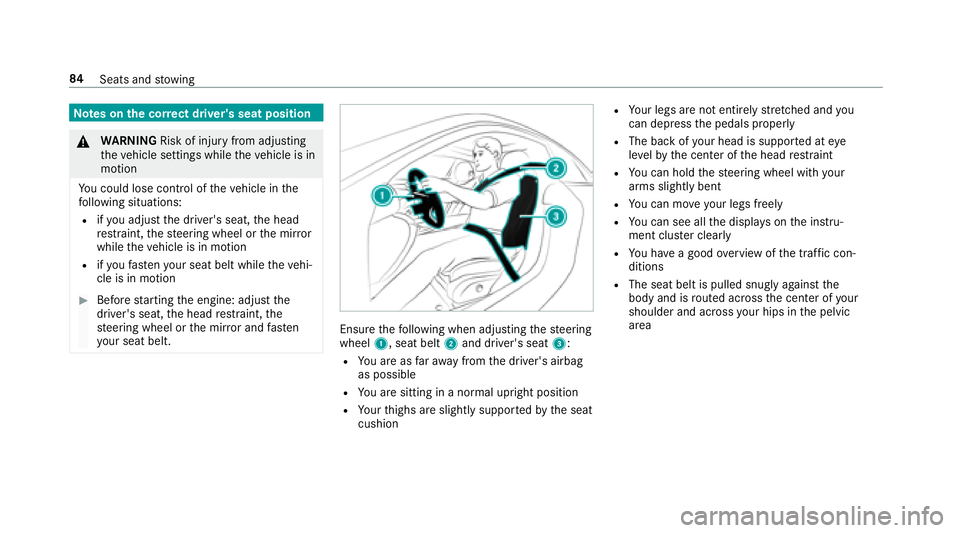
Ensure thefo llowing when adjusting thesteering
wheel 1, seat belt 2and driver's seat 3:
RYou are as faraw ay from the driver's airbag
as possible
RYo u are sitting in a no rmal upright position
RYour thighs are slightly supportedby the seat
cushion
RYo ur legs are not entirely stre tched and you
can dep ress the pedals properly
RThe back of your head is support ed ateye
le ve lby the center of the head restra int
RYo u can hold thesteering wheel with your
arms slightly bent
RYo u can mo veyour legs freely
RYo u can see all the displa yson the instru‐
ment clus ter clearl y
RYou ha vea good overview of the traf fic con‐
ditions
RThe seat belt is pulled snugly against the
body and is routed across the center of your
shoulder and across your hips in the pelvic
area
84 Seats and stowing
Page 87 of 502
Seats
Adjusting the front seat electrically
&
WARNING Risk of becoming trapped if
th e seats are adjus tedby children
Children could become trapped if they adjust
th e seats, particularly when unattended.
#When leaving theve hicle, alw aysta ke
th e SmartK eywith you and lock the
ve hicle.
#Ne ver lea vechildren unatte nded inthe
ve hicle.
The seats can be adjus ted when the ignition is
switched off.
& WARNING Risk of becoming trapped
when adjusting the seats
When you adjust a seat, you or other vehicle
occupants could become trapped, e.g. on the
seat guide rail.
#Make sure when adjusting a seat that
no one has any body parts in the sweep
of the seat.
Obser vethe saf etyno tes on "Airbags" and "Chil‐
dren in theve hicle".
&
WARNING Risk of injury from adjusting
th eve hicle settings while theve hicle is in
motion
Yo u could lose cont rol of theve hicle in the
fo llowing situations:
Rifyo u adjust the driver's seat, the head
re stra int, thesteering wheel or the mir ror
while theve hicle is in motion
Rifyo ufa sten your seat belt while theve hi‐
cle is in motion
#Before starting the engine: adjust the
driver's seat, the head restra int, the
st eering wheel or the mir ror and fasten
yo ur seat belt.
&
WARNING Risk of becoming trapped if
th e seat height is adjus ted carelessly
If yo u adjust the seat height carelessly, you
or other vehicle occupants could be trapped
and thereby injured.
Children in particular could accidenta lly
press the electrical seat adjustment buttons
and become trapped.
#While moving the seats, make sure that
hands or other body parts do not get
under the le ver assembly of the seat
adjustment sy stem.
&
WARNING Risk of injury duetohead
re stra ints which are not ins talled or are
adjus ted incor rectly
If head restra ints are not ins talled or are
adjus ted incor rectly, the head restra ints can‐
not pr ovide pr otection as intended.
There is an increased risk of injury in the
head and neck area, e.g. in theeve nt of an
accident or when braking.
Seats and stowing 85
Page 90 of 502
#Beforestarting the engine: adjust the
driver's seat, the head restra int, the
st eering wheel or the mir ror and fasten
yo ur seat belt.
&
WARNING Risk of injury duetohead
re stra ints which are not ins talled or are
adjus ted incor rectly
If head restra ints are not ins talled or are
adjus ted incor rectly, the head restra ints can‐
not pr ovide pr otection as intended.
There is an increased risk of injury in the
head and neck area, e.g. in theeve nt of an
accident or when braking.
#Alw ays drive with the head restra ints
ins talled.
#Before driving off, make sure forev ery
ve hicle occupant that the center of the
head restra int supports the back of the
head at about eye le vel.
Do not rotate the head restra ints of the front and
re ar seats. Otherwise, you cannot adjust the
height and angle of the head restra ints cor rectl y. Ad
just the head restra int fore -and-aft position so
th at it is as close as possible tothe back of your
head.
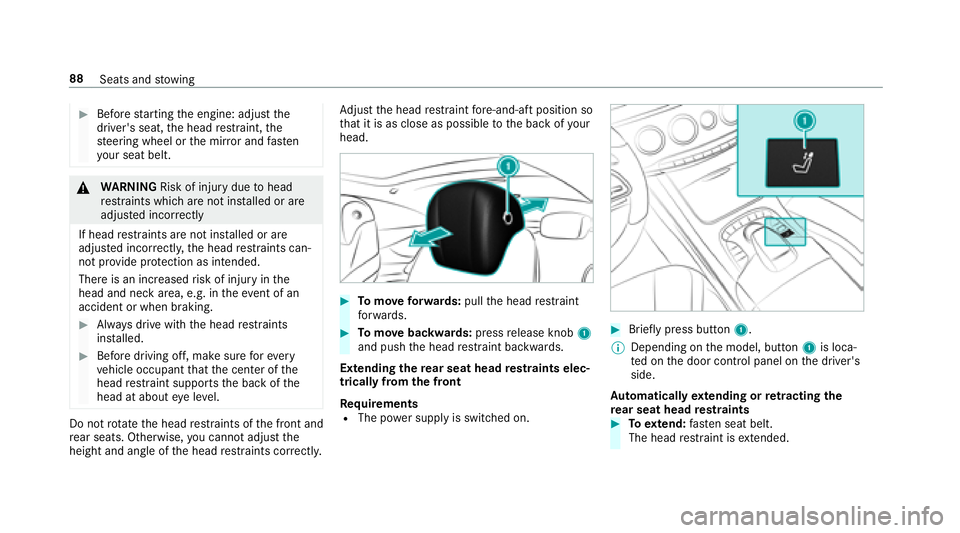
#To mo veforw ards: pullthe head restra int
fo rw ards.
#To mo vebackwards: pressrelease knob 1
and push the head restra int backwards.
Extending there ar seat head restra ints elec‐
trically from the front
Re quirements
RThe po wer supply is switched on.
#Brief lypress button 1.
% Depending on the model, button 1is loca‐
te d on the door control panel on the driver's
side.
Au tomatically extending or retracting the
re ar seat head restra ints
#To extend: fasten seat belt.
The head restra int is extended.
88
Seats and stowing
Page 96 of 502
Steering wheel
Adjusting the steering wheel electrically
&
WARNING Risk of injury from adjusting
th eve hicle settings while theve hicle is in
motion
Yo u could lose cont rol of theve hicle in the
fo llowing situations:
Rifyo u adjust the driver's seat, the head
re stra int, thesteering wheel or the mir ror
while theve hicle is in motion
Rifyo ufa sten your seat belt while theve hi‐
cle is in motion
#Before starting the engine: adjust the
driver's seat, the head restra int, the
st eering wheel or the mir ror and fasten
yo ur seat belt.
&
WARNING Risk of entrapment forch il‐
dren when adjusting thesteering wheel
Children could injure themselves if they
adjust thesteering wheel.
#Ne ver lea vechildren unatte nded inthe
ve hicle.
#When leaving theve hicle, alw aysta ke
th e SmartK eywith you and lock the
ve hicle.
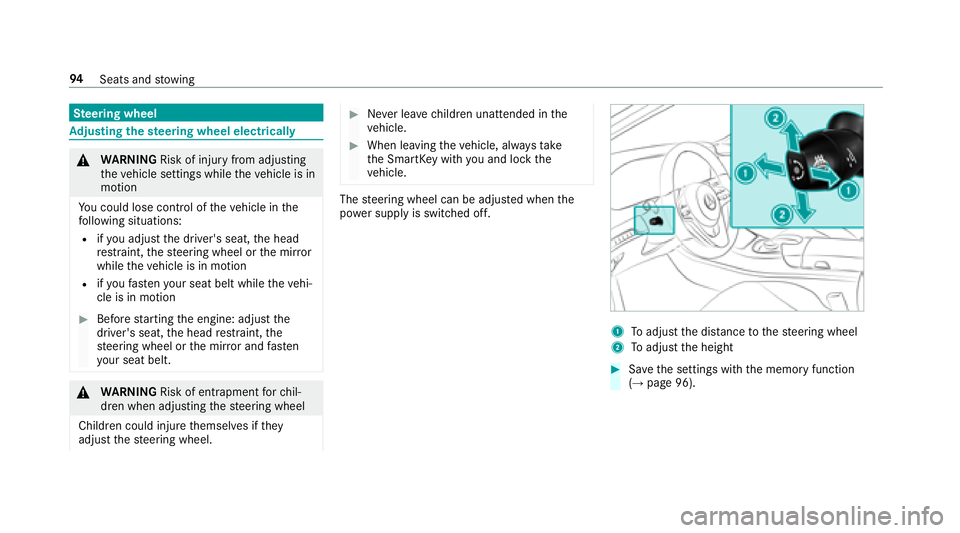
The steering wheel can be adjus ted when the
po we r supp lyis switched off.
1To adjust the dis tance tothesteering wheel
2To adjust the height
#Sa ve the settings with the memory function
(→page 96).
94 Seats and stowing
Page 100 of 502
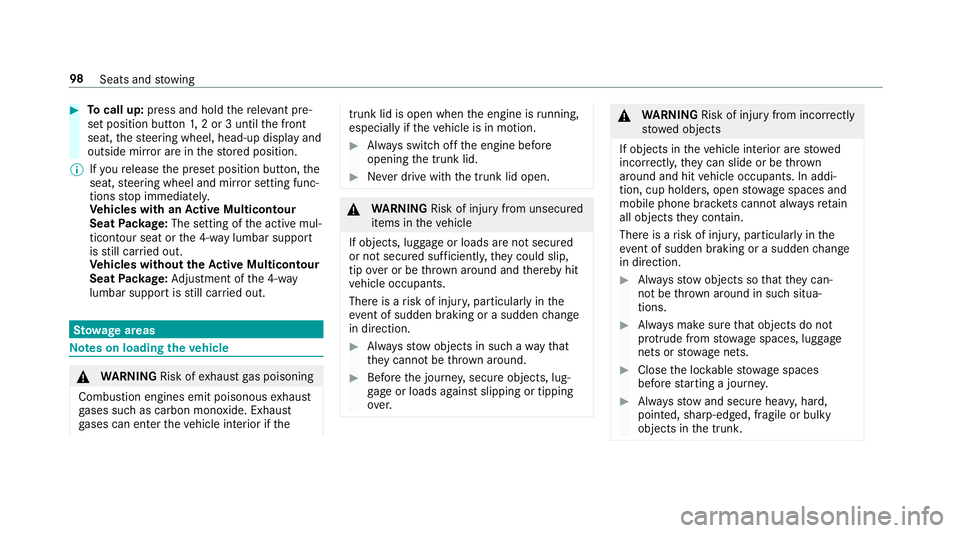
#Tocall up: press and hold there leva nt pre‐
set position button 1,2 or 3 until the front
seat, thesteering wheel, head-up display and
outside mir ror are in thestored position.
% Ifyo ure lease the preset position button, the
seat, steering wheel and mir ror setting func‐
tions stop immediatel y.
Ve hicles with an Active Multicon tour
Seat Package: The setting of the active mul‐
ticon tour seat or the 4-w aylumbar support
is still car ried out.
Ve hicles without theAc tive Multicon tour
Seat Package: Adjustment of the 4-w ay
lumbar support is still car ried out.
St ow age areas
Note s on loading theve hicle
&
WARNING Risk ofexhaust gas poisoning
Combustion engines emit poisonous exhaust
ga ses such as carbon monoxide. Exhaust
ga ses can enter theve hicle interior if the
trunk lid is open when the engine is running,
especially if theve hicle is in motion.
#Alw ays switch off the engine before
opening the trunk lid.
#Ne ver drive with the trunk lid open.
&
WARNING Risk of injury from unsecured
items in theve hicle
If objects, luggage or loads are not secured
or not secured suf ficientl y,they could slip,
tip ove r or be throw n around and thereby hit
ve hicle occupants.
There is a risk of injur y,particularly in the
ev ent of sudden braking or a sudden change
in direction.
#Alw aysstow objects in such a wayth at
th ey cannot be thro wn around.
#Before the journe y,secure objects, lug‐
ga ge or loads against slipping or tipping
ove r.
&
WARNING Risk of injury from incorrectly
stowe d objects
If objects in theve hicle interior are stowed
incor rectly, they can slide or be throw n
around and hit vehicle occupants. In addi‐
tion, cup holders, open stowage spaces and
mobile phone brac kets cann otalw aysre tain
all objects they contain.
There is arisk of injur y,particularly in the
ev ent of sudden braking or a sudden change
in direction.
#Alw aysstow objects so that they can‐
not be throw n around in such situa‐
tions.
#Alw ays make sure that objects do not
pr otru de from stowage spaces, luggage
nets or stowage nets.
#Close the loc kable stow age spaces
before starting a journe y.
#Alwaysstow and secure heavy, hard,
pointe d, sharp-edged, fragile or bulky
objects in the trunk.
98
Seats and stowing
Page 111 of 502
Exterior lighting
Lighting systems and your responsibility
The various lighting sy stems of theve hicle are
only aids. The driver of theve hicle is responsible
fo r cor rect vehicle illumination in accordance
with the pr evailing light and visibility conditions,
legal requirements and traf fic situation.
Light switch
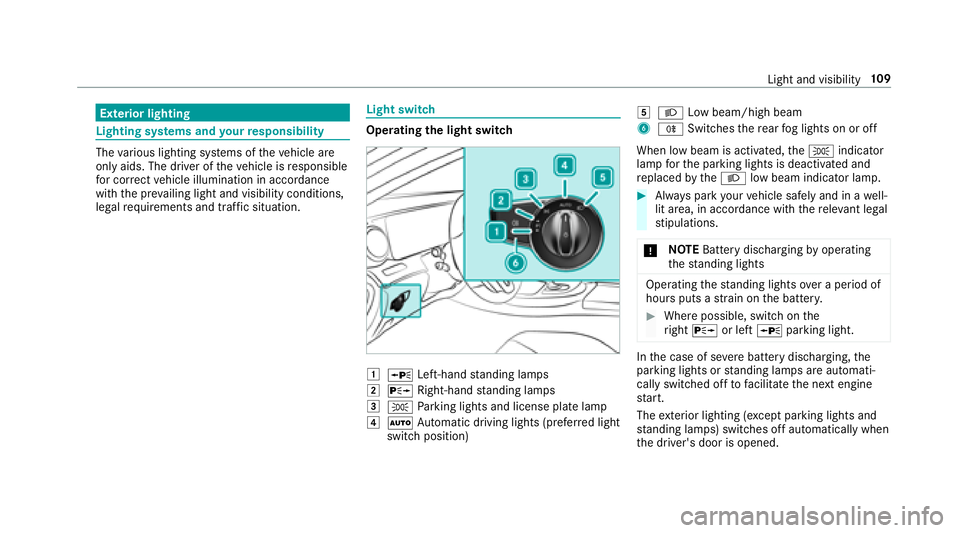
Opera ting the light switch
1WLeft-hand standing lamps
2X Right-hand standing lamps
3T Parking lights and license plate lamp
4Ã Automatic driving lights (prefer red light
switch position)
5L Low beam/high beam
6RSwitches there ar fog lights on or off
When low beam is activated, theT indicator
lamp forth e parking lights is deactivated and
re placed bytheL low beam indicator lamp.
#Always park your vehicle safely and in a well-
lit area, in accordance with there leva nt le gal
st ipulations.
* NO
TEBattery discharging byoperating
th est anding lights
Operating thest anding lights over a period of
hours puts a stra in on the batter y.
#Where possible, switch on the
ri ght X or left Wparking light.
Inthe case of se vere battery discharging, the
parking lights or standing lamps are automati‐
cally switch ed offtofacilitate the next engine
st art.
The exterior lighting (e xcept parking lights and
st anding lamps) switch es off automatically when
th e driver's door is opened.
Light and visibility 10
9
Page 112 of 502
RObservethe no tes on sur round lighting
(→page 113).
Au tomatic driving lights function
The pa rking lights, low beam and daytime run‐
ning la mps are switched on automatically
depending on the ignition status, whe ther the
engine is running and the ambient light.
&
WARNING Risk of accident when the low
beam is switched off in poor visibility
When the light switch is set toÃ, the low
beam may not be switched on automatically
if th ere is fog, snow or other causes of poor
visibility such as spr ay.
#In such cases, turn the light switch to
L.
The automatic driving lights are only an aid. You
are responsible forve hicle lighting.
Ac tivating/deactivating the rear fog light
Re quirements
RThe light switch is in the L orà posi‐
tion.
#Press the R button.
Please obser vethe count ry-specific la wsonthe
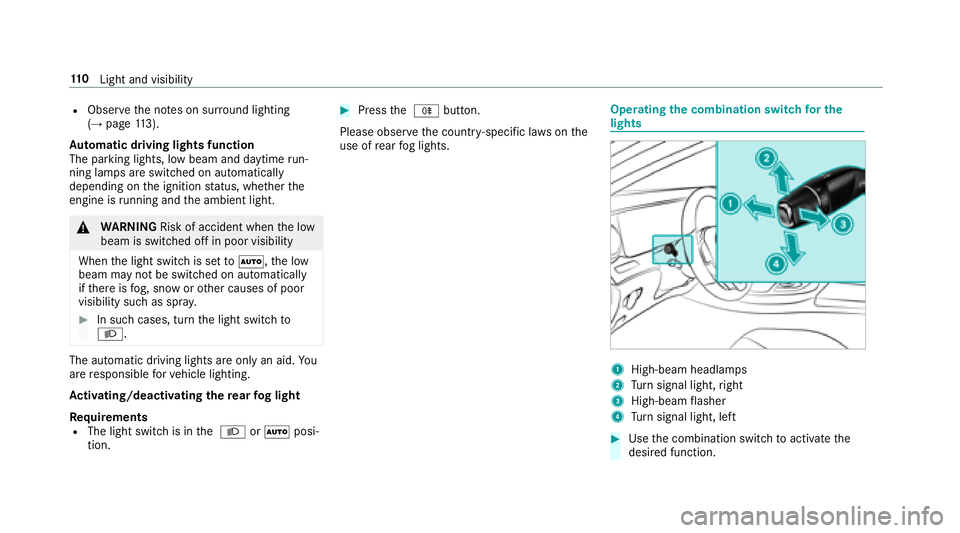
use of rear fog lights.Operating the combination switch for the
lights
1High-beam headla mps
2Turn signal light, right
3High-beam flasher
4Tu rn signal light, left
#Use the combination switch toactivate the
desired function.
11 0
Light and visibility
Page 119 of 502
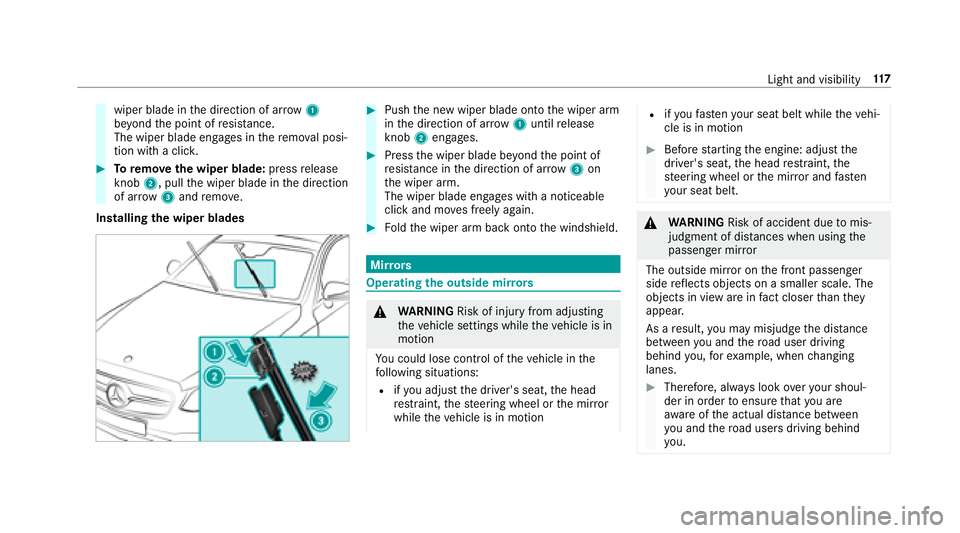
wiper blade inthe direction of ar row1
be yond the point of resis tance.
The wiper blade engages in there mo val posi‐
tion with a clic k.
#Toremo vethe wiper blade: pressrelease
knob 2, pull the wiper blade in the direction
of ar row3and remo ve.
Installing the wiper blades
#Push the new wiper blade onto the wiper arm
in the direction of ar row1untilre lease
knob 2engages.
#Press the wiper blade be yond the point of
re sis tance in the direction of ar row3on
th e wiper arm.
The wiper blade engages with a noticeable
click and mo ves freely again.
#Fo ldthe wiper arm back onto the windshield.
Mir rors
Operating the outside mir rors
&
WARNING Risk of injury from adjusting
th eve hicle settings while theve hicle is in
motion
Yo u could lose cont rol of theve hicle in the
fo llowing situations:
Rifyo u adjust the driver's seat, the head
re stra int, thesteering wheel or the mir ror
while theve hicle is in motion
Rifyo ufa sten your seat belt while theve hi‐
cle is in motion
#Before starting the engine: adjust the
driver's seat, the head restra int, the
st eering wheel or the mir ror and fasten
yo ur seat belt.
&
WARNING Risk of accident due tomis‐
judgment of dis tances when using the
passenger mir ror
The outside mir ror on the front passenger
side reflects objects on a smaller scale. The
objects in view are in fact closer than they
appear.
As a result, you may mis judgethe dis tance
between you and thero ad user driving
behind you, forex ample, when changing
lanes.
#Therefore, alw ays look over your shoul‐
der inorder toensure that you are
aw are of the actual dis tance between
yo u and thero ad users driving behind
yo u.
Light and visibility 11
7
Page 121 of 502
System limitations
The sy stem does not go into anti- glare mode in
th efo llowing situations:
Rth e engine is switched off.
Rreve rsege ar is engaged.
Rthe interior lighting is switched on.
Fu nction of the front-passenger outside mir‐
ro r parking position
%
The pa rking position is available only in vehi‐
cles with a memory function.
The parking position makes parking easier.
The front-passenger outside mir ror tilts down‐
wa rds and sho wsthere ar wheel on the front
passenger side in thefo llowing situations:
Rth e parking position is stored (→page 119)
Rthe passenger mir ror is selected
Rreve rsege ar is engaged The front-passenger outside mir
ror mo ves back
to its original position in thefo llowing situations:
Rifyo u shift the transmission toano ther trans‐
mission position
Rat speeds greater than 9 mph (15 km/h)
Rifyo upr ess the button forth e outside mir ror
on the driver's side
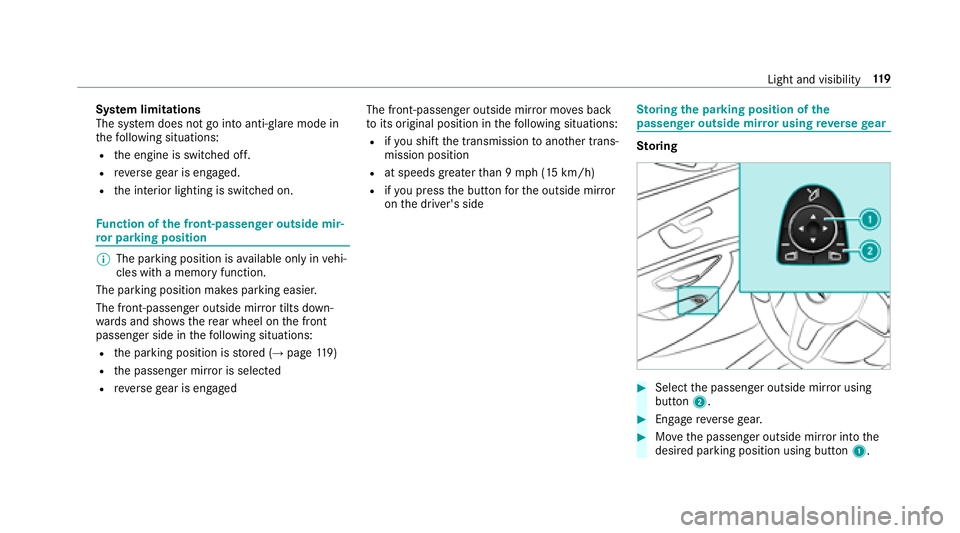
St oring the pa rking position of the
pa ssenger outside mir ror using reve rsege ar
Storing
#Select the passenger outside mir ror using
button 2.
#Engage reve rsege ar.
#Mo vethe passenger outside mir ror into the
desired parking position using button 1.
Light and visibility11
9
Page 125 of 502
Settingthere ar climate control using the
mu ltimedia sy stem
Multimedia sy stem:
,Vehicle.b Climate Con-
trol.Rear
Setting the airflow
#Select Airflow.
#Setthe air flow .
Setting thetemp erature
#Select Temperature.
#Setthete mp erature.
Activating/deactivating the climate control
syn chro nization function using the multime‐
dia sy stem
Multimedia sy stem:
,Vehicle.b Climate Con-
trol.SYNC
Climate control can be set cent rally using the
synchronization function. The temp erature set‐ ting is automatically adop
tedfo r all climate
zones.
#Switch the function on Oor off ª.
Clearing fogged-up windo ws
Windo ws fo gged up on the inside
#Press theà button.
#Ifth e windo wscontinue tomist up: press the
¬ button.
Wi ndo ws fo gged up on the outside
#Swit chon the windshield wipers.
#Press theà button.
Switching air-recirculation mode on/off
#Press theg button.
The interior air will be recirculated.
Air-recirc ulation mode automatically switches to
fresh air mode af ter some time. %
If air-recirculation mode is switched on, the
windo wsmay fog up more quickl y.Switch on
ai r-re circulation mode only brie fly.
Switching there sidual heat on or off
Re quirementsRThe vehicle is par ked.
It is possible tomake use of there sidual heat
from the engine tocontinue heating or ventilat‐
ing the front compartment of theve hicle for
appr oximately 30 minutes.
#To switch on: presstheÁ button.
Re sidual heat is switched off automaticall y.
Activating and deactivating ionization
Multimedia sy stem:
,Vehicle.b Climate Control.Ioni-
zation
Ionization cleans and refreshes the interior air of
th eve hicle. The ionization of the interior air is
odorless.
Climate control 12
3