engine MERCEDES-BENZ S-CLASS COUPE 2018 Workshop Manual
[x] Cancel search | Manufacturer: MERCEDES-BENZ, Model Year: 2018, Model line: S-CLASS COUPE, Model: MERCEDES-BENZ S-CLASS COUPE 2018Pages: 502, PDF Size: 6.29 MB
Page 326 of 502
Non-operational times with the batte rydis‐
connected
The AS SYST PLUS service inter val display
can only calculate the service due da tewhen
th e batte ryis connected.
#Notedown the service due date displa yed on
th e instrument display before disconnecting
th e battery (
→page 323).
Engine compartment
Ac tive hood (pedestrian pr otection)
Operation of the active hood (pedestrian pro‐
te ction)
In cer tain accident situations, therisk of injury
to pedestrians can be reduced bythe actuation
of the active hood. The rear area of the hood is
ra ised byappr oximately 80 mm.
Fo rth e drive tothewo rkshop, reset the trig‐
ge red active hood yourself. Af terth e active hood
has been triggered, pedestrian pr otection may
be limited. A
qu alified specialist workshop must re-ins tate
th e full functionality of the active hood.
The active hood is not available in all countries.
Re setting the active hood
&
WARNING Risk of burn s from hot com‐
ponent parts in the engine compartment
Cer tain component parts in the engine com‐
partment can be very hot, e.g. the engine,
th e cooler and parts of theex haust sy stem.
#Let the engine cool down and only
to uch the component parts described
as follo ws .
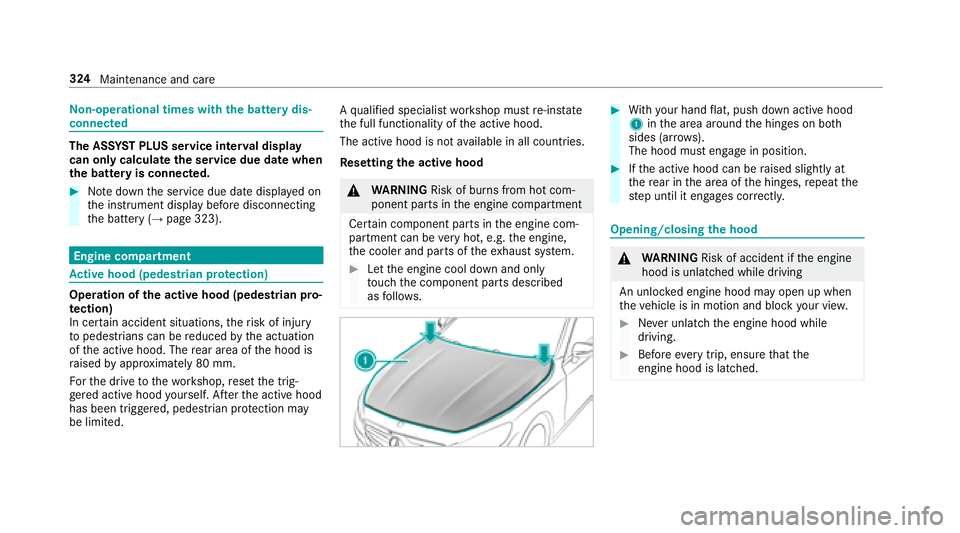
#With your hand flat, push down active hood
1 inthe area around the hinges on bo th
sides (ar rows).
The hood must engage in position.
#If th e active hood can be raised slightly at
th ere ar in the area of the hinges, repeat the
st ep until it engages cor rectl y.
Opening/closing the hood
&
WARNING Risk of accident if the engine
hood is unlatched while driving
An unloc ked engine hood may open up when
th eve hicle is in motion and block your vie w.
#Never unlatch the engine hood while
driving.
#Before every trip, ensure that the
engine hood is latched.
324 Maintenance and care
Page 327 of 502
&WARNING Risk of accident and injury
when opening and closing the engine
hood
When opening or closing the engine hood, it
may suddenly drop into the end position.
There is a risk of injury for an yone in the
engine hood's range of mo vement.
#Only open or close the engine hood
when there are no persons in the
engine hood's range of mo vement.
&
WARNING Danger of burn s when open‐
ing the hood
If yo u open the hood when the engine has
ove rheated or during a fire inthe engine
compartment, you could come into contact
wit h hot gases or other escaping operating
fl uids.
#Before opening the hood, allow the
engine tocool down.
#Intheeve nt of a fire inthe engine com‐
partment, keep the hood closed and
call thefire service.
&
WARNING Risk of injury duetomoving
parts
Cer tain components in the engine compart‐
ment may continue tomo veor suddenly
mo veagain even af terth e ignition has been
switched off, e.g. the cooler fan.
Make sure of thefo llowing before per form ing
ta sks in the engine compartmen t:
#Switchthe ignition off.
#Ne verto uch the danger zone sur round‐
ing moving co mponent parts, e.g. the
ro tation area of thefa n.
#Re mo vejewe lry and watches.
#Keep items of clo thing and hair away
from moving parts.
& WARNING Risk of injury fromtouching
co mp onent parts under voltage
The ignition sy stem and the fuel injection
sy stem workunder high voltage. If youto uch
co mp onent parts which are under voltage,
yo u could receive an electric shoc k.
#Neverto uch co mponent parts of the
ignition sy stem or the fuel injection sys‐
te m when the ignition is switched on.
&
WARNING Risk of burn s from hot com‐
ponent parts in the engine compartment
Cer tain component parts in the engine com‐
partment can be very hot, e.g. the engine,
th e cooler and parts of theex haust sy stem.
#Let the engine cool down and only
to uch the component parts described
as follo ws .
Maintenance and care 325
Page 328 of 502
&WARNING Risk of injury from usingthe
windshield wipers while the engine hood
is open
When the engine hood is open and the wind‐
shield wipers are set in motion, you can be
trapped bythe wiper linkage.
#Alw ays switch off the windshield wipers
and ignition before opening the engine
hood.
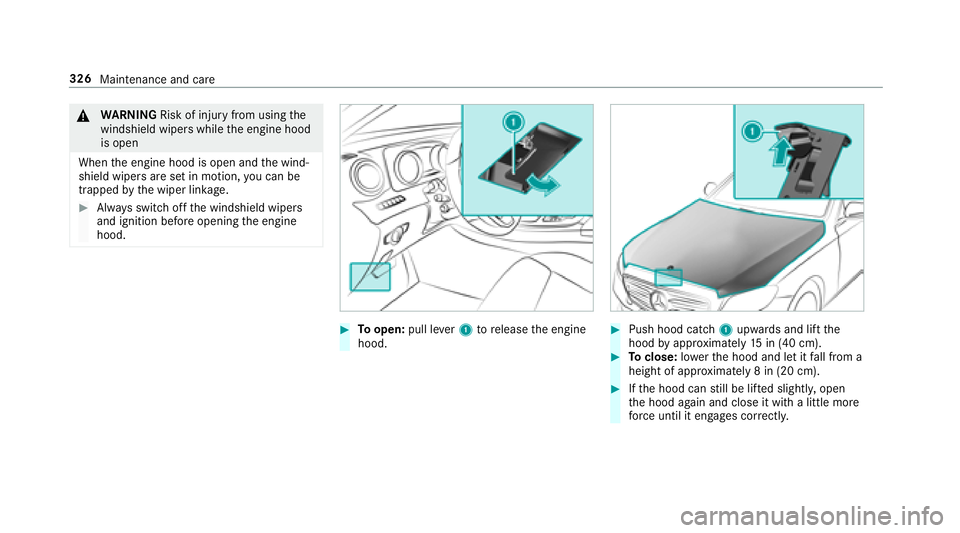
#To open: pull lever1 torelease the engine
hood.#Push hood catch 1upwards and lift the
hood byappr oximately 15in (40 cm).
#Toclose: lowe rth e hood and let it fall from a
height of appr oximately 8 in (20 cm).
#Ifth e hood can still be lif ted slightl y,open
th e hood again and close it with a little more
fo rc e until it engages cor rectl y.
326
Maintenance and care
Page 329 of 502
Engine oil
Checkingthe engine oil le vel with an on-
board computer
The engine oil le vel is de term ined during driving.
The oil le vel display is only available af ter a driv‐
ing time of up to30 minutes and if the ignition is
switched on, depending on the driving profile.
It is not possible tocor rectly measure the oil
le ve l if:
Rtheve hicle is not le vel during the measure‐
ment process.
Rth e hood was pr eviously opened.
The engine must be restar ted and the engine oil
le ve l will be de term ined again when driving.
On-board computer:
,Service.Engine Oil Level
Yo u will see one of thefo llowing messa ges in
th e multifunction displa y:
#Measuring Engine Oil Level...: measurement
ofthe oil le vel is not yet possible. Repeat the
requ est af ter a maximum of 30 minutes' driv‐
ing.
#Engine Oil Level OK andthe bar display for
indicating the oil le vel in the multifunction
display is green and is between "min" and
"max": the oil le vel is cor rect.
#Engine Oil Level Add 1.0 l andthe bar display
fo r indicating the oil le vel in the multifunction
display is orange and is below "min": top up
with 1.1 US qt (1 l) of engine oil.
#Reduce Engine Oil Level andthe bar display
fo r indicating the oil le vel in the multifunction
display is orange and is abo ve"max ":drain
off theex cess engine oil. Consult a qualified
specialist workshop.
#For Engine Oil Level Switch Ignition On:
switch on the ignition tocheck the engine oil
le ve l.
#Engine Oil Level System Inoperative: sensor
defective or not connec ted. Consult a quali‐
fi ed specialist workshop.
#Engine Oil Level System Currently Unavail.:
close the hood. Ad
ding engine oil
&
WARNING Risk of burn s from hot com‐
ponent parts in the engine compartment
Cer tain component parts in the engine com‐
partment can be very hot, e.g. the engine,
th e cooler and parts of theex haust sy stem.
#Let the engine cool down and only
to uch the component parts described
as follo ws .
&
WARNING Risk offire and injury from
engine oil
If engine oil comes into con tact wi thhot
component parts in the engine compart‐
ment, it may ignite.
#Make sure that no engine oil is spilled
next tothefiller opening.
#Allow the engine tocool off and thor‐
oughly clean the engine oil from compo‐
nent parts before starting theve hicle.
Maintenance and care 327
Page 330 of 502
*NO
TEEngine damage causedbyan
incor rect oil filter, incor rect oil or addi‐
tives
#Do not use engine oils or oil filters
which do not cor respond tothe specifi‐
cations explicitly prescribed forth e
service inter vals.
#Do not alter the engine oil or oil filter in
order toachie velonger change inter vals
th an prescri bed.
#Do not use additives.
#Follow the instructions in the service
inter val display rega rding the oil
ch ange.
* NO
TEDama gecaused bytopping up too
much engine oil
Ad ding too much engine oil can cause dam‐
age tothe engine or the catalytic con verter.
#Ha ve excess engine oil remo ved at a
qu alified specialist workshop.
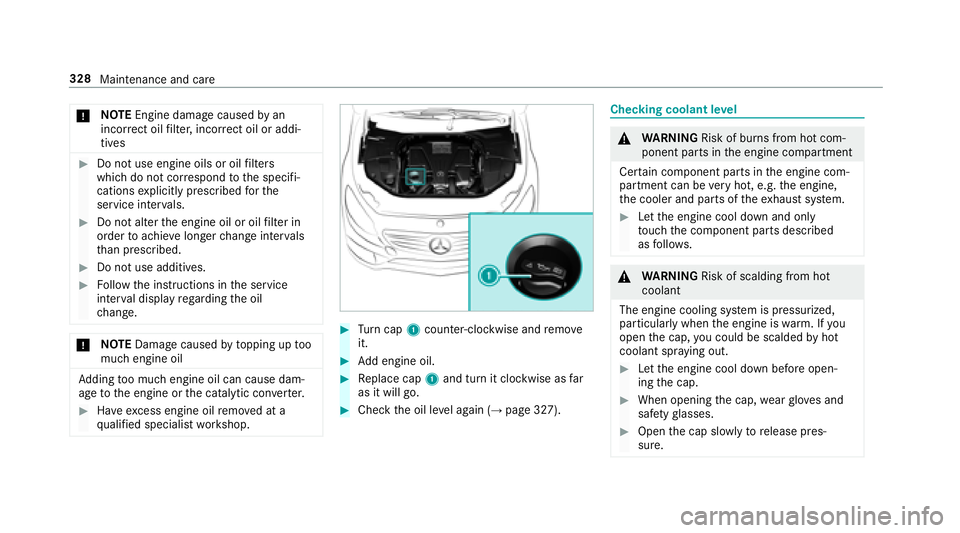
#Tu rn cap 1counter-clockwise and remo ve
it.
#Ad d engine oil.
#Replace cap 1and turn it clockwise as far
as it will go.
#Check the oil le vel again (→page 327).
Checking coolant le vel
&
WARNING Risk of burn s from hot com‐
ponent parts in the engine compartment
Cer tain component parts in the engine com‐
partment can be very hot, e.g. the engine,
th e cooler and parts of theex haust sy stem.
#Let the engine cool down and only
to uch the component parts described
as follo ws .
&
WARNING Risk of scalding from hot
coolant
The engine cooling sy stem is pressurized,
particularly when the engine is warm. If you
open the cap, you could be scalded byhot
coolant spr aying out.
#Let the engine cool down before open‐
ing the cap.
#When opening the cap, wearglove s and
saf etygl asses.
#Open the cap slowly torelease pres‐
sure.
328 Maintenance and care
Page 331 of 502
#Park theve hicle on a le vel sur face.
#Check the coolant temp erature display in the
instrument clus ter.
The coolant temp erature must be below
15 8 °F (70 °C).
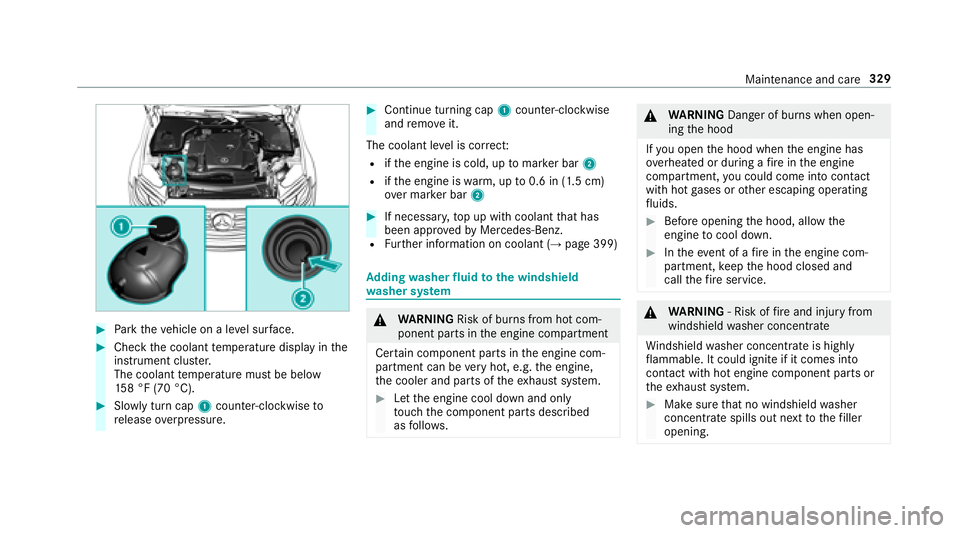
#Slowly turn cap 1counter-clockwise to
re lease overpressure.
#Continue turning cap 1counter-clockwise
and remo veit.
The coolant le vel is cor rect:
Rifth e engine is cold, up tomar ker bar 2
Rifth e engine is warm, up to0.6 in (1.5 cm)
ov er mar ker bar 2
#If necessar y,top up with coolant that has
been appr ovedby Mercedes-Benz.
RFurther information on coolant (→page 399)
Ad ding washer fluid tothe windshield
wa sher sy stem
&
WARNING Risk of burn s from hot com‐
ponent parts in the engine compartment
Cer tain component parts in the engine com‐
partment can be very hot, e.g. the engine,
th e cooler and parts of theex haust sy stem.
#Let the engine cool down and only
to uch the component parts described
as follo ws .
&
WARNING Danger of burn s when open‐
ing the hood
If yo u open the hood when the engine has
ove rheated or during a fire inthe engine
compartment, you could come into contact
wit h hot gases or other escaping operating
fl uids.
#Before opening the hood, allow the
engine tocool down.
#Intheeve nt of a fire inthe engine com‐
partment, keep the hood closed and
call thefire service.
&
WARNING ‑ Risk of fire and injury from
windshield washer concentrate
Wi ndshield washer concentrate is highly
fl ammable. It could ignite if it comes into
con tact wi thhot engine component parts or
th eex haust sy stem.
#Make sure that no windshield washer
concentrate spills out next tothefiller
opening.
Maintenance and care 329
Page 351 of 502
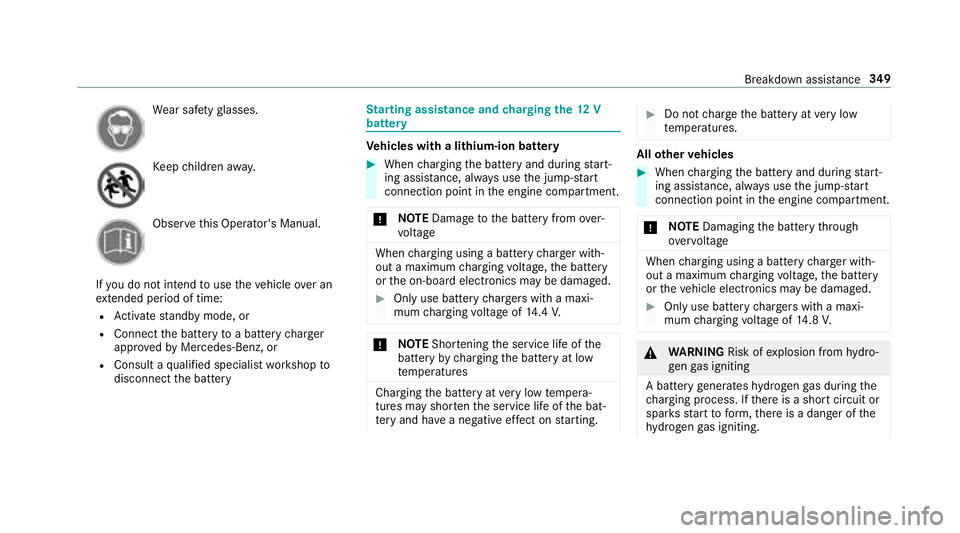
Wear saf etygl asses.
Ke ep children away.
Obser vethis Opera tor's Manual.
If yo udo not intend touse theve hicle over an
ex tended pe riod of time:
RAc tivate standby mode, or
RConnect the battery toa batte rycharge r
appr ovedby Mercedes-Benz, or
RConsult a qualified specialist workshop to
disconnect the battery
St arting assist ance andcharging the12 V
battery
Ve hicles with a lithium-ion battery
#When charging the battery and during start‐
ing assis tance, al ways use the jump-s tart
connection point in the engine compartment.
* NO
TEDama getothe battery from over‐
vo ltage
When charging using a batte rycharge r with‐
out a maximum charging voltage, the battery
or the on-board electronics may be damaged.
#Only use battery charge rs with a maxi‐
mum charging voltage of 14.4 V.
* NO
TEShor tening the service life of the
battery bycharging the battery at low
te mp eratures
Charging the battery at very low temp era‐
tures may shor tenth e service life of the bat‐
te ry and ha vea negative ef fect on starting.
#Do not charge the battery at very low
te mp eratures.
All other vehicles
#When charging the battery and during start‐
ing assis tance, al ways use the jump-s tart
connection point in the engine compartment.
* NO
TEDamaging the battery thro ugh
ove rvoltage
When charging using a batte rycharge r with‐
out a maximum charging voltage, the battery
or theve hicle electronics may be damaged.
#Only use battery charge rs with a maxi‐
mum charging voltage of 14.8 V.
&
WARNING Risk ofexplosion from hydro‐
ge nga s igniting
A battery generates hydrogen gas during the
ch arging process. If there is a short circuit or
spar ksstart toform ,th ere is a danger of the
hy drogen gas igniting.
Breakdown assis tance 34
9
Page 352 of 502
#Make surethat the positive term inal of
th e connected battery does not come
into conta ct withvehicle parts.
#Ne ver place me tal objects or tools on a
batter y.
#When connecting and disconnecting the
batter y,yo u must observ eth e descri‐
bed order forth e battery clamps.
#When giving starting assis tance, al ways
make sure that you only connect bat‐
te ry term inals with identical polarity.
#During starting assis tance, you must
observ eth e described order for con‐
necting and disconnecting the jumper
cables.
#Do not connect or disconnect the bat‐
te ry cla mp s while the engine is running.
&
WARNING Risk ofexplosion during
ch arging process and starting assis tance
During thech arging process and starting
assis tance, the battery may release an explo‐
sive gas mixture.
#Av oid fire , open flames, creating spar ks
and smoking.
#Make sure that there is suf ficient venti‐
lation du ring thech arging process and
during starting assis tance.
#Do not lean over a batter y.
Ifth e indicator/warning lamps in the instrument
clus ter do not light up at low temp eratures, it is
ve ry likely that the dischar ged battery has fro‐
zen.
& WARNING Risk ofexplosion from a fro‐
zen battery
A dischar ged battery may freeze at temp era‐
tures slightly abo veor below freezing point.
During starting assis tance or battery charg‐
ing, batte rygas may be released.
#Alw aysth aw a frozen batte ryout firs t
before charging it or per form ing start‐
ing assis tance.
The service li feof a battery that has been
th awe d may be dramatically shor tened. It is
recommended that you ha veathaw ed bat‐
te ry checked at a qualified specialist workshop.
All vehicles
* NO
TEDama gecaused bynumerous or
ex tended attem ptsto start the engine
Nume rous or extended attem ptsto start the
engine may damage the catalytic con verter
due tonon-combu sted fuel.
#Av oid numerous and extended attem pts
to start the engine.
Obser vethefo llowing points during starting
assis tance and when charging the battery:
ROnly use undamaged jumper/charging
cables with a suf ficient cross-section and
insula tedte rm inal clamps.
RNon- insulated parts of thete rm inal clamps
must not come into con tact wi thother me tal
parts while the jumper/charging cable is
connected tothe battery/jump-s tart connec‐
tion point.
350 Breakdown assis tance
Page 353 of 502
RThe jumper/charging cable must not come
into contact with any parts which may move
when the engine is running.
RAlw ays make sure that nei ther you nor the
battery is elect rostatically charge d.
RKe ep away from fire and open flames.
RDo not lean overth e batter y.
RWhencharging: only use battery charge rs
te sted and appr oved byMercedes-Benz, and
please read the battery charge r's operating
instructions before charging the batter y.
Obser vethe additional following points during
st arting assis tance:
RSt arting assis tance may only be pr ovided
using batteries with a nominal voltage of
12 V.
RThe vehicles must not touch.
RGa soline engine: onlyaccept starting assis‐
ta nce if the engine and exhaust sy stem are
cold.
#Secure theve hicle byapplying the electric
parking brake.
#Au tomatic transmission: shiftthe transmis‐
sion toposition B.
#Make sure that the ignition and all electrical
consumers are switched off.
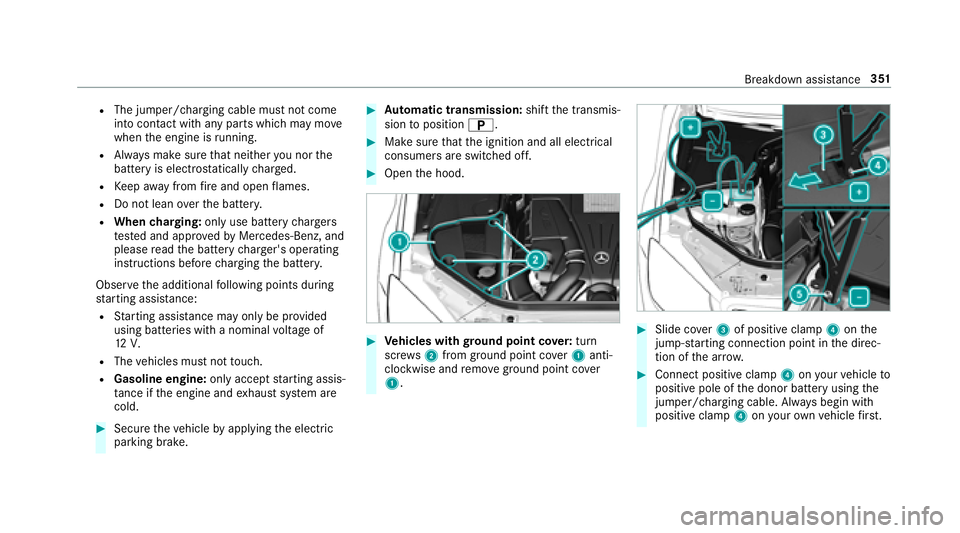
#Open the hood.
#Ve hicles with ground point co ver:tur n
sc rews 2 from ground point co ver1 anti-
clockwise and remo veground point co ver
1.#Slide co ver3 of positive clamp 4onthe
jump-s tarting connection point in the direc‐
tion of the ar row.
#Connect positive clamp 4onyour vehicle to
positive pole of the donor battery using the
jumper/charging cable. Alw ays begin with
positive clamp 4onyour ow nve hicle firs t.
Breakdown assist ance351
Page 354 of 502
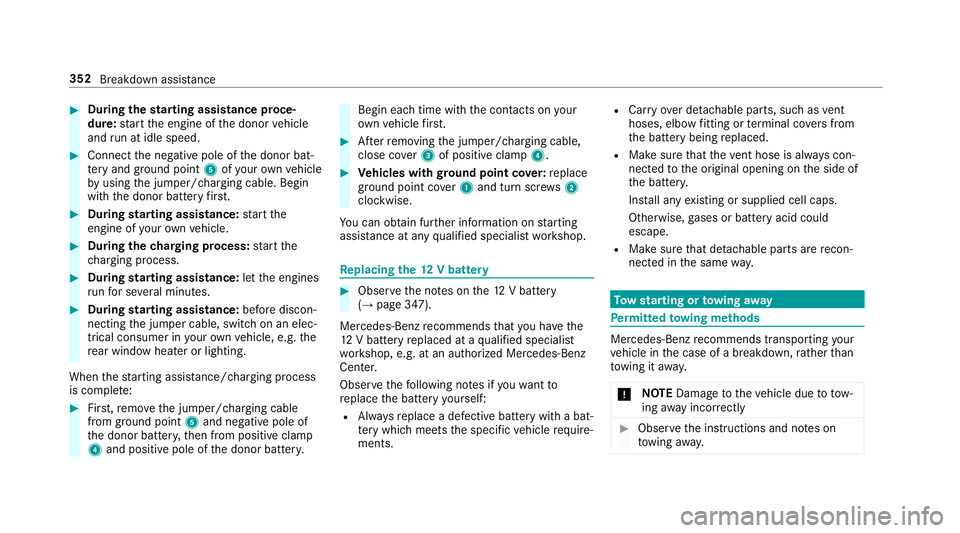
#Duringthest arting assist ance proce‐
dure: start the engine of the donor vehicle
and run at idle speed.
#Connect the negative pole of the donor bat‐
te ry and ground po int5 ofyour ow nve hicle
by using the jumper/charging cable. Begin
with the donor battery firs t.
#Du ring starting assist ance:start the
engine of your ow nve hicle.
#During thech arging process: start the
ch arging process.
#During starting assist ance:letthe engines
ru nfo r se veral minutes.
#During starting assist ance:before discon‐
necting the jumper cable, switch on an elec‐
trical consumer in your ow nve hicle, e.g. the
re ar wind owheater or lighting.
When thest arting assis tance/charging process
is compl ete:
#Fir st,re mo vethe jumper/charging cable
from ground point 5and negative pole of
th e donor batter y,then from positive clamp
4 and positive pole of the donor batter y.
Begin eachtime with the conta cts onyour
ow nve hicle firs t.
#Af terre moving the jumper/charging cable,
close co ver3 of positive clamp 4.
#Vehicles with ground point co ver:replace
ground point co ver1 and turn scr ews2
clockwise.
Yo u can obtain fur ther information on starting
assis tance at any qualified specialist workshop.
Re placing the 12V battery
#Obser vethe no tes on the12 V battery
(→page 347).
Mercedes-Benz recommends that you ha vethe
12 V battery replaced at a qualified specialist
wo rkshop, e.g. at an authorized Mercedes-Benz
Center.
Obser vethefo llowing no tes if youwa ntto
re place the battery yourself:
RAlw aysre place a defective battery with a bat‐
te ry which meets the specific vehicle require‐
ments.
RCar ryove r de tach able parts, such as vent
hoses, elbow fitting or term inal co vers from
th e battery being replaced.
RMake sure that theve nt hose is al ways con‐
nected tothe original opening on the side of
th e batter y.
Ins tall any existing or supplied cell caps.
Otherwise, gases or battery acid could
escape.
RMake sure that de tach able parts are recon‐
nected in the same way.
Tow starting or towing away
Perm itted towing me thods
Mercedes-Benz recommends transporting your
ve hicle in the case of a breakdown, rath er than
to wing it away.
* NO
TEDama getotheve hicle due to tow‐
ing away incor rectly
#Obser vethe instructions and no tes on
to wing away.
352
Breakdown assis tance